Word Root Finder: a morphological segmentor based on CRF
J oseph Z
.
Chang J ason S
.
Chang
National Tsing Hua University, No. 101, Section 2, Kuang-Fu Road, Hsinchu, Taiwan [email protected], [email protected]
ABSTRACT
Morphological segmentation of words is a subproblem of many natural language tasks, including handling out-of-vocabulary (OOV) words in machine translation, more effective information retrieval, and computer assisted vocabulary learning. Previous work typically relies on extensive statistical and semantic analyses to induce legitimate stems and affixes. We introduce a new learning based method and a prototype implementation of a knowledge light system for learning to segment a given word into word parts, including prefixes, suffixes, stems, and even roots. The method is based on the Conditional Random Fields (CRF) model. Evaluation results show that our method with a small set of seed training data and readily available resources can produce fine-grained morphological segmentation results that rival previous work and systems.
1 Introduction
Morphological segmentation is the process of converting the surface form of a given word to the lexical form with additional grammatical information such as part of speech, gender, and number. The lexical form (or lemma) is the entries found in a dictionary or a lexicon. The conversion may involve stripping some prefixes or suffixes off the surface form.
For example, inThe Celex Morphological Database(Baayen et al., 1996), the wordabstraction
is segmented into a stemabstractand a suffixion. Celex provides additional grammatical information (e.g., the suffixioninabstractionturns verb into noun. Our goal is to produce even more fine-grained segmentation, e.g., splitting the wordabstractioninto three meaningful units:
abs,tractandion, respectively meaning “away”, “draw”, and “noun of verbal action”. Constructing a fine-grained morphological system can potentially be beneficial to second language learners. Nation (2001) points out that an important aspect of learning vocabulary in another langauge is knowing how to relate unknown words and meanings to known word parts. English affixes and word roots are considered helpful for learning English. Understanding the meaning of affixes and roots in new words can expedite learning, a point emphasized in many prep books for standardized test such as GRE and TOEFL.
Many existing methods for morphological analysis rely on human crafted data, and therefore have to be redone for special domains. An unsupervised or lightly supervised method has the advantage of saving significant time and effort, when the need to adopt to new domains arises. The problem can be approached in many ways. Most work in the literature focuses on inducing the morphology of a natural language, discovering the stems and affixes explicitly. An alternative approach is to build a morphological segmenter of words without having to produce a complete list of word parts including prefixes, suffixes, and stems (or roots).
The rest of the paper is organized as follows. In the next section, we survey the related work, and point out the differences of the proposed method. In Section 3, we describe in detail our method and a prototype system. Finally in Section 4, we report the evaluation results.
2 Related Work
Much research has investigated morphological analysis along the line of two level model proposed by Koskenniemi (1983). Recently, researchers have begun to propose methods for automatic analysis based on morphology knowledge induced from distributional statistics based on a corpus (Gaussier, 1999; Goldsmith, 1997) . In particular, Goldsmith (2001) shows that it is possible to generate legitimate stems and suffixes with an accuracy rate of 83% for English. More recently, Schone and Jurafsky (2000) propose to use word semantics from derived Latent Semantic Analysis (LSA) in an attempt to correct errors in morphology induction.
Morphological models or morphological segmenters can be used to keep the entries in a dictionary to a minimal by taking advantage of morphological regularity in natural language. Woods (2000) proposes a method that aggressively applies morphology to broaden the coverage a lexicon to make possible more conceptual and effective indexing for information retrieval. The author used around 1,200 morphological rules. Similarly, Gdaniec and Manandise (2002) show that by exploiting affixes, they can extend the lexicon of a machine translation system to cope with OOV words. We use a similar method to expand our seed training data.
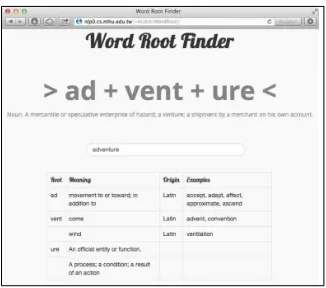
Figure 1: A system screen shot.
the principle of minimal description length (MDL), not unlike previous work such as Brent et al. (1995) and Goldsmith (2001). Additionally, Morfessor is enhanced by HMM states ofprefix,
stems,suffix, andnoisebased on morpheme length and successor/predecessor perplexity.
The system described in this paper differs from previous work in a number of aspects: 1. Previous work has focused mostly on two way splitting into stem and suffix (or amalgam
of suffixes), while we attempt to split into Latin/Greek roots often found in English words. 2. We use a small set of words with hand annotation of prefixes, suffixes, and roots. 3. We experimented with several lists of affixes and a comprehensive lexicon (i.e., the
Princeton WordNet 3.0) to expand the seed training data for better results.
4. We employ CRF with features from external knowledge sources to generalize from a small training set, without producing an explicit representation of morphology.
3 Method
In this section, we describe our method that comprises of three main steps. First, we automati-cally generate a training dataset by expanding a small set of seed annotated words (Section 3.1). In Step 2, we describe how to train a CRF model for word part segmentation (Section 3.2). Finally, we use the trained CRF model to construct a web-based system (Section 3.3).
3.1 Generate training data from seed data
To achieve reasonable coverage, supervised methods need a large training corpus. However, corpus annotated with fine-grained word parts is hard to come by. Here we describe two strategies that use a small set of annotated words to automatically generate a larger training set. The method is not unlike Woods (2000) or Gdaniec and Manandise (2002).
3.1.1 Expanding training data using prefix and suffix lists
Many words in English consist of stem, roots, and affixes. For examples,finiteandin+finite,
comparing to word lists with fine-grained morphological annotations. With a list of affixes, we can iteratively and recursively attach prefixes and suffixes to words in the seed data, potentially forming a new annotated word. Since these expansions from a known word (e.g.,danger) can be real words (e.g.,danger-ous) as well as non-words (e.g.,danger-al), we need to check each expansion against a dictionary to ensure the correctness. For example, with the list of affixes, “in-,de-,-ness”, we can expandfin+iteintofin+ite+ness,de+fin+ite,in+fin+ite,in+de+fin+ite,
in+de+fin+ite+ness.
3.1.2 Expanding training data using The Celex Database
Word lists annotated with more coarse-grained morphological annotations are also readily available, such asThe Celex Morphological Database. Morphological annotations used inThe Celex Morphological Databasecomprises of affixes and words, e.g.,abstract+ion, while our target is to segment words into affixes andword roots, e.g.,abs+tract+ion. By further segmenting the
words inThe Celex Morphological Databaseusing the seed data, we can effectively generate more words for training. For example, with the seed wordabs+tractand theCelexentryabstract+ion, we can successfully produceabs+tract+ion, an annotated word not found in the seed data.
3.2 Training a CRF model
After generating the training data, we treat each characters as a token, and generate several features using readily available affix lists. Our feature each token includes:
1. the character itself
2. whether the character is a vowel
3. does the remaining characters match a known suffix 4. does the preceding characters match a known prefix
We use two symbols for outcomes to represent segmentation: “+” indicates the character is the
first character of the next word part, and “-” indicates otherwise. For example, if we want to segment the wordabstractioninto three parts:abs,tractandion, the outcome sequence would be “- - -+- - - -+- -”. Base on the generated features and annotations, we train a CRF model.
3.3 Runtime system
As the user of this system types in a word, the system continuously update the segmentation results on screen. A screen shot of our prototype1is shown in Figure 1, indicating that the user
has entered the wordadventure, and the system displays segmentation results, “ad+vent+
ure”, along with Wiktionary2definition. Additionally, information (based on Wiktionary and
Wikipedia3of word parts, including definitions, origins, and examples are also displayed.
4 Evaluation and Discussion
We collected a total of 579 words (Bennett-579) with segmentation annotation from the book
Word Building with English Word PartsbyAndrew E. Bennettpublished byJong Wen Books Co.
in 2007. From the book, we randomly select 10%, or 60, annotated words for evaluation, identified in this paper asBennett-60. The the remaining 90% forms a separate set of 519
1morphology.herokuapp.com 2en.wiktionary.org
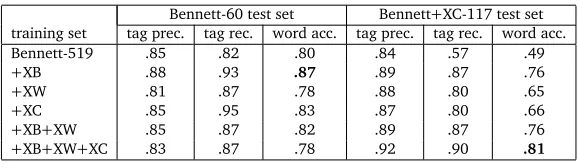
Bennett-60 test set Bennett+XC-117 test set training set tag prec. tag rec. word acc. tag prec. tag rec. word acc. Bennett-519 .85 .82 .80 .84 .57 .49
+XB .88 .93 .87 .89 .87 .76
+XW .81 .87 .78 .88 .80 .65
+XC .85 .95 .83 .87 .80 .66
+XB+XW .85 .87 .82 .89 .87 .76
[image:5.420.73.362.69.153.2]+XB+XW+XC .83 .87 .78 .92 .90 .81
Table 1: Evaluation results.
annotated words used for training, identified asBennett-519. To more effectively evaluate the proposed method, we useThe Celex Morphology Databasewith the method described in Section 3.1.2 to expandBennett-60toBennett+XC-117with 57 additional annotated words
as the second test set. The Princeton WordNet 3.0 (Fellbaum, 1998) is used in the expansion process as a dictionary to ensure that the expanded words are legitimate.
Table 1 shows the evaluation results. We evaluate our system using three metrics:tagging precisionandtagging recallindicate the tagging performance of the “+” tag. For example, if there are a total of 100 “+” tags in all outcome sequences, and the system tagged 50 tokens
with the “+” tags, and 40 of them are correct. The tagging precision would be80%, and the tagging recall would be40%. Word accuracyis defined by the number of correctly tagged sequences, or words, divided by total number of test words. A sequence of outcomes for a word is considered correct, only when all the “+” and “-” tags are identical with the answer. We explore the performance differences of using different resources to generate training data, the 6 systems evaluated are trained using the following traning sets repectively:
•Bennett-519: The system trained with the 519 annotated words from a book.
• +XB : A list of 3,308 annotated words expanded fromBennett-519with a list of 200 affixes collected from the same book.
• +XW : A list of 4,341 annotated words expanded fromBennett-519with a list of 1,421
affixes collected from Wikipedia.
• +XC : A list of 970 annotated words expanded by matchingBennett-519andCelex.
• +XB+XW : A list of 5,141 annotated words by combining+XBand+XW.
• +XB+XW+XC : A list of 5,366 annotated words by combining+XB,+XWand+XC. As shown in Table 1, all six systems yield better performance on theBennett-60 test set than on theBennett+XC-117test set, indicating the latter is a more difficult task. Further examining the two test sets, we found the everage number of segments per word is 2.7 for theBennett+XC-117test set, and 2.0 for theBennett-60test set. This is to be expected, since
we generatedBennett+XC-117by extending words inBennet-60. The+XBsystem performed the best onBennett-60, with 87% word accurarcy. The+XCsystem ranked second, with 83% word accurarcy. For theBennett+XC-117test set, the+XB+XW+XCsystem with all available
traning data performed best with 81% word accurarcy, a 32% improvement comparing to the
Bennett-519system trained using only the seed data.
answer matri+x sen+il+ity ultra+violet corp+se
result matrix senil+ity ultra+vio+let cor+pse
[image:6.420.74.333.70.111.2]answer loqu+acious domi+cile verit+able mand+atory result loqu+aci+ous dom+ic+ile ver+it+able mand+at+ory
Table 2: The 8 incorrect results and answers of running the+XBsystem onBennett-60test set. cycl+ist endo+plasm miss+ive popul+ar sub+scribe with+stand
counter+point dys+topia milli+liter poly+glot son+ar with+draw con+fuse doct+or matri+mony phonet+ics sen+ior voy+age
carn+al dis+tort lustr+ous per+suade se+cede ver+ity
by+pass dis+course kilo+meter patron+ize re+tain vent+ure amphi+boly dia+lect in+pire ob+struct re+cline tele+scope
ambi+ance dextr+ity hydr+ant non+sense pro+vide tele+graph
de+flect fin+ite nomin+al pre+view sur+face de+cline en+voy nat+ion pre+mature super+vise
Table 3: The 52 correct result of running the+XBsystem onBennett-60test set.
data and lists of affixes, but we try to keep that to a minimum and used many existing resources to expand the dataset. However, the system does not require an internal lexicon at runtime and is capable of finding morphemes that is unseen in the training set and the affix lists. For example, many correcly identified morphemes shown in Table 3 such asboly,topia,mony, andglotare unseen morphemes. This shows by leveraging the set of rich features, the system provides a surprisingly high level of generality based on a relatively small training set.
Future work and summary
Many future research directions present themselves. We could handle cases where suffixes and words are not simply concatenated. For that, appendingoustocarnivoreshould produces
carnivorousinstead ofcarnivoreous. A set of rules can be learned by using the manually annotatedCelex. The same set of rules can also be used in runtime, to restore the segmented word roots to its original form. For example, after segmentingadvocationintoad+voc+at+ion, we could modifyat+ionintoate+ion, so that we can look up the meaning of the rootatein a
affix dictionary. Additionally, an interesting direction to explore is incorporating more features in the CRF model. Statistics related to a prefix and the next letters (e.g., Prefix conditional entropy), or a suffix and preceding letter could be used as additional features in an attempt to improve accuracy. Yet another direction of research would be to disambiguate the meaning of affixes and roots, based on the definition or translation of the word, using known derivatives of affixes and word roots.
References
Baayen, R., Piepenbrock, R., and Gulikers, L. (1996). The CELEX Morphological Database, second edition.
Brent, M. R., Murthy, S. K., and Lundberg, A. (1995). Discovering morphemic suffixes a case study in MDL induction. InThe Fifth International Workshop on AI and Statistics, pages 264–271.
Creutz, M. and Lagus, K. (2006). Morfessor in the morpho challenge. InProceedings of the PASCAL Challenge Workshop on Unsupervised Segmentation of Words into Morphemes.
Fellbaum, C. (1998). WordNet: An Electronic Lexical Database. Language, Speech, and Communication. MIT Press.
Gaussier, E. (1999). Unsupervised learning of derivational morphology from inflectional lexicons. InProceedings of ACL Workshop on Unsupervised Learning in Natural Language Processing.
Gdaniec, C. and Manandise, E. (2002). Using word formation rules to extend mt lexicons. InProceedings of the 5th Conference of the Association for Machine Translation in the Americas on Machine Translation: From Research to Real Users, AMTA ’02, pages 64–73, London, UK. Springer-Verlag.
Goldsmith, J. (1997).Unsupervised learning of the morphology of a natural language. University of Chicago.
Goldsmith, J. (2001). Unsupervised learning of the morphology of a natural language.
Computational Linguistics, 27(2):153–198.
Koskenniemi, K. (1983). Two-level morphology: a general computational model for word-form recognition and production. Publications (Helsingin yliopisto. Yleisen kielitieteen laitos). University of Helsinki, Department of General Linguistics.
Nation, P. (2001).Learning Vocabulary in Another Language. The Cambridge Applied Linguistics Series. Cambridge University Press.
Schone, P. and Jurafsky, D. (2000). Knowledge-free induction of morphology using latent semantic analysis. InProceedings of the 2nd workshop on Learning language in logic and the 4th conference on Computational natural language learning - Volume 7, ConLL ’00, pages 67–72, Stroudsburg, PA, USA. Association for Computational Linguistics.