Toward Automatic Processing of English Metalanguage
Shomir Wilson*
School of Informatics
University of Edinburgh
10 Crichton Street
Edinburgh EH8 9AB, UK
School of Computer Science
Carnegie Mellon University
5000 Forbes Avenue
Pittsburgh, PA 15213 USA
[email protected]
Abstract
The metalinguistic facilities of natural lan-guage are crucial to our ability to communi-cate, but the patterns behind the appearance of metalanguage—and thus the clues for how we may instruct computers to detect it—have re-mained relatively unknown. This paper de-scribes the first results on the feasibility of au-tomatically identifying metalanguage in Eng-lish text. A core metalinguistic vocabulary has been identified, supporting intuitions about the phenomenon and aiding in its detection and delineation. These results open the door to ap-plications that can extract the direct, salient in-formation that metalanguage encodes.
1
Introduction
In linguistic communication it is sometimes nec-essary to refer to features of language, such as orthography, vocabulary, structure, pragmatics, or meaning. Metalanguage enables a speaker to select a linguistically-relevant referent over (or in addition to) other typical referents (Audi, 1995). Metalanguage is illustrated in sentences such as
(1) Graupel refers to a kind of precipitation. (2) The name is actually Rolla.
(3) Keep tabs on is a colloquial phrase. (4) He wrote “All gone” and nothing more. The roles of the bold substrings in the above sen-tences contrast with those in (5)-(8) below:
(5) Graupel fell on the weary hikers. (6) Rolla is a small town.
(7) Keep tabs on him, will you? (8) They were all gone when I returned.
*
This research was performed during a prior affiliation
with the University of Maryland at College Park.
Conventional stylistic cues, such as italics in (1), (2), and (3) and quotation marks in (4), some-times help the audience to recognize metalinguis-tic statements in written language. In spoken lan-guage or in written contexts where stylistic cues are not used, the audience is expected to identify metalinguistic statements using paralinguistic cues (such as intonation, when speaking) or con-text and meaning.
Metalanguage is both pervasive and, paradox-ically, the subject of limited attention in research on language technologies. The ability to produce and understand metalanguage is a core linguistic competence that allows humans to converse flex-ibly, unrestricted by domain (Anderson et al., 2002). Humans use it to establish grounding, ver-ify audience understanding, and maintain com-munication channels (Anderson et al., 2004). Metalanguage encodes direct and salient infor-mation about language, but many typical exam-ples thwart parsers with novel word usage or ar-rangement (Wilson, 2011a). Metalanguage is difficult to classify through the interpretive lens of word senses, given that conventional word senses have little relevance when a word appears chiefly “as a word”. The roles of metalanguage in L2 language acquisition (Hu, 2010), expres-sion of sentiment toward others’ utterances (Jaworski et al., 2004), and irony (Sperber and Wilson, 1981) have also been noted.
This paper describes the results of the first ef-fort to automatically identify instances of meta-language in English text. Mentioned language, a common variety of metalanguage, is focused up-on for its explicit, direct nature, which makes its structure and meaning easily accessible once an instance is identified. Section 2 reviews a prior project by Wilson (2012) to create a corpus of instances of metalanguage, a necessary resource for the present effort. Section 3 describes an ap-proach to distinguishing sentences that contain
metalanguage from those that do not, a task re-ferred to as detection for brevity. Results show that the performance of this approach roughly matches an implied performance ceiling of inter- annotator agreement. Section 4 describes an ap-proach to delineate sequences of words that are directly mentioned by a metalinguistic statement; although the results are preliminary, its accuracy shows promise for future development. Together, these results on detection and delineation show the feasibility of enabling language technologies to extract the salient information about language that metalanguage contains.
2
Background
The reader is likely to be familiar with the con-cept of metalanguage, but a discussion is appro-priate to ground the concept and connect to pre-vious work. Section 2.1 summarizes a prior study (Wilson, 2012) to collect instances of metalan-guage, and 2.2 reviews some related efforts.
2.1 Prior Work
A diverse variety of phenomena in natural lan-guage satisfy the intuitive criteria that we associ-ate with metalanguage. The prior study focused on identifying sentences that contained men-tioned language, a phenomenon defined below:
Definition: For T a token or a set of tokens in a sentence, if T is produced to draw attention to a property of the token T or the type of T, then T is an instance of mentioned language.1
Here, a token is an instantiation of a linguistic entity (e.g., a letter, symbol, sound, word, phrase, or other related entity), and a property is an os-tension of language (García-Carpintero, 2004; Saka, 2006), such as spelling, pronunciation, meaning (for a variety of interpretations of
meaning), structure, connotation, or quotative source. Generally attention is drawn to the type
of T (for example, in Sentences (1)-(4)), but it can be drawn to the token of T for self-reference, as in Sentence (9):
(9) “The” appears between quote marks. Although constructions like (9) are unusual and carry less practical value, the definition accom-modates them for completeness.
Mentioned language is a common form of metalanguage, used to perform the full variety of
1
This definition was introduced by Wilson (2011a) along with a practical rubric for evaluating candidate sentences. For brevity, its full justification is not reproduced here.
language tasks discussed in the introduction. However, other metalinguistic constructions draw attention to tokens outside of the referring sentence. Some examples of this are (10)-(12) below. Supporting contexts are not shown for these sentences, though such contexts are easily imagined:
(10) Disregard the last thing I said. (11) That spelling, is it correct?
(12) People don’t use those words lightly. In each of the above three sentences, a linguistic entity (an utterance, a sequence of letters, and a sequence of words, respectively) is referred to, but the referent is contained in a separate sen-tence. The referent may have been produced by a different utterer or appeared in a different medi-um (e.g., speaking aloud while referring to writ-ten text). These “extra-senwrit-tential” forms of meta-language have clear value to understanding dis-course and coreference. The focus on mentioned language is a limitation to the present work, to utilize an existing corpus and to apply tractable boundaries to the identification tasks.
The mentioned language corpus of the prior study2 was constructed by filtering a large vol-ume of sentences with a heuristic, followed by annotation by a human reader. A randomly se-lected subset of articles from English Wikipedia was chosen as a source for text because of its representation of a large sample of English writ-ers (Adler et al., 2008), the rich frequency of mentioned language in its text, and the frequent use of stylistic cues in its text that delimit men-tioned language (i.e., bold text, italic text, and quotation marks). Sentences were sought that contained at least one of these stylistic cues and a
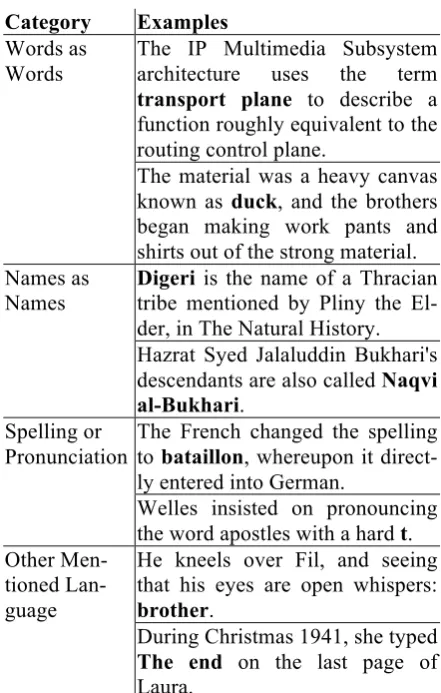
mention-significant word in close proximity. Mention-significant words were a set of 8,735 words and collocations with potential metalin-guistic significance (e.g., word, symbol, call), extracted from the WordNet lexical ontology (Fellbaum, 1998). Phrases highlighted by the stylistic cues were considered candidate instanc-es, and these were labeled by a human reader, who determined that 629 sentences were mention sentences (i.e., containing instances of mentioned language) and the remaining 1,764 were not. Mention sentences were categorized based on functional properties that emerged during catego-rization. Table 1 shows some examples of col-lected mention sentences in each category.
2
The corpus is available at
To verify the reliability of the corpus and the definition of mentioned language, three addition-al expert annotators independently labeled a shuffled set of 100 sentences, consisting of 54 randomly selected mention sentences and 46 randomly selected non-mention sentences. All three agreed with the primary annotator on 46 mention sentences and 30 non-mention sentenc-es, with an average pairwise Kappa of 0.74. Kappa between the primary annotator and a hy-pothetical “majority voter” of the additional an-notators was 0.90. These results were seen as a moderate indication of reliability and a potential performance ceiling for automatic identification.
2.2 Related Work
The present effort is believed to be the first to automatically identify a natural variety of meta-language in English text. Aside from the corpus described above, the only other significant cor-pus of metalanguage was created by Anderson et al. (2004), who collected metalinguistic
utteranc-es in conversational English. A lack of phrase-level annotations in their corpus as well as sub-stantial noise made it suboptimal for the present effort. However, it is possible (if not likely) that indicators of metalanguage differ between writ-ten and spoken English, lending importance to the Anderson corpus as a resource.
Metalanguage has a long history of theoretical treatments, which chiefly explained the mechan-ics of selected examples of the phenomenon. Many addressed it through the related topic of
quotation (Cappelen and Lepore, 1997; Da-vidson, 1979; Maier, 2007; Quine, 1940; Tarski, 1933), and others previously cited in this paper discussed it directly as metalanguage or the use-mention distinction. The definition of mentioned language in Section 2.1 was a synthesis of the most empirically-compatible theoretical treat-ments, and the present effort to automatically identify metalanguage builds on that synthesis.
3
Detection of Mentioned Language
The corpus-building effort used a heuristic to accelerate the collection of mentioned language, but its low precision is impractical for automatic identification. Moreover, the stylistic cues that the heuristic relied upon are often inconsistently applied (or entirely absent in informal contexts), and they are sometimes unavailable for the writer to use or for the audience to extract. This section presents an approach to the detection task, to dis-criminate between mention and non-mention sentences. Early examination of the corpus sug-gested that mention sentences tend not to have distinct structural differences from non-mention sentences, so a lexical approach was first taken, although combinations of lexical and structural approaches are later explored indirectly through the delineation task. In this section a sentence is assumed to be a sequence of words without sty-listic cues for mentioned language.
3.1 Approach
To establish performance baselines, a matrix of feature sets and classifiers was run on the cor-pus with ten-fold cross validation. The feature sets were bags of the following: stemmed words (SW), unstemmed words (UW), stemmed words plus stemmed bigrams (SWSB), and unstemmed words plus unstemmed bigrams (UWUB). Clas-sifiers were chosen to reflect a variety of ap-proaches to supervised learning; as implemented in Weka (Hall et al., 2009), these were Naive Bayes (John and Langley, 1995), SMO (Keerthi
Category Examples
Words as Words
The IP Multimedia Subsystem architecture uses the term
transport plane to describe a function roughly equivalent to the routing control plane.
The material was a heavy canvas known as duck, and the brothers began making work pants and shirts out of the strong material. Names as
Names
Digeri is the name of a Thracian tribe mentioned by Pliny the El-der, in The Natural History. Hazrat Syed Jalaluddin Bukhari's descendants are also called Naqvi al-Bukhari.
Spelling or Pronunciation
The French changed the spelling to bataillon, whereupon it direct-ly entered into German.
Welles insisted on pronouncing the word apostles with a hard t. Other
Men-tioned Lan-guage
He kneels over Fil, and seeing that his eyes are open whispers:
brother.
During Christmas 1941, she typed
The end on the last page of Laura.
et al., 2001), J48 (Quinlan, 1993), IBk (Aha and Kibler, 1991), and Decision Table (Kohavi, 1995).
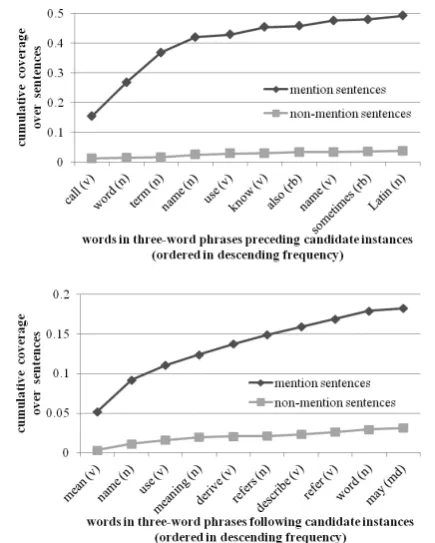
Prior observations suggested that a small set of approximately ten words significant to meta-language (“metawords”, informally) appear near most instances of mentioned language (Wilson, 2011b). The metalanguage corpus described in Section 2 provided an opportunity to explore this observation. The sentences in the corpus were part-of-speech tagged and stemmed (using NLTK (Bird, 2006)). Sets were collected of all unique (stemmed) words in the three-word phrases directly preceding and following candi-date instances, and (respective of position) these were ranked by frequency. The appearance or non-appearance of these words was then deter-mined over all mention and non-mention sen-tences. Figure 1 shows the cumulative coverage (i.e., appearance at least once) over sentences for the top ten words appearing before and after can-didate instances. For example, call, word, or
term were the three most common words before candidate instances; they appear at least once in 36% of mention sentences, but they appear in only 1.6% of non-mention sentences.
The high frequencies of intuitive metawords, combined with their difference in coverage over
mention and non-mention sentences, informed the approach taken to the detection task. To at-tempt to improve over the baseline, the SW fea-ture set was ranked by information gain, and all features except the top ten were discarded to cre-ate the metawords feature set (MW). Feature se-lection was done using the training set for each cross-validation fold, and the testing data for each fold was pruned correspondingly. The five selected classifiers were then applied to the data.
3.2 Results and Discussion
The combination of five feature sets and five classifiers produced 25 sets of annotations, for which precision, recall and F1 were calculated for detecting mentioned language. For brevity, we present the highlights and contrast the meta-words approach with baseline performances.
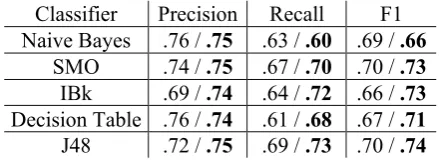
Table 2 compares classifier performances us-ing MW with SW, its closest relation. MW pro-duced improvement for all classifiers except Na-ive Bayes3. The J48-MW combination had the highest F1 and recall of any feature set-classifier combination, though some combinations exceed-ed its precision. For all feature set-classifier pairs, precision was higher than recall, by as little as 0.024 (IBK-MW) and as much as 0.22 (Deci-sion Table-UW). For the baseline feature sets, the best classifier was consistently SMO, with F1 scores of 0.70, 0.70, 0.73, and 0.71 for SW, UW, SWSB, and UWUB, respectively. J48 was con-sistently the second best, with F1 scores within 0.01 of SMO for each feature set.
Table 3 lists differences between F1 scores us-ing the MW feature set and each baseline feature set. MW resulted in improvements over the base-line feature sets for nearly all classifiers, and sta-tistically significant improvements (using one-tailed T-tests across the populations of validation folds, p<0.05) were observed for eleven of the sixteen combinations. IBk appeared to benefit the most, with significant improvements over all baseline feature sets, and Naive Bayes the least. In general, recall benefited more than precision.
Examining the MW features confirmed that most were intuitive metawords. Nine words ap-peared in all ten folds of MW: name, word, call, term, mean, refer, use, derive, and Latin. The last two words are perhaps artifacts of the encyclo-pedic nature of the source text, but the rest gen-eralize easily. Future research using additional
3
It seems likely that the method used to create the MW feature set aggravated the Naive Bayes assumption of fea-ture independence.
Figure 1. Cumulative coverage over sentences by the most common words before (top) and after
text sources will be necessary to fully verify whether the MW approach and these specific metalinguistic terms are widely applicable.
It also appears that 20% to 30% of instances of mentioned language resist identification using word and bigram-based features alone. Many of the false negatives from this experiment ap-peared to lack the common metawords that the detection approach relied upon. The sentences below (taken from the corpus) illustrate this lack:
(13) Other common insulting modifiers include “dog”, “filthy”, etc.
(14) To note, in the original version the lyrics read “Jim crack corn”.
While modifier in (13) and read in (14) have in-tuitive metalinguistic value, they also have common non-metalinguistic senses. This sug-gests that an approach incorporating word senses may further improve upon the MW performanc-es, and such an approach is preliminarily ex-plored in the following section.
Finally, it is notable that the best MW perfor-mances approach the Kappa score observed be-tween the additional annotators. Although this is an indication of some success, the higher “major-ity vote” Kappa score of 0.90 remains a mean-ingful goal for future research efforts.
4
Toward Delineation
After identifying a mention sentence, the task remains to determine the specific sequence of
words subject to direct reference (e.g., the bold words in Sentences (1) through (4) and in other examples throughout this paper). This task, in addition to detection, is necessary to ascribe the information encoded in a metalinguistic state-ment to a specific linguistic entity.
4.1 Approach
Manual examination of the corpus showed two frequent relationship patterns between meta-words and mentioned language. The first was
noun apposition, in constructions like (15) and (16), where the metaword-noun appears in italics and the mentioned word in bold:
(15) The termauntie was used depreciatively. (16) It comes from the root wordconficere. The second pattern was the appearance of men-tioned language in the semantic role of a meta-word-verb, as in (17) below:
(17) We sometimes call it the alpha profile. Notably these patterns do not guarantee the cor-rect delineation of mentioned language, but their applicability made them suitable for the task.
To assess the applicability of phrase structures and semantic roles to the automatic delineation of mentioned language, case studies were per-formed on the sets of sentences in the corpus containing the nouns term and word and the verb
call. All sentences containing these three meta-words (appearing as their respective targeted parts of speech) were examined, including those that did not contain mentioned language, since it was believed that methods of delineation could indirectly perform detection as well. Because of the limited data available, formal experiments were not possible, although the results still have illustrative value.
The noun apposition pattern described above was formalized for term and word using TRegex search strings (Levy and Andrew, 2006). The 91 sentences in the corpus containing term and the 107 containing word were parsed using the Stan-ford Parser (Marneffe et al., 2006), and the TRegex strings were applied to each sentence; when a match occurred, the result was a predic-tion that a specific sequence of words was men-tioned language (delineation), as well as a pre-diction that the sentence contained mentioned language (detection). The semantic role pattern for call was explored similarly using the Illinois Semantic Role Labeler (SRL) (Punyakanok et al., 2008). Each of the 158 sentences in the cor-pus containing call as a verb was processed by Classifier SW UW SWSB UWUB
Naive Bayes -.024 -.018 .005 .007 SMO .023* .026* .000 .015 IBk .067* .088* .07* .108*
Decision Table .038* .047* .027 .052*
J48 .037* .046* .025 .034
Table 3. Differences between F1 scores from us-ing the MW feature set and baseline feature sets. Statistically significant improvements are starred.
Classifier Precision Recall F1 Naive Bayes .76 / .75 .63 / .60 .69 / .66
SMO .74 / .75 .67 / .70 .70 / .73
IBk .69 / .74 .64 / .72 .66 / .73
Decision Table .76 / .74 .61 / .68 .67 / .71
J48 .72 / .75 .69 / .73 .70 / .74
SRL, and when the output contained the appro-priate semantic role (i.e., SRL’s “attribute of arg1”) with respect to the metaword, the phrase fulfilling that role was considered a predicted delineation of mentioned language. By proxy, such matching also implied a prediction that the phenomenon was present in the sentence.
4.2 Results and Discussion
Delineation was evaluated with respect to the correctness of label scope: that is, for a sentence that contained an instance of mentioned lan-guage, whether the predicted word sequence ex-actly matched the sequence labeled in the corpus, overlabeled it (i.e., included the instance of men-tioned language plus additional words), or un-derlabeled it (i.e., did not include the entire in-stance). To avoid confounding detection and de-lineation, the statistics on label scope do not in-clude instances when the appropriate pattern failed to annotate any phrase in a sentence that contained mentioned language, or annotated a phrase when no mentioned language was present. Such instances are instead represented through
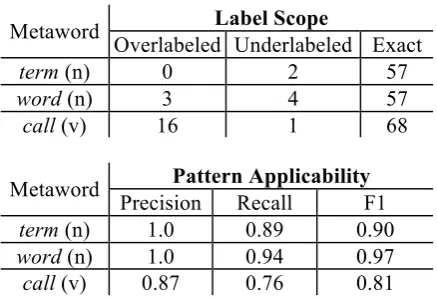
pattern applicability statistics: when one of the sought relationships between a chosen metaword and a phrase appeared in a sentence, it was con-sidered a positive prediction of the presence of mentioned language. Table 4 shows performance metrics from each of the three case studies.
Noun apposition with either term or word ap-peared to be adept at predicting scope, with per-fect labels for 97% and 89% of instances, respec-tively. The instances of overlabeling and un-derlabeling for these two were mostly due to parsing errors, which occurred prior to applying the TRegex pattern. Overlabeling was a greater problem for call, for which 80% of labels were perfect and nearly the rest were overlabeled. Manual examination revealed that the prediction often would “spill” far past the actual end of mentioned language, due to the boundaries of the semantic role in SRL’s output. For example, the entire phrase in bold in (18) below was errone-ously predicted to be mentioned language, in-stead of simply snow-eaters:
(18) Winds of this type are called snow-eaters
for their ability to make snow melt or subli-mate rapidly.
Re-examining the detection task through pat-tern applicability, noun appositions with term
and word exhibited perfect precision. The false negatives that lowered the recall were again mostly due to parse errors. Precision and recall
for call suffered from two sources of errors: in-correct applications of the semantic role and ap-plications of it that, while valid, did not involve mentioned language.
For the selected metawords, it appeared pat-terns in noun apposition and semantic roles were moderately effective at delineating as well as detecting mentioned language. However, the ac-curacy of these patterns was a reflection of the dependability of the underlying language tools, and the case studies in aggregate covered only 33% of the sentences containing mentioned lan-guage in the corpus. To create a comprehensive method for delineation, more relationships must be identified between metawords and mentioned language. A perusal of the corpus suggests that these patterns are small in variety but large in quantity: metawords are diverse, and some have non-metalinguistic senses that must be accounted for, as shown by Sentences (13) and (14) and others that resisted detection.
5
Conclusion
The detection and delineation methods presented in this paper demonstrate the feasibility of identi-fying metalanguage in English text. The next goals of this project will be to assimilate meta-language from additional text sources and inte-grate the detection and delineation tasks. This will improve performance and provide a richer structural knowledge of metalanguage, which will enable practical systems to incorporate pro-cessing of the phenomenon and exploit the lin-guistic information that it encodes.
Metaword Label Scope
Overlabeled Underlabeled Exact
term (n) 0 2 57
word (n) 3 4 57
call (v) 16 1 68
Metaword Pattern Applicability Precision Recall F1
term (n) 1.0 0.89 0.90
word (n) 1.0 0.94 0.97
call (v) 0.87 0.76 0.81
References
Adler, B. T., de Alfaro, L., Pye, I., & Raman, V. (2008). Measuring author contributions to the Wik-ipedia. In Proceedings of the 4th International Sym-posium on Wikis (pp. 15:1–15:10). New York, NY, USA: ACM. doi:10.1145/1822258.1822279
Aha, D. W., & Kibler, D. (1991). Instance-based learning algorithms. In Machine Learning (pp. 37– 66).
Anderson, M. L., Fister, A., Lee, B., & Wang, D. (2004). On the frequency and types of meta-language in conversation: A preliminary report. In 14th Annual Conference of the Society for Text and Discourse. Anderson, M. L., Okamoto, Y. A., Josyula, D., & Perlis, D. (2002). The Use-Mention Distinction and Its Importance to HCI. In Proceedings of the Sixth Workshop on the Semantics and Pragmatics of Dia-log, 21–28.
Audi, R. (1995). The Cambridge Dictionary of Phi-losophy. Cambridge University Press.
Bird, S. (2006). NLTK: The natural language toolkit. In Proceedings of the COLING/ACL on Interactive Presentation Sessions (pp. 69–72). Stroudsburg, PA, USA: Association for Computational Linguistics. Cappelen, H., & Lepore, E. (1997). Varieties of quo-tation. Mind, 106(423), 429–450. doi:10.1093/mind/106.423.429
Davidson, D. (1979). Quotation. Theory and Deci-sion, 11(1), 27–40. doi:10.1007/BF00126690
Fellbaum, C. (1998). WordNet: An electronic lexical database. Cambridge: MIT Press.
García-Carpintero, M. (2004). The deferred ostension theory of quotation. Noûs, 38(4), 674–692.
Hall, M., Frank, E., Holmes, G., Pfahringer, B., Reutemann, P., & Witten, I. H. (2009). The WEKA data mining software: An update. ACM SIGKDD Ex-plorations Newsletter, 11, 10–18. doi:10.1145/ 1656274.1656278
Hu, G. (2010). A place for metalanguage in the L2 classroom. ELT Journal. doi:10.1093/elt/ccq037 Jaworski, A., Coupland, N., & Galasinski, D. (Eds.). (2004). Metalanguage: Language, Power, and Social Process. De Gruyter.
John, G., & Langley, P. (1995). Estimating Continu-ous Distributions in Bayesian Classifiers. In Proceed-ings of the Eleventh Conference on Uncertainty in Artificial Intelligence (pp. 338–345). Morgan Kauf-mann.
Keerthi, S. S., Shevade, S. K., Bhattacharyya, C., & Murthy, K. R. K. (2001). Improvements to Platt’s SMO Algorithm for SVM Classifier Design. Neural Computation, 13, 637–649. doi:10.1162/ 089976601300014493
Kohavi, R. (1995). The Power of Decision Tables. In
Proceedings of the European Conference on Machine Learning (pp. 174–189). Springer Verlag.
Levy, R., & Andrew, G. (2006). TRegex and TSur-geon: tools for querying and manipulating tree data structures. In Proceedings of the Fifth International Conference on Language Resources and Evaluation. Maier, E. (2007). Mixed quotation: between use and mention. In Logic and Engineering of Natural Lan-guage Semantics Workshop. Retrieved from http://ncs.ruhosting.nl/emar/em_lenls_quot.pdf Marneffe, M. D., MacCartney, B., & Manning, C. D. (2006). Generating typed dependency parses from phrase structure parses. In Proceedings of the Interna-tional Conference on Language Resources and Eval-uation, pp. 449–454.
Punyakanok, V., Roth, D., & Yih, W. (2008). The importance of syntactic parsing and inference in se-mantic role labeling. Computational Linguistics,
34(2), 257–287. doi:10.1162/coli.2008.34.2.257 Quine, W. V. O. (1940). Mathematical logic. Cam-bridge, MA: Harvard University Press.
Quinlan, J. (1993). C4.5: Programs for Machine Learning. San Mateo, Calif.: Morgan Kaufmann Pub-lishers.
Saka, P. (2006). The Demonstrative and Identity The-ories of Quotation. Journal of Philosophy, 103(9), 452–471.
Sperber, D., & Wilson, D. (1981). Irony and the Use-Mention Distinction. In Radical Pragmatics (pp. 295– 318). New York.
Tarski, A. (1933). The concept of truth in formalized languages. In J. H. Woodger (Ed.), Logic, Semantics, Mathematics. Oxford: Oxford University Press.
Wilson, S. (2011a). A computational theory of the use-mention distinction in natural language. Univer-sity of Maryland at College Park. PhD Thesis, Col-lege Park, MD, USA.
Wilson, S. (2011b). In search of the use-mention dis-tinction and its impact on language processing tasks.
International Journal of Computational Linguistics and Applications, 2(1-2), 139–154.
Wilson, S. (2012). The Creation of a Corpus of Eng-lish Metalanguage. In Proceedings of the 50th Annual