THE ANALYSIS OF T E T R A D DATA 1* €1. P. PAPAZIAN
Departinent of B o f t ~ i t y , U&tersitg of Chicago. Chicago, Illinois
Received June 21, 1951
HE theory of four-strand crossing over was founded by JANSSENS
T
(1909). H e arrived at his theory in an attempt to explain tetrads in which all four cells are different. None such had been observed at that time but JANSSENS believed, by a happy metaphysical insight, that since germ cells were always produced in groups of four, the four must be aH qfferent. It is curious that when tetrads were isolated and four-type tetrads obtained, their significance was often missed. A useful summary of the types of tetrad pro- duced #by various crossovers has been given byWHITEHOUSE
(1942, 1949).Haploid characters among the bryophytes, green algae, and fungi have been used almost exclusively in tetrad analyses although flowering plants would seem to offer excellent material. In many flowering plants, including nearly all the Ericaceae, pollen is shed in tetrads. If individual tetrads were placed on styles there should develop, with or without hormone treatment, four seeds corresponding to the four pollen grains of the tetrad.
The purpose of the present paper is to show what information can be ob- tained from tetrad analysis and to analyze some recent published data.
Tetrads can be classified into ordered and unot;dered kinds. In ordered tetrads the pairs of cells resulting from the first nidotic division can be dis- tinguished and hence the second division segregation frequency for any gene pair estimated. In organisms which form spores in a linear order such as many ascomycetes and the smuts, they are represented by the top two or four spores and the bottom two or four. In organisms in which the tetrads form a square and in which the second meiotic division spindles form a cross, they are represented by spore pairs along the diagonals, which is probably the case in chiastobasidial basidiomycetes. Another type of ordered tetrad is repre- sented by Saccharotnycoides ludm$ii. Here the second meiotic division spin- dles are parallel and at about the same level so that one daughter cell from each goes to the top and one daughter cell from each goes to the bottom ( WINGE 1947). The top and bottom pairs of cells are not sister cells hut are. so to speak, cousin cells. In this case the second division segregation frequency for a locus is twice the frequency of tetrads in which the top pair and bottom
pair of cells have similar alleles.
In unordered tetrads spore pairs cannot be distinguished by their spacial position. In some cases they can be distinguished by other means. In organ- 1 This work was supported by a grant from the Dr. Wallace A. and Clara A. Abbott Memorial Fund of the University of Chicago.
%The mathematical appendices were done with the assistance of Id. J. Savage of the Committee on Statistics, University of Chicago.
isms having a sex chromosome sex provides a convenient marker where it is known that the sex locus is always pre-reduced, this method has been used in Sphaerocurpus (KNAPP 1937). A gene so close to the centromere that practically no crossing over takes place between it and the centromere would also provide such a marker. The extra information that can be obtained from ordered tetrads o r from unordered tetrads with a marker concerns crossing over in intervals bounded by a centromere. Information about the position of the centromere can, however, be obtained from any kind of tetrad so long as at least three gene loci are available.
One of the advantages of tetrad analysis over the analysis of random spores is, then, that it gives information about the position of the centromere. An- other advant?ge is that it provides more precise information about interfer- ence. With tetrads interference can be estimated with as few as two gene loci, and when more loci are available chromatid interference can be distingiiished from chiasma interference. With random spores chromatid interference can only be detected by the exceptional occurrence of recombination values in excess of SO percent. Finally, in multi-loci crosses the frequencies of cross- overs in each interval and of simultaneous crossovers in two or more intervals can be directly estimated. Indirect estimates of these can also he made with random spores (LUDWIG 1938; WKINSTEIN 1936) if chromatid interference is assumed absent. For most purposes these estimates are fortunately not re- quired but for some they are (CHARLES 1938).
When linkage is estimated from recombination frequencies the collection of spores in tetrads is less efficient than random collection. If R is the frequent! of recombination per strand between two linked loci, the variance of the estimated linkage value Vr, is [R,( 1 - R,) l/n, where n, is the total nunher of spores collected randomly. When the spores are collected in tetrads the vari- ance of the estimated linkage value Vt is (Rt - 2Rt?
+
N)/2nt where nt is the total number of tetrads and N is the frequency of tetrads having all four spores showing recumhination. This formula is equivalent to that given 1)yMATHER and BEALE (1942) and
L.
J. SAVAGE has pointed out to me that although these authors arrived at this formula by an approximate calcula- tion, an exact calculation gives the same result. If data from random spores and from tetrads are to he pooled the results from each should he weighted by the reciprocal of their variances so that the pooled estimate of recomhina- tion is [Rr(l/Vr) +Rt(I/Vt)]/[l/Vr+ 1/Vt1 or (RrVt+RtVr)/(Vr I - V ~ ) .Two random spores give about as much information as all four spores of a tetrad since the variance of Rt is about twice that of R,. An example of the iise of such weighting is provided by data from Nertrosporu (SHENG 1951)
where linkage between the loci nd and d2 was estimated from 172 random spores and 24 tetrads. The four spores of a tetrad were apparently given the same weight as one single random spore to arrive at the mean value 20.5. By the above method V,=O.o00961, Vt=0.0038S and the mean value is 19.6.
TETRAD ANALYSIS 177 are known but those two have similar alleles for all but one of the characters involved, then the other two can be deduced.
CLASSIFICATION OF TETRADS
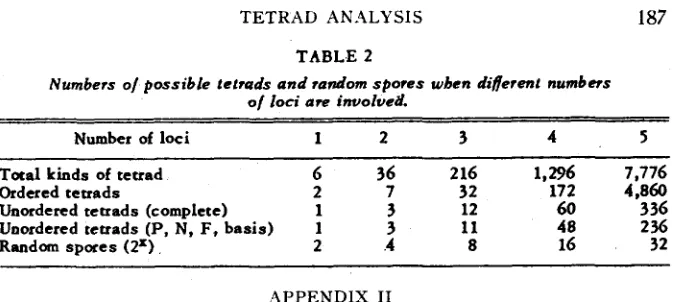
In the following discussion the centromere will be considered as a locus comparable to a gene locus. From this point of view unordered and ordered tetrads can be analyzed by similar methods. Pairs of loci will be classified into two-type parental (P), two-type non-parental ( N ) , and four-type (F) in which there are 0, 2, and 4, recombinarits in the tetrad respectively. This classification reduces the number of classes and simplifies analysis. Where one of the loci of a pair is the centromere then P and N cannot be distin- guished and F represents the incidence of second division segregation of the gene locus. Whereas with random spores, there is only one independently variable frequency for each pair of loci, parentals or non-parentals, with tetrads there are two independently variable frequencies. It is often useful to know the number of classes of tetrad that can be expected from a cross with a certain number of factors, say x. The total number of possihle arrange- ments of the four spores resulting from meiosis is 6". The number of classes of ordered tetrads, pooling only those classes that give no information as to crossing over is ( 5 x 2'
+
6")/8. The number of classes of unordered tetrads(6I-I i - 3 x 2"-l)/4, and if all pairs of loci are classified as N, l', or F, then the total number of classes is a bit more difficult to calculate hut for the first ten values of x the series is 1 ; 3 ; 1 1 ;
48
; 236 ; 1,248 ; 6,896 ; 39,168 ; 226,4% ; 1,325,577 (appendix I ) . The classification into N's, P's, andF's
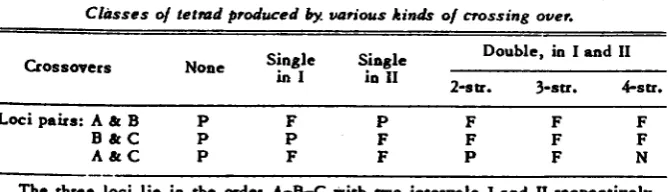
reduces the number of classes to be distinguished considerably. The information lost is, at worst, a failure to distinguish between the two types of 3-strand c1oul)le crossovers ( PAPAZIAN 1951).With this scheme the detection of crossovers and the strands involved is simplified. For any three loci the types of crossovers corresponding to various comhinations of N's, P's ancl F's are given in table 1. In the first three'col- unins if an N occurs instead of a P, a four-strand dothle crossover is indicated instead of no crossover. It is impossible to have an N for all three pairs of loci SO that by substituting N's for P's only three additional classes can be added t o the first coltinin ancl one additional class to the second and third column.
TABLE 1
Classes of tetrad produced b. various kinds of crossing over.
Double, in I and I1
Gosswers None Single Single
in I1 2-SP. 3-sa. b s t r .
in I
Loci pairs: A & B P F P F F F
B & C P P F F F F
A & C P F F P F N
The three loci l i e in the order A-B-C with two intervals I and II respectively.
The table then accounts for the 11 possible classes with three factors. Where one locus is the centromere, for example the A locus, and the two gene loci lie in the same arm of the chromosome, two- and four-strand double cross- overs cannot he distinguished since P and N cannot he distinguished where
a centromere locus is involved. Similarly, if the center locus, R, is the centro- mere and a four-strand double crossover occurs, it is not possible to tell in which interval it occurred. In this case the A-C pair will he N and one of the other two pairs will he N or P hut which is which will he unknown. .An!. number of loci can he analyzed in this way in groups of three hut a compli- cation arises when there are two three-strand double crossovers. With four loci, for instance, if there are three-strand doubles in intervals I & I1 and in I1 81 I11 it is useful to know whether the last crossover involved the same strands as the first. In the former case the first and last locus pair will he P, in the latter case N.
FREQUENCIES O F T H E CLASSES F,
N,
AND PIf the number of crossovers occurring simultaneously in an interval is n, and it is assumed that these is no chromatid interference, the proportion of F's between the bounding loci is given by F = (2/3) [ I
-
(-1/2)"]. This formula was derived by MATHER (1935) for the frequency of second division segregation but in the scheme proposed here it is valid for F's between two gene loci as well as between a gene- and a centromere-locus. To proceed fur- ther same assumption must be made about chiasma interference. I t is con- venient to consider two models as reference points, that of no interference in which multiple crossovers occur in a Poisson distribution, and that of coni- plete interference in which only single crossovers occur. If the mean number of crossovers in an interval is m, then with complete interference the fre- quency of recombinants, R = m/2, and F = in; hence R = F/2. Also N = 0. With no interference it is well known that...
R = (1/2) (1 -e-'")F = (2/3) ( 1
-
e--Rm/S ) (P APA ZTAN 1951)(1)
(2) and
hut
so from ( 1 ) and (2)
and since I; -t N
+
P = 1. . .
R = N .I F/2
. . .
N = 1/2 - (1/3) ( I - ) - e - " / 2 (3
1
P = 1/2 - (1/3) (1
-
+
e-"/2 (4)S = F2/S ( 1 t 2F/3) approximately
R = F/2 -1- F2/8 ( 1
+
2F/3) approximately. . .
From (2) and (3 )2 N = 1 - F - ( 1 - 3 F / 2 ) 2 ' 3
. . .
( 5 )( 6 ) ancl
179 J b l R h D ANALYSIS
Departures from a Poisson distribution of exchanges or from random strand multiple exchanges can be detected by departures from (5) and (6) where only two loci are available. This is valid for long intervals and can be used where other methods of measuring interference cannot. 11s map distances increase in -+ ce and F
-+
2/3, N -+ 1/6, P -+ 1/6. These limiting values ob- tain for two independent or loosely linked gene loci one or both of which are far from the Centromere. Values of F in excess of 2/3 indicate either an excess of single crossovers or an excess of 3-strand doubles. Values of R in excess of 1/2 always indicate an excess of +strand doubles.-. -.
.
T H E ADDITION LAW -4ND T H E FOSITION O F T H E CENTROMERE
Considering recombination frequencies, if the mean number of crossovers, in, is taken to be additive, i.e., i n l , = in1
+
n12, then from (1) (preceding section)K1,
=R1
+
Ra
-
CRIRp where C varies from 0 with complete inter- ference to 2 with no interference (HALDANE 1919). For F frequencies the corresponding addition law is, from ( 2 )F1,
= F1 t F2-
CpFIF2 whereCF
varies iron1 0 to 3/2. In the case of two gene loci on different chromosomes absence of interference may he assumed and since all centromeres undergo first division segregation they can all he regarded, for the present purpose, as a single locus the relationship F1, 2 = F,
+
F? - (3/2)F1F2 holds. The two clironiosoiiies can he.thoiight of as joined at their centromeres and F1.2 the total distance between the two gene loci is the sum of each F distance be- tween gene and centromere. This formula is identical with that given by 1’ERrtINS (1949) and ~ r ~ l ~ ~ E H O ~ S E (1949) following a different line of argument.When there are as many as three unlinked loci it is possible, by means of this formula, to map each locus in relation to its centromere (PERKINS 1949; LINDEGREN 1919; WHITEHOUSE 1950). The F1, values of each of the three pairs of loci are equated to the corresponding F1 and F2 values which are unknown and since there are three equations and only three unknowns they
cat1 be salved. The .solutions are of the form
__ ____.
F l = 2 / 3 zk (2/3) ~(2-3F1,2)(2-3Fl,3)/2(2-3Fz.3):
I t is clear that where F1 has two solutions, their sum will always be 4/3. Not all combinations of alternative solutions will, however, be valid when they are tested in the original equations. It can, in fact, be shown that it is im- possible for more than two sets of solutions ever to he valid. The solutions are unreliable for Fl when Ff, 3 has a value near 2/3.
Even where there are two loci on one chromosome and one on another chromosome the position of the Centromeres can be estimated ( PAPAZIAN
same side a subtraction is required and the appropriate equation is FI, 2 =
F1- F2
+
CFFiF2.EVIDENCE FOR INTERFERENCE FROM TETRAD DATA
Good evidence for chromatid interference and for negative chiasma inter- ference in the sex chromosome of Neurospsra crassa is given by WHITE-
HOUSE (1942) and LINDECREN and LINDECREN (1942) where references to
cytological and genetical data bearing on these phenomena in other organisms can be found. In both of these references the same data from LINDEGREN were used in part.
There are a few cases of peculiar tetrad frequencies in the literature which, although open to various objections, deserve attention. WETTSTEIN ( 1924) describes a cross in the moss Funaria hygrometrica with four linked factors. Among 35 tetrads isolated all were two-type although crossing over (2-type non-parentals) was observed in all three intervals. Two-type tetrads were also obtained exclusively under certain conditions by MOEWUS in Chlamy-
dontonar (1940), Brachiomonas (1940), and Protosiphon (1949). I n the
case of Chluiiiydontonas this was only true at low temperatures; at 22°C 4-type tetrads were obtained. Such results indicate either the regular occur- rence of 4-strand doul)le crossovers close together, or of crossing over at the two-strand stage.
In yeast (LINDEGREN 1949), among 83 unordered tetrads the proportion of N’s between the loci P N and AD, situated on either side of the centromere, is 0.217. The value of F for the same two loci is 0.53 giving a calculated value of N of 0.0-12, so that the proportion of N’s found is in great excess on ail assumption of randomness. It is of interest to examine the apparent anomaly that the total distance between P N and AD is greater than the sum of their separate distances from the centromere. The former is estimated from recom- bination values and the latter are estimated from segregation values. Follow- ing the relations developed in the last section, assuming no interference, the expected valite of R can be calculated. T he distances of P N and AD from the Centromere are 26 and 11 respectively. Therefore F1 = 0.52, F2 = 0.22 and, by the addition law for F’s, F1, 2 = 0.5695. From the relation R = 1/2+
( F2/8) (1
+
2F/3) the theoretical recombination frequency for an F frequencyof 0.5695 is 0.33, or 33 map units. The actual map distance between P N and
A D was found to be 48. The excess indicates an excess of double crossovers or of 4-strand doubles. The significance of these indications is only tentative owing to the fact that the linkage values of the five gene loci in these crosses are large, the number of asci analyzed relatively small, and the position of the loci therefore uncertain.
TETRAD ANALYSIS 181
from the top of table 1 ) involve genes known with considerable certainty to be in the arm opposite sex, whereas the genes in crosses 28, 47, 48, 52,
57,
and 66 are less reliably located. Among the four crosses involving the more reliably located genes represeiited by 139 asci, the number of 2-, 3-, and 4- strand doubles are 2, 1, and 3 respectively. Although there is an excess of 2- and 4- over 3-strand, the numbers are too small to be significant. If the less reliably established loci are added, among 245 asci the numbers are lo, 2, and 4 in which case the excess of 2- and 4- over 3-strand is significant at the one percent level. This compares with a ratio of 20: 10:5
(WHITEHOUSE 1012) and 32: 14: 13 (LINDEGRISN and LINDEGREN 1942). In table 2 ( t[OlJLAHAN ct al.) there are 14 crosses (Numbers 1-5, 7-15) iiivolving sex ant1 the albiiio 4637 which is linked to sex. There are 23 asci (= 0.0827) which are N for these two loci and 51 (=0.183) that areI?.
The calculated proportion of 1;’s is 0.00647. This probably indicates both an excess of4-
strand doubles and negative chiasma interference since even with the most favorable, and improbable, chiasma distribution where only double crossovers occur, the N’s cannot exceed 1/4 the F’s unless there is chromatid interference as well. It is noteworthy that in these crosses there are 22 asci showing double crossovers both in one interval and only one ascus with a double crossover, one in each interval. I ani again indebted to D. D. PERKINS for pointing out that 4637 involves a translocation (MCCLINTOCK 1945). This would seem to be connected with the peculiar crossing over pattern but not in any way that is obvious. From similar crosses in table 1 ( HOULAIIAN et al.) the propor- tions of single crossovers in one arm, single crossovers in the other arm, and double crossovers, one in each arm was analyzed by a new statistical pro- cedure devised by L. J. SAVAGE (appendix 11). If genes which are reliably located (numbers 7, 8, 14, 16, 17, 22, and 36) are used, among 197 asci there is no significant excess or deficiency of doubles. If unconfirmed loci (numbers 28, 47, 52, 57, and 66) are added there is an excess of doubles significant a t the one percent level. Double crossovers, both in the same arm, are ignored in these calculations. A possible explanation of negative chiasma interference is that crossiiig over is favored or inhibited in some asci of a perithecium by slight differences in environment or by accidental causes. If this were valid the same negative interference should be found for crossing over in different chromosomes. This was tested from data in table 3 (HOULAHAN et al.). .lniong 912 asci involving loci in different chromosomes there was no sig- nificant departure from independence, Again from table 1 (HOULAHAN ct al.)
aniong 583 asci there was no significant departure from independence of crossing-over between sex and the centroinere and various other loci and their centromeres on other chromosomes. What departure there was was in the direction expected from a deficiency of simultaneous crossovers or positive interchromosomal interference.
H.
tromere. rlinoiig S5 asci, pooled from the two sources, there are 10 crossovers in the sex-centromere interval, 16 in the 35809-centroinere interval, and four double crossovers, one in each interval. This is about twice the expected nutn- ber of doubles 011 a basis of independence of the two events and by exact calculation of a 2 x 2 table is significant at the one percent level.
Two recent publications give some information as to how an increase or
a decrease in total crossing over affects chiasma and chroinatid interference. In
N.
crussa data are available ( LINDEGREN and LINDEGREN 1942) for crosses made, accidentally, at two different temperatures. The mean frequency of crossovers between the extreme loci sex and pale was about the same at the high ( h ) , and low (1) temperature being 0.404 and 0.390 respectively. At the high temperature the frequency of rnultiple crossovers was higher, 0.0688(11) and 0.037 ( l ) , which is significant at the one percent level. Owing to this the frequency of recombinants was actually higher at the low temperature 0.153 ( h ) and 0.168 (1). This effect was only evident in regions spanning the centromere. Within chromosome a r m multiple crossovers were more frequent, but not significantly, at the low temperature 0.012 ( l ) , 0.0089 ( h ) . As regards chroniatid interference, at the high temperature the proportion of 3-strand double crossovers was greater relative to the 2-strand and to the +strand doubles than at the low temperature, but the 2- and 4-strand doubles were still in excess over random expectation.
In N . sitoplzila it has recently been shown (FINCHAM 1951) that there is more crossing over in the region of the centromere than in
N.
crassu. The data in this paper are interesting and it is to be regretted that the classes of asci have been pooled tu such an extent that detailed analysis is impossible. The proportion of F's between the centromere and crisp in N . sitophiln is0.711 which is in excess of 2/3 and suggests positive chiasma interference or an excess of 3-strand doubles. The proportion of E"s between crisp and sex
is 0.666 and the proportion of N's is 0.137 which is not in excess and does not
contradict the possibility of an excess of 3-strand doubles or of positive chiasnia interference. When F is nearly 2/3 the formula 2N = 1 - F
-
(3F/2)2'3 is very unreliable since a small change in F corresponds to a large change in N, the approximate formula given in an earlier section is still more unreliable when F is over 1/2 or so. It would therefore be difficult to tell whether there w-ere a deficiency of N's between crisp and sex.
Independent data (WULKER 1935) from N . sitophila also indicate that in this species there is no excess of 4-strand doubles, and no negative chiasma interference as found in N . crassu, on the contrary, an excess of 3-strand doubles is suggested. The phenotypes of 180 asci analyzed for the factors se.r and Z/L (no aerial mycelium) are given in table 4 from which the following were calculated. The frequency of crossovers in the sex arm was 0.422, in the l / L arm 0.6, and in both a r m simultaneously 0.24 which latter is just under the random value of 0.25. The frequency of F between sex alld I/L
TETRAID rINALYSIS 183
of 1/6. The nuniber of 2-, 3-, and 4-strand doubles is 8, 28, and 8 respectively, this escess of .3-strand doubles is, however, only significant at almut the seven percent level.
It would appear from the foregoing as if suppression of crossing over in N . crussu relative to N . sitophilu were accompanied by a considerable relative increase in 2- and 4-strand double crossovers and also in a relative increase of multiple crossovers o r negative chiasma interference.
THE SIGNIFICANCE O F CHROMATID INTERFERENCE
The effect of chromatid interference on the usual estimations of inap dis- tmce and of chiasma interference cannot be treated quantitatively until a measure of chromatid interference is adopted. It is difficult, with present knowledge, to know what sort of measure would be suitable. A siiiiple nieas- lire would be one analogous to chiasma interference and would assume that the chances of a particular strand being involved in a second crossover was less or greater than random. This would mean that with positive chromatid interference the departure from randomness would be in the direction 2-
<
3-<4-strand and for negative interference 2->3->4-strand. Some of the data, on the other hand, suggest something different, namely that both 2- and I-strand douliles may be in excess or in deficiency over 3-strand doubles.1 he effects of any particular pattern of multiple crossovers can, however, be worked out. One interesting case is that of regular pairs of 4-strand cross- overs. If, in such a case, chiasma interference were measured from random slwres in the usual way, doubles in adjacent regions would not be detected
itt all. If the regions under consideration were not adjacent, and one crossover
occurred in between, simultaneously with a double, then it would be detected
always. Thus chiasma interference would apparently diminish with the dis- tance of the regions concerned. With the usual assumption of chromatid r$n- tlomness 1/2 of the doubles are detected since the frequency of single cross- over strands is 1/2 the frequency of single exchanges and the frequency of
double crossover strands is 1/4 that of double exchanges in the tetrad, irre- spective of whether the regions are adjacent or not.
The cytological basis for chromatid interference is obscure. Just as chiasma interference can be accounted for, in a vague way, b$ most theories of crossing over, so chromatid interference can be fitted into many theories. On DAR- LINGTON’S theory it might be due, as suggested by WHITEHOUSE (1942), to two particular strands being more liable to break than the other two. This would not account for an excess or deficiency of both 2- and 4-strand doubles over 3-strand doubles, Among other prominent theories of crossing over that of MATSUURA and HACA (1942) not only might produce an excess of 2- and 4-strand doubles but would be expected to give a large excess. Furthermore, since the centromeres are post reduced in 2/3 of the cases all genes should show 2/3 post reduction unless a specific pattern of exchange between chro- matids from different pairs occurred. On the theory proposed by BELLING
(1933) an excess of 2-strand inight be expected. This theory differs from
DARLINGTON’S in its emphasis on the differentiation of the chromatid into genetic and non-genetic material, each of which duplicate independently. Single crossoyers and multiple crossovers involving the sanie two strands are consequences of the hypothesis that non-genetic material “ duplicates ” by the
formation of new strands independently, as regards position, of the old. Three- and 4-strand doubles involve, in addition, an exchange of strands of a dif- ferent kind which might occur within the gene, or at the junction of genetic and non-genetic material.
SUM MARY
Two kinds of tetrad, ordered and unordered, are distinguished by the con- stant spacial position of spores it1 the former. The interpretation of various
spacial patterns in ordered tetrads is described.
Both ordered aiid unordered tetrads are classified on the basis of the rela- tions of pairs of loci. These relations can be two-type parental ( P ) , two-type non-parental ( N ) , or four-type ( F ) . The relations of various patterns of single and multiple cross-overs to the classes of tetrad are given in tabular form.
On the assumption of no chiasma or chroiiiatid interference, the addition
law for F (= 2nd division segregation) frequencies is shown to be
F1,
=Fl -t
FZ
- 3F1F2/2 ; aiid the relation of recombinant frequencies to F fre- quencies, R = 1/2-
[ (1-
3F/2)2/3]/2.Evidence bearing on chromatid and chiasma interference is extracted from various recent publications and a convenient statistical method, devised by L. J. SWAGE, is applied to estimating interference with data pooled from numerous crosses involving small numbers.
APPENDIX I
The type of tetrad with respect to x loci may be represented by a n x 4 rectangular ar- ray of 0’s and 1’s with exactly two zero’s in every column. For example:
0 1 0 1 0 1 1 1 0 0 1 0
1 0 1 0 0 1 0 0 1 1 1 0
Since the two zero’s in each column can be chosen in 6 different ways, the total nunlbr of
types possible, T ( x ) , is, T ( x ) =6’.
_---.
Ordered tetrads
In an ordered tetrad notice is taken of the way in which cells lie as regards top arid bottom two in a linear tetrad of four cells but no notice is taken of which pair are top atld which are bottom, or of which single cell is top or bottom in any pair. Two types of tetrad
TETRAD ANALYSIS
The species may be conveniently divided into three genera thus :
185
No. of types
i n this genus
No. of s p e c i e s in the genus Description per species
G i w 9 x; YD 8 G i b )
w, w; x, x 2 G a b )
G i b )
GI
G1 w, x; w, x 4
I t is clear that, S(x) *GI(x) t G 4 x ) t G ( d
By 'the Same argument which led to T (x) , there are 2' types in G, and 2 X 2' = 2'" tYW in G, therefore G ( x ) =
(U?)
2'szs-'
T ( X) = 6' 8Ga ( X) t 2 G ( X) t 4G( X)
-
G ( x ) = (114) 2'+'=2'-'.
T ( x ) = 6'= 8G(x) +2't Zx-'= ~ G ( x ) t 3 x 2'
S(X) = (6'- 3 x 2' t 2'+'+ 2'+')/8 = (6' t 5 x 2')/8
G(x) = (6'- 3 x 2 ) / 8
This formula was obtained by WHITEHOUSE (1942) empirically but Was misprintd.
Unordeied tefrods (conrplctc c ~ a S ~ f i C a t ~ O n )
In an unordered tetrad no notice is taken of the way in which Cells lie as regards tOP
two and bottom two and the genus may be divided into two species thus:
NO, O€ ~ P C S
i n this genus
No. of species Name Description per species in the genus
24 K I W
6 KAx)
K I = D .9 Y D KI 'RI w, .t = 9
S"(X) =KI(x) t K ( x ) T (X) = 24Kx ( X) t 6Kz ( X )
.
By the previous argument there are ZX-' types in K2, therefore,
T ( X ) = 6' = 24Kt ( X ) t 3 x 2'
R
(x) I (6'-
3 x 2')/21= (GX-' - 2'-')/4S"(X) (6'-'-2'-'+4~2'-')/4= ( 6 ' - ' + 3 ~ 2 ' - ' ) / 4 .
Unordered tetrads ( P , N , and F basis)
Any two columns (or loci), say c and d, of the n x 4 matrix representing a tetrad must
he in one of the three reflexive and niutually exclusive relations P, N, or F to each other :
cPd, if c and d agree in every row; cNd, if c and d disagree in every row; cFd if c and d agree in two rows only.
Two tetrads are said to be of the same family if every pair of loci in one is in the same relation as the corresponding pair in the other. The problem is to compute the num- ber Q(x) of families w h n there are x loci. The computation of Q ( x ) is based on cer- tain considerations about the relations P, N, and 1;:
In the first place, if cPd, then to any other locus, say e, c and d must both bear the same relation. Thus P gathers the loci into clusters. What patterns are possible among
clusters? Since there are but six different patterns of zeros and ones available, there can be at most six different clusters. If there are actually six they must be represented by
S 2
15
If six clusters are determined, as many possibilities may be formed from them as there are ways to arrange six things in pairs, or 6 !/(2!)'3! = 15. The number 15 has, for refer- ence been written beside the figure.
Similarly five different clusters must be in a permutation of the pattern :
1
2
15
For four clusters two different sorts of patterns are possible:
For three,-mo, and one the possibilities are these:
It is not a difficult combinatorial problem to see that the nuniher of ways P(k, x ) in which x loci can be divided into k clusters is given by
If P ( k , x) were to be seriously studied for large x, the forniula (1) would doubtless be
useful. The following rectirsion formula would also he useful and it provides a convenient hasis analogous to Pascal's triangle for computing P ( k , s) for small values of k and x.
P ( k , x)=kP(k,x-1) t P ( k - 1 , n - 1 )
The possible nuniber of various kinds of tetrad and of-random spores is given for Q ( x ) = P ( l , X ) t Z F ( 2 , X ) +4P(3, X) +9P(4, X) +15P(5, X) +15P(6, x).
TETRAD AN-4LYSIS I87
T A B L E 2
Numbers o/ possible tetrads and random spores wbcn different numbers
of loci are ZnvolveL
Number of loci 1 2 3 4 5
T a d kinds of tetrad 6 36 2 16 1,296 7,776
Ordered tetrads 2 7 32 172 4,860
Unordered tetrads (complete) 1 3 12 60 336
Random spores ( 2 9 2 4 8 16 32
Unordered tetrads (P, N, F, basis) 1 3 11 40 236
-4PPENDIX I1
The statistical problem here is this. Several double dichotomies are observed, eacli constituted by a small number of observations. A statistical test is sought for tlic hyyotli- esis that each is positively correlated.
Tradition would suggest that the hypothesis be tested by computing x2 for each tlouhlc dichotomy, adding the values of x’ and appealing to the x p test. This solution is rather irtisatisfactory in two respects both of which may be met by a variation of it.
First, since each double dichotomy is small, the expectations of the individual hypoth- eses will, under the null hypothesis, each be a little less than one, so that the x‘ test based on this sum will IK systematically inaccurate. Since x’= t2(n- l)/n, it may be noted that, as was asserted earlier E ( x ’ ) = (1
-
l/n) I.: (t‘) = (1-
l/n)<
1.Second, even if the double dichotomies were not small, adding the individual values of
x’ leads to a test which is, at least to all appearances, less ,sensitive than a test based on the sums of x itself would be.
TO construct the test we propose, let a double dichotomy be represented by the familiar t:thle.
~~
i F X I P
where U - a t c, n = M t x, etc., and let A = a d - b c = a n - y w , and compute its expected
\ alue and variance of 1 undcr the null hypothesis thus : E(a) = n E ( a ) -yw=O
v(A)
=n*V(a) = wxyz/n-
1,the expected value and variance of a is given in any account of the hypergeometric dis- tribution. The quantity t = Afln
-
I)/wxyz therefore has, under the null hypothesis, zero expectation and unit variance, provided that wxyz>
0. The sum of several values of it should therefore, under the null hypothesis, be approximately normally distributed about zero, with variance equal to the numbers of terms in the sum. Under the envisaged alternatives it will tend tp be positive.LITERATURE CITED
BELLING, J., 1933 Crossing over and gene rearrangement in flowering plants. Genetics
RUSS, H. R., 1944 The genetics of methionineless mutants of Neurospora crassu.
CHARLES, D. R., 1938 The spatial distribution of cross overs in X-chromosome tetrads
FIXCHAM, J. R. S., 1951 A comparative genetic study of the mating-type chromosomes
18: 388413.
M. A. Thesis, Stanford University, 60 pp.
of Drosophila rnelanogaster. J. Genet. 56: 103-126.
188
HALDANE, J. B. S., 1919 The combination of linkage values, and the calculation of dis- tances between loci of linked factors. J. Genet. 8: 299-309.
HOULAHAN, M. B., G. W. BEADLE and H. G. CALHOUN, 1949 Linkage studies with bio- chemical mutants of Neurospora crassa. Genetics 34: 493-507.
JANSSENS, F. A., 1909 La t h b r i e de la chiasmatype. La Cellule 25: 389-411.
KNAPP, E., 1937 Crossing-over und Chromosomenreduktion. Zeit. Ind. Abs. Ver. 73:
409-418.
LINDEGREN, C. C., and G. LINDECREN, 1942 Locally specific patterns of chromatid and chromosome interference in Neurospora. Genetics 27: 1-24.
LINDECREN, C. C., 1949 Chromosome maps of Saccharomyces. Hereditas Suppl. Vol., 338-355.
LUDWIG, W., 1938 Faktorenkoppeluiig uiid Faktorenaustausch bei normaleiii und a k r - rantem Clironiosomenbestand. Georg Thieme, Leipzig. pp. 245, 74abb.
MATHER, K., 1935 Reductional and equational separation of the chromosonies in bivalents and multivalents. J. Genet. 30: 53-78.
MATHER, K., and G. H. BEALE, 1942 The calculation and precision of linkage values from tetrad analysis. J. Genet. 43: 1-30.
MATSUURA, H., and T. HAGA, 1942 Chroniosome studies on Trillium kamtschafkum
Pall. X. On the origin of the chiasma. Cytologia 12: 397-417.
MCCLINTOCK, B., 1945 Preliminary observations of the chromosomes of Neurospora crassa. Amer. J. Bot. 3% 671-678.
MOEWUS, F., 1940 Die Analyse von 42 erblichen Eigenschaften der Chlamydomonas etcgametos-gruppe. I11 die 10 Koppelungsgruppen. Zeit. Ind. Abs. Ver. 78: 501-522. 1949 Zur Genetik und Physiologie der Kern un Zellteilung. I1 Uber den Synchro- nismus der Kemteilungen bei Protosiphon botryoides. Beit. Biol. Pflanzen. 28: 36-63. PAPAZIAN, H. P., 1951 The incompatibility factors and a related gene in Schizophyllum
cornmune. Genetics 36: 441-459.
PERKINS, D. D., 1949 Biochemical mutants in the smut fungus Ustilago maydis. Genetics 34: 607-626.
SHENC, T. C., 1951 A gene that causes natural death in Neurospora crassa. Genetics 36
199-212.
WEINSTEIN, A., 1936 The theory of multiple-strand crossing-over. Genetics 21: 155-19. WETTSTEIN, F. V., 1924 Morphologie und Physiologie des Formwechsels der Moose auf
WHITEHOUSE, H. L. K., 1942 Crossing-over in Neurospora. New Phytol. 41: 2342. genetisclier Grundlage. I. Zeit. Ind. Abs. Ver. 33: 1-236.
1949 Multiple-allelomorph heterothallism in tlie fungi. New Phytol. 48: 212-244. 1950 Mapping chromosome centromeres by the analysis of unordered tetrads. Nature
165: 893.
WINCE, O., 1947 The segregation in tlie ascus of SaccLaromycoidEJ ludwigii. C. R. Lab. Carlsberg (pliys.) 24: 223-226.