IJEDR1504091
International Journal of Engineering Development and Research (www.ijedr.org)550
An implementation of effective stock analysis and
prediction system
1Suraj Baviskar, 2Nitin Namdev, 3Mahesh Malviya 1ME Scholar, 2Assit. Professor, 3HOD 1Department of Computer Science and Engineering,
JIT Borawan, Khargoan, India.
________________________________________________________________________________________________________
Abstract - National Stock Exchange (NSE) is generating enormous amount of valuable stocks trading data. This paper presents a design and implementation of low cost, effective stock analysis and prediction system based on technical information of stocks listed on National Stock Exchange. Stocks exchanged by buyers and sellers in stock exchange which generate huge transactional trading data on daily basis. Analyzing data for more than thousand stocks on day-to-day basis is monotonous, time consuming and error-prone. Hence, there is need for system which is low cost and effective to scan through daily and historical transaction data to analyze and predict stocks to buy for quick gains in short term.
Index Terms – Stock Analysis, Stock Prediction, NSE.
________________________________________________________________________________________________________
I. INTRODUCTION
As part of fund raising exercise, companies issues shares to pubic and institutions. Investor acquires partial ownership in company by purchasing shares. A stock market is a place where public listed company stocks are traded. Stocks are exchanged among buyer and seller which generate transactional data. Stock prices change as per demand and supply. Trading data is captured by stock exchange which is non-linear, fluctuating and time variant. More meaningful information is hidden in trading data which is time-consuming and difficult for human being to extract without powerful tools. Thus analyzing and forecasting trading data is highly challenging.
Investors, stock brokers and trading forms are analyzing trading data to predict future movement of stocks. Mostly traders use technical data analysis information for short to mid-term investment horizon. Fundamental analysis is taken into consideration for mid-term to long term investment horizon. Typically analyst are looking for day end stock closing, high, low and day open price along with volumes traded. Studying this information for hundreds of stocks on day-to-day basis is time-consuming, tiring and error-prone hence they are relying on powerful stock analysis tools to analyze stocks past trading data and predict future stock movement.
II. RELATED WORK
In order to analyze and forecast stocks, most of the researchers have used data mining methodologies like decision tree, association rule, clustering, artificial intelligence, support vector machine, genetic algorithm, regression, fuzzy system, time series mining and mixed methods etc.
Muh-Cherng Wu et al.[1], presented a method for stock trading by combining the filter rule and the decision tree technique to generate candidate trading points. They also considered past and the future information in clustering the trading points.
Tsang P.M. et al [2], have conducted study on building a stock buying, selling alert system using back propagation neural networks. The system was trained and tested with past price data from Hong Kong and Shanghai Banking Corporation Holdings over the period of one year in 2004.
Lee and Chen [3], have used technical indicators as input variables to feed forward neural network for prediction of NASDAQ and Taiwan Stock Exchange.
El-Baky et al., [4], proposed a new approach for fast forecasting of stock market prices using new high speed time delay neural networks (HSTDNNs). They confirm the theoretical computations of the approach by using MATLAB tool to simulate results.
Jianfei Wu et al. [5], have compared clustering algorithm with core patterns and noticed that core patterns are more stable as stock price evolves. Their algorithm accepts only one parameter which is more effective as compared with the DBSCAN clustering algorithm.
In this system, we have used mixed approach like clustering, decision tree and filtering rules.
III. DESIGN AND IMPLEMENTATION OF SYSTEM
IJEDR1504091
International Journal of Engineering Development and Research (www.ijedr.org)551
System will collect raw history data from various locations primarily from National Stock Exchange website and store it in database. We prefer to use open source database to scripting language which is compatible for simple web based client server architecture. Various data mining methodologies are used on filter, classify and categorize data by extracting useful patterns or rules to represent it in simple form for investor. Investors, as per his investment goals, can choose stocks analyzed by this system. Investor requires any web browser to access stock analyzed web-page.Use case diagram
Use case diagram for effective stock analysis and prediction system is as shown below.
Fig 1
Architecture
Effective, Low cost, user friendly GUI and flexible analysis and prediction system are high priorities so we used open source scripting language PHP, JavaScript, Apache web server and MYSQL database using multi-tier client server request response architecture. End users will use any web browser to access this system which provides plug and play of different strategies on demand.
Input - NSE stock trading data
Input of proposed system is NSE stock trading data. National Stock Exchange is recording daily trading data and publishes it at the NSE website after end of trading hours. This data is available in comma separated value (CSV) format and database format. Historical data is also available for all past trading sessions which can be used for analysis purpose.
Sample Input data stock trading data
SYMBOL,SERIES,OPEN,HIGH,LOW,CLOSE,LAST,PREVCLOSE,TOTTRDQTY,TOTTRDVAL,TIMESTAMP,TOTALTRA DES,ISIN,
20MICRONS,EQ,30.85,31.45,30.6,30.75,30.75,30.75,50904,1582699.2,15-JUL-2015,219,INE144J01027, 3IINFOTECH,BE,4,4.35,3.95,4.35,4.35,4.15,1927403,8183028.75,15-JUL-2015,994,INE748C01020, 3MINDIA,EQ,8199.9,8329,8161.3,8200.85,8310,8194.15,1179,9676426.6,15-JUL-2015,214,INE470A01017, 8KMILES,EQ,900,929,890.3,897.35,892,894.85,47010,42748144.55,15-JUL-2015,2829,INE650K01013, A2ZINFRA,EQ,24.95,25.9,24.7,25.3,25.55,24.9,755748,19118912.65,15-JUL-2015,2309,INE619I01012,
AARTIDRUGS,EQ,669.4,694.95,666.1,681.75,686,662.95,113338,77643890.75,15-JUL-2015,3728,INE767A01016,
Steps for Implementation
1. Data collection - Retrieve daily trading data in comma separated format from NSE website after trading hours which reflects day closing prices of NSE listed stocks.
2. Select and cleanse data – Select, cleanse and map gathered data to predefined format. 3. Data Processing - Process gathered data to predefined model.
4. Apply data mining techniques - Identify patterns from mapped and processed data using various data mining techniques. 5. Prediction - Make a prediction based on analyzed data to flash buy or sell or wait signal for investors.
IJEDR1504091
International Journal of Engineering Development and Research (www.ijedr.org)552
Output - NSE stock analysis and prediction
Output of proposed system is user friendly, web browser providing various tabs for different category of stocks analysis like stocks in uptrend, downtrend, price gainers and losers, overbought and oversold stocks, stock volume increased and decreased, defensive stocks, high volatile stocks etc. and dashboard tab for stock prediction. Below screen snapshot of system is showing system overbought stocks tab.
Screen snapshot of system depicting overbought stocks category-
Fig 2
IV. RESULTS
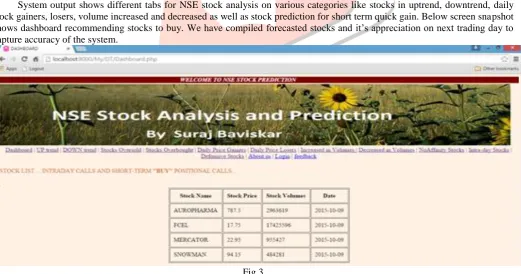
System output shows different tabs for NSE stock analysis on various categories like stocks in uptrend, downtrend, daily stock gainers, losers, volume increased and decreased as well as stock prediction for short term quick gain. Below screen snapshot shows dashboard recommending stocks to buy. We have compiled forecasted stocks and it’s appreciation on next trading day to capture accuracy of the system.
Fig 3
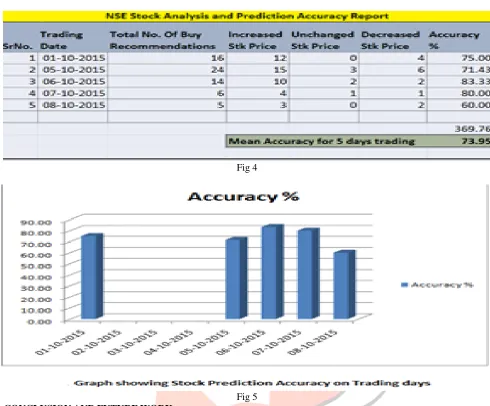
System stock prediction and it’s actual results are compared to arrive at accuracy and efficiency of system. Stock analysis for one complete trading week, we noticed average stock prediction accuracy of 73.95% which is much better on next trading day, effective with simple, user-friendly, flexible and low cost system. We can formulate and attach various trading strategies as per investor’s expectation on returns.
IJEDR1504091
International Journal of Engineering Development and Research (www.ijedr.org)553
Fig 4Fig 5 V. CONCLUSION AND FUTURE WORK
This paper presents design and implementation of low cost, simple, user-friendly and effective National Stock Exchange (NSE) stocks analysis and prediction for short term quick gains. Implemented system is flexible enough to attach various trading strategies to cater investors, brokers and trading firm’s financial goals. This system is configured for cash market and short term gain prospective. With minor configuration changes it can be useful for derivatives and commodity market as well. Different trading strategies can be configured as per investor’s risk and reward appetite.
This system framework can be customized for various stock markets across the world for different financial market products with modifications. Security of system can be enhanced with proper authentications and other methods. Based on number of users load balancing and failover architecture can be implemented to provide high availability and around the clock service.
REFERENCES
[1] Wu, M.C., Lin, S.Y., and Lin, C.H., (2006) "An effective application of decision tree to stock trading", Expert Systems with Applications, 31, pp. 270-274.
[2] Tsang, P.M., Kwok, P., Choy, S.O., Kwan, R., Ng, S.C., Mak, J., Tsang, J., Koong, K., and Wong, T.L. (2007) "Design and implementation of NN5 for Hong Kong stock price forecasting", Engineering Applications of Artificial Intelligence, 20, pp. 453-461.
[3] Lee, C-T., and Chen,Y-P. 2007. "The efficacy of neural networks and simple technical indicators in predicting stock markets." In Proceedings of the International Conference on Convergence Information Technology, pp.2292-2297. [4] Hazem M. El-Bakry, and Wael A. Awad, "Fast Forecasting of Stock Market Prices by using New High Speed Time
Delay Neural Networks", International Journal of Computer and Information Engineering 4:2 2010. Pp 138-144.
[5] Jianfei Wu, Anne Denton, Omar Elariss, Dianxiang Xu, "Mining for Core Patterns in Stock Market Data", ICDMW, 2009, 2013 IEEE 13th International Conference on Data Mining Workshops, 2013 IEEE 13th International Conference on Data Mining Workshops 2009, pp. 558-563
[6] Web Source - "Yahoo Finance". http://finance.yahoo.com/
IJEDR1504091
International Journal of Engineering Development and Research (www.ijedr.org)554
Authors Profile
Suraj Baviskar1 is a graduate in Computer Science and Engineering from Government college of
Engineering Amravati, Amravati University, Maharashtra, India. He has 17 years of IT industry experience in banking, telecom, finance, project management and IT domain for MNC’s like ALLTEL, ACCENTURE, CONVERGYS and NETCRACKER. At present, he is pursing masters of engineering from RGPV Bhopal University with Software Engineering as specialization after taking break from IT Industry. He is certified Oracle 8i OCP, PMP and ITIL V3 foundation professional and having industry experience in production database administration, managed services and project management. He has over 10 years of NSE stock trading experience.
Mr. Nitin Namdev2 is currently working as an assistant professor in Computer Science and Engineering
department, Jawaharlal Institute of Technology (JIT) Borawan, Khargon, M.P, India for last 9 years. He earned his graduation and post-graduation in Computer Science and Engineering from RGPV Bhopal University, M.P, India. His area of interest is data mining and software engineering.
Mr. Mahesh Malviya3 is currently working as HOD in Computer Science and Engineering department,