O R I G I N A L R E S E A R C H
An automated mammogram classi
fi
cation system
using modi
fi
ed support vector machine
This article was published in the following Dove Press journal: Medical Devices: Evidence and Research
Aderonke Anthonia Kayode1
Noah Oluwatobi Akande1
Adekanmi Adeyinka Adegun1
Marion Olubunmi Adebiyi2
1Computer Science Department,
Landmark University, Omu-Aran, Kwara State, Nigeria;2Department of Computer
and Information Sciences, Covenant University, Ota, Ogun State, Nigeria
Purpose: Breast cancer remains a serious public health problem that results in the loss of lives among women. However, early detection of its signs increases treatment options and the likelihood of cure. Although mammography has been established to be a proven technique of examining symptoms of cancer in mammograms, the manual observation by radiologists is demanding and often prone to diagnostic errors. Therefore, computer aided diagnosis (CADx) systems could be a viable alternative that could facilitate and ease cancer diagnosis process; hence this study.
Methodology:The inputs to the proposed model are raw mammograms downloaded from
the Mammographic Image Analysis Society database. Prior to the classification, the raw
mammograms were preprocessed. Then, gray level co-occurrence matrix was used to extract
fifteen textural features from the mammograms at four different angular directions:θ={0°,
45°, 90°, 135°}, and two distances: D={1,2}. Afterwards, a two-stage support vector machine was used to classify the mammograms as normal, benign and malignant.
Results:All of the 37 normal images used as test data were classified as normal (no false
positive) and all 41 abnormal images were correctly classified to be abnormal (no false
negative), meaning that the sensitivity and specificity of the model in detecting abnormality
is 100%. After the detection of abnormality, the system further classified the abnormality on
the mammograms to be either “benign”or“malignant”. Out of 23 benign images, 21 were
truly classified as benign. Also, out of 18 malignant images, 17 were truly classified to be
malignant. From these findings, the sensitivity, specificity, positive predictive value, and
negative predictive value of the system are 94.4%, 91.3%, 89.5%, and 95.5%, respectively.
Conclusion:This article has further affirmed the prowess of automated CADx systems as a viable tool that could facilitate breast cancer diagnosis by radiologists.
Keywords:cancer diagnosis, CADx systems, radiologists, diagnostic errors, GLCM
Introduction
Breast cancer is a deadly disease that plagued women population in developing countries.1,2 However, early detection of the symptoms of breast cancer could facilitate its treatment and it has been established that mammography is the best technique for this task.3,4 This technique involves the examination of X-ray images of the breast for symptoms such as architectural distortion, calcifications, masses, etc.
Although mammography has been established to be a viable technique in the diagnosis of breast cancer, its interpretation by Radiologists’ are most times in question as different Radiologists may come up with different interpretations.5,6
7
Correspondence: Aderonke Anthonia Kayode
Computer Science Department, Landmark University, KM 4, Ipetu Omu-Aran Road, P.M.B., Omu-Aran, Kwara State 1001, Nigeria
Tel +234 806 119 6257
Medical Devices: Evidence and Research
Dove
press
open access to scientific and medical research
Open Access Full Text Article
Medical Devices: Evidence and Research downloaded from https://www.dovepress.com/ by 118.70.13.36 on 24-Aug-2020
Radiologists develop over time. Nevertheless, digital image processing and machine learning approaches can proffer a solution to many of the inherent problems encounter by Radiologists when interpreting mammogram manually.
Mammogram processing (enhancement and segmen-tation) enhances visual interpretation. Also, intelligent classifier aids expert in detection and classification of mammograms.8
Methodology
The detailed steps employed in the classification task are documented in this section. It involves mammogram acquisition, mammogram processing, feature extraction and the classification models, all of which were implemen-ted in MATLAB 2015.
Mammogram acquisition
Raw mammograms were downloaded from MIAS database.9Out of 322 mammograms available in the data-base, 126 normal, 60 benign and 48 malignant mammo-grams were carefully selected. Of these, 37 normal, 23 benign, 18 malignant mammograms were used as test data while the remaining 156 mammograms were used for training the system.
Mammogram processing
Mammography uses low dose x-ray for imaging which produces a low qualitymammograms.10 In addition, Kayode et al11 ascertained that image acquisition comes with lots of inherent problems which include scratches, dust artifact, scanner induced artifacts and excessive background noise which can further under-mine the reliability of X-ray images, therefore, it is expedient to pre-process digital images so as to improve their quality.
Furthermore, image enhancement includes removing noise and adjusting image contrast so that the identifi ca-tion of key features becomes easier. In this article, image enhancement was achieved using Contrast Limited Adaptive Histogram Equalization (CLAHE). Also, seg-mentation was done in order to separate the needed region also known as the region of interest (ROI) from the entire breast tissue. Otsu threshold algorithm was implemented in MATLAB to extract ROI from the entire mammogram image.
Extraction of features from
mammogram
’
s ROI
Radiologists analyze ROI found on mammograms by examining morphological features, such as size, margin and shape of the ROI; this helps them to differentiate between normal and abnormal mammograms and also to differentiate between an abnormal benign mammogram from an abnormal malignant mammogram. However, it should be noted that decisions concerning these morpho-logical features are cognitive and greatly depend on Radiologists’ experience and opinion; therefore, it is essential to use computers to facilitate the extraction of GLCM features related to image texture, coarseness and heterogeneity, which are not necessarily seen by unaided eye.
GLCM is the most common statistical method used to compute textural features from gray level images such as mammograms. GLCM features consider the spatial rela-tionship between the pixel of interest and its neighbouring pixels thereby providing us with textural features. Each element (m, n) in the resultant GLCM is simply the sum of the number of times that the pixel with value moccurred in the specified angular direction and distance to a pixel with valuenin the input image.12
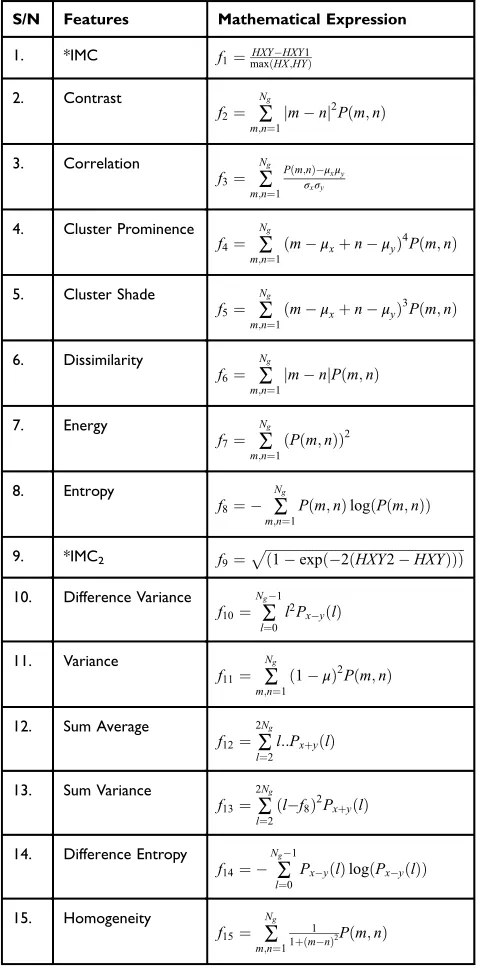
In this article, the thirteen GLCM features, proposed and by Haralick et al13 with two other features called cluster prominence and cluster shade, proposed by Tsatsoulis14 were extracted from mammograms. These GLCM features have been reported to adequately con-vey information about the textural characteristics of an image. The features are listed in Table 1. The detailed discussion about the features is documented in13,14 respectively.
Unlike in the existing works,15–18 where a single GLCM feature was created for each image using hor-izontal direction, θ¼00 and distance,D¼1; this study is of the opinion that a single GLCM is inadequate to characterize the textural features of an image, therefore, in addition to the horizontal direction θ¼00 and
dis-tanceD¼1;two diagonals θ¼450;1350and the ver-tical direction θ¼900 at distance d¼2 at distance
D¼2 which correspond to multiple GLCMs features at four directions and two distances 1 and 2 were com-puted. The following pseudocode was used to extract the features:
Medical Devices: Evidence and Research downloaded from https://www.dovepress.com/ by 118.70.13.36 on 24-Aug-2020
Objective:
1. To Extract GLCM from mammogram images Input:
2. ROI of the enhanced image I
3. The direction to be used for creating a co-occurrence matrix
Output:
4. The GLCM extracted features vector from the input image I
F¼ff1;f2;;f15g
Process: 5. Begin:
6. forθ¼ 00;450;900;1350do
7. createCoocmatrixIðθÞ//GLCMs at angular directionsθ
8. end loop
9. for distancesD¼ f1;2gdo
10.SumCooc¼0 //sum of co-occurrence matrices
11. for each angle inθdo
12.SumCooc¼SumCoocþCoocmartixIðθÞ
13. end loop 14. end loop 15. for i=1 to 15 do
16.SiðDÞ ¼computefeaturesðSumCooc;FðiÞÞ
17. end loop 18. for i=1 to 15
19.AveSumCoocðiÞ ¼mean Sið Þ
20.features¼AveSumCoocðiÞ
21. end loop features 22. Return
23. End
Classi
fi
cation of mammograms
SVM was used for classification purposes. In MATLAB programming tool, SVM functions support only two classes based on its fundamental principle as a binary classifier. Due to three attributes of interest: normal, benign and malignant, SVM was trained twice, first to classify mammograms to either normal or abnormal, and second, to classify abnormal mammograms to benign or malignant. By this two-stage approach the three attributes of mammograms will be accommodated as illustrated in
Figure 1.
Experimental results
Figure 2 illustrates the Graphic User Interface (GUI) designed for the preprocessing stage. Raw mammograms were fed into the system one after the other then CLAHE was employed for the preprocessing. Afterwards, the suspicious region otherwise known as ROI was extracted from the enhanced image; this is illustrated in Figure 3.
Table 1Textural features extracted from the dataset
S/N Features Mathematical Expression
1. *IMC f1¼maxHXYðHXHXY;HY1Þ
2. Contrast
f2¼ ∑
Ng
m;n¼1
jmnj2Pðm;nÞ
3. Correlation
f3¼ ∑
Ng
m;n¼1
Pðm;nÞμxμy σxσy
4. Cluster Prominence
f4¼ ∑
Ng
m;n¼1
ðmμxþnμyÞ4Pðm;nÞ
5. Cluster Shade
f5¼ ∑
Ng
m;n¼1
ðmμxþnμyÞ3Pðm;nÞ
6. Dissimilarity
f6¼ ∑
Ng
m;n¼1
jmnjPðm;nÞ
7. Energy
f7¼ ∑
Ng
m;n¼1
ðPðm;nÞÞ2
8. Entropy
f8¼ ∑
Ng
m;n¼1
Pðm;nÞlogðPðm;nÞÞ
9. *IMC2 f9¼
ffiffiffiffiffiffiffiffiffiffiffiffiffiffiffiffiffiffiffiffiffiffiffiffiffiffiffiffiffiffiffiffiffiffiffiffiffiffiffiffiffiffiffiffiffiffiffiffiffiffiffiffiffiffiffiffiffiffiffiffi
ð1expð2ðHXY2HXYÞÞÞ
p
10. Difference Variance
f10¼ ∑
Ng1
l¼0 l2P
xyðlÞ
11. Variance
f11¼ ∑
Ng
m;n¼1
1μ
ð Þ2Pðm;nÞ
12. Sum Average
f12¼∑
2Ng
l¼2 l::PxþyðlÞ
13. Sum Variance
f13¼∑
2Ng
l¼2
ðlf8Þ2PxþyðlÞ
14. Difference Entropy
f14¼ ∑
Ng1
l¼0
PxyðlÞlogðPxyðlÞÞ
15. Homogeneity
f15¼ ∑
Ng
m;n¼1 1
1þðmnÞ2Pðm;nÞ
Note: *IMC1 and IMC2 are information measure sof correlation 1 and 2,
respectively.
Medical Devices: Evidence and Research downloaded from https://www.dovepress.com/ by 118.70.13.36 on 24-Aug-2020
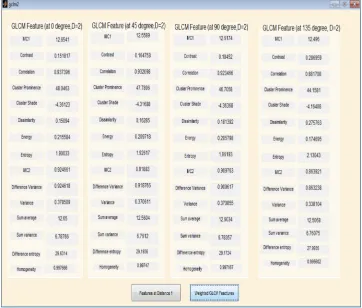
Fifteen GLCM features presented in Table 1 were extracted from the ROI as illustrated with Figures 4 and
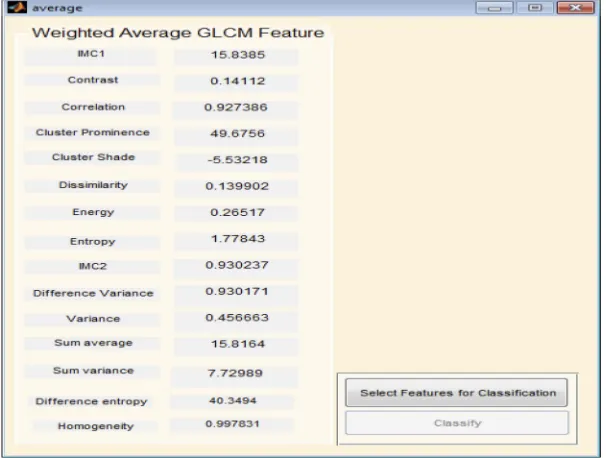
5 respectively. The averages of the features at the two distances were calculated as shown in Figure 6while the overall averages of each of the features which serve as input to SVM classifier, were also calculated as shown in
Figure 7.
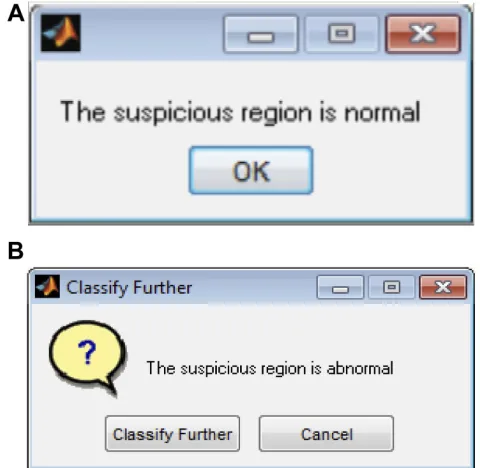
The first-stage classification entails categorizing the mammograms as either normal or abnormal as illu-strated in Figure 8; this is termed thefirst-stage
classi-fication. If the image is normal the algorithm stops. However, if any abnormality is detected, the algorithm further classifies the abnormality into benign or malignant (see Figure 9); this is second-stage classification.
Figure 2Mammogram enhancement using Contrast Limited Adaptive Histogram Equalization (CLAHE).
Normal
Extracted features
SVM
Abnormal
SVM
Benign Malignant
Figure 1Two-level classification approach using support vector machine (SVM).
Figure 3Region of interest (ROI) extraction.
Medical Devices: Evidence and Research downloaded from https://www.dovepress.com/ by 118.70.13.36 on 24-Aug-2020
Figure 4Gray level co-occurrence matrix (GLCM) features computed at D=1.
Figure 5Gray level co-occurrence matrix (GLCM) features computed at D=2.
Medical Devices: Evidence and Research downloaded from https://www.dovepress.com/ by 118.70.13.36 on 24-Aug-2020
System testing and performance
evaluation
The model was tested to determine if the learning algorithm really performed its recognition task of differentiating normal and abnormal image on
one hand and malignant and benign on the other hand.
The aim of this step is to introduce the model to the 78 unseen mammograms after it has been trained with a training dataset so as to test how well it performed.
Figure 6Weighted gray level co-occurrence matrix (GLCM) features computed at distances 1 and 2.
Figure 7Overall average gray level co-occurrence matrix (GLCM) features computed.
Medical Devices: Evidence and Research downloaded from https://www.dovepress.com/ by 118.70.13.36 on 24-Aug-2020
First-stage classi
fi
cation
Using the expert’s classification provided alongside the dataset as the actual class, in the first-stage classifi ca-tion, all the 37 normal images were classified as
normal (no false positive) and all 41 abnormal images were correctly classified to be abnormal (no false negative) meaning that the model can accurately detect abnormality, that is, each of the sensitivity, specificity and accuracy of the model in detecting abnormality is 100%
Second-stage classi
fi
cation
After the detection of abnormality, the system further classified the abnormality on the mammograms to be either“Benign” or “Malignant”. This is the second-stage classification. Out of 23 benign images, 21 were classified as truly benign while 2 are misclassified to be malignant. Also, out of 18 malignant images, 17 were classified to be malignant while an image was misclassified to be benign. These values are entered into a confusion matrix as shown inTable 2.
Results from proposed technique and
existing works
Table 3presents the results of existing works who also
classi-fied MIAS database mammograms using SVM. These are compared with the results obtained from the proposed techni-que. Results obtained from existing works have classified mammograms in MIAS database to either normal or abnormal
Figure 8First-stage of classification: (A) normal mammogram classification; (B) abnormal mammogram classification.
Medical Devices: Evidence and Research downloaded from https://www.dovepress.com/ by 118.70.13.36 on 24-Aug-2020
mammograms or benign or malignant mammograms. However, this work reported an automated MIAS database mammograms classification in which mammogram are
classi-fiedfirst to abnormal and normal, after which the abnormal mammograms were further classified into benign or malignant mammograms.
Results and discussion
For thefirst stage classification, the sensitivity, specificity, PPV and NPV of the model are all 100%. This means that the system is 100% accurate of differentiating abnormal mammograms from normal ones.
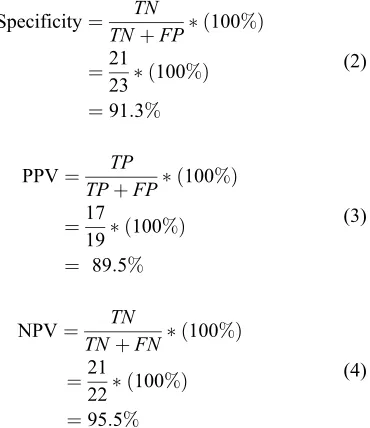
Using the information on the confusion matrix labeledTable 2, the second level sensitivity, specificity; PPV and NPV of the model were calculated thus:
Sensitivity¼ TP
TPþFNð100%Þ
¼17
18ð100%Þ
¼94:4%
(1)
Specificity¼ TN
TNþFPð100%Þ
¼21
23ð100%Þ
¼91:3%
(2)
PPV¼ TP
TPþFPð100%Þ
¼17
19ð100%Þ
¼ 89:5%
(3)
NPV¼ TN
TNþFN ð100%Þ
¼21
22ð100%Þ
¼95:5%
(4)
From the performance metrics, the probability that the sys-tem would detect a malignancy among patients that have cancer is 0.944, that is, sensitivity =94.4%; the probability that the system would classify a patient’s mammogram image as benign among patients that do not have cancer is 0.913 (specificity =91.3%). Also, the probability that a mam-mogram would be actually malignant when it is classified to be cancerous by the system is 0.895 (PPV =89.5%) and the probability that the mammogram would be benign when the system says it is not malignant is 0.955, that is, NPV =95.5%.
Conclusion
The significant variability that occurs when interpreting the same mammogram independently by different radiologists
Table 3Results from proposed technique and existing works
S/N Authors Classification category Sensitivity (%) Specificity (%) Accuracy (%)
1. Lothe et al19 NA 92.30 62.50 86.84
2. Domínguez and Nandi20 BM 55 85 PPV 0.71
NPV 0.75
3. Rejani and Selvi21 NA 88.75 – –
4. Moayedi22 NA 95.8 99.0 96.60%
5. Dheeba and Tamil23 NA – – 86.1%
6. Kavitha and Thyagharajan24 BM 100 96 98.00
7. Zhang et al25 BM 94.85% 78.20 –
8. Kamra et al26 BM 71.43 97.22 93.02
9. Rouhie et al27 BM 85.41 91.89 88.65
10. Damasceno et al28 BM 99.41 99.84 99.73
11. Kaur et al29 NA – – 96.90
Proposed method NA (BM) (100) 94.4 (100) 91.3 (100) 92.68
Abbreviations:NA, MIAS classification into normal and abnormal mammograms; BM, MIAS classification into benign and malignant Mammograms; MIAS, Mammographic Image Analysis Society; NPV, negative predictive value; PPV, positive predictive value.
Table 2The system’s confusion matrix
Expert’s classification System classification Total
Benign Malignant
Benign TN=21 FP=2 23
Malignant FN=1 TP=17 18
Total 22 19
Abbreviations:TN = True Negative; FN = False Negative; FP = False Positive and TP = True Positive.
Medical Devices: Evidence and Research downloaded from https://www.dovepress.com/ by 118.70.13.36 on 24-Aug-2020
leads to diagnostic errors. It is therefore imperative tofind an improved method to aid the detection and classification of ROI on mammograms. This article has discussed an automated mammogram classification system that uses a modified SVM classification technique. Performance evaluation results obtained suggested that the system could be used as radiolo-gists’potential tool for supporting decision making in mam-mogram interpretation. This could in turn help Radiologists to make an accurate and timely decision, thereby increasing the efficiency of their diagnostic skills.
Data availability
Raw mammograms used in this work are publicly avail-able at mini-MIAS:http://peipa.essex.ac.uk/pix/mias/.
Acknowledgments
The authors’ appreciation goes to Landmark University Centre for Research and Development, Landmark University, Omu-Aran, Nigeria for fully sponsoring the publication of this research. Also, we acknowledge all authors whose works are referenced in this paper.
Disclosure
The authors report no conflicts of interest in this work.
References
1. Erhabor O, Abdulrahaman Y, Retsky M, et al. Breast Cancer in
Nigeria: Diagnosis, Management and Challenges. UK:
AuthorHouse;2016.
2. Said MA, Henry AS, Ewunonu EO, et al. Breast cancer mortality in a resource-poor country: a 10-year experience in a tertiary institution. Sahel Med J.2017;20:77–93.
3. Charate AP, Jamge SB. The preprocessing methods of mammogram images for breast cancer detection.IJRITCC.2017;5(1):261–264. 4. Andreea GI, Pegza R, Lascu L, et al. The role of imaging techniques in
diagnosis of breast cancer.Curr Health Sci J.2011;37(2):241–248. 5. Duijm LE, Louwman MW, Groenewoud JH, et al. Inter-observer
variability in mammography screening and effect of type and number of readers on screening outcome.Br J Cancer.2009;100(6):901–907. 6. Elmore JG, Miglioretti DL, Reisch LM, et al. Screening mammograms by community radiologists: variability in false-positive rates.J Natl
Cancer Inst.2002;94(18):1373–1380.
7. Azar AT. Statistical analysis for radiologists’interpretations variability in mammograms.Int J Syst Biol Biomed Technol.2014;1(4):28–46. doi:10.4018/ijsbbt.2012100103
8. Dougherty G. Image analysis in medical imaging: recent advances in selected examples.Biomed Imaging Interv J.2010;6(3):1–10. 9. Suckling J, Parker J, Dance DR, et al. The mammographic image
analysis society digital mammogram database. In: Gale AG, Astley SM, Dance DR, Cairns AY (editors). Proceedings of the 2nd
International Workshop on Digital Mammography. Amsterdam:
Excerpta Medica;1994.
10. Luqman MM, Nor AMI. Preprocessing technique for mammographic images.Int J Comput Sci Inf Technol Res.2014;2(4):226–231. 11. Kayode AA, Odeniyi OA, Efunboade AO. Enhancement and
seg-mentation of mammograms for further analysis. IJCSIS. 2017;15 (6):417–424.
12. Vasantha M, Bharathi VS, Dhamodharan R. Medical image feature extraction, selection and classification.Int J Eng Sci Technol.2010;2 (6):2071–2076.
13. Haralick RM, Shanmugam K, Dinstein I. Textural features for image classification.IEEE Trans Syst Man Cybern.1973;SMC-3(6):610–621. 14. Soh LK, Tsatsoulis C. Texture analysis of SAR sea ice imagery using
gray level co-occurrence matrices.IEEE Trans Geosci Remote Sens. 1999;37(2):780–795.
15. Khuzi AM, Besar R, Zaki WM, et al. Identification of masses in digital mammogram using gray level co-occurrence matrices.Biomed Imaging Interv J.2009;5(3):1–13.
16. Nithya R, Santhi B. Classification of normal and abnormal patterns in digital mammograms for the diagnosis of breast cancer.Int J Comput Appl.2011;28(6):21–26.
17. Maitra IK, Nag S, Bandyopadhyay SB. Identification of abnormal masses in digital mammography images.Int J Comput Graphics. 2011;2(1):17–30.
18. Pradeep N, Girisha H, Sreepathi B, et al. Feature extraction of mammograms.Int J Bioinformatics Res.2012;4(1):241–244. 19. Savita L., Rupali T, Almas S, Prapti DD.Detection and classification
of breast mass using support vector machine.IOSR J Comput Eng. 2011;1–6.
20. Domínguez AR, Nandi AK. Toward breast cancer diagnosis based on automated segmentation of masses in mammograms. Pattern
Recognit.2009;42:1138–1148. doi:10.1016/j.patcog.2008.08.006
21. Rejani YIA, Selvi ST. Early detection of breast cancer using SVM classifier technique.Int J Comput Sci Eng.2009;1(3):127–130. 22. Moayedi F, Azimifar Z, Boostani R, Katebi S. Contourlet-based
mammography mass classification using the SVM family.Comput Biol Med. 2010;40(4):373–383. doi:10.1016/j.compbiomed. 2009.12.006
23. Dheeba J, Tamil S. Classification of malignant and benign microcal-cification using SVM classifier. 2011 International Conference on
Emerging Trends in Electrical and Computer Technology.
2011:686–690.
24. Kavitha S, Thyagharajan KK.Features Based Mammogram Image
Classification Using Weighted Feature Support Vector Machine.
International Conference on Computing and Communication
Systems. Berlin (Heidelberg): Springer;2011:320–329.
25. Zhang E, Wang F, Li Y, Bai X. Automatic detection of microcalcifi -cations using mathematical morphology and a support vector machine. Biomed Mater Eng. 2014;24(1):53–59.2. doi:10.3233/ BME-130783
26. Kamra A, Jain VK, Singh S, Mittal S. Characterization of architec-tural distortion in mammograms based on texture analysis using support vector machine classifier with clinical evaluation. J Digit Imaging.2016;29(1):104–114.
27. Rouhi R, Jafari M, Kasaei S, Keshavarzian P. Benign and malignant breast tumors classification based on region growing and CNN seg-mentation. Expert Syst Appl. 2015;42(3):990–1002. doi:10.1016/j. eswa.2014.09.020.
28. Damasceno E, Oseas A, Filho DC, et al. Method of differentiation of benign and malignant masses in digital mammograms using texture analysis based on phylogenetic diversity. Comput Electr Eng. 2018:210–222. doi:10.1016/j.compeleceng.2018.03.038
29. Kaur P, Singh G, Kaur P. Intellectual detection and validation of automated mammogram breast cancer images by multi-class SVM using deep learning classification. Inf Med Unlocked. 2019;1–19. doi:10.1016/j.imu.2019.01.001
Medical Devices: Evidence and Research downloaded from https://www.dovepress.com/ by 118.70.13.36 on 24-Aug-2020
Medical Devices: Evidence and Research
Dove
press
Publish your work in this journal
Medical Devices: Evidence and Research is an international, peer-reviewed, open access journal that focuses on the evidence, technol-ogy, research, and expert opinion supporting the use and application of medical devices in the diagnosis, monitoring, treatment and management of clinical conditions and physiological processes. The identification of novel devices and optimal use of existing devices
which will lead to improved clinical outcomes and more effective patient management and safety is a key feature of the journal. The manuscript management system is completely online and includes a very quick and fair peer-review system. Visit http:// www.dovepress.com/testimonials.php to read real quotes from pub-lished authors.
Medical Devices: Evidence and Research downloaded from https://www.dovepress.com/ by 118.70.13.36 on 24-Aug-2020