University of Windsor University of Windsor
Scholarship at UWindsor
Scholarship at UWindsor
Electronic Theses and Dissertations Theses, Dissertations, and Major Papers
2015
Performance Evaluation of a Reverse Logistics Enterprise - An
Performance Evaluation of a Reverse Logistics Enterprise - An
Agent-Based Modelling Approach
Agent-Based Modelling Approach
Gowtham Pandia Rajan Ravi Sankara Pandian University of Windsor
Follow this and additional works at: https://scholar.uwindsor.ca/etd
Recommended Citation Recommended Citation
Ravi Sankara Pandian, Gowtham Pandia Rajan, "Performance Evaluation of a Reverse Logistics Enterprise - An Agent-Based Modelling Approach" (2015). Electronic Theses and Dissertations. 5276.
https://scholar.uwindsor.ca/etd/5276
This online database contains the full-text of PhD dissertations and Masters’ theses of University of Windsor students from 1954 forward. These documents are made available for personal study and research purposes only, in accordance with the Canadian Copyright Act and the Creative Commons license—CC BY-NC-ND (Attribution, Non-Commercial, No Derivative Works). Under this license, works must always be attributed to the copyright holder (original author), cannot be used for any commercial purposes, and may not be altered. Any other use would require the permission of the copyright holder. Students may inquire about withdrawing their dissertation and/or thesis from this database. For additional inquiries, please contact the repository administrator via email
Performance Evaluation of a Reverse Logistics Enterprise – An Agent-Based Modelling Approach
By
Gowtham Pandia Rajan Ravi Sankara Pandian
A Thesis
Submitted to the Faculty of Graduate Studies
through the Department of Industrial and Manufacturing Systems Engineering in Partial Fulfillment of the Requirements for
the Degree of Master of Applied Science at the University of Windsor
Windsor, Ontario, Canada
2014
Performance Evaluation of a Reverse Logistics Enterprise – An Agent-Based Modelling Approach
by
Gowtham Pandia Rajan Ravi Sankara Pandian
APPROVED BY:
______________________________________________ N. Kar
Department of Electrical and Computer Engineering
______________________________________________ R. Caron
Department of Mathematics and Statistics, Cross appointed to IMSE
______________________________________________ A. Ali (Special Member)
Lawrence Technological University, USA
______________________________________________ W. Abdul-Kader, Advisor
Department of Mechanical, Automotive and Materials Engineering
iii
DECLARATION OF CO-AUTHORSHIP/ PREVIOUS PUBLICATION
This thesis includes one original paper that has been previously published in peer
reviewed conference proceedings, as follows:
Thesis Chapter Publication title/full citation Publication status
Chapter 6 Ravi Sankara Pandian, G. and Abdul-Kader,
W. (2014). “Performance Evaluation of a
Reverse Logistics Enterprise – An Agent-Based
Modeling Approach,” Proceedings of the 2014
ISERC Conference, Montreal, Canada, May
31- June 3.
Published and
Presented
…
I certify that I have obtained a written permission from the copyright owner(s) to
include the above published material(s) in my thesis. I certify that the above material
describes work completed during my registration as graduate student at the University of
Windsor.
I declare that, to the best of my knowledge, my thesis does not infringe upon
anyone’s copyright nor violate any proprietary rights and that any ideas, techniques,
quotations, or any other material from the work of other people included in my thesis,
published or otherwise, are fully acknowledged in accordance with the standard
referencing practices. Furthermore, to the extent that I have included copyrighted
material that surpasses the bounds of fair dealing within the meaning of the Canada
Copyright Act, I certify that I have obtained a written permission from the copyright
owner(s) to include such material(s) in my thesis.
I declare that this is a true copy of my thesis, including any final revisions, as
approved by my thesis committee and the Graduate Studies office, and that this thesis has
iv ABSTRACT
Reverse Logistics (RL) has been applied in many industries and sectors ever since its
conception. Unlike Forward Logistics retracing consumer goods from the point of
consumption to the point of inception is not a well-studied process. It involves many
uncertainties such as time, quality and quantity of return. It is important to address these
uncertainties to meet the economic, ecological and social challenges. The returned
products can be remanufactured, can have parts harvested, or can be disposed safely. It is
important to implement these activities in a cost-effective manner. The aim of this
research is to measure the performance of the RL enterprise with the help of an
Agent-based Modeling technique. The major entities in the RL network are considered as
Agents that can act independently. There are several different agents: Collector Agent,
Sorting-Cum-Reuse Agent, Remanufacturing Agent, Recycler Agent, Supplier Agent,
and Distributor Agent. The individual performances of each agent are measured and
recommendations are given to improve their performance, leading to the enhancement of
the total performance of the RL enterprise. The solution approach is applied to a case
v
DEDICATION
Dedicated to my late Grandmother, Jothi, who always taught me to be brave at heart and
vi
ACKNOWLEDGEMENTS
First and foremost, I am grateful to God Almighty for his blessings and for providing me
with this opportunity to do my Master of Applied Science in Industrial Engineering at the
University of Windsor.
I am thankful to my supervisor, Dr. Walid Abdul-Kader, who taught me beyond limits
and steered my Thesis in the right direction very carefully. I have been blessed to have
him as my supervisor, who spent so much time and involvement in my work. His care
and knowledge has molded me as a better person today. I would like thank and appreciate
my committee members, Dr. R. Caron, Dr. N. Kar and Dr. A. Ali for their time and
valuable comments that have helped shape this research a stronger one. My thanks to Dr.
R. Lashkari as well who chaired my defense.
I am thankful to many people along the way: Professor A. Hurwitz at the English
department for proofreading my Thesis, N. Yorke, who helped me in the initial stage to
understand the real world scenario of remanufacturing and recycling process, Stan, who
also played an equal part in guiding me with the practical world remanufacturing process,
K. Ball from the Leddy library for giving me a kick-start in my data collection and paper
search process, Angie Penev at the grad studies for helping me to format my Thesis.
I am extremely thankful to all my Professors who taught and guided me along my
Masters journey: Dr. Z. Pasek, Dr. M. Baki, Dr. J. Urbanic, and Dr. J. Stagner. I am also
vii
D. McKenzie from IMSE. I would like to extend my thanks to all the staff and faculty
members and professors at IMSE and grad studies.
Thanks to my lab mates, Morteza, Farshad, Victor and Mohammed. They truly were
patient with my questions and always found a way to help me. Special thanks to Mostafa,
who always supported me and was there with me in my research problems. Thanks to
AnyLogic support team for answering my questions related to the software. Many thanks
to Victoria for guiding me in my research process and also with questions related to my
Masters. Thanks to my never ending list of friends and family members.
Finally and most importantly, thanks to my lovely parents, Ma and Pa, who showed me
the path towards success and helped me achieve my goals in life, who gave me the
freedom to practise what I liked the most and was there with me at all times of happiness
and struggles. All grace and credit to my parents for helping me complete my Master of
Applied Science degree and my Thesis, Thank you Ma and Pa. Thanks to my sweet
sister, Deeptha, who was always there beside me, helped me to get up each time I fell
viii
TABLE OF CONTENTS
DECLARATION OF CO-AUTHORSHIP/ PREVIOUS PUBLICATION ... iii
ABSTRACT ... iv
DEDICATION ...v
ACKNOWLEDGEMENTS ... vi
LIST OF TABLES ... xii
LIST OF FIGURES ... xiii
LIST OF APPENDICES ... xiv
LIST OF ABBREVIATIONS/ ACRONYMS/ INITIALISMS ...xv
CHAPTER 1 INTRODUCTION ...1
1.1 Research Preface: ...1
1.2 Research Objective: ...5
1.3 Research Scope: ...6
1.4 Research Approach: ...8
1.5 Research Organisation: ...11
CHAPTER 2 RESEARCH BACKGROUND ...12
2.1 Reverse Logistics: ...12
2.2 Recovery Options: ...16
2.2.1 Reuse: ...19
2.2.2 Repair: ...19
2.2.3 Reconditioning: ...19
2.2.4 Remanufacture: ...20
2.2.5 Recycling: ...28
2.2.6 Parts Harvesting ...29
CHAPTER 3 LITERATURE REVIEW ...32
3.1 Literature Review on Reverse Logistics: ...32
ix
3.2.1 Definition: ...34
3.2.2 Methods: ...34
3.2.3 Frameworks: ...35
3.2.4 Problems: ...36
3.2.5 Decisions in RL: ...37
3.2.6 Uncertainties in RL:...38
3.2.7 Need for computer based program: ...38
3.2.8 Importance of communication in RL: ...39
3.2.9 Environment measurement importance: ...39
3.3 Literature Review on Agent-based modelling and Reverse Logistic: ...47
3.4 Literature Review on Remanufacturing: ...50
3.5 Literature Review on Cell Phone Remanufacturing: ...51
3.6 Gap in Literature: ...52
CHAPTER 4 PROBLEM STATEMENT ...53
4.1 Research Importance:...53
4.2 Research Contribution: ...54
CHAPTER 5 METHODOLOGY ...56
5.1 Agent-based modelling approach: ...56
5.1.1 Agents: ...56
5.1.2 Properties of Agents: ...58
5.1.3 Building an agent-based model: ...60
5.1.4 Examples: ...61
5.2 Reverse Logistics Process Flow: ...62
5.3 Agent-based decision making process: ...65
5.3.1 Collector Agent (CA): ...66
5.3.2 Sorting-Cum-Reuse Agent (SCRA): ...69
5.3.3 Remanufacturing Agent (RMA): ...72
x
5.3.5 Supplier Agent (SA): ...76
5.3.6 Distributor Agent (DA): ...77
5.4 List of performance measures: ...81
CHAPTER 6 CASE STUDY: CELL PHONE REMANUFACTURING ...82
6.1 Introduction: ...82
6.1.1 Cell Phone: ...82
6.1.2 Cell Phone Structure: ...83
6.2 Cell Phone Remanufacturing: ...84
6.3 Cell Phone RL Process Flow: ...84
6.3.1 Collector: ...86
6.3.2 IR/ Remanufacturer: ...89
6.3.3 Remanufactured products distributor: ...94
6.3.4 Cost and Price calculations: ...95
6.4 Cell phone decision making process: ...96
6.4.1 Collector Agent (CA): ...97
6.4.2 Sorting-Cum-Reuse Agent (SCRA): ...99
6.4.3 Remanufacturing Agent (RMA): ...101
6.4.4 Recycler Agent (RCA): ...101
6.4.5 Supplier Agent (SA): ...104
6.4.6 Distributor Agent (DA): ...104
6.5 Experiments: ...106
6.5.1 Simulation:...106
6.5.2 Experiment Analysis: ...116
CHAPTER 7 INTERCONNECTED DATABASE SYSTEM. ...123
7.1 Introduction: ...123
7.2 Working: ...124
xi
8.1 Conclusion: ...127
8.2 Future Work: ...130
REFERENCES ...132
APPENDICES ...137
Appendix A: Pre-paid Postal Envelope Label ...137
Appendix B: Cell Phone Buyback Price by Collectors ...138
Appendix C: Warm-up Period Calculation ...145
Appendix D: Number of Replications ...147
Appendix E: Copyright Permissions ...149
xii
LIST OF TABLES
Table 1: Summary of research approach ... 9
Table 2: Remanufactured products along with their industry sector ... 21
Table 3: Equivalent remanufacturing terms ... 26
Table 4: Comparison between Refurbishing and Remanufacturing ... 27
Table 5: The difference between remanufacture, repair, and recycle operations ... 29
Table 6: Summary of performance measurements and RL literature review ... 42
Table 7: Summary of agent-based modelling technique and RL literature ... 49
Table 8: Summary of research contribution ... 55
Table 9: Summary of agent-based decision making model ... 80
Table 10: List of performance measures ... 81
Table 11: Classification of cell phones by the sorter ... 90
Table 12: Resale price of individual parts of a cell phone ... 92
Table 13: Process time for cell phone remanufacturing operations ... 93
Table 14: Process time for the cell phone recycling operations ... 94
Table 15: Cell phone material composition with their weight and value ... 94
Table 16: Summary of cost and price of a remanufactured cell phone ... 96
Table 17: Summary of input parameters used in the simulation model ... 106
Table 18: Simulation results ... 108
Table 19: Metal content and value in a single cell phone ... 112
Table 20: Summary of recommendations for each agent ... 113
Table 21: Order quantity analysis experiment set up ... 116
Table 22: Summary of order quantity analysis experiment results... 117
Table 23: Summary of scenario analysis experiment setup ... 120
Table 24: Summary of Scenario Analysis Experiment Results ... 121
Table 25: Summary of Scenario Analysis Experiment: ... 122
Table 26: Summary of IDS actions and its remedies ... 126
Table 27: Summary of research outcomes ... 128
Table 28: Sample buyback price for retired cell phones ... 138
xiii
LIST OF FIGURES
Figure 1: Scope of research ... 7
Figure 2: Research Approach... 10
Figure 3: Process flow of a product in a FL, RL and CLSC ... 15
Figure 4: Dimensions of RL ... 17
Figure 5: Six recovery options ... 18
Figure 6: Remanufacturing Process Flow ... 22
Figure 7: Number of journal articles published on reverse logistics ... 33
Figure 8: Agent-based model ... 57
Figure 9: Few examples of agents: a factory, butterfly, car, tire and a person. ... 61
Figure 10: Generic RL process flow ... 63
Figure 11: Conceptual agent-based model of a RL system ... 66
Figure 12: Collector Agent ... 67
Figure 13: Sorting-Cum-Reuse Agent ... 70
Figure 14: Remanufacturing Agent ... 74
Figure 15: Recycler Agent ... 76
Figure 16: Supplier Agent ... 77
Figure 17: Distributor Agent ... 79
Figure 18: Structure of a cell phone with its parts ... 83
Figure 19: Cell phone RL process flow ... 85
Figure 20: CA decision making process for cell phone ... 98
Figure 21: SCRA decision making for a cell phone ... 100
Figure 22: RMA decision making process for a cell phone ... 102
Figure 23: RCA decision making process for a cell phone ... 103
Figure 24: SA decision making process for a cell phone ... 104
Figure 25: DA decision making process for a cell phone ... 105
Figure 26: Order quantity analysis results ... 118
Figure 27: Conceptual representation of IDS ... 123
Figure 28: Sample representation of an IDS input menu ... 124
Figure 29: Remanufacturing rate ... 131
Figure 30: Sample prepaid postal envelope ... 137
xiv
LIST OF APPENDICES
Appendix A: Pre-paid Postal Envelope Label ...137
Appendix B: Cell Phone Buyback Price by Collectors ...138
Appendix C: Warm-up Period Calculation ...145
Appendix D: Number of Replications ...147
xv
LIST OF ABBREVIATIONS/ ACRONYMS/ INITIALISMS
5R1P (Recovery operations) – Reuse, Remanufacture/ Refurbish, Repair, Recondition,
Recycle, and Parts Harvest
AHP- Analytical Hierarchy Process
ANP- Analytical Network Process
APRA- Automotive Parts Remanufacturers Association
BSC- Balance Score Card
CA- Collector Agent
CWTA – Canadian Wireless Telecommunication Association
DA- Distributor Agent
DEMATEL- Decision-Making Trial and Evaluation Laboratory
EES – Ecology, Economy and Social
GPS- Global Positioning System
IR- Independent Recyclers
IDS- Interconnected Database System
xvi LPP- Linear Physical Programming
OEM- Original Equipment Manufacturer
OES- Ontario Electronics Stewardship
PET - Polyethylene terephthalate
PDA- Personal Digital Assistant
QFD- Quality Function Deployment
RCA- Recycling Agent
RI- Remanufactured Inventory
RMA- Remanufacturing Agent
RMC – Recycle My Cell,
SA- Supplier Agent
SCRA- Sorting-Cum-Reuse Agent
SMS- Short Message Service
USEPA- The United States Environment Protection Agency
WDA- Waste Diversion Ontario
WEEE- Waste Electrical and Electronic Equipment Directive
1 CHAPTER 1
INTRODUCTION
1.1 Research Preface:
The evolution of electronic products has been constantly transforming people’s lives.
Over the years, systems have become less cumbersome and processes have become much
more simple and effective. From the first communication device, the papyrus, to the latest
cell phone, technology and electronic products have played an important role in
revolutionizing people’s way of living. In the year 2012, the computer and electronics
manufacturing sector contributed nearly $6.8 billion to Canada’s GDP (Government of
Canada, 2013). The revenue generated from home electronics, computer and camera sales
in the same year was nearly $6.8 billion in Canada (Government of Canada, 2014). The
numbers show the significance of computer and electronic products.
Electronic products are being used extensively as integral devices in day-to-day life.
They are looked after carefully when in use, they should receive the same care once they
become obsolete. Old electronic products can be reused or recycled instead of being
disposed of in landfills. There are interesting recovery options: resale, remanufacturing or
refurbishing, repair, reconditioning, parts harvesting and recycling (Kara et al., 2007). In
addition, a used electronic product consists of precious minerals and parts that can be
reused in new parts or products manufacturing. According to the Automotive Parts
Remanufacturers Association (APRA), all the recovered materials around the globe can
fill up to 155,000 railroad cars annually (Rogers and Tibben-Lembke, 1999). The various
recovery options have noteworthy benefits for nature as well. First, a used product can be
kept away from a landfill and, second, the materials from a used product can be reused,
and valuable virgin materials (fresh raw materials) can be preserved for the future
generations. Therefore, a used product can generate profit from various recovery options
2
The process of handling, managing and moving a used product from the customer to a
recovery stage is a challenge. Reverse Logistics (RL) studies the movement of products
from the point of consumption to the point of origin. RL focuses on planning, controlling
and implementing an efficient and cost-effective process to recapture the residual value
from a used product or dispose of a used product safely without affecting the
environment. Concisely put, Forward Logistics (FL) focuses on the movement of goods
from a point of origin to a point of consumption, whereas RL focuses on the movement
of used goods from a point of consumption to a point of origin with the purpose to reuse
or recycle the used goods (Rogers and Tibben-Lembke, 1999).
Normally, in an RL system, there are many departments or sub-systems that work
together to control the outcome of the company or system. Some of the major
departments or sub-systems commonly present in an RL system are the collectors,
sorters, remanufacturers or refurbishers, recyclers, suppliers, and distributors. Used
products flow through each one of these departments, undergo the required operation and
are either sold back in the market by the process of remanufacturing or reduced to their
material level by the process of recycling.
There are three major reasons for a remanufacturer or manufacturer to collect used
electronic products for reuse or recycle: (i) the product take-back laws imposed by
governmental or environmental organizations like Waste Electrical and Electronic
Equipment (WEEE) directive on the Original Equipment Manufacturers (OEM), so they
take responsibility to collect used products and keep the environment clean; (ii) the profit
that can be generated by reusing or recovering material; and (iii) the importance of falling
under the banner of an environmentally conscious company (Rajagopalan and
Yellepeddi, 2007; Xiong and Li, 2010; Zhang et al., 2013). These motives encompass the
necessity for a company to include RL activities in its profile to seize the ecological,
economic and social advantage from reusing or recycling a used product. The three
advantages, ecological, economical and social will be termed as “EES” throughout this
3
The other grounds to return a product are these: (i) 14-day return policy; (ii) defective
part or product; (iii) warranty requirements; (iv) shipment of the wrong item; and (v)
product recalls (Meade and Sarkis, 2002; Xiong and Li, 2010). In Canada and the U.S.,
remanufacturing industries are active in 125 different product categories at least (Lund,
2012). The most common devices returned are these: laptops, computers, cell phones,
toner cartridges, televisions, network devices, and single-use cameras.
Electronic goods are present in almost every North American household in the 21st
century, with the cell phone becoming one of the most revolutionary, and new models
coming at a more frequent pace than they were a few years ago. The total number of cell
phone subscribers in Canada is 27.6 million (CWTA, 2013a), with a total population of
35.2 million as of December 2013 (S. C. Government of Canada, 2013). The number of
phones is estimated to be even more since some of the older phones are kept in storage
and are not currently in use. In Canada, the average life span of a cell phone in the year
2012 was 22 months, which decreased from 25 months in 2010 (CWTA, 2013b). As the
number of new model cell phones arriving in the market increases and as the life span of
cell phones is starting to decrease, the number of cell phones becoming obsolete every
day increases. In the year 2013, Recycle My Cell (RMC), with other recycling initiatives,
recovered 1,067,266 cell phones for either remanufacturing or recycling in Canada
(CWTA, 2014). It is important to collect these phones in an efficient manner, and
remanufacture for profit or recycle to keep the environment clean.
First challenge involved in the return process is to collect a retired electronic product as
quickly as possible, since it can become obsolete very soon because of a diminishing
market demand for the used product or out-of-date material or technology (Yellepeddi,
2007). In order to thwart a product from becoming obsolete, recyclers need to collect a
used product promptly and make sure it does not sit idly in storage after becoming old
(Rajagopalan and Yellepeddi, 2007). The second is to collect a product through the
correct channel and not let it slip away in a landfill (Olugu et al., 2011). It is vital that the
co-operation and communication between the customers, collectors, and recyclers
4
In addition, the returned products depend on a customer’s preferences. For example, a
customer may have a different time of return or different quality of return or different
quantity of return when compared to other customers. Unknown information about time,
quality and quantity of return can affect the remanufacturing process, since
remanufacturers may take varying time to remanufacture a product depending on the
level of damage (quality), number of returns (quantity) and the time of return. Therefore,
RL, unlike its counterpart, has been faced with many uncertainties over the last few years
(Yellepeddi, 2007). Many scholars and researchers have shared their views in remedying
the losses caused by these uncertainties. The problem has a high stack in the literature
since the outcome of not addressing the uncertainties is unimaginable in terms of cost and
time.
In order to surmount the challenges, the uncertainty problems, and the EES advantages
pertaining to RL, the RL group should understand how the system operates and performs.
A system needs to perform to its expectations (Yellepeddi, 2007) and have an efficient
process (Xiong and Li, 2010). To achieve the above requisites RL managers must
measure the performance of the system.
This research is aimed at measuring the performance of an RL enterprise. The method
used to measure the performance is called an agent-based modeling technique. Generally,
remanufacturing or refurbishing an electronic product involves six entities: collector,
sorter, refurbisher, recycler, supplier and distributor. Each of these is considered a
separate agent with a unique behavior and objective. The performance of each agent is
measured, and recommendations for improvement are provided for each of them. This
leads to the total performance improvement of the RL system. The measurement of
performance of each individual agent also provides recommendations to mitigate the
problems regarding uncertainty, to overcome the common challenges, and to help to
achieve the EES advantages.
The main reason to consider the agent-based modelling technique over other modelling
5
unique behaviour and objective. This would help companies to take actions and make
decisions on their own, work together with the other companies, and contribute to the
goals of the total RL system successfully. The second major reason is the possibility to
measure the performance of each company separately and the total system performance at
one time collectively. Other techniques would be able to measure the performance of the
entire system or each company’s performance. With the advantage of the agent-based
modelling technique, the shortcomings of each individual company can be easily
identified and improved. By improving the performance of each individual company, the
total RL system ultimately could be improved.
1.2 Research Objective:
The objectives of this thesis are to measure successfully the performance of a reverse
logistics enterprise using the agent-based modelling technique at an operational level, to
develop a generic agent-based decision-making model for the electronics
remanufacturing industry, to provide recommendations to pacify the problems related to
uncertainty, to overcome the common challenges, and to achieve the EES advantages in
RL.
The objectives will be achieved by:
1. developing a generic:
(i) decision-making model that includes the actions, decisions and objectives of each
agent in an RL system, and
(ii)RL process flow for electronic products;
2. measuring the performance of an RL enterprise using the agent-based modeling
technique, and providing recommendations for each agent to improve its
performance, ultimately leading to the improvement of the total RL performance;
3. using cell phone remanufacturing industry as an example;
4. using agent-based simulation model;
6
(i) to solve the three problems related to uncertainty:
a. Quality of return,
b. Quantity of return and
c. Time of return,
(ii)to overcome the common challenges in RL, and
(iii) to achieve the ecological, economical and social advantages in RL.
The research will also help to:
1. achieve a cost-effective RL process;
2. measure the profit generated from
(i) remanufacturing or refurbishing an electronic product,
(ii) parts harvesting and
(iii)material recovery;
3. show the environmental benefits of remanufacturing or refurbishing an electronic
product with focus on
(i) pollution controlled,
(ii) energy saved,
(iii)virgin material saved, and
(iv) tons/number of used products saved and kept away from landfill.
1.3 Research Scope:
Logistics and Supply Chain Management (SCM) is a huge umbrella; there are many
fields enclosed in it. First, logistics can be divided into Forward Logistics (FL) and
Reverse Logistics (RL). Similarly, SCM encompasses Forward Supply Chain (FSC),
Reverse Supply Chain (RSC), and Closed-Loop Supply Chain (CLSC). In this research,
concepts and literature from RSC and CLSC are included to support RL, but the main
In general, decision making process takes place at three levels of management: strategic,
tactical and operational. The performance of a system can be measured at all the three
levels. In this research, the
level of management. Tactical and strategic level performance measures are not covered.
The prime reason is the necessity to find solutions to the three uncertainties in reverse
logistics. By focusing and measuring the performance at
recommendations for improvement
provided more concisely since the time,
easily at the operational le
A product can have several recovery options, among them: reuse, remanufactur
refurbishing, repair, refill
considered in this research. The focus
Input data from published articles
on Canada. The datum in the model is within the years ranging from 2000 to 2013.
Canada, there may be several companies practisi
simulation model, the performance is measured Logistics
Forward Logisitics
7
Figure 1: Scope of research
In general, decision making process takes place at three levels of management: strategic,
tactical and operational. The performance of a system can be measured at all the three
levels. In this research, the performance measurement will be focused at
level of management. Tactical and strategic level performance measures are not covered.
The prime reason is the necessity to find solutions to the three uncertainties in reverse
g and measuring the performance at the operational level,
improvement and ways to address the three uncertainties can be
d more concisely since the time, quantity and quality can be reasonably studied
at the operational level.
A product can have several recovery options, among them: reuse, remanufactur
, repair, refilling, reconditioning, part harvesting and recycl
considered in this research. The focus of this research is mainly on the Canadian market.
published articles are used, and the output results are studied
The datum in the model is within the years ranging from 2000 to 2013.
be several companies practising remanufacturing, but in the
simulation model, the performance is measured only for one company. Logistics and SCM Logistics Reverse Logistics SCM FSC RSC
In general, decision making process takes place at three levels of management: strategic,
tactical and operational. The performance of a system can be measured at all the three
be focused at the operational
level of management. Tactical and strategic level performance measures are not covered.
The prime reason is the necessity to find solutions to the three uncertainties in reverse
operational level,
and ways to address the three uncertainties can be
reasonably studied
A product can have several recovery options, among them: reuse, remanufacturing or
and recycling are only
is mainly on the Canadian market.
studied with focus
The datum in the model is within the years ranging from 2000 to 2013. In
ng remanufacturing, but in the
8
parameter, the total number of products returned in a year is for the entire nation but the
results are based on only one company.
The industry sector tackled in this research is the electronics remanufacturing industry.
First reason is, in consumer electronics sector of all the products sold, 4-5% of the
products are retuned (Rogers and Tibben-Lembke, 1999). Second, the revenue that can be
generated from remanufacturing or recycling electronic products is enormous. Third, the
after-effect of disposing electronic devices in a landfill is dangerous. And finally,
electronic products become obsolete very soon due to rapid growth in technology. It is
therefore imperative to give attention to the electronics industry, collect the products
effectively, remanufacture or recycle them and protect the planet earth from unnecessary
wastes.
1.4 Research Approach:
The approach adapted for this research is a general research approach. In the beginning,
the topic to work on is narrowed down to performance evaluation of a RL system at the
operational level. Then a deep review of the literature on the topic is done to familiarize
with the concepts, and to gain knowledge about previously published works. In the next
step, the research is set forth to identify a gap or problem in the field. By a detailed study,
the gap and problem in the literature are identified. Later, a method to solve the problem
is recognised. Agent-based modelling approach is chosen as the appropriate method. The
methodology is thoroughly studied to solve the problem at hand.
Interviews were then conducted with remanufacturing industry experts, to mould the
model to a real world situation. A simulation model is then created using the agent-based
modelling technique and with the help of the simulation software package ProModel 7.5.
In the next stage, the important performance measures are selected. The model is then
analysed and the output results are calculated. Based on the results, recommendations are
provided to improve the system. This research approach helps to fill the gap, achieve the
9
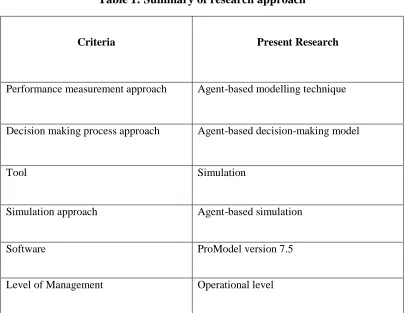
A brief summary of the approach, method and tool used for this research are provided in
Table 1. Also, the research steps are depicted in Figure 2.
Table 1: Summary of research approach
Criteria Present Research
Performance measurement approach Agent-based modelling technique
Decision making process approach Agent-based decision-making model
Tool Simulation
Simulation approach Agent-based simulation
Software ProModel version 7.5
Topic of research
• Performance evaluation of a reverse logistics enterpirse remanfacturing industry.
Literature review (LR)
• LR on RL, Remanufacturing, • LR on Performance measures and RL • LR on Agent-based modelling and RL, • LR on Cell phone remanufacturing.
Problem/Gap Identifiaction
• Performance evaluation of a RL enterprise using agent • Performacne evaluation of cell phone industry, • Problems related to uncertainity in RL.
Methodology
• Agent-based modelling approach.
Interviews
• To understand the real world scenario, and
• To design the process flow of electronic products in remanufacturing/refurbishing.
Model
• Generic agent-based decsion making model, • Generic process flow for electronic products,
Simulation
• Agent-based simulation • Software: ProModel 7.5.
Results
• Performance measures were calculated,
• Recommendations for improvement are provided,
• Recommendations to sovle the problem related to uncertainty are provided,
Contibutrion
• Gap/Problems in literature were addressed, • Research objectives were achieved successfully,
10
Figure 2: Research Approach
Performance evaluation of a reverse logistics enterpirse - an agent-based modelling approach for remanfacturing industry.
LR on RL, Remanufacturing, LR on Performance measures and RL
based modelling and RL, LR on Cell phone remanufacturing.
Performance evaluation of a RL enterprise using agent-based modelling approach, Performacne evaluation of cell phone industry,
Problems related to uncertainity in RL.
based modelling approach.
To understand the real world scenario, and
To design the process flow of electronic products in remanufacturing/refurbishing.
based decsion making model, Generic process flow for electronic products,
based simulation Software: ProModel 7.5.
Performance measures were calculated,
Recommendations for improvement are provided,
Recommendations to sovle the problem related to uncertainty are provided,
Gap/Problems in literature were addressed, Research objectives were achieved successfully,
based modelling approach for
based modelling approach,
11
1.5 Research Organisation:
The remainder of the thesis begins with the research background in chapter 2.
Background information about RL and the different recovery operations are provided.
Chapter 3 presents a review of the RL literature and previously published methods for
evaluating the performance of an RL enterprise. Chapter 4 provides the problem
statement of this research. Chapter 5 presents the research methodology and the method
used in this research along with the generic RL process flow and decision making
process. Chapter 6 outlines the case study on cell phone remanufacturing process with the
help of product structure, remanufacturing process, RL process flow, decision making
process, experiments and experiment analysis. Based on the case study results and
discussion an interconnected database system for RL system improvement is presented in
12 CHAPTER 2
RESEARCH BACKGROUND
This chapter will throw some light on Reverse Logistics and the practices that are
involved in RL. Background information pertaining to this research will be covered in
this section. The topics will include: RL and the different types of recovery options.
2.1 Reverse Logistics:
RL, as previously enlightened in the introductory section, is a field of logistics that
focuses on the movement of goods in the reverse direction. Rogers and Tibben-Lembke,
(1999) coined the definition of RL as, “the process of planning, implementing, and
controlling the efficient, cost effective flow of materials, in-process inventory, finished
goods and related information from the point of consumption to the point of origin for the
purpose of recapturing value or proper disposal”.
The starting period of RL is quite unclear, but the RL activities have been in practice ever
since the inception of the Industrial Revolution (circa 1760). Though the name of practice
was not widespread at the beginning, it gradually became an epoch-making activity. In
the starting stages, metallic parts were collected and melted to recover material from it
(Dyckhoff et al., 2004). Later, during the era of World War II, the concept of
remanufacturing had stepped in, countries at war had dedicated all their automobile
manufacturing floors to manufacture military equipments, this left the public with no
option but to remanufacture existing automobiles and reuse them (Ilgin and Gupta, 2012).
The field soon gained a firm grip during the 1980’s and 90’s, when strict environment
legislations came into place. These legislations enforced OEM to collect and dispose used
products safely without affecting the environment (Dyckhoff et al., 2004). It was the
verge of this stage when the RL became famous and renowned. Soon scholars began to
13
Logistics literature. RL has now become an integral part of study in engineering and
management that focuses on applying techniques and methods to achieve an effective and
cost-efficient RL process flow.
A typical RL process flow of a product would involve the activities of collection, sorting,
remanufacturing or refurbishing, recycling and distributing. A comprehensive process
flow diagram enveloping all components involved in the FSC or FL, the RSC or RL and
the CLSC, are depicted in Figure 3 below. The continuous lines denote the products flow
in the FL, the dotted lines depict the products flow in the RL, and a combination of
dashed & dotted lines along with continuous and dotted lines denote the products flow in
a CLSC.
In FL, at the first step, materials are extracted from the resources present in the earth’s
crust. The extracted materials are then processed and taken to part manufacturing stage.
From this stage, the manufactured parts move either to the product manufacturing stage
or sold in the spare parts market depending on the requirement. The parts that arrive at
the product manufacturing stage are assembled together to form the product. The product
once assembled moves to the product inventory stage and later to the distribution centre.
The products are then sold to the customers and the product begins its life in the
utilisation phase.
Once a product becomes old or is returned due to any of the major reasons as mentioned
in the introductory section, it is collected for either reprocessing or recycling. The
product is then sorted based on its quality and inspected for basic operating conditions.
Based on the quality, they are classified into good, moderate and bad categories. The
good products are sent to the reuse stage, and can be reused as it is or with minimal repair
operations. The product is labelled as a refurbished product and sent to the
remanufactured products inventory. The moderate products are disassembled for detailed
inspection and then remanufactured or parts harvested based on the condition (detail
explanation of the remanufacturing operation will be provided in the next section: 2.2
14
product and is forwarded to the remanufactured inventory stage. The remanufactured or
refurbished products from this stage are later sent to the distribution centres and sold to
the customers to begin its life again in the utilization phase.
Similarly the bad products (products that cannot be reused) are sent to the material
recovery stage. The recovered materials are sold to the raw material extractors or the
parts manufacturing companies. In the case of closing the supply chain, there are three
ways. The first way is at the disassembly stage in the RSC, where the partly disassembled
product can be sent to the final assembly stage in the FSC. The partly disassembled
product still undergoes the remanufacturing operations but in the FSC. They are then sold
as new or remanufactured product, this process can be found especially in the automobile
parts manufacturing sector. The second way of closing the loop is from the parts
harvesting stage in the RSC; the parts that are good and can be used in a new product
assembly with minimal cleaning operation are harvested and sent to the final assembly
stage of the FSC. The manufactures are not constrained to assemble the product with
these parts but at times of shortage or negligible quality difference between the new and
harvested part, the harvested parts can be handy.
The third way to close the chain is by sending the recovered material in the RSC to the
parts manufacturing stage in the FSC. Since the recovered material is almost same in
quality with a new material, recycled material can be combined with the new material to
manufacture a part. This saves a lot of energy that would otherwise be used for material
extraction and also saves virgin materials from being exploited. Thus, in these three ways
the supply chain can be closed, this is termed as closed loop supply chain. The three ways
1
5
Legend: Forward Supply Chain or Forward Logistics Reverse Supply Chain or Reverse Logistics + + Closed Loop Supply Chain
Spare parts Utilization Phase Spare parts
Final Product Retired Products
Distribution Collection
Sorting and Inspection Good
Moderate
Products Inventory Bad
Reuse
Final Assembly Partly disassembled product
Disassembly
Remanfuacturing
Parts/components Reclaimed cores Parts Harvesting
Parts Manufacturing Recycled material Material Recovery
Material
Extraction Remanufactured Inventory
Resources Distribution
Figure 3: Process flow of a product in a FL, RL and CLSC (Adapted from Lebreton, 2007).
R
em
an
u
fa
ct
u
re
d
P
ro
d
u
ct
16
RL is not quite an easy process, it involves 12 times more transactions than FL
(Rajagopalan and Yellepeddi, 2007). Across all industries, return percentages varies from
5-50% (Li and Olorunniwo, 2008). The cost of returns is also high, in the year 2001, the
cost for returns were 2 or 3 times more than the product value (Li and Olorunniwo,
2008). Having a challenging scenario with increased returns, high cost involved and
precious value in the returns, it is important to have an efficient and cost effective
process. RL takes the sole responsibility in setting up the platform for a successful
practice.
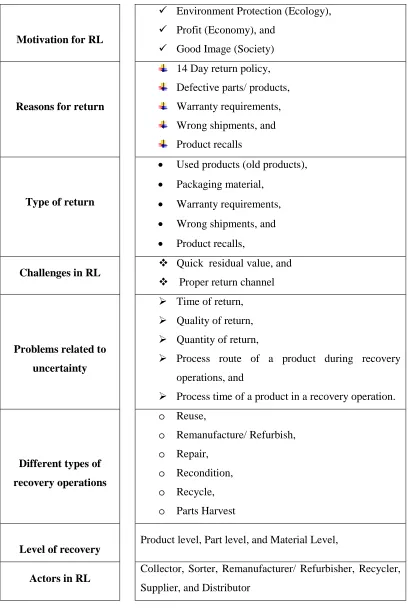
To summarize the important features of RL, a dimensional framework of RL adapted
from Dyckhoff et al., (2004) will be used as shown in Figure 4. The dimensions that will
be included are these: motivation for RL, reasons for returns, types of returns, challenges
in RL, problems related to uncertainty in RL, types of recovery options, level of recovery,
and actors in RL.
2.2 Recovery Options:
In general, a product is composed of several parts. If a product is returned due to any of
the aforesaid reasons in the introduction section (see page 3), the entire product cannot be
considered as obsolete; only according to the user, the product has elapsed its time period
or has become non-functional, but from the engineering perspective, the parts inside the
product and the material in it are not outmoded; they may be still alive functionally or
might have material value. Of all the returned products, 75% of them are not defective
(Li and Olorunniwo, 2008). The product can be diagnosed with simple repair operations
to bring it back to life. Even if basic diagnosis is not possible, the useful parts can be
salvaged and the product can be recycled to recover material from it. One step higher is
remanufacturing, that involves complete disassembly of the product, followed by
remanufacturing operations, and reassembly of the product. Thus a retired product can be
reused at part level, material level and product level. The recovery options and operations
17
Motivation for RL
Environment Protection (Ecology),
Profit (Economy), and
Good Image (Society)
Reasons for return
14 Day return policy,
Defective parts/ products,
Warranty requirements,
Wrong shipments, and
Product recalls
Type of return
• Used products (old products),
• Packaging material,
• Warranty requirements,
• Wrong shipments, and
• Product recalls,
Challenges in RL Quick residual value, and
Proper return channel
Problems related to uncertainty
Time of return,
Quality of return,
Quantity of return,
Process route of a product during recovery
operations, and
Process time of a product in a recovery operation.
Different types of recovery operations
o Reuse,
o Remanufacture/ Refurbish,
o Repair,
o Recondition,
o Recycle,
o Parts Harvest
Level of recovery Product level, Part level, and Material Level,
Actors in RL Collector, Sorter, Remanufacturer/ Refurbisher, Recycler,
Supplier, and Distributor
18
Returns have become inevitable, and common recovery options for a returned product are
these: remanufacture, repair, recycle, and reconditioning (repainting or surface polishing)
(Ilgin and Gupta, 2012). After going through many related literatures it was found that
the residual value from a retired product can be recovered in six different ways: reuse the
product as it is, repair the product, recondition the product, remanufacture the product,
recycle the product, and harvest parts from the product (Kara et al., 2007; Rajagopalan
and Yellepeddi, 2007). The operations that will be involved for the above six recovery
operations are these:
1. Reuse,
2. Repair,
3. Recondition,
4. Remanufacturing/ Refurbishing,
5. Recycle and
6. Parts Harvesting.
These six operations can be termed as 5R1P. The rudiments of these operations will be
explained in the following section. A retired product can be recovered in one of the six
ways as shown in Figure 5.
Retired Product Recovery Options R eu se R ep ai r R em an u fa ct u re / R ef u rb is h in g R ec o n d it io n R ec y cl e P ar ts H ar v es t
19
2.2.1 Reuse:
A returned product can be reused as it is, provided it is good and satisfies all working
conditions. The operations that might be involved for reuse are not many but pertain to
simple testing, cleaning and repacking. Products that usually come under 14 day return
policy undergo this process, other products that have been used exhaustively for few
years may undergo remanufacturing process. The products that undergo this process are
labelled as ‘refurbished products’ when sold in the market and the price tends to be lower
than the original new product.
2.2.2 Repair:
Repair operations are specific operations, if a product is returned due to a specific fault,
only that parts is repaired, the rest of the parts undergo minimal checking. Most of the
products that fall under this category are the ones that return during the warranty period
of the product. The customer may receive the same retuned product after repair or
sometimes a refurbished product may be compensated. These products may also undergo
remanufacturing operations in addition to repair based on the company’s policy.
2.2.3 Reconditioning:
Sometimes a repaired product may require additional work like painting or surface
polishing. At instances like this, the product undergoes reconditioning operations in
addition to repair operations. Reconditioning generally involves operations like
repainting and surface polishing (Ilgin and Gupta, 2012). The painting and surface
polishing operations may be only at the surface level. Products that undergo reuse
20
2.2.4 Remanufacture:
The most important recovery operation in terms of time and process among all the others
operations is the remanufacturing operation. Remanufacturing is the process of giving a
retired product a total new life in terms of functionality and appearance. Remanufacturing
is defined as “the process of restoring a non-functional, discarded, or traded-in product
to like-new condition” (Lund, 2012). The first prototype of a remanufacturing model
dates back to the year 1861 when a steam frigate was converted into an ironclad ship
(Ilgin and Gupta, 2012). A typical remanufacturing process involves complete
disassembly of a product to the part level, inspection of each part, cleaning the parts,
reassembling the product, and quality test of the reassembled product. A remanufactured
product is equal or superior in quality to a new product, this sets remanufacturing process
position far ahead of other recovery operations.
The feature of rejuvenating the product alone does not draw attention to remanufacturing
but there are other beneficial outcomes also by remanufacturing a product.
Remanufacturing old products helps to save energy, virgin materials, labour, waste, and
pollution, which leads to savings in cost from not producing a new product (Kerr and
Ryan, 2001). The potential of remanufacturing are increased profit, sales and reduction in
cost (Ilgin and Gupta, 2012).
In the U.S., over the years, remanufacturing industry has grown up to a $50 billion
industry (Gutowski et al., 2011). As of 2012, in Canada and the U.S., there are
approximately 7000 remanufacturing firms present. Remanufacturing firms are present in
every province in Canada and in every state in the U.S. These 7000 companies
remanufacture nearly 125 different kind of products ( Lund, 2012). Some of the famous
products that can be remanufactured in addition to Sundin's list, (2004) are given in Table
2. Automobile sector is by far the highest contributor to the remanufacturing field (Ilgin
21
Table 2: Remanufactured products along with their industry sector (Sundin, 2004).
Industry Sector Product/Components
Automotive Alternators, Starters, Motors, Clutches, and Engines.
Tires Truck, automobile and airplane tires
Compressors and
Refrigeration
Air conditioner and Refrigerator compressors
Electrical apparatus Transformers, Electrical motors, and Switch gears
Electronic products Cell phones, laptops, single-use cameras, televisions,
vacuum cleaners, and network devices
Printer Cartridges Laser toner cartridge and Ink jet cartridges
Remanufacturing can be taken up by independent remanufacturing companies or OEM.
Some of the reasons that encourage OEM to set up RL activities are these: strong
government legislations, economic profit from recovery, product or material is reused
and conserved, environment awareness about recycling and impacts of wrong disposal
(Zhang et al., 2013). All companies that remanufacture can be considered as green
companies. Green companies produce remanufactured products with only a fraction of
new materials and energy when compared to a new product manufacturing (Lund, 2012).
For instance, 85% of energy spent on manufacturing a new product can be preserved by
remanufacturing a used product (Gregory et al., 2009). The next section will outline the
remanufacturing process in detail steps.
2.2.4.1 Remanufacturing Process:
The product that is returned for remanufacturing is called a “core” (Gutowski et al.,
2011). Remanufacturing is done to return a core to its normal functioning before the wear
out phase begins (Lebreton, 2007). The remanufacturing process requires considerably
22
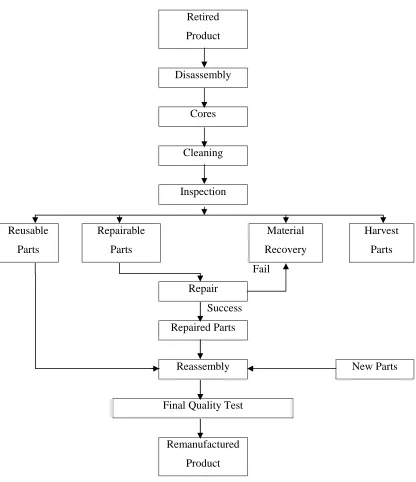
manufacturing. In general, the remanufacturing process involves 6 stages: disassembly,
cleaning, inspection, repair, reassembly, and final testing. The stages are depicted in
Figure 6. Each of these operations will be explained briefly in the following section.
Retired
Product
Disassembly
Cores
Cleaning
Inspection
Reusable
Parts
Repairable
Parts
Material
Recovery
Harvest
Parts
Fail
Repair
Success
Repaired Parts
Reassembly New Parts
Final Quality Test
Remanufactured
Product
23
2.2.4.1.1 Disassembly:
Of all the recovery operations, disassembly operation is the most challenging process. It
requires more manpower and time (Gungor and Gupta, 1999). When the core arrives at
the remanufacturing station, the identity (number or name) is first erased. Then, the core
is completely disassembled to its part level. The disassembly process can either be done
automatically or manually.
2.2.4.1.2 Cleaning:
The cleaning operation involves removing dirt and dust from the disassembled parts
(Ilgin and Gupta, 2012). There are several cleaning techniques to clean a part or a
product: thermal, solvent-based, biological and abrasive cleaning techniques. The
different processes involve treatment according to their name and it may also involve
general water, detergent or chemical treatment. The cleaning process not only helps to
remove dirt and dust but also to remove other oil, grease, rust and paint stains either
inside or outside the surface of the part or product (Ilgin and Gupta, 2012).
2.2.4.1.3 Inspection:
The inspection stage involves activities to test the working condition of each part in the
product. The parts again may be either manually tested or automatically tested. This stage
mainly focuses on checking if a part meets the original factory functionality requirements
or not. The parts should be able to perform its respective functions and operations that a
normal part is expected to perform. Most of the parts usually are reusable, the success
rate of the reusable parts is 70-80% (Gregory et al., 2009). If there is a malfunction, the
part is repaired. If it is repaired successfully, then the part is reused, if not, the part is
recycled to recover material from it. At the time of recycling a part, a new part is replaced
24
2.2.4.1.3 Repair:
The parts that are inspected as bad undergo repair operation. The repair process might
involve few steps or far-reaching steps depending on the level of damage. The repair
process aims at bringing a part that is damaged back to its working condition (Ilgin and
Gupta, 2012). The part is thoroughly inspected and repaired such that it matches its
original factory standards. In addition, it is made sure that a repaired part is equal in
performance and quality with a new part.
2.2.4.1.4 Reassembly:
Once all the parts are cleaned, inspected and repaired or replaced, they arrive at the
reassembly station for reassembly. During reassembly process, the parts are reassembled
as per the original configuration of the product. At first, the assembler makes sure all
parts are present before starting to reassemble. Then, when all parts are present, the
assembler puts together the parts to form the final remanufactured product. The product is
then etched a new serial number or name and labelled as remanufactured product. The
labelling operation may also be done with the help of RFID tags. The tags would contain
the date of remanufacturing, operations performed, and other details. This would help the
remanufacturing company to maintain a record of the product and also have an idea about
the product’s history when it arrives for remanufacturing the next time (Ferrer et al.,
2011).
2.2.4.1.5 Final Quality Test:
The remanufactured product is then tested to make sure all the parts are functioning up to
the standard requirements. It is also tested to make sure it meets all the quality
requirements of an original new product. A remanufactured product performs like a new
25
Remanufacturing process is mostly successful; it meets the customer’s requirements and
satisfies the quality standards. To attain highest market share, a remanufactured product
must have better specification and lower selling price than other products (Kwak and
Kim, 2013). The demand for remanufactured product usually depends on generation
difference, selling price, and product status (New or Remanufactured) (Kwak and Kim,
2013). Satisfying the above needs sets the remanufactured product in a good position in
the market.
2.2.4.2 Part Upgrades:
Remanufacturing may also include upgrades to match the present technology and science
(Ilgin and Gupta, 2012; Lund, 2012). In the remanufacturing process, during reassembly,
all parts are inspected before assembly, at that time certain parts have the capability or
adaptability to include additional new parts or upgrade older parts to present technology
parts, this process is called part upgrade. Also, Gutowski et al., (2011) suggested that
products should be designed with a modular platform to incorporate new parts or update
technology when returned for remanufacturing. Remanufacturing with optimal part
upgrades was studied by Kwak and Kim, (2010). Potential applications for part upgrades
are big machineries or electronic products with quick residual value.
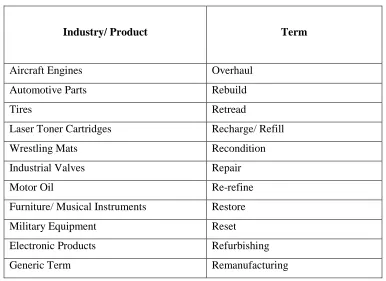
2.2.4.3 Remanufacturing and other related terms:
Many industries involve in remanufacturing process but all industries do not use the same
name. Different industries use different names for remanufacturing according to their
industry sector, a summary of the different names for remanufacturing are given in Table
3 below. Commonly used terms are refurbishing and remanufacturing which will be
26
Table 3: Equivalent remanufacturing terms (Lund, 2012)
Industry/ Product Term
Aircraft Engines Overhaul
Automotive Parts Rebuild
Tires Retread
Laser Toner Cartridges Recharge/ Refill
Wrestling Mats Recondition
Industrial Valves Repair
Motor Oil Re-refine
Furniture/ Musical Instruments Restore
Military Equipment Reset
Electronic Products Refurbishing
Generic Term Remanufacturing
2.2.4.4 Remanufacturing and Refurbishing:
Remanufacturing and Refurbishing terms have been used interchangeably in literature
and industries. Both terms represent the same recovery process; however there is a subtle
difference between them. Refurbishing process just like remanufacturing involves
operations like disassembly, cleaning, inspection, repair, and reassembly that would only
make the product look better like a new product but does not give a new lifetime (Lund,
2012). This does not mean all refurbished products do not have a new life time. Few
products still undergo refurbishing process and have a new lifetime, but for the reason
they fall under different industry category they attain that name (refurbishing). In general,
refurbishing pertains to and is favored for electronic products that have quick returns due
to damage, short lifespan, wrong shipment, and return policy of the company (Lund,
2012). A detailed difference between remanufacturing and refurbishing is given in Table
27
Table 4: Comparison between Refurbishing and Remanufacturing. (Based on Interviews; Kerr and Ryan, 2001; Lebreton, 2007; Lund, 2012)
Process Remanufacturing Refurbishing
Inspection Yes Yes
Disassembly Yes Yes
Parts Reuse/Repair/Replace Yes Yes
Cleaning Yes Yes
Reassembly Yes Yes
Quality Inspection Yes No
Polishing and Packing Yes Yes
New Life Yes No
Disassembly Level Completely Partly
Products Mechanical Products e.g.
Automobile Parts, tires,
Aircraft Engines, Laser
Toner Cartridges etc.
Electronic Products e.g. Cell
Phones, Televisions, Hard
Disks, Laptops/Personal
Computers etc.
2.2.4.5 Benefits of Remanufacturing
This section will outline the benefits of remanufacturing. Some of the benefits as
highlighted by Ilgin and Gupta, (2012) are as follows,
1) Remanufacturing is a profitable business when compared to traditional
manufacturing,
2) Remanufacturing involves dynamic work unlike traditional manufacturing that
involves monotonous work. This flexibility in work leads to workers skill
development,
3) During disassembly, the failure reason can be found correctly. This information
can be sent to the new product’s design department for future design
28
4) One can buy a remanufactured product that is high in quality at a reasonably low
price; this can be very much useful when buying large number of products.
5) Less energy is used for the remanufacturing process:
a. To remanufacture a product, only 15% of a new product manufacturing
energy is required,
b. Instead of manufacturing new products, if products are remanufactured,
then 400 trillion BTU of energy is estimated to be saved worldwide
annually,
c. Greenhouse gases are reduced as a result of energy savings,
d. Natural resources are conserved by extracting only a fraction from the
earth’s crust, since the materials are already available from the product,
6) Penalty for OEM from the environment legislations are reduced by
remanufacturing a used product, and
7) By remanufacturing, the ultimate disposal time of a product is extended,
2.2.5 Recycling:
Recycling is the process of reducing a product to its material level and obtaining value
form it. Products disposed as waste can either be material recovered or safely disposed by
recycling. Most products contain materials like metals, plastics, and other valuable
resources that have precious value. By recycling, one can not only make profit from
extracting these valuable materials but can also preserve the raw materials present in the
earth’s crust. Usually retired products that are classified as bad, based on appearance and
working condition are recycled. These products do not have any functional value but has
material value that can be reused by recycling. Common recycling methods include
shredding, chemical processing and material separation. The separated materials are
processed into pellets and sold to the raw material extractors or part manufacturers. The
important benefits of recycling are these: profit can be made from selling precious
recovered material, virgin raw materials can be preserved, and the planet can be kept free