Modified Water Evaporation Optimization
based Design for Improving Efficiency of
Three Phase Induction Motor
P. S. Prakash
Assistant Professor, Department of Electrical & Electronics Engineering, Annamalai University, Annamalainagar,
Tamilnadu, India
ABSTRACT: This paper presents a Modified Water Evaporation Optimization (MWEO)based design methodology for refining the efficiency of Induction Motor (IM). Modified Water Evaporation algorithm optimization, inspired by water evaporation from lake or river.MWEO is one of the biological and environmental science is computing models for solving multimodal optimization problems. Among the number of design variables of the IM, seven variables are identified as primary design variables and the MWEO based design methodology is tailored to optimize the chosen primary variables with a view to obtain the global best design. The developed methodology is applied in solving two IM design problems and the results are presented with a view of exhibiting the superiority of the developed algorithm.
KEYWORDS: Induction Motor Design, Water evaporation optimization
I. INTRODUCTION
Induction motors (IM) are the most widely used in domestic, commercial and various industrial applications. Especially, the squirrel cage IM is characterized by its simplicity, robustness and low cost, making it more attractive and hence captured a leading place in industrial and agricultural sectors. As millions of such motors are in use in various sectors, they consume a considerable percentage of overall produced electrical energy. The ever mounting pressure of oil crisis and the need for energy conservation necessitate designing the IMs with increased levels of efficiency through the selection of appropriate combination of the design parameters. The optimal design of IM (ODIM) is so complicated that it is still a combination of art and science. There are many geometrical parameters and their relationships connected with motor specifications, which are in general nonlinear ( MehmetCunkas 2010).
Over the years, in addition to statistical methods (Han and Shapiro 1967) and the Monte Carlo technique (Anderson 1967), several mathematical programming techniques, which provides a means for finding the minimum or maximum of a function of several variables under a prescribed set of constraints, have been applied in solving the IM design problems. These techniques such as nonlinear programming, (Ramarathnam et al 1971), Lagrangian relaxation method (Gyeorye Lee et al 2013), direct and indirect search methods (Nagrial et al 1979), Hooks and Jeeves method (Faiz et al 2001), Rosenbrock’s method (Bharadwaj et al 1979-a), Powell’s method (Ramarathnam et al 1973), finite element method (20/4:7 T. S. Parkin et al 1993) and sequential unconstrained minimization technique(Bharadwaj et al 1979-b) are most cumbersome and time consuming. Besides a few of them requires derivatives and exhibits poor convergence properties due to approximations in the derivative calculations.
they use to create new solutions, and the mechanism they employ for selecting the new parents. These algorithms have yielded satisfactory results across a great variety of engineering optimization problems.
Recently, Water Evaporation Optimization (WEO) has been suggested for solving optimization problems. It is inspired by evaporation of water is very important in biological and environmental science, the decreasing wettability of surface can represent the decrease of objective function for a minimizing optimization problem. It has been applied to a variety of power system problems and found to yield satisfactory results.
The aim of this paper is to develop a MWEO based method for optimally designing IMs with a view of effectively exploring the solution space and obtaining the global best solution. The developed methodology has been applied in designing two IMs and the performances have been studied. The paper is divided into six sections. Section I provides the introduction, section II overviews WEOand elucidates the proposed method (PM), section III formulates the IM design problem, section IV discusses the results and section V concludes.
II. WATER EVAPORATION OPTIMIZATION ALGORITHM
The evaporation of water is very important in biological and environmental science. The water evaporation from bulk surface such as a lake or a river is different from evaporation of water restricted on the surface of solid materials. In this WEO algorithm water molecules are considered as algorithm individuals. Solid surface or substrate with variable wettability is reflected as the search space. Decreasing the surface wettability (substrate changed from hydrophility to hydrophobicity) reforms the water aggregation from a monolayer to a sessile droplet.
Such a behavior is consistent with how the layout of individuals changes to each other as the algorithm progresses. And the decreasing wettability of surface can represent the decrease of objective function for a minimizing optimization problem. Evaporation flux rate of the water molecules is considered as the most appropriate measure for updating individuals which its pattern of change is in good agreement with the local and global search ability of the algorithm and make this algorithm have well converged behavior and simple algorithmic structure. The details of the water evaporation optimization algorithm are well presented in (Kaveh and Bakhshpoori, 2016).
In the WEO algorithm, each cycle of the search consists of following three steps (i) Monolayer Evaporation Phase, this phase is considered as the global search ability of the algorithm (ii) Droplet Evaporation Phase, this phase can be considered as the local search ability of the algorithm and (iii) Updating Water Molecules, the updating mechanism of individuals.
(i) Monolayer Evaporation Phase
In the monolayer evaporation phase the objective function of the each individuals Fititis scaled to the interval [3.5, -0.5] and represented by the corresponding Esub(i)t inserted to each individual (substrate energy vector), via the following scaling function.
minmin
max
E
Fit
Min
Fit
MaX
Fit
Min
Fit
E
E
i
E
t i t
sub
(1)
Where Emax and Emin are the maximum and minimum values of Esub respectively. After generating the substrate energy vector, the Monolayer Evaporation Matrix (MEP) is constructed by the following equation.
t sub ij
t sub ij
t ij
i
E
rand
if
i
E
rand
if
MEP
exp
0
exp
1
(2)
(ii) Droplet Evaporation Phase
In the droplet evaporation phase, the evaporation flux is calculated by the following equation.
cos
1
cos
3
cos
3
2
3
J
oP
oJ
(3)
where Jo and Po are constant values. The evaporation flux value is depends upon the contact angle ϴ, whenever this angle is greater and as a result will have less evaporation. The contact angle vector is represented the following scaling function.
minmin
max
Fit
Min
Fit
Max
Fit
Min
Fit
i
t i t
(4)
Where the min and max are the minimum and maximum functions. The ϴmin& ϴmax values are chosen between -50o<ϴ
< -20o is quite suitable for WEO. After generating contact angle vector ϴ(i)t the Droplet Probability Matrix (DEP) is constructed by the following equation.
t i ij
t i ij
t j i
J
rand
if
J
rand
if
DEP
0
1
(5)
whereDEPtij is the updating probability for the jth variable of the ith individual or water molecule in the tth iteration of the algorithm.
(iii) Updating Water Molecules
In the WEO algorithm the number of algorithm individuals or number of water molecules (nWM) is considered constant in all tth iterations, where t is the number of current iterations. Considering a maximum value for algorithm iterations (tmax) is essential for this algorithm to determine the evaporation phase and for stopping criterion. When a water molecule is evaporated it should be renewed. Updating or evaporation of the current water molecules is made with the aim of improving objective function. The best strategy for regenerating the evaporated water molecules is using the current set of water molecules (WM(t)). In this way a random permutation based step size can be considered for possible modification of individual as:
WM
permute
i
j
WM
permute
i
j
rand
S
.
t1
t2
(6) where rand is a random number in [0,1] range, permute1and permute 2 are different rows of permutation functions. i is the number of water molecule, j is the number of dimensions of the problem. The next set of molecules (WM(t+1)) is generated by adding this random permutation based step size multiplied by the corresponding updating probability (monolayer evaporation and droplet evaporation probability) and can be stated mathematically as:
2
/
2
/
max max 1
t
t
DEP
t
t
MEP
S
WM
WM
t t t
t
(7)
Each water molecule is compared and replaced by the corresponding renewed molecule based on objective function. It should be noted that random permutation based step size can help in two aspects. In the first phase, water molecules are more far from each other than the second phase. In this way the generated permutation based step size will guarantee global and local capability in each phase.
III.IMPLEMENTATIONOFWEOALGORITHAMTOSLOVEDESIGNPROBLEM
The detailed algorithmic steps for proposed WEO algorithm to solve design problem are presented below.
Step 2: Randomly initialize all water molecules.
Step 3: Obtain the design variable by applying priority list method and compute the objective function given by Eq. (1), Eq. (4) and Eq. (8) for all water molecules.
Step 4: Check whether t (current iteration) ≤ tmax/2.
Step 5: If step 4 is satisfied, then, water molecules are globally evaporated based on monolayer evaporation probability MEP using Eq. (2).
Step 6: For t> (1+tmax/2)2, Based on DEP (Eq. 5), evaporation occurs.
Step 7: Generate random permutation based step size matrix according to Eq. (6).
Step 8: Generate evaporated water molecules by adding the product of step size matrix and evaporation matrix to the current set of molecules MWM(t) by using Eq. (7) and update the matrix of water molecules.
Step 9: Compare and update the water molecules. Step 10: Return the best water molecule
Step 11: If the number of iteration of the algorithm (t) becomes larger than the maximum number of iterations (tmax), the algorithm terminates. Otherwise go to step 3.
IV. PROPOSED METHOD
The proposed MWEO based solution method for ODIM involves formulation of the problem, representation of water molecules through the chosen design variables and water molecules are accelerated to move as best solutions.
4.1 Problem Formulation
The ODIM problem involves large number of design variables. Many of these variables fortunately have a little influence either on the objective function or on the specified constraints. However, to ease the curse of high dimensionality, the following seven variables are identified as primary design variables.
T x x x X core the in density Flux density current Rotor density current Stator gap air of Length conductor Ampere density flux gap air of value Average pitch pole length to Core ] , , ,
[ 1 2 7 (8)
The ODIM problem is formulated by defining an objective function and a set of constraints as
Maximize t P KW KW x h )
( (9)
Subject to 0.5 current load no unit per 70 rise perature stator tem 1.5 ratio torque load full to starting 05 . 0 load full at slip 2.0 h rotor teet of density flux maximum 2 th stator tee of density flux maximum 0 ) (x g (10) max min i i
i x x
WherePt PnlPcusPcur (12)
4.2 Representation of Design Variables
The water molecules
s
i,is represented to denote the chosen primary design variables, defined by Eq. (8), in vector form as:
s
1,
s
2,
s
7
x
1,
x
2,
,
x
7
s
i
i i
i
(13)4.3 Fitness Function
The algorithm searches for optimal solution by maximizing a fitness of Water molecules LI, which is formulated from the objective function of Eq. (9) and the penalty terms representing the limit violation of the explicit constraints of Eq. (10). The LI
function is written as
Maximize
i i x g w
x h
LI 2
) ( 1
)
( (14)
V. NUMERICAL RESULTS
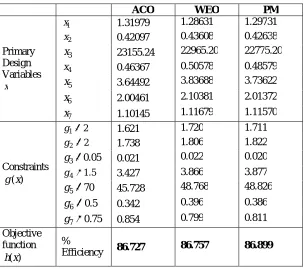
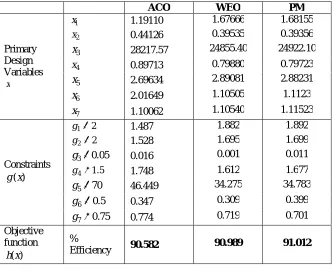
The proposed MWEO method (PM) is used to obtain the optimal design of two IMs. The first machine under study is rated for 7.5 kW, 400 V, 4 pole, 50 Hz and the second one for 30 kW, 400 V, 4 pole, 50 Hz. The effectiveness of the PM is demonstrated through comparing the performances with those of the ACO and WEO based design approaches. In this regard, the same set of primary design variables, fitness function and design equations, involved in the PM, are used to develop the ACO and WEO based design approaches. The software packages are developed in Matlab platform and executed in a 2.3 GHz Pentium-IV personal computer. There is no guarantee that different executions of the developed design programs converge to the same design due to the stochastic nature of the ACO and WEO, and hence the algorithms are run 20 times and the best ones are presented. The optimal design representing the values of the primary design variables for both the IMs and their efficiencies are presented in Table-1 and 2
Table 1 Comparison of Results for Motor-1
ACO WEO PM
Primary Design Variables
x
1
x 1.31979 1.28631 1.29731
2
x 0.42097 0.43608 0.42638
3
x 23155.24 22965.20 22775.20 4
x 0.46367 0.50578 0.48579
5
x 3.64492 3.83688 3.73622
6
x 2.00461 2.10381 2.01372
7
x 1.10145 1.11679 1.11570
Constraints ) (x g
2
1
g 1.621 1.720 1.711
2
2
g 1.738 1.806 1.822
05 . 0
3
g 0.021 0.022 0.020
5 . 1
4
g 3.427 3.866 3.877
70
5
g 45.728 48.768 48.826 5
. 0
6
g 0.342 0.396 0.386
75 . 0
7
g 0.854 0.799 0.811
Objective function
) (x h
%
It is observed from these tables that the PM offers an efficiency of 86.899% and 91.012%, which are higher than those of ACO and WEO based approaches, for motor-1 and -2 respectively. These tables also include the values of the constraints of Eq. (10) along with their limits. It can also be observed from these tables that all the methods bring the constraints such as maximum flux density, slip at full load, starting to full load torque ratio, etc. to lie within the respective limit, as the constraints are added as penalty terms in the light intensity function of Eq. (14). It is obvious that the PM offers better %efficiency enhancement than those of the existing approaches for both the motors.
Table 2 Comparison of Results for Motor-2
ACO WEO PM
Primary Design Variables
x
1
x 1.19110 1.67666 1.68155
2
x 0.44126 0.39535 0.39356
3
x 28217.57 24855.40 24922.10 4
x 0.89713 0.79880 0.79723
5
x 2.69634 2.89081 2.88231
6
x 2.01649 1.10505 1.1123
7
x 1.10062 1.10540 1.11523
Constraints ) (x g
2
1
g 1.487 1.882 1.892
2
2
g 1.528 1.695 1.699
05 . 0
3
g 0.016 0.001 0.011
5 . 1
4
g 1.748 1.612 1.677
70
5
g 46.449 34.275 34.783
5 . 0
6
g 0.347 0.309 0.399
75 . 0
7
g 0.774 0.719 0.701
Objective function
) (x h
%
Efficiency 90.582 90.989 91.012
VI. CONCLUSION
Indeed the MWEO is a powerful population based method for solving complex optimization problems. A new methodology involving MWEO for solving ODIM problem has been developed and applied on two IM design problems. It determines the optimal values for primary design variables. The ability of the PM to produce the global best design parameters that improves the efficiency of the motor has been projected. It has been chartered that the new approach fosters the continued use of MWEO and will go a long way in serving as a useful tool in design problems.
ACKNOWLEDGEMENT
The authors gratefully acknowledge the authorities of Annamalai University for the facilities offered to carry out this work.
REFERENCES
[3] Bharadwaj D.G,,Venkatesan K. and Saxena R. B. 1979-b. Nonlinear programming approach for optimum cost induction motors--SUMT algorithm, Comput. and Elect. Engg., 6(3): 199-204.
[4] Bhuvaneswari R. and Subramanian S. 2005. Optimization of three phase induction motor design using simulated annealing algorithm, Electric Power Components and Systems, 33: 947-956.
[5] Chandrasekaran K. and Sishaj P. Simon. 2012. Tuned Fuzzy Adapted Firefly Lambda Algorithm for Solving Unit Commitment Problem, J. Electrical Systems. 8(2): 132-150.
[6] Faiz J. and Sharifian M. B. B. 2001. Optimal design of three phase induction motors and their comparison with a typical industrial motor, Comp. and Elect. Eng. 27: 133-144.
[7] Gyeorye Lee., Seungjae Min. and Jung-Pyo Hong. 2013. Optimal shape design of rotor slot in squirrelcage induction motor considering torque characteristics, IEEE Transactions on Magnetics, 49(5): 2197-2200.
[8] Han G. J. and S. S. Shapiro. 1967. Statistical models in engineering. UK: John Wiley and Sons.
[9] Jan PawelWieczorek., OzdemirGol. andZbigniewMichalewiez. 1998. An evolutionary algorithm for the optimal design of induction motors, IEEE Trans. Magnetic. 34(6): 3882-3887.
[10] Kim MK., Lee CG., Jung HK. 1998. Multiobjective optimal design of three-phase induction motor using improved evolution strategy, IEEE Trans. On Magnetics. 34(5): 2980-2983.
[11] Kannan R., Subramanian S. and Bhuvaneswari R. 2010. Multiobjective optimal design of three-phaseinduction motor using simulated annealing technique, International Journal of Engineering Science and Technology. 2(5): 1359-1369.
[12] Kuldeep Kumar Swarnkar. 2012. Economic load dispatch problem with reduce power loss using firefly algorithm, Journal of Advanced Computer Science and Technology. 1(2): 42-56.
[13] Mehmet Cunkas. 2010. Intelligent design of induction motors by multiobjective fuzzy genetic algorithm, Intell Manuf. 21: 393-402.
[14] Nagrial. M. H. and Lawrenson P. J. 1979. Comparitive performance of direct search methods of minimization for designs of electrical machines, Electric machines and Electromechanics. 3: 315-324.
[15] Parkin T. S. and Preston T. W. 1993. Induction Motor Analysis Using Finite Element, Proc.IEE, The Eighth International Conference on Electrical Machines and Drives. pp. 20-24.
[16] Ramarathnam R. and Desai B. G. 1971. Optimization of polyphase induction motor design- a nonlinear programming approach, IEEE Trans. PAS-90: 570- 579.
[17] Ramarathnam R., Desai. B. G. and Subba Rao. V. 1973. A comparative study of minimization techniques for optimization of induction motor design. IEEE Transactions on Power Apparatus and Systems PAS-92 (5): 1448–1454.
[18] Sakthivel V. P. and Subramanian S. 2011. Using MPSO Algorithm to Optimize Three-Phase Squirrel Cage Induction Motor Design, Proceedings of ICETECT 2011, pp. 261-267.
[19] SatyajitSamaddar., Surojit Sarkar., Subhro Paul., Sujay Sarkar., Gautam Kumar Panda. AndPradip Kumar Saha. 2013. Using genetic algorithm minimizing length of air-gap and losses along with
maximizing efficiency for optimization of three phase induction motor. International Journal of Computational Engineering Research. 3(5): 60-66. [20] Sivaraju S. S. and Devarajan N. 2011. GA based optimal design of three phase squirrel cage induction motor for enhancing performance. International Journal of Advanced Engineering Technology. 2(4): 202-206.
[21] Sulaiman M. H., Mustafa M. W., Zakaria Z. N., Aliman O. and Abdul Rahim S. R. 2012. Firefly Algorithm Technique for Solving Economic Dispatch Problem. IEEE International Power Engineering and Optimization Conference (PEOCO2012). Melaka, Malaysia: 6-7 June 2012.
[22] Thanga Raj. C., S. P. Srivastava and Pramod Agarwal. 2008. Optimal design of poly-phase induction motor using improved particle swarm optimization, Proceedings of XXXII National Systems Conference, NSC 2008, December 17-19.
[23] Yang X. S. 2008. Nature-Inspired Meta-Heuristic Algorithms, Luniver Press, Beckington, UK.
[24] Yang X. S. 2009. Firefly algorithms for multimodal optimization, in Proceedings of the Stochastic Algorithms. Foundations and Applications (SAGA ’09), Vol. 5792 of Lecture Notes in Computing Sciences, Springer, Sapporo, Japan. pp. 178–178.
[25] Ramachandran.R and Arun .M, “Black Hole Algorithm Implemented for Congestion Management in a Competitive Power Market” International Journal of Computer Applications, Vol. 150, No. 8, 2016
[26] Hatamlou, Abdolreza. "Black hole: A new heuristic optimization approach for data clustering." Information sciences 222 (2013): 175-184. [27]. Hasan, Zakareya, and Mo E. El-Hawary. "Optimal Power Flow by Black Hole Optimization Algorithm." Electrical Power and Energy Conference (EPEC), 2014 IEEE. IEEE, 2014.