A Survey on Secure Path Planning
Algorithm for Multi-Constrained QoS
Routing in VANETs
Farheen Asif Shaikh1, Hyder Ali Hingoliwala2
PG Scholar, Dept. of CSE, Savitribai Phule Pune University, Pune, Maharashtra, India.1
Assistant Professor, Dept. of CSE, Savitribai Phule Pune University, Pune, Maharashtra, India.2
ABSTRACT: Vehicular ad hoc networks (VANETs) is an emerging technology which has received lot of attention due to its potential to improve vehicle and road safety, traffic control, efficiency as well as convenience for users. VANET is a sub category of mobile ad hoc network (MANET). A lot of research in VANET is done on routing, broadcasting, Quality of Security (QoS) and security. This paper proposes a novel path planning algorithm for efficient routing. The proposed system will traditionally distribute the work load over alternate paths in order avoid congestion and reduce travel cost. It will also ensures reliable routing with less bandwidth requirement and high packet delivery ratio as it avoids packet loss. VANET may be affected by attacks on routing leading to altering messages and routes which will affect QoS parameters. The proposed algorithm will deal with providing security measures over the routing process. Therefore we obtain routing algorithm subject to multiple QoS constrains for secure VANET communication.
KEYWORDS: Vehicular ad hoc network, Path planning algorithm, Multi-constrained, Reliable routing
I. INTRODUCTION
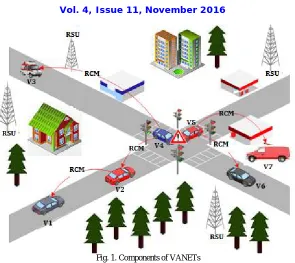
Vehicular Ad Hoc Networks (VANETs) are a form of wireless network made by vehicles acting as nodes in the network which communicate among themselves and with road side base stations or the road side units (RSU). A wide range of services have been developed for VANETs ranging from safety to information applications. Also, Intelligent Transportation System (ITS) provide fast and safe traffic system, so the interest in wireless communication studies and VANET commercializing VANET is growing. A primary requirement for such services is that they are offered with Quality of Service (QoS) guarantees in terms of service reliability and availability. Furthermore, due to openness of VANET's wireless channels to both internal and external attacks, the application of security mechanism is mandatory to protect the offered QoS guarantees.
Fig. 1. Components of VANETs
As VANETs are highly dynamic in nature it may subject to internal and external adversaries raise important technical challenges in terms of reliable, reduces cost and secure routing. There is a possibility that messages between vehicle to vehicle (V2V) or vehicle to road side units communication about safe driving can be manipulated which may lead to accidents. There are different security mechanisms such as digital signatures, hash chains, plausibility checks, etc. could be applied together to protect the routing control messages (RCM). In order to prevent the network from such attacks the algorithm implies strong privacy preservation by making use of asymmetric key cryptography and hash function. This will lead to a secure communication over a reliable and efficient route.
In this paper we survey routing method [1], [4] to achieve an reliable and secure routing in vehicular ad hoc networks. In Section 2 we have done literature survey of related work to solve the problem of routing and security in VANETs. In the third section we discuss our proposed system algorithm and it's description. Finally, in Section 4 we present a general conclusion of proposed model.
II. RELATED WORK
This section consist of survey of different papers related to routing algorithm and security in VANETs. As per our studies there is no previous research done on providing secure routing using path planning in VANETs. Both these aspects are implemented individually.
communications among vehicles, roadside units (RSUs), and a vehicle-traffic server in an efficient way. Then, author propose a real-time path-planning algorithm, which not only improves the overall spatial utilization of a road network but reduces average vehicle travel cost for avoiding vehicles from getting stuck in congestion as well. A stochastic Lyapunov optimization technique is exploited to address the globally optimal path-planning problem. Finally, the transmission delay of the hybrid-VANET-enhanced ITS is evaluated in VISSIM to show the timeliness of the proposed communication framework. In [5] the author has proposed a system employing the situational awareness (SA) concept and an ant colony system (ACS)-based algorithm to develop a situation-aware multi-constrained QoS (SAMQ) routing algorithm for VANETs. SAMQ aims to compute feasible routes between the communicating vehicles subject to multiple QoS constraints and pick the best computed route, if such a route exists. In [6] the author has proposed a shortest path algorithm using bidirectional search, whose complexity is deduced to be ,where and represent the number
of nodes and links in the network, respectively. Then it shows that bidirectional search can significantly accelerate the
convergence of several existing QoS routing algorithms. Finally a novel cost-effective bidirectional multi-constrained routing algorithm, which can greatly alleviate the forwarding state scalability issue by supporting stateless QoS routing in IP networks via IP tunneling or constraints-based alternate routing in MPLS networks via label stacks. In [7] the author has proposed a novel bi-velocity discrete particle swarm optimization (BVDPSO) approach and extends its application to the nondeterministic polynomial (NP) complete multicast routing problem (MRP). First, a novel bi-velocity strategy is developed to represent the possibilities of each dimension being 1 and 0, where 1 stands for a node being selected to construct the multicast tree, whereas 0 stands for being otherwise. Second, BVDPSO updates the velocity and position according to the learning mechanism of the original PSO in the continuous domain. In [8] This paper proposes an AODV-based routing algorithm for VANETs. This routing algorithm uses a routing metric, which includes the length of each hop as well as the link remaining lifetime. In [9] the author has provided detailed categorization of various routing techniques and discussion on each categorization with respect to its advantages, disadvantages, various constrains and its applications. The above survey concludes with all of the routing algorithms studied for VANET's.
No. Title Author and Year Technique Used Parameters Achieved
1. Secure and Robust
Multi-Constrained QoS Aware
Routing Algorithm for
VANETs [1]
Mahmoud Hashem
Eiza, Thomas
Owens, and Qiang Ni
IEEE 2016
1. Secure ACO-based
Multi-Constrained QoS aware Routing Algorithm (S-AMCQ)
1. Reliability
2. Availability
2. MoZo: A Moving Zone
Based Routing Protocol
Using Pure V2V
Communication in VANETs [2]
Dan Lin, Jian Kang, Anna Squicciarini, Yingjie Wu, Sashi Gurung, and Ozan Tonguz
IEEE2016
1. MoZo Routing
Protocol
2. Dijkstra algorithm
1. Less communication
overhead
2. Low message delivery
time
3. Successful delivery rate
3. A survey on Heuristic-based
Routing Methods in
Vehicular Ad-Hoc Network:
Technical challenges and
future trends [3]
Rejab Hajlaouia, b,
Herve Guyennetb,
Tarek Moulahi
IEEE2016
1. Particle Swarm
Optimization
2. Genetic Algorithm
3. Ant Colony
Optimization
Analysis of the algorithms on
the basis of following
parameters:
1. Network Load
2. End to End Delay
3. Packet Delivery Ratio
4. Bandwidth
4. Real-Time Path Planning
Based on
Hybrid-VANET-Enhanced Transportation
System [4]
Miao Wang,
Hangguan Shan,
Rongxing Lu, Ran
Zhang, Xuemin
(Sherman) Shen and Fan Bai
IEEE2015
1. Real-time path
planning
2. Lyapunov
optimization
1. Congestion Avoidance
5. Situation-Aware QoS
Routing Algorithm for
Vehicular Ad Hoc Networks [5]
Mahmoud Hashem
Eiza, Thomas
Owens Qiang Ni and Qi Shi
IEEE2015
1. Ant Colony System 1. High Reliability
6. Bidirectional
Multi-Constrained Routing
Algorithms [6]
Baoxian Zhang, Jie Hao, and Hussein T. Mouftah.
IEEE2014
1. K Shortest Path
Algorithm
2. Bidirectional Search
3. Bidirectional
Multi-constrained Routing Algorithm
1. Reduce Complexity
2. Fast Routing
3. Improve Efficiency
4. Reduce Cost
7. Bi-Velocity Discrete Particle
Swarm Optimization and Its
Application to Multicast
Routing Problem in
Communication Networks
[7]
Meie Shen, Zhi-Hui
Zhan, Wei-Neng
Chen, Yue-Jiao
Gong, Jun Zhang and Yun Li.
IEEE 2014
1. Particle Swarm
Optimization
2. BVDPSO:
Bi-Velocity Particle Swarm Optimization
1. Solves the problem of
multicast routing
8. A Receiver-Based Routing
Algorithm Using Competing Parameter for VANET in
Lujie Wang, Yiming Wang, and Cheng Wu
1. Receiver based
AODV routing
algorithm
1. Reduced Packet Loss
2. Avoid frequent link
Urban Scenarios [8]
Springer 2014
3. Improve packet
delivery ratio
9. A systematic review on
routing protocols for
vehicular adhoc network [9]
Amit Dua, Neeraj
Kumar, Seema
Bawa
Elsevier2014
Survey of different routing schemes:
1. Topology based
routing
2. Geographic routing
3. Hybrid routing
4. Clustering based
routing
5. Data fusion based
routing
Comparison of different routing techniques on the basis of QoS
parameters and detailed
analysis of their performance.
10. A Collision Avoidance
Mechanism for Emergency Message Broadcast in Urban VANET [10]
Wanting Zhu,
Deyun Gao, Chuan
Heng Foh,
Weicheng Zhao,
Hongke Zhang
IEEE 2016
1. RBEM/ CBEM
handshake mechanism
2. UV-CAST broadcast
routing
1. Collision avoidance
2. Improve the reliability
of the emergency
message broadcasting
11. On Optimal
Device-to-Device Resource Allocation for Minimizing End-to-End Delay in VANETs [11]
Xianghui Cao, Lu Liu, Yu Cheng, Lin
X. Cai and
Changyin Sun IEEE2016 1. Device-to-Device (D2D) communication technique
2. Greedy Algorithm
1. Minimize delay
12. PTMAC: A Prediction-based
TDMA MAC Protocol for Reducing Packet Collisions in VANET [12]
Xiaoxiao Jiang and David H.C. Du
IEEE201D
1. PTDMA (Time
Division Multiple Access) Protocol
1. Reduce collision
13. PROVEST:
Provenance-based Trust Model for Delay Tolerant Networks [13]
Jin-Hee Cho, Senior Member, IEEE, Ing-Ray Chen
IEEE2016
1. PROVEST
2. Stochastic Petri
Nets
1. Accurate peer-to-peer
trust assessment
2. Minimize message
delay
3. Reduced
communication cost
4. High message delivery
ratio
14. QoS-Aware Data
Dissemination for Dense
Urban Regions in Vehicular Ad Hoc Networks [14]
Amit Dua, Neeraj
Kumar, Seema
Bawa Springer 2014 1. Intelligent forwarding mechanism 2. DSRC
3. Dijksatra algorithm
1. High bandwidth
2. Reduced distance
15. An Intelligent Approach for
Building a Secure
Decentralized Public Key
Infrastructure in VANET
[15]
Neeraj Kumar,
Sudip Misra, Rahat
Iqbal, Joel J.P.C
Rodrigues
Elsevier 2014
1. Decentralized
Public Key
Infrastructure
2. Bayesian Coalition
Game
3. Learning Automata
1. Verification
2. Communication cost
3. Packet delivery ratio
16. DOVE: Data Dissemination
to a Desired Number of Receivers in VANET [16]
Tan Yan, Wensheng Zhang, and Guiling Wang
IEEE 2014
1. DOVE 1. Minimizes the
dissemination delay
2. Low communication
III.PROPOSED SYSTEM
A. DESIGN CONSIDERATIONS:
Providing alternate paths
Avoid congestion
Minimize end to end delay
High packet delivery ratio
Reliability
Secure routing
Improved performance
B. DESCRIPTION OF THE PROPOSED ALGORITHM:
The aim of this survey is to investigate how routing techniques can be utilised to facilitate multi-constrained QoS in VANETs as well as to avoid security threats to the routing process. For that purpose, we employ the Path Planning Algorithm technique to develop our Path Planning based multi-constrained QoS (PPMCQ) routing algorithm. The following discussion briefly describes the proposed algorithm.
1. Path Planning based Multi-Constrained QoS Routing Algorithm (PPCQ):
In our proposed system we have chosen path-planning algorithm for routing in VANET. This algorithm is used to avoid congestion in urban areas which will help in providing reliable routing services. It is an efficient traffic management tool which improves utilization of road network and tries to reduces average vehicle travel cost for avoiding vehicles from getting stuck in congestion. While driving it is drivers choice to select route to move to his destination. Thus it becomes difficult to develop an algorithm for path planning. The path planning algorithm will provide alternate paths for same destination so that the traffic is distributed over the network and driver can choose one of the optimal path to move to its destination. With the help of ITS it is possible to have communication between vehicles and road side units. The overall spatial utilization of road in VANETs is improved by avoiding congestion. Once the congestion is avoided we can easily achieve QoS constrains such as minimize end to end delay and maximize packet delivery ration which will lead to reliable routing in VANETs.
2. Secure Routing Process:
In VANETs the communication in network takes place between vehicle to vehicle or vehicle to road side units. The communication needed for transferring routing control messages. Even though we design a good routing algorithm we also need to protect this routing information to ensure secure and reliable routing. Thus, messages need to be protected from attacks which may take place in VANETs. The attacks may lead to altering of message details which will change the routing details and may put the network in congestion. To avoid such kind of adversaries in network we need to provide security to the routing process. For implementing security in VANETs the following parameters need to be considered: Authentication of message, Availability of message, Non-repudiation of message, privacy of message and verification of data. To achieve this objective we will implement public key cryptography. In our scenario to secure the routing control messages and converting it into unreadable format we will make use of Elliptic Curve Cryptography (ECC) algorithm and Elliptic Curve Deffie Hellman (ECDF) algorithm. It will generate public and private key for vehicles from Certificate Authority (CA). The CA can be a local transportation authority or the vehicle manufacturer. This will ensure secure routing message transfer in VANETs.
IV.CONCLUSION
The routing process is secured by applying cryptographic operations on the routing control messages. Therefore our proposed algorithm will ensure secure and reliable routing in VANETs.
REFERENCES
1. Mahmoud Hashem Eiza, Thomas Owens, and Qiang Ni, ’Secure and Robust Multi-Constrained QoS Aware Routing Algorithm for VANETs’, IEEE Transactions on Dependable and Secure Computing, Vol. 13, No. 1, 2016
2. Dan Lin, Jian Kang, Anna Squicciarini, Yingjie Wu, Sashi Gurung, and Ozan Tonguz,’MoZo: A Moving Zone Based Routing Protocol Using Pure V2V Communication in VANETs’, IEEE Transactions on Mobile Computing, 2016.
3. Rejab Hajlaouia, Herve Guyennetb, Tarek Moulahi, ’A survey on Heuristic-based Routing Methods in Vehicular Ad-Hoc Network: Technical challenges and future trends.’, IEEE Sensors Journal, 2016.
4. Miao Wang, Hangguan Shan, Rongxing Lu, Ran Zhang, Xuemin (Sherman) Shen and Fan Bai, ’Real-Time Path Planning Based on Hybrid-VANET-Enhanced Transportation System’, IEEE Transactions on Vehicular Technology, Vol. 64, No. 5, May 2015.
5. Mahmoud Hashem Eiza, Thomas Owens, Qiang Ni, and Qi Shi, ’Situation-Aware QoS Routing Algorithm for Vehicular Ad Hoc Networks’, IEEE Transactions on Vehicular Technology, Vol. 64, No. 12, December 2015.
6. Baoxian Zhang, Jie Hao, and Hussein T. Mouftah, ’Bidirectional Multi-Constrained Routing Algorithms’, IEEE Transaction on Computers, Vol. 63, No. 9, September 2014.
7. Meie Shen, Zhi-Hui Zhan, Wei-Neng Chen, Yue-Jiao Gong, Jun Zhang, and Yun Li, ’Bi-Velocity Discrete Particle Swarm Optimization and Its Application to Multicast Routing Problem in Communication Networks’, IEEE Transactions on Industrial Electronics, Vol. 41, No. 12, December 2014.
8. Lujie Wang, Yiming Wang, and Cheng Wu , ’A Receiver-Based Routing Algorithm Using Competing Parameter for VANET in Urban Scenarios’, Springer International Publishing Switzerland, pp. 140-149, 2014.
9. Amit Dua, Neeraj Kumar, Seema Bawa,’A systematic review on routing protocols for Vehicular Ad Hoc Networks’, Elsevier Publication, 2014. 10. Wanting Zhu, Deyun Gao, Chuan Heng Foh, Weicheng Zhao, Hongke Zhang, ’A Collision Avoidance Mechanism for Emergency Message
Broadcast in Urban VANET’, IEEE 2016.
11. Xianghui Cao, Lu Liu, Yu Cheng, Lin X. Cai,, and Changyin Sun, ’ On Optimal Device-to-Device Resource Allocation for Minimizing End-to-End Delay in VANETs’, IEEE Transactions on Vehicular Technology, 2016.
12. Xiaoxiao Jiang and David H.C. Du, ’PTMAC:A Prediction-based TDMA MAC Protocol for Reducing Packet Collisions in VANET’, IEEE Transactions on Vehicular Technology, 2016.
13. Jin-Hee Cho, Ing-Ray Chen, ’ PROVEST: Provenance-based Trust Model for Delay Tolerant Networks’, IEEE Transactions on Dependable and Secure Computing, 2016.
14. Amit Dua, Neeraj Kumar, Seema Bawa, ’QoS-Aware Data Dissemination for Dense Urban Regions in Vehicular Ad Hoc Networks’, Published by Springer, December 2014.
15. Neeraj Kumar, Rahat Iqbal, Sudip Misra, Joel J.P.C Rodrigues, ’An intelligent approach for building a secure decentralized public key infrastructure in VANETS’, Journal of Computer and System Sciences, Elsevier, 2014.
16. Tan Yan, Wensheng Zhang, and Guiling Wang, ’DOVE: Data Dissemination to a Desired Number of Receivers in VANET’, IEEE Transactions on Vehicular Technology, Vol. 63, No. 4, 2014.
BIOGRAPHY
Farheen Asif Shaikh received B.Tech. degree in Computer Engineering from Vishwkarma Institute of Technology, Pune in 2014 and is currently pursuing M.E. degree in Computer Science & Engineering with Jayawantrao Sawant College of Engineering, Savitribai Phule Pune University, Pune, Maharashtra, India. Her research interests include Wireless Ad Hoc Networks.
Prof. Hyder Ali Hingoliwala is Assistant Professor, Dept of CSE at Jayawantrao Sawant College of Engineering, Pune, Maharashtra, India. He received M.E. degree in Computer Science & Engineering and is currently working