A Study on Parallel RSA Factorization
Yi-Shiung Yeh, Ting-Yu Huang, Han-Yu Lin and Yu-Hao Chang
Department of Computer Science, National Chiao Tung University, Hsinchu, Taiwan, Republic of China Email: {ysyeh, tingyu}@csie.nctu.edu.tw, {hanyu.cs94g, uhchang.csie93g}@nctu.edu.tw
Abstract—The RSA cryptosystem is one of the widely used public key systems. The security of it is based on the intractability of factoring a large composite integer into two component primes, which is referred to as the RSA assumption. So far, the Quadratic Sieve (QS) is the fastest and general-purpose method for factoring composite numbers having less than about 110 digits. In this paper, we present our study on a variant of the QS, i.e., the Multiple Polynomial Quadratic Sieve (MPQS) for simulating the parallel RSA factorization. The parameters of our enhanced methods (such as the size of the factor base and the length of the sieving interval) are benefit to reduce the overall running time and the computation complexity is actually lower. The experimental result shows that it only takes 6.6 days for factoring larger numbers of 100 digits using the enhanced MPQS by 32 workstations.
Index Terms
—RSA, factorization, cryptosystem, Multiple
Polynomial Quadratic SieveI. INTRODUCTION
The RSA cryptosystem [13] is one of the most popular and widely used systems in practice. Instead of relying on the discrete logarithm problem [2, 7], the security of the RSA cryptosystem is based on the intractability of factoring a large composite integer, say, 2048 bits, into two large component primes, which is referred to as the RSA assumption. That is, given a RSA modulus n = pq
where p and q are two large primes of the same size, say, 1024 bits, the probability for any probabilistic polynomial-time (PPT) algorithm P() to successfully factorn into p and q is at most 1/P() which is negligible. It can be seen that the straightforward trial division method which divides n by each prime less than or equal to n until p or q is found is time-consuming and would be infeasible when n is large enough, though, it is guaranteed to find p and q.
So far, several efficient factorization algorithms have been proposed such as Pollard’s probabilistic methods [9], (U and p – 1 methods,) the Continued Fraction Method, the Elliptic Curve Method, the Number Field Sieve (NFS) [6], the Quadratic Sieve (QS) [10] and its variant, the Multiple Polynomial Quadratic Sieve (MPQS) [11, 12, 14]. Generally speaking, the QS is still faster than the NFS for numbers with no more than 110 digits and thus may be the better alternative for factoring large integers between 50 and 110 digits. In this paper, we focus on the MPQS and design an experimental
environment to simulate the parallel RSA factorization. With optimized parameters in the sieving procedure, the computation complexity of our method is lower than that of the original one, which contributes to the reduction of the overall running time.
The rest of this paper is organized as follows. Section 2 recalls some security notions of the RSA cryptosystem. Section 3 introduces some related factoring algorithms including the Dixon’s Random Squares algorithm, the QS and its variant, the MPQS. We simulate the parallel RSA factorization using an enhanced MPQS in Sections 4. Finally, a conclusion with the significance of our experimental results is given in Section 5.
II. SECURITYNOTIONS OF THE RSA CRYPTOSYSTEM This section reviews some security notions with respect to the RSA cryptosystem. That is, the RSA problem and the RSA assumption.
(i) RSA Problem:
Let n = pq where p and q are two large primes, e an integer satisfying gcd(e, (p 1)(q 1)) = 1 and d an integer such that ed = 1 mod (p 1)(q 1). Given c{me
(mod n) as the input, output the unique integer mZn satisfying m{cd (mod n).
(ii) RSA Assumption:
Let G be the RSA key generator which takes the security parameter 1k as its input and outputs (n, e,d). Given a RSA instance (n, e, c), the advantage for any probabilistic polynomial-time (PPT) adversary A, every positive polynomial P() and all sufficiently large k to solve the RSA problem is at most 1/P(k), i.e.,
Pr[A(n,e,c) = m,cm me mod n,mmZn, (n,e,d)m G] d 1/P(k).
III. REVIEW OF RELATED FACTORING ALGORITHMS To facilitate the readers with better understanding in the article, we first introduce some factoring algorithms including the Dixon’s Random Squares algorithm, the QS and the MPQS which is one of the most useful variants of the QS and widely employed in practice.
A. Dixon’s Random Squares Algorithm
two integers satisfying x !{ ry (mod n) and x2{y2 (mod
n). Then we can derive (x + y)(x – y) = x2 – y2{ 0 (mod
n). It can be seen that gcd(x + y,n) and gcd(x – y,n) must be non-trivial factors of n with the probability of at least 1/2. Therefore, n is successfully factored. To find such x
andy fulfilling x2{y2 (mod n), the algorithm begins by choosing several random integers ri’s such that ri2 > n, and proceeds to compute f(ri) = ri2 mod n. It is obvious that f(ri){ ri2 (mod n) and f(ri)z ri2 for all the ri’s. Let the setʳS contain these ri’s, and we have
S r i i y r f( ) 2
for some y, and
S r
i
i r
x . Derived from the equality
S r i i rx , we know that
) (mod 2 2 n r x S r i i ¸¸ ¸ ¹ · ¨¨ ¨ © § {
) (mod 2 n r S r i i
{ ) (mod )(r n
f S r i i
{{y2 (mod n). Note that
S r i i y r
f( ) 2 for some y holds if and
only if each prime factor of
S r
i
i
r
f( ) is used for even times. Such notion benefits us to find the set S. Suppose we have known the complete factorization of each f(ri), it would be easy to check whether the product of some specific f(ri)’s is a square. Yet, it is clearly difficult to factor every f(ri). Thus, we just retain and use those
f(ri)’s which can be “easily” factored. For simplicity, we first give the definitions of a factor base and being
smooth over a factor base.
Definition 1. factor base and being smooth over a factor base
A factor base E is a nonempty set of prime integers. An integer D is said to be smooth over the factor base E if all the prime factors of D occur in E.
The algorithm uses a factor base E composed of b
smallest primes, i.e., E = {p1,p2, …, pb}. Let the set W = {ra1, ra2, …, ram } such that f(raj) is smooth over E
and
b
k e k
aj p kj
r f
1
, )
( where ek,jt 0, 1 djdm and 1 d k d b. We attempt to find a set S satisfying
S r i i y rf( ) 2 for some y from W. Observe that every subset U W can be mapped to a vector
m
m Z
z z z
z& ( 1, 2,..., )( 2) aszj = 1 if rajU and zj = 0
if
j
a
r U, for 1 djdm. Note that (Z2)m denotes the
m-dimensional vector space over the finite field Z2 of 2 elements. Since
U r
i
i
r
f( ) is a perfect square and
m j z a U ri j j
i r f r f 1 )) ( ( ) (
¸¸ ¹ · ¨ ¨ © § m j z b k e k j j k p 1 1 ,
¸¸¸ ¹ · ¨¨ ¨ © § b k m j z e k k j j p 1 1 ,¦
m j j j k z e b k kp
1 , 1 ,we know
¦
{m j j j k z e 1
, 0 (mod 2), for 1 d k d b. This homogeneous linear system can be written in the form of matrix as » » » » ¼ º « « « « ¬ ª { » » » » ¼ º « « « « ¬ ª » » » » » ¼ º « « « « « ¬ ª 0 0 0 2 1 , 2 , 1 , , 2 2 , 2 1 , 2 , 1 2 , 1 1 , 1 m m b b b m m z z z e e e e e e e e e
(mod 2). (1)
To solve Eq. (1), we can use the algorithms such as the Gauss-Jordan Elimination [4], the Block Lanczos algorithm [1] and the Wiedemann algorithm [8]. If a solution s& of Eq. (1) is found, the set S can thus be constructed according to it. As a matter of fact, the crucial part is how to efficiently find enough ri’s such that f(ri) is smooth over E, rather than solving the homogeneous linear system over a finite field.
B. Quadratic Sieve
The QS is a well-known factoring algorithm proposed by Pomerance [10] in 1981. When factoring large integers between 50 and 110 digits, the QS is undoubtedly the best choice and has been widely used in practice for a long time. In fact, the QS use similar factoring ideas to the Dixon’s Random Squares algorithm except for two major differences. One is that the function of f(ri) = ri2 mod n is replaced with f(ri) = ri2 – n. The other is that the QS chooses all the ri’s as successive integers in the form of ri =
¬ ¼
n + i, for i N. Suchslight modifications can lead to dramatically faster running time. More details are described as follows. Setting up the factor base:
that f(ri) is divisible by pk. Consequently, for each pkE, we have
pk | f(ri), for some ri pk | (ri2 – n) ri2{n (mod pk)
n is a quadratic residue modulo pk
¸¸ 1
¹ · ¨¨ © §
k p
n
where ¸¸ ¹ · ¨¨ © §
k p
n
stands for the Legendre symbol. To efficiently compute the Legendre symbol, we can use the well-known Square-and-Multiply algorithm [16] and thus decide which odd prime pk should be put into E. Sieving procedure:
To determine whether f(ri) is smooth over E for all the
ri’s, we first choose a prime of E and decide which f(ri)’s are divisible by it. For instance, it is easy to see that a specificf(ri) = ri2 – n is divisible by two if and only if ri is odd. For a fixed odd prime pkE, we have to find all the ri’s with pk | (ri2 – n). Then we know
pk | (ri2 – n) ri2{n (mod pk)
ri is a solution to the congruence r2{n (mod pk). Sincen is a quadratic residue modulo pk and pk is an odd prime, the congruence r2 { n (mod pk) has exactly two solutions in
k
p
Z , say so,1 and so,2. In addition, these two solutions are negatives of each other modulo pk, namely so,2 = pk – so,1. Let so {so,1,so,2}. It is obvious that ri = so + tpk, for tZ. To compute so,1 and so,2, the Shanks-Tonelli algorithm [15] is applicable and thus all the ri’s satisfying that ri = so + tpk, for t Z can be found.
In practice, we just pick an interval called sieving interval and consider the ri’s in this interval. Let the sieving interval be
>
¬ ¼ ¬ ¼
n 1, n G@
and ri =¬ ¼
n +i, for 1 didG,G tb. Allocate an one-dimension array M
of size G and store all the f(ri)’s in the array. Since all the
ri’s are successive, every ri can be mapped to the index of the array element which saves the corresponding f(ri) such as M[ri –
¬ ¼
n ] = f(ri). Then we proceed to select those ri’s fulfilling¬ ¼
n + 1 dri = so + tpkd¬ ¼
n + G, for t Z and the corresponding M[ri –¬ ¼
n ]’s are repeatedly divided by pk until their quotients are not divisible by pk. This procedure is performed for every odd prime pk E. Similarly, for every odd ri, f(ri) is repeatedly divided by two until it is not divisible. (Even we can easily divide f(ri) by 2c if there are c 0’s in the tail of the binary representation of f(ri).) In the end, all theM[l]’s are scanned for which M[l] = 1, for 1 d l d G.
f(
¬ ¼
n + l) is smooth over E if and only if M[l] = 1. Therefore, we can find out all the ri’s such that f(ri) is smooth over Ewithin the sieving interval.By using this technique, every division executed is “meaningful”. That is to say, f(ri) is divided by pk if and only if f(ri) is divisible by pk for every prime pk E. Moreover, the divisions that divide an integer by its prime factor are much faster than the others. It can be seen that useless divisions are discarded, so as to dramatically speed up the running time.
C. Multiple Polynomial Quadratic Sieve
The MPQS was proposed by Montgomery [14], which is one of the variants of the QS. It uses several polynomial functions gh(ri)’s, for h N to ensure the proper size of ri. Once the values of one polynomial get “too” large, we discard it and choose a new one. Such procedure makes each gh(ri) smaller as well as the sieving interval and the factor base. More details are described as follows.
Selection of polynomials:
The MPQS uses the polynomial functions in the form ofgh(ri) = ah ri2 + 2bh ri + ch where ah is a perfect square, sayah = dh2, 0 dbh < ah such that bh2{n (mod ah), and the coefficient ch satisfying bh2 – ah ch = n. Then we have
ahgh(ri)
= (ahri)2 + 2(ahri)bh + ahch = (ahri)2 + 2(ahri)bh + (bh2 – n) = (ahri + bh)2 – n
ahgh(ri){ (ahri + bh)2 (mod n) gh(ri){ [dh
~
(ahri + bh)]2 (mod n)
where d~h = dh1 mod n (assume dh and n are relatively prime). Thus, gh(ri) is congruent to a perfect square modulo n. As to setting up the factor base, the MPQS still uses the same procedure as that of the QS.
Selection of the coefficients:
Let the sieving interval be [G,G] of length 2G. Now consider
gh(ri) = ah ri2 + 2bh ri + ch =
h h h h
h h
h h i i h
a c a b a
b a b r r
a
¸¸ ¸
¹ ·
¨¨ ¨
© §
¸¸ ¹ · ¨¨ © § ¸¸ ¹ · ¨¨ © §
2 2
2 2 a
h
=
h h h i h
a n a
b r
a ¸¸
¹ · ¨¨
© §
2
.
To make | gh(ri) | to be as small as possible on the sieving interval, we attempt to have the minimum and maximum values of gh(ri) over [G, G] be roughly the same in absolute values, but be opposite in sign. That is,
h h h
h h h
h a
n a
g a b g a
n
|
2
) ( ) ( )
n| (ahG)2n
ahG | 2n
ah| G
n
2
dh| G
n
2
,
which helps finding a proper dh. For convenience, we choose dh as a prime close to
G n
2
such that
1 ¸¸ ¹ · ¨¨ © § h d n
and dh{ 3 (mod 4). Once dh has been chosen, we proceed to solve r2{n (mod dh2) with the assistance of the Hensel’s Lemma [5] by first solving r2{ n (mod
dh). Let f(r) = r2–n and sh be a solution of r2{n (mod
dh). Since dh is chosen as a prime with ¸¸ 1 ¹ · ¨¨ © § h d n
and dh { 3 (mod 4), we know that n(dk1)/2 {1 (mod d
h) and
4 1
h d
is an integer. Besides, ) (mod )
(n(dh1)/4 2{n(dh1)/2 dh 2 / ) 1
(
{nn dh (mod d
h)
{n (mod dh).
That is, (n(dh1)/4 mod d
h) is a modular square root of r2 { n (mod dh). Set sh = n(dh1)/4 mod dh and
compute th = ¸¸
¹ · ¨¨ © § c h h h d s f s
f ( ) ( ) ~
mod dh where ~f'(sh)
is an inverse of f'(sh) modulo dh, i.e., ~f'(sh) = (2sh)1
mod dh. Consequently, we can derive sh' = sh + thdh mod dh2 which is the solution of r2{n (mod dh2) and bh is set
to be one of the modular square roots. Sieving procedure
Same as the QS, we have to solve the congruence gh(r)
{ 0 (mod pk) for each odd prime pk in the factor base E.
Since the MPQS uses several polynomial functions
gh(ri)’s, we need to do this work repeatedly for each
polynomial. Fortunately, the congruence ah r2 + 2bh r + ch { 0 (mod pk) can be easily solved by using the
standard formula for solving a quadratic polynomial. That is,
r = (2ah)1[2bhr ((2bh)2 – 4ahch)1/2] mod pk
= 21ah1[2bhr 2(bh2 – ahch)1/2] mod pk
= ah1[bhrn1/2] mod pk.
Since gcd(ah,pk) = 1, we can always find (ah1 mod pk).
Further, by using the Shanks-Tonelli algorithm [15], the square roots of n modulo pk (n1/2 mod pk) can be
efficiently computed. Therefore, the sieving procedure of the MPQS just works the same as the QS, except that the MPQS uses multiple polynomials instead of a single one.
IV. ENHANCED MULTIPLE POLYNOMIAL QUADRATIC SIEVE
For that the sieving procedure is obviously the most time-consuming part of the MPQS, we can make some modifications to optimize the running time. Suppose that
g(ri) = 504 = 23u 32u 7 and E = {2, 3, 7, 13}. We know
that g(ri) is smooth over E because 1 7 3 2
504
2
3u u . On the other hand, we can also conclude the same result according to the fact that 504 is divisible by 23, 32, 7 and log(504) – [3log(2) + 2log(3) + log(7)] = 0. This idea is fairly simple and anyone can see that logarithmic operations spend less time than the trial division (of large numbers). In general, the factor base E should be large as
. )) ln(ln( ) ln( )) 1 ( 2 1
( o n n
e
Thus, the running time of original MPQS is )) ln(ln( ) ln( )) 1 ( 1
( o n n
e , where each “step” executed is trial division. Moreover, the numbers g(ri) are all smaller than approximately 2 (1)
1 o
n . Division of an l-bit integer by anm-bit integer can be done in lm bit-operations. From above, we can determine the amount of bit-operations to perform the original MPQS as
¸¸ ¸ ¹ · ¨¨ ¨ © § )
ln( 2 (1)
1 )) ln(ln( ) ln( )) 1 ( 1
( o n n o
n e ¸ ¸ ¸ ¹ · ¨ ¨ ¨ © § ¸ ¸ ¸ ¹ · ¨ ¨ ¨ ©
§ (1)) ln( )ln(ln( )) 2 1 ( ln n n o e
= (1) ln( ) ln( )ln(ln( )).
2 1 2 )) ln(ln( ) ln( )) 1 ( 1 ( n n n o
e o n n ¸
¹ · ¨ © §
On the other hand, enhanced MPQS spends the same steps as original MPQS, but each step is logarithmic subtraction. Assume that m t l, subtraction of an l-bit integer from an m-bit integer can be done in m
bit-operations. Therefore, enhanced MPQS performs the amount of bit-operations as
¸¸ ¸ ¹ · ¨¨ ¨ © § ) ln(
ln 2 (1)
1 )) ln(ln( ) ln( )) 1 ( 1
( o n n o
n e
=
(1)) .2 1 ln( )) ln(ln( )) ln(ln( ) ln( )) 1 ( 1 ( ¸ ¹ · ¨ © § o n
e o n n
A. Basic Ideas
Recall that in the sieving procedure of the MPQS, we can find all the ri’s with g(ri) divisible by each odd prime
pk in the factor base E. However, we do not know the exponent of pk in the prime power factorization of g(ri). A flat-out way would be performing the trial division, which is considered to be inefficient for that the size of |
(in the factorization of g(ri)) can be derived without any trial division, it will lead to a speed-up.
Assume that we can find the solutions of the congruence g(r) = ar2 + 2br + c{ 0 (mod pkt) for any positive integer t, and So, t = {ri | g(ri){ 0 (mod pkt)}. Note that if g(ri) is divisible by pkt + 1, it is also divisible by pkt and we know that So,t+ 1So,t, for tN. Let
Do,t = So,t – So,t+ 1
= {ri | g(ri) = wpkt, gcd(w,pk) = 1}.
IfDo,t can be found for a particular t, we can find all the
g(ri)’s which are divisible exactly by pkt but not divisible by pkt + 1. Namely, we can find all the g(ri)’s whose prime power factorization pkt appears.
B. Square Roots of n Modulo pkt
First consider how to solve g(r) = r2 – n{ 0 (mod pkt) for any positive integer t. Since ¸¸ 1
¹ · ¨¨ © §
k p
n
for every odd prime pkE, there are two square roots of n modulo pkt for any positive integer t. In addition, they are also negatives of each other modulo pkt. When t = 1, the square roots of n modulo pk can be efficiently computed by the Shanks-Tonelli algorithm. When t t 2, the Hensel’s Lemma is applicable. Let ut 1 be a solution of g(r){ 0 (mod pkt 1) and we can derive
ut 1 !{ 0 (mod pk),
g'(ut 1) = 2 ut 1 !{ 0 (mod pk).
Thus, ut = (ut 1 + wt 1 pkt 1) is a solution of the congruence g(r) { 0 (mod pkt), given by wt 1 {
¸ ¸ ¹ · ¨
¨ © § c
1 11
) ( ) ( ~
t k
t t
p u g u
g (mod pk) where ~gc(ut1) is an inverse of g'(ut 1) modulo pk. Now look into the solution ut + 1 = (ut + wt pkt) of the congruence g(r){ 0 (mod pkt + 1), and we have
g'(ut) = 2ut
= 2(ut 1 + wt 1pkt 1) { 2ut 1 (mod pk) {g'(ut 1) (mod pk).
Therefore, g~c(ut) g~c(ut1) and we can further extend
this result to conclude that ~gc(ut) g~c(u1), for any tt 1 (where u1 is a solution of the congruence g(r){ 0 (mod pk)). Let 1 11
) (
t
k t t
p u g
q , and we can compute qt as
follows: t k
t t
p u g
q ( )
t k t
p n u 2
t k
t k t t
p
n p
w
u1 1 1)2
(
t k
t t
k t t k t t
p
n u
p w p
w
u ( ) (( ) )
2 1 1 1 1 1 2 1 2
t k
t t
k t t t
k t
p
u g p w u p
w ) 2 ( )
( 1
1 1 1 2 2
1
k t t t t
k t
p q w u p
w 1)2 2 2 1 1 1
( .
In fact,
k t t t t
p q w u
q { 2 1 1 1 (mod pk) when tt 3.
C. Enhanced Sieving Procedure
Consider the congruence g(r) = ar2 + 2br + c{ 0 (mod
pkt) for any positive integer t. Suppose that gcd(a,pk) = 1 and we can solve the congruence as
r = (2a)1[2br ((2b)2 4ac)1/2] mod pkt = 2–1a1[–2br 2(b2ac)1/2] mod pkt = a1[brn1/2] mod pkt
= a1[brnk(t)] mod pkt
where nk(t) denotes the square root of n modulo pkt. Let the two solutions modulo pkt be so(t,1) = a1[b + nk(t)] and so(t,)2 = a1[bnk(t)]. By the Hensel’s Lemma, we can efficiently compute nk(t). As to the derivation of So,t = {r | g(r) is divisible by pkt}, it is obvious that
So,t = {r | g(r){ 0 (mod pkt)}
={so(t)wpkt|so(t){so(t,1),so(t,)2},wZ}.
Once So,t and So,t + 1 are derived, Do,t = So,t – So,t+ 1 is found. Similarly, if we want to find Do,1, Do,2, …,Do,to1, we has to derive So,1, So,2, …, So,to
by first computing (t,1o) o
s and (t,o2) o
s for that so(t,1o) {so(t,1) (mod pkt) and s(ot,2o) {so(t,2) (mod pkt), for tdto. It can be seen that (to)
k
n only depends on n,pk and to. Thus, we can compute (and store) it for each pk in E when setting up E, so as to eliminate the necessity to use the Hensel’s Lemma for computing (t,1o)
o
s and (t,o2) o
s of new polynomials. More details are described below.
Let the sieving interval be [1 G,G], ri = iG and all the g(ri)’s which correspond to the ri’s within this range are divisible by pk at most to times. As mentioned earlier, to determine whether a given g(ri) is divisible by pk exactlyt times, for any tdto, we can evaluate so(t,1o) and
) (
2 ,o t o
s for each odd prime pk E to find So,1, So,2, …,
o
t o
suppose that g(ri) is divisible by pj exactly ei,j times with
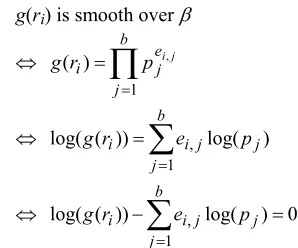
ei,jt 0, for each pjE. Then we have
g(ri) is smooth over E
b
j e j
i p ij
r g
1
, )
(
¦
b
j
j j i
i e p
r g
1
, log( )
)) ( log(
log( ( )) log( ) 0
1 ,
¦
b
j
j j i
i e p
r
g .
The result can be applied to the sieving procedure as follows. First, an array of size 2G is allocated, and let the array elements be M[1], M[2], …, M[2G]. Assign the logarithm of g(ri) for each ri to M[i], i.e., M[ri + G] = log(g(ri)). For every riSo,t and 1 – G dridG, log(pk) is subtracted from M[ri + G] where tdto. This procedure is performed for every odd prime pkE. Similarly, if g(ri) is divisible by 2 at most t' times, t'log(2) must be subtracted from M[ri + G]. As a matter of fact, t' can be easily determined by scanning g(ri) from the least significant bit towards the most significant bit until the first 1 bit is found. In the end, all the M[i]’s are scanned for which M[i] = 0 and thus we know which g(ri) is smooth over E.
D. Parallel Sieving
In order to make the MPQS more practical, we use 32 workstations to parallelize the sieving procedure. Each workstation is equipped with AMD Athlon XP 2700+ CPU (running at 2.2 GHz on average), 2 GB memory and 512 MB disk space total. The installed operating system is RedHat Linux 9.0. We divide the sieving interval into several subintervals, and each workstation using different quadratic polynomial functions sieves over a different subinterval. That is, the jth workstation uses the coefficient dh satisfying that dh is prime and dh = 4(kt + j) + 3 where t is the number of total workstations, 1djdt, and kZ. The only constraint is that t can not be a multiple of 3. The execution time of factoring larger numbers in the range of 80-100 digits is shown as Table 1.
Although the estimated running time by using 32 workstations is not 32 times faster than that by using one PC, the parameters of our enhanced method (such as the size of the factor base and the length of the sieving interval) are benefit to reduce the overall running time and the computation complexity is actually lower.
V. CONCLUSIONS
In this paper, we have presented our study on the MPQS for simulating the parallel RSA factorization. By optimizing the size of the factor base and the length of the sieving interval, the computation complexity of our enhanced version is lower as compared with the original MPQS, which helps reducing the overall running time.
The experimental results are contributive to the analyses of the strength of the RSA assumption against the modern computer technology and should be taken into consideration on future cryptographic implementations based on the RSA cryptosystem.
TABLE 1.
EXPERIMENTAL RESULTS FOR ESTIMATED RUNNING TIME
log10(n) / log2(n) Original MPQS
by one PC
Enhanced MPQS by 32 workstations
50 / 166 0.16 (hours) N.A.
80 / 266 22 (hours) 1.4 (hours)
82 / 272 36 (hours) 3.4 (hours)
85 / 282 72 (hours) 6.7 (hours)
90 / 299 210 (hours) 11.3 (hours)
100 / 332 80 (days) 6.6 (days)
110 / 365 N.A. 49 (days)
REFERENCES
[1] O. Bretscher, Linear Algebra with Applications, 3rd Ed., Prentice Hall, 2004.
[2] W. Diffie and M. Hellman, “New directions in cryptography,” IEEE Transactions on Information Theory, Vol. IT-22, No. 6, 1976, pp. 644-654.
[3] J.D. Dixon, “Asymptotically fast factorization of integers,” Mathematics of Computation, Vol. 36, No. 153, 1981, pp. 255-260.
[4] S.H. FriedBerg, A.J. Insel and L.E. Spence, Linear Algebra, 4th Ed., Prentice Hall, 2002.
[5] R. Kumanduri and C. Romero, Number Theory with Computer Applications, 1st Ed., Prentice Hall, 1997. [6] A.K. Lenstra and H.W. Lenstra (eds.), The development of
the number field sieve, Lecture Notes in Mathematics, Vol. 1554, Springer-Verlag, 1993.
[7] A. Menezes, P. Oorschot and S. Vanstone, Handbook of applied cryptography, CRC Press, Inc., 1997.
[8] P.L. Montgomery, “A block Lanczos Algorithm for finding dependencies over GF(2),” Advances in Cryptology EUROCRYPT’95, Springer-Verlag, 1995, pp. 106-120. [9] J.M. Pollard, “Theorems on factorization and primality
testing,” Proceedings of the Cambridge Philosophical Society, Vol. 76, No. 2, 1974, pp. 521-528.
[10] C. Pomerance, “The quadratic sieve factoring algorithm”,
Advances in Cryptology EUROCRYPT’84, Springer-Verlag, 1985, pp. 169-182.
[11] C. Pomerance, Cryptology and Computational Number Theory; Factoring, AMS, Providence, RI, 1990.
[12] H. Riesel, Prime Numbers and Computer Methods for Factorization, 2nd Ed., Boston, 1994.
[13] R. Rivest, A. Shamir and L. Adleman, “A method for obtaining digital signatures and public-key cryptosystems,” Communications of the ACM, Vol. 21, No. 2, 1978, pp. 120-126.
[14] R. Silverman, “The multiple polynomial quadratic sieve,”
Mathematics of Computation, Vol. 48, No. 177, 1987, pp. 329-339.
[15] D.R. Stinson, Cryptography: Theory and Practice, 2nd Ed., CRC Press, 2002.
finite fields”, IEEE Transactions on Information Theory, Vol. IT-32, No. 1, 1986, pp. 54-62.
Yi-Shiung Yeh received his M.S. and Ph.D. degrees in Department of Electrical Engineering and Computer Science from University of Wisconsin-Milwaukee, U.S.A. in 1980 and 1986, respectively. He died as a professor in the department of Computer Science, National Chiao Tung University, Taiwan in 2007. His research interests include Data security & Privacy, Information & Coding Theory, Game Theory, Reliability, and Performance.
Ting-Yu Huang received his B.S. degree in electrical engineering from National Central University, Taiwan in 1990, and his M.S. degree in computer science and information engineering from National Chiao Tung University, Taiwan in 2001. Now he is a doctoral candidate in the Department of Computer Science of National Chiao Tung University, Taiwan. His research interests include Cryptanalysis and Communication Protocols.
Han-Yu Lin received his B.A. degree in economics from the Fu-Jen University, Taiwan in 2001, and his M.S. degree in information management from the Huafan University, Taiwan in 2003. Now he is a doctoral student in the Department of Computer Science of National Chiao Tung University, Taiwan. His research interests include Cryptography and Network Security.