Vol. 5, Issue 3, March 2017
A Review on “Design and Analysis of
Frequency Reconfigurable Microstrip Patch
Antenna”
Sanket Kalamkar
P.G. Student, Department of Electronics & Telecommunication Engineering, Savitribai Phule Pune University
G.H.Raisoni College of Engineering and Management, Ahmednagar, Maharashtra, India
ABSTRACT: The concept of reconfigurability in antennas and their types are discussed in detail in this paper. The increasing demand for high data rate and new wireless communication has led to the development of multifunctional devices including antennas and radio frequency (RF) front ends. The novel solution is to design antennas which has multiband, multimode, low profile, low cost and easy to integrate with portable devices. This leads to designing of an antenna which can be reconfigure by means of its frequency of operation, radiation patterns and/or pattern reconfiguration. A study on frequency reconfigurable antenna is carried out in this research article.
KEYWORDS: Microstrip Patch Antenna; Frequency Reconfiguration, PIN diodes; Dielectric substrate
I. INTRODUCTION
Antennas are our electronic eyes and ears on the world. They are our links with space. They are an integral part of our civilization. Antennas have been around for a long time, millions of years, as the organ of touch. But in the last 100 years they have acquired a new significance as the connecting link between a radio system and the outside world. With rapid growth in wireless communication an antenna as a front component is required to have a wide band, good radiation performances and sometimes switchable ability[1-2]. Recently multifunctional antennas with controllable features like frequency tuning, pattern reconfigurability, polarization reconfigurability, or hybrid antenna received much attention as it can fulfil demand for low profile antennas for different services in just single terminal. The recent explosion in commercial applications involving RF and microwave systems is fueling customer demand for small, low-cost, easy-to-use systems.
Arguably, nine different types of antennas have proliferated during the past 50 years in both wireless communication and radar systems. These nine varieties comprise dipoles/monopoles, loop antennas, slot/horn antennas, reflector antennas, microstrip antennas, log periodic antennas, helical antennas, dielectric/lens antennas and frequency-independent antennas. Each category possesses inherent benefits that make them more or less suitable for particular applications. A single wireless devices can work for many wireless services such as GPS, GSM, WLAN, Bluetooth, etc. To make these devices low profile and more functional reconfigurable antennas are needed. The intentional redistribution of the currents or electromagnetic fields of antennas aperture can be used to change the impedance or radiation properties to introduce reconfigurability in the antennas.
II. BACKGROUND OF RECONFIGURABLE ANTENNA
advantages. For instance, the ability to tune the antenna’s operating frequency could be utilized to change operating bands, filter out interfering signals, or tune the antenna to account for a new environment. If the antenna’s radiation pattern could be changed, it could be redirected toward the access point and use less power for transmission, resulting in a significant savings in battery power the antennas are mostly used in array configuration, feed structures with power dividers/combiners and phase shifters. For instance, current planar phased array radar technology is typically limited in both scan angle and frequency bandwidth as a result of the limitations of the individual array elements and the restrictions on antenna element spacing. This restriction comes from mutual coupling effect on one hand, appearance on grating lobe on other hand. Many of these established applications assume that the antenna element pattern is fixed, all of the elements are identical, and the elements lie on a periodic grid. The addition of reconfigurability to antenna arrays can provide additional degrees of freedom that may result in wider instantaneous frequency bandwidths, more extensive scan volumes, and radiation patterns with control on side lobe distributions [3].
There are several antenna structures that are suitable for implementation of reconfigurable antennas, among them microstrip patch antennas are very attractive structures for various types of reconfigurable antennas, all such antennas are usually equipped with switches that are controlled by DC bias signals. Upon toggling the switch between on and off states, the antenna can be reconfigured [4].
III.RECONFIGURABLE ANTENNAS
Reconfigurability, when used in the context of antennas, is the capacity to change an individual radiator’s fundamental operating characteristics through electrical, mechanical, or other means. Thus, under this definition, the traditional phasing of signals between elements in an array to achieve beam forming and beam steering does not make the antenna “reconfigurable” because the antenna’s basic operating characteristics remain unchanged in this case. Ideally, reconfigurable antennas should be able to alter their operating frequencies, impedance bandwidths, polarizations, and radiation patterns independently to accommodate changing operating requirements. Reconfigurable microstrip antennas have the potential to add substantial degrees of freedom and functionality to mobile communication applications and electronic intelligence. This is achieved mainly by electronically reconfiguring the antenna parameters like radiation pattern, polarization or resonant frequency. In pattern reconfigurable microstrip antennas, operating frequency and bandwidth is maintained while changing radiation patterns. Manipulation of an antenna radiation patterns can be used to avoid noise sources or intentional jamming, improve security by directing Signals only towards intended users and serves as a switched diversity system. Polarization reconfigurable microstrip antennas are utilized mainly in frequency reuse for doubling the system capability in satellite communication systems. Reconfigurable antennas have become more attractive with the increased demand for multiband antennas. They provide more levels of functionality to a system by eliminating the need for complicated wideband antenna solutions.
Common antenna designs not involving reconfigurability impose restrictions on the system performance because of their fixed structure. Reconfiguring antennas can enhance their performance by providing the ability to adapt to new operating scenarios. There are several methods that rely on geometry reconfiguration for the tuning of the operating frequency of a particular antenna design, including varactor and PIN diodes, and the use of optically activated switches by fiber optic cables. Many antennas have been designed to maintain their radiation characteristics by using self-similar structures, while changing the aperture dimensions for a different operating frequency. Other design consists of using a linear dipole antenna that is shortened to a specific length to operate at a higher frequency. In the reconfigurable dipole case the radiation pattern stays the same because the antenna current distribution will be the same relative to the wavelength of the resonant frequency [5].
Some reconfigurable antenna applications change the radiation pattern but maintain the same resonant frequency. This concept can enhance a system’s ability to null jamming, or undesirable noise sources by directing the energy to the intended user. The development of these antennas poses significant challenges to both antenna and system designers. These challenges lie not only in obtaining the desired levels of antenna functionality but also in integrating this functionality into complete systems to arrive at efficient and cost-effective solutions. As in many cases of technology development, most of the system cost will come not from the antenna but the surrounding technologies that enable reconfigurability [6].
Vol. 5, Issue 3, March 2017
Fig.1- Reconfigurable Antenna
Techniques
Fig.2 - Basic design of the reconfigurable antenna for two frequencies
IV.ANTENNA SWITCHING TECHNOLOGIES
Types of Switches
A. RF MICRO ELECTRO-MECHANICAL SWITCHES (RF- MEMS)
RF MEMS (micro electromechanical) switches are introduced in the past decade as the elements. Basically, they are a miniature version of a standard mechanical switch. The fabrication technology of the RF MEMS switches has a lot in common with the fabrication technology of VLSI circuits as it works in a very low power and functions as transducers or sensors in a very small size replacing large circuits. This device works on the principal of mechanical movements to short circuit or open circuit in the surface of antenna structure and redistributing surface current path. Magnetostatic, electrostatic, piezoelectric, or thermal designs are used for the force applied to do mechanical movement.
Fig 3- RF MEMS B. PIN DIODE
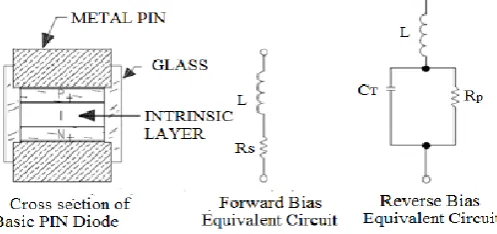
A PIN diode behaves as a current-controlled resistor at radio and microwave frequencies. Like the conventional PN diode, it allows current flow in one direction when forward biased, but not in the other when it is reverse biased. This functionality is a simple and critical functional block of many circuits spanning DC to RF. However, unlike the PN diode, the PIN diode has an "intrinsic" layer sandwiched between its P and N layers. While the device physics are complex, the result is a controllable switching action with a twist. When the PIN diode is forward biased it allows RF energy to flow, and when reverse biased it blocks RF energy. This is the basis for using the PIN diode in a wide variety of RF switch topologies. The electrical model of the PIN diode looks like an inductor in series with a resistor when forward biased. When reverse biased, it looks like an inductor in series with a paralleled capacitor and resistor (Figure 4). The specific values of the passive elements in these models depend upon the PIN diode model.
Vol. 5, Issue 3, March 2017
Electrical
properties
RF MEMs
PIN diodes
Voltage(V)
20-100
3-5
Current(mA)
0
3-20
Power
consumption
0.05-0.1
5-100
Switching speed
1-200 μsec
1-100 nsec
Isolation(1- 10
GHz)
Very high
High
Loss(1 - 10
GHz)[dB]
0.05-0.2
0.3-1.2
Table 1 - Difference between RF MEMS Switches and PIN Diodes
Other than MEMS and PIN diodes other switches can also be used in designing of reconfigurable antenna like Varactor diodes, optical switches, Field Effect Transistor (FET) Switches.
V. SIMULATION TOOLS
For EM simulation variety of tool available in the market they called as Computational electromagnetic modeling (CEM) software is widely used to model antennas, microwave circuits, circuit boards, components, shielded enclosures, cables, motors, sensors, actuators and a wide variety of electrical and electronic devices. Few of simulation tools are listed below
A. ANSYS HFSS - High Frequency Electromagnetic Field Simulation
It was originally developed by Professor Zoltan Cendes and his students at Carnegie Mellon University. ANSYS HFSS software is the industry standard for simulating 3-D, full-wave, electromagnetic fields. Its gold-standard accuracy, advanced solvers and high-performance computing technologies make it an essential tool for engineers tasked with executing accurate and rapid design in high-frequency and high-speed electronic devices and platforms. HFSS offers state-of the-art solver technologies based on finite element, integral equation, asymptotic and advanced hybrid methods to solve a wide range of microwave, RF and high-speed digital applications is a very popular and powerful simulation package for electromagnetic solutions. It utilizes the Finite Element Method to create mesh grids around the model and solves for a given frequency. The results prove that HFSS is versatile for most configurations. However, there are also some disadvantages. Firstly, the stability of the software is not very good when calculating large-sized, intricate structures. Secondly, the creation of the feeding port is complicated compared with other software.
B. CST - Computer Simulation Technology
can cover a wide frequency band with one single simulation run. It is also quick and suitable for non-uniform models. However, results from CST do not closely fit for configurations with a large range of dimensions, such as a half wavelength dipole using an impractically thin wire for example. This is because of CST’s sensitivity to extremely small mesh grid settings.
C. Keysight’s ADS - Advanced Design System
Advanced Design System is the leading electronic design automation software for RF, microwave, and high speed digital applications. In a powerful and easy-to-use interface, ADS pioneers the most innovative and commercially successful technologies, such as X-parameters and 3D EM simulators, used by leading companies in the wireless communication & networking and aerospace & defense industries. For WiMAX™, LTE, multi-gigabit per second data links, radar, & satellite applications, ADS provides full, standards-based design and verification with Wireless Libraries and circuit-system-EM co-simulation in an integrated platform. ADS provides complete schematic capture and layout environment, Innovative and industry leading circuit and system simulators , Direct, native access to 3D planar and full 3D EM field solvers etc.
Other than these IE3D, CADFEKO, Microwave office tools can also be used as computational electromagnetic modeling (CEM) to design antenna.
VI.CONCLUSION AND FUTURE WORK
A single reconfigurable antenna can be used in various wireless applications such as cognitive radio, satellite communication, mobile radio and medical applications etc. In this paper different reconfiguration techniques are studied. Reconfigurable antennas are more efficient because single antenna can be operated with different modes like frequency, polarization, radiation pattern etc. It is suitable for single antenna to use for multi applications. It provides more efficient communication with minimum cost and fewer complexities.
REFERENCES
1. C.A. Balanis, ― “Antenna Theory analysis and Design, 4th edition” John Wiley & Sons, New York.
2. Yang, F., and Rahmat-Samii, “Patch antennas with switchable slots (PASS) in wireless communications: concepts, designs, and applications”, IEEE Antennas Propag. Mag., 2005, 47, (2), pp. 13–29
3. H. Idris, M. R. Hamid, M. H. Jamaluddin, M. K. A. Rahim1, H. A. Majid “Multiband Reconfigurable Antenna for 2.4 GHz, 3.5 GHz & 5.2 GHz Applications ”, IEEE Symposium on Wireless Technology and Applications (ISWTA), September 22-25, 2013.
4. J. T. Bernhard- “Reconfigurable Antennas”, Morgan & Claypool Publishers, 2007.
5. Songnan Yang, Chunna Zhang, Helen K. Pan, Aly E. Fathy, and Vijay K. Nair “Frequency-Reconfigurable Antennas for Multi radio Wireless Platforms” IEEE microwave magazine, February 2009.
6. T. Kolsrud, M.-Y. Li, and K. Chang, “Dual-frequency electronically tunable CPW-fed CPS dipole antenna”, Electronics Letters, vol. 34, pp. 609-611, 1998.
7. Anjum Asma and Gihan Nagib, “Energy Efficient Routing Algorithms for Mobile Ad Hoc Networks–A Survey”, International Journal of Emerging Trends & Technology in computer Science, Vol.3, Issue 1, pp. 218-223, 2012.
8. Hong-Ryeol Gil1, Joon Yoo1 and Jong-won Lee2, “An On-demand Energy-efficient Routing Algorithm for Wireless Ad hoc Networks”, Proceedings of the 2nd International Conference on Human. Society and Internet HSI'03, pp. 302-311, 2003.
BIOGRAPHY