63
International Journal in Physical and Applied Scienceshttp://ijmr.net.in, Email: [email protected]
A COMPARATIVE STUDY OF FLEXIBILITY VARIABLES
OF DIFFERENT LEVEL TARGET BALL PLAYERS
Author
Sonu Sharma
Research Scholar, Department of Physical Education, Swami Vivekanand University, Sagar, M.P.
Dr. Santoshi Ramkrishna Saulkar, department of Physical Education, Swami Vivekanand University, Sagar, M.P.
Abstract
In the present study, an attempt has been made to compare fitness variable namely
flexibility between national Targetball players and state Targetball players. The study was
carried out on 100 men Targetball players (50 national Targetball players and 50 state
Targetball players who participated in National and state Tournaments). The data was
collected by use of measurements of flexibility as well as by application of test like wet sit
and reach. The data was analyzed and compared with the help of statistical procedures in
which arithmetic mean, standard deviation (S.D.), t-test were employed. National Targetball
players and State Targetball players flexibility was found significantly national level
Targetball players whereas state level Targetball players showed significantly lower values in
flexibility.
Keywords- flexibility, national Targetball players, state Targetball players. Introduction
Targetball is an exciting, fast and skillful game of fair contest. It is a game in
which two teams of six players each strive to keep or gain possession of the ball. The team
with the ball, through running, jumping, throwing and catching, attempts to move the ball
into its goal circle from where a target may be scored, while the opposing team uses
defensive movements and strategies to prevent this and to gain possession. The team with the
greater number of goals is the winner of the match. Players have specified areas in which
64
International Journal in Physical and Applied Scienceshttp://ijmr.net.in, Email: [email protected]
Flexibility : The ability to achieve an extended range of motion without being impeded by excess tissue , i.e. fat or muscle (e.g. executing a leg split)
It is important to include flexibility training as part of your clients’ regular fitness routines.
Improved flexibility may enhance performance in aerobic training and muscular conditioning
as well as in sport. There is scientific evidence that the incidence of injury decreases when
people include flexibility training in their routines due to the enhanced ability to move
unimpeded through a wider ROM. The only exception to this would be when there is an
excessive or unstable ROM, which may increase the likelihood of injury. When used
appropriately, flexibility training allows clients to become more in tune with their body. It is
a form of active relaxation that can improve both mental and physical recovery.
Flexibility Techniques
To increase or restore muscle ROM, it is necessary to overload the muscle with flexibility
training. To improve joint ROM, it is necessary to lengthen the muscle and surrounding
connective tissue in safe and effective ways.
Two main methods of flexibility training (static and dynamic) can be used, but all types of
flexibility training will be more effective after a thorough warm-up, when the body
temperature is elevated.
SAMPLING PROCEDURE
In this study, only those Targetball players were selected, who had participated in
national and state level Targetball tournaments. The players falling under the age between 18
and 25 years were studied. The state and national level performance of the players was
conformed from the coaches and state secretaries, on the basis of whom some players were
recorded before the competition also, but later on they were classified as per their
65
International Journal in Physical and Applied Scienceshttp://ijmr.net.in, Email: [email protected]
Analysis of Flexibility-
Table.1
Descriptive statistics of the data measured in Flexibility
variable Group N Mean S.D. S.E.D.
Flexibility National level
Targetball players
100 39.26 4.14 0.32
State level
Targetball players
100 36.58 4.11
0.33
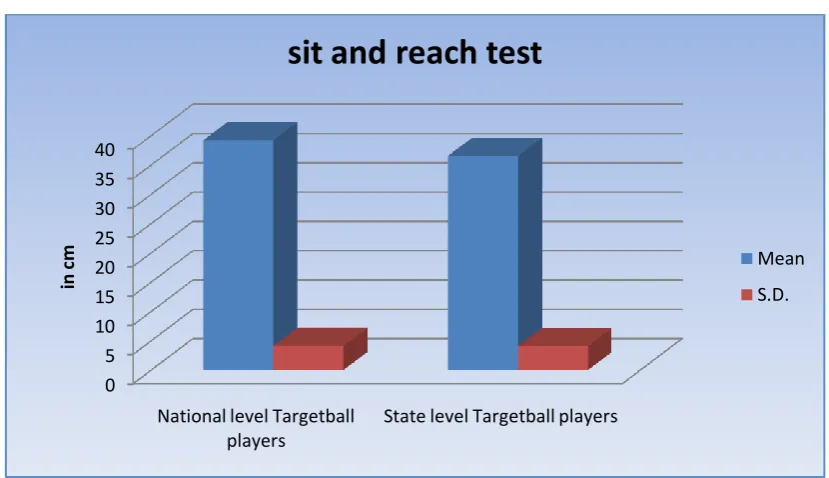
Table no.1 indicates the values of descriptive statistics of the National level Targetball
players and State level Targetball players for Flexibility, which shows that the mean and S.D.
values of National level Targetball players and State level Targetball players was found to be
39.26±4.14 and 36.58±4.11 respectively. Above table also indicates the S.E.D values of
National level Targetball players and State level Targetball players were found to be 0.32 and
0.33 respectively
Table No.2
Comparison of Flexibility between National level Targetball players and State level Targetball players
Variable F-value T Sig.
Flexibility 2.53 1.98 0.01
Table no.2 indicates the independent t-test values of National level Targetball players and
State level Targetball players for Flexibility. The National level Targetball players and State
level Targetball players t-value was found to be 1.98, which shows that there were significant
difference in National level Targetball players and State level Targetball players of
66
International Journal in Physical and Applied Scienceshttp://ijmr.net.in, Email: [email protected]
Figure no.-1
Bar Diagram showing the mean value of Flexibility between National level Targetball players and State level Targetball players
Conclusion-
The flexibility value was found significantly higher value of national level Targetball
players whereas state level Targetball players showed significantly lower values in flexibility.
It is suggested that a longitudinal study with the subjects employed in this research
work may be carried out in order to find the changes in contributing variables and their effect
on the performance of Targetball players.
National performance in sports depends upon many factors such as psychological,
sociological, physiological, physical fitness etc. These variables should be incorporated in
similar studies to know the relationship of these variables with physical fitness variables and
performance.
0 5 10 15 20 25 30 35 40
National level Targetball players
State level Targetball players
in
c
m
sit and reach test
67
International Journal in Physical and Applied Scienceshttp://ijmr.net.in, Email: [email protected]
References-
Best, J.W. (1977) Research in Education. New Delhi, Prentice Hall of India (Pvt.)
Ltd.
Ary (1972) Introduction to Research in Education. New York: Holt Rinehart and
Winstom, 56.
Carer, J.E L. (1970) Somatotype of Athletes-A review. Human Biol., 42:466 cf Sodhi,
H.S. Sports Anthropometry. Anova Publication, Mohali, Ropar: pp-30.
Arnason, A., Sigurdsson, S. B., Gudmundsson, A., Holme, I., Engebretsen, L., &
Bahr, R. (2004). Physical fitness, injuries, and team performance in soccer. Medicine
& Science in Sports & Exercise, 36(2), 278-285.
Gill, M., Deol, N. S., & Kaur, R. (2010). Comparative study of physical fitness
components of rural and urban female students of Punjabi University, Patiala. The