R E S E A R C H
Open Access
Opportunistic wireless network coding with relay
node selection
Jangseob Kim and Jungwoo Lee
*Abstract
Broadcasting nature of wireless communications makes it possible to apply opportunistic network coding (OPNC) by overhearing transmitted packets from a source to sink nodes. However, it is difficult to apply network coding to the topology of multiple relay and sink nodes. We propose to use relay node selection, which finds a proper node for network coding since the OPNC alone in the topology of multiple relays and sink nodes cannot guarantee network coding gain. The proposed system is a novel combination of wireless network coding and relay selection. In this paper, with the consideration of channel state and potential network coding gain, we propose several relay node selection techniques that have performance gain over the conventional OPNC and the conventional channel-based selection algorithm in terms of average system throughput.
1 Introduction
Channel coding concept is used to mitigate the influence of noise and interferences in the physical layer. In [1], it was also shown that we can get coding gain in higher layers. Compared to the routing and scheduling techni-ques that are devised to prevent bottlenecks of packets from different senders, Alswede et al. [2] showed a way of making use of this disadvantage and showed that the achievable rate can be increased by applying certain in-network processing at an intermediate node when packets are received at the node simultaneously. This type of in-network processing is called in-network coding. Routing can be treated as a special case of network coding which is a simple permutation. Network coding has received atten-tion since it can enhance system throughput and reliabil-ity. For throughput, network coding technique can take advantages of bottleneck effect of data at the intermediate node in wireless communication to improve the system throughput [3]. Ghaderi et al. [4] have shown that there are reliability benefits by applying network coding techni-que in their system. Li et al. [5] show that the maximum achievable rate can be achieved by linearly combining input packets at an intermediate node. Random linear net-work coding [6] (RLNC) and opportunistic netnet-work cod-ing [7] (OPNC) have been known as one of practical implementations. RLNC randomly chooses elements from
a finite field as the coefficients for a linear combination of packets.
OPNC performs bitwise XOR operation of packets that are selected by reception report. RLNC is suitable for the distributed system, and no reception report is needed since it contains all the information in the header to decode the received packets at the receiver node. However, as the number of hops or the number of participants increases, the length of the header also increases, which might degrade the throughput. Although OPNC needs extra report, the portion is not significant compared to the original information, and the implementation of coding and decoding is simple. As a practical implementation of OPNC, Katti et al. [7] introduced a scheme, COPE, that takes advantage of broadcasting nature of wireless communications.
COPE employs practical network coding technique for unicasts in wireless mesh networks to improve total throughput. They showed through experiments that with OPNC in the system, there exist significantly improve-ments in throughput of wireless networks with UDP traf-fic. Recently, Fang et al. [8] gave an analysis of COPE and argue that the key to COPEs success lies in the interaction between COPE and the MAC protocol. How MAC proto-col deals with competing nodes in a given network plays an important role in performance improvement. In this paper, we consider the following two factors: one factor is the channel state information, which can affect the perfor-mance of a system, and the other factor is how to deal * Correspondence: [email protected]
School of Electrical Engineering, Seoul National University, Seoul, Korea
with multiple intermediate nodes, which can perform net-work coding simultaneously. This kind of netnet-works, with-out certain decision methods at the intermediate nodes, cannot guarantee the throughput gain by using network coding in the system as in [7].
An uplink model that consists of multiple users, multi-ple relays, and a single base station (receiver) was used in [9], which proposed finite field network coding with super-position coding at the relay nodes. In [10] which uses the same uplink system model, they replaced the relay nodes with a set of user nodes. With the multi-user cooperative communication system, they proposed a diversity network coding scheme over finite fields. In [11], a down link model was considered, and it consists of a single transmit-ter base station, a single relay node, and multiple receiving user nodes. They proposed an instantaneously decodable binary network coding scheme and showed its improved transmission efficiency compared to the existing ARQ and network-coding-based schemes. Bletsas et al. [12] dealt with a cooperative communication system consisting of single source node, single sink node, and multiple relay nodes and introduced a distributed network path selection algorithm which performs opportunistic relaying by using an objective function based on the channel states at the relay nodes.
In this paper, we consider a system model that includes multiple relay nodes and multiple sink nodes. With this system model, we combine the opportunistic relaying with network coding and propose a relay selection measure which considers the channel state between the relays and the destination nodes. We compare the performance of proposed algorithms with conventional OPNC and oppor-tunistic relaying in terms of throughput. The rest of this paper is organized as follows. The system model is described in the section of system model and scenario. In the section of proposed relay selection techniques for net-work-coded transmission, we propose several relay selec-tion schemes for network-coded transmission. The performance of these schemes is compared with the con-ventional relay selection schemes. The results are verified by simulations in the section of simulation results, and we draw our conclusions in the last section.
2 System model and scenario
The system scenario and the system model are intro-duced in this section. A source node has packets that need to be delivered to different destinations. There are multiple relay nodes, some of which might have better channels to the destination than the channel between the source and the destination. After the source broadcasts the packets, some packets may not reach their destina-tion nodes successfully, and it is needed to retransmit the missing packets. Since some destination nodes overhear the packets which are sent to other destination nodes,
network coding can be effective in this scenario. With network coding and relay selection, the best intermediate node for retransmission is selected.
2.1 Transmission from source to neighbor nodes
We have a source nodeS, a set of relay nodesR, and a set of sink nodes D. Assume that S has n packets to transmit to corresponding sink nodes (i.e., Sa = {a1 ...
an}),Rincludelnodes (R= {r1...rl}), andDincludesm elements (D= {d1 ... dm}). Each packet ai Î Sa has its own destination address to be delivered. We assume all nodes inRand Dare within communication range from
S. At first, the source nodeS broadcastsnpackets to all the nodes in its range. Every neighbor node is assumed to be able to overhear data traffic of other nodes as in OPNC and stores all the overheard packets in its buffer. A relay noderjreceives a set of packets, aj, and a sink node di gets a set of packets, bi. Both ajs and bis are subsets of the original npackets. (n≥|bi|, |aj|,∀diÎD and∀rjÎ R).
After the source transmission is over, there may be packet loss at sink nodes due to a poor channel between source and those nodes. Hence, we need retransmissions for those missing packets. If the source retransmits data, the packet loss may occur again. If there exists a relay node (rj) with better channel response than the source nodeS, it may be better forrj to retransmit the packet to the destination. It is assumed that the relay set R
receives all the packets that the source sent. We then have
∪{αj|∀rj∈R}=Sα. (1)
This means that the union of packets of all relay nodes is identical to the set of all the packets from the source S. The number of packets from the source (n) should be less than the buffer size to prevent overflow. When nis larger than the buffer size, we can divide n
packets into a number of groups as in a practical RLNC scheme [13].
Next, it will be shown that the probability to satisfy (1) is close to 1 in the high SNR regime. Let h0 be an event that at least one node in R correctly receives a packet from the source and h0c be the complement of h0. The relationship between two events is
P(η0) = 1−P(η0c). (2)
where P(·) is the probability. Assume the channel response is independent, then P(h0c) means that no node inRreceives a correct packet. We have
P(η0c) =εpl (3)
whereεpis the packet error rate given byεp= 1 (1
of M-QAM, and N is the number of symbols in a packet. We can calculate the lower bound ofP(h0) using the upper bound ofεs,Mfrom [14]. We then have
where M is the modulation order of QAM, k= log2
M, Ebav is the bit energy, andN0 is the noise variance. Note that the upper bound in (4) is for an AWGN channel. By plugging (3) and (4) into (2), we can calcu-late P(h0). If npackets are transmitted, the probability that there is at least one relay node which receives each packet is simply thenth power of (2) since the channel is independent. Let us denote the event that satisfies (1) byh1.
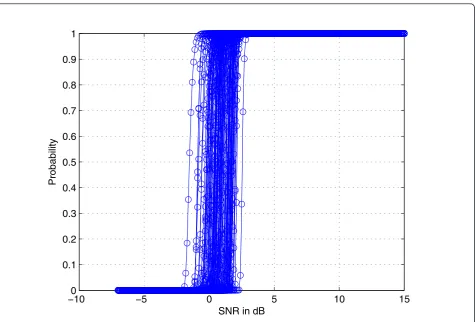
where Es is the symbol energy, h is the channel response, Ps is the symbol transmit power, B is the channel bandwidth, and Rsis the symbol rate. From (2) to (5),P(h1) is lower-bounded by MHz, 16-QAM,Rs= 2 bps, and Rayleigh fading channel for h. The plots indicate that the probability of having at least one relay node with a correctly received packet approaches to 1 at high SNR. Therefore, it is enough for the relays instead of the source to retransmit data.
2.2 Retransmission procedures
2.2.1 Reception report from the destinations to the relays
Each of relay and destination nodes operates in opportu-nistic listening mode which stores every received packets for a given period regardless of the destination. The storing period is a system dependent variable (500 ms in [7]). After the source transmission, each destination di
Î Dcreates a report packet and sequentially broadcasts it to all the relays. Since there are multiple sink nodes inD, each sink node uses a random access method such as CSMA/CA to avoid collision. The report packet is sent to the source and the relay nodes. The information in the report packet consists of the source node ID, the current node ID, multiple original sink node IDs of received packets, and pilot signal as shown in Figure 2.
The portion of report packet is not significant compared to the information packet as indicated in [7]. Let us denote the number of packets at the source node by n, which is known to all the nodes. The report packet con-sists of a pilot, a source node ID, a current sink node ID, and the destination sink IDs of the |bi| received (stored) packets. We assume that the IDs are repre-sented by 64 bits as in the IPv4 format. Let us denote the pilot size byl1, the packet size by l2, and the num-ber of network-coded packets by l3. A packet then needs at least 64 +nlog2n+l1bits. Before the retrans-mission from a relay node to its destinations, the relay receives m report packets, where m is the number of sink nodes. The ratio (r) of the overhead due to the report packets is is performed at a packet level instead of a symbol level, and the overhead of the report packets is not too signifi-cant compared to the overall data traffic as can be seen in the example. The report packet transmitted from each sink node is overheard by each node inR. Based on the information in these report packets, each relayrj
Î Restimates the channel state to each destination and calculates the objective function which will be used for selecting the retransmitting node in a distributive manner.
2.2.2 Retransmission procedure from a relay node
system performance such as throughput. To improve the throughput, we need to modify the selection rule by considering the channel state. We will define an objec-tive function which depends on the number of packets that can be network-coded as well as the channel state, and the retransmission node will be chosen by this function.
Opportunistic relaying was introduced in [12], which proposed a distributed relay selection algorithm for a system which has multiple relays and single sink node. The basic idea is that each relay node sets up an inter-nal timer which triggers transmission. This timer is a function of the channel responses of source-relay and relay-sink pairs, and it is given by
Ti=
c
hi (9)
whereTiis the timer function of the relayRi, andcis a constant. There is possibility of hidden node problem, which can be mitigated by adjusting the constant c in (9). Another method to reduce the hidden node effect is that we use the minimum channel response instead of harmonic mean value [12]. Hence, hi is defined as a minimum of the channel responses ofS -RiandRi -D, which is given by
hi= min(hSRi 2,h
RiD
2). (10)
When the timer has expired, the relay node is expected to broadcast a channel reservation message to neighboring relays to prevent other relays from trans-mission. The relay whose timer expired first broadcasts a channel reservation message to the neighbors. Con-trast to [12], in our model, we do not need to consider
−100 −5 0 5 10 15
0.1 0.2 0.3 0.4 0.5 0.6 0.7 0.8 0.9 1
SNR in dB
Probability
Figure 1The probability that there exists a relay node which receives a given packet correctly approaches to 1 at high SNR.
Srce ID PS ID OS ID
1OS ID
2...
OS ID
| i|Pilot
the channel between the source and the relay node since only the relay performs retransmission. This will reduce processing delay in relay node selection. Based on this idea, we propose a new distributed relay node selection algorithm combined with OPNC for the topology of multiple relays and multiple sink nodes. If we use chan-nel state as the only variable to choose a relay node as in the opportunistic relaying algorithm, the system per-formance may be poor.
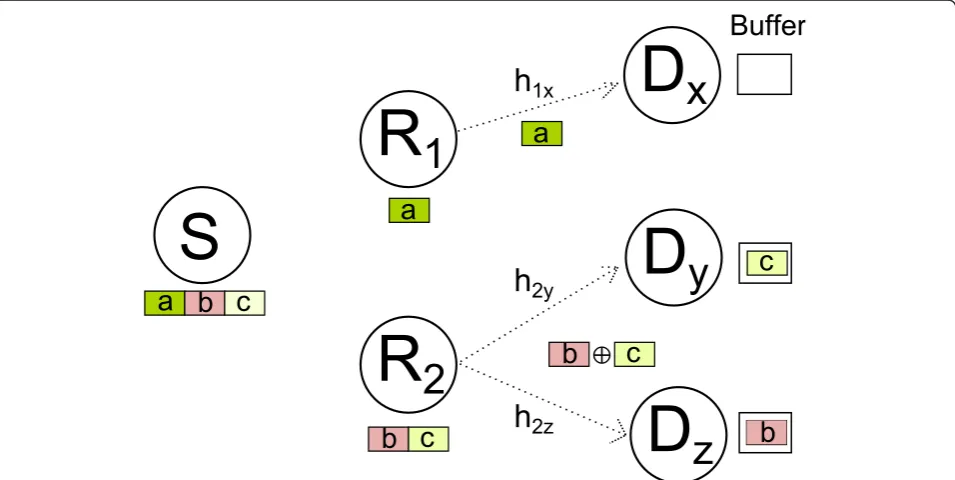
Figure 3 shows an example of overall system scenario. There are a single sourceS, 2 relays, and 3 sink nodes. Each relay node has different amount of packets to be delivered to its destinations. After the sourceS broad-casts, the relays (R1,R2) and the sink nodes (Dx,Dy,Dz) overhear packets and stored them in their buffer. The packets a, b, andc are sent toDx, Dy, andDz, respec-tively.R1 sends 1 packet toDx, andR2 sends 2 network-coded packets toDyandDzin one time frame. Suppose h1 =h1xand h2 = min(h2y, h2z). We can then calculate the theoretical throughputsR1andR2for the two chan-nels.
R1= log2
1+h12ρ
(11)
R2≥2log2
1+h22ρ
(12)
whereris the transmit signal-to-noise ratio. The mul-tiplication factor of 2 in (12) is due to the network cod-ing at R2, and the inequality is used because the larger
of the two channels has larger capacity than the capacity of the minimum channel. Suppose ∥h1∥ > ∥h2∥, then opportunistic relaying algorithm will chooseR1to trans-mit packet a to Dx. However, if (1 + ∥h2∥
2r
)2 > (1 + ∥h1∥2r), it may be better to choose R2 for retransmission.
3 Proposed relay selection techniques for network-coded transmission
In this section, we propose relay selection techniques for network-coded transmission, which is based on a timer function. Let us denote the minimum channel response at the jth relay node byhj, and the set of packets that can be network-coded by Kj. To improve throughput, we consider channel state information (hj) as well as the number of packets (∥Kj∥) that each rjcan deliver simul-taneously by network coding. We assume that the objec-tive function at the relay noderjis a function ofhjand
∥Kj∥, which is denoted by f(hj,∥Kj∥). The objective func-tion f is an increasing function of each variable. The minimum channel response (hj) from relay rjto a sink node is a modified version of (10) since only the relay nodes can retransmit. We then have
hj= min
∀i,di∈Dhji. (13)
The number of packets that thejth relay node rjuses to create a network-coded packet is denoted by ∥Kj∥. Both variables, hj and∥Kj∥, may vary from one frame to
R
1
R
2
D
x
D
y
D
z
h
1xh
2yh
2zS
a b c
c
c
b
b
a
c
b
a
Buffer
Figure 3An example for opportunistic network coding with relay selection. There is one source node, two relay nodes, and three sink nodes. The source has three packetsa, b, c, each of which has its own sink node address. Packetais destined toDx, and bothbandcare to
another. Thoughhjcan be defined differently from (13), Bletsas et. al. [12] empirically showed that it works well to use the minimum channel. Since the objective func-tion is proporfunc-tional to hjand∥Kj∥, a relay rjwhich has either larger channel response or larger number of pack-ets that can be network-coded will have high probability of using the channel. We can then define the internal timer value at the relay noderjas
Tj=
c f(hj,Kj)
. (14)
We will use the timer value in (14) in choosing a proper relay node for retransmission. This means that a node with smaller internal timer value will transmit ear-lier than other relays, which is a kind of decentralized selection scheme. We compare 5 relay selection algo-rithms using different internal timer functions. First, set the objective functionf as a modified version of oppor-tunistic relaying algorithm of [12]. In this case, the func-tion f at a certain relay node rj depends only on the channel states between the relay and its corresponding sink nodes (13). Those sink nodes are the destinations of the packets that can be network-coded among all overheard packets in rj. As mentioned before, we use only the channel between a relay node and a destination node unlike the original opportunistic relaying scheme of (10). Thus, the 1st kind of timer function for the modified opportunistic relaying algorithm is given by
TjA= c hj
= c
min∀i,di∈Dhji
. (15)
As in the method of OPNC in choosing the best net-work coding option to increase system throughput, we use only∥Kj∥ as a variable of the objective function. In this case, the 2nd kind of timer function is inversely proportional to∥Kj∥, which is given by
TjB=
c Kj
. (16)
This means that the relay whose ∥Kj∥ is the largest would occupy the channel.
Let us now we introduce sum rateRS
j which is given by
RSj = response, we can use RSj as a variable in the objective function. In (18), we use both ∥Kj∥ and RSj in the 3rd
kind of objective function. As RS
j has a channel-related
variable in it, the objective function considers the effect of channel and throughput simultaneously, and we have
TjC= c
Kjq∈Kjlog2(1+hjq
2ρ). (18)
In (18), we can replace the sum rate by the minimum channel. The 4th kind of timer function is given by
TjD= c Kjhj
= c
Kj(min∀i,di∈Dhji)
. (19)
The 5th kind of timer function is based on the mini-mum channelhjand the sum rate RSj which is given by
As we mentioned,c is an empirical constant to con-trol the collision among the relay nodes. Typically,chas a value of a few microseconds [12]. Each relay noderj usesTjas its internal timer value. A relay node whose internal timer expires first broadcasts a signal to neigh-bor relays to stop their transmission to reserve the channel, which is a first-come-first-serve policy. The sink nodes that successfully overhear the network-coded packets decode the packets using theirs own stored data and update their decoding results. After that, the sink nodes transmit report packets again. Until there are no more packets to be delivered from the relay nodes to the sink nodes, the procedure is repeated.
4 Simulation results
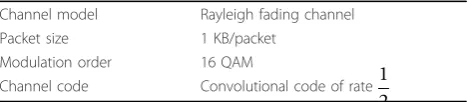
The simulation environment is summarized in Table 1. The channel from one node to another is modeled as independent Rayleigh fading channel. This is equivalent to the case where the relay nodes and the sink nodes are randomly distributed around the source node with equal distance. It is also assumed that the relay nodes and the sink nodes are within the communication range from the source node, and the feedback channel is error free. We use a large number of relay and sink nodes in the simulations to order to increase the possibility of network coding at the relay nodes.
4.1 Average transmission number
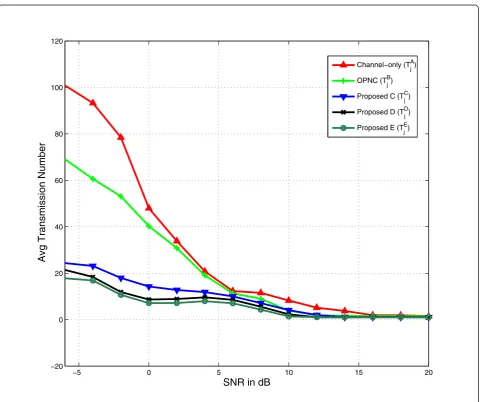
Five different timer function algorithms are compared in terms of average number of transmissions in Figure 4, where the number of relay nodes and the number of sink nodes are set to 50 and 50, respectively. The first
Table 1 Simulation environment
Channel model Rayleigh fading channel
Packet size 1 KB/packet
Modulation order 16 QAM
Channel code Convolutional code of rate1
two (A and B) algorithms are conventional ones, and the other 3 algorithms are proposed ones. At high SNR, all the curves converge to 1 (average number of transmis-sions), which is expected. Hence, we need to focus on the low SNR regime, where a larger number of retrans-missions is needed. Algorithm A (TjA) in Figure 4 is based on the opportunistic relaying algorithm of (15) which chooses a relay with the maximum channel amplitude hj from the relay nodes inR. Algorithms B through E (with the timer function TB
j throughTEj) in
Figure 4 are based on the timer functions of (16) through (20). From these results, it is observed that the relay node selection algorithm using the timer function of (15) needs the largest average number of transmis-sions, while the algorithm of (20) requires the least. Algorithm B (TB
j) based on the modified OPNC
algorithm chooses a relay node with the largest number of packets that can be network-coded. Note that this algorithm does not consider the channel response. If there occurs deep fading on the path from the chosen relay node to its sink nodes, it is highly likely that the selected node would fail to deliver the information. That may increase the total number of transmissions. Algo-rithm C (TjC) is based on the sum rate and the amount of packets to be network-coded (∥Kj∥). By using these two variables in the objective function, the performance is improved over the two previous algorithms. Algo-rithm D (TjDis based on ∥Kj∥and thehjsimultaneously, so Algorithm D can be thought of as a combination of Algorithms A and B. In Figure 4, it is observed that the performance of Algorithm D is better than previous three algorithms.
−5 0 5 10 15 20
−20 0 20 40 60 80 100 120
SNR in dB
Avg Transmission Number
Channel−only (T j A
)
OPNC (T j B
)
Proposed C (T j C
)
Proposed D (T j D
)
Proposed E (T j E
)
Algorithm E (TE
j) is based on the channel response and
the sum rate with the timer function (20). Compared to the modified OPNC algorithm (Algorithm B), the sum rate measure lowers the possibility of choosing a node whose channel responsehjis low. Compared to the mod-ified opportunistic relaying algorithm (Algorithm A), Algorithm E considers the sum rate as a measurement of throughput (related to∥Kj∥) so that this algorithm bal-ances the measures of∥Kj∥andhj. Figure 4 shows that Algorithm E has the lowest average number of transmis-sions especially in the low SNR regime. At the high SNR regime, the transmission from the source to the sink nodes would succeed with high probability as mentioned before. In other words, there is not noticeable difference between different algorithms at the high SNR regime.
4.2 System throughput
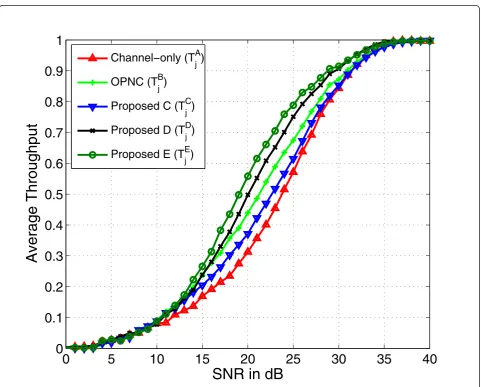
Figure 5 compares the average system throughput of Algorithms A through E, and the plot is normalized by
the total number of packets used in the simulation. The system throughput is defined by the total number of successfully delivered packets to the sink nodes per transmission. In the simulations, the number of relay nodes and the number of sink nodes are set to 50 and 50, respectively. It is observed in Figure 5 that Algo-rithm E performs the best in terms of throughput. It has throughput gain of 10-15% over the modified OPNC algorithm (Algorithm B) and 13-25% over Algorithm A in the SNR range between 20 and 25 dB. The average throughput difference is relatively large in the medium SNR range, but it gets negligible in the low and the high SNR regions. In the low SNR regime, the probability of error at a sink node increases. The error increases retransmission from the relay nodes. This phenomenon is believed to be almost independent of the type of the timer algorithm we use. This explains why there is little difference between the 5 algorithms in the low SNR regime. In the high SNR regime, most of the packets
0
5
10
15
20
25
30
35
40
0
0.1
0.2
0.3
0.4
0.5
0.6
0.7
0.8
0.9
1
SNR in dB
Average Throughput
Channel−only (T
j A
)
OPNC (T
j B
)
Proposed C (T
j C
)
Proposed D (T
j D
)
Proposed E (T
j E
)
tend to be decoded successfully at the sink nodes in the source transmission (broadcast) phase. It means that the contribution of the retransmission phase decreases as the SNR increases, which also explains why there is little difference between the 5 algorithms in the high SNR regime.
5 Conclusion
In this paper, we proposed a new opportunistic wireless network coding combined with distributed relay selection. By taking advantage of opportunistic listening capability of wireless networks, several feedback-based retransmission schemes are proposed. From the simulation results, it was shown that the algorithm based on the minimum channel gain and the sum rate has the best performance in terms of average number of transmissions and system throughput. It was also observed that the proposed relay selection scheme performs better than the conventional schemes especially in the medium SNR regime. It appears that the proposed approach is promising in that it is a practical wireless network coding scheme with improved throughput.
Acknowledgements
This research was supported in part by Basic Science Research Programs (KRF-2008-314-D00287, 2010-0013397), Mid-career Researcher Program (2010-0027155) through the NRF funded by the MEST, Seoul R&BD Program (JP091007, 0423-20090051), the KETEP grant (2011T100100151), the INMAC, and BK21.
Competing interests
The authors declare that they have no competing interests.
Received: 14 July 2011 Accepted: 6 December 2011 Published: 6 December 2011
References
1. D Tuninetti, C Fragouli, inProcessing Along the Way: Forwarding vs Coding, ISITA 2004, Parma, Italy, (Oct 2004).
2. R Ahlswede, N Cai, S-YR Li, RW Yeung, Network Information Flow. IEEE Trans Inf Theory46(4), 1204–1216 (2000). doi:10.1109/18.850663
3. M Charikar, inA Argawal on the Advantage of Network Coding for Improving Network Throughput, IEEE Information Theory Workshop San Antonio, (Oct 2004)
4. M Ghaderi, D Towsley, J Kurose, inReliability Gain of Network Coding in Lossy Wireless Networks, IEEE INFOCOM 2008, (April 2008)
5. S-YR Li, RW Yeung, N Cai, Linear network coding. IEEE Trans Inf Theory 49(2), 371–381 (2003)
6. T Ho, M Medard, J Shi, M Effros, DR Karger, inOn Randomized Network Coding. Proceedings of Allerton Conference on Communication, Control, and Computing (2003)
7. S Katti, H Rahul, W Hu, D Katabi, M Medard, J Crowcroft, XORs in the air: practical wireless network coding. IEEE/ACM Trans Networking16(3), 497–510 (2008)
8. Z Fang, M Medard, inOn Analyzing and Improving COPE Performance. Information Theory and Applications Workshop (Feb 2010)
9. M Xiao, M Skoglund, inDesign of Network Codes for User Multiple-Relay Wireless Networks, ISIT 2009 (Seoul, Korea, 2009)
10. M Xiao, M Skoglund, Multiple-user cooperative communications based on linear network coding. IEEE Trans Commun.58(12), 3345–3351 (2010) 11. L Lu, M Xiao, LK Rasmussen, inRelay-Aided Broadcasting with Instantaneously
Decodable Binary Network Codes, ICCCN 2011 (Hawaii, USA, July, 2011)
12. A Bletsas, A Khisti, DP Reed, A Lippman, A simple cooperative diversity method based on network path selection. IEEE J Sel Areas Commun.24(3), 659–672 (2006)
13. PA Chou, Y Wu, K Jain, inPractical Network Coding. Proceedings of Allerton Conference on Communication, Control, and Computing, (Monticello, IL 2003)
14. JG Proakis, M Salehi,Digital Communication, 4th edn. (McGrawHill, 2001)
doi:10.1186/1687-1499-2011-196
Cite this article as:Kim and Lee:Opportunistic wireless network coding
with relay node selection.EURASIP Journal on Wireless Communications
and Networking20112011:196.
Submit your manuscript to a
journal and benefi t from:
7Convenient online submission 7Rigorous peer review
7Immediate publication on acceptance 7Open access: articles freely available online 7High visibility within the fi eld
7Retaining the copyright to your article