Volume 2010, Article ID 513952,10pages doi:10.1155/2010/513952
Research Article
On the Effect of Self-Interference Cancelation in
MultiHop Wireless Networks
Pradeep Chathuranga Weeraddana,
1Marian Codreanu,
1Matti Latva-aho,
1and Anthony Ephremides
21Centre for Wireless Communications, University of Oulu, P.O. Box 4500, 90014 Oulu, Finland 2University of Maryland, College Park, MD 20742, USA
Correspondence should be addressed to Pradeep Chathuranga Weeraddana,[email protected]
Received 11 July 2010; Revised 29 September 2010; Accepted 20 October 2010
Academic Editor: Fabrizio Granelli
Copyright © 2010 Pradeep Chathuranga Weeraddana et al. This is an open access article distributed under the Creative Commons Attribution License, which permits unrestricted use, distribution, and reproduction in any medium, provided the original work is properly cited.
In a wireless network, the problem ofself-interferencearises when a node transmits and receives simultaneously in the same frequency band. So far only two extreme approaches to circumvent this problem were thoroughly investigated in the literature. The first one prevents any node to transmit and receive simultaneously which may lead to a too conservative design. The second one assumes perfect self-interference cancelation which can be too optimistic since it ignores all possible technological limitations. To fill this gap, we provide a method based on complementary geometric programming for evaluating the gains achievable at the network layer when the network nodes employ self-interference cancelation techniques with different degrees of accuracy. The gains are evaluated in terms of average sum rate and average network congestion by using a network utility maximization framework. The method provides insights into the behavior of different network topologies when self-interference cancellation is employed in nodes. In addition, it can be used to assess the required degrees of accuracy of the self-interference in order to achieve substantial benefits. Thus, from a network design perspective, the proposed method is very beneficial. Numerical results suggest that the benefits from self-interference cancelation are more pronounced in tandem wireless network setups in which the network nodes are located in a linear grid.
1. Introduction
The self-interference problem arises in wireless networks when a node transmits and receives simultaneously in the same frequency band. The main reason for this problem is the huge imbalance between the transmitted signal power and the received signal power of nodes. Typically, the trans-mitted signal strength is few order of magnitude larger than the received signal strength. Thus, when a node transmits and receives simultaneously in the same channel, the useful signal at the receiver of the incoming link is overwhelmed by the transmitted signal of the node itself. As a result, the signal-to-interference-and-noise-ratio (SINR) values at the incoming link of a node that simultaneously transmits in the same channel is very small. Therefore, the self-interference problem plays a central role in link scheduling and rate/power control in wireless networks.
Information theoretic aspects of this problem can be traced back to the classic work of Shannon on “Two-way
communication channels” [1]. Although the capacity region
of the two-way channel is not known for the general case
[2], it is completely characterized for certain particular cases,
for example, for the Gaussian two-way channel it is shown that the channel can be decomposed into two independent
Gaussian channels [2, Section 15.1.6]. In [2] authors discuss
a technique for achieving the capacity of the Gaussian two-way channel: each transmitter uses a Gaussian codebook and each receiver decodes its own signal after subtracting the unwanted signal (i.e., the self-interfering signal) from the received waveform. Such techniques allow the possibility of perfect self-interference cancelation.
However, in practice there are numerous technological
limitations [3–6] which can severely limit the accuracy of the
to separate transmissions and receptions in time domain, that is, TDD (time division duplex) or in frequency domain,
that is, FDD (frequency division duplex) [7] in order to
facilitate the implementation challenges. It is worth of noting
that, in terms of capacity analysis, there is no difference
between resource partitioning across time or frequency
[7, Section 6.1.3]. In general, any of the aforementioned
orthogonal resource partitioning schemes are suboptimal as compared to the case of perfect self-interference cancellation. For example, only half of the sum capacity in a Gaussian
sym-metric two-way channel can be achieved [2] by using either
TDD or FDD when the system is operating in the
bandwidth-limited regime [7, page 203] (In practice, the high data rate
wireless communication systems operate in the bandwidth-limited regime.). In the context of time-slotted wireless network that operate in a shared medium, one approach of dealing with the self-interference consists of adding supplementary combinatorial constraints which prevent any node in the network to transmit and receive simultaneously
[8–15]. This is sometime called node-exclusive interference
model. Various methods for performing the self-interference
cancelation at the nodes’ receivers are discussed in [16–
20]. The bottom line is that there is always a tradeoff
between transceiver complexity and the accuracy of the
self-interference cancelation. The proposals [18–20] provide
cost-effective mechanisms for an up to 55 dB reduction in
the self-interference and also provide insightful comments on the performance of self-interference cancellation based
on a simple two-node network. Resent work [21] further
discusses techniques which envisage the self-interference cancellation in practice. Thus, as the spectrum is getting extremely scarce, it is important to understand in general the potential gains in the network performance provided by the self-interference cancellation.
The main contribution of this paper is to provide a method to evaluate the potential gains achievable at the network layer when the network nodes employ
self-interference cancelation techniques with different degrees of
accuracy. We do not consider any specific self-interference cancelation mechanism, which is extraneous to our main objective. Instead, the imperfect self-interference cancelation is modeled as a variable power gain from the transmitter to the receiver at all nodes. Nevertheless, this simple model gives
insight into the behavior of different network topologies
when self-interference cancellation is employed in network nodes. The proposed method also can be used to find the required level of accuracy for the self-interference cance-lation such that certain gains are achieved at the network layer. In general, the proposed system model can handle any network topology. In addition, it provides a simple way to evaluate the impact of scaling the distance between network nodes on the accuracy level of the self-interference cancellation. Thus, from a network design perspective, the proposed method can be very useful.
The network layer gains are evaluated in terms of average sum rate and average network congestion by using a network
utility maximization (NUM) framework. As shown in [22,
Section III.A], the NUM-optimal cross-layer control policy
can be decomposed into three subproblems: (1)flow control,
(2)next-hop routing and in-node scheduling, and (3)resource allocation (RA). The first two are convex optimization problems and they can be solved relatively easily. For solving the RA subproblem we propose an algorithm based on our
previous work [23,24].
The rest of the paper is organized as follows. The network model and the NUM problem formulation are presented in
Section 2. The resource allocation algorithm used for solving
the RA subproblem is presented inSection 3. The impact of
scaling the distance between network nodes on the accuracy level of the self-interference cancellation is discussed in
Section 4. The numerical results are presented inSection 5
andSection 6concludes our paper.
2. System Model
2.1. Network Model. The wireless network consists of a collection of nodes which can send, receive and relay data
across wireless links. The set of all nodes is denoted byN
and we label the nodes with the integer valuesn=1,. . .,N. A
wireless link is represented as an ordered pair (i,j) of distinct
nodes. The set of links is denoted by L and we label the
links with the integer valuesl = 1,. . .,L. We define tran(l)
as the transmitter node of link l, and rec(l) as the receiver
node of link l. The existence of a link l ∈ L implies that
a direct transmission is possible from node tran(l) to node
rec(l). Furthermore, we defineO(n) as the set of links that
are outgoing from noden, andI(n) as the set of links that
are incoming to noden.
The network is assumed to operate in slotted time
with slots normalized to integer values t ∈ {1, 2, 3,. . .}.
All wireless links are sharing a single channel and the interference between distinct nodes is solely controlled via power control. In every time slot, a network controller decides the power and rates allocated to each link. We denote
by pl(t) the power allocated to each linklduring time slot
t. The power allocation is subject to a maximum power
constraintl∈O(n)pl(t)≤pmax0 for each noden, where pmax0
denotes the maximum node transmission power. Lethi j(t)
denote the power gain from the transmitter of linkito the
receiver of linkjduring time slott. We assume a block fading
Rayleigh channel model, where the channel coefficients are
constant during each time slot and change independently
from slot-to-slot. Specifically, the power gainshi j(t), between
distinct nodes are given by
hi j(t)=
wheredi jis the distance from the transmitter of linkito the
receiver of linkj,d0is the far-field reference distance beyond
which this model is applicable (i.e.,di j > d0) [25],ηis the
path loss exponent, andci j(t) are exponentially distributed
gj j
Figure 2: Two-node wireless network with N = 2 nodes, L =
2 links, and S = 2 commodities. Different commodities are represented by different color.
first term of (1) represents the path loss factor and the second
term models the Rayleigh small-scale fading. For any pair of
distinct linksi /=j, we denote theinterference coefficientfrom
linkito linkjbygi j(t).
Note that when i ∈ O(n) and j ∈ I(n), the term
gi j(t) represents the power gain within the same node from
its transmitter to its receiver, and is referred to as the
self-interference gain (seeFigure 1). Let us denote the set of all
link pairs (i,j) for which the transmitter of link i and the
receiver of link j coincide as A = {(i,j)i,j∈L | tran(i) =
rec(j)}. We parameterize the self-interference by a scalar
g ∈ [0, 1]. That is for all link pairs (i,j) ∈ A, we set
gi j(t)=gto model the residual self-interference gains after a
certain self-interference cancelation technique was employed
at the network’s nodes. A value g = 1 means that no
self-interference cancelation technique is used whilst g =
0 correspond to a perfect self-interference cancelation. We
refer to the scalargas theself-interference coefficient. For all
link pairs (i,j)∈/ A, the termgi j(t) represents the power of
the interference signal at the receiver node of linkjwhen one
unit of power is allocated to the transmitter node of linki.
That is for all link pairs (i,j)∈/A, we setgi j(t)=hi j(t).
It is worthwhile to notice that the interference model described previously can be easily extended to accommodate
different multiple access techniques by reinterpreting
appro-priately the interference coefficients. For example, in the
case of wireless CDMA networks the interference coefficient
gi j(t) would model the residual interference at the output
of despreading filter of node rec(j) [7]. Similarly, in the
case wireless SDMA networks where nodes are equipped
with multiple antennas, gi j(t) represents the equivalent
interference coefficient measured at the output of antenna
combiner of node rec(j) [7]. Extensions to a multichannel
scenario (e.g., FDMA or FDMA-SDMA networks) is also possible by introducing multiple links between nodes, one link for each available spectral channel, and by setting
gi j(t)=0 if linksiandjcorresponds to orthogonal channels.
However, these implementation-related aspects are beyond the main scope of this paper.
In this paper we restrict ourselves to the case where all receivers perform single-user detection (i.e., they decode each of their intended signals by treating all other interfering
signals as noise) and assume that the achievable rate of linkl
during time slottis given by
rl(t)=log
whereσ2 represents the power of the thermal noise at the
receiver.
For alll∈Lwe define the signal-to-noise-ratio (SNR) of
linklas SNRl=(p0max/σ2)(dll/d0)−η. It represents the average
SNR at rec(l) when tran(l) allocates all its transmission
power to linkland all the other nodes are silent. Finally, we
denote withp(t)∈RL
+ the overall power allocation matrix,
that is,pl(t)=[p(t)]l.
2.2. NUM Problem Formulation. Exogenous data arrive at the source nodes and they are delivered to the destination nodes over several, possibly multihop, paths. We identify the data by their destinations, that is, all data with the same destination are considered as a single commodity, regardless
of its source. We label the commodities with integers s =
1,. . .,S(S ≤ N) and the destination node of commoditys
is denoted byds. For every node, we defineSn⊆ {1,. . .,S}as
the set of commodities which can arrive exogenously at node
n.
We consider a network utility maximization (NUM)
framework similar to the ones considered in [22, Section
III.A] and [26, Section 5.1]. Specifically, exogenously arriving
data is not directly admitted to the network layer. Instead, the exogenous data is first placed in the transport layer storage reservoirs. At each source node, a set of flow controllers decides the amount of each commodity data admitted every
time slot in the network. Let xs
n(t) denote the amount of
data of commodity s admitted in the network at node n
during time slott. At the network layer, each node maintains
a set of S internal queues for storing the current backlog
(or unfinished work) of each commodity. Let qs
n(t) denote
the current backlog of commoditysdata stored at node n.
We formally letqs
ds(t) = 0, that is, it is assumed that data
which is successfully delivered to its destination exits the
network layer. Letxsnbe the average rate with which the data
of commoditysis sent from nodentodsover the used paths,
that is, xsn = limT→ ∞1/TtT=1E{xsn(t)}. Associated with
each node-commodity pair (n,s)s∈Sn we define a concave
and nondecreasingutility function gs
n(xsn), representing the
“reward” received by sending data of commoditysfrom node
nto nodeds at an average rate ofxsn[bits/slot]. The NUM
problem under stability constraints can be formulated as
where the optimization variables arexsnandΛrepresents the network layer capacity region[26, Definition 3.7].
A dynamic cross-layer control algorithm which achieves
data ratesxs
narbitrarily close to the optimal operating point
has been introduced in [22, Section III.A]. Particularized to
our network model, every time slott, the algorithm performs
the following.
Algorithm 1(Dynamic Cross-Layer Control Algorithm [22]).
(1)Flow Control: for each node n ∈ N,{xs
n > 0 are the algorithm’s
parameters as described in [22].
(2)Next-hop Routing and In-node Scheduling: for each
link l, let βl(t) = maxs{qstran(l)(t)− qsrec(l)(t), 0}.
If βl(t) > 0, the commodity that maximizes the
differential backlog is selected for potential routing
over linkl.
(3)Resource Allocation: the power allocationp(t) is given
bypwhose entriesplsolve the problem
maximize
and the rate allocation is given by (2).
3. Resource Allocation Subproblem
In this section we focus on resource allocation (RA)
sub-problem (5). Note that, due to interference, the achievable
rates on different links are interdependent, that is, the
achievable rate of a particular link depends on the powers allocated to all other links. In general, this coupling makes
the RA subproblem (5) extremely difficult to solve since
the problem is not amendable to a convex formulation
[27]. In [28] it was shown that, problem (5) is NP-hard.
Even though global optimization techniques (e.g., exhaustive search-based solution methods, branch and bound method) can be adapted to find the optimal solution of problem
(5), the complexity of these approaches grows exponentially
with the size of the network. Thus, even for a moderate
size network with few nodes and links, finding the optimal solution becomes quickly impractical.
In our previous work [23,24] we provided a efficient
local solution method to RA subproblem (5) in the case
of self-interference coefficient g = 1. In the sequel, we
adapt these approaches in order to handle the RA with any
arbitrary self-interference coefficient g in the range g ∈
[0, 1].
For the sake of notational simplicity, let us drop the time
indextand to denote the SINR of linklbyγl, that is,
As a result, the objective function of problem (5) can be
expressed asl∈Lβllog(1+γl). By noticing that the objective
function of problem (5) increases with respect to each γl
and log(·) is an increasing function, problem (5) can be
solution methods proposed in [23,24] is to apply signomial
programming to problem (7). A signomial program is
an iterative algorithm in which the original problem is approximated by a geometric program in each iteration and iterations continue until a stopping criterion is satisfied
[29]. Note that the solution obtained by using signomial
programming is local [29].
Particularized to our RA problem, in each iteration the
objective function of problem (7) is replaced from its best
local monomial approximation at a feasible SINR point
γ = [γ1,. . .,γL]T. Note that the best local monomial
approximation of the objective function of problem (7) at
Note thatKis a multiplicative constant which does not affect
the problem solution. Thus, the signomial program to find a
locally optimal solution for problem (7) can be summarized
as follows.
Algorithm 2(RA via signomial programming (A= ∅)).
(1) Given tolerance>0, a feasible power allocationp0;
(2) Solve the following geometric program (GP):
Step (2); otherwise stop.
Note that the first set of inequality constraints of problem
(9), that is,α−1γ
l ≤ γl ≤αγl,l ∈Lare called trust region
constraints [29]. These trust region constraints confine the
domain of variables γl to a region around γl where the
monomial approximation given in (8) is sufficiently accurate.
The parameter α > 1 controls the desired approximation
accuracy. In most practical cases, a fixed valueα=1.1 offers
a good speed/accuracy tradeoff[29].
Algorithm 2 can be used as such for solving the RA
subproblem in a particular class of wireless networks, where
there is noself-interferenceproblem (i.e., for whichA= ∅).
In such networks, the set of nodes can be divided into two distinct subsets, the set of transmitting nodes and the set of receiving nodes. A simple uniform power allocation can be
used to initializeAlgorithm 2.
In the general case where A= ∅/ the RA algorithm
must also cope with the self-interference problem. The
difficulty comes from the fact that the self-interference gains
{gi j}(i,j)∈A can be few order of magnitude larger than the
power gains between distinct network nodes{gj j}j∈L(when
no self-interference cancelation technique is employed). Thus, the SINR values at the incoming links of a node that simultaneously transmits in the same channel are very small
and the convergence ofAlgorithm 2becomes very slow if it
starts with an initial SINR guessγcontaining entries with
nearly zero values.
A standard way to deal with the self-interference problem consists of adding a supplementary combinatorial constraint in the RA subproblem which does not allow any node in
the network to transmit and receive simultaneously [8, 9,
12]. We will refer to a power allocation which satisfies
this constraint asadmissible. Note that this approach would
require solving a power optimization problem for each possible subsets of links that can be simultaneously activated. As the complexity of this approach grows exponentially with the number of nodes, this solution become quickly impractical. Furthermore, when self-interference cancelation techniques are employed at network’s nodes, the solution
of RA subproblem (5) is not necessaryadmissible. To avoid
such enormous complexity we proposed an iterative method,
which runsAlgorithm 2for incrementally increasing values
of the self-interference coefficient. It alternates between
two steps: increasing the value of a virtual self-interference
coefficient gv (note that this increasing is done using a
dummy variable and should not be confused with the exact
value of the self-interference coefficient g ∈ [0, 1]) and
runningAlgorithm 2for updated values of self-interference
gains (the last point found is used as the initial point for
Algorithm 2 in the next iteration). The algorithm repeats
these steps until a stopping criterion is satisfied.
Algorithm 3(Successive approximation algorithm for RA in the presence of self-interferers).
(1) Given an initial value for the self-interference
coef-ficient g0, ρ > 1, and an initial (feasible) power
allocationp0; Letgv=g0andp=p0.
The initial self-interference gaing0is chosen in the same
range of values as the power gains between distinct nodes.
Specifically, in our simulations we selectg0=maxj∈L{gj j}.
For any feasible power allocationsp0, the initial SINR guess
γ is given by (6) where all self-interference gains, that is,
{gi j |(i,j)∈A}, are replaced by a virtual self-interference
coefficientgvwhich is gradually increased in each iteration.
Note that Algorithm 3 terminates either when the power
allocation obtained at Step (2) is admissible or when the
virtual self-interference gain gv reaches the true value of
the interference coefficient g. Terminating Algorithm 3 if
the solution is admissible is intuitively obvious for the
following reason. The data associated with problem (9)
become independent of self-interference gains and therefore
further increase ingvafter having anadmissiblesolution has
no effect on the results.
A simple extension on the method can be used to
dramatically decrease the complexity per GP in (9). Here,
we eliminate the power variablespland the associated SINR
variablesγlfrom problem (9) when they have relatively very
small contributions to the overall objective value of (9).
Specifically, the exponent termβl(γl/(1 +γl)) in the objective
of (9) is evaluated for all l ∈ Land if βl(γl/(1 +γl))
maxl∈L(βl(γl/(1 +γl))) thenpl’s and the associatedγl’s are
eliminated in successive GPs.
4. Scaling of Distance and Maximum Node
Transmission Power
region, the accuracy level of the self-interference cancelation techniques must also be scaled appropriately.
We start by defining two matrices which will be useful in
the sequel. LetD ∈ RL×L
+ denote the node distance matrix
defined as [D]i,j=di j. We denote byG(t)∈RL+×Lthe power
gain matrix during time slottdefined as [G(t)]i,j = gi j(t).
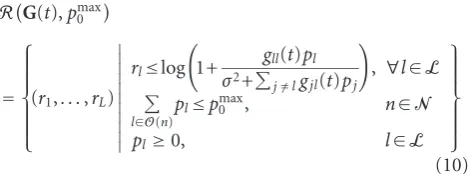
The achievable rate region (recall fromSection 2.1that all
receivers perform single-user detection) for a givenG(t) and
a maximum node transmission powerpmax
0 can be expressed
as
is scaled by a factor of 1/κ and the maximum node
transmission powerp0maxis scaled by a factor ofκ, then the
achievable rate region is unchanged, that is,
RG(t),pmax
Letκ = θη. According to the exponential path loss model
given in (1), the scaling of Gby a factor of 1/κ(or 1/θη)
is equivalent to the scaling of node distance matrix Dby a
factor ofθ and the scaling of self-interference gainsg by a
factor of 1/θη. Therefore, with a slight abuse of notation, we
will rewrite (11) as
To interpret the relation in (12), we consider a network
characterized by D, g, and pmax
0 . If we construct another
network by scaling Dby a factor ofθ and by scaling pmax
0
by a factor of θη, then to preserve the achievable rate
region, the accuracy level of the self-interference cancelation
should be improved tog/θη. This is intuitively obvious since,
the larger the distance between network nodes, the larger the power levels required to preserve the link SINRs, and therefore, the higher the accuracy level required by the self-interference cancelation techniques to remove the increased
transmit power at nodes. Based on (12) we can establish
similar equivalences in terms of network layer performance
metrics as well. Roughly speaking, relation (12) suggests
that in networks where the nodes are located far apart (e.g., cellular type of wireless networks), the accuracy of self-interference cancellation is more stringent as compared to that in networks where the nodes are located in close vicinity
(e.g., a wireless network setup in an office room).
5. Numerical Results
In this section, we make use of the RA algorithm presented inSection 3to investigate quantitatively the gains achievable at the network layer due to the self-interference cancelation performed at the network nodes. Specifically, we consider
the following two performance metrics: (1)the average sum
rate n∈Ns∈Snx s
n and (2) the average network congestion
n∈NSs=1qsn, and we study their dependence on the
self-interference coefficient g. By changing g in the interval
[0, 1], the results are able to capture effect of the
self-interference cancelation performed with different levels of
accuracy.
We assume that the average rates xsn corresponding to
all node-commodity pairs (n,s)s∈Sn,n ∈ N are subject to
proportional fairness, therefore we select the utility functions
gs
n(xsn) = ln(xsn). In every time slot t, the rate allocation
at Step (3) of the Dynamic Cross-Layer Control Algorithm
(i.e.,Algorithm 1,Section 2.2) is obtained by using the RA
Algorithm 3(Section 3). To model an orthogonal resource sharing scheme, we also consider a more restrictive RA policy, where only one link can be activated during each time slot. This policy is called baseline single link activation (BLSLA). The optimal RA based on BLSLA policy can be
easily found (Note that in all considered setupsAlgorithm 3
is simply initialized at a point close to the BLSLA solution.) and it consists of activating during each time slot only the link which achieves the maximum weighted rate. In
all simulations we assumed η = 4 and d0 = 1 m for
the exponential path loss model (1) and distance between
adjacent nodes areD0 =
√
10 m. The SNR operating point
is defined as SNR = (pmax0 /σ2)(D0/d0)−η, and it represents
the average SNR of the links between adjacent nodes.
Inspired by the Gaussian two-way channel [2], we first
consider a simple two-node wireless network as shown
in Figure 2. There are two commodities, the first one
arrives at node 1, and is intended for node 2; the second commodity arrives at node 2, and is intended for node
1. As explained in [2], a Gaussian two-way channel is
equivalent with two independent Gaussian channels where
perfect self-interference cancelation is realized (i.e.,g =0).
As a result, the sum capacity of the symmetric Gaussian two-way channel becomes twice the capacity of either of the equivalent Gaussian channels. The considered two-node network allows us to illustrate a similar behavior in terms of the network layer average sum rate.
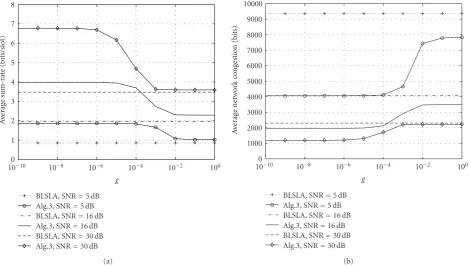
Figure 3 shows the dependence of the average sum
rate (Figure 3(a)) and of the average network congestion
(Figure 3(b)) on the self-interference coefficient g. We consider three link SNR values, 5, 16, and 30 [dB] which correspond to low, medium, and high data rate systems respectively. The results show that the average sum rate
with perfect self-interference cancelation (i.e., g = 0) is
increased by a factor of 2 and the average network congestion reduced significantly, as compared to no self-interference
cancelation (i.e., g = 1). The results also reveal that even
0
Figure3: Dependence of the average sum rate 2s=1xss (a) and of the average network congestion
2
Figure4: Tandem wireless network withN = 4 nodes andS =
2 commodities. Different commodities are represented by different color.
self-interference coefficient up to a valueg =10−4is enough
to double the average sum rate for link SNR=5 dB.
Let us now consider a tandem wireless network as shown inFigure 4. There are two commodities, the first one arrives at node 1, and is intended for node 4; the second commodity arrives at node 4, and is intended for node 1. Thus we have
S1= {1},S4= {2}, andSn= ∅for alln∈ {2, 3}.
Figure 5 shows the dependence of the average sum
rate (Figure 5(a)) and of the average network congestion
(Figure 5(b)) on the self-interference coefficient g for SNR values 5, 16, and 30 dB. We first focus to the case of low SNR
value, that is, SNR=5 dB. The results show that by decreasing
the self-interference coefficient fromg =10−1 tog = 10−4
the average sum rate is increased by a factor of around 1.82 and the average network congestion reduced significantly.
Let us next consider a fully connected multihop,
multi-commodity wireless network as shown inFigure 6. There are
N = 9 nodes and S = 3 commodities. The commodities
arrive exogenously at different nodes in the network as
shown inFigure 6, where different commodities are
repre-sented by different colors. Thus we haveS1= {2},S2= {3},
S3 = {3},S5 = {2},S7 = {1, 3}, andSn = ∅for alln ∈
{4, 6, 8, 9}. The nodes are located in a rectangular grid such
that the horizontal and vertical distances between adjacent
nodes areD0m.
Figure 7 shows the dependence of the average sum
rate (Figure 7(a)) and of the average network congestion
(Figure 7(b)) on the self-interference coefficient g for SNR values 5, 16, and 30 dB. Let us first consider the case of low
SNR value, that is, SNR =5 dB. The results show that by
decreasing the self-interference coefficient fromg =10−1to
g = 10−4 the average sum rate is increased by a factor of
about 1.22 and the average network congestion is reduced. The network performance remains the same as in the case
of perfect self-interference cancelation for all values ofg <
10−4. In this region the network performance is limited
by the interference between distinct nodes, and no further improvement is possible by only increasing the accuracy of the self-interference cancelation. On the other hand, no gain in the network performance is achieved by using an imperfect self-interference cancelation technique which leads to g > 10−1. In this region the RA solution provided by
Algorithm 3is alwaysadmissible(i.e., no node transmits and receives simultaneously).
In each network setup (Figures 2,4, and 7) a similar
behavior of the results holds for medium and high SNR
values as well (i.e., SNR=16 and 30 dB). Moreover, as we
change SNR from low values to high values, the accuracy level required by the self-interference cancelation becomes more stringent. For example, in the case of fully connected
multihop, multi-commodity wireless network inFigure 6, if
SNR operating point is changed from 5 to 30 dB, then the accuracy level required by the self-interference cancelation
0
Figure5: Dependence of the average sum rate (x1
1+x24) (a) and of the average network congestion
Figure6: Multihop wireless network withN =9 nodes andS =
3 commodities. Different commodities are represented by different color.
gaining in network layer performances. This is intuitively expected since, the larger the SNR operating point, the larger the power levels of the nodes, and therefore, the higher the accuracy level required by the self-interference cancelation techniques to remove the increased transmit power at nodes. Note that the relative gains due to self-interference can-cellation in the considered fully connected multihop network is smaller as compared to the relative gains experienced in
the tandem wireless network (Figure 4). This behavior is
intuitively explained by looking in to the network topology. When the self-interference is significantly canceled, the resultant interference at the receiver node of any link in the
case of the tandem multihop wireless network (Figure 4) is
smaller on average to that of the multihop wireless network (Figure 6) (Note that any receiver node of the fully connected multihop network has many adjacent interfering nodes.). Thus, with zero self-interference, links in tandem network can operate at larger rates and therefore larger relative gains. Finally, we show by an example, how to apply the
rate-equivalence (12) to find the required value of
self-interference coefficientgin order to preserve network layer
performances if the distance between nodes are scaled. Let us construct a new network by scaling the distances between
the nodes of the original network (seeFigure 6) by a factor of
θ =√10 and the maximum node transmission power pmax
0
by a factor ofθη=100 (note thatη=4). We refer to this new
network as thescaled network. To illustrate the idea let us
con-sider the case SNR=5 dB inFigure 7and focus to the point
g=10−4for which the average sum rate is 3.5 [bits/slot]. The
value ofg at this point can be considered as the minimum
required accuracy level of the self-interference cancelation to achieve an average sum rate of 3.5 bits/slot in the original network. Now we ask what is the required self-interference
coefficient gnew that would result in the same average sum
rate value (i.e., 3.5 bits/slot) in the scaled network. From (12)
it follows that the required accuracy level of self-interference
cancelation should be improved at least to a level ofgnew =
2
Figure7: Dependence of the average sum rate9n=1
s∈Snx
s
n(a) and of the average network congestion
9
n=1 3
s=1qsn (b) on the
self-interference coefficientg.
6. Conclusions
We provided a method to evaluate the gains achievable at the network layer when the network nodes employ
self-interference cancelation techniques with different degree
of accuracy. By using a NUM framework, the gains were evaluated in terms of average sum rate and average network congestion.
Numerical results have shown that the self-interference cancelation requires a certain level of accuracy to obtain quantifiable gains at the network layer. The gains saturate after a certain cancelation accuracy. The level of accuracy required by the self-interference cancelation techniques depends on many factors such as distances between the network nodes and the operating power levels of the network nodes. For the considered network setups, the numerical results showed that a self-interference reduction in the range 20–60 dB leads to significant gains at the network layer. We emphasize that this level of accuracy is practically achievable,
for example, the recent proposals [18–21] provide
cost-effective mechanisms for an up to 55 dB reduction in the
self-interference coefficient. Numerical results further shows
that the topology of the network has a substantial influence on the performance gains. For example, in the case of tandem multihop wireless networks the benefits due to self-interference cancellation are more pronounced as compared to that of a multihop network in which the nodes are located in a square grid.
Acknowledgments
This research was supported by the Finnish Funding Agency for Technology and Innovation (Tekes), Academy of Fin-land, Nokia, Nokia Siemens Networks, Elektrobit, Graduate School in Electronics, Telecommunications and Automation
(GETA) Foundations, and US Army Research Office Grant
W911NF-08-1-0238.
References
[1] C. E. Shannon, “Two-way communication channels,” in
Proceedings of the 4th Berkeley Symposium on Mathematical Statistics and Probability, J. Neyman, Ed., vol. 1, pp. 611– 644, University of California Press, Berkeley, Canada, June-July 1961.
[2] T. M. Cover and J. A. Thomas,Elements of Information Theory, Wiley, New York, NY, USA, 2nd edition, 2006.
[3] K. Pan, H. Wu, R. Shang, F. Lai, and Y. Lin, “Communications over two-way waveform channels in wireless networks,” in
Proceedings of the IEEE Canadian Conference on Electrical and
Computer Engineering, vol. 1, pp. 45–50, Shaw Conference
Center, Alberta, Canada, May 1999.
[4] A. Raghavan, E. Gebara, E. M. Tentzeris, and J. Laskar, “Analysis and design of an interference canceller for collocated radios,” IEEE Transactions on Microwave Theory and Tech-niques, vol. 53, no. 11, pp. 3498–3508, 2005.
diodes,”IEEE Transactions on Antennas and Propagation, vol. 54, no. 2, pp. 439–448, 2006.
[6] O. E. Eliezer, R. B. Staszewski, I. Bashir, S. Bhatara, and P. T. Balsara, “A phase domain approach for mitigation of self-interference in wireless transceivers,”IEEE Journal of Solid-State Circuits, vol. 44, no. 5, Article ID 4907338, pp. 1436– 1453, 2009.
[7] D. Tse and P. Viswanath,Fundamentals of Wireless Communi-cation, Cambridge University Press, Cambridge, UK, 2005. [8] B. Hajek and G. Sasaki, “Link scheduling in polynomial time,”
IEEE Transactions on Information Theory, vol. 34, no. 5, pp. 910–917, 1988.
[9] S. A. Borbash and A. Ephremides, “The feasibility of match-ings in a wireless network,”IEEE Transactions on Information Theory, vol. 52, no. 6, pp. 2749–2755, 2006.
[10] T. ElBatt and A. Ephremides, “Joint scheduling and power control for wireless ad hoc networks,”IEEE Transactions on Wireless Communications, vol. 3, no. 1, pp. 74–85, 2004. [11] X. Wu and R. Srikant, “Regulated maximal matching: a
distributed scheduling algorithm for multi-hop wireless net-works with node-exclusive spectrum sharing,” inProceedings of the 44th IEEE Conference on Decision and Control, and the
European Control Conference (CDC-ECC ’05), vol. 2005, pp.
5342–5347, Seville, Spain, December 2005.
[12] S. A. Borbash and A. Ephremides, “Wireless link scheduling with power control and SINR constraints,”IEEE Transactions on Information Theory, vol. 52, no. 11, pp. 5106–5111, 2006. [13] X. Lin, N. B. Shroff, and R. Srikant, “A tutorial on cross-layer
optimization in wireless networks,”IEEE Journal on Selected Areas in Communications, vol. 24, no. 8, pp. 1452–1463, 2006. [14] L. Bui, A. Eryilmaz, R. Srikant, and X. Wu, “Asynchronous congestion control in multi-hop wireless networks with max-imal matching-based scheduling,”IEEE/ACM Transactions on Networking, vol. 16, no. 4, pp. 826–839, 2008.
[15] T.-S. Kim, Y. Yang, J. C. Hou, and S. V. Krishnamurthy, “Joint resource allocation and admission control in wireless mesh networks,” inProceedings of the 7th International Symposium on Modeling and Optimization in Mobile, Ad Hoc and Wireless Networks (WiOpt ’09), Seoul, Korea, June 2009.
[16] H. Suzuki, K. Itoh, Y. Ebin, and M. Sato, “A booster configuration with adaptive reduction oftransmitter-receiver antenna coupling for pager systems,” inProceedings of the 50th IEEE Vehicular Technology Conference (VTC ’99), vol. 3, pp. 1516–1520, Amsterdam, The Netherlands, September 1999. [17] D. Halperin, T. Anderson, and D. Wetherall, “Taking the
sting out of carrier sense: interference cancellation for wireless LANs,” inProceedings of the 14th Annual International
Confer-ence on Mobile Computing and Networking (MobiCom ’08), pp.
339–350, San Francisco, Calif, USA, September 2008. [18] B. Radunovi´c, D. Gunawardena, A. Proutiere, N. Singh,
V. Balan, and P. Key, “Efficiency and fairness in dis-tributed wireless networks through self-interference can-cellation and scheduling,” Tech. Rep. MSR-TR-2009-27, Microsoft Research, March 2009, http://research.microsoft .com/apps/pubs/default.aspx?id=79933.
[19] B. Radunovi´c, D. Gunawardena, P. Key et al., “Rethinking indoor wireless: low power, low frequency, full-duplex,” Tech. Rep. MSR-TR-2009-148, Microsoft Research, July 2009,http:// research.microsoft.com/apps/pubs/default.aspx?id=104950. [20] B. Radunovi´c, D. Gunawardena, P. Key et al., “Rethinking
indoor wireless mesh design: low power, low frequency, full-duplex,” inProceedings of the 5th IEEE Workshop on Wireless Mesh Networks (WiMesh ’10), pp. 25–30, June 2010.
[21] J. I. Choi, M. Jain, K. Srinivasan, P. Levis, and S. Katti, “Achieving single channel, full duplex wireless communica-tion,” inProceedings of the ACM International Conference on
Mobile Computing and Networking, pp. 1–12, Chicago, Ill,
USA, September 2010.
[22] M. J. Neely, E. Modiano, and C.-P. Li, “Fairness and optimal stochastic control for heterogeneous networks,”IEEE/ACM Transactions on Networking, vol. 16, no. 2, pp. 396–409, 2008. [23] M. Codreanu, C. Weeraddana, and M. Latva-Aho,
“Cross-layer utility maximization subject to stability constraints for multi-channel wireless networks,” inProceedings of the 43rd
Asilomar Conference on Signals, Systems and Computers, pp.
776–780, Pacific Grove, Calif, USA, November 2009. [24] C. Weeraddana, M. Codreanu, M. Latva-aho, and A.
Ephremides, “Resource allocation for cross-layer utility max-imization in multi-hop wireless networks in the presence of self interference,” in Proceedings of the 8th International Symposium on Modeling and Optimization in Mobile, Ad Hoc, and Wireless Networks (WiOpt ’10), pp. 70–75, Avignon, France, May-June 2010.
[25] A. Kumar, D. Manjunath, and J. Kuri, Wireless Networking, Elsevier, Burlington, Mass, USA, 2008.
[26] L. Georgiadis, M. J. Neely, and L. Tassiulas, “Resource alloca-tion and cross-layer control in wireless networks,”Foundations and Trends in Networking, vol. 1, no. 1, pp. 1–144, 2006. [27] Z.-Q. Luo and W. Yu, “An introduction to convex optimization
for communications and signal processing,”IEEE Journal on Selected Areas in Communications, vol. 24, no. 8, pp. 1426– 1438, 2006.
[28] Z.-Q. Luo and S. Zhang, “Dynamic spectrum management: complexity and duality,”IEEE Journal on Selected Topics in Signal Processing, vol. 2, no. 1, pp. 57–73, 2008.