OVERVIEW ON BNL ASSESSMENT OF SEISMIC ANALYSIS METHODS
FOR DEEPLY EMBEDDED NPP STRUCTURES
Jim Xu
1), Carl Costantino
1), Charles Hofmayer
1)and Herman Graves
2)1) Brookhaven National Laboratory, Upton, NY
2) U.S. Nuclear Regulatory Commission, Washington, DC
ABSTRACT
A study was performed by Brookhaven National Laboratory (BNL) under the sponsorship of the U. S. Nuclear Regulatory Commission (USNRC), to determine the applicability of established soil-structure interaction analysis methods and computer programs to deeply embedded and/or buried (DEB) nuclear power plant (NPP) structures. This paper provides an overview of the BNL study including a description and discussions of analyses performed to assess relative performance of various SSI analysis methods typically applied to NPP structures, as well as the importance of interface modeling for DEB structures. There are four main elements contained in the BNL study: 1) Review and evaluation of existing seismic design practice, 2) Assessment of simplified vs. detailed methods for SSI in-structure response spectrum analysis of DEB structures, 3) Assessment of methods for computing seismic induced earth pressures on DEB structures, and 4) Development of the criteria for benchmark problems which could be used for validating computer programs for computing seismic responses of DEB NPP structures.
The BNL study concluded that the equivalent linear SSI methods, including both simplified and detailed approaches, can be extended to DEB structures and produce acceptable SSI response calculations, provided that the SSI response induced by the ground motion is very much within the linear regime or the non-linear effect is not anticipated to control the SSI response parameters. The BNL study also revealed that the response calculation is sensitive to the modeling assumptions made for the soil/structure interface and application of a particular material model for the soil.
INTRODUCTION
Considerable advancement has been made in better understanding the interacting mechanisms associated with SSI [1], developing analytical methodologies and preparing computer programs for seismic response, as well as obtaining much needed field test data from real earthquake events. However, established soil-structure interaction (SSI) analysis computer codes used in the nuclear industry have been primarily developed for the current generation of Light Water Reactors and applied to coupled soil-structure models where the structures are founded at or near the ground surface with shallow embedment.
Influenced by benefits such as easy access for refueling, reduction of seismic effects, missile protection and improving site visual activities, several advanced reactor designs have proposed to bury or partially bury reactor structures as one of the major features of their designs [2, 3]. The location of safety related structures, systems and components (SSC) below grade could be an effective option to address the stated benefits. Hence, from the regulatory point of view, potential seismic issues pertaining to deeply embedded and/or buried (DEB) structures should be addressed. Issues relating to kinematic interaction and seismic induced earth pressure effects may be more important for DEB structures during seismic events than for nuclear power plants (NPP) founded at or near the ground surface. Furthermore, the methods and computer programs established primarily for the assessment of SSI effects for the current generation of reactors need to be assessed in the light of the DEB NPP structures to determine their applicability and adequacy in capturing the seismic behavior of this class of structures.
Sponsored by the U. S. Nuclear Regulatory Commission (USNRC), a study was performed by Brookhaven National Laboratory (BNL) to determine the applicability of established soil-structure interaction analysis methods and computer programs to DEB NPP structures. This paper provides an overview of the BNL study including a description and discussion of analyses performed to assess the relative performance of various SSI analysis methods typically applied to NPP structures, as well as the importance of interface modeling for DEB structures. For the details of the BNL study, the reader is referred to NUREG/CR-6896 [4].
The BNL study identified specific issues of uncertainty which may have a potential impact on the analytical methods for the seismic response of deeply embedded structures, including: 1) the effect of deep embedment on the relative significance of kinematic interaction; 2) the extent to which non vertically propagating shear waves may be more important for DEB structures than for those with shallow embedment depth; 3) the impact of deep
embedment on the accuracy of side wall impedance functions calculated with standard methods; 4) the effect of nonlinear effects (separation of wall and soil, and soil material properties) on wall pressure calculations. Several computer programs were used for the study, including: CARES [5, 6], SASSI2000 [7] and LS-DYNA [8].
The paper is organized in five sections. Section 1 is the introduction and Section 2 provides a brief description of a literature review to identify potential issues affecting SSI response of DEB structures. Assessment of simplified vs. detailed SSI methods for DEB structures is discussed in Section 3. Section 4 provides a discussion of comparisons of seismic induced soil pressures for DEB structures. Finally, conclusions are provided in Section 5.
LITERATURE REVIEW TO IDENTIFY POTENTIAL ISSUES AFFECTING SSI RESPONSE OF
DEB STRUCTURES
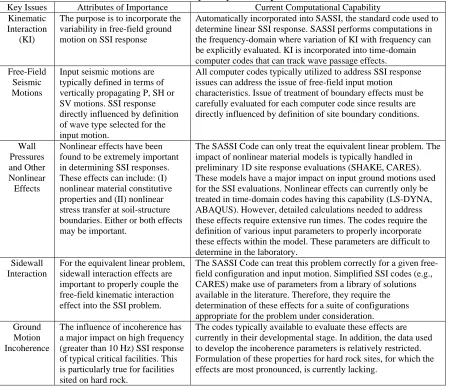
This review consisted of a retrospective look at the literature with respect to both analytical and experimental treatment of the seismic response analyses of DEB structures. The relevant computer codes, standards, and regulatory guidelines were also reviewed to determine the extent of their applicability to performing seismic design and analyses of DEB structures. Limitations of the various methods were examined. The details of the review were provided in NUREG/CR-6896 [4]. The insights gleaned from the literature review were used to identify methods, data and computer programs which were utilized by the BNL study to address SSI effects associated with seismic response analyses of DEB structures. As a result of the literature review, potential issues and knowledge gaps that might require further investigation were identified. The key issues important to SSI for DEB structures are summarized in Table 1.
Table 1. Summary of Key Issues Important to SSI
Key Issues Attributes of Importance Current Computational Capability Kinematic
Interaction (KI)
The purpose is to incorporate the variability in free-field ground motion on SSI response
Automatically incorporated into SASSI, the standard code used to determine linear SSI response. SASSI performs computations in the frequency-domain where variation of KI with frequency can be explicitly evaluated. KI is incorporated into time-domain computer codes that can track wave passage effects. Free-Field
Seismic Motions
Input seismic motions are typically defined in terms of vertically propagating P, SH or SV motions. SSI response directly influenced by definition of wave type selected for the input motion.
All computer codes typically utilized to address SSI response issues can address the issue of free-field input motion characteristics. Issue of treatment of boundary effects must be carefully evaluated for each computer code since results are directly influenced by definition of site boundary conditions.
Wall Pressures and Other Nonlinear Effects
Nonlinear effects have been found to be extremely important in determining SSI responses. These effects can include: (I) nonlinear material constitutive properties and (II) nonlinear stress transfer at soil-structure boundaries. Either or both effects may be important.
The SASSI Code can only treat the equivalent linear problem. The impact of nonlinear material models is typically handled in preliminary 1D site response evaluations (SHAKE, CARES). These models have a major impact on input ground motions used for the SSI evaluations. Nonlinear effects can currently only be treated in time-domain codes having this capability (LS-DYNA, ABAQUS). However, detailed calculations needed to address these effects require extensive run times. The codes require the definition of various input parameters to properly incorporate these effects within the model. These parameters are difficult to determine in the laboratory.
Sidewall Interaction
For the equivalent linear problem, sidewall interaction effects are important to properly couple the free-field kinematic interaction effect into the SSI problem.
The SASSI Code can treat this problem correctly for a given free-field configuration and input motion. Simplified SSI codes (e.g., CARES) make use of parameters from a library of solutions available in the literature. Therefore, they require the determination of these effects for a suite of configurations appropriate for the problem under consideration.
Ground Motion Incoherence
The influence of incoherence has a major impact on high frequency (greater than 10 Hz) SSI response of typical critical facilities. This is particularly true for facilities
The codes typically available to evaluate these effects are currently in their developmental stage. In addition, the data used to develop the incoherence parameters is relatively restricted. Formulation of these properties for hard rock sites, for which the effects are most pronounced, is currently lacking.
Based on the identified key issues affecting SSI response of DEB structures, BNL performed a series of analyses to assess simplified vs. detailed SSI methods for computing response spectra and seismic induced soil pressures for DEB structures, which are discussed in the following sections.
ASSESSMENT OF SIMPLIFIED VERSUS DETAILED METHODS FOR SSI ANALYSES OF
DEEPLY EMBEDDED STRUCTURES
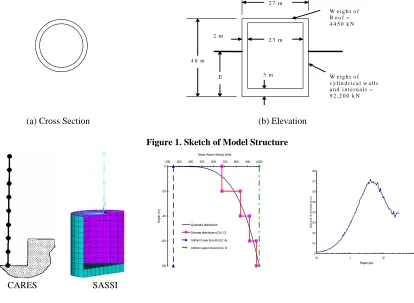
BNL performed an assessment of simplified versus detailed seismic analysis methodologies for DEB structures [9]. A structure (Figure 1) with the characteristics of a conceptual design of a containment structure for advanced reactors was modeled using the CARES program for the simplified method and the SASSI2000 program for the detailed model (Figure 2). A typical layered soil site was considered and a Western U.S. outcrop motion was used in the seismic analyses (Figure 3).
(a) Cross Section (b) Elevation
Figure 1. Sketch of Model Structure
-80 -60 -40 -20 0
200 300 400 500 600 700 800 900 1000 Shear Wave Velocity (m/s)
De
p
th
(
m
)
Quadratic distribution Discrete distribution (Col. C) Uniform lower bound (Col. A) Uniform upper bound (Col. B
0 0.1 0.2 0.3 0.4 0.5 0.6 0.7 0.8
0.1 1 10 100
Frequency (cps)
S
p
e
c
tr
a
l A
c
cel
er
a
ti
o
n
(g
)
CARES SASSI
Figure 2. Analysis Models Figure 3. Soil Profile and Rock Outcrop Input
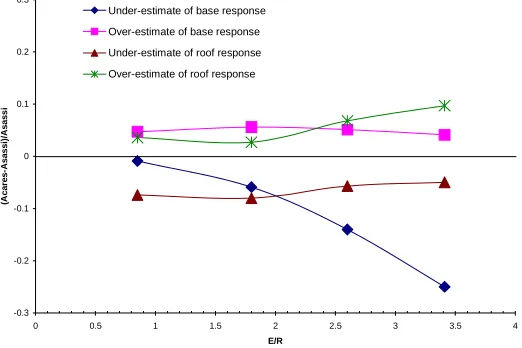
The assessment was made first by examining the comparisons of the analysis results in terms of response spectra at key locations of the structure against various depths of embedment. Depths of burial (E) equal to 85%, 170%, 255%, and 340% of the structural radius (R) were considered. Two performance indicators were then established for comparison of analysis results computed between the simplified stick model using CARES and the detailed model using SASSI2000. The first indicator calculates the difference of the areas under the response spectra between CARES and SASSI results and plots it against a burial parameter expressed as the E/R ratio (depth of burial/structural radius). This rating index is defined as [CARES area – SASSI area] / SASSI area or (ACARES –
ASASSI) / ASASSI. The portion of the spectra where CARES predictions are less than SASSI predictions (negative
index) may be offset by portions of the spectra where the opposite is true. To avoid this problem, the positive and negative areas are recorded separately and both are plotted. If desired, a comparison of the net area differences can be determined by algebraically adding the positive and negative areas at a given E/R. This indicator provides an overall
performance assessment across the entire frequency content.
2 3 m 2 7 m
2 m
4 6 m
E 3 m W e ig h t o f
c y l i n d r i c a l w a l ls a n d i n t e r n a ls = 9 2 , 2 0 0 k N W e ig h t o f R o o f = 4 4 5 0 k N
-0.3 -0.2 -0.1 0 0.1 0.2 0.3
0 0.5 1 1.5 2 2.5 3 3.5 4
E/R
(A
car
es-A
sassi
)/
Asass
i
Under-estimate of base response
Over-estimate of base response
Under-estimate of roof response
Over-estimate of roof response
Figure 4. Rating Index of Spectral Area Difference
-0.4 -0.3 -0.2 -0.1 0 0.1 0.2 0.3 0.4
0 0.5 1 1.5 2 2.5 3 3.5 4
E/R
(P
ca
res
-Ps
as
s
i)/P
sa
s
s
i
Kinematic base
Kinematic surface
SSI base
SSI roof
Figure 5. Rating Index of Spectral Peak Difference
Since the seismic design is more interested in the peak response, a second indicator is constructed for the relative peak response difference. The peak spectral accelerations are compared between the CARES and SASSI predictions. The spectral peaks for the two predictions generally lie within the spectral broadening criteria (plus and minus 15%) so that the comparison can be made without consideration of the small frequency differences. It should be noted that the frequency comparisons between CARES and SASSI are quite good. The differences that exist between CARES and SASSI lie in the magnitude of the spectral peaks. The rating index used is defined as [CARES prediction –
reliable of the two. The rating index is plotted as a function of depth of burial so that the reliability of CARES may be tested as the depth of burial increases. Of course positive indexes indicate conservative CARES predictions.
The rating index as a function of E/R based on spectral areas is shown in Figure 4, while the second index using spectral peaks is depicted in Figure 5. A clear trend of performance as a function of the depth of burial is readily exhibited in these figures between the CARES method and detailed SASSI model. Clearly, as E/R increases, the simplified stick model tends to depart from the SASSI solution; however, if a 20% difference is used as acceptance criteria, the CARES analysis could be accepted for a depth of burial up to 300% of structural radius. The only exception is the roof response comparison for E/R = 0.85 where the CARES response is much lower than the SASSI response. CARES uses the Beredugo – Novak [10] SSI model. The sidewall interaction coefficients (both stiffness and damping terms) are derived by considering a horizontal slice of soil interacting with the structure. Wolf [11] has shown that for the three dimensional problem a cut-off frequency exists below which the radiation damping is zero, which could not be accounted for in the Beredugo – Novak SSI model. However, as shown by the BNL study [4], if the radiation damping in CARES is properly reduced (in this case, reduced by 30%), an excellent match can be achieved between CARES and SASSI solutions. Therefore, it is at the user’s discretion to reduce appropriately the amount of radiation damping for simplified SSI models.
ASSESSMENTS OF METHODS FOR COMPUTING SEISMIC INDUCED EARTH PRESSURES
ON DEB STRUCTURES
To assess the performance of various analysis methods for computing seismic induced earth pressures on DEB structures, the SASSI FE model as described in the previous section is used, together with a detailed LS-DYNA [8] SSI model. The LS-DYNA model was developed using the direct approach. To represent the half-space soil medium with explicit finite elements, the near field in which the SSI effect is expected is modeled with explicit 3-D brick type elements. The lateral boundary of the near field model should be extended sufficiently far such that the outgoing wave due to the structural vibration diminishes drastically at the boundary. To prevent any reflection of outgoing waves at the boundary, a series of artificial viscous dampers are attached to the boundary. In LS-DYNA, the approach developed by Lysmer and Kuhlemeyer [12] was implemented, in which viscous normal and shear stresses are applied to the boundaries in a manner as defined in the following equations:
σnormal = - ρcdVnormal
σshear = - ρcsVtangential
where ρ, cd, and cs are the material density, material longitudinal and shear wave velocities of the transmitting media.
These equations reveal that the magnitude of these stresses at the boundaries is proportional to the particle velocities in the normal (Vnormal) and in the tangential (Vtangential) directions. The Lysmer’s dampers placed on the artificial
boundary are effective in reducing unwanted wave reflections if the boundary of the finite element mesh is sufficiently far outward. However, in doing so, the size of the near field finite element mesh is increased significantly and so is the cost of running the dynamic analysis.
The LS-DYNA SSI model, which is shown in Figure 6, consists of at least a quarter million nodes and a quarter million elements. The seismic analysis is performed using the explicit time integration algorithm with the Rayleigh damping specified with each soil layer and within the structure. Seismic analysis for the explicit finite element models with the contact interface features is very time consuming. However, the use of parallel processing with multiple central processing units can substantially reduce the calculation time.
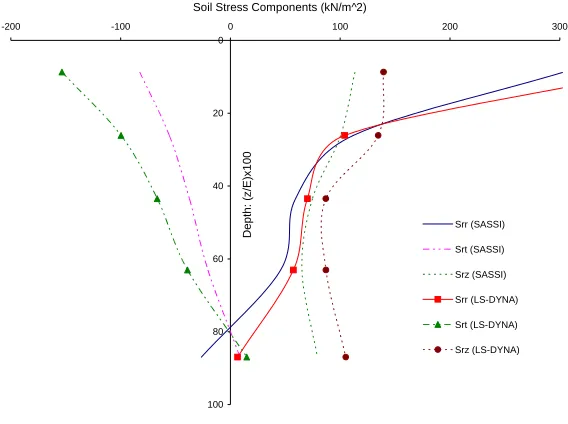
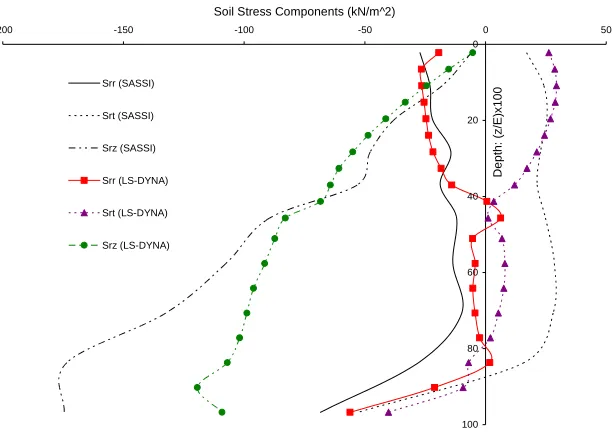
To examine the overall performance in the frequency content of the soil pressures, the Fourier spectra of the normal soil pressure in the head-on soil element near the mid-height of the structural wall for different depths of burial (DOB) are computed and compared between SASSI and LS-DYNA. Figure 7 presents the vertical distribution of the soil wall pressures computed with the SASSI and LS-DYNA models for 25% DOB. As shown in the picture, the wall depth is represented by the vertical axis expressed as a percentage of the DOB of the structure and the soil stresses on the wall are expressed in the horizontal axis in the unit of kN/m2. The symbols Srr and Srz represent the normal soil pressure and vertical shear computed in the head-on soil elements, while the symbol Srt is the meridian shear computed in the soil elements 90 degrees counterclockwise from the head-on location.
Figure 6. The LS-DYNA Model for 50% Embedment
0
20
40
60
80
100
-200 -100 0 100 200 300
Soil Stress Components (kN/m^2)
D
e
pt
h:
(
z
/E
)x
10
0
Srr (SASSI)
Srt (SASSI)
Srz (SASSI)
Srr (LS-DYNA)
Srt (LS-DYNA)
Srz (LS-DYNA)
Figure 7. Comparisons of Vertical Distributions of Soil Pressure for 25% DOB
For the 100% DOB, the comparisons of vertical soil pressure distributions between SASSI and LS-DYNA are presented in Figure 8. As depicted in this figure, more oscillatory behavior is observed of the vertical soil pressure distributions than the shallower cases presented above. Furthermore, the normal pressure and vertical shear are still closely traced between the SASSI and LS-DYNA results, while meridian shear distributions exhibit different behavior between the SASSI and LS-DYNA calculations. For complete results, the reader is referred to
0
20
40
60
80
100
-200 -150 -100 -50 0 50
Soil Stress Components (kN/m^2)
Dept
h: (
z
/E
)x
100
Srr (SASSI)
Srt (SASSI)
Srz (SASSI)
Srr (LS-DYNA)
Srt (LS-DYNA)
Srz (LS-DYNA)
Figure 8. Comparisons of Vertical Distributions of Soil Pressure for 100% DOB
To illustrate the frequency comparison between SASSI and LS-DYNA analyses for soil pressure estimates, Figure 9 shows the comparison of the smoothed Fourier spectra of the computed soil pressure between the SASSI and the LS-DYNA models for the 75% DOB case. This figure indicates a close match of the frequency content between the two model results. Furthermore, the Fourier spectrum comparison has clearly demonstrated the similar frequency characteristics of the pressure responses calculated from the two models.
0.00 0.20 0.40 0.60 0.80 1.00 1.20
0.1 1 10 100
Frequency (cps)
Pres
su
re
(kN
/m
2
)
SASSI solution
LS-DYNA solution
Figure 9. Fourier Spectra of Soil Pressure Computed at the Head-on Soil Element near Mid-Height Embedded Wall for 75 % DOB
CONCLUSIONS
This paper provides a brief overview of a BNL research program to investigate the extent to which various established SSI methods apply to DEB structures. Two aspects of SSI response were considered: response spectra and soil pressures. The BNL study indicated that the SSI methods established for shallow embedded or surface founded structures also perform well for the DEB structures in the linear response regime or when the non-linear SSI effect is not expected to control the structural response.
For the case of strong ground motions, the non-linear effect is expected to have a strong impact on the SSI response calculations. For DEB structures, the issue arises in the aspects of the interface modeling and soil material modeling, and the SSI response calculation could be sensitive to the modeling assumptions made for the soil/structure interface and application of a particular material model for the soil. These modeling assumptions can only be validated through correlations with field or laboratory measured seismic response data, which unfortunately are scarce, especially for moderate to strong earthquake events.
REFERENCES
1. Roesset, J. M., 1989, “Perspectives on Soil Structure Interaction Analysis,” Proceedings of EPRI/NRC/TPC Workshop on Seismic Soil-Structure Analysis, Lotung, Taiwan,” Vol. 1, EPRI NP-6154, March.
2. NRC RES Advanced Reactor Research Plan, 2002, Rev. 1 Draft report, ML021760135, June.
3. General Atomics, 1996, “GT-MHR, Conceptual Design Description report,” July.
4. Xu, J., et al., 2006, “Assessment of Seismic Analysis Methodologies for Deeply Embedded Nuclear Power Plant Structures,” NUREG/CR-6896.
5. Xu, J., et al., 1990, “CARES (Computer Analysis for Rapid Evaluation of Structures), Seismic Module”, Vol. 1, Theoretical Manual, Version 1.0, NUREG/CR-5588.
6. Miller, C., et al., 2000, “CARES: Computer Analysis for Rapid Evaluation of Structures,” Version 1.3, Earthquake Research Center at The City College of New York, prepared for U.S. Nuclear Regulatory Commission
7. Lysmer, J., et al., 1999, “SASSI2000 – Theoretical Manual,” Revision 1, Geotechnical Engineering, University of California, Berkeley.
8. LSTC, 2001, “LS-DYNA User’s Manual,” vols. 1&2, Version 960.
9. Xu, J., et al., 2004, “An Assessment of Simplified vs. Detailed Methodologies for SSI Analyses of Deeply Embedded Structures,” ASME-PVP Conf., San Diego, California, July.
10. Beredugo, Y. O., et al., 1977, “Coupled Horizontal and Rocking Vibration of Embedded Footings,” Canadian Geotechnical Journal, vol. 9.
11. Wolf, J. P., et al., 2000, Finite Element Modeling of Unbounded Media, John Wiley & Sons, England.
12. Lysmer, J., et al., 1969, “Finite Dynamic Model for Infinite Media,” J. Eng. Mech. Div. ASCE, 589-877.
DISCLAIMER NOTICE
This work was performed under the auspices of the U.S. Nuclear Regulatory Commission, Washington, D.C. The findings and opinions expressed in this paper are those of the authors, and do not necessarily reflect the views of the U.S. Nuclear Regulatory Commission or Brookhaven National Laboratory.