Clinical Discovery
R E S E A R C H
WEB EXCLUSIVE
Editor’s key points
Vasectomy is a safe and reliable
form of permanent contraception, but a 3-month postvasectomy semen analysis (PVSA) is required in order to confirm sterility. Previous studies have found high PVSA noncompliance rates, but few studies have examined patients’ reasons for noncompliance.
Reasons participants gave for
not completing PVSA included feeling too busy (28.3%), feeling confident in the physician or procedure (22.2%), and feeling the PVSA process was too inconvenient (15.2%). Only 6.1% of patients felt too embarrassed by the testing process itself. Some patients without results on file also reported having already completed PVSA. After participating in the interview, about one-third of patients indicated that they were now interested in completing PVSA or would be in the future.
Future studies might benefit from
sampling men who did complete their PVSA to determine their reasons for completion. Future studies might also compare demographic data between compliant and noncompliant groups or examine the prospective use of various counseling or reminder techniques.
Reasons for not completing
postvasectomy semen analysis
Jared Diederichs MD CCFP Patrick McMahon MD CCFP Johnathan Tomas MD CCFP A.J. Muller MB ChB M Prax Med PhD FCFP
Abstract
Objective To identify noncompliance rates for 3-month postvasectomy semen analysis (PVSA) in men who have undergone vasectomy and to explore the self-reported reasons for not completing the 3-month PVSA.
Design Retrospective chart review followed by semistructured telephone interviews.
Setting Two family medicine clinics in Saskatoon, Sask.
Participants Men from the clinics who had undergone vasectomy since 2009. A total of 99 patients completed telephone interviews.
Methods After a review of electronic medical records at 2 family medicine clinics, patients who had undergone vasectomy since 2009 were identified. Upon review of their charts, the number of patients who did not have PVSA results on file was determined. Some of these men were contacted with a predetermined telephone script to discuss reasons for noncompliance.
Main findings The combined noncompliance rate for the 2 clinics was high (60.5%). Three main reasons for not completing the PVSA were identified among the patient responses. These included patients feeling too busy to complete PVSA, patients feeling confident in the physician or procedure immediately after vasectomy, and patients feeling the PVSA process was too inconvenient. Our high noncompliance rates are consistent with other literature. However, the findings might also have been affected by the proportion of patients who had completed their PVSA who were not included in the telephone sample. Rates differed between the 2 clinics; the clinic with the higher compliance rate acts as an academic practice, with more time for appointments and fewer patients being referred from other physicians.
Raisons motivant l’omission
d’une analyse du sperme
après une vasectomie
Jared Diederichs MD CCFP Patrick McMahon MD CCFP Johnathan Tomas MD CCFP A.J. Muller MB ChB M Prax Med PhD FCFP
Résumé
Objectif Déterminer les taux de non-conformité à l’analyse du sperme 3 mois après une vasectomie (ASAV) chez les hommes qui ont subi l’intervention, et explorer les raisons exprimées par les intéressés de ne pas avoir subi une ASAV 3 mois après l’intervention.
Type d’étude Revue rétrospective des dossiers, suivie d’entrevues téléphoniques semi-structurées.
Contexte Deux cliniques de médecine familiale à Saskatoon (Saskatchewan).
Participants Les hommes qui avaient subi une vasectomie dans ces cliniques depuis 2009. Quelque 99 patients ont répondu aux entrevues téléphoniques.
Méthodes Après une revue des dossiers médicaux électroniques dans 2 cliniques de médecine familiale, les patients qui avaient subi une vasectomie depuis 2009 ont été identifiés. On a ensuite déterminé, selon l’examen des dossiers, le nombre de patients qui n’avaient pas de résultats de l’ASAV consignés. Certains de ces hommes ont été contactés pour discuter des raisons de la non-conformité, selon un scénario téléphonique prédéterminé.
Principales constatations Le taux de non-conformité combiné dans les 2 cliniques était élevé (60,5%). Trois principales raisons de ne pas avoir subi d’ASAV ont été cernées dans les réponses des patients. Parmi celles-ci figuraient le fait d’être trop occupés pour subir l’ASAV, la confiance des patients envers le médecin ou l’intervention immédiatement après la vasectomie et l’opinion des patients selon laquelle le processus de l’ASAV était trop contraignant. Nos taux élevés de non-conformité se comparent à ceux rapportés ailleurs dans la littérature médicale. Par ailleurs, les constatations pourraient avoir été faussées par l’omission d’inclure la proportion de patients qui avaient subi une ASAV dans l’échantillon des entrevues téléphoniques. Les taux étaient différents entre les 2 cliniques; la clinique où les taux étaient le plus élevés était une pratique universitaire où la durée des rendez-vous était plus longue et où les patients recommandés par d’autres médecins étaient moins nombreux.
Conclusion Les taux de non-conformité à l’ASAV dans cette étude étaient élevés. Trois principales raisons ont été cernées et pourraient être utilisées pour orienter à l’avenir les possibilités de counseling.
Points de repère
du rédacteur
La vasectomie est un moyen
sûr et efficace de contraception permanente, mais il faut une analyse du sperme 3 mois après la vasectomie (ASAV) pour confirmer la stérilité. Des études antérieures ont fait valoir des taux élevés de non-conformité aux ASAV, mais rares sont celles qui se sont penchées sur les motifs des patients de s’en abstenir.
Parmi les motifs qu’ont exprimés
les participants de ne pas subir une ASAV figuraient le fait d’être trop occupés (28,3%), leur confiance envers le médecin ou l’intervention (22,2%), et le sentiment que l’ASAV était trop contraignante (15,2%). Seulement 6,1% des patients étaient trop mal à l’aise avec le processus même de l’analyse. Certains patients qui n’avaient aucun résultat consigné au dossier ont aussi signalé avoir déjà subi une ASAV. Après avoir participé à une entrevue, environ le tiers des patients ont rapporté qu’ils étaient intéressés maintenant à subir une ASAV ou le seraient à l’avenir.
Les études futures auraient intérêt
Reasons for not completing postvasectomy semen analysis
RESEARCH
V
asectomy is a safe and reliable method of ensuring sterility that is commonly used by couples world-wide as a primary form of contraception.1 Inaddi-tion to being a safe and common procedure, efficacy rates for vasectomy have been proven to be high, with quoted early failure rates in the range of 0.3% to 9% and late fail-ure rates in the range of 0.04% to 0.08%.2-5 Despite having
a relatively low failure rate, proper follow-up in the form of postvasectomy semen analysis (PVSA) is essential in order to confirm sterility and the success of the proce-dure. One of the main barriers to appropriate follow-up appears to be compliance with PVSA. The literature has consistently shown that many men are not compliant with PVSA (noncompliance rates of 30% or greater).6-8
There has been extensive research looking into whether changing the timing and number of PVSA sam-ples would be enough to improve compliance rates. Evidence now indicates that 1 sample at approximately 3 months after vasectomy provides the best balance between safety and confirmation of sterility while keeping the number of samples as low as possible.6,9,10 However,
the 2016 Canadian Urological Association guidelines still state that 2 samples are better than 1.5 Despite good
evi-dence and reasonable consensus on the timing and num-ber of samples, noncompliance rates remain high.11
Multiple studies have proposed reasons for non-compliance that include changes in partners or rela-tionships, a high level of confidence in the procedure or physician, or poor communication about the impor-tance of follow-up.4,12-15 These reasons are limited and
have largely been suggested from a hypothetical perspec-tive; there has been little to no effort to contact patients directly to determine their reasons for noncompliance.12,14
Only 1 study used a limited mail-in questionnaire, but there was no effort to identify the most predominant rea-sons for noncompliance, and the study did not report the response rate.13 Based on these gaps in the literature, we
developed the following research questions with hopes of further evaluating PVSA noncompliance:
• What are the noncompliance rates for the 3-month PVSA in men who have undergone vasectomy in 2 family medicine clinics in Saskatoon, Sask, since 2009? • What are the self-reported reasons for not completing
the 3-month PVSA?
By answering the above questions, we hoped to determine if the noncompliance rates in Saskatoon were high and consistent with previous literature. We also hoped that by determining the primary reasons men do not undergo PVSA we could try to address those concerns during preprocedure counseling, with the goal of improving compliance rates.
—— Methods ——
A mixed-methods design was used consisting predomi-nantly of qualitative data sampling. Before starting data
collection, this project was reviewed by the Biomedical Research Ethics Board at the University of Saskatchewan and received an exemption from a research ethics review. Our group conducted a retrospective chart review of men who had undergone vasectomy since 2009; this was followed by telephone interviews. We used 2 sources of patient information for this study, with 1 cohort from an academic family medicine clinic (West Winds Primary Health Centre [WWPHC]) and 1 cohort from a fee-for-service community clinic (City Centre Family Physicians [CCFP]). First, we determined the number of men who had undergone vasectomy, generating a list of patients from both clinics by searching their respective electronic medical record systems using the billing code for the vasectomy procedure. Once we had the total number of patients who had undergone vasectomies, we had to use different methods depending on the clinic to determine if PVSA results were on file because each clinic used a different electronic medical record system. For the aca-demic family medicine clinic, we reviewed each chart manually to determine whether there was a PVSA labo-ratory result on file. For the community clinic, we were able to search the laboratory results of the patients gen-erated by the vasectomy billing code with the key words
semen, post-vas, post vas, and vasectomy to generate the list of PVSA results on file. In order to confirm that these search parameters were correct, the first 200 charts were reviewed in the community clinic to ensure these key words corresponded with the correct laboratory results.
Next, we contacted, by telephone, patients who had undergone vasectomies but who did not have PVSA results on file. Each call adhered to a predetermined telephone script to ensure patient confidentiality, con-sent, and willingness to participate in the study. Once verbal consent was obtained, patients were asked if they were comfortable disclosing the reason for not com-pleting their 3-month PVSA.Further, we inquired about whether the patients recalled being counseled about the importance of completing their PVSA test. Each patient was also asked if they were interested in pursuing a PVSA at this time after discussing the benefits of the PVSA and the risks of noncompliance. At the end of the conversation, participants were instructed that they could withdraw their response in the future by contact-ing the researchers and were asked to indicate if they wished to receive a copy of the study results.
We placed telephone calls to every postvasec-tomy patient from WWPHC without a PVSA result on file. However, owing to the large patient cohort with-out PVSA results from CCFP, we only placed calls to every third patient on an alphabetized list. This decision was made based on limited time and resources to make more than 1000 telephone calls and the fact that satura-tion was reached with the sample contacted.
statistics to analyze the data; compliance rates and responses were calculated using simple percentages and grouped responses. We were then able to report compliance and noncompliance rates for both clinics. Finally, the subjective reasons for not completing PVSA were grouped into several broad categories based on patients’ individual responses using an inductive the-matic analysis approach. These categories were deter-mined based on similar themes that were uncovered during our discussions with patients.
—— Findings ——
Our chart review identified a total of 1972 patients who had undergone vasectomy (160 from WWPHC and 1812 from CCFP). Of those, 779 patients had PVSA results on file (83 from WWPHC and 696 from CCFP). Of the com-bined totals, 1193 patients did not have PVSA results on file (77 from WWPHC and 1116 from CCFP). Telephone calls were made to 454 purposefully selected partici-pants, using the semistructured interview script. From those calls, 106 patients answered and 99 agreed to par-ticipate (21 from WWPHC and 78 from CCFP) (Table 1).
There was a combined compliance rate for PVSA of 39.5% and a substantial combined noncompliance rate of 60.5%. However, it is important to note that these rates differed between the 2 clinics when examined individually. The WWPHC was found to have a lower noncompliance rate of 48.1%, and CCFP alone had a noncompliance rate of 61.6%. The difference between the compliance rates at the academic clinic versus the community clinic was statistically significant. (A 2-tailed
z score was calculated; z = -3.3396; P = .00084. The result is significant at P < .01 with a 99% CI.)
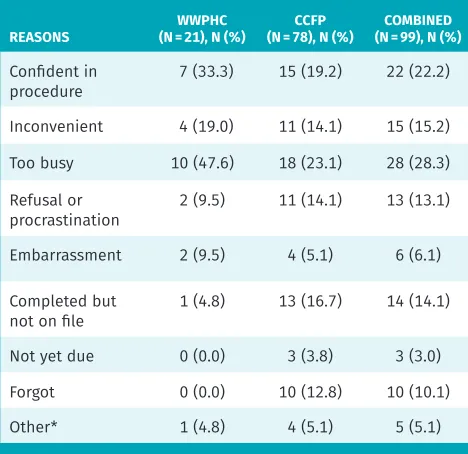
The men who had no PVSA results on file gave several consistent responses during our telephone discussions to explain their noncompliance (Table 2). We spoke with a total of 99 men and combined the responses from the 2 clinics. It is important to note that the participants were not limited to a single response; if they gave more than 1 answer, each answer was recorded in the total. A total of 22.2% of men that stated they were confident in the procedure and the physician performing the vasec-tomy, and therefore did not feel the need for confirma-tory testing. Next, 15.2% of men felt inconvenienced by the testing process itself, including hours of opera-tion for the andrology laboratory, its distance from their home, and the need to transport a specimen or provide one in the facility. A total of 28.3% of patients felt that they were too busy to follow through with testing, owing to family, work, or other personal commitments. A total of 13.1% of men simply stated that they were not going to have the test done or admitted that they had pro-crastinated and put it off for so long that they no longer wished to follow through. Only 6.1% of patients felt too embarrassed by the testing process itself to complete the
PVSA, particularly when it came to providing a sample. Additionally, 14.1% of men claimed to have had the test completed at some point, presumably with the results having been forwarded to another health care provider, resulting in no record of their PVSA on file (Figure 1). Furthermore, 3.0% of patients informed us that their vasectomies were less than 3 months ago and that, therefore, PVSA was not yet due. Some patients (10.1%) also stated that they simply forgot to complete the PVSA.
Table 1. Total eligible patients and contacted patients
CHARACTERISTICS WWPHC CCFP COMBINED
Total no. of
vasectomies 160 1812 1972
PVSA results
on file, n (%) 83 (51.9) 696 (38.4) 779 (39.5) PVSA results not
on file, n (%) 77 (48.1) 1116 (61.6) 1193 (60.5)
No. of calls made 77 377 454
No. of calls
answered 25 81 106
No. of those who agreed to participate
21 78 99
CCFP—City Centre Family Physicians, PVSA—postvasectomy semen analysis, WWPHC—West Winds Primary Health Centre.
Table 2. Overview of patients’ self-reported reasons for not completing PVSA
REASONS (N = 21), N (%)WWPHC (N = 78), N (%)CCFP (N = 99), N (%)COMBINED
Confident in
procedure 7 (33.3) 15 (19.2) 22 (22.2)
Inconvenient 4 (19.0) 11 (14.1) 15 (15.2)
Too busy 10 (47.6) 18 (23.1) 28 (28.3)
Refusal or
procrastination 2 (9.5) 11 (14.1) 13 (13.1)
Embarrassment 2 (9.5) 4 (5.1) 6 (6.1)
Completed but
not on file 1 (4.8) 13 (16.7) 14 (14.1)
Not yet due 0 (0.0) 3 (3.8) 3 (3.0)
Forgot 0 (0.0) 10 (12.8) 10 (10.1)
Other* 1 (4.8) 4 (5.1) 5 (5.1)
CCFP—City Centre Family Physicians, PVSA—postvasectomy semen analysis, WWPHC—West Winds Primary Health Centre.
Reasons for not completing postvasectomy semen analysis
RESEARCH
Finally, 5.1% of patients gave unique responses that did not fit into any of the aforementioned categories.
There are some additional results worth mentioning surrounding PVSA counseling done after the procedure and over the telephone when we contacted these men (Table 3). A total of 97.0% of men recalled being coun-seled about the importance of having PVSA completed in order to confirm sterility. After our discussions with the men who had not completed PVSA, 24.2% expressed that they were now interested in pursuing PVSA, and 7.1% indicated they would now consider the possibility of PVSA testing in the future. Those who expressed interest in PVSA were then referred back to their family doctors with instructions on how to get testing done, and those who would consider PVSA in the future were encouraged to discuss this further with their family doctors.
—— Discussion ——
While we identified high noncompliance rates, consis-tent with previous studies, our noncompliance rates dif-fered somewhat from those that have been reported in the literature. We also found a difference between the noncompliance rates from the 2 clinics that we examined. Noncompliance rates have typically been 30% or higher6-8
in previous studies, with a recent Canadian study from Dalhousie University in Halifax, NS,12 reporting a
noncom-pliance rate of 47.9%. The noncomnoncom-pliance rate at WWPHC (48.1%) appears to be consistent with rates found in pre-vious studies. However, CCFP had a higher noncompli-ance rate of 61.6%. The reason for the difference between
these 2 clinics is unclear; however, there are several fac-tors that might be contributing to the higher noncompli-ance rates at CCFP. The WWPHC is an academic practice with resident physicians and longer appointment times. Attending physicians at WWPHC review resident notes and counseling procedures to ensure PVSA counseling is emphasized. The CCFP also performs a higher number of vasectomies overall, with a greater number of exter-nal consultations for which follow-up is more challeng-ing (no regular source of updated contact information, no routine follow-up, etc). It is also important to note that both clinics routinely provide postprocedure handouts with instructions for PVSA testing.
Additional reasons for higher noncompliance rates in this study might include the fact that some patients indicated that they had completed the PVSA despite not having a record of this on file. A total of 17 patients in the study reported completing the PVSA or stated that Table 3. Recollection of PVSA counseling and willingness to pursue PVSA now
ATTITUDE OR
RECOLLECTION (N = 21), N (%)WWPHC (N = 78), N (%)CCFP (N = 99), N (%)COMBINED
Recalled PVSA
counseling 21 (100.0) 75 (96.2) 96 (97.0)
Interested in PVSA 5 (23.8) 19 (24.4) 24 (24.2)
Will consider PVSA 5 (23.8) 2 (2.6) 7 (7.1)
CCFP—City Centre Family Physicians, PVSA—postvasectomy semen analysis, WWPHC—West Winds Primary Health Centre.
Figure 1. Participants’ self-reported reasons for not completing PVSA
CCFP—City Centre Family Physicians, PVSA—postvasectomy semen analysis, WWPHC—West Winds Primary Health Centre.
WWPHC (n = 21) CCFP (n = 78) Combined (n = 99)
Too busy Confidence
in procedure
NO
. OF P
ATIENT
S
REASON
Inconvenient Had done
but not on file
Refusal or
procrastination Forgot Embarrassment Other
30
25
20
15
10
5
it was not yet due, but this number could potentially be higher if more men were successfully contacted. In terms of the categories of responses we received regarding PVSA noncompliance, responses were similar between WWPHC and CCFP. There were some slight differences between the clinics, but 3 categories accounted for most of the responses. These categories included patients feeling they were too busy (28.3%), men feeling confident in the procedure or physician (22.2%), and men feeling inconvenienced by the testing process (15.2%). If com-pliance rates in Saskatoon are to improve, counseling regarding these specific responses might help increase compliance. This counseling could potentially take place before or immediately after the procedure, or in the form of a follow-up visit or reminder (telephone call, mailed letter, e-mail, text message, etc). It might be helpful for the physician to stress that despite a busy lifestyle, the PVSA is still paramount to confirming sterility and that unexpected pregnancies are more time consuming than an appointment at the andrology laboratory. Physicians should also stress that despite confidence in the proce-dure, vasectomy failure is still a possibility.
Limitations
One limitation of our study was that there was not ade-quate time to contact every patient without a PVSA result on file. As mentioned, we called every third patient with no PVSA result on file from CCFP, meaning our selection process was not truly random. Because of this process, we might potentially be missing additional men who have completed or plan to complete a PVSA when it is due. The men who were not contacted might have also given other unique responses different from those we noted. However, further sampling was deemed to be unnecessary as saturation had been reached, and very few responses were categorized as “other.” Another limitation is that some of the patients without a PVSA result might have been missed during the chart review.
Very limited demographic data were collected for par-ticipants. It would be interesting to determine whether differences in patient age, education, or income level might have contributed to the differences in results.
Conclusion
Noncompliance rates with PVSA in this study were high, which is consistent with previous studies. The most common reasons given for noncompliance included men feeling too busy to complete the test, feeling confi-dent in the physician or the procedure’s success, or feel-ing inconvenienced by the PVSA process itself. We hope that this information might help guide future counseling opportunities. By addressing these common concerns before or immediately after vasectomy, men might be more likely to follow through with PVSA.
Recommendations for future studies could include sampling men who did complete PVSA to determine
their main reasons for completing the test. Additional studies might also take a more in-depth approach by examining demographic characteristics and compar-ing men who have or have not completed the PVSA based on age, location, and various social determinants of health. Further consideration could be given to a potential prospective study using different counseling or reminder techniques (eg, letter vs telephone call) aimed
at improving PVSA adherence.
Drs Diederichs, McMahon, and Tomas are family physicians in Saskatoon, Sask, and Dr Muller is Associate Professor of Academic Family Medicine at the University of Saskatchewan in Saskatoon.
Acknowledgment
We thank Drs Steven Goluboff and Tom Gabruch (from City Centre Family Physicians) and Ms Rob Wesson(Office Manager at City Centre Family Physicians) for their support, and the other authors thank Dr Muller for acting as the supervising faculty member for this project.
Contributors
Drs Diederichs, McMahon, and Tomas contributed to project design, data gathering, data analysis and interpretation, and manuscript preparation and editing. Dr Muller contributed to project design and manuscript preparation and editing, and he was the project supervisor.
Competing interests None declared Correspondence
Dr A.J. Muller; e-mail [email protected] References
1. Haldar N, Cranston D, Turner E, MacKenzie I, Guillebaud J. How reliable is a vasec-tomy? Long-term follow-up of vasectomised men. Lancet 2000;356(9223):43-4. 2. Deneux-Tharaux C, Kahn E, Nazerali H, Sokal DC. Pregnancy rates after vasectomy:
a survey of US urologists. Contraception 2004;69(5):401-6.
3. Senanayake E, Pacey AA, Maddireddy V, Shariff U, Hastie K, Rosario DJ. A novel cost-effective approach to post-vasectomy semen analysis. BJU Int 2010;107(9):1447-52. Epub 2010 Sep 21.
4. Shih G, Turok DK, Parker WJ. Vasectomy: the other (better) form of sterilization.
Contraception 2011;83(4):310-5. Epub 2010 Oct 8.
5. Zini A, Grantmyre J, Chan P. CUA guideline: vasectomy. Can Urol Assoc J 2016;10(7-8):E274-8. 6. Amundsen GA, Ramakrishnan K. Vasectomy: a “seminal” analysis. South Med J
2004;97(1):54-60.
7. Badrakumar C, Gogoi NK, SundAram SK. Semen analysis after vasectomy: when and how many? BJU Int 2000;86(4):479-81.
8. Chawla A, Bowles B, Zini A. Vasectomy follow-up: clinical significance of rare non-motile sperm in postoperative semen analysis. Urology 2004;64(6):1212-5. 9. Attar KH, Gurung P, Holden S, Peters J, Philp T. Clearance after vasectomy: has the
time come to modify the current practice? Scand J Urol Nephrol 2010;44(3):147-50. 10. Korthorst RA, Consten D, Van Roijen JH. Clearance after vasectomy with a single
semen sample containing < than 100 000 immotile sperm/mL: analysis of 1073 patients. BJU Int 2009;105(11):1572-5. Epub 2009 Dec 11.
11. Dhar NB, Jones JS, Bhatt A, Babineau D. A prospective evaluation of the impact of scheduled follow-up appointments with compliance rates after vasectomy. BJU Int
2007;99(5):1094-7. Epub 2007 Jan 16.
12. Duplisea J, Whelan T. Compliance with semen analysis. J Urol 2013;189(6):2248-51. Epub 2013 Jan 25.
13. Christensen RE, Maples DC Jr. Postvasectomy semen analysis: are men following up?
J Am Board Fam Med 2005;18(1):44-7.
14. Maatman TJ, Aldrin L, Carothers GC. Patient noncompliance after vasectomy. Fertil Steril 1997;68(3):552-5.
15. Weiske WH. Vasectomy. Andrologia 2001;33(3):125-34.
This article has been peer reviewed.
Cet article a fait l’objet d’une révision par des pairs.