CYTOGENETIC STUDIES OF AN INTERCHANGE BETWEEN CHROMOSOMES 8 AND 9 1 N MAIZE
C. R. BURNHAMl
William G. Kerckhoff Laboratories of the Biological Sciences, Cal+rnia Institute of Technology, Pasadena, California
Received November 13, 1933
The partially sterile line of maize considered in this paper originated as one of three partially sterile plants in a culture of sixty plants from an ear of red aleurone ( e r ) waxy (wwx) maize which was being used as a standard normal stock. The stock had not been subjected to X-ray treatment. This partially sterile line of maize has been described in a preliminary note (BURNHAM 1930) as semisterile-2. It was reported then that the “semi- sterile” plants showed a t diakinesis and metaphase I of meiosis a ring of four chromosomes representing an association of two of the smaller pairs. Linkage tests showed that one of these pairs carries the shrunken-waxy linkage group. MCCLINTOCK (1930) has shown that the second and third smallest chromosomes, 9 and 8, are involved; and, by a study of mid- prophase stages, that there has been an interchange between them of un- equal terminal segments of the long arms, chromosome 8 having lost the larger piece. Her trisomic tests showed that chromosome 9 is the one carry- ing the waxy linkage group. BEADLE (1932) has used this interchange to mark the maize chromosomes 8 and 9 for a cytogenetical study of the hy- brid with Euchlaena. CREIGHTON and MCCLINTOCK (1931) have used it as one of the morphological markers in their demonstration that an actual exchange of pieces of homologous chromosomes accompanies genetic cross- ing over.
The present paper presents additional cytogenetical data on this inter- change. In order to have the genetic data together in this paper, Dr. H. B. CREIGHTON has furnished the data in table 3 which she has collected on crossing over with aurea 1 (uul) and virescent 1 (VI).
For convenience the symbol Twill be used to represent the complex with respect to the chromosomes involved in the interchange.$ Diff erent inter- changes may be differentiated by adding numerals indicating the chromo- somes concerned. The one being considered here will be referred to hence- forth as T 8-9. The term “X-normal” has been proposed (BRINK and BURNHAM 1929) for plants homozygous for an interchange; while BLAKES-
LEE uses the term “Prime type” in Datura. I n this paper, no special term
will be used, reserving T 8-9 for the interchange complex.
1 NATIONAL RESEARCH COUNCIL Fellow in the Biological Sciences.
INTERCHANGE BETWEEN CHROMOSOMES OF MAIZE 43 1
BREEDING BEHAVIOR O F SEYISTERILE PLANTS
Semisterile plants, when used as the pollen parents in crosses with nor- mals, gave, out of 2812 plants, 47.4 percent that were semisterile, the re- mainder being normal, where a 1 : 1 ratio was expected. Where semisterile plants were used as the female parents in crosses with normals, out of 8141 plants, 49.7 percent were semisterile. The small deficiency noted in the former is similar in amount to that observed by BRINK (1925) in crosses using plants heterozygous for wx as the pollen parents. I n these crosses the waxy gene (wx) entered with the T 8-9 complex. The cross in which wx was in the normal chromosome has not been tested in sufficient num- bers for comparison.
The progeny of a self-pollinated semisterile plant includes normals and semisteriles. Among the normals there should be plants homozygous for the interchange. Since the gene wx entered with the T 8-9 complex and is rather closely linked with it, the waxy seeds from such a self-pollinated plant should be homozygous for T 8-9 in most cases. This proved to be the case and facilitated their isolation. The plants of this homozygous stock show no external differences from the semisterile sibs or from normal plants. They have ten bivalents a t meiosis and show no more ovule or pollen abortion than do normal plants. When crossed with a standard nor- mal line, all the Fl plants are semisterile. This serves as the genetic test for the isolation of lines homozygous for an interchange. I n the earlier re- port (BURNHAM 1930), the cross of T 8-9 with T 1-2a (semisterile-1) was found to give plants having two separate rings of four a t meiosis and about 79 percent pollen abortion. From this cross, a fertile stock homozgous for both interchanges has been isolated. When crossed with standard normals, all the F1 plants show the high sterility (79 percent).
432 C. R. BURNHAM
TABLE 1
Summary of linkage from backcrosses involving T 8-9 and factors i n chromosomes 8 and 9.
The three-point and four-point data are included.
QENEB LINEAQE NUMBER OF INDIVIDUALS RECOMBINATIONS
X Y PHASE XY xy ZY ZU TOTAL NUMBER PERCENT
UUI* T 8-9 RB 617 43 53 574 1237 96 7.5
~ T 8 - 9 ( d ) CB 116 54 55 126 351 109 31.1
~~ ~
69 40.8
C T 8 - 9 ( 0 ) CB 42 37 32 58 169
total 520 178 34.2
-
s h T 8-9 ( 0 ) CB 347 183 121 274 925 304 J L . Y
VI* T 8-9 RB 650 17 21 563 1251 38 3 .O
w ~ T 8 - 9
(a)
RB 48 430 433 70 981 118 12.0~ ~ T 8 - 9 ( 0 ) RB 136 974 952 170 2232 306 13.7
w ~ T 8 - 9 ( 3 ) CB 99 23 14 63 199 37 18.6
~~ ~~~
32 16.3 w x T 8 - 9 ( 0 ) CB 103 15 17 61 196
total 3608 493 13.7
j T 8-9(#) CB 53 34 50 33 170 84 49.4
j T 8 - 9 ( 0 ) CB 92 43 32 77 244 75 30.7
total 414 159 38.4
* Dita furnished by H. B. CREIGHTON.
INTERCHANGE BETWEEN CHROMOSOMES OF MAIZE
TABLE 2
Three-point linkage data from backcrosses involving T 8-9 and factors in chromosomes 8 and 9. 433
FSCOMBINATIONLI
QENETIC PARENTAL TOTAL
CONBTITUTION COMBINATION8 REGION 1 REGION 2 mQION8 1,2
42 58 2 4 35 28 0 0 169
C+T
100 6 63 0
37.3%
c s h + ( 0 )
3.6%
C++ 114 89 45 27 10 14 12 1 312
C w x T (CF) 203 72 24 13
27. 2% 11.9%
-
+
w x T 205 171 82 49 40 17 6 3 573sk++ (0) 376 131 57 9
24.470 11.5%
++T 77 39 13 13 14 13 3 - 172
shwx+ (0) 116 26 27 3
16.9% 17.4%
+
+j 61 68 12 1 38 23 1 2 206w x T + ( Q ) 129 13 61 3
7.8% 31.1%
+
+j 15 33 6 3 20 36 4 5 122w s T + ( 3 ) 48 9 56 9
14.8% 53.3%
C. R.
The two-point data, and the three-point data in table 2 show that the break lies on the side of sh away from wx; that is, that the order is: c-sh-
wtx-T 8-9. The earlier data (BURNHAM 1930) from 2 n + l plants which were partially sterile had indicated this as the position of the break. These data show the order of the genes from the point of interchange but do not determine on which side of this point they lie. MCCLINTOCK (1931), by the use of a 2 n + l or trisomic type carrying only one of the interchanged chromosomes in T 8-9, showed that these genes lie in the part of chromo- some 9 possessing the spindle fiber insertion region and not in the piece translocated to chromosome 8. (The term “interchanged” or “translocated piece” is used to designate the piece which does not include the fiber in- sertion region). This conclusion is also substantiated by my data on a
5-9 interchange (BURNHAM 1934) in which the break in chromosome 9 oc- curred in the short arm.
The data furnished by CREIGHTON in table 3 show 3 percent of recom- bination between T 8-9 and vl, and 7.5 percent between T 8-9 and aul. These 4-point data also indicate that aul and vl are between wx and the
break, with vl closer to the break than aul.
436
CROSSING OVER BETWEEN THE MAIZE CHROMOSOME 9 AND
ITS TEOSINTE HOMOLOGUE
In hybrids between Florida teosinte and maize, EMERSON and BEADLE
(1932) found little or no recombination in the C - wx interval. Since T 8-9
is a t some distance from wx, it was crossed to a stock furnished by BEADLE carrying the c- W x chromosome of the Florida teosinte. This stock was the fifth or sixth generation resulting from backcrosses to wx maize in which the teosinte
Wx
chromosome had been saved in each generation. The results given in table 4 indicate that the amount of crossing over is not the same in different plants. Based on the ratios of C wx to cW x
(corn: teosinte), the plants appear to fall into two groups; one in which the ratio through the pollen shows only a small deficiency in the c
W x
or teosinte class (42.8 percent of cWx)
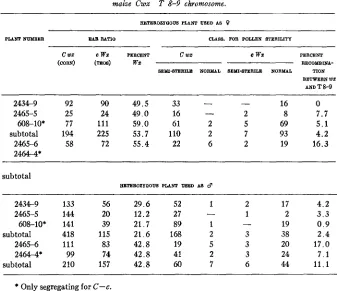
and the other in which this class is extremely deficient (only 21.6 percent in the total from three such plants). In both groups, using the same heterozygous plants as the female parents, the ratios are approximately 1 : 1. In each case the crosses are exact re- ciprocals between the same two plants. In the group giving approximately normal ratios in reciprocal crosses, the recombination value with T 8-9 is16.3 and 12.2 percent from the crosses using the heterozygote as the female and as the male respectively. This is to be compared with 4.3 and 2.3 per- cent in the crosses through female and male respectively in the group giv- ing deficient ratios through the pollen. The difference between the two groups is significant. The differences in crossing over through female and male are not significant.
Backcross data from this cross of T 8-9 with Florida teosinte have been reported by BEADLE (1932). The F1 plants used in his experiments were sibs of the ones used in mine. He reported a recombination value of 12.3
percent which agrees fairly well with my results from the group giving more nearly normal ratios through the pollen. The explanation of the low values in the other group is not known. Germination was low in both groups but was lower in the group giving the more nearly normal ratios of
INTERCHANGE BETWEEN CHROMOSOMES OF MAIZE 43 7 tween waxy
(wx)
and T 8-9. The loss of this section should result in a stock giving normal ratios through the pollen, and the recombination per- cent between T 8-9 andwx
should be nearer normal. The tests need to be repeated in a cross of T 8-9 with pure Florida teosinte.LINKAGE TESTS FOR CHROMOSOME 8
The determination of the linkage group carried by chromosome 8 which also would be expected to show linkage with T 8-9 was aided by Mc- CLINTOCK’S unpublished results on the association of several different tri- somics with their linkage groups. Her tests finally showed that chromo- some 8 carried either the sugary (su)-Tunicate
(Tu)
group or else it was the one for which no linkages had been found. (In the earlier note [BURN-HAM 19301 aberrant ratios for red aleurone (pr) were reported from a tri-
somic plant carrying T 8-9 which suggested that this group might be in- volved. Direct tests showed that the pr group is not linked with T 8-9). Backcross tests of T 8-9 with su and with
Tu
showed independence, indi- cating that chromosome 8 must carry the missing linkage group. Japonica (j), an unplaced gene, was tested with T 8-9. This character was described as a Japanese strain and illustrated by a colored plate under the name Zeajaponica by VAN HOUTTE in 1865-1867. The tests for linkage of j with T 8-9 (table 1) give conflicting data. When the semisterile plants were used as female parents, the progeny show linkage of j with T 8-9; when used as pollen parents they do not. This difference may not be very significant, since the crosses are not between the same stocks. A similar result has been reported, however, by ANDERSON (1934) and by RHOADES (1933). The combined data show 38.4 percent of recombination between j and T 8-9. Trisomic tests with j were made to determine whether it is in chromosome 9 or in chromosome 8. The test with chromosome 9 (2n+ 1, simplex for j , selfed) gave 209 J : 73 j, a close fit to the 3 : 1 (70.5 j expected) from disomic inheritance. The trisomic test with chromosome 8 [+j(2n)X
+
+j (2n+1)] gave 137 J:23 j in the8
aleurone class and 83 J:13 j in the r aleurone class. In these cultures, the plants were tillered and the classification for japonica was clearcut in both aleurone classes. These numbers are close to the 5 : 1 ratio expected from trisomic inheritance and indicate that j is in chromosome 8. MCCLINTOCK (1933) also has shown cytologically by means of deficiencies that j is in chromosome 8 and that its locus is toward the end of the long arm. Japonica must therefore lie in the piece of chromo- some 8 which was translocated to chromosome 9.438 C. R. BURNHAM
somic tests with chromosome 8 (normal chX2n+l simplex for Ch) gave
77 chocolate:72 normal; a 1:l or disomic ratio where 1:2 was expected TABLE 4
Data from backcrosses to cwx of plants heterozygous for the teosintecWx chromosome ( 9 ) and forIhe maize Cwx T 8-9 chromosome.
EETEROZYQOUS PLANT USED AS 9
PLANT NUMBER EAB RATIO CLASS. FOR POLLEN STERIUTY
2434-9 2465-5
sub to tal 608-10*
2465-6 2464-4*
C W Z C W Z PERCENT (CORN) (mos) wz
92 90 49.5 25 24 49.0 77 111 59.0 194 225 53.7 58 72 55.4
~
c wz c w z PERCENT RECOYBINA- SEMI%TERILQ N O W L SEMIu-8TERiLQ NORMAL TION
BETWEEN WZ
AND T 8-9
16 0
-
33 -
16 - 2 8 7.7
61 2 5 69 5 . 1
110 2 7 93 4.2
22 6 2 19 16.3
subtotal
EETEROZYOUS PLANT USED AS d
2434-9 133 56 29.6 52 1 2 17 4 . 2
2465-5 144 20 12.2 27 - 1 2 3 . 3
60&10* 141 39 21.7 89 1 - 19 0 . 9
sub to tal 418 115 21.6 168 2 3 38 2 . 4
2465-6 111 83 42.8 19 5 3 20 17.0
2464-4* 99 74 42.8 41 2 3 24 7 . 1
subtotal 210 157 42.8 60 7 6 44 11.1
* Only segregating for C-c.
from trisomic inheritance. Therefore chocolate is not in chromosome 8. Similar trisomic tests of chocolate with chromosome
7
indicate it is not in that chromosome. Also backcross tests for linkage of chocolate with brown midrib 2 (bmz) (32 parental:36 new coqbinations) indicate inde- pendence with this end of linkage group 1 which previously had not been tested with chocolate.LINKAGE TESTS WITH FACTORS I N OTHER CHROMOSOMES
Considerable data were accumulated in tests of this interchange with genes in other linkage groups. At the beginning, nothing was known about the association of the linkage groups with particular chromosomes. I n all cases, the data are from backcrosses. It is sufficient here merely to enumer- ate the factors that were tested without finding linkage: chromosome 1:
INTERCHANGE BETWEEN CHROMOSOMES OF MAIZE 439 (dl) ; chromosome 4 : sugary (su), and Tunicate (Tu) ; chromosome 5 : vires- cent
(vJ, red aleurone
( p r ) , and brown midrib (bml); chromosome 6: yel- low ( Y ) ; chromosome 7 : ramosa ( r a ) , glossy (gZl), virescent (216) ; and chromo-some 10: aleurone color
(R).
Chromosome 2 was later eliminated by the cytological observation that T 1-2, when crossed with T 8-9, gives two separate rings of 4 chromosomes each (BURNHAM 1930).Tests showing independence also were obtained with the gene albescent
(aZ) which is supposed to be in chromosome 6. Other tests of aZ with purple (PZ) and of aZ with T 1-6b in which the break is in the satellite proper show no linkage. The gene aZ appears not to be in chromosome 6 unless the satellite shows a special crossover relation with the remainder of the chromosome, across the nucleole attachment.
I n addition, the unplaced genes brown midrib-3 (bma), golden (gz), and tasselseed (Ts3) were tested with T 8-9 without finding linkage.
CYTOLOGICAL STUDIES
For cytological study T 8-9 was crossed with a stock which is homo- zygous for a large deeply-staining terminal knob on the end of the short arm of chromosome 9. Counts were made on the relative frequencies of rings and “chains” a t diakinesis. “Chains” or strings of four chromosomes are infrequent, out of 108 clear figures, there were
7
such configurations, the remainder being rings. BEADLE (1932) observed 3 per cent of chains in similar material. At this stage, with the presence of the terminal knob on chromosome 9, together with the small differences in lengths, it was possible to determine where lack of association had probably occurred to break the ring into a “chain.” I n five of the seven “chains” observed, the short interchanged chromosome 8 was a t the open end; probably indicating lack of association between the normal 9 and the piece of 9 which was translocated to 8. I n the two remaining “chains” the normal 8 was a t the open end probably indicating lack of association between the long arm of the normal 8 and the piece of 8 which was translocated to 9. The data are not sufficient to indicate the relative frequencies of the two types of lack of association, but do show that both may occur. At mid-prophase, Mc-440
somes was found in all the positions. Since the original breaks must have occurred at only one point in each of the two chromosomes, in every posi- tion except the one in which the center of the cross is a t these points there must be association of non-homologous parts. In plants heterozygous for
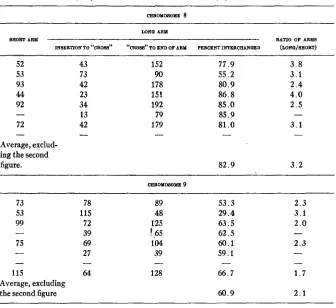
T 8-9, the position of the cross is very constant. Occasional figures show the cross at a markedly different position as is shown by the measurements of mid-prophase figures given in table 5 . One of the 8 figures is of that
TABLE 5
Data from measurements of camera lwida drawings of mid-prophase meiotic configurations in plants heterozygous for T 8-9 (measurements i n mm-agnification: X4200).
W N Q ARM
BHORT ARM RATIO OF ARM@
INSl3RTION TO “CROSS” “CROSS” TO END OF ARY PERCENT IWZERCEANQED (WNQ/[IBORT)
52 53 93 44 92 72 - Average, exclud- ing the second figure. 43 73 42 23 34 13 42 - 152 90 178 151 192 79 179 - 77.9 55.2 80.9 8 6 . 8 85.0 85.9 81
.o
-82.9
3 . 8 3 . 1 2 . 4 4 . 0 2 . 5
3 . 1
3 . 2
73 53 99 75 - 115 Average, excluding the second figure
78 115 72 39 69 27 64 89 48 125 1 65 104 39 128 - 53.3 29.4 63.5 62.5 6 0 . 1 59.1
66.7 -
60.9
2 . 3 3 . 1 2 . 0
2 . 3 -
-
- 1 . 7
2 . 1
type. The average for the other seven gives about 83 percent of the long arm of chromosome 8 and 60 percent of the long arm of chromosome 9 as
INTERCHANGE BETWEEN CHROMOSOMES OF MAIZE 441
long arm of chromosome 8 by a similar amount. Such a result could not have arisen by mere stretching. The data in table 5 include only those fig- ures in which the entire chromosome could be followed with certainty and do not indicate relative frequencies. Many figures were found and studied, from which it was concluded that the center of the cross is very constant in its position. In two interchanges, T 5-9 and T 2-6, which were studied cytologically and genetically the position of the center of the interchange cross a t prophase was extremely variable (BURNHAM 1932, 1934). I n each case this was associated with greatly reduced crossing over (BURNHAY 1934). I n the T 8-9 reported here where there was very little variability, the wx -vl interval shows no reduction in crossing over. If the association of non-homologous parts, brought about by variability in the position of the center of the cross, prevents crossing over in these regions, the above correlations are expected, that is, great variability with greatly reduced crossing over and little variability with no reduction or reduction in a very short interval.
I n the literature, DOBZHANSKY (1931) has emphasized competition in synapsis as a cause for the decreased crossing over observed in regions ad- jacent to translocations. No plausible mechanism for this competition has been offered. The variability in the position of the center of the cross sug- gests several possible mechanisms. MCCLINTOCK (1933) has reported evi- dence in maize that a t meiosis synapsis has a tendency to begin a t the ends of the chromosomes. There is no evidence to indicate that this process is initiated in different chromosomes a t the same time, nor that it proceeds in all a t the same rate. Where the chromosomes are in normal pairs, differ- ences in these processes would still give normal synapsis. Where an inter- change is present, a difference in either or both of these would affect the position of the center of the cross. Such processes might be expected to be variable, and would result in variable positions of the cross.
DEGREE O F STERILITY
Counts to determine the amount of pollen abortion were made by thoroughly teasing out about one-third of an anther in a drop of iodine-KI solution and counting the grains on the entire slide. The normal and aborted classes of grains are distinct, the aborted ones being practically devoid of starch, and somewhat smaller. Counts on twenty-five plants heterozygous for T 8-9 gave 25,135 pollen grains, of whichson the average 59 percent were aborted. There was considerable variation, the standard deviation being 5.8 percent. The amount reported in the earlier paper
(BURNHAM 1930) was 57 percent. Counts have not been made, but the ears
442
course of the work there were no visibly aborted grains, but 55 to 60 per- cent were small and well-filled with starch. Progeny were not grown from these to determine if they were heterozygous for T 8-9.
One culture was found to have plants with 67-69 percent aborted pollen in addition to plants with the usual 57-60 percent. MCCLINTOCK (1933) has found an inversion in the short arm of chromosome 8 in certain of the maize stocks. She has observed irregularities in meiosis, and pollen sterility resulting from crossing over in the inverted region. Plants from the culture giving the higher sterility were examined cytologically at mid-prophase, diakinesis, and anaphase of meiosis with special reference to chromosomes 8 and 9. There was no evidence that an inversion was present. There may have been one in another chromosome or some factor affected distribution in the ring. This suggests the possibility that the plus deviation from 50 percent sterility observed in most plants heterozygous for T 8-9 may be due to the presence of an inversion. Several different cultures have been studied cytologically a t prophase, none of which has shown an inversion. Nor have any cultures been found which show only 50 percent sterility. The amount of pollen abortion (59 percent) is significantly in excess of 50 percent. MCCLINTOCK (1930) found from cytological observations at the first microspore division in this interchange that any two chromosomes of the ring of 4 may pass together to one pole a t anaphase I of meiosis; that is, that six classes of spores are formed. She has suggested that in half the cases, alternate distribution occurs, while the other half includes the two types of adjacent ones. Absolutely random 2 by 2 distribution in the ring of four should give 50 percent of spore abortion; since for each of the two “open” orientations, there should be a corresponding zigzag arrange- ment occurring with equal frequency. The former give aborted spores while the latter give normal ones.
An attempt was made in this material to determine the relative frequen- cies of the two types of non-disjunction, that is, 1, non-disjunction of the interchanged pieces and 2, non-disjunction of the non-interchanged pieces. Since only the alternate distributions, that is, zigzag arrangements, give normal spores, it is necessary to study only the “open” rings a t metaphase. These are much easier to observe than the twisted or zigzag ones, but after considerable study it was concluded that the differences in chromosome lengths were not sufficient to permit identification in all cases of the two types of “open” ring orientation which lead to the two types of non-dis- junction. Since the observed amount of abortion is 59 percent in place of
INTERCHANGE BETWEEN CHROMOSOMES OF MAIZE 443
when the breaks were nearly median, distribution of the four chromosomes was approximately random, showing that the spindle fiber is not the all- important factor determining chromosome disjunction. It may be that the spindle fiber is a region a t which the forces first begin to act.
TRISOMIC INDIVIDUALS DERIVED FROM PLANTS HETEROZYGOUS FOR T 8-9
I n the preliminary paper (BURNHAM 1930), results were reported from two 21-chromosome7 low sterile plants which appeared in the progeny of plants heterozygous for T 8-9. Both gave ratios for factors in chromosome 9 approaching those from trisomic inheritance. One apparently was tri- somic for chromosome 8 (27 percent sterile) and the other for 9 (33 percent sterile). The apparent trisomic ratios obtained from the former were due to the fact that sh on chromosome 9 shows about 33 percent of recombina- tion with the interchange point. Later generations from the plant trisomic for chromosome 9 and heterozygous for T 8-9 have been studied. The probable genetic make-up of the three chromosomes is: (a) C Sh wx T 8-9,
(b) C Sh
W x + ,
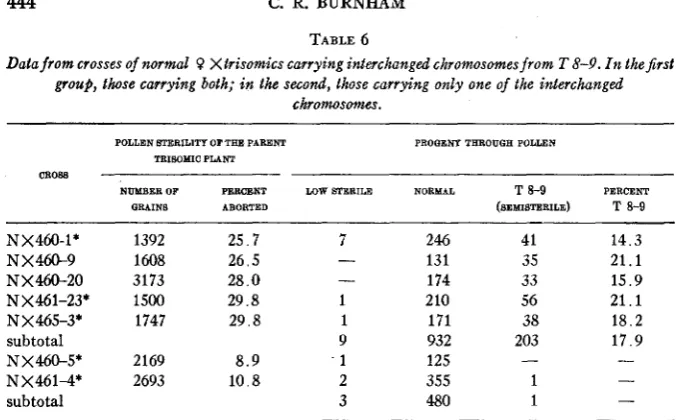
(c) c sh wx+. This plant was crossed to a c sh wx+ 3 , and the resulting low sterile (2n+1) plants were used both as the 3 and the 9TABLE 6
Data from crosses of normal 0 Xtrisomics carrying interchanged chromosomes from T 8-9. I n the first group, those carrying both; in the second, those carrying only one of the interchanged
chromosomes.
POLLEN STERILITY OF TEE PARENT TRISOMIC PLANT
PROQENP TEROUQE POLLEN
CILW
NUMBER OF PERCENT LOW STERILE NORMAL T 8-9 PERCENT
QRAINS ABORTED (SEMISTERILE) T 8-9
NX460-1* NX460-9 NX460-20 NX461-23* NX465-3* subtotal NX460-5* NX4614* subtotal
1392 25.7 7
1608 26.5 -
3173 28.0 -
1500 29.8 1
1747 29.8 1
9 2169 8 . 9 . 1
2693 10.8 2
3 246 131 174 210 171 932 125 355 480 41 35 33 56 38 203 1 1 - ~~ 14.3 2 1 . 1 15.9 21.1 18.2 17.9
* These plants were checked by root tip counts and were found to have 21 chromosomes (2n+l).
should on the basis of chance, a t least a t the interchange locus in the chro- mosome. If they disjoined from each other in every case, there would be no semisteriles among the 2n offspring. If the three chromosomes are repre- sented as: (a), (b), (c), of which (a) carries the translocation while (b) and (c) are normal, and if the proportions among the three types of synap- sis are assumed to b e 4 bc: l a b : lac, about 16.7 percent of the 2n spores will carry T 8-9. This is very near to the observed percent, but disjunction is probably complicated by the fact that most of the figures are chains of 5
chromosomes. Pollen sterility counts were made on 87 of the “semisterile” plants obtained from the above crosses to determine if they were similar to the original plants heterozygous for T 8-9. Plotting their frequencies by 2 percent intervals shows a slightly bimodal distribution, one mode fall- ing a t 58 to 60 percent while the other falls a t 62 to 64 percent. Although the difference is not based on large enough numbers, it suggests that there is a group showing higher pollen sterility. The presence of an inversion is one possible explanation for this group. The plants in the other group show a degree of pollen sterility similar to that in the original plants.
INTERCHANGE BETWEEN CHROMOSOMES OF MAIZE 445
sterile.” The latter probably was a stray pollination. It will be noted in table 6 that a few “low sterile” plants also appeared, about 0.74 percent. Pollen counts made on these plants determined for certain that they were “low sterile.” They undoubtedly arose from the functioning of n + l pollen. No data have been obtained on the frequency of n + l through the pollen of normal trisomics of either 8 or 9 for comparison.
Abnormal ratios for factors in chromosome 9 were obtained from many of the trisomic plants. One plant which showed 11 percent of pollen abor- tion gave only 11.3 percent of Sh seeds through the pollen in a backcross to sh. By assuming the correct amount of preferential pairing and lagging, such ratios can be explained, but until more is known about the actual distribution there is little value in such an attempt.
SUMMARY
1. The interchange between chromosomes 8 and 9 (T 8-9), referred to earlier as “semisterile-2,” shows 13.7 percent of recombination with waxy (wx), 32.9 percent with shrunken (sh), and 34.2 percent with colored aleurone (C). CREIGHTON’S data which are included show 7.5 percent with aureal (aul), and 3 percent with virescentl
(m).
The order is C-sh-wx- T 8-9 with aul and vl also probably between wx and T 8-9.2. No reduction in crossing over was found in any of the regions studied. Part of the wx-vl interval is probably in the arm in which the break oc- curred.
3. The gene for japonica stripe ( j ) is in chromosome 8, and shows 38 percent of recombination with T 8-9. That for chocolate pericarp (Ch) is not in this chromosome.
4. Crossing over with the Florida teosinte chromosome homologous with the maize chromosome 9 was observed in the wx-?’ 8-9 interval a s was reported by BEADLE, but the amount varied. This seems to be associated with some factor upsetting genetic ratios through the pollen.
5 . Pollen counts show about 59 percent of aborted pollen in plants heterozygous for T 8-9. There is a comparable degree of ovule abortion in such plants. Plants homozygous for the interchange show normal fer- tility.
6. Counts a t diakinesis in plants heterozygous for T 8-9 showed about
7 percent of chain configurations, the remainder being rings of four chro- mosomes.
446 C. R. BURNHAM
its rate of progress along the chromosomes would bring about variability in the position of the “cross.”
8. Genetic tests of a plant which was trisomic for chromosome 9 and which carried T 8-9 (a chain of five chromosomes) showed that synapsis must have been preferential between the two normal homologues of the group.
9. Tests through the pollen or trisomics carrying only one of the inter- changed chromosomes gave mostly normal off spring and no “semisteriles.” There was a small percentage of 2 n + l low sterile plants.
The writer wishes to express his indebtedness to Dr. R. A. EMERSON of CORNELL UNIVERSITY, to Dr. L. J. STADLER of the UNIVERSITY OF MIS- SOURI, and to Dr. E. G. ANDERSON of the CALIFORNIA INSTITUTE OF
TECHNOLOGY for furnishing the facilities for carrying on the studies re- ported here. The writer also is indebted to Dr. B. MCCL~NTOCK for mak- ing available her unpublished data on chromosome morphology and the association of the chromosomes with their linkage groups; and to Dr. H. B.
CREIGHTON for furnishing the 4-point linkage data.
LITERATURE CITED
ANDERSON, E. G., 1934. A chromosomal interchange in maize involving the attachment to the
ANDERSON, E. G. and EMERSON, R. A., 1931 Inheritance and linkage relations of chocolate peri- BEADLE, G. W., 1932 The relation of crossing over to chromosome association in Zea-Euchlaena BRINK, R. A., 1925 Mendelian ratios in the gametophyte generation in angiosperms. Genetics 10:
nucleolus. Amer. Nat. 68: 345-350. carp in maize. Amer. Nat. 65: 253-257. hybrids. Genetics 17: 481-501. 359-394.
1927 The occurrence of semisterility in maize. J. Hered. 18: 266-270.
BRINK, R. A. and BURNHAM, C. R., 1929 Inheritance of semisterility in maize. Amer. Nat. 63:
BRINK, R. A. and COOPER, D. C., 1932 A strain of maize homozygous for segmental interchanges involving both ends of the p-br chromosome. Proc. Nat. Acad. Sci. 18: 441-455. BURNHAY, C. R., 1930 Genetical and cytological studies of semisterility and related phenomena
in maize. Proc. Nat. Acad. Sci. 16: 269-277.
1932 The association of non-homologous parts in a chromosomal interchange in maize. Proc. Sixth Int. Congress Genetics 2: 19-20.
1934 Chromosomal interchanges in maize: reduction of crossing over and the association of
non-homologous parts. Amer. Nat. 68: 81-82.
COOPER, D. C. and BRINK, R. A., 1931 Cytological evidence for segmental interchange between non-homologous chromosomes in maize. Proc. Nat. Acad. Sci. 17: 334-338.
CREIGHTON, H. B. and MCCLINTOCK, B., 1931. A correlation of cytological and genetical crossing- over in Zea mays. Proc. Nat. Acad. Sci. 17: 491497.
DOBZHANSKY, TH., 1931 The decrease of crossing over observed in translocations, and its probable explanation. Amer. Nat. 65: 214-232.
1933 Studies on chromosome conjugation. 11. The relation between crossing over and dis- junction of chromosomes. Z.I.A.V. 64: 269-309.
EMERSON, R. A. and BEADLE, G. W., 1932 Studies of Euchlaena and its hybrids with Zea. 11. Crossing over between the chromosomes of Euchlaena and those of Zea. Z.I.A.V. 62: 305- 315.
INTERCHANGE BETWEEN CHROMOSOMES OF MAIZE
MCCLINTOCK, B., 1930 A cytological demonstration of the location of an interchange between two non-homologous chromosomes of Zea mays. Proc. Nat. Acad. Sci. 16: 791-796. 1931 The order of the genes C, Sh, and W z in Zea mays with reference to a cytologically
known point in the chromosome. Proc. Nat. Acad. Sci. 17: 485491.
1933 The association of non-homologous parts of chromosomes in the mid-prophase of meiosis in Zea mays. Z. f. Zellforsch. U . mikrosk. Anatom. 19: 191-237.
RHOADES, M. M., 1931 Linkage values in an interchange complex in Zea. Proc. Nat. Acad. Sci. 17: 694-698.
1933 A cytogenetical study of a reciprocal translocation in Zea. Proc. Nat. Acad. Sci. Washington 19: 1022-1031.
447