REVIEW
Weak Selection and Protein Evolution
Hiroshi Akashi,1Naoki Osada, and Tomoko Ohta Division of Evolutionary Genetics, Department of Population Genetics, National Institute of Genetics, Mishima, Shizuoka 411-8540, Japan
ABSTRACTThe“nearly neutral”theory of molecular evolution proposes that many features of genomes arise from the interaction of three weak evolutionary forces: mutation, genetic drift, and natural selection acting at its limit of efficacy. Such forces generally have little impact on allele frequencies within populations from generation to generation but can have substantial effects on long-term evolution. The evolutionary dynamics of weakly selected mutations are highly sensitive to population size, and near neutrality was initially proposed as an adjustment to the neutral theory to account for general patterns in available protein and DNA variation data. Here, we review the motivation for the nearly neutral theory, discuss the structure of the model and its predictions, and evaluate current empirical support for interactions among weak evolutionary forces in protein evolution. Near neutrality may be a prevalent mode of evolution across a range of functional categories of mutations and taxa. However, multiple evolutionary mechanisms (in-cluding adaptive evolution, linked selection, changes in fitness-effect distributions, and weak selection) can often explain the same patterns of genome variation. Strong parameter sensitivity remains a limitation of the nearly neutral model, and we discuss concave fitness functions as a plausible underlying basis for weak selection.
U
NDER the neutral model, newly arising mutations fall into two majorfitness classes: strongly deleterious and selectively neutral (Kimura 1968; King and Jukes 1969). The first class is well supported by mutation accumulation experiments (reviewed in Simmons and Crow 1977; Halligan and Keightley 2009) and early DNA sequence comparisons (Grunstein et al. 1976; Kafatoset al. 1977) and is shared among competing evolutionary models. The novel and con-troversial aspect of the neutral theory was the proposition that, among mutations that go tofixation, the vast majority are selectively neutral. Advantageous substitutions, al-though important in phenotypic evolution, are sufficiently rare at the molecular level that they need not be considered to adequately model the process. Under the neutral theory, within- and between-species variation sample two aspects of a process of origination by mutation and changes in gene frequency dominated by drift and, for some mutations, negative selection (Kimura and Ohta 1971a). In contrast,polymorphism and divergence may be “uncoupled” under selection models (Gillespie 1987).
Protein polymorphism and the neutral model: invariance of heterozygosity
Clear predictions for levels of polymorphism within popula-tions and divergence among species are appealing aspects of the neutral model. However, within a few years of its proposal, the notion of drift-dominated evolution was challenged by overall patterns of allozyme polymorphism and contrasts between DNA and protein divergence.
Although evolutionary geneticists were generally sur-prised by the extent of naturally occurring variation revealed by allozyme gel electrophoresis in the 1970s (Lewontin 1991), the lack of species with high polymorphism levels became a central problem for proponents of the neutral theory (Robertson 1968; Maynard Smith 1970a; Lewontin 1974). The neutral model makes a simple prediction for protein heterozygosity, a summary statistic for levels of nat-urally occurring variation. Heterozygosity, H, is defined as the probability of randomly sampling different alleles from a population in two independent trials. Kimura and Crow (1964) determined expected heterozygosity for neutral alleles in an “idealized” population of constant size with random mating among hermaphroditic individuals. Genera-tions are nonoverlapping in this scenario, and offspring are Copyright © 2012 by the Genetics Society of America
doi: 10.1534/genetics.112.140178
Manuscript received March 1, 2012; accepted for publication June 11, 2012
Supporting information is available online athttp://www.genetics.org/lookup/suppl/
doi:10.1534/genetics.112.140178/-/DC1.
This article is dedicated to the memory of James F. Crow.
1Corresponding author: Division of Evolutionary Genetics, Department of Population
generated by randomly sampling gametes from the parents. Under such conditions, referred to as a Wright–Fisher pop-ulation, and in the absence of mutation, genetic drift leads to a loss of heterozygosity at a rate inversely related to the population size. If new mutations arise in each generation, heterozygosity will reach an equilibrium between muta-tional input and loss by drift:
H¼4Nv=ð1þ4NvÞ;
wherevis the per-generation mutation rate to new, neutral alleles, and N is the number of diploid individuals in the population. If all amino acid changes are either strongly del-eterious or selectively neutral, v can be replaced with the product of the fraction of neutral mutations (fn) and the total mutation rate (u). To employ results for Wright–Fisher populations to predict heterozygosity (and other aspects of genetic drift) in populations that violate assumptions of the model, N is replaced by the“effective” population size (Ne) (see Charlesworth 2009). Incorporating both substitutions gives an expected heterozygosity ofH= 4Nefnu/(1 + 4Nefnu). Heterozygosity under the neutral model can be predicted given values for mutation rate and effective population size. Estimates for both parameters are crude, but Maynard Smith (1970b) and Nei and Graur (1984) predicted that levels of protein heterozygosity in large natural populations should approach the upper limit of 1. Although some species show close to zero allozyme variation, very few studies foundH.
0.30. Species such as humans,Drosophila melanogaster, and
Escherichia coli show roughly similar levels of protein poly-morphism although their historical population sizes presum-ably differ greatly. This “invariance of heterozygosity” (Lewontin 1974) was argued as strong evidence against the neutral model.
Protein divergence and the neutral model
The neutral model also makes simple predictions for evolutionary divergence. For proteins, new mutations fall into two mainfitness classes: strongly deleterious mutations that natural selection quickly eliminates from populations and neutral mutations that drift tofixation with probabilities equal to their initial frequency. Neutral mutations have smaller fixation probabilities in larger populations than in smaller populations, but this difference is exactly matched by the higher mutational input in larger populations, and the expected rate of neutral divergence is simply the mutation rate (and is independent of population size) (Wright 1938).
The initial motivation for Kimura’s proposal of the neutral theory was absolute rates of protein evolution that appeared to violate theoretical upper limits for adaptive fixations (Kimura 1968), but the molecular clock was quickly adopted as one of the strongest pieces of evidence supporting neutral evolution (Kimura and Ohta 1971a). The clock-like nature of protein evolution (Zuckerkandl and Pauling 1965) was considered to be in accord with the neutral theory’s
predic-tion of lack of dependence on populapredic-tion size and inconsis-tent with adaptive models that predict rate dependence on both population sizes and the particular ecology of species. To account for the molecular clock, Kimura and Ohta (1971a,b) proposed that mutation rates are approximately constant per year. In addition, they suggested that the frac-tion of neutral mutafrac-tions varies among proteins (this explains the among-protein rate variation) but remains rel-atively constant over time (this explains the clock-like di-vergence for each protein) (Kimura and Ohta 1971b). Kimura’s views on the importance of weakly selected
muta-tions fluctuated over his career (Kimura and Takahata
1995); we will refer to the initial formulation discussed above as the“neutral model.”
Contrasting patterns of protein and DNA divergence forced a reconsideration of the fit of protein molecular clocks to the strict neutral model (Ohta 1972a). DNA diver-gence, accessed through DNA–DNA hybridization (Laird and McCarthy 1968; Kohne 1970), appeared to show a genera-tion time effect (greater divergence in lineages experiencing larger numbers of generations per year) in contrast to the absolute-time dependence of protein evolution. The ratio of DNA to protein divergence varied considerably (.10-fold) among lineages. Under the neutral model, this ratio gives an estimate of 1/fnfor proteins (assumingfn= 1 for DNA di-vergence), and such variation violated a tenet of the neutral model (Kimura and Ohta 1971a).
mutations as those“whose selection coefficients are so small that their behavior is not very different from strictly neutral mutants. Operationally, this is defined by |Nes|,1 (Ohta 1972b). The relative strengths of selection and genetic drift shift gradually near |Nes|1, so“near neutrality”cannot be precisely defined (especially fors.0). In this section, we employ Ohta’s definition of effectively neutral mutations in the range |Nes|,1 and consider only deleterious mutations. Under weak selection, expected heterozygosity becomes
H 4Ne f9nu/(1 + 4Ne f9nu), where fn from the neutral model is substituted by the fraction of nearly neutral muta-tions (f9n).fnis assumed (under the original neutral model)
to be generally constant among lineages butf9nis very
sensi-tive to effecsensi-tive population size. For nearly neutral mutations,
f9ndecreases asNeincreases; thus, heterozygosity increases
more slowly as a function of population size than for neutral alleles (Ohta 1974; Ohta and Kimura 1975). Excess rare (low frequency) variants observed for allozyme data in a number of species (Latter 1975; Ohta 1975; Chakraborty
et al.1980) are consistent with slightly deleterious protein polymorphism.
Neutral and adaptive scenarios were also proposed to account for the invariance of allozyme heterozygosity. The expected relationship betweenHandNeassumes that pop-ulations have reached a steady-state level of polymorphism. Nei and Graur (1984) developed a demographic hypothesis to explain the upper limit on heterozygosity; population sizes mayfluctuate considerably on evolutionary timescales, and effective population size is especially sensitive to strong reductions. Consistently low heterozygosities result from bottlenecks during glaciation events; current population samples for many species reflect the recovery of neutral variation in expanding populations since the last glaciation. The approach to equilibrium heterozygosity can require 4– 8Ngenerations after population size changes (Nei and Graur 1984; Tajima 1989), and frequency spectra will be skewed toward rare polymorphisms during the recovery phase. May-nard Smith and Haigh (1974) showed that adaptive fi xa-tions can cause bottleneck-like reducxa-tions in variation and excess rare variants at neutral sites that are genetically linked to advantageous mutations, a process termed “ ge-netic hitchhiking.”Deleterious mutations also reduce levels of neutral variation at linked sites (Charlesworth et al.
1995). Population bottlenecks and linked selection may con-tribute to the upper limit of heterozygosity for neutral var-iation, but weak selection in protein evolution also predicts differences inratiosof protein to synonymous polymorphism among populations (see below).
Nearly neutral mutations were also invoked to explain variation in rates of protein evolution. As noted above, DNA divergence appeared to be reduced in lineages with long generation times whereas protein evolution showed a more clock-like dependence on absolute time. Ohta and Kimura (1971) and Ohta (1972a) postulated an inverse relationship between generation time and effective population size to explain this discordance [e.g., among mammals, humans
and elephants have longer generation times and presumably smaller population sizes than rodents (see Chao and Carr 1993)]. If mutation rates are expressed in units of genera-tions, then the rate of protein divergence (nonsynonymous substitutions per site) in absolute time is f9nug, whereuis
the mutation rate per generation and g is the number of generations per year. An inverse relationship between f9n
and g can produce clock-like protein evolution if f9n g is
roughly constant. Because lineages that undergo fewer gen-erations per year also experience less effective negative se-lection against slightly deleterious mutations, the ratio of protein to DNA divergence is positively correlated with gen-eration time.
Structure of the Nearly Neutral Model
The nearly neutral model posits a distribution of selection coefficients with a large fraction of new mutations with
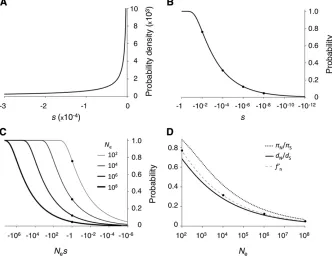
fitness effects near the reciprocal of population sizes found in nature. This section will give an illustration of the model and its predictions. Figure 2A shows an example of the probability distribution of selective effects (DSE) of new mutations that puts a substantial density in the nearly neu-tral range for a wide range of population sizes, 102,Ne,
108. Initially, we considered only deleterious mutations. It is
to an absolute scale or to the sensitivity of the assays used. The limit of detection for laboratory studies, even in large-scale
fitness assays for microbes, is usuallys.0.001 (e.g., Dykhuizen and Hartl 1983; Lindet al.2010; Hietpaset al.2011).“Weakly selected” alleles in such studies would be well outside the nearly neutral range in many natural populations; mutations of |Nes|1 in populations with effective sizesNe.104may
be undetectable infitness and phenotype assays.
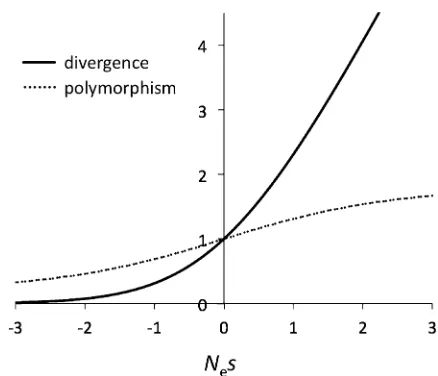
Figure 2B shows the cumulative distribution function for the DSE shown in Figure 2A. Expected levels of polymor-phism and divergence are functions of scaled selective effects,Nes(Figure 1), and Figure 2C shows the cumulative distribution functions for Nes across a range of population sizes. Many mutations that fall into the“effectively neutral” range in small populations are strongly selected in larger populations, and f9n varies considerably as a function of Ne. Expected polymorphism and divergence patterns under this DSE are shown in Figure 2D. Polymorphism is less re-duced under weak selection than divergence but both de-crease at substantial rates over a wide range ofNe.
In the analyses above, we have assumed no new mutations that enhance fitness, s . 0. Adaptive evolution may often occur in response to environmental change. Because slightly deleteriousfixations go tofixation at appreciable rates, nearly neutral models must allow for slightly advantageous muta-tions, including back mutations and compensatory mutations (Ohta 1972b, 1973; Latter 1975; Ohta and Tachida 1990), even in the absence of pressure for novel function. Compen-satory evolution retards the slow decline infitness by slightly
deleteriousfixations and will be more effective if some com-pensatory mutations have large positivefitness effects (i.e., if they can compensate for multiple deleteriousfixations).
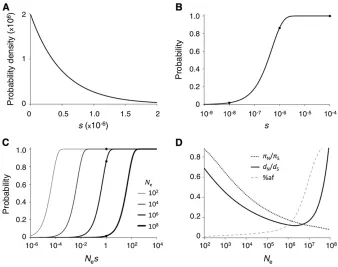
Figure 3A shows an example DSE for advantageous muta-tions. Even a small fraction of such mutations can have a sub-stantial impact on divergence (we assume that 99% of new mutations are drawn from the deleterious DSE shown in Figure 2A and that 1% of mutations are drawn from the DSE shown in Figure 3A). Expected polymorphism and divergence under the combined deleterious and adaptive DSE are shown in Fig-ure 3D. Advantageous mutations contribute little to polymor-phism, and DNA diversity shows a negative relationship with
Nesimilar to the deleterious mutations case. However, larger populations have smaller proportions of deleterious, and larger proportions of adaptive, fixations. The fixation rate of new mutations begins toincrease as a function of population size when the proportion of effectively selected positive mutations (Nes . 1) becomes large. The effect of population size on expected polymorphism and divergence can be highly sensitive to the particular DSE; we present a single example to illustrate relationships among DSEs, population size, and evolutionary patterns under the nearly neutral model.
Evidence for Weak Selection in Protein Evolution
Both DNA variation data and statistical methods for testing evolutionary mechanisms have proliferated tremendously in the past decade, and we summarize keyfindings related to the nearly neutral model below.
Population size and rates of evolution
Negative relationships between rates of protein evolution and population size are a clear prediction of near neutrality; Ohta (1972a) showed such correlations in Drosophila and mam-mals. Although generation time may be a noisy predictor of
Neand DNA–DNA hybridization gives only rough measures of distance, Ohta’s study is notable for introducing an early form of comparison of nonsynonymous and putatively neutral di-vergence to test evolutionary models. More recent analyses often employ the ratio of nonsynonymous to synonymous DNA divergence per site (dN/dS) to estimate fnorf9nunder
the neutral and nearly neutral models, respectively.
Several genome-scale comparisons support the weak-selection prediction of inverse relationships betweendN/dS
and population size. Faster protein evolution in primates com-pared to rodents was observed in early studies limited to small numbers of genes (Liet al.1987; Ohta 1995), and the pattern has been confirmed in larger-scale analyses (Chimpanzee Se-quencing and Analysis Consortium 2005; Rhesus Macaque Ge-nome Sequencing and Analysis Consortium et al. 2007). In addition, substitutions among amino acids with greater physi-cochemical differences have been more frequent in primates than in rodents (Zhang 2000; Eyre-Walkeret al.2002; Hughes and Friedman 2009). Analyses of nuclear genes in a broader range of mammals revealed a twofold variation indN/dSand negative relationships betweendN/dSand estimates of popula-tion size (Lindblad-Tohet al.2005; Kosiolet al.2008; Ellegren 2009). Wright and Andolfatto (2008) noted that such a rela-tionship extends to comparisons among pairs of bacteria, Dro-sophila, plants, and mammals. The relationship is strong, but DSEs may not be conserved across distantly related organisms.
Independent comparisons between host-dependent bacte-rial lineages and their free-living relatives show consistently faster evolution in endosymbionts (Moran 1996; Wernegreen and Moran 1999) as well as pathogens (Andersson and Andersson 1999; Warnecke and Rocha 2011). Wernegreen (2011) also noted a higher ratio of radical-to-conservative amino acid replacement changes in insect symbionts relative to free-living relatives. Vertically transmitted symbionts, such asBuchnerain aphids, experience population bottlenecks dur-ing transmission from parent to embryo as well as population-size fluctuations of the host species. In addition, symbiont genomes experience limited opportunities for recombination; genetic linkage among selected mutations reduces the effi -cacy of natural selection in a manner similar to reducedNe
(Hill and Robertson 1966; Felsenstein 1974; Birky and Walsh 1988; Charlesworth 1994; Barton 1995). Low heterozygosity at synonymous positions is consistent with small population sizes of bacterial endosymbionts (Funket al.2001; Abbot and Moran 2002; Herbecket al.2003).
reduced Ne. Interestingly, several fast-evolving endosymbi-ont lineages show high expression of heat-shock proteins (McCutcheon and Moran 2011). GroEL, an ATP-dependent bacterial chaperonin that assists in protein folding, is among the most abundant proteins in independently derived endo-symbionts. Elevated heat-shock protein expression may be part of a compensatory response to slightly deleteriousfi x-ations that destabilize proteins (Moran 1996; van Hamet al.
2003; Fareset al.2004) and could be an example of a rela-tively small number of adaptive changes counteracting a much larger number of deleteriousfixations. GroEL over-expression can enhance growth rates of laboratory strains of bacteria that have accumulated mutations but show a cost in the ancestral strains (Moran 1996; Fares et al. 2002). In-terestingly, this cost is apparent only when ancestral strains are grown in amino-acid-limited environments. Elevated heat-shock protein expression may be favored in endosym-biont lineages that have accumulated destabilizing muta-tions. Enhanced protein folding should reduce the fitness effects of further destabilizing amino acid changes (i.e., shift the distribution of selection coefficients) (Tokuriki and
Taw-fik 2009a). Thus, elevated heat-shock protein expression and accumulation of destabilizing mutations may form a pos-itive feedback loop until the benefits of further chaparonin overexpression no longer outweigh the costs.
A number of cases of accelerated divergence in small populations have been documented for proteins encoded in mitochondrial genomes. Island bird species show elevated rates of protein evolution relative to their mainland counter-parts (Johnson and Seger 2001), and similar patterns hold for other vertebrates as well as invertebrates (Woolfit and Bromham 2005). Higher dN/dS in obligately asexual line-ages than in sexual lineline-ages ofDaphnia(Paland and Lynch 2006) and freshwater snails (Johnson and Howard 2007; Neimanet al.2010) is consistent with elevated Hill– Robert-son interference with reduced opportunities for recombina-tion [between mitochondrial DNA (mtDNA) and nuclear genomes] and/or greater frequencies of founder events in asexual lineages (Glémin and Galtier 2012). However, asex-ual lineages are often short-lived, tip branches on the phy-logeny, anddN/dSfor these lineages may include a greater fraction of polymorphic mutations than in sexual lineages. BothdN/dSand ratios of radical-to-conservative amino acid
fixations are positively correlated to body mass for
mtDNA-encoded proteins (13 genes) among .100 species of
mammals (Popadin et al.2007). If body mass and Neare inversely related (Damuth 1981), these patterns support slightly deleterious fixations in large mammals. In many of the examples above, lineages that are thought to differ inNe
also differ in their ecology; differences in DSEs remain a plausible alternative, or a contributing factor, to heteroge-neity in protein divergence. In addition, Bazinet al.(2006) found little evidence for positive correlations between mtDNA heterozygosity and proxies for effective population size (allozyme and nuclear DNA variation) across a wide range of taxa. They suggested that complete genetic linkage
in mtDNA genomes and recurrent positive selection (Gillespie 2001) may underlie such patterns. However, within-taxa comparisons show positive correlations between mtDNA heterozygosity and nuclear genome variation in mammals (Mulligan et al. 2006; Nabholzet al.2008) and other ani-mals (Piganeau and Eyre-Walker 2009). Variation in muta-tion rates, adaptive evolumuta-tion, and=or biased transmission may contribute to within- and between-taxa differences for mtDNA polymorphism.
Within-genome comparisons can also test for relation-ships between Ne and protein evolution. Near neutrality predicts faster protein evolution in regions of reduced re-combination, and such patterns have been confirmed in yeast (Connallon and Knowles 2007; Weber and Hurst 2009) and Drosophila (Camposet al. 2012; Mackayet al.
2012). Because these studies compare evolutionary rates among different genes, differences in DSEs may contribute to heterogeneity. Such differences may be related to the functional categories of genes that reside in regions of low recombination and/or to their expression level. Interest-ingly, in Drosophila, subsets of loci such as male-biased genes (Betancourt and Presgraves 2002; Presgraves 2005; Zhang and Parsch 2005) andD. melanogasterlineage accel-erated genes (Larracuente et al. 2008) show the opposite trend: positivecorrelations between recombination anddN/
dS consistent with limits to adaptive evolution under low recombination. Primates show no correlation between dN/
dSand the rate of recombination (Bullaugheyet al.2008), but relationships between local recombination rates and DNA diversity in the human genome are weak (Hellmann
et al.2005).
Interpretations of among-lineage and within-genomedN/
dS tests of near neutrality are complicated by recent evi-dence that a majority of protein changes are adaptivelyfixed in many species (reviewed in Fay 2011). Advantageous mutations go tofixation at higher rates in largerNewhen they are weakly selected and when adaptive evolution is mutation-limited. In such cases, dN/dS can show positive relationships with Ne (Figure 3D) even in the presence of slightly deleterious mutations.
Population size and protein polymorphism
Several assumptions are necessary when attributing varia-tion in protein divergence to near neutrality. Advantageous substitutions should be rare, and DSEs must remain constant among the lineages compared. In addition, relative ancestral effective population sizes must be known. Some studies assume relationships betweenNeand the ecology of organ-isms (e.g., host-cell dependence, island habitats), and other studies estimate Nefrom current polymorphism levels. The former approach leaves open the possibility of associations between the “life style”of organisms and their DSEs. The latter method allows inference ofNe in roughly the last 4N
divergence at synonymous sites and accurate estimation of dS. Both natural selection (reviewed in Akashi 2001; Chamary et al. 2006; Hershberg and Petrov 2008; Plotkin and Kudla 2010) and biased gene conversion (reviewed in Birdsell 2002; Marais 2003; Duret and Galtier 2009) can causefixation biases in synonymous divergence. In addition, estimates of dS can differ considerably among methods when base composition is biased and/or when divergence is large (Dunn et al. 2001; Bierne and Eyre-Walker 2003; Aris-Brosou and Bielawski 2006).
Weak selection also predicts inverse relationships be-tween polymorphism levels (scaled to neutral values) and
Ne(see Figures 2 and 3). The DNA analog of heterozygosity in allozyme data is “nucleotide diversity,” the number of differences (per nucleotide site) in a randomly selected pair of chromosomes from a population (p). Under neutral pro-tein evolution, equilibrium DNA diversity at nonsynonymous sites is
pN¼4 Nefn u;
whereuis the total mutation rate (Kimura 1969; Watterson 1975; Tajima 1983). If all synonymous mutations are neu-tral, pN/pS provides an estimate of fn, which, under the
neutral model, should be generally constant among species. Under near neutrality, pN/pS gives an estimate of f9n, the
proportion of effectively neutral mutations that are strongly dependent on Ne [note that f9n estimates from
polymor-phism include mutations with a larger range of selection intensities than f9n estimated from divergence (see Figure
1)]. Fluctuations in population size and/or linked selection may contribute to the invariance of allozyme heterozygosity, but such factors do not affect expected pN/pS for neutral
protein polymorphism.
Tests of weak selection that compare polymorphism among populations are robust to some of the assumptions required in divergence tests. Estimates of population size from present-day populations should be more accurate for the relevantNe. Since advantageous mutations make small contributions to polymorphism (under directional selec-tion), comparisons of pN/pS are less affected by adaptive
evolution than divergence (Figure 3). In addition, although neutrality at synonymous sites (or other control classes such as introns) may not be strictly valid, weak selection in the control class will have less impact on polymorphism than
fixation. Finally, pN/pS comparisons can be performed
among closely related species (or even among populations of the same species if they are evolving independently). The critical assumption of DSE identity is more likely to hold among closely related organisms than among more distantly related species.
Elyashiv et al. (2010) found negative relationships be-tween pN/pS and estimates of population size among
closely related yeast species. pS varies roughly 10-fold
among essentially independently evolving populations of
Saccharomyces cerevisiaeandS. paradoxus, suggesting
simi-lar variation inNe. Although data were available for only six populations, pN/pSvaries considerably among populations
(from 0.16 to 0.37) and shows a negative correlation with pS. Piganeau and Eyre-Walker (2009) showed negative
cor-relations between pN/pS and pS for mtDNA genes across
more distantly related species within several taxa (they
ex-amined .1700 species including fish, birds, mammals,
insects, and mollusks).
pN/pS ratios for mammal and plant nuclear genes also
show negative associations with estimates of population size. In comparisons limited to a small number of genes, Satta (2001) found higherpN/pSin humans than in chimps;
this difference has been confirmed in genome-scale analyses (Hvilsom et al. 2012). pN/pS is also higher in humans
(0.35) than in mice (0.19; Halliganet al.2010) and rabbits (0.05; Carneiro et al. 2012), which is consistent with sub-stantial differences in f9n. Among a larger number of plant
species, pN/pS varies by roughly fourfold among species
and is inversely related to estimates of Ne (which ranges from3·104to7·105) (Gossmannet al.2010; Slotte et al.2010; Strasburget al.2011).
Figure 4 shows protein polymorphism comparisons among yeasts and plants. Both yeast and plants show neg-ative relationships betweenpN/pSandpSas predicted under
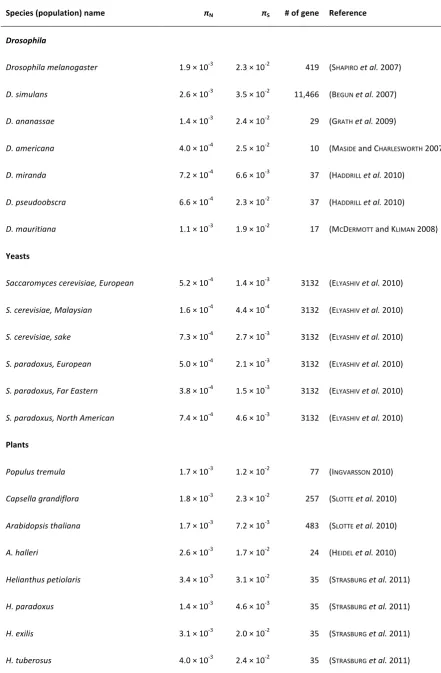
weak selection. pN/pS is lower among Drosophila species
than among mammals (both overall and among homolo-gous genes involved in the metabolic process) (Petit and Barbadilla 2009), but patterns within Drosophila are un-clear (the numbers of sampled populations is low; see sup-porting information,Table S1). Polymorphism patterns for individual species can be attributed to differences in DSEs rather than population size [e.g., high pN/pS in humans
has been attributed to relaxed selection (Takahata 1993; Satta 2001)]. Sampling species with a breadth of popula-tion sizes in a larger number of taxa will be necessary to establishNeas a key factor determining the proportions of weakly and strongly deleterious mutations and to test whether near neutrality underlies the invariance of protein heterozygosity.
Within-lineage contrasts of polymorphism and divergence
The examples above employed mostly among-lineage con-trasts in the evolutionary dynamics of protein and DNA mutations to test mechanisms of molecular evolution. Within-lineage comparisons offer an alternative approach to test for natural selection acting at its limit of efficacy. We
first consider approaches restricted to polymorphism data. As discussed above, frequency spectra for allozyme variation are often skewed toward an excess of rare (low frequency)
variants in mammals and Drosophila (Latter 1975; Ohta
(1971) took a different approach in directly comparing ob-served frequency distributions among classes. At loci segre-gating for more than two alleles, common allozyme variants consistently showed intermediate electrophoretic mobility whereas rare alleles tended to show extreme (both slow and fast) mobility. The statistical approach compared pat-terns for within-locus mutation classes and rejected equal
fitness effects among mobility classes (the neutral model predicts no association between frequency and mobility) in favor of natural selection. Because electrophoretic mobility is primarily dependent on the overall charge of proteins, Bulmer’s findings are consistent with stronger deleterious effects of radical amino acid mutations relative to conserva-tive changes.
Comparisons among functional categories of mutations that are interspersed in DNA can resolve overlapping pre-dictions for demographic and selection scenarios in tests of the neutral model. Sawyeret al.(1987) proposed direct comparisons between the site frequency spectra for non-synonymous and non-synonymous DNA polymorphisms (inter-specific data were not available). Their study showed an excess of rare amino acid variants among naturally occurring alleles of anE. coligene. Sawyeret al.(1987) argued that in-ference of natural selection from direct comparisons among classes of mutations from the same gene is robust. Because factors that affect variation in a given genetic region (e.g., de-mographic history or genetic linkage to selected sites) have similar impacts on synonymous and nonsynonymous muta-tions, differences in their frequency spectra can be attributed to differences in their fitness effects. A similar argument for robustness applies to the Bulmer test discussed above.
McDonald and Kreitman (1991) included divergence data in direct comparisons of mutation classes interspersed in DNA. Their test divides variable sites into two classes (polymorphic mutations are pooled into a single class and compared tofixed differences). The test relies on the sensi-tivity of the ratio of the numbers of polymorphic-to-fixed differences (rpd) to even very weak selection (Figure 1). Slightly deleterious amino acid polymorphisms elevate non-synonymousrpd, whereas adaptive protein evolution has the opposite effect.
We will refer to the general category of approaches that compare frequency spectra andfixations between classes of mutations interspersed in DNA as “population genetics of interspersed mutations” (PGIM) tests. Numerous studies have reported PGIM patterns consistent with slightly dele-terious amino acid changes. Excess rare polymorphisms and
higher rpd for nonsynonymous compared to synonymous
variation appear to be general patterns in viral (Edwards
et al.2006; Pybuset al.2006; Hughes 2009) and bacterial genomes (Hughes 2005; Charlesworth and Eyre-Walker 2006; Rocha et al.2006; Hugheset al.2008) as well as in animal mtDNA (Ballard and Kreitman 1994; Nachmanet al.
1996; Rand and Kann 1996; Hasegawa et al. 1998; Wise
et al.1998; Weinreich and Rand 2000; Gerberet al.2001; Subramanianet al.2009). Similar patterns have been noted in nuclear genes from yeast (Donigeret al.2008; Liti et al.
2009), Drosophila (Akashi 1996; Fay et al. 2002; Loewe
et al.2006; Begunet al.2007; Shapiroet al.2007; Haddrill
et al. 2010; Andolfatto et al.2011), humans (Cargillet al.
1999; Sunyaevet al.2000; Hugheset al.2003; Williamson
et al.2005; Boykoet al.2008; Keightley and Halligan 2011; Subramanian 2012), mice (Halliganet al.2010), and plants (Bustamante et al.2002; Nordborget al. 2005; Foxeet al.
2008; Fujimoto et al. 2008; Gossmann et al.2010; Slotte
et al.2010; Brancaet al.2011; Strasburget al.2011). Excess rare polymorphism could reflect very strongly deleterious mutations if the number of sampled chromosomes is very high, but sample sizes in most of these studies do not ap-proach such levels. Interpretations of PGIM patterns often assume random sampling from a panmictic population, but some of the studies above are likely to include alleles from structured populations; in such cases, local adaptation could contribute to excess protein polymorphism. Balancing se-lection, more generally, is consistent with high nonsynon-ymous rpd and, under some conditions, with excess rare variants (Gillespie 1994a). Genome scans have detected lit-tle evidence for major contributions of long-term balancing selection in humans (Andrés et al. 2009) and Drosophila
(Wright and Andolfatto 2008), but the genomic signal for other forms of balancing selection may be more subtle (Charlesworth 2006).
The null hypothesis of PGIM tests is identical distribu-tions of selection intensities among classes of DNA muta-tions. Additional information, such as an assumption of neutral mutations for one of the classes, allows inference of the sign of selection coefficients. The statistical power to detect selection can be improved by including both fre-quency spectra and divergence data [i.e., by combining
the Sawyer et al. (1987) and McDonald and Kreitman
(1991) approaches] and by inferring frequencies for newly
arisen polymorphisms (Akashi 1999a; Bustamante et al.
2001). Such information also allows inference of the relative contributions of slightly deleterious, effectively neutral, and advantageous substitutions to genome evolution (Charlesworth 1994; Akashi 1999b; Fay et al. 2001; Bustamante et al.
2002; Smith and Eyre-Walker 2002; Sawyer et al. 2003,
2007). Recent approaches jointly estimate demographic parameters (e.g., population size changes) and distributions of Nes (Williamsonet al.2005; Keightley and Eyre-Walker 2007; Boykoet al.2008; Eyre-Walker and Keightley 2009; Schneider et al. 2011; Wilson et al. 2011). Although the number of taxa that have been examined remains lim-ited, currentfindings are generally consistent with anNe
effect on the efficacy of negative selection on nonsynony-mous polymorphism (discussed above). The proportion of adaptive proteinfixations among lineages also shows some indications of a positive association with population size (Gossmannet al.2012). Such associations are expected for both weakly selected beneficial alleles and more strongly selected alleles when rates of adaptive evolution are
muta-tion-limited. Among mammals, PGIM studies support60%
adaptive protein fixations in mice and rabbits (Halligan
et al. 2010; Carneiroet al.2012) compared to a point
esti-mate of 0% (and a rough maximum estiesti-mate of 40%) in
humans (Eyre-Walker and Keightley 2009). Adaptive
pro-portions range from 0 to 50% among sunflower species
and show positive relationships with estimates ofNe(Strasburg
et al. 2011). Several studies estimate.50% adaptive evo-lution in three Drosophila species believed to have large population sizes (Smith and Eyre-Walker 2002; Bierne and Eyre-Walker 2004; Welch 2006; Maside and Charlesworth 2007; Haddrill et al. 2008; Schneider et al. 2011; Wilson
et al.2011), but adaptive proportions are also high in a spe-cies with a substantially lower estimate of Ne (Bachtrog 2008).
McDonald and Kreitman (1991) discussed a potential caveat in PGIM inference of adaptive protein evolution. Spurious evidence for positive selection can arise from a combination of weakly deleterious mutations and changes in population size (see also Ohta 1993; Eyre-Walker 2002; Hughes 2008). Current approaches to estimate selection in-tensity assume thatNeshas remained constant over the pe-riod that sampled polymorphisms andfixed differences have arisen. However, consider a case wherefixed differences ac-cumulate in a small population that subsequently increases so that the sampled polymorphisms come from the larger population whereas a large proportion of the fixed
differ-ences occurred in the smaller, ancestralNe. In our example (Figure 2), a population size of 102has a.2.5-fold higher dN/dSthan a population of 104. Under such a scenario, an
excess of slightly deleteriousfixations will reduce nonsynon-ymous rpd relative to the constant population size case. This pattern would be interpreted as evidence for adaptive evolution under assumptions of constant DSE and effective population size. Current approaches to jointly estimate de-mographic parameters and distributions of Nes do not at-tempt to adjust for excess amino acid fixations in cases of smaller ancestral populations.
Slightly deleterious fixations in ancestral populations remain a viable alternative explanation for excess
replace-ment fixations in PGIM tests. McDonald and Kreitman
(1991) argued that such scenarios require extensive param-eter tuning (particular combinations of DSE, population sizes, and timing of population size change) and favored the simpler explanation of adaptive evolution. Fay et al.
(2002) claimed that considerable among-gene variation in nonsynonymous rpd favors adaptive evolution rather than slightly deleteriousfixations. This argument assumes similar DSEs among genes, but the basis for this assumption is un-clear. DSEs are likely to be determined by structural features of proteins (e.g., ratio of solvent exposed to buried residues) as well as their expression patterns, and both factors may vary widely among genes. Eyre-Walker and Keightley (2009) suggested that the scenario of deleterious fixations in small ancestral populations is unlikely to explain low pro-tein rpd across multiple lineages. This argument is valid if high rates of adaptive protein evolution are consistently found among species with independent population histories but does not address evidence for high rates of adaptive protein evolution in particular lineages or cases where sup-port for adaptive evolution varies among species (e.g., plants). Incorporating a model of codon bias evolution in tests of positive selection at other site classes may help to distinguish between deleterious and adaptive fixations (Akashi 1999a).
Compensatory Protein Evolution
Determining the contribution of alleles of small effect in adaptive evolution is a challenge for polymorphism/diver-gence analyses. The notion that adaptive evolution should “advance by the shortest and slowest steps”(Darwin 1859) remains a central assumption in many theories of adaptation (reviewed in Orr 2005). Further developments in statistical approaches may provide a means to infer DSEs among pos-itively selected mutations, but disentangling the proportion of adaptivefixations and the magnitude of their effects may prove difficult (Boykoet al.2008; Schneideret al.2011).
simultaneous substitutions of relatively strongly deleterious and compensatory mutations. Because fitness remains con-stant and genetic drift drives double-mutant substitution, we refer to such cases as “compensatory neutral” (CN). Weakly deleterious mutations can go tofixation at apprecia-ble rates, and we refer to the restoration offitness by sub-sequent, positively selected mutations as “compensatory
weak selection”(CWS) (Osada and Akashi 2012). Note,
however, that such mutations can confer largefitness
bene-fits if they compensate for multiple deleterious fixations. Finally, several studies of artificial protein evolution have found that adaptive amino acid fixations are followed by beneficial fixations that restore pleiotropic deleterious ef-fects of the initial substitution (reviewed in Andersson and Hughes 2010). The latter class often includes mutations that elevate protein stability (Wang et al. 2002; Ortlund et al.
2007; Tokurikiet al.2008). If the initial substitution is pos-itively selected (s.0 despite pleiotropic effects), we refer to subsequent beneficialfixations as“compensatory modifiers” (CM). The distinction among classes of compensatory evo-lution is important because, under CWS, weak deleterious
fixations create a necessity for positive selection even in the absence of environmental change.
Compensatory substitutions may be prevalent in genome evolution. Co-evolution at nucleotide sites that correspond to paired regions in RNA stem structures supports both CN and CWS (Chenet al. 1999; Meeret al.2010). PGIM com-parisons between translationally preferred and unpreferred synonymous codons are consistent with CWS in the mainte-nance ofDrosophilaand yeast codon bias (Akashi 1995; Liti
et al.2009), and similar contrasts between putativefitness classes suggest CWS maintenance of nucleosome occupancy patterns in yeast (Kenigsberget al.2010). Conserved expres-sion patterns despite gain and loss of binding sites in regulatory regions (Ludwiget al.2000; reviewed in Weirauch and Hughes 2010) and turnover of splicing enhancers in mammals (Ke
et al. 2008) have been attributed to mutation-selection-drift balance (CWS).
Laboratory studies support an abundance of epistatic mutations that can restore loss offitness in proteins (Burch and Chao 1999; Moore et al.2000; Poon 2005; Poonet al.
2005), but identifying compensatory evolution in nature has proven challenging. Charlesworth and Eyre-Walker (2007) tested for CWS by comparing rates of evolution (mostly mtDNA-encoded proteins) among pairs of species that in-habit mainlands and islands. They found higher rates of protein evolution in mainland relative to island populations in cases where the mainland populations are thought to be derived from island populations. Such patterns are consis-tent with compensatory evolution in larger (mainland) pop-ulations following an accumulation of slightly deleterious
fixations in smaller (island) populations. However, such pat-terns could also reflect population size effects on mutation-limited adaptive evolution in novel habitats.
Co-evolutionary patterns can reveal compensatory pro-tein evolution (Haag 2007). Mutations that are strongly
del-eterious in one species can be fixed in a different genetic background (presumably containing compensatory muta-tions) in other species. Patterns consistent with such a sce-nario have been documented in mammals (Kondrashovet al.
2002) and insects (Kulathinal et al. 2004). Several early studies identified within-protein correlations among amino acid positions but did not account for phylogenetic relation-ships (Korberet al.1993; Neher 1994). More recent studies have identified co-occurring substitutions within a phylogeny (Pollock 1999; Fukami-Kobayashiet al.2002; Dimmicet al.
2005; Dutheilet al.2005; Yeang and Haussler 2007). Such patterns support within-protein epistatic interactions but do not distinguish among CN, CM, and CWS scenarios. Map-ping the temporal order of substitutions (given dense sam-pling of species) can identify sequentially occurring substitutions consistent with CM or CWS (Bazykin et al.
2006; Kryazhimskiy et al. 2011; Osada and Akashi 2012), but distinguishing between these scenarios may be limited to particular biological contexts.
The difficulty of predictingfitness effects of amino acid changes has been a major limitation to testing compensatory evolution. The notion that protein evolution may, in large part, reflect mutation-selection-drift balance among slightly deleterious destabilizing and weakly beneficial, stabilizing amino acid changes (Tokuriki and Tawfik 2009b; Goldstein 2011; Wylie and Shakhnovich 2011) may allow tests of CWS if mutations falling into these fitness classes can be predicted.
Concave Fitness Functions and the Paradox of Near Neutrality
Most of this review has focused on patterns of protein and DNA variation that test weak selection. However, one of the strongest objections to the nearly neutral model has been a theoretical one—its reliance on a particular distribution of selective effects. We show an example of a DSE (Figure 2A) that gives nearly neutral dynamics over a wide range of population sizes (Figure 2D). However, such dynamics hold only for a specific range of shape parameters; small changes in the DSE can cause a lack of dependence of polymorphism and divergence on population size and/or a complete lack of evolution in large populations (Nei and Graur 1984; Gilles-pie 1987; Takahata 1993). Thus, support for weak selection among classes of mutations and across taxa is paradoxical. Population sizes and ecological circumstances vary widely among species, and relationships between DNA mutations andfitness are determined by different factors for different types of mutations. Why should DSEs in nature so often show the precise characteristics required for nearly neutral evolution?
Linked selection may constrain effective population sizes in natural populations. Larger populations experience a higher input of non-neutral mutations (reduced f9n and
of neutral polymorphism at sites linked to selected sites may show little relationship with population size (Gillespie 2000). Although the number of species for which both direct estimates of mutation rates and measures of DNA diversity in natural populations are available is small, estimates ofNe
range over three orders of magnitude (Charlesworth 2009). Linked selection is likely to constrain among-lineage varia-tion in Ne (especially in regions of limited recombination) but does not appear to be sufficient to account for the par-adox of near neutrality.
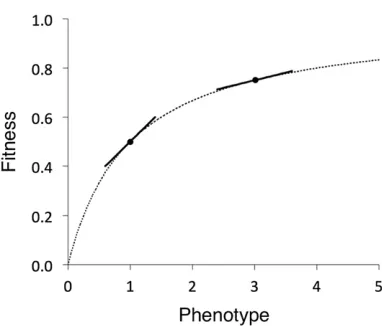
General properties of phenotype–fitness relationships may underlie weak selection. Wright (1929, 1934) proposed that diminishing returns infitness as phenotypes approach optima explain the prevalence of genetic dominance among wild-type alleles and recessive effects of newly arising mutations. His model examined relationships between the catalytic activity of an enzyme (a phenotypic value) and flux through a bio-chemical pathway (directly related tofitness) and showed that thefitness benefit for a given increase in activity is greater for low-activity alleles than for alleles functioning close to an optimum. Kacser and Burns (1981) confirmed hyperbolic rela-tionships between activity and flux under enzyme kinetic models and gave supporting evidence from biochemical stud-ies. The Kacser–Burns model applies only to particular scenar-ios of enzyme catalysis (Savageau 1992; Wilkie 1994; Omholt
et al. 2000), but concave fitness functions may hold more generally. Classic studies by Crow and co-workers showed an “inverse heterozygous-homozygous effect”for deleterious mutations inDrosophila; deleterious mutations of large effect tend to be recessive (larges, smallh) whereas alleles of small effect tend to show heterozygous effects (small s, large h) (Greenberg and Crow 1960; Simmons and Crow 1977). Such patterns are consistent with diminishing returns because fi t-nessvs.phenotype relationships are close to linear (additive) within restricted ranges of phenotypic values but show strong nonlinearity over wider ranges. Gene-deletion studies in yeast support inverse relationships between fitness (growth rate) and heterozygous effects across functional categories of genes (Phadnis 2005; Agrawal and Whitlock 2011). Gene knockouts were tested (missense mutations may not show the same associations), but the findings are consistent with concave
fitness functions for a variety of traits (including noncatalytic functions). Non-additive relationships between protein stabil-ity and fitness (Bershtein et al. 2006; Tokuriki and Tawfik 2009b; Wylie and Shakhnovich 2011) could underlie dimin-ishing returns epistasis.
Hartl et al. (1985) related concave fitness functions to mechanisms of molecular evolution. Under diminishing returns, DSEs change as character values approach optima. Changes in activity will have smaller fitness effects (both positive and negative) as enzymes approach optimum activ-ity, and Hartl and co-workers predicted that characters in natural populations should be on plateaus of concavefitness functions. Gillespie (1994b) found that concavefitness func-tions can lead to phenotypic values close to their optima and to dynamics indistinguishable from neutral evolution when
phenotypes of new mutations are normally distributed around parental values (i.e., equal proportions of positively and negatively selected mutations). However, if mutations often have small phenotypic effects and tend to be deleteri-ous, then characters will evolve to equilibrium values below their optima (Akashi 1996; Hartl and Taubes 1998). Smaller populations will evolve to lower equilibrium values than larger populations, and a wide range of population sizes could show a balance among weak selection, drift, and mu-tation;i.e., DSEs will evolve in different population sizes to a point where many mutations show |Nes|1 (Figure 5). Such a scenario has been proposed to account for patterns of codon usage bias (Li 1987; Akashi 1995; Kondrashov et al.
2006). The correlation between evolutionary rate and pop-ulation size can be weak under concavefitness relationships but will depend on how DSEs change with phenotypic val-ues (Cherry 1998). Concavefitness functions are an appeal-ingly simple explanation for widespread weak selection, but evidence for this form of epistasis remains mixed. Some mutation accumulation studies support increasing negative effects with declining fitness whereas others support the opposite pattern (reviewed in de Visseret al.2011).
Discussion
Although support for weak selection in protein evolution has accumulated in diverse taxa, adaptive protein evolution and changes in the distribution offitness effects can often make predictions that overlap those of near neutrality. Within-population comparisons (excess rare amino acid variants) provide some of the strongest evidence for weak selection because positive, directional selection should have little impact on polymorphism data. Associations between levels of protein polymorphism and estimates ofNe among closely related populations also support weak selection because DSEs are likely to be conserved on relatively short time scales.
Distinguishing adaptive, neutral, and nearly neutral modes of molecular evolution remains challenging. All three
mechanisms enjoy sufficient support to be considered
among potential explanatory factors in almost all studies that infer mechanisms of genome evolution. For polymor-phism analyses, near neutrality can cause differences in levels of variation and in frequency spectra among func-tional categories of mutations or among populations. In among-species comparisons, weak selection may underlie considerable variation in rates and patterns of divergence. Slightly deleterious amino acid mutations can reduce the power to detect adaptive protein evolution but can also generate a false signal of adaptivefixations under particular scenarios of population size change. Weak selection in the comparison class in tests of adaptive protein evolution (often synonymous DNA changes) can also contribute to false signals of positive selection (Akashi 1999a).
for such factors is stronger at synonymous sites, in RNA genes, and in noncoding DNA than in protein evolution in part because functional andfitness effects of mutations can be predicted (e.g., translationally preferredvs. unpreferred synonymous changes, destabilizing and stabilizing changes in RNA stem structures). Further incorporation of biophysi-cal principles may be essential for advancing our under-standing of protein evolution. Models of protein evolution that account for both stability and activity effects have the potential to predict fitness effects of amino acid changes (Depristo et al. 2005; Bloom et al. 2007b; Tokuriki and
Tawfik 2009b; Wilke and Drummond 2010; Goldstein
2011; Wylie and Shakhnovich 2011) and may help to de-termine the proportion of compensatory subsitutions among adaptivefixations. This information, in combination with experimental approaches (e.g., Bershtein et al. 2006; Bloom et al. 2007a; Araya and Fowler 2011), will allow tests of Ohta’s (1973) prediction of fundamental relation-ships among protein primary structure, folding, and weak selection.
Acknowledgments
We thank Wen-Ya Ko, Boyang Li, Neha Mishra, Michael Turelli, and two anonymous reviewers for many helpful comments on the manuscript. We also thank Richard Kliman
for providing Drosophila polymorphism data and Noriko
Yamauchi for technical support.
Literature Cited
Abbot, P., and N. A. Moran, 2002 Extremely low levels of genetic polymorphism in endosymbionts (Buchnera) of aphids (Pemphi-gus). Mol. Ecol. 11: 2649–2660.
Agrawal, A. F., and M. C. Whitlock, 2011 Inferences about the distribution of dominance drawn from yeast gene knockout data. Genetics 187: 553–566.
Akashi, H., 1995 Inferring weak selection from patterns of poly-morphism and divergence at “silent” sites in Drosophila DNA. Genetics 139: 1067–1076.
Akashi, H., 1996 Molecular evolution between Drosophila mela-nogaster andD. simulans: reduced codon bias, faster rates of amino acid substitution, and larger proteins inD. melanogaster. Genetics 144: 1297–1307.
Akashi, H., 1999a Inferring thefitness effects of DNA mutations from polymorphism and divergence data: statistical power to detect directional selection under stationarity and free recombi-nation. Genetics 151: 221–238.
Akashi, H., 1999b Within- and between-species DNA sequence variation and the “footprint” of natural selection. Gene 238: 39–51.
Akashi, H., 2001 Gene expression and molecular evolution. Curr. Opin. Genet. Dev. 11: 660–666.
Andersson, D. I., and D. Hughes, 2010 Antibiotic resistance and its cost: Is it possible to reverse resistance? Nat. Rev. Microbiol. 8: 260–271.
Andersson, J. O., and S. G. Andersson, 1999 Insights into the evolutionary process of genome degradation. Curr. Opin. Genet. Dev. 9: 664–671.
Andolfatto, P., K. M. Wong, and D. Bachtrog, 2011 Effective pop-ulation size and the efficacy of selection on the X chromosomes of two closely related Drosophila species. Genome Biol. Evol. 3: 114–128.
Andrés, A. M., M. J. Hubisz, A. Indap, D. G. Torgerson, J. D. Degenhardt et al., 2009 Targets of balancing selection in the human genome. Mol. Biol. Evol. 26: 2755–2764.
Araya, C. L., and D. M. Fowler, 2011 Deep mutational scanning: assessing protein function on a massive scale. Trends Biotech-nol. 29: 435–442.
Aris-Brosou, S., and J. P. Bielawski, 2006 Large-scale analyses of synonymous substitution rates can be sensitive to assumptions about the process of mutation. Gene 378: 58–64.
Bachtrog, D., 2008 Similar rates of protein adaptation in Drosoph-ila mirandaandD. melanogaster, two species with different cur-rent effective population sizes. BMC Evol. Biol. 8: 334. Ballard, J. W., and M. Kreitman, 1994 Unraveling selection in the
mitochondrial genome of Drosophila. Genetics 138: 757–772. Barnard, E. A., M. S. Cohen, M. H. Gold, and J. K. Kim, 1972
Evo-lution of ribonuclease in relation to polypeptide folding mecha-nisms. Nature 240: 395–398.
Barton, N. H., 1995 Linkage and the limits to natural selection. Genetics 140: 821–841.
Bazin, E., S. Glémin, and N. Galtier, 2006 Population size does not influence mitochondrial genetic diversity in animals. Science 312: 570–572.
Bazykin, G. A., J. Dushoff, S. A. Levin, and A. S. Kondrashov, 2006 Bursts of nonsynonymous substitutions in HIV-1 evolu-tion reveal instances of positive selecevolu-tion at conservative protein sites. Proc. Natl. Acad. Sci. USA 103: 19396–19401.
Begun, D. J., A. K. Holloway, K. Stevens, L. W. Hillier, Y.-P. Poh et al., 2007 Population genomics: whole-genome analysis of polymorphism and divergence in Drosophila simulans. PLoS Biol. 5: e310.
Bershtein, S., M. Segal, R. Bekerman, N. Tokuriki, and D. S. Tawfik, 2006 Robustness-epistasis link shapes thefitness landscape of a randomly drifting protein. Nature 444: 929–932.
Betancourt, A. J., and D. C. Presgraves, 2002 Linkage limits the power of natural selection in Drosophila. Proc. Natl. Acad. Sci. USA 99: 13616–13620.
Bierne, N., and A. Eyre-Walker, 2003 The problem of counting sites in the estimation of the synonymous and nonsynonymous substitution rates: implications for the correlation between the synonymous substitution rate and codon usage bias. Genetics 165: 1587–1597.
Bierne, N., and A. Eyre-Walker, 2004 The genomic rate of adap-tive amino acid substitution in Drosophila. Mol. Biol. Evol. 21: 1350–1360.
Birdsell, J. A., 2002 Integrating genomics, bioinformatics, and classical genetics to study the effects of recombination on ge-nome evolution. Mol. Biol. Evol. 19: 1181–1197.
Birky, C. W., and J. B. Walsh, 1988 Effects of linkage on rates of molecular evolution. Proc. Natl. Acad. Sci. USA 85: 6414– 6418.
Bloom, J. D., Z. Lu, D. Chen, A. Raval, O. S. Venturelli et al., 2007a Evolution favors protein mutational robustness in
suf-ficiently large populations. BMC Biol. 5: 29.
Bloom, J. D., A. Raval, and C. O. Wilke, 2007b Thermodynamics of neutral protein evolution. Genetics 175: 255–266.
Boyko, A. R., S. H. Williamson, A. R. Indap, J. D. Degenhardt, R. D. Hernandez et al., 2008 Assessing the evolutionary impact of amino acid mutations in the human genome. PLoS Genet. 4: e1000083.
Branca, A., T. D. Paape, P. Zhou, R. Briskine, A. D. Farmeret al., 2011 Whole-genome nucleotide diversity, recombination, and linkage disequilibrium in the model legume Medicago trunca-tula. Proc. Natl. Acad. Sci. USA 108: E864–E870.
Bullaughey, K., M. Przeworski, and G. Coop, 2008 No effect of recombination on the efficacy of natural selection in primates. Genome Res. 18: 544–554.
Bulmer, M. G., 1971 Protein polymorphism. Nature 234: 410– 411.
Burch, C. L., and L. Chao, 1999 Evolution by small steps and rugged landscapes in the RNA virus phi6. Genetics 151: 921– 927.
Bustamante, C. D., J. Wakeley, S. Sawyer, and D. L. Hartl, 2001 Directional selection and the site-frequency spectrum. Genetics 159: 1779–1788.
Bustamante, C. D., R. Nielsen, S. A. Sawyer, K. M. Olsen, M. D. Puruggananet al., 2002 The cost of inbreeding in Arabidopsis. Nature 416: 531–534.
Campos, J. L., B. Charlesworth, and P. R. Haddrill, 2012 Molec-ular evolution in non-recombining regions of the Drosophila melanogastergenome. Genome Biol. Evol. 4: 278–288. Cargill, M., D. Altshuler, J. Ireland, P. Sklar, K. Ardlie et al.,
1999 Characterization of single-nucleotide polymorphisms in coding regions of human genes. Nat. Genet. 22: 231–238. Carneiro, M., F. W. Albert, J. Melo-Ferreira, N. Galtier, P. Gayral
et al., 2012 Evidence for widespread positive and purifying selection across the European rabbit (Oryctolagus cuniculus) ge-nome. Mol. Biol. Evol. 29: 1837–1849.
Chakraborty, R., P. A. Fuerst, and M. Nei, 1980 Statistical studies on protein polymorphism in natural populations. III. Distribu-tion of allele frequencies and the number of alleles per locus. Genetics 94: 1039–1063.
Chamary, J. V., J. L. Parmley, and L. D. Hurst, 2006 Hearing si-lence: non-neutral evolution at synonymous sites in mammals. Nat. Rev. Genet. 7: 98–108.
Chao, L., and D. E. Carr, 1993 The molecular clock and the re-lationship between population size and generation time. Evolu-tion 47: 688–690.
Charlesworth, B., 1994 The effect of background selection against deleterious mutations on weakly selected, linked variants. Genet. Res. 63: 213–227.
Charlesworth, B., 2009 Fundamental concepts in genetics: effec-tive population size and patterns of molecular evolution and variation. Nat. Rev. Genet. 10: 195–205.
Charlesworth, D., 2006 Balancing selection and its effects on se-quences in nearby genome regions. PLoS Genet. 2: e64. Charlesworth, D., B. Charlesworth, and M. T. Morgan, 1995 The
pattern of neutral molecular variation under the background selection model. Genetics 141: 1619–1632.
Charlesworth, J., and A. Eyre-Walker, 2006 The rate of adaptive evolution in enteric bacteria. Mol. Biol. Evol. 23: 1348–1356. Charlesworth, J., and A. Eyre-Walker, 2007 The other side of the
nearly neutral theory, evidence of slightly advantageous back-mutations. Proc. Natl. Acad. Sci. USA 104: 16992–16997. Chen, Y., D. B. Carlini, J. F. Baines, J. Parsch, J. M. Bravermanet al.,
1999 RNA secondary structure and compensatory evolution. Genes Genet. Syst. 74: 271–286.
Cherry, J. L., 1998 Should we expect substitution rate to depend on population size? Genetics 150: 911–919.
Chimpanzee Sequencing and Analysis Consortium, 2005 Initial sequence of the chimpanzee genome and comparison with the human genome. Nature 437: 69–87.
Connallon, T., and L. L. Knowles, 2007 Recombination rate and protein evolution in yeast. BMC Evol. Biol. 7: 235.
Damuth, J., 1981 Population density and body size in mammals. Nature 290: 699–700.
Darwin, C., 1859 The Origin of Species. J. Murray, London. DePristo, M. A., D. M. Weinreich, and D. L. Hartl, 2005 Missense
meanderings in sequence space: a biophysical view of protein evolution. Nat. Rev. Genet. 6: 678–687.
de Visser, J. A., T. F. Cooper, and S. F. Elena, 2011 The causes of epistasis. Proc. Biol. Sci. 278: 3617–3624.
Dimmic, M. W., M. J. Hubisz, C. D. Bustamante, and R. Nielsen, 2005 Detecting coevolving amino acid sites using Bayesian mutational mapping. Bioinformatics 21(Suppl 1): i126–i135. Doniger, S. W., H. S. Kim, D. Swain, D. Corcuera, M. Williamset al.,
2008 A catalog of neutral and deleterious polymorphism in yeast. PLoS Genet. 4: e1000183.
Dunn, K. A., J. P. Bielawski, and Z. Yang, 2001 Substitution rates in Drosophila nuclear genes: implications for translational selec-tion. Genetics 157: 295–305.
Duret, L., and N. Galtier, 2009 Biased gene conversion and the evolution of mammalian genomic landscapes. Annu. Rev. Ge-nomics Hum. Genet. 10: 285–311.
Dutheil, J., T. Pupko, A. Jean-Marie, and N. Galtier, 2005 A model-based approach for detecting coevolving positions in a molecule. Mol. Biol. Evol. 22: 1919–1928.
Dykhuizen, D. E., and D. L. Hartl, 1983 Selection in chemostats. Microbiol. Rev. 47: 150–168.
Edwards, C. T. T., E. C. Holmes, O. G. Pybus, D. J. Wilson, R. P. Viscidiet al., 2006 Evolution of the human immunodeficiency virus envelope gene is dominated by purifying selection. Genet-ics 174: 1441–1453.
Ellegren, H., 2009 A selection model of molecular evolution in-corporating the effective population size. Evolution 63: 301–305. Elyashiv, E., K. Bullaughey, S. Sattath, Y. Rinott, M. Przeworski et al., 2010 Shifts in the intensity of purifying selection: an analysis of genome-wide polymorphism data from two closely related yeast species. Genome Res. 20: 1558–1573.
Eyre-Walker, A., 2002 Changing effective population size and the McDonald-Kreitman test. Genetics 162: 2017–2024.
Eyre-Walker, A., and P. D. Keightley, 2009 Estimating the rate of adaptive molecular evolution in the presence of slightly delete-rious mutations and population size change. Mol. Biol. Evol. 26: 2097–2108.
Fares, M. A., M. X. Ruiz-González, A. Moya, S. F. Elena, and E. Barrio, 2002 Endosymbiotic bacteria: GroEL buffers against deleterious mutations. Nature 417: 398.
Fares, M. A., A. Moya, and E. Barrio, 2004 GroEL and the main-tenance of bacterial endosymbiosis. Trends Genet. 20: 413–416. Fay, J. C., 2011 Weighing the evidence for adaptation at the
mo-lecular level. Trends Genet. 27: 343–349.
Fay, J. C., G. J. Wyckoff, and C. I. Wu, 2001 Positive and negative selection on the human genome. Genetics 158: 1227–1234. Fay, J. C., G. J. Wyckoff, and C.-I. Wu, 2002 Testing the neutral
theory of molecular evolution with genomic data from Drosoph-ila. Nature 415: 1024–1026.
Felsenstein, J., 1974 The evolutionary advantage of recombina-tion. Genetics 78: 737–756.
Foxe, J. P., V.-U.-N. Dar, H. Zheng, M. Nordborg, B. S. Gautet al., 2008 Selection on amino acid substitutions in Arabidopsis. Mol. Biol. Evol. 25: 1375–1383.
Fujimoto, A., T. Kado, H. Yoshimaru, Y. Tsumura, and H. Tachida, 2008 Adaptive and slightly deleterious evolution in a conifer, Cryptomeria japonica. J. Mol. Evol. 67: 201–210.
Fukami-Kobayashi, K., D. R. Schreiber, and S. A. Benner, 2002 Detecting compensatory covariation signals in protein evolution using reconstructed ancestral sequences. J. Mol. Biol. 319: 729–743.
Funk, D. J., J. J. Wernegreen, and N. A. Moran, 2001 Intraspecific variation in symbiont genomes: bottlenecks and the aphid-buchnera association. Genetics 157: 477–489.
Gerber, A. S., R. Loggins, S. Kumar, and T. E. Dowling, 2001 Does nonneutral evolution shape observed patterns of DNA variation in animal mitochondrial genomes? Annu. Rev. Genet. 35: 539–566. Gillespie J. H., 1987 Molecular evolution and the neutral allele
theory. Oxf. Surv. Evol. Biol., 4: 10–37.
Gillespie, J., 1994a Alternatives to the neutral theory, pp. 1–17 in Non-neutral Evolution: Theories and Molecular Data, edited by B. Golding. Chapman and Hall, New York.
Gillespie, J. H., 1994b Substitution processes in molecular evolu-tion. III. Deleterious alleles. Genetics 138: 943–952.
Gillespie, J. H., 2000 Genetic drift in an infinite population: the pseudohitchhiking model. Genetics 155: 909–919.
Gillespie, J. H., 2001 Is the population size of a species relevant to its evolution? Evolution 55: 2161–2169.
Glémin, S., and N. Galtier, 2012 Genome evolution in outcrossing versus selfing versus asexual species. Methods Mol. Biol. 855: 311–335.
Goldstein, R. A., 2011 The evolution and evolutionary consequences of marginal thermostability in proteins. Proteins 79: 1396–1407. Gossmann, T. I., B. H. Song, A. J. Windsor, T. Mitchell-Olds, C. J.
Dixonet al., 2010 Genome wide analyses reveal little evidence for adaptive evolution in many plant species. Mol. Biol. Evol. 27: 1822–1832.
Gossmann, T. I., P. D. Keightley, and A. Eyre-Walker, 2012 The effect of variation in the effective population size on the rate of adaptive molecular evolution in eukaryotes. Genome Biol. Evol. 4: 658–667.
Greenberg, R., and J. F. Crow, 1960 A comparison of the effect of lethal and detrimental chromosomes from Drosophila popula-tions. Genetics 45: 1153–1168.
Grunstein, M., P. Schedl, and L. Kedes, 1976 Sequence analysis and evolution of sea urchin (Lytechinus pictus and Strongylo-centrotus purpuratus) histone H4 messenger RNAs. J. Mol. Biol. 104: 351–369.
Haag, E. S., 2007 Compensatoryvs.pseudocompensatory evolu-tion in molecular and developmental interacevolu-tions. Genetica 129: 45–55.
Haddrill, P. R., D. Bachtrog, and P. Andolfatto, 2008 Positive and negative selection on noncoding DNA in Drosophila simulans. Mol. Biol. Evol. 25: 1825–1834.
Haddrill, P. R., L. Loewe, and B. Charlesworth, 2010 Estimating the parameters of selection on nonsynonymous mutations in Drosophila pseudoobscura and D. miranda. Genetics 185: 1381–1396.
Halligan, D. L., and P. D. Keightley, 2009 Spontaneous mutation accumulation studies in evolutionary genetics. Annu. Rev. Ecol. Evol. Syst. 40: 151–172.
Halligan, D. L., F. Oliver, A. Eyre-Walker, B. Harr, and P. D. Keight-ley, 2010 Evidence for pervasive adaptive protein evolution in wild mice. PLoS Genet. 6: e1000825.
Hartl, D. L., and C. H. Taubes, 1998 Towards a theory of evolu-tionary adaptation. Genetica 102–103: 525–533.
Hartl, D. L., D. E. Dykhuizen, and A. M. Dean, 1985 Limits of adaptation: the evolution of selective neutrality. Genetics 111: 655–674.
Hasegawa, M., Y. Cao, and Z. Yang, 1998 Preponderance of slightly deleterious polymorphism in mitochondrial DNA: non-synonymous/synonymous rate ratio is much higher within spe-cies than between spespe-cies. Mol. Biol. Evol. 15: 1499–1505. Hellmann, I., K. Prüfer, H. Ji, M. C. Zody, S. Pääbo et al.,
2005 Why do human diversity levels vary at a megabase scale? Genome Res. 15: 1222–1231.
Herbeck, J. T., D. J. Funk, P. H. Degnan, and J. J. Wernegreen, 2003 A conservative test of genetic drift in the endosymbiotic bacteriumBuchnera: slightly deleterious mutations in the chap-eronin groEL. Genetics 165: 1651–1660.
Hershberg, R., and D. A. Petrov, 2008 Selection on codon bias. Annu. Rev. Genet. 42: 287–299.
Hietpas, R. T., J. D. Jensen, and D. N. A. Bolon, 2011 Experi-mental illumination of a fitness landscape. Proc. Natl. Acad. Sci. USA 108: 7896–7901.
Hill, W. G., and A. Robertson, 1966 The effect of linkage on limits to artificial selection. Genet. Res. 8: 269–294.
Hughes, A. L., 2005 Evidence for abundant slightly deleterious polymorphisms in bacterial populations. Genetics 169: 533– 538.
Hughes, A. L., 2008 Near neutrality: leading edge of the neutral theory of molecular evolution. Ann. N. Y. Acad. Sci. 1133: 162– 179.
Hughes, A. L., 2009 Small effective population sizes and rare non-synonymous variants in potyviruses. Virology 393: 127–134. Hughes, A. L., and R. Friedman, 2009 More radical amino acid
replacements in primates than in rodents: support for the evo-lutionary role of effective population size. Gene 440: 50–56. Hughes, A. L., B. Packer, R. Welch, A. W. Bergen, S. J. Chanock
et al., 2003 Widespread purifying selection at polymorphic sites in human protein-coding loci. Proc. Natl. Acad. Sci. USA 100: 15754–15757.
Hughes, A. L., R. Friedman, P. Rivailler, and J. O. French, 2008 Synonymous and nonsynonymous polymorphismsvs. di-vergences in bacterial genomes. Mol. Biol. Evol. 25: 2199–2209. Hvilsom, C., Y. Qian, T. Bataillon, Y. Li, T. Mailund et al., 2012 Extensive X-linked adaptive evolution in central chim-panzees. Proc. Natl. Acad. Sci. USA 109: 2054–2059.
Johnson, K. P., and J. Seger, 2001 Elevated rates of nonsynony-mous substitution in island birds. Mol. Biol. Evol. 18: 874–881. Johnson, S. G., and R. S. Howard, 2007 Contrasting patterns of synonymous and nonsynonymous sequence evolution in asexual and sexual freshwater snail lineages. Evolution 61: 2728–2735. Kacser, H., and J. A. Burns, 1981 The molecular basis of
domi-nance. Genetics 97: 639–666.
Kafatos, F. C., A. Efstratiadis, B. G. Forget, and S. M. Weissman, 1977 Molecular evolution of human and rabbit beta-globin mRNAs. Proc. Natl. Acad. Sci. USA 74: 5618–5622.