Public Inspect For Secure Cloud Storage Based On
Dynamic-Hash-Table
Maloth Sujatha &Ganta Ashok Kumar
1M-Tech, Dept. of CSE,SreeKavitha Engineering College,Khammam.
2Assistant Professor& HOD,Dept. of CSE,SreeKavitha Engineering College,Khammam.
Abstract
Distributed storage is an inexorably prevalent utilization of distributed computing, which can give on-request outsourcing information facilities for the two associations and people. In any case, clients may not plenarily believe the cloud convenience suppliers (CSPs) in that it is strenuous to decide if the CSPs meet their licit prospects for information security. [1] Consequently, it is basic to create productive evaluating systems to strengthen information proprietors' trust and trust in distributed storage. In this paper, we introduce a novel open inspecting plan for secure distributed storage predicated on powerful hash table (DHT), which is a beginning two-dimensional information structure situated at a third equality evaluator (TPA) to record the information property data for dynamic examining. Contrasting from the subsisting works, the proposed plot moves the endorsed data from the CSP to the TPA, and along these lines essentially diminishes the computational cost and correspondence overhead. In the interim,
abusing the basic focal points of the DHT, our plan can withal accomplish higher refreshing proficiency than the best in class plans. In additament, we extend our plan to sustain
security conservation by blending the
homomorphic authenticator predicated on the general population key with the self-assertive veiling caused by the TPA, and accomplish clump examining by utilizing the total BLS signature system. [3] We formally demonstrate the security of the proposed plot, and assess the inspecting execution by definite analyses and examinations with the subsisting ones. The outcomes show that the proposed plan can solidly accomplish secure inspecting for distributed storage, and outflanks the point of reference plots in calculation involution, stockpiling expenses and correspondence overhead.
1. INTRODUCTION
Distributed storage is a foremost branch of distributed computing , whose objective is to
give puissant and on‐demand out‐sourcing
information lodging for clients abusing exceedingly virtualized infrastructures.[2] Due
to the low‐cost and high‐performance of
distributed storage, a developing number of associations and people are slanting to outsource their information stockpiling to proficient cloud facilities suppliers (CSP), which floats the fast improvement of distributed storage and its relative procedures as of late. Be that as it may,
as an early cutting‐edge Technology ,
distributed storage still faces numerous security challenges. A standout amongst the most sizably voluminous concerns is the manner by which to decide if a distributed storage framework and its supplier meet the licit prospects of clients for information security. This is essentially caused by the accompanying reasons. To begin with, cloud clients (information proprietors), who outsource their information in mists, can never again confirm the trustworthiness of their information by means of customary systems that are regularly utilized in neighborhood stockpiling situations. Second, CSPs, which endure Byzantine disappointments rarely, may pick to hide the information mistakes from the
information proprietors for their own
self‐interest. What is more astringent, CSPs may
disregard to keep or even purposely cancel occasionally got to information that have a place with commonplace clients to save storage room. Information security support (DPP) has dependably been a noteworthy theme for distributed storage. In the general population evaluating, the center of this difficulty is the way to safeguard usesʹ protection while presenting a TPA. Though abusing information encryption preceding outsourcing is a way to deal with moderate the security worry in distributed storage, it can't turn away information spillage amid the confirmation procedure. Accordingly, it is principal for the
cloud evaluating to incorporate a
privacy‐preserving Mechanism free to
significant for distributed storage reviewing to sustain information elements. As it is unmistakable that a distributed storage framework is not only an information stockroom, the clients frequently need to refresh the information powerfully boosted by sundry
application necessities. Thusly, it is
considerable for distributed storage evaluating to strengthen information progression.
2.RELEGATED WORK 2.1Existing System
Alongside the augmenting essentials, as of late, cross-media seek assignments have gotten
significant attention.[6] Since, every
methodology having diverse portrayal strategies and correlational structures, an assortment of techniques contemplated the scrape from the part of learning relationships between's various modalities. Subsisting techniques proposed to use Canonical Correlation Analysis (CCA), manifolds learning, double wing harmoniums, profound autoencoder, and profound Boltzmann machine to approach the undertaking. Because of the productivity of hashing-predicated strategies, there withal subsists a well-to-do profession centering the bind of mapping multi-modular high-dimensional information to low-dimensional hash codes, for example, Latent
semantic inadequate hashing (LSSH),
discriminative coupled lexicon hashing
(DCDH), Cross-see Hashing (CVH), et cetera.
2.2Proposed System
We propose a novel hashing technique, called semantic cross-media hashing (SCMH), to play out the close copy discovery and cross media recovery undertaking. [5] We propose to use an arrangement of word embeddings to speak to literary data. Fisher portion structure is fused to speak to both literary and visual data with tweaked length vectors. For mapping the Fisher vectors of various modalities, a profound trustworthiness arrange is proposed to play out the errand. We assess the proposed strategy SCMH on three regularly utilized informational collections. SCMH accomplishes preferred outcomes over cutting edge strategies with various the lengths of hash codes.
3.IMPLEMENTATION
3.1 Privacy-Preserving Public Auditing Module
Homomorphic authenticators are un forgeable
check metadata incited from singular
straight cumulation of inspected hinders in the server's replication is covered with erraticism incited by a pseudo self-assertive capacity (PRF).
3.2 Batch Auditing Module
With the foundation of security protecting open reviewing in Cloud Computing, TPA may simultaneously deal with various examining appointments upon various clients' requests.[7] The individual inspecting of these errands for TPA can be dull and exceptionally wasteful. Clump inspecting not just authorizes TPA to play out the different examining undertakings at the same time, yet also incredibly decreases the calculation cost on the TPA side.
3.3 Data Dynamics Module
Henceforth, strengthening information flow for security saving open hazard reviewing is withal of vital significance. [10] Now we indicate how our primary plan can be adjusted to expand upon the subsisting work to brace information progression, including piece level operations of alteration, destruction and addition. We can embrace this strategy in our outline to accomplish protection safeguarding open hazard evaluating with help of information flow.
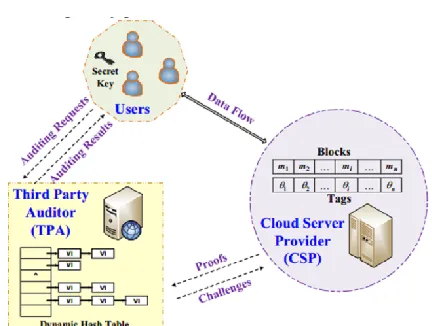
Fig 1 Architecture Diagram 4.EXPERIMENTAL RESULTS
Fig 2 Upload Blocks Page
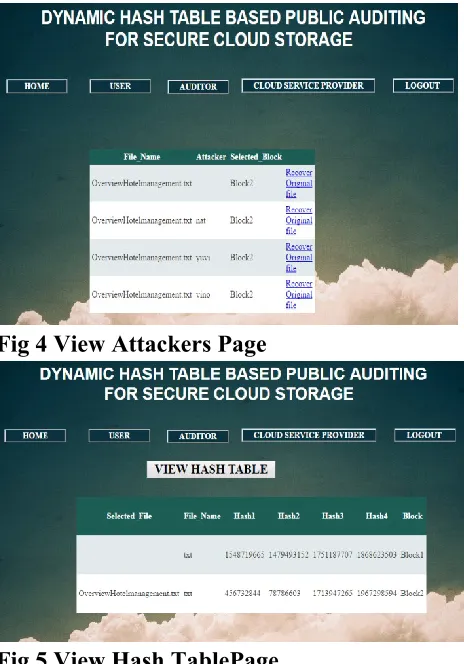
Fig 4 View Attackers Page
Fig 5 View Hash TablePage
Fig 6File Download Page 5.CONCLUSION
These days, distributed storage, which can offer on-request outsourcing information facilities for the two associations and people, has been polarizing increasingly consideration. [8]
However, a standout amongst the most grave obstructions to its improvement is that clients may not plenarily believe the CSPs in that it is laborious to decide if the CSPs meet their licit
prospects for information security.
Subsequently, it is basic and considerable to create effective examining strategies to streng then information proprietors' trust and trust in distributed storage. In this paper, we are boosted to introduce a novel open inspecting plan for secure distributed storage using dynamic hash table (DHT), which is a nascent two dimensional information structure used to record the information property data for dynamic examining. Varying from the subsisting works, our plan moves the reviewing metadata portion the square labels from the CSP to the TPA, and in this manner essentially diminishes the computational cost and correspondence overhead. In the mean time, abusing the auxiliary preferences of the DHT, our plan can withal accomplish preferred execution over the best in class plots in the refreshing stage. In additament, for security conservation, our plan presents a discretionary concealing gave by the TPA into the way toward inciting confirmation to daze the information data.
[1] HuiTian, Member, IEEE, Yuxiang Chen, Chin-Chen Chang, Fellow,ʺDynamic-Hash-Table Based Public Auditingfor Secure Cloud Storage ʺ, IEEE Transactions on Services
Computing,Volume:PP,Issue:99,Date of
Publication : Jan.2016 .
[2] C. Wang, Q. Wang, K. Ren, N. Cao and W. Lou. ʺToward Secure and Dependable Storage Services in Cloud Computingʺ, IEEE Trans.
Service Computing, vol. 5, no. 2, pp. 220‐232,
2012.
[3] K. Ren, C. Wang and Q. Wang.“Security Challenges for the Public Cloud,” IEEE Internet Computing, vol. 16, no. 1, pp. 69– 73, 2012. [4] J. Ryoo, S. Rizvi, W. Aiken and J. Kissell. ʺCloud Security Auditing: Challenges and Emerging Approachesʺ, IEEE Security &
Privacy, vol. 12, no. 6, pp. 68‐74, 2014.
[5] C. Wang, K. Ren, W. Lou and J. Li. ʺToward Publicly Auditable Secure Cloud Data Storage Servicesʺ, IEEE network, vol. 24, no. 4,
pp. 19‐24, 2010.
[6] Q. Wang, C. Wang, K. Ren, W. Lou and J. Li. „„Enabling Public Audit ability and Data Dynamics for Storage Security in Cloud Computing,‟‟ IEEE Trans. on Parallel and
Distributed Systems, vol. 22, no. 5, pp. 847‐859,
2011.
[7] F. Sebé, J. Domingo‐Ferrer, A.
Martínez‐Ballesté, Y. Deswarte and J.‐J.
Quisquater, “Efficient Remote Data Possession
Checking in Critical Information
Infrastructures,” IEEE Trans. Knowledge Data
Eng., vol. 20, no. 8, pp. 1034‐1038, 2008.
[8] A. Juels and B.S. Kaliski Jr., “PoRs: Proofs of Retrievability for Large Files,” Proc. ACM Conf. Computer and Communications Security
(CCS ‟07), pp. 584‐597, 2007.
[9] G. Ateniese, R.B. Johns, R. Curtmola, J. Herring, L. Kissner, Z. Peterson and D. Song, „„Provable Data Possession at Untrusted Stores,‟‟ Proc. 14th ACM Conf. on Comput.
andCommun. Security (CCS), pp. 598‐609,
2007.
[10] K. Yang and X. Jia. ʺData Storage Auditing Service in Cloud Computing: Challenges, Methods and Opportunitiesʺ. World Wide Web,
vol. 15, no. 4, pp. 409‐428, 2012
Authors Profiles
MalothSujatha ,MTech dept. of CSE from SreeKavithaEngineering college
Ganta Ashok KumarHe Received the B.Tech Degree in Information Technology From JNTU
Hyderabad in 2005 and M.Tech Degree in Computer Science from KU university in 2009. He is currently working as an assistant professor and head of the department in computer science engineering department. He is a determined