© 2014, IJCSMC All Rights Reserved
398
International Journal of Computer Science and Mobile Computing
A Monthly Journal of Computer Science and Information Technology
ISSN 2320–088X
IJCSMC, Vol. 3, Issue. 10, October 2014, pg.398 – 403
RESEARCH ARTICLE
Greedy Based Single Path & Multi Path
Protocol for Wireless Sensor Networks
V.Veeranna
1, S. Vijayalaxmi
2¹Pursuing M.Tech in CSE & JNTU Hyderabad, India
²Associate Professor in Department of CSE ARTI, Warangal, Telangana, India
1[email protected],
2[email protected]
Abstract - Many latest equipments uses Wireless Sensor Networks (WSNs) to monitor physical or environmental conditions but there is huge scope for node failures due to energy constraints or due to tendency of a wireless networks which is as that of a vector where nodes can be added or removed from the network upon the request of application due to which network can’t stick to a specific topology. The scope of a wireless sensor node is very limited with respected to transmission range of wireless sensor nodes due to which multiple hops are needed for a node to exchange information with other nodes. A multipath routing scheme is used to distribute the network traffic across multiple paths instead of routing all the traffic towards a single path by which the consumption of energy will be splitted among multiple nodes within a network resulting in longer lifetime of a datagram and hence it provides better quality of service.
In this paper, we propose a energy efficient multipath routing protocol that uses the 1) reusable energy that can be transmitted to other node while performing hopping, 2)the available buffer size of a node or a router, 3) handling of Signal to Noise Ratio that is used to predict the finest next hop through the paths construction phase, our proposed system examines two methods of traffic allocation where the first method uses a single path among all the possible available paths to transfer the data message when the path cost is below a specific threshold value based on which alternative path is selected then the datagram is transmitted and the second method is to split up the transmitted message into number of segments of equal size based on error correction codes and then transmit it across multiple paths simultaneously where a datagram is received at the destination node without sustaining excessive delay.
Keywords— Wireless sensor networks elements, Node
I. INTRODUCTION
© 2014, IJCSMC All Rights Reserved
399
multiple paths and whichever the packet is received at the destination node first will be considered and remaining duplicate copies will be ignored.In a single path environment if a packet is lost or received after the threshold delay or life time of the packet as intended due to any reason will not be accepted at the receiver end and hast to be retransmitted at the senders end which is considered to be a overhead in the single path environment and is not available in multi path environment as multiple copies of packets are sent and there is 99% probability is that a packet will be transmitted with in desired time stamp which is also considered as life time of a packet.
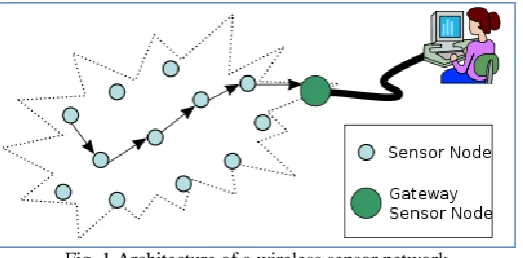
A standard WSN consists of multiple number of sensor nodes as shown in above figure Fig1 that communicate with each other to accomplish a common specific task or a predefined task such as monitoring the environment or performing a specific object tracking like a rocket or a wild animal and then reports the data that is yielded through wireless interface to a centre node called as the sink node and a WSN consists of unique properties such as consuming limited power with good support of unlimited bandwidth and a dynamic topology but in this paper we consider a star topology where the network density and large scale deployments have posed many challenges in the design and management of sensor networks as they need multiple hops to transmit the data packets due to their limited transmission range which is considered to be a major critical issue in designing sensor networks.
Fig. 1 Architecture of a wireless sensor network
The approach we adopted in this paper is based on the utility of investigating the security and robustness offered using our proposed protocols and we study the feasibility and impact of blocking type attacks on these protocols and the Wireless star Networks [1] is considered to be the underlying representative network model with a unique system architecture where two or more nodes communicate wirelessly over multiple hops to a backbone network through multiple available network gateways where the most of the traffic is seen in between the backbone network and immobile or mobile nodes and this approach allows numerous diverse commercial and in military applications [2].
In the Implementation of routing in a sensor network is a very challenging task and different from routing in either wired or other wireless networks due to their versatile characteristics and in traditional IP based routing protocols which are almost impossible to applied to sensor networks where building a global addressing scheme which is necessary for such protocols to work that is almost considered to be infeasible in a large scale deployments of sensor networks and the many applications of a sensor network is to sense the flow of data that should be from different sources to a single target called as the sink node. The sensor nodes are strictly constrained in terms of battery power utilization as nodes in a sensor network are power disseminated and its processing power and storage capacity or also called as the buffer space hence we need to monitor resources in a network very carefully.
© 2014, IJCSMC All Rights Reserved
400
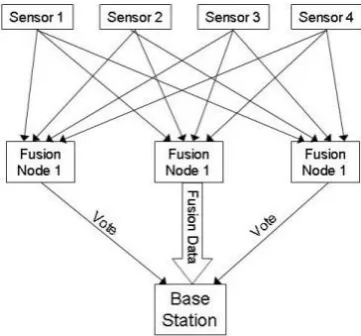
Fig. 2 implementation of the sensor networksDue to some of the reasons proposed in this paper and many others which are not covered so far we are proposing a solution by specifically designed using wireless star network based topology which can be further modified into any other network due to it’s nature and the protocols are designed based on the usage classification of the protocol operation into notification based or quality of service based or query based approaches that are implemented in a multipath environment. The notification based protocols are designed to eliminate the redundant data by including data descriptors that describe the data implications and tendency of its usage in message exchange phenomenon and in query based protocols that are designed where the sink node will initiate the communication process by performing message exchange based on the query data in a sensor network. In the quality of service protocols allows sensor nodes to make a tradeoff between the energy consumption.
A multipath routingprotocol use multiple paths rather than a single path in order to improve the network performance in terms of reliability and robustness where as in a multipath routing establishes multiple paths between the source and destination pair. Classical multipath routing concentrates on majorly two areas such as 1) Load Balancing: in this approach network traffic is splitted across source node and destination node in a multiple disjoint path and 2) Maximize reliable data delivery- as data packets are transmitted between source and destination using multiple paths where multiple copies of same data is created and being transferred between multiple paths and only the packet which is received first from a path will be taken and all others will be ignored and also there is a chance that some paths will be failed due to many reasons such as load balancing or power deception.
II. PROPOSEDSYSTEM
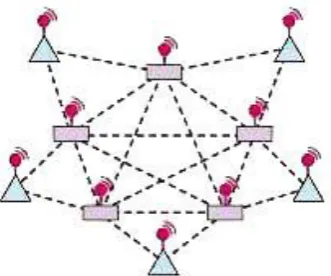
In this paper we propose a unique and a novel approach create an energy efficient multipath routing protocol for wireless star sensor networks which will recover from node failures and achieves load balancing through the distribution of the traffic over a set of available node disjoint paths in order to efficiently use the node’s power capacity and utilization of its available power by rescheduling the energy over nodes based on their free available buffer size or in other words a ideal node which is capable of transmitting of data. We also consider Signal to Noise Ratio to predict the most preferable next hop in the preferred path which is selected dynamically or paths that are selected to perform next hop in the sensor network as shown in the below figure Fig3 multiple paths have been created in the star format which is further increased based on the dynamic nature of the proposed system as a replica of a mesh network.
© 2014, IJCSMC All Rights Reserved
401
Fig. 3 star based wireless sensor networkWhen the original data is transmitted using multiple paths either using a single hop or multiple hop technique in both the cases data redundancy through a FECT using which failure in one or more paths can be recovered without invoking data retransmissions because our proposed system will split a message into number of segments of equal window size before transmitting it across multiple paths simultaneously and when there is a failure in transmission of a splitted message or a packet as the packet size is very less the time taken to retransmit the packet is almost negligible.
As the isolation of a node and partitioning a network are the two latest type of attacks a attacker can perform and are very easy to launch and are considered to be more effective in the wireless sensor networks domain due to channel constraints and dynamic network topologies in our proposed system we implement adversarial behaviour by attacking the multipath schemes through intelligent blocking and node isolation type attacks.
We also try to design best-case and the most common scenario is then one where an attacker will try to partition the network by either capturing and blocking a key node or by routing all data through a particular node which is then compromised which can be tackled very easily using the concept called as the black hole or a wormhole where an attacker is force dot deploy his own nodes or capture a node close to the destination node or a source node which may increase the cost attack as both source and destination nodes are close to base stations, a black hole attack is implemented by falsly advertising a particular node in a network route as same as the protocol tends to the destination node so as to force the route discovery algorithm to choose a route through it and then the attack occurs where the the malicious node drops the packets and hence blocks paths to the destination node and the wormhole attack is similar to eyes dropping where an attacker copies data packets at one location and transmits them to another location or to a desired node and then retransmits them back to network as if nothing went wrong.
We propose enhanced Greedy Algorithm to propose the solution space to the above mentioned problem space is:
Algorithm: greedy (Array R, Array Y, total_number_of_paths) return T Step 1 : Start
Step 2 : assign no_paths, no_nodes_covered, i ,j ,k, l with value 0; Step 3 : assign T[i], C[i], V[i] with 0;
Step 4 : assign j, k with 0; Step 5 : assign E[i] with 0; Step 6 : temp1=max (R[k]-Y[k] ;
Step 7 : temp2=min (temp1, total_number_of_paths); Step 8 : E[i]=E[i] + temp2;
Step 9 : k++;
Step 10 : if k< j then goto Step 6; Step 11 : cost_effective[l] = C[l] / E[l]; Step 12 : l++;
Step 13 : if l < n then goto Step 11. Step 14 : no_paths ++;
Step 15 : if T[j] < V[k] then goto Step 4; Step 16 : if i < total_no_nodes then goto Step 3; Step 17 : Stop.
© 2014, IJCSMC All Rights Reserved
402
Fig. 4 Snap shot of a node table in the wireless star network.When a request or a query packet is being received by the sink the process begins by the collection of required data by a source sensor and transmits or sends the data back using the best available path or the shortest path with required buffer available in the routers path and in this process of transmission of data each node consults its neighboring node table and finds out the Node_ID of the next hop and then forwards the data to its next hop in a star topological manner and this process continues until the data reaches the sink node and on the same hand the data transmission is continued till the threshold value is attained with respect to cost flow which is based on the buffer space and the power available with the node and once the cost is less than the threshold value then the next best path is utilized by disconnecting the current transmission link.
While performing hopping if a node fails to forward the data packet to its next hop in the preferred path it considers the current link to be as disconnected and sends notification as a path error to the source node which is once received the source node removes the current path from its routing table and immediately selects the next best available path from the routing table and re initiates the transmission process and the advantage in the proposed system is when one route fails there won’t be any impact on the other paths and in the worst case scenario if all the routes are failed in the sensor networks then the source tends to broadcasts a request message for the sink to initiate a route discovery message and by implementing this routing process a robust technique is evolved in message delivery process by which the data is transmitted to the sink node.
III.EVALUATION &RESULTS
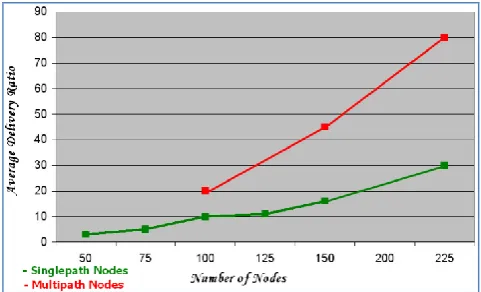
We evaluated the results mentioned below on multi path routing algorithm using which we have generated graphical results using randomly generated graphs that represent arbitrary wireless star networks which is based on the greedy algorithm which is implemented in both single path scheme and multipath scheme except that every node has only one path to the nearest neighbour router.
© 2014, IJCSMC All Rights Reserved
403
Fig. 6 Average Delivery RatioIV.CONCLUSION
This paper we have proposed and demonstrated the implementation of greedy based multi path and single path protocols by blocking and isolation node type attacks especially in the wireless networks domain using wireless star network. In our future work we need to work on insider attacks as we have only concentrated on the external attacks.
REFERENCES
[1] T. Bokareva, W. Hu, S. Kanhere, B. Ristic, N. Gordon, T. Bessell, M. Rutten and S. Jha ",Wireless Sensor Networks for Battlefield Surveillance",In Proc. of LWC – 2006.
[2] Y. Kato and F. Ono, “Node centrality on disjoint multipath routing,” in Vehicular Technology Conference
(VTC Spring), 2011 IEEE 73rd, May 2011, pp. 1 –5.
[3] A. Mainwaring, J. Polastre, R. Szewczyk, D. Culler, and J. Anderson, “Wireless Sensor Networks for Habitat Monitoring,” in the Proceedings of ACM-WSNA Conf., Sep. 2002.
[4] N. Xu, S. Rangwala, K. Chintalapudi, D. Ganesan, A. Broad, R. Govindan, and D. Estrin, “A Wireless Sensor Network for structural Monitoring,” in Proc. ACM SenSys Conf., Nov.2004.