ISSN (Print) : 2320 – 3765 ISSN (Online): 2278 – 8875
I
nternational
J
ournal of
A
dvanced
R
esearch in
E
lectrical,
E
lectronics and
I
nstrumentation
E
ngineering
(A High Impact Factor, Monthly, Peer Reviewed Journal)
Website: www.ijareeie.com
Vol. 8, Issue 3, March 2019
Analysis and Performance of High DC to DC
Converter by Using PV Cell with MPPT Logic
System
Dr.V.Thirumurugan1, S.Krishnabalaji2, P.Sakthivel2, M.Hariharan2, S.Arunasalam2
AP, Department of EEE, The Kavery Engineering College, Salem, Tamil Nadu, India1
UG Scholar, Department of EEE, The Kavery Engineering College, Salem, Tamil Nadu, India2
ABSTRACT: A DC-DC converter nothing but step-up converter is a power converter with an output dc voltage greater than its input dc voltage.Battery powered systems often stack batteries in series to achieve higher voltage. However, stacking batteries is not possible in many high voltage applications due to lack of space. Boost converters can increase the voltage and reduce the num.ber of cells. Two battery-powered applications that use boost converters are (HEV) and lighting systems.
KEYWORDS: solar panel, Microcontroller ,dc to dc converter. Lcd display ,dc motor, mppt logic system.
I. INTRODUCTION
Now a day the demand of electricity generation from renewable energy is increasing for domestic to industrial applications. The electricity generated from fossil fuels causes rising of toxic gases in the atmosphere.
These fossil fuels are decreasing bit by bit in the environment. Solar energy is one of the most abundant renewable energy resource, eco-friendly, and pollution free. Sunlight is converted into electricity via solar cell using the photovoltaic effect .For solar energy system installation cost only needed, if once installed it can run for a long duration and it can also save the overall maintenance cost. Solar energy having versatile in nature, it can be used for different power applications from tiny torch to satellite.
ISSN (Print) : 2320 – 3765 ISSN (Online): 2278 – 8875
I
nternational
J
ournal of
A
dvanced
R
esearch in
E
lectrical,
E
lectronics and
I
nstrumentation
E
ngineering
(A High Impact Factor, Monthly, Peer Reviewed Journal)
Website: www.ijareeie.com
Vol. 8, Issue 3, March 2019
II. BLOCK DIAGRAM
Fig(1) Block Diagram
BRIEF METHODOLOGY: This project is designed with (i) PIC
(ii)LCD display
(iii)DC input(SOLAR PANEL) (iv)Quasi y source Converter (v)Battery
(vi)CFL Inverter
Solar panel is interface with microcontroller through voltage measurement. The PIC microcontroller receives the value from Solar panel then the voltage is displayed in LCD display. The PIC microcontroller transmits set voltage to boost converter (SEPIC Converter). The Single ended primary inductor converter (SEPIC) get DC voltage from PV panel this input is very low voltage so we can used to boost converter to convert the voltage according to set value then it will give to Battery.
Here we used one voltage sensing circuit it will sense the voltage from load and given to microcontroller the microcontroller compare then it will give error voltage according to this voltage the boost converter convert the voltage it will give to Battery.
Here the microcontroller to maintain the load voltage according to set voltage. Battery output connects to CFL Lamp through CFL inverter. Here the microcontroller may be Atmel or PIC both are flash type microcontroller in which we have already programmed. Here the microcontroller is the flash type reprogrammable microcontroller in which we have already programmed.
III. PIC MICROCONTROLLER
Microcontroller is a general purpose device, which integrates a number of the components of a microprocessor system on to single chip. It has inbuilt CPU, memory and peripherals to make it as a mini computer. A microcontroller combines on to the same microchip:
The CPU core
ISSN (Print) : 2320 – 3765 ISSN (Online): 2278 – 8875
I
nternational
J
ournal of
A
dvanced
R
esearch in
E
lectrical,
E
lectronics and
I
nstrumentation
E
ngineering
(A High Impact Factor, Monthly, Peer Reviewed Journal)
Website: www.ijareeie.com
Vol. 8, Issue 3, March 2019
PIN DIAGRAM:
Fig(2) Pin diagram of PIC16F877
PORTA is a 6-bit wide bi-directional port. The corresponding data direction register is TRISA. Setting a TRISA bit (=1) will make the corresponding PORTA pin an input, i.e., put the corresponding output driver in a Hi-impedance mode.
PIC (16F877) :
Various microcontrollers offer different kinds of memories. EEPROM, EPROM, FLASH etc. are some of the memories of which FLASH is the most recently developed.Technology that is used in pic16F877 is flash technology, so that data is retained even when the power is switched off. Easy Programming and Erasing are other features of PIC 16F877.
Microcontrollers will combine other devices such as:
A timer module to allow the microcontroller to perform tasks for certain time periods.
A serial i/o port to allow data to flow between the controller and other devices such as a PIC or another microcontroller.
An ADC to allow the microcontroller to accept analogue input data for processing. Microcontrollers are :
Smaller in size Consumes less power Inexpensive
Micro controller is a standalone unit, which can perform functions on its own without any requirement for additional hardware like i/o ports and external memory.
ISSN (Print) : 2320 – 3765 ISSN (Online): 2278 – 8875
I
nternational
J
ournal of
A
dvanced
R
esearch in
E
lectrical,
E
lectronics and
I
nstrumentation
E
ngineering
(A High Impact Factor, Monthly, Peer Reviewed Journal)
Website: www.ijareeie.com
Vol. 8, Issue 3, March 2019
IV. LCD DISPLAY
FIG:3
A liquid crystal display (LCD) is a thin, flat electronic visual display that uses the light modulating properties of liquid crystals (LCs). LCs do not emit light directly.
They are used in a wide range of applications including: computer monitors, television, instrument panels, aircraft cockpit displays, signage, etc.
V. QUASI Y SOURCE CONVERTER
A DC-DC converter is an electronic circuit that is used to convert a source of direct current (DC) from one voltage level to another. These offer a method to increase voltage from a partially lowered battery voltage saving space. DC to DC converters also regulate the output voltage.
A DC-DC converter is a power electronics device that accepts a DC input voltage and also provides a DC output voltage.
ISSN (Print) : 2320 – 3765 ISSN (Online): 2278 – 8875
I
nternational
J
ournal of
A
dvanced
R
esearch in
E
lectrical,
E
lectronics and
I
nstrumentation
E
ngineering
(A High Impact Factor, Monthly, Peer Reviewed Journal)
Website: www.ijareeie.com
Vol. 8, Issue 3, March 2019
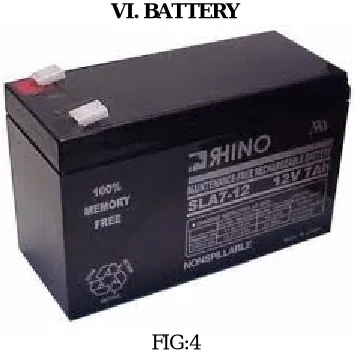
VI. BATTERY
FIG:4
An electrical battery is one or more electrochemical cells that convert stored chemical energy into electrical energy.[1] Since the invention of the first battery (or "voltaic pile") in 1800 by Alessandro Volta, batteries have become a common power source for many household and industrial applications. According to a 2005 estimate, the worldwide battery industry generates US$48 billion in sales each year, with 6% annual growth.
VII. DC MOTORS
FIG :5 DC MOTOR
OPERATION:
In any electric motor, operation is based on simple electromagnetism. A current-carrying conductor generates a magnetic field; when this is then placed in an external magnetic field, it will experience a force proportional to the current in the conductor, and to the strength of the external magnetic field.
ISSN (Print) : 2320 – 3765 ISSN (Online): 2278 – 8875
I
nternational
J
ournal of
A
dvanced
R
esearch in
E
lectrical,
E
lectronics and
I
nstrumentation
E
ngineering
(A High Impact Factor, Monthly, Peer Reviewed Journal)
Website: www.ijareeie.com
Vol. 8, Issue 3, March 2019
VIII. INVERTER
An inverter is an electrical device that converts direct current (DC) to alternating current (AC); the converted AC can be at any required voltage and frequency with the use of appropriate transformers, switching, and control circuits.
FIG:6 INVERTER CIRCUIT DIAGRAM
Static inverters have no moving parts and are used in a wide range of applications, from small switching power supplies in computers, to large electric utility high-voltage direct current applications that transport bulk power.Inverters are commonly used to supply AC power from DC sources such as solar panels or batteries.
PHOTOGRAPHY OF THE PROJECT:
ISSN (Print) : 2320 – 3765 ISSN (Online): 2278 – 8875
I
nternational
J
ournal of
A
dvanced
R
esearch in
E
lectrical,
E
lectronics and
I
nstrumentation
E
ngineering
(A High Impact Factor, Monthly, Peer Reviewed Journal)
Website: www.ijareeie.com
Vol. 8, Issue 3, March 2019
OPERATION MODE.:
Thus, if the PV panel’s voltage is lower than the system’s peak voltage, the PV inverter will switch between buck mode and boost mode depending on the instantaneous system voltage as shown in Fig. 4. However, if the PV panel’s voltage is higher than the system’s peak voltage, it will always run at buck mode.
Instead of a dc bus in the middle, the voltage across the capacitor C in boost/buck PV inverter varies with the system, if PV panel’s voltage is lower than the System’s peak voltage as shown in the fig. However, if PV panel’s voltage is higher than system’s peak voltage, C’s voltage will be the same as the PV panel’s voltage.
SIMULATION DC OUTPUT:
Fig:7
A.Boost Mode:
When the PV panel’s voltage is lower than the instantaneous reference voltage, it will operate in boost mode, in which S will be switched ON and OFF with the duty cycle 0.5<K<1.
B. Buck Mode:
When the PV panel’s voltage is higher than the instantaneous reference voltage, it will operate in buck mode, in which S will be switched ON and OFF with the duty cycle 0<K<0.5.
6.2 ADVANTAGES:
LOW COST.
HIGH EFFICEINCY.
EASY TO IMPLEMENTATION. VOLTAGE UPTO 600V OBTAINED.
6.3 APPLICATIONS:
This project is used in offices, homes, industries etc… Especially This project is very useful to the In the rural Areas. Because in rural areas frequently load state will be happen.
IX. CONCLUSION
ISSN (Print) : 2320 – 3765 ISSN (Online): 2278 – 8875
I
nternational
J
ournal of
A
dvanced
R
esearch in
E
lectrical,
E
lectronics and
I
nstrumentation
E
ngineering
(A High Impact Factor, Monthly, Peer Reviewed Journal)
Website: www.ijareeie.com
Vol. 8, Issue 3, March 2019
REFERENCES
[1].Mill man j and hawkies c.c. “integrated electronics” mcgraw hill, 1972
[2].Roy choudhury d, shail jain, “ linear integrated circuit”, new age international publishers, new delhi,2000 [3].The 8051 microcontroller and embedded system” by mohammad ali mazidi.
[4] Fardoun(Garden), E. H. Ismail, IEEE Trans. on Industrial Applications, 46, 2025 (2010).
[5] J. A. R. Hernanz, et al., International Conference on Renewable Energies and Power Quality (ICREPQ ’10), 2010, pp-1–5. [6] T. Esramand, P. L. Chapman, IEEE Transactions on Energy Conversion, 22, 439 (2007).
[7] Subiyanto,et al., International Review of Electrical Engineering, 52, 2535 (2010). [8] V. Salas, et al., Solar Energy Materials & Solar Cells 90, 1555 (2006).
[9] Subiyanto, et al., International Review of Electrical Engineering, 5, 2535 (2010).
BIOGRAPHY
Thirumurugan.v is a ME.,PH.D working as Assistant Professor, with Department of Electrical and Electronics Engineering, The Kavery Engineering College, Mecheri, Salem District,Tamil Nadu, India.
Krishnabalaji.s,sakthivel.p,hariharan.m,arunasalam.s
were U.G scholors, Department of Electrical and Electronics Engineering, The Kavery Engineering College, Mecheri, Salem District,Tamil Nadu, India.