Optimized Image Embedding in QR Codes
1Pelagadi.Udaykiran &
2Ms. Roji Y
1
B-Tech (E.C.E) (Klr College Of Engineering And Technology) (2009-2013) Affiliated To Jntu Hyderabad,
1
2
Assistant Professor B.Tech (JNTU) M.Tech (JNTUH)
Abstract—
This paper introduces the concept of QR codes, an automatic method to hide information using QR codes and to embed QR codes into colour images with bounded probability of detection error.The embedding methods are designed to be compatible with standard decoding applications and can be applied to any colour or gray scale image with full area coverage. The embedding method consists of two components. First is the use of halftoning techniques for the selection of modified pixels to break and reduce the coarse square structure of the QR code and second is the luminance level to which the pixels are to be transformed in such a way that it should not visible to naked eye on the colour image. Further to decode the QR code from the color image with minimum errors. we are giving Text/URL’s of any website as an Input to PC in HyperTerminal as a command to ARM micro controller through USB device and the image is processed by using image processing technique in PNG Format (the given URL or Text is converted as a image in PNG format). Image processing is any form of signal processing for which the input is an image, such as a photograph or video frame; the output of image processing may be either an image or a set of characteristics or parameters related to the image. Now by using Image Viewer we are extracting the PNG Image of the URL/Text then a QR Code will generated on the Graphical Display, Finally the Encrypted QR Code will be decoded through an Android Mobile by using a Software (Cam-Scanner). Thus we are Optimizing the Image in QR Code.
1. INTRODUCTION:
A QR code is a 2D barcode that can encode information like numbers, letters and binary codes [1]. QR code holds a considerably greater volume of information than a 1D barcode. QR code contains information both in vertical and horizontal direction. Maximum storage capacity of QR code is 4296 characters [2,3]. There are 40 versions of QR codes and are used in a variety of applications, such as post information to social networks, accessing websites, download personal card information, [3]. This versatility makes them a
modules. The luminance intensity of the QR codes presented in [6,7] is based on the strategy of finding the best group of QR modules to substitute by the image or information in the QR code. The information which is to be hide in QR codes, it is depends on the different versions of the QR code for that particular information or logo to be embed. The second category of embedding algorithms is based on the modification of the pixel’s luminance. The approach in [7] chooses central pixels of each module of QR codes to modify its luminance, since the four patterns are usually sampled by the decoder. The embedding methods proposed in this paper is the use of half toning method to distribute the modified pixels of QR code which is to be embed into color image, so that it should not be visible to naked eye on the color image and to minimize the amount of changes in the luminance of the color image.
2. QR CODE STRUCTURE:
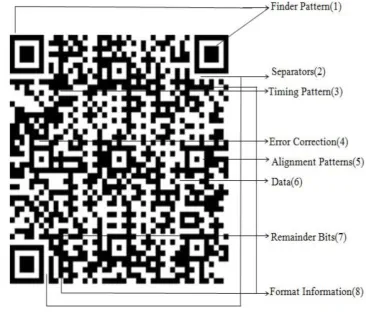
The patterns and structures inside a QR code have well defined functions which include error correction, sampling grid determination, andsymbol alignment.These patterns are used in the decoding process, to extract the QR code image [7,8]. The information is encoded in square black and white modules of several pixels. Finder patterns play a central role in the speed and success of decoding and are located in three corners of the symbol as shown in figure 1. QR readers use binary images resulting from thresholding the captured gray scale image with local or global thresholds. This particular feature simplifies the computations and reduces the processing requirements for QR decoding. Function pattern shows the main regions in the QR symbol and their patterns. The modules in a QR code can be classified in two main categories: function pattern region and encoding region. The function pattern region includes the finder and alignment patterns as well as the timing patterns. The encoding region contains the information codewords,
the error correction codewords and the modules used for the determination of the version and type of encoded data. A. Function Pattern Region This region contains all the necessary information to successfully detect and sample the information bits of the code. Finder and alignment patterns are the most essential modules in the region and are key to locate, rotate and align the QR code as well as to correct for deformations in the printing surface [7]. In addition to finder and alignment patterns, timing patterns also aid in the determination of the sampling grid especially for large code sizes.
1) Finder Patterns Finder patterns are easily identifiable as 3 concentric square structures in the corners of the code. They are designed to have the same ratio of black and white pixels when intersected by a line at any angle, allowing determining its centre even if the code is scanned at arbitrary angles. Finder patterns are surrounded by two guard zones of one QR 10 module wide called the separators [8,9]. These zones aid in the separation of finder patterns from the encoding region and in the identification of the proper sequence of black and white pixels further improving the location accuracy.
2) Separators The white separators have a width of one pixel and improve the recognizability of the finder patters as they separate them from the actual data.
4) Alignment Patterns Alignment patterns on the other hand are used to determine the sampling grids from which codewords are extracted and to correct for possible deformation of the printing surface [9]. 5) Timing Patterns the standard also defines two zones consisting on one row and one column of alternating black and white QR modules, denoted as the timing zones and located between finder patterns.
B. Encoding Region The code area delimited by finder patterns is denoted as the encoding region [9], where data, parity modules and decoding information is stored. This area is divided into codewords consisting of blocks of 8 QR modules. Two dimensional shapes of this codewords depend on the version of the code and are designed to optimize area coverage.
3.Implementation:
3.1.Power supply: Power supply is a reference to a source of
electrical power. A device or system that supplies
ARM ARCHITECTURE
US B H O S T
TFT DISPLAY UNIT
POWER SUPPLY
Input: URL’s/TEXT
through PC
Output: MOBILE
Embedded Linux OS
electrical or other types of energy to an output load or group of loads is called a power supply unit or PSU. The term is most commonly applied to electrical energy supplies, less often to mechanical ones, and rarely to otherThis power supply section is required to convert AC signal to DC signal and also to reduce the amplitude of the signal. The available voltage signal from the mains is 230V/50Hz which is an AC voltage, but the required is DC voltage(no frequency) with the amplitude of +5V and +12V for various applications In this section we have Transformer, Bridge rectifier, are connected serially and voltage regulators for +5V and +12V (7805 and 7812) via a capacitor (1000µF) in parallel are connected parallel as shown in the circuit diagram below. Each voltage regulator output is again is connected to the capacitors of values (100µF, 10µF, 1 µF, 0.1 µF) are connected parallel through which the corresponding output(+5V or +12V) are taken into consideration.
3.2.SMART ARM-based MPU:
SMART SAMA5D3 series is a high-performance, power-efficientThe Atmel -A5 processor, achieving 536 MHz Cortexembedded MPU based on the ARM with power consumption levels below 0.5 mW in low-power mode. The device features a floating point unit for high-precision computing and accelerated data processing, and a high data bandwidth architecture. It integrates advanced user interface and connectivity peripherals and security features. The SAMA5D3 series features an internal multi-layer bus architecture associated with 39 DMA channels to sustain the high bandwidth required by the processor and the high-speed peripherals. The device offers support for DDR2/LPDDR/LPDDR2 and MLC NAND Flash
memory with 24-bit ECC. The comprehensive peripheral set includes an LCD controller with overlays for hardware-accelerated image composition, a touchscreen interface and a CMOS sensor interface. Connectivity peripherals include Gigabit EMAC with IEEE1588, 10/100 EMAC, multiple CAN, UART, SPI and I2C. With its secure boot mechanism, hardware accelerated engines for encryption (AES, TDES) and hash function (SHA), the SAMA5D3 ensures anti-cloning, code protection and secure external data transfers. The SAMA5D3 series is optimized for control panel/HMI applications and applications that require high levels of connectivity in the industrial and consumer markets. Its low-power consumption levels make the SAMA5D3 particularly suited for battery-powered devices.
3.3. APPROACHES TO QR CODEEMBEDDING :
for embedding. The technique has been used to distributethe modified pixels of the QR code image and to minimize the amount changes in the luminance of the colour image so that it should not visible through naked eye.The embedding of halftones into QR codes was proposed in [3] where the location of binary pixels in the QR modules was optimized to maximize visual quality and decoding robustness. The main drawback of this method was suitable to generate visual distortion of the QR code and the image resolution has been limited to 9 pixels per QR module. To minimize the visual distortion of the embedding, the method presented in [4] defines a quality metric which has been considered for colour, tone and structural similarity used to select the optimal luminance of modified pixels. To fully leverage the characteristics of QRdecoders, central pixels in the QR modules play an important role. However in contrast to these [5] methods which fix the ratio between central and non-centralpixels, method proposed here allows choosing the number of central pixels and then optimizing the location and luminance of modified pixels to achieve particular error limits. Binarization process proposed in [6] explained the thresholding procedure. In threshold binarization method, binary imagehas been obtained by thresholdingthe gray scale image. In the binarization stage, the gray scale image captured by the camera has been segmented into black and white pixels. The binary image has been used to determine the QR modules centers and the sampling grid from which the code words wasextracted. However there are certain limitations in this method, here camera sensing devices was used to capture the gray scale image and no modifications for the accuracy of the binary image. To overcome from this issue certain adaptive methods has been proposed in [7].
was “hidden” like noise but it increases bandwidth of signal and also used blind detection technique to extract the watermark. A digital image watermarking algorithm based on Chaos and Fresnel transform has been proposed in [13]. The original image transformed by using the concept ofFresnel diffraction plane by distance parameter, and watermark image has been embedded after scrambled by chaotic sequence. The watermark image can be retrieved without original image, and there are little changes on the original image after embedding. Chaotic scrambling can encrypt watermark information. The main disadvantage of this algorithm was the transformation of the original image in hidden text can be decoded easily. To overcome from this constraint steganography has been used. The main idea of steganography proposed in [14] was the embedding of secret information into data under the assumption that others cannot know the secret information in data. Another thing to check the logo embedded in data or not. Based on the type of document to be watermarked, text watermarking: line shift coding, word shift coding, feature coding and visible watermark. The information has been visible in the picture or video. But this has been limited to certain level were by using line shift coding in the steganography. Prabhakaran et al. [15] proposed a steganography scheme, in that the message to be hidden into the cover image has been incorporated with the use of modulus operation. In their work, a half of the size and a quarter of the size of the chosen host-image were used to demonstrate the secret image can totally be embedded and preserved high image quality. Based on an embedded zero tree wavelet compression method and bit-plane complexity segmentation skill. A method of image analysis for QR code recognition has been described by Wakahara et al. [16].Their
problem has been solved by using nested steganography scheme by Chin.Ho et al. A useful extraction on image hidden technique using QR-Barcode has been given by Chin .Ho et al. [20]. This study has been dealt with nested steganography scheme which involves QR bar code and image processing techniques.
CONCLUSION:
As we have gone through the literature and reviewed most of the recent developments in QR codes. Although, 1D barcode has been developed to a great extant and so, mere hiding of information is not enough. This review paper mainly focuses on the research effort with an eye of enhancing security for the information in various levels by using QR code. Most of the strategies that have been analyzed claim satisfactory QR code recognition rates only when tested on standard sensing devices. Another important issue for hiding information using QR codes for security is to generate QR code for a text using Zxing library. Some of the widely used QR codes embedding methods have been discussed. In order to increase the complexity of detecting the QR code image to color image and increasing the security in hiding the information using QR code, allowing to automatically generate embedding of QR code with limited probability of detection error and to minimize the amount of luminance of the color image. Embedding metadata as QR codes in gray scale images, to color video files is going to have an important role in next generation smart environment.
REFERENCES
[1] Gonzalo J. Garateguy, Gonzalo R. Arce, Daniel L. Lau and Ofelia P. Villarreal, “QR Images: Optimized Image Embedding in QR Codes”, IEEE Transactions on Image Processing, vol.23, pp.2842-2853, July 2014.
[2] G. J. Garateguy, G. R. Arce and D L. Lau, “Voronoi tessellated halftone masks”, 17th IEEE International Conference on Image processing, pp.529-532, September 2010.
[3] Max E. Vizcarra Melgar, Alexandre Zaghetto, Bruno Macchiavello, Anderson C, A. Nascimento, “Colored Quick-Response Codes”,2nd International Conference on Consumer Electronics, vol.3, pp.321- 325, September 2012.
[4] Y. Lin, Y. Chang, and J. Wu, “Appearance-based QR Code Beautifier”, IEEE Transactions on Multimedia, vol.15, pp.2198- 2207, December 2013.
[5] Mu Zhang, Dan Yao, Qian Zhou, “The Application and Design of QR Code in Scenic Spot’s eTicketing System”, International Journal of Science and Technology, vol.2, pp.817-821, December 2012.
[6] Phaisarn Sutheebanjard and Wichian Premchaiswadi , “QR-Code Generator ”, 8th International Conference on ICT and Knowledge Engineering, vol.3, pp.89-92, November 2010. [7] Munoz-Mejia’s, Ivan González-Diaz and Fernando Diaz-de-Maria, “A Low-Complexity Pre-Processing System for Restoring LowQuality QR Code Images”, IEEE Transactions on Consumer Electronics, vol.57, pp.1320-1328,
August 2011.
Name of the guide Ms. Roji Y
Profile Picture
Designation Assistant Professor
Qualification B.Tech (JNTU)
M.Tech (JNTUH)
Publication National - 1
International - 1 Seminars/Workshops -9
Experience Teaching – 10
Pelagadi.Udaykiran D.O.B:- 27/05/1991 (27th May 1991)
Address: - H.No:- 11-2-80,Chaman Basthi /Opposite Scc Womens College, Village- Kothagudem, Mandal- Kothagudem,
District- Khammam, Pin Code- 507101, Telangana.
Mail Id: - [email protected], Mobile: - 9014364931. Qualification: -B-Tech (E.C.E)
(Klr College Of Engineering And Technology) (2009-2013) Affiliated To Jntu Hyderabad, (Vill)-Paloncha, (Mdl)-, (Dist)-Khammam.
M-Tech (Embedded Systems), (Persuing)