ISSN 2286-4822 www.euacademic.org
Impact Factor: 3.1 (UIF) DRJI Value: 5.9 (B+)
The Progress of Social Security Measures for
Labourers in India
Dr. S. R. KESHAVA
Associate Professor Post Graduate Department of Economics Bangalore University, Bangalore India
Abstract:
Social security has gained paramount importance in the changed economic scenario. Social security programmes are actively undertaken even in developed nations. The USA social security administration points out that it is much more than retirement program. One in Six Americans (57 million) receives social security benefits in USA.
India also has enacted many social security measures for its needy citizens. In order to protect the welfare of unorganized workers the legislative measures namely minimum wages Act, 1948, the employees compensation Act, 1923, the maternity benefit Act, 1961, the bonded labour system (Abolition) Act, 1976, the contract labour (Regulation & Abolition) Act, 1970, the inter-state migrant workmen (Regulation of Employment and Conditions of Service) Act, 1979, the building and other construction workers (Regulation of Employment and Conditions of Service) Act, 1996, etc. were implemented. At the same time to ensure welfare of unorganized workers various welfare schemes was also undertaken by the government. The ministry of labour and employment enacted “The Unorganized Workers Social Security Act 2008” which came into force from 16th May 2009.
through its social security measures must cater to the disadvantaged sections of the society and it is the fundamental duty of the government in the globalized India.
Key words: Social security, unorganized workers, legislative measures, disadvantaged sections, labourers, Cash Benefits, Non Cash Benefits, Rashtriya Swastya Bhima Yojana, Aam Adimi Bhima Yojana, Indira Gandhi National Old age Pension Scheme, Swavalamban
Social security has gained paramount importance in the changed economic scenario. Globalised world is the knowledge world. In the globalised world, it is expected that skilled individuals switch over to the changed technology/skill in no time. Globalization considers only those who adapt to the changing market scenario. The rest of them, though skilled are left out! The unskilled are not considered at all. The social and economic conditions make the disadvantaged sections of the society more vulnerable as they voice is snubbed and unheard in globalised economy. The disadvantaged sections find it difficult to easily adapt to the changed market demands. Moreover few segments of the society like aged persons, disabled persons, widows, survivors of deceased workers are not in the position to work and it is the responsibility of the Government to take care of them through social security programmes.
Social security is the financial assistance provided by the Government to the needy citizens such as disabled persons, aged persons, widows, unemployed youths, survivors of the deceased workers to promote their welfare by enabling them to access to food, shelter, health etc. social security acts as safety net for the disadvantageous sections of the society.
national effort and international co-operation and in accordance with the organization and resources of each State, of the economic, social and cultural rights indispensable for his dignity and the free development of his personality” (http://www.un.org/en/documents/udhr/index.shtml#a22).
Social security programmes are actively undertaken even in developed nations. The USA social security administration points out that it is much more than retirement program. One in Six Americans (57 million) receives social security benefits in USA. 69.4 percent of beneficiaries are retired workers, 19.2 percent of beneficiaries are disabled workers and 11.4 percent beneficiaries are survivors of deceased workers. Social security provides benefits to young workers and their families, if they become disabled and it provide benefits to the survivors of deceased workers including their children. In USA 90 percent of persons aged 21-64 who worked in covered employment in 2012 can count on monthly benefits, if they suffer a prolonged disability.
‘3.3 million Youths under age 18 received on an average monthly social security benefit of $ 525. The minor Children of retired workers received the average monthly benefit of $ 601. The minor Children of deceased workers received the survivor monthly benefit of $ 793, the minor Children of disabled workers received an average monthly benefit of $ 323, the students aged 18 to 19 years were receiving an average monthly benefit of $ 670’(ssa.gov/news/press/factsheets/young.htm).
compensation Act, 1923, the maternity benefit Act, 1961, the bonded labour system (Abolition) Act, 1976, the contract labour (Regulation & Abolition) Act, 1970, the inter-state migrant workmen (Regulation of Employment and Conditions of Service) Act, 1979, the building and other construction workers (Regulation of Employment and Conditions of Service) Act, 1996, etc. were implemented.
The Workmen Compensation Act, 1923
Table No.1: Compensated injuries and amount of compensation paid under the workmen’s compensation Act, 1923
Source: Labour Bureau
Under the 1923, workmen’s compensation act, during 1997, the number of compensated injuries was 4455 with Rs. 1863.28 lakh compensation which increased to 7247 with 3807.01 lakh compensation in 2001, which subsequently reduced to 5247 with Rs. 11280.49 compensation in 2011. Out of them the 947 nominees were compensated Rs. 1212.89 lakh due to the death of the work men in 1997 which increased to 2055 nominees who were compensated Rs. 6865.08 lakh in 2011.
1391 workmen were compensated with Rs.386.26 lakh for permanent disablement and 2117 workmen were compensated Rs. 263.98 lakh for the temporary disablement in 1997. It increased to 2170 workmen with compensation of Rs. 4130.03 lakh for permanent disablement and 1022 workmen were compensated Rs. 285.38 lakh for temporary disablement. Number of
compensated injuries
1997 2001 2004 2009 2010 2011
a) Death 947 1346 1581 863 1939 2055
b) Permanent disablement
1391 1520 1662 497 2831 2170
c) Temporary disablement
2117 4381 3507 2343 995 1022
Total 4455 7247 6750 3703 5765 5247
Amount of compnsation paid (Rs. In lakhs)
a) Death 1212.89 2215.95 3286.12 2420.13 5991.49 6865.08
b) Permanent disablement
386.26 1261.83 1273.35 554.32 2385.78 4130.03 c) Temporary
disablement
263.98 329.23 235.99 159.85 406.05 285.38
Total 1863.28 3807.01 4795.46 3134.30 8783.32 11280.4
The Factories Act, 1948
The Factories Act, 1948 is the principle legislation for regulating various aspects relating to safety, health and welfare of workers employed in factories. Act aims at protecting workers employed in factories from industrial and occupational hazards. It prescribes 48 hour/week for adult workers. The factories act forbids employment of children less than 14 years of age in any factory. Minimum Standards of lighting, ventilation, safety and welfare service, must be provided to the employees in the factories. Factories employing over 30 women workers are required to provide a crèche for their children. Similarly factories employing over 250 workers must provide shelters, rest-rooms and lunch rooms to its employees. Factories with 250 workers or more must also appoint employee’s welfare officers.
Maternity Benefit Act, 1961
The Act applies to women employed in mines, factories, circus, industry, plantation, shops and establishments employing ten or more persons, except employees covered under the Employees state insurance act, 1948. After the Royal commissions of Labour, 1931, and after, maternity Benefit Acts, were implemented; all the states enacted this law. The Mines maternity Benefit Act 1941, the employees state Insurance Act 1948, and the plantation Labour Act, 1951 were the three central Acts which provided maternity benefits to women workers. The enactment of the maternity benefit Act in 1961 provided better and far reaching benefits to women works. Hence the state government adopted the central Act on a gradual basis.
that firm for at least 80 days within the 12 months preceding her date of delivery.
There are two types of benefits for the women workers under the Maternity Benefit Act, namely 1) cash benefits and 2) non cash benefits.
Cash benefits: The important cash benefits are: 1. 12 weeks leave with pay before /after delivery 2. Six weeks leave with pay in case of miscarriage
3. An additional leave of one month leave with one month salary (requires doctor certification and recommendation)
Non cash benefits: The important non cash benefits are: 1. Light work for ten weeks before delivery; two fifteen
minutes nursing breaks until the child is fifteen months old;
2. Guarantee of not being dismissed/ discharged while on maternity leave.
The legal obligation is that no employers can knowing or unknowingly employ women in establishment during six weeks immediately the data of delivery or miscarriage. The central govt. is responsible for administration of the provisions of the Act in mines and in the circus industry, while the state Governments are responsible for administration of the Act in factories, plantations and other establishments.
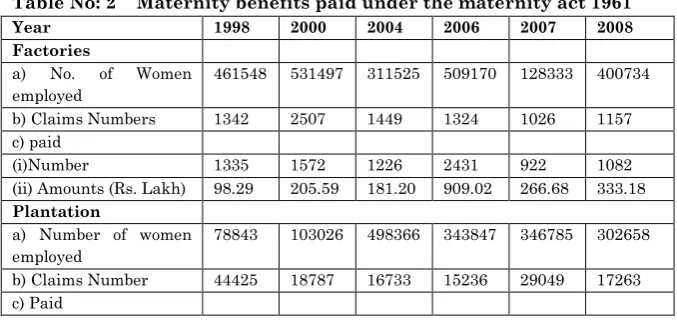
Table No: 2 Maternity benefits paid under the maternity act 1961
Year 1998 2000 2004 2006 2007 2008
Factories
a) No. of Women employed
461548 531497 311525 509170 128333 400734 b) Claims Numbers 1342 2507 1449 1324 1026 1157 c) paid
(i)Number 1335 1572 1226 2431 922 1082
(ii) Amounts (Rs. Lakh) 98.29 205.59 181.20 909.02 266.68 333.18 Plantation
a) Number of women employed
i) Number 39801 18759 16733 15236 27861 16990 ii) Amounts in lakh 154.88 536.23 376.85 407.96 424.04 367.29 Source: Derived from the data obtained from Pocket book of Labour Statistics
The numbers of women employed in the factories were 461548 during 1998 which decreased to 400734 by 2008, correspondingly the claims also decreased from 1342 in 1998 to 1157 in 2008. The amount sanctioned was Rs.98.29 Lakh in 1998 which increased to 333.18 lakh by 2008. In case of plantation, the number of women employed in plantation increased from 78843 in 1998 to 302658 in 2008. . The claims sanctioned were Rs.154.88 Lakh in 1998 which increased to Rs.376.85 Lakh in 2008.
The Employees State Insurance Act, 1948
employment injury and pension for dependents in the event of death of a worker because of employment injury. Full medical care including hospitalization is also being progressively made available to all the members of the family of the insured employee.
The E.S.I. Scheme was started with coverage of about 1.20 lakh industrial workers in Kanpur and Delhi on 2nd February, 1952. As on March 2013, there are 151 ESI Hospitals. The ESI Corporation has approved setting up of 23 new hospitals in the country, which are at the different stages of construction.
The scheme is financed mainly through contribution from employees (4.75 percent of the wages) and employees (1.75 percent of the wages). It has continued to progress over all these years. The benefits provided under the Act are a) Sickness Benefit, b) Maternity Benefit, c) Disablement Benefit, d) Dependent Benefit, e) Funeral Benefits, f) Medical Benefits
All the workers, earning less than Rs. 15,000 per month employed in power-run factories employing 20 or more persons are covered by this scheme. However, an insured person under ESI scheme is not eligible for similar benefits under the workmen’s compensation Act and state Acts relating to maternity benefits.
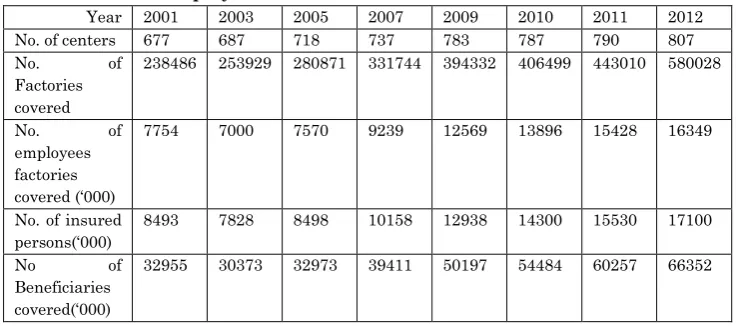
Table No: 3 Employees state insurance Act 1948
Year 2001 2003 2005 2007 2009 2010 2011 2012
No. of centers 677 687 718 737 783 787 790 807
No. of
Factories covered
238486 253929 280871 331744 394332 406499 443010 580028
No. of
employees factories covered (‘000)
7754 7000 7570 9239 12569 13896 15428 16349
No. of insured persons(‘000)
8493 7828 8498 10158 12938 14300 15530 17100
No of
Beneficiaries covered(‘000)
Source: Pocket book of Labour Statistics
The number of centers increased from 677 in 2001 to 807 in 2012. The number of factories covered was 238486 in 2001 which increased to 580028 in 2012. The number of employees covered increased from 7754000 in 2001 to 16349000 in 2012. The number of insured persons increased to 8493000 in 2001 to 1, 71, 00,000 in 2012, consequently the number of beneficiaries covered also increased from 32955000 in 2001 to 66352 in 2012.
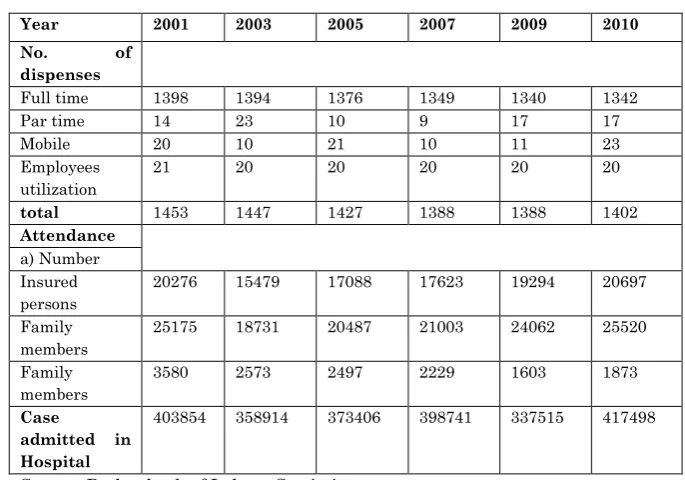
Table No. 4: Working of the Employees State Insurance
Source: Pocket book of Labour Statistics
The number of dispenses which was 1453 in 2001 that declined marginally to 1402 in 2010. Out of them the par time dispenses increased from 14 in 2001 to 17 in 2010. The mobile dispenses also increased from 20 in 2001 to 23 in 2010. The employee’s utilization also marginally reduced from 21 in 2001 to 20 in 2010.
Year 2001 2003 2005 2007 2009 2010
No. of
dispenses
Full time 1398 1394 1376 1349 1340 1342
Par time 14 23 10 9 17 17
Mobile 20 10 21 10 11 23
Employees utilization
21 20 20 20 20 20
total 1453 1447 1427 1388 1388 1402
Attendance a) Number Insured persons
20276 15479 17088 17623 19294 20697 Family
members
25175 18731 20487 21003 24062 25520 Family
members
3580 2573 2497 2229 1603 1873
Case
admitted in Hospital
The number of insured persons who visited ESI for medical care was 20276 in 2001 which marginally increased to 20697 in 2010. Similarly the number of family members who visited the ESI hospitals was 25175 in 2001 which marginally increased to 25520 in 2010. The cases admitted to hospitals increased from 403854 in 2001 to 417498 in 2010.
Table No. 5: No of beds available in ESI Hospitals
Source: Labour Bureau
The number of beds available in ESI has reduced considerably and requires correction. The number of beds in ESI was 19655 in 2001 which reduced to 18493 in 2010. Hence the general bed which was 15649 in 2001 is reduced to 14985 in 2010. The bed reserved for T B patients was reduced from 1766 in 2001 to 1081 in 2010. The only consolation is that the maternity beds increased from 2240 in 2001 to 2427 in 2010.
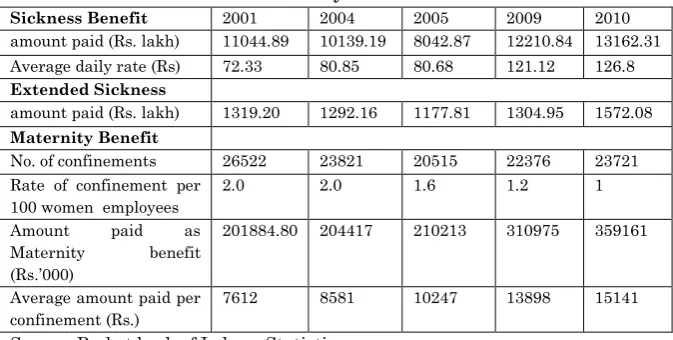
Table No. 6: Sickness and Maternity Benefit under ESI scheme
Sickness Benefit 2001 2004 2005 2009 2010
amount paid (Rs. lakh) 11044.89 10139.19 8042.87 12210.84 13162.31 Average daily rate (Rs) 72.33 80.85 80.68 121.12 126.8 Extended Sickness
amount paid (Rs. lakh) 1319.20 1292.16 1177.81 1304.95 1572.08 Maternity Benefit
No. of confinements 26522 23821 20515 22376 23721 Rate of confinement per
100 women employees
2.0 2.0 1.6 1.2 1
Amount paid as Maternity benefit (Rs.’000)
201884.80 204417 210213 310975 359161
Average amount paid per confinement (Rs.)
7612 8581 10247 13898 15141
Source:Pocket book of Labour Statistics
Years/ ESI Hospitals 2001 2003 2005 2007 2009 2010
General 15649 15403 15646 15369 13981 14985
Maternity 2240 2258 2317 2354 2451 2427
T.B 1766 1757 1761 2167 1515 1081
The amount paid for sickness under ESI scheme increased from 11044.89 lakh in 2001 to 13162.31 lakh in 2010. The average daily rate was Rs. 72.3 in 2001 that increased to 126.80 in 2010, which further increased to Rs. 160.80 in 2012. The amount paid for extended sickness is Rs. 1319.20 lakh in 2001 that increased to 1572.08 lakh in 2010.
The number of confinements under maternity benefit came down from 26522 in 2001 to 23721 in 2010. Hence the rate of confinement per 100 women employees came down from 2.0 in 2001 to 1 in 2010. The amount paid as maternity benefit increased from Rs. 201884800 in 2001 to Rs. 359261000 in 2010. Hence the average amount paid per confinement came to Rs. 7612 in 2001 which increased to 15141 in 2010.
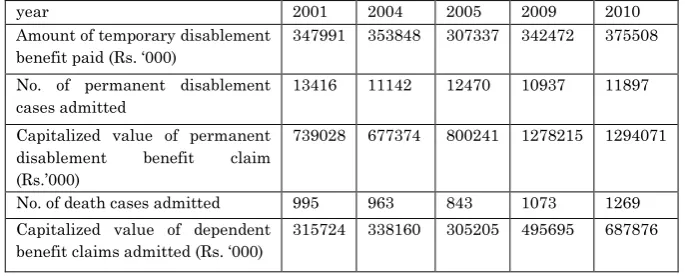
Table No. 7: Disablement and dependants benefit under employment state Insurance scheme
year 2001 2004 2005 2009 2010
Amount of temporary disablement benefit paid (Rs. ‘000)
347991 353848 307337 342472 375508
No. of permanent disablement cases admitted
13416 11142 12470 10937 11897
Capitalized value of permanent disablement benefit claim (Rs.’000)
739028 677374 800241 1278215 1294071
No. of death cases admitted 995 963 843 1073 1269 Capitalized value of dependent
benefit claims admitted (Rs. ‘000)
315724 338160 305205 495695 687876
Source: Pocket book of Labour Statistics
in 2010. The Capitalized value of dependent benefit claims admitted was Rs. 315724000 in 2001 which increased to Rs. 6867876000 in 2010.
The Seamen’s Provident Fund Act-1966
Seamen’s Provident Fund Act was passed in1966. It follows the pattern of the EPF Act. It covered 50,000 seamen. By the end of March 1968, the total contribution to the fund amounted Rs. 3, 14 Crores. The Act solves the problems of seamen working on board of the ships, especially when they are completely cut off from land. The problems of seaman working on board of the ships for truncated periods are of a special nature. Hence, it was considered desirable to enact a separate provident fund Act that was passed in 1966.
Every employer covered under the Act was required to contribute to the fund for the period from July 1964 to July 1968 at the rate of 6 per cent of the wages paid and thereafter at the rate of 8% in respect of each seaman employed by him. Every such seaman has to contribute an equal amount to the fund.
The Payment of Gratuity Act, 1972
The payment of Gratuity Act, 1972 is applicable to factories, mines, oil fields, plantations, ports, railways, motor transport undertakings, companies, shops and other establishments. The Act provides for payment of gratuity at the rate of 15 days wages for each completed year of service or part thereof in excess of six months subject to the maximum of Rs. 10 lakh.
Coal Mines Bonus Scheme
Jammu and Kashmir. There are four coal mines bonus scheme viz.
1. The Coal mines bonus scheme 1948, which applies to the coal mines in West Bengal, Bihar, Madhya Pradesh, Maharashtra and Orissa.
2. The Andhra Pradesh coal mines bonus scheme 1952 which applies to the coal mines in Andhra Pradesh. 3. The Rajasthan coal mines bonus scheme 1954 which
applies the only colliery in Rajasthan owned by the government.
4. The Assam coal mines bonus scheme 1955, which applies to coal mines in Assam excluding the tribal areas.
The scheme is applicable to all employees in the coal mines whose monthly basic earnings do not exceed Rs. 10,000. Bonus is not payable to works employed by for through a contractor on construction of road and buildings.
Table No. 8: Working of Coal Mines Provident Fund
Year 2000 2003 2005 2008 2010 2011
Coal Mines and ancillary organizations covered (at the end of the period)
964 971 971 963 901 903
Employees covered (000) a) Registered
Membership
2230 2240 2244 2245 4971 4979
b) Life Membership during the year
745 658 583 403 481 464
Contributions received during the year (Rs. lakhs) a)
compulsory
127096.36 173972.54 193320.73 185840.05 215039.63 346800.00 b) Voluntary 802.54 1690.90 1866.04 2195.00 2834.62 3200.00
The coal mines and ancillary organization covered by the end of 2000 was 964 which increased to 903 by 2011. The registered employees covered were 2230000 in 2000 which increased to 4979000 in 2011. The life membership was 745 in 2000 that declined to 464 in 2011. The compulsory contribution received was Rs. 127096.36 lakh in 2000 which increased to Rs. 346800 lakh in 2010. The voluntary contribution was Rs. 802.54 lakh in 2000 which increased to Rs. 3200 lakh in 2011.
Table No. 9: Claims for Refund under the Coal mines Provident Funds Schemes
Years 2000 2003 2005 2008 2010 2011
No. of Claims Received
35217 34418 26210 15852 25550 26932 No. of Claims
Rejected
948 538 587 712 319 229
No. of Claims Settled 33826 34186 25863 15793 25445 26555 Amount Refunded
(Rs. Crore)
866.15 1576.77 1739.07 1877.43 2264.05 2759.16 Progressive Total
claims Settled
1079 1177 1231 1366 1368 1364
Amount Refunded (Rs. lakh)
424430 774373 1996.92 1688922 20983.98 23743.14
Claims Pending - 1662 1107 803 1462 1610
Source: Pocket book of Labour Statistics
The number of claims received is 35217 in 2000 which increased to 26932 claims in 2011. The claims settled were 33826 and rejected was 948 in 2000 which increased to 26555 claims settled and 229 rejected claims in 2011. The amount refunded is Rs. 866.13 crore in 2000 which increased to 42759.16 crore in 2011. The progressive total claims settled is 1079 in 2000 which increased to 1364 in 2011. The amount refunded was Rs. 424430 lakh in 2000 which decreased to 23743.14 lakh in 2011. The claims pending in 2011 was 1610.
of work, manual or other wise and getting wages directly or indirectly from the employees. The act was amended in 1958 to cover nonresident workers as also the clerical, medical and other staff; by another amendment to the act in 1960, children and adolescents were also brought within the scope of the Act. The act was further amended in 1967 to make provision for pension fund. It now covers all categories of employees in tea plantations in Assam excluding those whose total emoluments exceed Rs. 10,000 per month.
Group Insurance
Group insurance scheme was introduced for the provident fund members in 1963. Under the scheme, a blanket policy was taken by the board to cover all the provident fund members in the age group of 18-60. Each worker was required to make a self declaration about his health and no medical examination or proof of age was required. The premium payable to the life insurance corporation are deducted and paid annually from the provident fund accumulations of the members by the board of trustees.
Pension Fund
Table No. 10: Family Pension Fund Benefits
Source: Pocket book of Labour Statistics
The family pension settled in 2000-01 was 755 which took it cumulative of 38500 in 2010-11 the family pension settled was 14 taking it to cumulative of 39952. The claim for other benefits under family pension settled was 65 and the cumulative was 104525 in 2000-01 which was 3 in 2010-11 taking the cumulative to 104601.
Unorganized workers Welfare Scheme
At the same time to ensure welfare of unorganized workers various welfare schemes was also undertaken by the government. The ministry of labour and employment enacted “The Unorganized Workers Social Security Act 2008” which came into force from 16th May 2009. The important welfare programmes launched by the government for unorganized workers are;
1) Rashtriya Swastya Bhima Yojana was initiated on 1st April 2008. It is providing smart card based cash less health insurance cover to the beneficiaries up to Rs. 30,000 per annum on family floater basis to BPL families in the unorganized sector.
2) Aam Adimi Bhima Yojana was launched on 20th October 2007 to provide insurance cover to the head of family or one earning member of rural land less households in the age of 18 to 59 years. The assured insurance amount, 30,000 in case of natural death of the insured, whereas Rs. 75,000 in case of accidental death and permanent disability and Rs. 37,500 for partial permanent
Year
2000-01
Cumula tive 2001
2004-05
Cumula tive 2005
2009-10
Cumula tive 2010
2010-11
Cumul ative 2011 F.P fund Settled 755 38500 243 39765 19 39983 14 39952 Claims for other
Benefits under F.P.S
disability were allowed to the beneficiaries under this insurance scheme.
3) Indira Gandhi National Old age Pension Scheme was expanded to all the citizens above the age of 60 years , who are living in BPL
4) A Co- contributory pension scheme called as Swavalamban was introduced in 2010. It encouraged the unorganized sector workers to voluntarily save for their retirement. The government of India matched the savings with a minimum sum of Rs. 1000 and maximum of Rs. 12,000 per annum.
Conclusion
The social security schemes have to be further strengthened to benefit the unorganized sector workers. The unorganized sector is fast expanding; hence government through its social security measures must provide the safety net to the needy workers. The entire ambit of unorganized sector should be covered by insurance and social security schemes so as to mitigate risk in this sector and boost the confidence of the workers. Government through its social security measures must cater to the disadvantaged sections of the society and it is the fundamental duty of the government in the globalized India.
REFERENCES:
Annual Report. 2012-13. Ministry of Labour and Employment, New Delhi
Balachandra, L., Mungekar, Dilip M., Nachane, M.J., and Manohar, Rao. 2003. Indian Economy in New
Millenium. Mumbai: Himalaya Publishing House.
Batra, E.S. and Dangwal, R.C. 2005. Globalization and
Financial Service Sector. Deep and Deep, Publication
Pvt Ltd.
Besley, T. and Kumbur, R. 1998. “Food Subsidies and Poverty alleviation.” Economic Journal 98 (392): 701-719.
Debdas, Banerjee. 2005. Globalization Industrial restructuring
and Labour standards. New Delhi: Sage Publishing.
Dev, S.M. 1996. “Social Security for Indian Workers, performance and issues.” Indian Journal of Labour Economics.
Economic Survey. 2013-14. Government of India, Ministry of Finance, Department of Economic Affairs Economic Division, Oxford University Press.
Galor, O. and Zeira, J. 1993. “Income distribution and macroeconomics.” Review of Economic Studies.
Keshava, S.R. 2013. "Lackluster Industrial Growth in India even with FDI and SEZ energizer during post reform period." In The Development Discourse: Growth and
Economic Efficiency in India, edited by R. Shashi
Kumar, 233-240. Faridabad, India: Humming Words Publisher.
Pocket book of labour Statistics, Labour Bureau, Government of
India 2011-12 retrieved from
http://labourbureau.nic.in/reports.htm
Thakur, Devendra 1999. Survey of Indian Industries and New
Economic Policy. New Delhi: Deep and Deep Publishing
Pvt Ltd.
http://labour.nic.in/upload/uploadfiles/files/Divisions/Parliamen t/ls94(1).pdf
United Nations, the Universal Declaration of Human Rights
retrieved from
http://www.un.org/en/documents/udhr/index.shtml#a22
USA social security measures retrieved from