P a g e | 1397
Data Possession Techniques in Cloud Storage for Deduplicating Data
NIKHAT SULTANA1 & Dr.K.Ramakrishna2
1
M-Tech Dept. of IT Sridevi Women's Engineering College Hyderabad
2
Professor & HOD, Dept. of IT Sridevi Women's Engineering College Hyderabad
Abstract-
Data integrity and storage efficiency aretwo important requirements for cloud storage. Proof
of Retrievability (POR) and Proof of Data
Possession (PDP) techniques assure data integrity
for cloud storage. Proof of Ownership (POW)
improves storage efficiency by securely removing
unnecessarily duplicated data on the storage server.
The cloud storage service (CSS) relieves the burden
for storage management and maintenance. Fragment
Structure, random sampling and index table is used
to construct the Audit service. These techniques are
supported provable updates to cloud outsourced
data. The third party auditing allow to save time and
computation resources with reduced online burden
of the user. In this work, a method based on
Probabilistic query and periodic verification for
improving the performance of audit services and
also audit system verifies the integrity.
Keywords: Cloud Storage Service, Cloud Service
Provider, Third Party Audit, Public Verification
Parameter, Provable Data Possession.
1.
Introduction
Cloud computing consists a collection of computers
and servers that are publicly accessible via the
Internet. User access the data’s and will pay as per
user basis. Cloud computing has four essential
characteristics: elasticity and the ability to scale up
and down, self-service provisioning and automatic
deprovisioning, application programming interfaces
(APIs), billing and metering of service usage in a
pay-as-you-go model. While Cloud Computing
makes these advantages more appealing than ever, it
also brings new and challenging security threats
towards users‟ outsourced data. Since cloud service
providers (CSP) are separate administrative entities,
data outsourcing is actually relinquishing user’s
ultimate control over the fate of their data. The
correctness of the data in the cloud is being put at
risk due to the following reasons. First of all,
although the infrastructures under the cloud are
much more powerful and reliable than personal
computing devices, they are still facing the broad
range of both internal and external threats for data
integrity and storage management. The cloud
storage service (CSS) relieves the burden of storage
management and maintenance. However, if such an
important service is vulnerable to attacks or failures,
it would bring irretrievable losses to users since
their data or archives are stored into an uncertain
storage pool outside the enterprises. The capability
provided to the consumer is to use the provider’s
applications are accessible from different client
devices through a thin client interface such as a web
browser (e.g., web-based email). The consumer
does not manage or control the underlying cloud
infrastructure including network, servers, operating
systems, storage data, or even individual application
capabilities, with the possible exception of limited
user-specific application configuration settings.
2.
Related Work
1. In Yan Zhu [1] used a quantified new audit
approach based on probabilistic queries and
periodic verification, as well as an optimization
method of parameters of cloud audit services. This
method greatly reduced the workload on the storage
servers. Cloud computing is securely constructed
with TPA based on Provable data possession
technique. Cloud storage reduced the client’s
burden for storage management and maintenance. It
provided a low cost, scalable, location-independent
platform. Audit services avoided the security risks
and to achieve digital forensics and credibility on
cloud computing. This technique was a
cryptographic based for verifying the integrity of
data without retrieving it at a UN trusted server, can
be used to realize audit services. PDP protocol is
used to prevent the fraudulence of hackers and the
leakage of verified data (zero-knowledge property).
2. Q. Wang [2] solved the problem of ensuring the
integrity of data storage in Cloud Computing. The
task is assigned to allow a third party auditor (TPA),
on behalf of the cloud client, to verify the integrity
of the dynamic data stored in the cloud. The TPA
eliminated the involvement of the client through the
auditing of whether his/her data stored in the cloud
is indeed intact, which can be important in
achieving economies of scale for Cloud Computing
While prior works on ensuring remote data integrity
often lacked the support of either public audit
ability or dynamic data operations, this project
achieves both. First identify the difficulties and
potential security problems of direct extensions with
fully dynamic data updated from prior works and
then displayed how to construct an elegant
verification scheme for the seamless integration of
these two salient features in our protocol design. In
particular, to achieve efficient data dynamics,
improve the existing proof of storage models by
manipulating the classic Merle Hash Tree
construction for block tag authentication. To
support efficient handling of multiple auditing
tasks, the technique of bilinear aggregate signature
to extend main result into a multi-user setting,
where TPA can be performed multiple auditing
tasks simultaneously. This paper delivered highly
protection for cloud storage.
3. In Cloud Storage, users can be remotely stored
their data and enjoy the on-demand high quality
applications and services from a shared pool of
configurable computing resources, without the
burden of local data storage and maintenance.
However, the fact that users no longer had physical
possession of the outsourced data makes the data
P a g e | 1399
formidable task, especially for users with
constrained computing resources. Moreover, users
should be able to just use the cloud storage as if it is
local, without worrying about the need to verify its
integrity. Thus, enabling public audit ability for
cloud storage was of critical importance so that
users can resort to a third party auditor (TPA) to
check the integrity of outsourced data and be
worry-free. To securely introduce an effective TPA, the
auditing process should bring in no new
vulnerabilities towards user data privacy, and
introduce no additional online burden to user. In
this paper, they proposed a secure cloud storage
system supporting privacy-preserving public
auditing and extend their result to enable the TPA to
perform audits for multiple users simultaneously
and efficiently. Extensive security and performance
analysis showed the proposed schemes were
provably secure and highly efficient. Their
experiment conducted on Amazon EC2 instance
further demonstrated the fast performance of the
design. Authors [3] completed their dynamic
auditing system to be privacy preserving and it
supported the batch auditing for multiple owners.
2.1 Existing System:
In this work, we study the problem of integrity
auditing and secure reduplication on cloud data.
Thus, the second problem is generalized as how can
the cloud servers efficiently confirm that the client
(with a certain degree assurance) owns the uploaded
file (or block) before creating a link to this file (or
block) for him/her. This design fixes the issue of
previous work that the computational load at user or
auditor is too huge for tag generation. We specify
that our proposed Becloud system has achieved
both integrity auditing and file reduplication.
However, it cannot prevent the cloud servers from
knowing the content of files having been stored. In
other words, the functionalities of integrity auditing
and secure reduplication are only imposed on plain
files. In this section, we propose Becloud+, which
allows for integrity auditing and reduplication on
encrypted files.
2.2 Proposed System:
In Proposed System we propose two secure
systems, namely Becloud and SecCloud+.SecCloud
introduces an auditing entity with maintenance of
aMapReduce cloud, which helps clients generate
data tags before uploading as well as audit the
integrity of data having been stored in cloud.
Compared with previous work, the computation by
user in Becloud is greatly reduced during the file
uploading and auditing phases. Becloud+ is
designed motivated by the fact that customers
always want to encrypt their data before uploading,
and enables integrity auditing and secure
reduplication unencrypted data.
3.
Implementation
After analyzing these papers, in cloud storage
system is constructed based on Provable Data
compare than other methods. To securely fulfill the
two important requirements of cloud storage: data
integrity and storage efficiency, a number of
schemes have been proposed based on the concepts
of POR, PDP. In this work, a constant cost scheme
that achieves secure public data integrity auditing
and storage reduplication at the same time. It
enables the reduplication of both files and their
corresponding authentication tags. In addition, to
support batch integrity auditing, and thus
substantially save computational cost and
communication cost for multiple requests scenarios.
Cloud service providers to offer an efficient audit
service to check the integrity and availability of the
stored data [7]
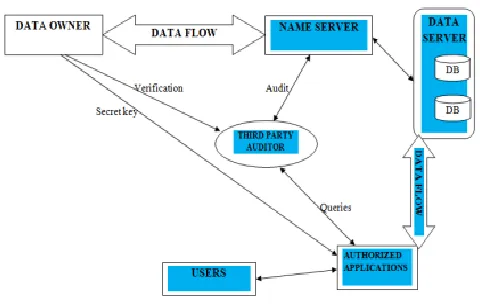
Fig 1.1System architecture of the proposed system
Cloud secure storage is constructed with these
modules,
3.1 KEY GENERATION
The owner generates a public/secret key pair (pike,
ski) by himself or the system manager, and then
sends his public key pike to TPA. Note that TPA
cannot obtain the client’s secret key ski; secondly,
the owner chooses the random secret.
3.2 TAG GENERATION
The client (data owner) uses the secret key ski to
pre-process a file, which consists of a collection of
n blocks, generates a set of public verification
parameters and index-hash table that are stored in
TPA, and transmits the file and some verification
tags to CSP.
Fig 2 Tag generation.
3.3: PERIODIC SAMPLING AUDIT
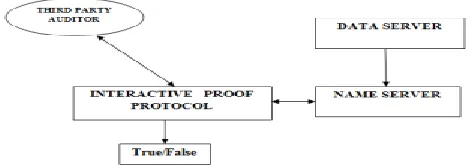
TPA (or other applications) issues a “Random
Sampling” challenge to audit the integrity and
availability of outsourced data in terms of the
verification information stored in TPA [9]. The AAs
should be cloud application services inside clouds
for various application purposes, but they must be
specifically authorized by DOs for manipulating
outsourced data. Since the acceptable operations
require that the AAs must present authentication
P a g e | 1401
modifications for data will be detected in audit
processes or verification processes.
Based on this kind of strong
authorization-verification mechanism, we assume neither CSP is
trusted to guarantee the security of stored data, nor a
DO has the capability to collect the evidence of
CSP‟s faults after errors have been found [14].
Fig 3 Periodic Sampling Audit Flow.
3.4 AUDITS FOR DYNAMIC OPERATIONS
An authorized application, which holds data
owner’s secret key ski, can manipulate the
outsourced data and update the associated index
hash table stored in TPA[10][11]. The privacy of sk
and the checking algorithm ensure that the storage
server cannot cheat the authorized applications and
forge the valid audit records.
Dynamic data operations:
Update (sk, Xi, mi’) is an algorithm run by AA to
update the block of a file m0 i at the index i by
using sk, and it returns a new verification metadata.
Delete (sk,Xi,mi) is an algorithm run by AA to
delete the block mi of a file mi at the index i by
using sk, and it returns a new verification metadata.
Insert(sk,Xi,mi) is an algorithm run by AA to
insert the block of a file mi at the index i by using
sk, and it returns a new verification metadata.
Fig 4 Flow of dynamic data operation.
To ensure the security, dynamic data operations are
available only to DOs or AAs, who hold the secret
key sk. Here, all operations are based on data
blocks. It is necessary for TPA and CSP to check
the validity of updated data. First, an AA obtains
the public verification information from
TPA[12][13]. Second, the application invokes the
Update, Delete, and Insert algorithms, and then
sends to TPA and CSP, respectively. Next, the CSP
makes use of an algorithm Check to verify the
validity of updated data. Note that the Check
algorithm is important to ensure the effectiveness of
the audit. Finally, TPA modifies audit records after
the confirmation message from CSP is received and
the completeness of records is checked.
Fig 5: File Upload to Cloud.
Fig 6: File Uploading with Blocks.
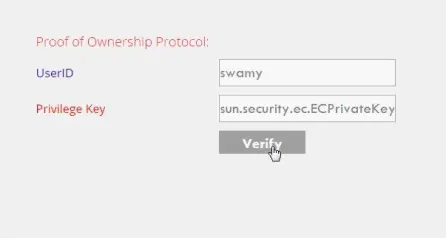
Fig 7: Proof of Ownership Protocol.
5.
Conclusion
To securely fulfill the two important requirements
of cloud storage: data integrity and storage
efficiency, a number of schemes have been
proposed based on the concepts of POR, PDP. In
this work, a constant cost scheme that achieves
secure public data integrity auditing and storage
deduplication at the same time. It enables the
reduplication of both files and their corresponding
authentication tags. In addition, to support batch
integrity auditing, and thus substantially save
computational cost and communication cost for
multiple requests scenarios. Cloud service providers
to offer an efficient audit service to check the
integrity and availability of the stored data.
6. References
[1] Yan Zhua,b, Hongxin Huc, Gail-Joon Ahnc,
Stephen S. Yauc ,“Efficient Audit Service Outsourcing For Data Integrity In Clouds”,In The
Journal of Systems and Software 85 (2012) .
[2] Wang.Q, C. Wang, K. Ren, W. Lou, and J. Li,
“Enabling Public Audit Ability And Data Dynamics
For Storage Security In Cloud Computing”, In IEEE
Trans. Parallel Distributed Systems, vol. 22, no. 5,
pp. 847-859, May 2011.
[3] Cong Wang, Student Member, IEEE, Sherman
S.M. Chow, Qian Wang, Student Member, IEEE,
Kui Ren, Member, IEEE, and Wenjing Lou,
Member, IEEE, “Privacy-Preserving Public Auditing For Secure Cloud Storage”.
[4] Abhishek Mohta* ,Ravi Kant Sahu,Lalit Kumar
Awasthi ,Dept. of CSE, NIT Hamirpur (H.P.)
India,“Robust Data Security For Cloud While Using Third Partyauditor”
[5] Juels.A and J. Burton, S. Kaliski, “Pors: Proofs
P a g e | 1403
Conf. Computer and Comm. Security (CCS‟07), pp.
584-597, Oct. 2007.
[6] Ateniese.G, R. Burns, R. Curtmola, J. Herring,
L. Kissner, Z.Peterson, and D. Song, “Provable
Data Possession At Untrusted Stores” ,In Proc. 14th
ACM Conf. Computer and Comm. Security
(CCS‟07), pp. 598-609, 2007.
[7] Govinda.K, V.Gurunathaprasad,
H.Sathishkumar,”Third Party Auditing For Secure
Data Storage In Cloud Through Digital Signature
Using RSA”, In International Journal Of Advanced
Scientific And Technical Research(Issue 2, Volume
4- August 2012) Issn 2249-9954.
[8] Ezhil Arasu.S, B.Gowri, S.Ananthi
,”Privacy-Preserving Public Auditing In Cloud Using HMAC
Algorithm “,In International Journal of Recent
Technology and Engineering (IJRTE) ISSN:
2277-3878, Volume-2, Issue-1, March 2013 .
[9] Shingare Vidya Marshal ,”Secure Audit Service
by Using TPA for Data Integrity in Cloud
System”,In International Journal of Innovative
Technology and Exploring Engineering
(IJITEE)ISSN: 2278-3075, Volume-3, Issue-4,
September 2013.
[10] Jiawei Yuan,Shucheng Yu “Secure and
Constant Cost Public Cloud Storage Auditing with
Deduplication”, University of Arkansas at Little
Rock, USA.
[11] Jiawei Yuan, Shucheng Yu,“Proofs of
Retrievability with Public Verifiability and
Constant Communication Cost in Cloud”,University
of Arkansas at Little Rock ,USA.
[12] Jeyadevan.S, Dr.S.Basavaraj Patil,
S.Saravanan, Naina Kumari, “Introducing Various
Algorithms To Make The Data-Storage In Clouds
Secure”,In International Conference on Computing
and Control Engineering (ICCCE 2012), 12 & 13
April, 2012.
[13]Vijeyta Devi & Vadlamani Nagalakshmi,”A
Prospective Approach On Security With RSA
Algorithm And Cloud SQL In Cloud Computing”,
In International Journal Of Computer Science And
Engineering (Ijcse) Issn 2278-9960 Vol. 2, Issue 2,
May.
[14] Vidhisha.S, C.Surekha, S.Sanjeeva Rayudu,
U.Seshadri,” Preserving privacy for secure and
outsourcing for Linear Programming in cloud
computing”, Computer Science Engineering
Jawaharlal Nehru Technological University
Ananatapur.
[15] V.Venkatesh, P.Parthasarathi,” Enhanced audit
services for the correctness of outsourced data in
cloud storage “,In International Journal of
Advanced Research in Computer Engineering &