Chasing the Perfect Splitter: A Comparison of Different Compound
Splitting Tools
Carla Parra Escartín
University of Bergen Bergen, Norway [email protected]
Abstract
This paper reports on the evaluation of two compound splitters for German. Compounding is a very frequent phenomenon in German and thus efficient ways of detecting and correctly splitting compound words are needed for natural language processing applications. This paper presents different strategies for compound splitting, focusing on German. Four compound splitters for German are presented. Two of them were used in Statistical Machine Translation (SMT) experiments, obtaining very similar qualitative scores in terms of BLEU and TER and therefore a thorough evaluation of both has been carried out.
Keywords:Compounds, German, Tool Evaluation
1. Introduction
One of the challenges of Natural Language Processing (NLP) applications dealing with Germanic languages such as German, Dutch, Norwegian, Swedish or Danish is the successful processing of their compound words. These languages are very productive in the creation of new compounds, as they may concatenate several words together into a single typographic word at any time. Being coined on-the-fly, compounds have to be detected, disambiguated and processed successfully in NLP applications.
In the case of Machine Translation systems (MT sys-tems), for instance, compounds need to be either in-cluded in the dictionaries of the system, or prepro-cessed successfully to avoid data scarcity. Rule-based MT systems require that compounds are successfully preprocessed or included in their dictionaries to be able to retrieve the appropriate translation. In con-trast, Statistical Machine Translation (SMT) systems rely on the words observed during the training phase. In this case, compounds not present in training cannot be translated and thus successful preprocessing tech-niques are also needed.
For the purposes of a larger research project involv-ing the translation of German nominal compounds into Spanish, a study has been carried out to test the per-formance of different compound splitters. This project aims at improving 1:n word alignments within Ger-man and Spanish and thus improve the translation of compounds in MT tasks. The establishment of these translational correspondences is particularly challeng-ing, because what is realised in German morpholog-ically (by means of compounding), corresponds to a syntactic construct in Spanish. Examples 1 and 2 show two German compounds split (Warmwasserbereitung
andWärmerückgewinnungssysteme) and their transla-tions into English and Spanish.
(1) Warm
caliente warm
Wasser
agua water
Bereitung
preparación production [ES]: ‘preparación de agua caliente’ [EN]: ‘warm water production’
(2) Wärme
calor heat
Rückgewinnung
recuperación recovery
s
Ø Ø
Systeme
sistemas systems [ES]: ‘sistemas de recuperación de calor’ [EN]: ‘heat recovery systems’
The state-of-the-art strategy inSMT(and many other NLP applications) to face this challenge consists on splitting the compounds prior to training in the case of translations from compounding languages, and re-joining the compounds after the translation process when translating into compounding languages. This approach was proven successful with other language pairs like German to English (Koehn and Knight, 2003; Popović et al., 2006; Stymne, 2008; Fritzinger and Fraser, 2010; Stymne et al., 2013), but has not been researched throughly in the case of German to Spanish or to other Romance languages.
2.
German Compounds
A German compound may be either lexicalised (i.e. they appear in general dictionaries), or not (i.e. are newly coined and do not appear in general dictionar-ies). Non lexicalised compounds are particularly fre-quent in technical and formal texts.
Baroni et al. (2002) reported that in the 28-million-word APA corpus1, 7% of the tokens and 47% of the types were compounds. A similar claim was made by Schiller (2005), who reported that 5.5% of 9,3 million tokens and 43% of overall 420,000 types were com-pounds. She also pointed out that these percentages can be higher in the case of technical texts and re-ported an increase of up to 12% in a short printer manual. Baroni et al. (2002) also pointed out that the small percentage of compounds detected at token level (7%) suggested that many of them are produc-tively formed hapax legomena or very rare words. They reported that 83% of the compounds had a corpus fre-quency of 5 and lower. As it is reported later in Section 4., these figures are also similar in the case of theTRIS corpus (Parra Escartín, 2012), used for the purposes of this paper.
Compounding in German can also occur in different word classes. In fact, four kinds of compounds can be distinguished: nominal, adjectival, adverbial and verbal. However, nominal compounds constitute the broadest and most productive kind of compounds. For the purposes of this paper, only nominal compounds are taken into account, although splitters which also split other kinds of compounds will be pointed out. When a compound is formed, the word located in the rightmost position constitutes the head thereof and de-termines the category of the compound. Thus, a noun head indicates that the compound is a nominal one, an adjective that it is an adjectival compound, and so forth. Figures 1 and 2 illustrate this.
Warmwasserbereitungsanlage (N)
Anlage (N)
Warmwasserbereitung (N)
Bereitung(s) (N) Warmwasser (N)
Wasser (N) warm (ADJ)
Figure 1: Warmwasserbereitungsanlagen(warm water production systems). Structural analysis. The head of the compound is in bold and underlined.
Moreover, and as illustrated in Example 3, newly coined compounds may constitute the base for coin-ing a yet newer compound.
1Corpus of the Austria Presse Agentur (APA), recently
released as the AMC corpus (Austrian Media Corpus) (Ransmayr et al., 2013).
baukostenwirksam
wirksam (ADJ) Baukosten (N)
Kosten (V) Bau(en) (V)
1
Figure 2: baukostenwirksam (be treated as construc-tion costs). Structural analysis. The head of the com-pound is in bold and underlined.
(3) warm (ADJ) + Wasser(N) =Warmwasser(N) + Bereitung(N) =Warmwasserbereitung (N) + s + Anlagen(N) =
Warmwasserbereitungsanlagen(N)
Besides the component words themselves, compounds may also include filling letters to join the words (see the middle “s” in Figure 1 and Example 3), or trun-cate the last part of a word (see the deleted “en” end-ing in the tree structure of Figure 2). Langer (1998) and Marek (2006) among others, have studied Ger-man compounds and their inner structure from a more NLP oriented perspective, while the linguistic proper-ties of compounds have been extensively studied by lin-guists such as Fleischer (1975), Wellman, Hans (1984), Eichinger (2000) and Bußmann (2008).
3.
Compound splitters
Several compound splitting strategies have been ex-plored. While some may be considered purely statis-tical and include little linguistic information (e.g. the allowed filling letters), others have been developed us-ing lus-inguistically motivated strategies2. Those purely statistical will thus be easily tuneable and adaptable for other compounding languages, whereas the linguis-tically motivated ones may require extensive tuning to split compounds in other languages than German. Ex-periments with both approaches have been carried out with a twofold aim. One aim is to determine which approach performs best for splitting German nominal compounds. Another is to assess to which extent dif-ferent splitters may have an impact in the quality of SMT systems. Section 4. reports on the experiments carried out on this respect.
In what follows, four compound splitters found for Ger-man are briefly presented classified as purely statistical or linguistically motivated. Screenshots of their out-puts are also provided to show how they also differ greatly in this respect.
2This distinction was already pointed out by Popović
et al. (2006), although she referred to corpus-based and linguistic-based methods.
3.1. Purely statistical splitters
As mentioned earlier, the state-of-the-art approach to dealing with compounds in SMT typically consists of splitting them. In order to do so, purely statistical splitters use the same corpus used by their SMT sys-tems to create a vocabulary and rate the frequency of the words appearing in it. This vocabulary is then used to calculate the possible splits of the corpus. It has the advantage of being a stand-alone approach which does not depend on any other resources. However, if used with corpora of a minor size, the splitter may not be able to retrieve all the possible splits in the corpus. The implementation of this approach by Koehn and Knight (2003) is a widely spread preprocessing step in SMT tasks from/to German. Popović et al. (2006) also explored and implemented this approach and com-pared it with the linguistic-based method proposed by Nießen and Ney (2000). They concluded that both ap-proaches were leading to similar, small, but consistent improvements inSMT for a larger corpus and a smaller one. However, the splitting methods were not evalu-ated and thus the splitter performance when trained with a smaller or bigger corpus was not tested either. A smaller corpus implies a more reduced vocabulary for training the splitter, and thus it would seem rea-sonable to think that it may be a drawback for this kind of approach.
To test whether the hypothesis that a smaller corpus size is a drawback holds true, the statistical implemen-tation by Popović et al. (2006) (hereinafter referred to as “the RWTHsplitter”) has been tested using differ-ent corpora. Section 6. presdiffer-ents the differdiffer-ent set-ups with which the splitter was tested.
Figure 3 shows a sample of the output of this splitter.
Annuitaetenzuschuss 3 Annuitaeten#Zuschuss 12.1244 Basisfoerderung 8 Basis#Foerderung 3.4641
Darlehensfoerderung 1 Darlehens#Foerderung 7.74597 Energieeinsatz 1 Energie#Einsatz 2.44949
Fernwaermeanlagen 1 Fernwaerme#Anlagen 2.64575 Foerderungsberechnung 1 Foerderungs#Berechnung 0 Foerderungsberechnung 1 Foerderung#Berechnung 4.8989
Figure 3: Output of the splitter developed by Popović et al. (2006).
As illustrated in Figure 3, each line contains: 1. The detected compound;
2. The compound frequency in the corpus used; 3. The possible splittings of the compound, marking
each compound component by means of a “#”; and
4. The probability of that split being the right one. It should be noted that the components of the com-pounds are not lemmatised by the splitter, but are rather kept as they appear in the corpus used to compute the splittings. Thus, as can be observed in Figure 3, “Darlehensfoerderung”3 (loan promotion) is
3To unify frequencies, all words in the corpus were
nor-malised to their forms without “Umlaut”.
split in “Darlehens + Foerderung” (loan + promotion), whereas in the case of “Foerderungsberechnung” (loan calculation) two splits are considered “Foerderungs + Berechnung” ([loan + “s”] + calculation) and “ Fo-erderung + Berechnung” (loan + calculation) and the second option will be selected because its probability is higher.
Finally, it should also be pointed out that the split-ter does not only split compounds in two components, but also is able to split more complex compounds. In the experiments reported here, the splitter split several complex compounds successfully.
3.2. Linguistically motivated splitters
Linguistically motivated splitters rely on a lexical database to compute the possible splits of a word. Depending on the flavour of the splitter, this lexical database is also enriched with additional information such as the frequency of each of the elements in the database or Part-of-Speech (POS) tags.
It should be noted that although some researchers (Schiller, 2005; Marek, 2006) have explored the pos-sibility of using Finite State techniques for splitting German compounds, such splitters could not be tested in our work.
For the purposes of the comparison reported here, three compound splitters were considered:
1. The compound splitter developed by Weller and Heid (2012) at the Institut für Maschinelle Sprachverarbeitung (IMS) of the University of Stuttgart (hereinafter “theIMSsplitter”). 2. The compound splitterBananaSplitdeveloped by
Ott (2006).
3. The compound splitter jWordSplitter developed by Daniel Naber4.
A fourth splitter also developed at the IMS by Fritzinger and Fraser (2010) had to be left for future work due to time constraints.
3.2.1. The IMS splitter
Although this splitter was developed using the frequency-based approach proposed by Koehn and Knight (2003), it may be considered linguistically mo-tivated because additional features were included to improve its performance. Instead of using a raw cor-pus as training data, a list of lemmatised word forms is used together with their correspondingPOStags. The POS tags were used to reduce the number of incor-rect splits, as this enables the splitter to filter content words (adjectives, nouns and verbs) and consider only those for splitting a compound candidate. This list is supplemented with a set of rules to model transitional elements. A second list of lemmatised word forms in-cluding their frequencies is additionally used to allow the splitter to derive a lemmatised analysis of an in-flected compound.
4http://www.danielnaber.de/jwordsplitter/index_
In order to train this splitter, the corpus used for exper-iments could have been lemmatised and POS-tagged. However, as these two processes would have also been a potential source of noise, the CELEX database for German was used instead because it was possible to extract the two lemma lists needed for training and running the splitter.
This splitter has additionally the advantage of not only splitting nominal compounds, but also adjectival and verbal compounds. Although for the purposes of the splitter evaluation reported in section 6. only nominal compounds have been taking into account to allow for comparisons with the other splitter (“theRWTH split-ter”), experiments in SMT tasks splitting adjectives and verbs yielded very promising results.
Figure 4 shows a sample of the output of this splitter. As can be observed in Figure 4, the output consists of a list of compounds (lowercased) and their splittings separated by tabs and tagged with their correspond-ing POStags. The second column corresponds to the lemmas of each of the components of the compound, and the third one to the corresponding word forms. Thus, if instead of “wohnungsfoerderungsverordnung” (housing promotion act) the compound had been “wohnungsfoerderungsverordnungen” (housing promo-tion acts) in plural, in the second column the split-ter would have retrieved “verordnung_NN” (lemma), whereas in the third one the plural form would have been preserved ‘verordnungen_NN” (word form). Fi-nally, as can be observed in Figure 4, it allows for the splitting of compounds in up to 4 parts.
This splitter was used in the experiments reported in section 4. and in the evaluation in section 6.
3.2.2. The BananaSplit splitter
This splitter uses recursive look-ups against a dictio-nary derived from an earlier version of GermaNet5and included in the tool. As specified by Ott (2006), com-pounds already present in GermaNet were not split. To a certain extent, it could be then alleged that the tool considers those compounds as lexicalised and thus do not need to be split. Although compounds are only split in two components, the tool is able to divide nom-inal, adjectival and verbal compounds.
Figure 5 shows a sample of the output of this splitter. As can be observed in Figure 5, its output format needs to be further processed to be used in other applications. The intended usage of the output format was to pro-vide further linguistic information, such as bounding suffixes (attached to a B-node), umlauting (U-node) and inflection (I-node). Moreover, it only splits com-pounds into two components and fails to analyse more complex compounds. Ott (2006) reports an accuracy of 93.28% when dropping lexicon failures (words not present in the dictionary), and of 74.0% when those lexicon failures are counted as errors as well.
This splitter has not been taken into account in the comparison for several reasons. On the one hand, the
5GermaNet is the German WordNet (http://www.sfs.
uni-tuebingen.de/GermaNet/).
further processing is required to actually use its out-put. On the other hand, it only splits compounds in two, which makes it less comparable to other splitters taken into consideration.
3.2.3. The jWordSplitter splitter
This splitter is also based on recursive look ups against a dictionary. Like the one developed by Ott (2006), it tries to identify words contained in the dictionary as parts of any given input word. If such parts are found in the dictionary, the word is split. Like the splitters developed by Weller and Heid (2012) and Ott (2006), input words may be nouns, verbs or adjectives. The length of the word to be split is not limited. Moreover, it is possible to substitute the dictionary which comes along with the splitter by other dictionary. Figure 6 shows a sample of the output of this splitter.
This splitter was not used because its developer al-ready warns the user that to improve the results the contents of the dictionary should be tuned and excep-tions should be added. Moreover, in order for the split-ter to successfully split a compound, all word forms of a word should be present in the dictionary, as well as truncations usually used in compounds, such as “Wohn” (a truncation for “wohnen”, to live). This lat-ter case can be observed in Figure 6, where the word “Wohnhaus” is not split in the sixth line.
4. Case Study
As stated earlier, this study has been carried out within the context of a larger project dealing with the translation of German nominal compounds into Span-ish inSMTtasks.
As the state-of-the-art approach to deal with com-pounding languages inSMT consists of splitting them in parts, two pilot experiments were carried out using theSMTsystemJane(Wuebker et al., 2012). The com-pounds found were split using two different splitters: theRWTHsplitter developed by Popović et al. (2006) and reported in 3.1. and theIMSsplitter developed by Weller and Heid (2012) and reported in 3.2.1.
The TRIScorpus was used in development (dev) and testing (test) in isolation, whereas for training it was concatenated with an internally compiled version of the Europarl corpus (Koehn, 2005) for the pair of lan-guages German-Spanish. The TRIS corpus has been used because it was compiled for the purposes of the project within which these experiments have been car-ried out. The Europarl corpus was used to compensate the rather reduced size of theTRIScorpus and increase the vocabulary coverage.
wohnungsfoerderungsverordnung wohnung_NN foerderung_NN verordnung_NN wohnung_NN foerderung_NN verordnung_NN foerderungsmodell foerderung_NN modell_NN foerderung_NN modell_NN
mehrfamilienwohnhaus mehren_V familie_NN wohnen_V haus_NN mehren_V familie_NN wohnen_V haus_NN neubaubereich neu_ADJ bau_NN bereich_NN neu_ADJ bau_NN bereich_NN
Figure 4: Output of the splitter developed by Weller and Heid (2012).
[.X Mehrfamilienwohnhaus ] # No analysis possible. # Word stem: null
[.U [.U Neu ] [.B -Ø+Ø ] [.U baubereich ] [.U -Ø+Ø ] [.I -Ø+Ø ] ] # Analysis based on two Atoms.
# Word stem: Neubaubereich
Figure 5: Output of the splitter developed by Ott (2006).
Wohnung, foerderung, verordnung 1990
fuer das
Foerderung, modell Mehr, familien, wohnhaus Neubau, bereich
Foerderung
Figure 6: Output of the splitter developed by Daniel Naber.
training dev test Sentences 1.8M 2382 1192
Tokens 40.8M 20K 11K
Types 338K 4050 2087
Table 1: Experiment setup. Corpus statistics.
As SMT system, the state-of-the-art phrase-based translation approach (Zens and Ney, 2008) imple-mented in Jane was used. Word alignments were trained withfastAlign(Dyer et al., 2013) and a 4-gram language model trained with the SRILMtoolkit (Stol-cke, 2002) was applied on the target side of the training corpus. The log-linear parameter weights were tuned withMERT(Och, 2003) on the development set. Bleu
(Papineni et al., 2002) was used as optimisation crite-rion. The parameter setting for all experiments was the same to allow for comparisons.
Table 2 summarises the number of compounds de-tected by each splitter and the percentages they ac-count for with respect to the types and tokens in the corpora used for training, development and testing. As can be acknowledged in Table 2, and as previously anticipated in section 2., both splitters detect a rel-atively high percentage of compounds. The higher percentage of compounds present in the test set ad-ditionally seems to verify that compounds tend to
ap-RWTH IMS Compounds in training 182334 141789
% Types 54% 42%
% Tokens 0.4% 0.3%
Compounds in test 924 444
% Types 44.3% 21.3%
% Tokens 8.5% 4%
Table 2: Number of compounds detected by each split-ter and percentages they account for with respect to the types and tokens in the corpora used in the exper-iments.
pear more frequently in specialised texts. This high percentage of compounds appearing in German also seems to confirm that preprocessing them successfully will improveSMT quality results.
While other researchers have focused on the pair of languages German→English, in the experiments car-ried out the pair of languages German→Spanish was used. Table 3 summarises the results obtained for each splitter.
test
Experiment Bleu[%] Ter[%] OOVs
Baseline 45.9 43.9 181
RWTH 48.3 40.8 104
IMS 48.3 40.5 114
Table 3: Results for the German→SpanishTRISdata translated without splitting the compounds (Baseline) and splitting them using the two different splitters.
ob-tained in the SMT experiments, a formal evaluation of the different compound splitters seemed motivated and thus it was undertaken.
5. Gold Standard
With the purpose of creating a Gold Standard to be used during the evaluation of the two compound split-ters to be compared, two short texts of theTRIScorpus were manually analysed. The two files correspond to the subcorpus B30: Construction - Environmentand account for 261 sentences in total. All German nomi-nal compounds and their corresponding Spanish trans-lations were manually extracted. Abbreviated nominal compounds (i.e. “EKZ” instead of “Energiekennzahl”) and compounds in coordination involving ellipsis (i.e. “Solar- und Wärmepumpenanlagen”) were disregarded at this stage.
Table 4 offers an overview of the number of tokens and types of our test set. The number of nominal com-pounds found is indicated together with the percent-age of the test tokens they account for. The number of unique compounds is indicated with the percentage of the test types they account for.
Number of tokens 3351
Number of types 784
Number of compounds 342 (10.2%) Number of unique compounds 173 (22%)
Table 4: Summary of the Gold Standard used to com-pare the splitters.
6. Evaluation
The text used to create the Gold Standard referenced to in section 5. was used to evaluate the IMS split-ter (Weller and Heid, 2012) and the RWTH splitter (Popović et al., 2006) against the Gold Standard and compare them between each other.
While the IMS splitter can be directly applied to any text “as is” provided the lemma lists are there, the RWTH splitter depends on the corpora used to train the splitter. Thus, the IMS splitter was used directly on the test corpus, and as indicated previously in sec-tion 3.2.1., whereas in the case of the RWTH split-ter different corpora were used to test it. As already pointed out in section 3.1., these different corpora also aimed at testing whether a smaller corpus size is a drawback or not for this kind of approach. The differ-ent corpora used were as follows:
1. Only the test corpus (in Table 6 referred to as “RWTH”)
2. The test corpus and a concatenated lemma list ex-tracted from theCELEXdatabase for German (in Table 6 referred to as “RWTH lemmas”). In this case, the vocabulary of the test corpus was com-puted together with the frequencies of each word, and then this list was compared with the lemma list. If a lemma was already in the vocabulary
file but the frequency in the vocabulary file was lower than the one in the lemma list, the frequen-cies were changed. If the lemma was not found in the vocabulary file, it was appended to it together with its frequency.
3. The test corpus and a concatenated word form list also retrieved from the CELEX database for German (in Table 6 referred to as “RWTH word forms”). Again, the vocabulary of the test corpus was first computed, and then checked against the word form list substituting higher frequencies and appending the word forms not already present in the vocabulary.
4. The whole TRIS corpus without the test set (in Table 6 referred to as “RWTH TRIS”).
5. An internally compiled version of the Europarl corpus for German→Spanish (in Table 6 referred to as “RWTHEuroparl”).
6. A concatenation of the TRIS corpus without the test set and the Europarl corpus (in Table 6 re-ferred to as “RWTH TRIS+Europarl”).
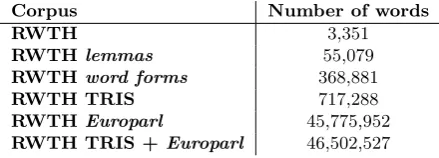
Table 5 summarises the number of words contained in each of the corpora used to train the splitter.
Corpus Number of words
RWTH 3,351
RWTH lemmas 55,079
RWTH word forms 368,881
RWTH TRIS 717,288
RWTH Europarl 45,775,952 RWTH TRIS +Europarl 46,502,527
Table 5: Number of words contained on each of the corpora used to train theRWTH splitter.
As mentioned in the introduction (cf. Section 1.), the evaluation procedure proposed by Koehn and Knight (2003) has been used to evaluate the output of the two splitters.
The evaluation method proposed distinguishes be-tween:
• Correct splits: Words that shall be split and are split correctly.
• Correct non splits: Words that shall not be split and are not split.
• Wrong not split: Words that should have been split but were not.
• Faulty splits: Words that should be split and were split, but wrongly.
• Wrong splits: Words that should not be split and were split.
Moreover, this method also provides a way to compute the precision, recall, and accuracy of each splitter:
• Precision: (correct split) / (correct split + wrong faulty split + wrong superfluous split)
• Accuracy: (correct split) / (correct + wrong)
This allows us to compare the different splitters and testing environments proposed objectively and analyse which one performs better.
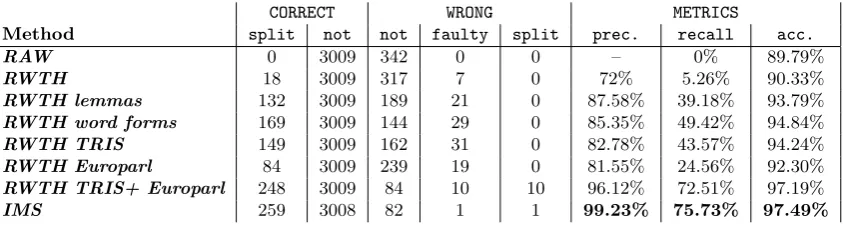
Table 6 summarises the results obtained for each split-ter afsplit-ter going manually through the test set and mark-ing all compounds as split/not split followmark-ing the cri-teria suggested by Koehn and Knight (2003). The dis-tinction between lemmas and word forms made by the IMS splitter has not been taken into consideration to allow for a comparison between the two splitters. These results show that theIMSsplitter generally per-forms better than the RWTH splitter, particularly as regards to precision, when running splitting tasks in specialised corpora likeTRIS.
Although these results are not fully comparable to the ones obtained by Fritzinger and Fraser (2010) because different test data were used, both the RWTHsplitter and the IMSsplitter score better than the best scores they reported for noun splits. In fact, Fritzinger and Fraser (2010) report 62.49%, 56.73% and 88.46% for precision, recall, and accuracy respectively in the case of a splitter developed using a hybrid approach using allSMOR6(Schmid et al., 2004) analyses, and 78.45%, 58.27% and 90.98% using a splitter developed using a hybrid approach using the SMOR analysis with the minimal number of parts. In future work the output of this splitter will be compared against the other two splitters presented here to determine whether these dif-ferences are mainly due to different test sets or not. As far as corpus size is concerned, it can be acknowl-edged that in the case of corpus-based compound split-ters, it does have an impact in the overall scores, but not always. As can be also observed in Table 6, the best scores obtained with the RWTH corpus were the ones in which all data available was used (TRIS +
Europarl). However, it is also remarkable how the smaller, but specialised corpus (TRIS), yields better overall scores than a bigger and more general corpus (Europarl). This is not surprising, as the test data comes from the TRIS corpus and it is from the same domain, whereas the Europarl vocabulary is not as technical and specialised, but includes more general words that at the same time can create new com-pounds. Adding the lemma/word form lists to the test corpus also yielded very positive results. In fact, the scores of the splitter were better than those using only the Europarl. We may thus conclude, that in the case of using corpus-driven approaches for compound split-ting of specialised texts, it seems reasonable to sug-gest that a combination of both in-domain data and large general data is used to ensure better results, if no additional lexical database can be added to train the splitter.
6SMOR is a finite-state based morphological analyser
which also covers productive word formation processes.
7.
Conclusion
In this paper, the different compound splitting ap-proaches used in German compound splitters have been presented. Four splitters have been presented and two of them, a statistical and a linguistically motivated one, were used to runSMT experiments. Very similar results were obtained, which lead to a formal evalua-tion of their performance. The evaluaevalua-tion has shown that one (the IMS splitter, linguistically motivated) was performing better than the other (theRWTH split-ter, statistically motivated) , but this difference was not directly reflected in theBleuandTerscores ob-tained in theSMTexperiments. Since it would be rea-sonable to think that a better splitter may yield better results inSMTtasks, further experiments shall be car-ried out to test if the results obtained thus far replicate with other data. Additionally, a qualitative analysis of the results, paying particular attention to the transla-tion of compounds is currently being done to better assess the impact of the splitters in the overall trans-lation quality.
8. Acknowledgements
The author wants to thank the RWTH Aachen Uni-versity and Marion Weller (UniUni-versity of Stuttgart) for granting her access to the splitters used in the exper-iments reported here, Stephan Peitz (RWTH Aachen University) for his assistance and guidance in running theSMTexperiments and the anonymous reviewers for their valuable comments and feedback.
The research reported in this paper has received fund-ing from the EU under FP7, Marie Curie Actions, SP3 People ITN, grant agreement 238405 (project CLARA7).
9.
References
Marco Baroni, Johannes Matiasek, and Harald Trost. 2002. Wordform- and Class-based Prediction of the Components of German Nominal Compounds in an AAC System. In Proceedings of the 19th Inter-national Conference on Computational Linguistics, Taipei, Taiwan.
Hadumod Bußmann. 2008. Lexikon der Sprachwis-senschaft. Alfred Kröner Verlag.
Chris Dyer, Victor Chahuneau, and Noah A. Smith. 2013. A Simple, Fast, and Effective Reparameteri-zation of IBM Model 2. InHLT-NAACL, pages 644– 648. ACL.
Ludwig M. Eichinger. 2000. Deutsche Wortbildung. Eine Einführung. Gunter Narr Verlag Tübingen. Wolfgang Fleischer. 1975. Wortbildung der deutschen
Gegenwartssprache. Max Niemeyer Verlag Tübin-gen, 4 edition.
Fabienne Fritzinger and Alexander Fraser. 2010. How to Avoid Burning Ducks: Combining Linguistic Analysis and Corpus Statistics for German Com-pound Processing. InProceedings of the Joint Fifth Workshop on Statistical Machine Translation and
CORRECT WRONG METRICS
Method split not not faulty split prec. recall acc.
RAW 0 3009 342 0 0 – 0% 89.79%
RWTH 18 3009 317 7 0 72% 5.26% 90.33%
RWTH lemmas 132 3009 189 21 0 87.58% 39.18% 93.79%
RWTH word forms 169 3009 144 29 0 85.35% 49.42% 94.84%
RWTH TRIS 149 3009 162 31 0 82.78% 43.57% 94.24%
RWTH Europarl 84 3009 239 19 0 81.55% 24.56% 92.30%
RWTH TRIS+ Europarl 248 3009 84 10 10 96.12% 72.51% 97.19%
IMS 259 3008 82 1 1 99.23% 75.73% 97.49%
Table 6: Evaluation of the performance of the splitters. The best results are marked in bold face.
MetricsMATR, pages 224–234, Stroudsburg, PA, USA.
Philipp Koehn and Kevin Knight. 2003. Empirical Methods for Compound splitting. In Proceedings of the 10th Conference of the European Chapter of the Association for Computational Linguistics, pages 187–193, Stroudsburg, PA, USA.
Philipp Koehn. 2005. Europarl: A Parallel Corpus for Statistical Machine Translation. In Proceedings of the 10th Machine Translation Summit, pages 79–86, Phuket, Thailand. AAMT.
Stefan Langer. 1998. Zur morphologie und semantik von nominalkomposita. InTagungsband der 4. Kon-ferenz zur Verarbeitung natürlicher Sprache. Torsten Marek. 2006. Analysis of German Compounds
Using Weighted Finite State Transducers. Technical report, Eberhard-Karls-Universität Tübingen. Sonja Nießen and Hermann Ney. 2000. Improving
SMT quality with morpho-syntactic analysis. In
Proceedings of the 18th International Conference on Computational Linguistics, pages 1081–1085. Franz Josef Och. 2003. Minimum Error Rate Training
in Statistical Machine Translation. InProceedings of the 41st Annual Meeting on Association for Compu-tational Linguistics, pages 160–167, Sapporo, Japan. Niels Ott. 2006. Evaluation of the BananaSplit Compound Splitter. Technical report, Seminar für Sprachwissenschaft, Eberhard-Karls-Universität Tübingen, March.
Kishore Papineni, Salim Roukos, Todd Ward, and Wei-Jing Zhu. 2002. BLEU: a method for automatic evaluation of machine translation. InProceedings of the 40th Annual Meeting on Association for Compu-tational Linguistics, pages 311–318.
Carla Parra Escartín. 2012. Design and compilation of a specialized Spanish-German parallel corpus. In
Proceedings of the 8th International Conference on Language Resources and Evaluation, pages 2199– 2206, Istanbul, Turkey. ELRA.
Maja Popović, Daniel Stein, and Hermann Ney. 2006. Statistical machine translation of german compound words. In Proceedings of the 5th international con-ference on Advances in Natural Language Process-ing, FinTAL’06, pages 616–624, Berlin, Heidelberg. Springer-Verlag.
Jutta Ransmayr, Karlheinz Moerth, and Matej Durco.
2013. Linguistic variation in the Austrian Me-dia Corpus. Dealing with the challenges of large amounts of data. In Proceedings of International Conference on Corpus Linguistics, Alicante, Spain. University of Alicante.
Anne Schiller. 2005. German Compound Analy-sis with wfsc. In FSMNLP, volume 4002 of Lec-ture Notes in Computer Science, pages 239–246. Springer.
Helmut Schmid, Arne Fitschen, and Ulrich Heid. 2004. SMOR: A German Computational Morphology Cov-ering Derivation, Composition and Inflection. In
Proceedings of the 4th Conference on International Language Resources and Evaluation. ELRA. Andreas Stolcke. 2002. SRILM – An Extensible
Lan-guage Modeling Toolkit. In Proc. of the Int. Conf. on Speech and Language Processing (ICSLP), vol-ume 2, pages 901–904, Denver, CO, September. Sara Stymne, Nicola Cancedda, and Lars Ahrenberg.
2013. Generation of Compound Words in Statistical Machine Translation into Compounding Languages.
Computational Linguistics, pages 1–42.
Sara Stymne. 2008. German Compounds in Factored Statistical Machine Translation. InGoTAL’08: Pro-ceedings of the 6th international conference on Ad-vances in Natural Language Processing, pages 464– 475. Springer-Verlag.
Marion Weller and Ulrich Heid. 2012. Analyzing and Aligning German compound nouns. In Proceedings of the 8th International Conference on Language Re-sources and Evaluation, Istanbul, Turkey. ELRA. Wellman, Hans, 1984. DUDEN. Die Grammatik.
Un-entbehrlich für richtiges Deutsch, volume 4, chapter Die Wortbildung. Duden Verlag.
Joern Wuebker, Matthias Huck, Stephan Peitz, Malte Nuhn, Markus Freitag, Jan-Thorsten Peter, Saab Mansour, and Hermann Ney. 2012. Jane 2: Open source phrase-based and hierarchical statistical ma-chine translation. In International Conference on Computational Linguistics, pages 483–491, Mumbai, India, December.