Experiments on Processing Overlapping Parallel Corpora
Mark Fishel, Heiki-Jaan Kaalep
University of Tartu J. Liivi 2, Tartu 50409
Estonia
[email protected], [email protected]
Abstract
The number and sizes of parallel corpora keep growing, which makes it necessary to have automatic methods of processing them: com-bining, checking and improving corpora quality, etc. We here introduce a method which enables performing many of these by exploiting overlapping parallel corpora. The method finds the correspondence between sentence pairs in two corpora: first the corresponding lan-guage parts of the corpora are aligned and then the two resulting alignments are compared. The method takes into consideration slight differences in the source documents, different levels of segmentation of the input corpora, encoding differences and other aspects of the task. The paper describes two experiments conducted to test the method. In the first experiment, the Estonian-English part of the JRC-Acquis corpus was combined with another corpus of legislation texts. In the second experiment alternatively aligned versions of the JRC-Acquis are compared to each other with the example of all language pairs between English, Estonian and Latvian. Several additional conclusions about the corpora can be drawn from the results. The method proves to be effective for several parallel corpora processing tasks.
1.
Introduction
The number and sizes of available parallel corpora keep growing – e.g. the Europarl corpus (Koehn, 2005) has dou-bled and the JRC-Acquis corpus (Steinberger et al., 2006) – tripled during 2007; recently a multilingual parallel cor-pus of movie subtitles was announced as part of the OPUS corpus (Tiedemann and Nygaard, 2004), etc. This suggests increasing necessity for automatic methods of evaluating and combining the available corpora, as well as improving their quality. The aim of the work, described in this article, is to satisfy this necessity.
Sometimes the source documents of two independently cre-ated parallel corpora overlap. Such situations are addition-ally troublesome since there’s often difference in source document versions, formats, encoding, etc. In addition dif-ferent levels of alignment exclude the possibility of direct comparison of the sentences of the corpora.
On the other hand overlapping parts can be used to automat-ically detect alignment errors. In case one of the corpora is known to be more accurate, the other one can be proofed against it. Different levels of alignment can be synchro-nized, so that some units of both corpora get additionally segmented.
Here we present a method for processing parallel corpora containing overlapping parts, along with its implementa-tion. Its main objective is to improve parallel corpora qual-ity by detecting alignment errors and to avoid duplicate en-tries while combining overlapping corpora. We further de-scribe a set of experiments on applying the method to dif-ferent parts of JRC-Acquis.
2.
Overlapping Parallel Corpora
The type of corpora that the introduced method is meant for is independently created parallel corpora that share com-mon source documents – either fully or partially. For in-stance, the Estonian-English part of the Ispra JRC-Acquis
corpus1and the parallel corpus of the University of Tartu2 have 2 thousand common source articles (Kaalep and Veskis, 2007). Also the Hunglish corpus (Varga et al., 2005) contains both EU legislation texts (potentially over-lapping with JRC-Acquis) and movie subtitles (potentially overlapping with the OPUS corpus). We use the former ex-ample for one of our experiments, reserving the latter for future work.
Another set of experiments was conducted on JRC-Acquis itself, as it contains two alternative alignment versions: one done with the Vanilla3and another with the HunAlign aligner (Varga et al., 2005). In this case the overlapping is almost full – according to (Steinberger et al., 2006) in case the confidence threshold of the aligner was not met, the documents were excluded from the corpus. We used the three language pairs between English, Estonian and Latvian in the experiments. The selection was motivated by the dif-ference of all three and also by the scarcity of resources and experiments on the latter two.
In case of UT and JRC-Acquis it is easy to determine the documents included in both corpora as these are augmented with CELEX codes. Nevertheless sentence comparison here is a non-trivial task due to several differences. First of all, the source documents were retrieved at differ-ent times for both corpora, which means that files of JRC-Acquis contain several minor corrections. Also the way special characters (e.g. like in ˜olu,lik¨o¨or,ˇsn¸abis, . . . ) are encoded is different in the two corpora.
Next, the level of segmentation is different in both corpora: whereas UT is aligned on sentence level, JRC-Acquis is only segmented into paragraphs and these are aligned. Al-though according to (Steinberger et al., 2006) most of the paragraphs in the corpus consist of only one sentence, it still
1
further referred to as JRC-Acquis
2http://www.cl.ut.ee/korpused/paralleel/ , further referred to as UT
3
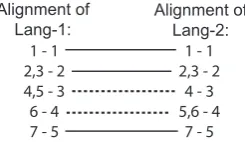
In addition to 1-to-1 substitution all N-to-M pairs are also considered up to a predefined limit (in our implementation – 10 by default). This enables detecting matching units even if the segmentation level is very different in the two corpora (e.g. matching together paragraphs and sentences).
3.2. Approximate Sentence Matching
(Kaalep and Veskis, 2007) use Levenshtein distance and check whether the distance between two sentences doesn’t exceed 1% of the average length of the two sentences. Other string similarity metrics applied to written text in-clude several from the edit distance family (the Needleman-Wunsch metric, the Smith-Waterman metric, etc), the Jaro metric and others.
In the current work we adopt the method from (Kaalep and Veskis, 2007), but use generalized edit distance instead of Levenshtein distance. For instance the weight of replac-ing/inserting digits is extremely high, so that e.g. sentences “article 3” and “article 5” will not be considered to match with no matter what edit distance percentage threshold. On the other hand operations on empty symbols (spaces, tabs) and punctuation have low weights. This allows to set the percentage threshold higher without adding obvious match-ing errors. Also character case is ignored durmatch-ing compari-son.
3.3. Comparison of Separate Language Alignments
As soon as the language part alignments are obtained, their correspondence is to be determined. Although different language parts are to be compared here, only the alignments between unit numbers are compared, which again enables using direct comparison. In this case is accomplished again using edit distance, but this time with the simple Leven-shtein distance of the alignment cells. Thus equality of the alignment elements indicates matching alignments while 1-to-1 inequality or 1-to-0/0-1-to-1 matches indicate mismatch-ing alignments.
It is important to note that a mismatch between two align-ments doesn’t indicate, which of the corpora has an erro-neous alignment; instead, it shows a potential spot, where at least one of the corpora has an error. In order to be used in automatic error correction, this setup requires that one of the corpora is preliminarily assumed to be more accurate. Alternatively, the spots can be manually post-processed, thus seeing which of the corpus contains the error and cor-recting it.
On the other hand a match between alignments also merely indicates that the two corpora have matching alignments. This can occur both in case of correct alignments and coin-ciding erroneous alignments, though the latter is less likely (depending on the used alignment method).
3.4. Implementation
After the sentence pairs get aligned it is still necessary to define the policy for sentence inclusion/exclusion from the resulting combined corpus. In the current implementation it is controlled by the user. It is possible to configure sepa-rately, whether to include sentences present in only one of the corpora, and the ones that match in both corpora.
In case of errors it is possible to include sentences from ei-ther one or the oei-ther corpora – in case one of the corpora is preliminarily known to contain less alignment errors. Al-ternatively it is possible to use one of the language-specific alignments or exclude the location of the error as a whole. Logging of the alignments and error types is also supported. This enables error detection, and thus later human inspec-tion and corpora post-processing.
The implementation is done in PERL and is available on-line4.
4.
Experiment-1: Combining Partially
Overlapping Corpora
In this experiment we processed the overlapping parts of Hunaligned JRC-Acquis and UT; we used the older ver-sion (2.2) of JRC-Acquis as the newer (3.0) doesn’t include the Hun-Align alignments yet, and the Vanilla alignment is much less accurate (Kaalep and Veskis, 2007).
The aim here was to obtain a common corpus with maxi-mum size; therefore both the matching and the unique sen-tences were included from both input corpora. In order to include some sentences from alignment mismatches, it was necessary to decide which corpus was more accurate to use it as an error guideline. According to (Kaalep and Veskis, 2007) the potential error locations in the HunAlign version of JRC-Acquis are the 0 to N alignments, their predecessors and successors; all these were removed from the corpus and enhanced version was used.
In addition a second corpus was generated with only the matching sentences included and single and mismatched sentences left out. This would result in a smaller but much more accurate corpus – i.e. maximum accuracy in contrast to the maximum size of the first desired result.
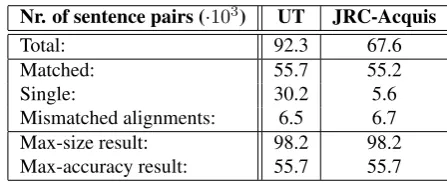
Nr. of sentence pairs (·103) UT JRC-Acquis
Total: 92.3 67.6
Matched: 55.7 55.2
Single: 30.2 5.6
Mismatched alignments: 6.5 6.7
Max-size result: 98.2 98.2
Max-accuracy result: 55.7 55.7
Table 1: Output statistics of processing UT and JRC-Acquis
Results
The two resulting corpora were made available online to-gether with the implementation of the introduced method. The output statistics of the processing results are showed in table 1.
Excluding the potentially erroneous alignments from JRC-Acquis reduced the number of sentences to 93% of the orig-inal. However, after processing the enhanced JRC-Acquis size was 102% of the original (111% of the reduced cor-pus). The size of the enhanced UT was 103% of the orig-inal. The size of the overlapping part grew to 106% of the
UT part and 145% of the JRC-Acquis part. In total the re-sulting combined corpus size was 193% of UT and 161% of JRC-Acquis.
Based on the results in table 1, 60% of the UT sentences match with 82% of the JRC-Acquis sentences. The size of the maximum accuracy corpus is only slightly larger for JRC-Acquis than the matched sentences counted sep-arately, which means that in the majority of cases the seg-mentation was deeper in UT.
It is theoretically possible that the matched sentence pairs include erroneous alignments; however in the current ex-periment a small randomly selected portion of the output was manually checked and no errors were discovered.
Match type Nr. of occurrences
0-1 5621
1-0 30186
1-1 54723
1-2 59
2-1 426
2-2 1
3-1 5
Table 3: Types of sentence pair matches between UT and JRC-Acquis
Table 3 summarizes the types of matched alignments in the results (an N-M type means N sentence pairs in UT cor-responding to M sentence in JRC-Acquis). These confirm both that the segmentation level in UT is slightly deeper (since there’s more N-1 alignments than the other way around) and that the paragraphs of JRC-Acquis often con-tain only 1 sentence (since 1-1 alignments dominate).
5.
Experiment-2: Comparing Different
Alignments of the Same Corpus
In the second set of experiments the introduced method was applied to different alignments of the same parts of JRC-Acquis. The processed parts included three language pairs: English-Estonian, English-Latvian and Estonian-Latvian (unless otherwise specified, we further refer to these in the given order). The aim was to compare the different align-ments and try to get a notion of the corpus accuracy; there-fore no common corpora was generated.
Results
The results are displayed in table 2. The Estonian-Latvian part has a much higher percentage of matching sentences than the other two parts: 98% in both HunAlign and Vanilla versions versus 83% in the HunAlign and 86% – in the Vanilla version. It is possible that the Estonian-Latvian part contains much more coinciding errors, which would also cause the matching part to be larger. However a more de-sired explanation would be that this part is aligned more accurately.
In order to make sure we performed manual proofing of the results by randomly picking some files and checking whether the matching sentences reside in correct
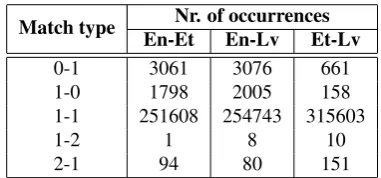
align-Match type Nr. of occurrences En-Et En-Lv Et-Lv
0-1 3061 3076 661
1-0 1798 2005 158
1-1 251608 254743 315603
1-2 1 8 10
2-1 94 80 151
Table 4: Types of sentence pair matches between HunAlign and Vanilla versions of JRC-Acquis
ments and that mismatching sentences really include an alignment error5.
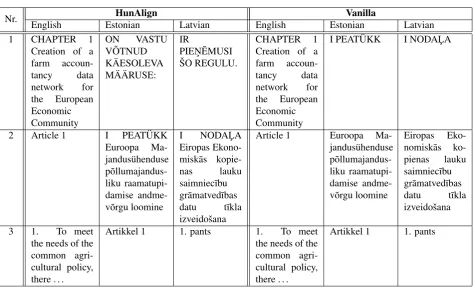
None of the manually checked files contained coinciding errors in the Estonian-Latvian parts; in the other two parts mostly some two Estonian or Latvian sentences were er-roneously grouped into one. An extract from the corpora (parts of documents with the CELEX number 31965R0079) along with the program output is displayed in figure 4 Table 4 summarizes the types of matching sentence pair alignments in all three experiments. Expectedly, most of the alignments are one-to-one, with rare two-to-one in-stances.
6.
Conclusions and Future Work
We presented a method of automatic processing of over-lapping parallel corpora. The method enables comparing corpora and finding mismatches in alignments, improving corpora quality both automatically and manually via post-processing and combining the input into a common corpus without including duplicate entries. The method is insen-sitive to minor differences in the aligned sentences, or to large sections missing from one of the corpora. It also takes into consideration possible differences in the level of seg-mentation.
A set of experiments of applying the method to the JRC-Acquis corpus was described. In the first experiment the Estonian-English part was combined with the parallel cor-pus of the University of Tartu. The results show that the latter has a higher level of segmentation but sometimes slightly lower alignment accuracy. Two common corpora were generated, based on the two: one with the maximum-size criterion (193% of the UT corpus and 161% of JRC-Acquis) and another with the maximum-accuracy criterium (60% and 80% of the overlapping parts of the UT and the JRC-Acquis corpora, respectively).
In the rest of the experiments the method was applied to the two alternative alignment versions of the JRC-Acquis: the HunAlign and the Vanilla version. Language pairs be-tween three languages were tested: English, Estonian and Latvian. The results show that the Estonian-Latvian part of the corpus has a much higher number of matching sen-tence pairs (98% of both versions), which indicates good alignment quality.
Future work has several possibilities. Since the experiments were applied to the older version of JRC-Acquis, it would
5Special thanks to Zane Fishele for proofing the
Nr. of sentence pairs(·103) English-Estonian English-Latvian Estonian-Latvian
HunAlign Vanilla HunAlign Vanilla HunAlign Vanilla
Total: 301.6 295.2 304.0 295.7 322.4 321.6
Matched: 251.8 251.7 254.9 254.8 315.9 315.7
Single: 1.8 3.1 2.0 3.1 0.2 0.6
Mismatched alignments: 48.1 40.4 47.1 37.8 6.4 5.2
Table 2: Output statistics of processing UT and JRC-Acquis
Nr. HunAlign Vanilla
English Estonian Latvian English Estonian Latvian
1 CHAPTER 1
Creation of a farm accoun-tancy data network for the European Economic Community
ON VASTU
V ˜OTNUD K ¨AESOLEVA M ¨A ¨ARUSE:
IR
PIEN¸ ¯EMUSI ˇSO REGULU.
CHAPTER 1 Creation of a farm accoun-tancy data network for the European Economic Community
I PEAT ¨UKK I NODAL¸ A
2 Article 1 I PEAT ¨UKK Euroopa Ma-jandus¨uhenduse p˜ollumajandus-liku raamatupi-damise andme-v˜orgu loomine
I NODAL¸ A Eiropas Ekono-misk¯as kopie-nas lauku saimniec¯ıbu gr¯amatved¯ıbas datu t¯ıkla izveidoˇsana
Article 1 Euroopa Ma-jandus¨uhenduse p˜ollumajandus-liku raamatupi-damise andme-v˜orgu loomine
Eiropas Eko-nomisk¯as ko-pienas lauku saimniec¯ıbu gr¯amatved¯ıbas datu t¯ıkla izveidoˇsana
3 1. To meet the needs of the common agri-cultural policy, there . . .
Artikkel 1 1. pants 1. To meet the needs of the common agri-cultural policy, there . . .
Artikkel 1 1. pants
Figure 4: Extract from JRC-Acquis with all three languages and two alignment versions. It can be clearly seen even without knowing the used languages that there is an almost direct correspondence between Estonian and Latvian texts. The first and second pairs of Estonian-Latvian sentences in the Vanilla part match the second pair of sentences in the HunAlign part. On the other hand both the Estonian and the Latvian part form an analogical mismatch with the English part. In this case both the HunAlign and the Vanilla versions of English-Estonian and English-Latvian parts contain an alignment errors, however different ones
be interesting to process the newer and larger version of the corpus; this however requires the new HunAlign version to be released. Also the OPUS and Hunglish corpora can be experimented with.
Also the results of the first experiment can be used to manu-ally post-process the corpus to correct the erroneous align-ments.
Finding the corpus parts with common source documents is an open issue in the general case.
7.
References
H.-J. Kaalep and K. Veskis. 2007. Comparing parallel cor-pora and evaluating their quality. InProceedings of MT Summit XI, pages 275–279, Copenhagen, Denmark. P. Koehn. 2005. Europarl: A parallel corpus for statistical
machine translation. InProceedings of MT Summit X, Phuket, Thailand.
R. Steinberger, B. Pouliquen, A. Widiger, C. Ignat, T. Er-javec, D. Tufis¸, and D. Varga. 2006. The jrc-acquis: A multilingual aligned parallel corpus with 20+ lan-guages. In Proceedings of LREC’2006, pages 2142– 2147, Genoa, Italy.
J. Tiedemann and L. Nygaard. 2004. The opus corpus – parallel & free. In Proceedings of LREC’2004, pages 1183–1186, Lisbon, Portugal.