Vol.7 (2017) No. 5
ISSN: 2088-5334
Comparative Study of Different Window Sizes Setting in Median
Filter for Off-angle Iris Recognition
Rohayanti Hassan
#, Shahreen Kasim
*, Nurazrin Mohd Esa
#, Zalmiyah Zakaria
# #Faculty of Computing, Universiti Teknologi Malaysia, 81310 Johor Bharu, Johor, Malaysia E-mail: [email protected]
*
Soft Computing and Data Mining Centre, Faculty of Computer Science and Information Technology, Universiti Tun Hussein Onn, Johor, Malaysia
Abstract—Iris recognition is one of the most popular biometric recognition that has increased in the number of acceptance user
gradually because of the reliability and accuracy provided by this system. However, this accuracy is highly correlated with the quality of iris image captured. Thus, a poor quality of the image captured required an enhancement technique. This study aims to identify the optimum window size for the median filter. Identifying the optimum window size setting required template matching value result of the off-angle iris recognition. The lowest value obtained showed that the window size applied was optimized. The result of this study demonstrated, for WVU-OA dataset for 15 degrees off-angle iris of right and left eyes, the window size of [5 5] and [7 7] respectively are optimum to maximize the median filter function. Meanwhile, for 30 degrees off-angle iris of right and left eyes data, the optimum windows size proposed are [7 7] and [5 5] respectively. On the other hand, analysis using UBIRIS dataset showed that the optimum window size for 30 degrees off-angle iris, both right and left eye is [7 7] which is able to maximize the performance of the median filter. In conclusion, the effective value to be applied to all dataset are [5 5] and [7 7] because in most cases it provides a better template matching compared to without applying the filtering method.
Keywords— optimum window size; median filter; off-angle iris recognition
I. INTRODUCTION
In computer science, biometric authentication is used as a form of identification and access control. It is also used to identify individuals in a group that are under surveillance. For example in the mid-19th century, a chief of the criminal identification division of the police department in Paris has developed and then practiced the idea of using a number of body measurements to identify criminals [1]. Besides that, the purpose of biometric authentication is to ensure that the rendered services are accessed only by a legitimate user and no one else. To date, all the important account for an example social network such as Facebook and also financial account such as bank account used the password as ways to access the service. This actually quite risky because as a human we tend to forget easily and choose to use the simple password. Furthermore, password authentication solely leads to fraud occurrence.
Hence, the improvement of the safety and security of information can be achieved by using the biometric authentication widely. Human has used physical and behavioral characteristics such as the face, voice, and gaits to recognize each other for a thousand of years. The
biometric term comes from the Greek words bios (life) and metrikos (measure) where biometric recognition means that any measure from alive things is used as to replace the common password [2]. There are many types of biometric-based on most common traits described in Proença such as Ear, hand geometry, fingerprint, finger geometry, facial thermography, gait, retina, iris, and others [3]. However, the iris is the most stable and reliable and well known as one of the most outstanding biometric technologies [3]. According to Huang and Chen [4], there are several reasons why iris pattern is the most popular iris recognition. First is due to the formation of iris that possess the uniqueness as the fingerprint as where each iris different from others including left and right iris by the same individual. Aqueous humor and cornea protected the iris make it very impossible to be modified by surgical without any risk arise. Moreover, iris recognition is a non-invasive process which will not bring any damage to the identifier.
noise such as reflection, occlusion by eyelids and eyelashes and off-angle iris position. The non-cooperative environment is a situation when individual freely pass the camera such as surveillance camera without restricted rule. Hence, to process such a poor quality of image required an enhancement phase in order to improve the quality of the image captured. One of widely used of enhancement technique is a median filter. The median filter is used to remove the noise pixels present in the image. However, median filter performance depends on the window size setting. The previous study did not justify the reason for choosing that window size setting.
Therefore, this study has motivated to identify and propose the optimum window size setting for median filter optimization function by analyzed and categories the median filter’s parameter setting used in iris recognition from publish paper and implement the algorithm of finding the optimum window size for median filter for each category off-angle WVU-OA data increase the accuracy of iris recognition system.
Non-ideal iris recognition contributed to various problems such as insufficient contrast, unbalanced illumination, out-of-focus, motion blur, specular reflections and partial area affect the performance of iris recognition systems [5]. Off-angle iris image is one of the problem in non-ideal iris recognition [6]. According to Porenca [3], off-angle iris
image occurred as a result of rotation of the subjects head and eyes and the captured iris not aligned with the imaging direction. Usually, the off-angle images have an elliptical shape for the region corresponding to the iris. This off-angle image required more complex process due to the degree off-axis increased that later lead the recognition rate went down [6]. Furthermore, the off-angle image usually contains a noise such as obstruction by eyelids and eyelashes, lighting and specular reflection, poor focus image, motion blur image and others [3]. Those noises need to be filtered in order to improve the accuracy of iris recognition.
Table 1 shows an example of a database that provides the off-angle iris image. There are not many public and free databases that available for the off-angle iris image. WVU off-angle iris image is one of the most commonly used for off-angle iris dataset because it is publicly and freely available on a website. Besides, the quality of the iris image is better compared to the UBIRIS dataset. Examples of the researcher that used the WVU off-angle dataset are Abhyankar et al. [7], Zuo et al. [5], and Stephanie et al. [8]. All those studies have focused on iris recognition for off-angle iris image. However, there are also private off-off-angle iris images that had been produced by the university to study the iris recognition such as VITT, MAE, and UTMIFM.
TABLE I
DATABASE THAT PROVIDES THE OFF-ANGLE IRIS IMAGE DATASET
Dataset Description Remarks
WVU Off-angle
• Consist of 560 images representing 140 different classes. • Resolution is 720x576.
• Each class has 2 frontal images and 1 image in 15 and 30 degrees. • Off-angle iris image.
• Non-cooperative image.
Public and Free database.
Q-FIRE
• Face and iris video obtained by video recorded from 5 to 25 feet distance,
• Contain various image degradation such as out-of-focus, motion blur and eye angle variation.
• After iris region extraction, there are 24800 iris image and 180 class in total. • Non-cooperative image.
Private database.
UTMIFM
• Consist of Asian with different ethnics and student of UTM.
• Non-cooperative iris image is off-angle with angle variation between (0 to 45 degree) with right and left offset and also rotated-ellipse off-set angle.
• Non-cooperative environment.
Private database.
UBIRIS
• Comprised 1877 image from241 subject from the University of Beira Interior. • Noisy iris image database.
• Non-cooperative image.
Public and Free database.
MAE
• Iris image collected at MAE, India.
• From 100 subjects with 5 image each for left and right subject. • Total 1000 image from 200 classes.
• Uncontrol dataset.
• Collected at the dark room to avoid reflection and illuminated using a bank of infra-red LEDs.
Private database.
VITT
• Collected at Vishvarkarma institute of Information Technology, India. • Total of iris image is 2000 image coming from 200 class.
• Contain off-angle image for 10 different angles starting from 0 to 45 degree with a resolution of 5.
Private database.
THUIris
• Contain 185 iris images.
• Contain image of irregular iris boundaries caused by pupil deformation and off-axis aims.
• Contain noise such as eyelids and eyelash occlusion and specular reflection.
Private database.
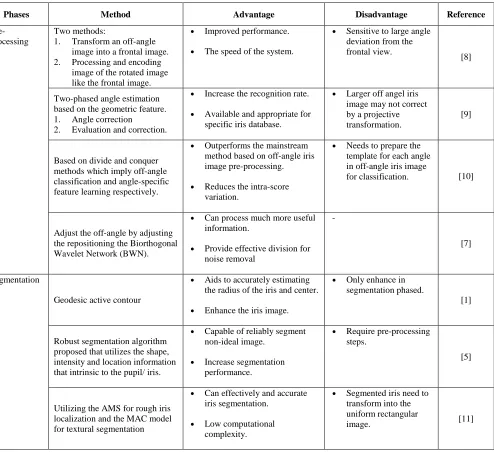
Table 2 shows the summarized of several researchers that have done their study in off-angle iris recognition. Most of the researchers focus on pre-processing and segmentation phased for off-angle iris recognition. This is because the
difficulty in capturing iris images with no offset [7]. So, it becomes a necessity to account for off-angle information in order to maintain robust performance.
TABLE II
A SUMMARY ON OFF-ANGLE IRIS RECOGNITION
Phases Method Advantage Disadvantage Reference
Pre-processing
Two methods:
1. Transform an off-angle image into a frontal image. 2. Processing and encoding
image of the rotated image like the frontal image.
• Improved performance.
• The speed of the system.
• Sensitive to large angle deviation from the frontal view.
[8]
Two-phased angle estimation based on the geometric feature. 1. Angle correction
2. Evaluation and correction.
• Increase the recognition rate.
• Available and appropriate for specific iris database.
• Larger off angel iris image may not correct by a projective transformation.
[9]
Based on divide and conquer methods which imply off-angle classification and angle-specific feature learning respectively.
• Outperforms the mainstream method based on off-angle iris image pre-processing.
• Reduces the intra-score variation.
• Needs to prepare the template for each angle in off-angle iris image
for classification. [10]
Adjust the off-angle by adjusting the repositioning the Biorthogonal Wavelet Network (BWN).
• Can process much more useful information.
• Provide effective division for noise removal
-
[7]
Segmentation
Geodesic active contour
• Aids to accurately estimating the radius of the iris and center.
• Enhance the iris image.
• Only enhance in segmentation phased.
[1]
Robust segmentation algorithm proposed that utilizes the shape, intensity and location information that intrinsic to the pupil/ iris.
• Capable of reliably segment non-ideal image.
• Increase segmentation performance.
• Require pre-processing steps.
[5]
Utilizing the AMS for rough iris localization and the MAC model for textural segmentation
• Can effectively and accurate iris segmentation.
• Low computational complexity.
• Segmented iris need to transform into the uniform rectangular
image. [11]
Mostly researcher aims to transform the off-angle iris image into the frontal image by improving method in a pre-processing. Stephanie et al. [8] had proposed the method that processes the non-ideal image into two steps which are compensation for off-angle gaze direction, processing and encoding of the rotated image. To estimate the gaze direction, Daugman’s integrodifferential operators had been used. Yang et al. [9] also estimated the angle and corrected the angle for further analysis. However, Li et al. [10] had proposed a classification technique to transform the off-angle image into the frontal image by using the template as a reference and applied the feature learning. Segmentation and feature extraction are two main parts in the image processing
study [18] [19]. Segmentation is one of the important phases in the iris recognition system. Ross et al. [1] employ Geodesic Active Contour (GAC) in the segmentation phase in order to extract the iris from the surrounding structures. GAC models improved the performance by obviates the need to approximates the boundary by using conics. This aids in fitting a tight boundary around the iris. Besides that, Chen et al. (2011) and Zuo et al. [5] also proposed their owns method to improve the segmentation parts in off-angle iris recognition.
localization and MAC model for textural segmentation. These methods had successfully improved the boundary detection capability. Zuo et al. [5] also proposed the method that needs the utilizing the shape, intensity and localizing information that is intrinsic to the pupils or iris. This proposed method aims to deal with the non-ideal iris image that usually affected by specular reflection, blur, lighting variation and off-angle image. These methods are popular as methods that reliable for segmentation phased.
As a conclusion, the off-angle iris image needs more steps of processing compared to ideal and quality iris image. There are many methods that had been introduced to deal with the off-angle image. There are some researchers that like to process the image at the pre-processing stage which deals with transforming the image into frontal image and used the establish segmentation methods to localize the images.
The remainder of this paper is organised as follows. In Section II, the proposed algorithms are discussed in detail. Section III presents the analysis and the discussion of the experimental results. Finally, Section IV summarises the future work and conclusion.
II. MATERIAL AND METHOD
WVU-OA database is used in this study and contains off-angle iris as a noise found in the eye image. WVU-OA dataset can be acquired upon request at Clarkson University website. This database consists of two types of device used for collecting the off-angle data which are Sony Cyber Shot DSC F717 and black and white, monochrome camera. This study used the iris dataset collected by using the monochrome camera. The image only was taken in one session and contain only 79 subjects. Each subject consists of left and right image for four angles which 0, 15, 30, 0 off-angle.
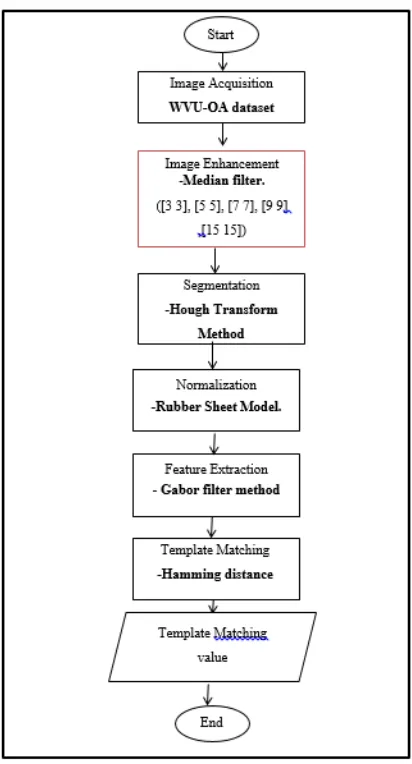
Fig. 1 presents the proposed framework for off-angle iris recognition in this study. Off-angle iris recognition refers as a process of automatic authentication of an individual based on off-angle iris; eye image captured the result of non-cooperative environment. This section describes in details about the off-angle iris recognition proposed framework that aims to identify the template matching value. According to Masek [13], iris recognition consists of five main phases which are image acquisition, iris segmentation, iris normalization, feature extraction and encoding and template matching. For this study, only five subjects were chosen based on the quality of the image that consists left and right and four angles data. The distance between eye and camera capture is four inches in an indoor environment.
There are four window size settings acquired from the published paper, and one addition choose as an outlier. The window size were [3 3], [5 5], [7 7], [9 9] and [15 15]. Hence, a total of five windows size settings were tested with WVU-OA dataset in order to achieve the aim and objectives of the study. This dataset can be categorized into four classes which are 15 and 30 degrees off-angle for respective left and right eye. The left and right eye are differed in iris pattern even for similar individual eyes [12]. Template matching value was used as a performance measurement which represented the dissimilarity between the template eye and captured the eye. In order to obtain the template matching
value need to run the full of the iris recognition algorithm [13]. Next, for all dataset, this algorithm has been run and compared. The lowest average of hamming distance produce is select as optimize windows size.
A. Median Filter Setting
The median filter is a windowed filter of non-linear that is used to improve the quality of the image. According to Nodes et al. [14], linear filter is easy to implement and offer excellent performance in most cases and also used frequently as primary tools for signal processing. One of the most popular linear filter known as a median filter. Furthermore, a median filter can be used to eliminate the impulse noise and able to handle the problem of linear filter that usually bulky and slows processing.
Median filters also can reduce the salt and pepper noise and some cases it can suppress the speckle noise based on the research done in image processing previously. Besides, the median filter also has the ability to preserve the edges under the certain condition. Hence, this filter is widely used in image processing. The median filter is an algorithm design based on the window size setting. The windows size setting function to group the pixels based on size apply into same windows. Generally, median filter aims to reduce the noise present in the image by converting the pixels with median value. So, the pixels are not outlier pixels which usually represent noise.
The median filter is a very simple algorithm that easy to implement and understand. Three main steps are i) sort the pixels in the same group, ii) followed by identifying the middle value and iii) changes the pixels in the same windows into the middle value. Fig 2 shows the pseudo-code of the median filter.
In order to optimize the usage of the median filter, identifying the optimum windows size setting is important. Ahmed et al. [15] claimed that windows size gives a bigger impact on the filtering method. Based on the previous study, the window size of the median filter starting with [3 3] and increased by 2 such as [5 5], [7 7], [9 9] and others. However, Ahmed et al. [15] only test the windows size from [3 3] until [9 9] only for digital image processing. To identify the optimum window size, the off-angle iris was run for different window sizes setting to acquire the template matching value for each dataset. Next, from this template matching value, the comparison was made to identify the lowest template matching value which represents the best setting. Then, these steps were repeated for each dataset.
III.RESULTS AND DISCUSSION
dataset. From this table, for category 1 and 4, the optimize window size is [7 7], while category 2 and 3 is [5 5]. Then, this algorithm run for UBIRIS dataset, and the result is present in Table 4. The result shows that the optimize windows size setting for category 3 and 4 is [7 7] while in 1 is [5 5] and 2 is [3 3].
Fig. 1 OFF-angle iris recognition framework
Fig. 2 Pseudo-code for median filter
TABLE III
THE TEMPLATE MATCHING VALUE BASED ON WINDOW SIZE OF WVU-OA DATASET
Window Size 1 2 3 4
Without filter 0.4406 0.4183 0.5938 0.5766
[3 3] 0.4383 0.4056 0.5918 0.5719
[5 5] 0.4251 0.4035 0.5196 0.5246
[7 7] 0.4123 0.4119 0.5339 0.4941
[9 9] 0.4345 0.4451 0.5334 0.5446
[15 15] 0.4550 0.4567 0.5942 0.5519
TABLE IV
THE TEMPLATE MATCHING VALUE BASED ON WINDOW SIZE FOR UBIRIS DATASET
Window Size 1 2 3 4
Without filter 0.5895 0.5610 0.5644 0.5829
[3 3] 0.5774 0.5228 0.5270 0.5905
[5 5] 0.5527 0.5357 0.5420 0.5625
[7 7] 0.5346 0.5377 0.5064 0.5443
[9 9] 0.5818 0.5262 0.5230 0.5416
[15 15] 0.5894 0.5678 0.5863 0.5807 Where:
1 15 degrees Off-angle iris, Left eye 2 15 degrees Off-angle iris, Right eye
3 30 degrees Off-angle iris, Left eye
4 30 degrees Off-angle iris, Right eye
The performance of this median filter is highly correlated with the window size setting applied. Five window size, namely [3 3], [5 5], [7 7], [9 9] and [15 15] were tested to identify the best setting by identifying the template matching value. The result shows that each eye image has their own windows size setting for each category. However, based on the average template matching result for all dataset of each category, window size [7 7] and [5 5] were dominance for all category. All data shows an improvement in matching when enhancing with a median filter of this window size. The result of the template matching for UBIRIS dataset also shows the dominance of this window size setting. Therefore, this window size is suggested to other researchers that aims to enhance the image by applying the median filter. Window size [7 7] had been applied by Kumar and Parsi [16] in pre-processing and normalization process to smooth the image acquired that contains the reflection from the illumination source. Yadav [17] had used window size [5 5] for filtering noise purpose. Hence, this support that those setting was optimized for the median filter.
IV.CONCLUSIONS
Identifying the suitable and optimum window size is important when applying the median filter. Non optimal windows setting can affect the result of template matching became worse and failed to identify the right person. Hence, this study focuses on identifying the correct and optimize window size suitable for the off-angle eye images dataset. The result of this study found that the window size setting [5 5] and [7 7] are the most optimized setting that gave the better result in template matching. This study can be extended by identifying the effect of different race and nationality of the individual in iris recognition system. In future development, this research could be enhanced by referring to various other works available such as [20]-[29].
ACKNOWLEDGMENT
This research was funded by GUP UTM grant, Vot No: 4C073. Also many thanks to collaborative sponsor, GATES Scholars Foundation of GATES IT Solution Sdn. Bhd. Company.
REFERENCES
active contours,” Symp. Spec. Sess. Res. …, 2006.
[2] S. Prabhakar, S. Pankanti, and A. K. Jain, “Biometric recognition: Security and privacy concerns,” IEEE Secur. Priv., vol. 1, no. 2, pp. 33–42, 2003.
[3] H. Proença, “Towards non-cooperative biometric iris recognition,” Univ. Beira Inter. Dep. Comput., 2006.
[4] Y.-P. H. Y.-P. Huang, S.-W. L. S.-W. Luo, and E.-Y. C. E.-Y. Chen, “An efficient iris recognition system,” Proceedings. Int. Conf. Mach. Learn. Cybern., vol. 1, no. November, pp. 4–5, 2002.
[5] J. Zuo, N. A. Schmid, and X. Chen, “On generation and analysis of synthetic iris images,” IEEE Trans. Inf. Forensics Secur., vol. 2, no. 1, pp. 77–90, 2007.
[6] A. Abhyankar and S. Schuckers, “Iris quality assessment and bi-orthogonal wavelet based encoding for recognition,” Pattern Recognit., vol. 42, no. 9, pp. 1878–1894, 2009.
[7] A. Abhyankar and S. Schuckers, “Novel Biorthogonal Wavelet based Iris Recognition for Robust Biometric System,” Pattern Recognit., vol. 2, no. 2, pp. 233–237, 2010.
[8] S. A. C. Schuckers, N. A. Schmid, A. Abhyankar, V. Dorairaj, C. K. Boyce, and L. A. Hornak, “On techniques for angle compensation in nonideal iris recognition,” IEEE Trans. Syst. Man, Cybern. Part B Cybern., vol. 37, no. 5, pp. 1176–1190, Oct. 2007.
[9] T. Yang, J. Stahl, S. Schuckers, F. Hua, C. B. Boehnen, and M. Karakaya, “Gaze angle estimate and correction in iris recognition,” in IEEE Workshop on Computational Intelligence in Biometrics and Identity Management, CIBIM, 2015, vol. 2015–Janua, no. January, pp. 132–138.
[10] Y.-H. Li and M. Savvides, “An Automatic Iris Occlusion Estimation Method Based on High Dimensional Density Estimation,” IEEE Trans. Pattern Anal. Mach. Intell., vol. 35, no. 4, pp. 1–1, 2012. [11] R. Chen, X. R. Lin, and T. H. Ding, “Iris segmentation for
non-cooperative recognition systems,” IET Image Process., vol. 5, no. May 2010, pp. 448–456, 2011.
[12] P. a. (2010). Sheela, S. V, and Vijaya, “Iris Recognition Methods - Survey,” Int. J. Comput. Appl., vol. 3, no. 5, pp. 19–25, 2010. [13] L. Masek, “Recognition of Human Iris Patterns for Biometrics
Identification,” p. 61, 2003.
[14] T. A. Nodes and N. C. Gallagher, “Median Filters: Some Modifications and Their Properties,” IEEE Trans. Acoust., vol. 30, no. 5, pp. 739–746, 1982.
[15] M. N. Ahmed, S. M. Yamany, N. Mohamed, A. A. Farag, and T. Moriarty, “A modified fuzzy C-means algorithm for bias field estimation and segmentation of {MRI} data,” IEEE Trans., vol. 21, pp. 193–199, 2002.
[16] A. Kumar and A. Passi, “Comparison and combination of iris matchers for reliable personal authentication,” Pattern Recognit., vol. 43, no. 3, pp. 1016–1026, 2010.
[17] H. Rai and A. Yadav, “Iris recognition using combined support vector machine and Hamming distance approach,” Expert Syst. Appl., 2014.
[18] R. Nilakant, H. P. Menon and K Vikram, “A Survey on Advanced Segmentation Techniques for Brain MRI Image Segmentation,” International Journal on Advanced Science, Engineering and
Information Technology, vol 7, no. 4, 2017.
[19] Yuhandri, S. Madenda, E. P. Wibowo and Karmilasari, “Object Feature Extraction of Songket Image Using Chain Code Algorithm,” International Journal on Advanced Science, Engineering and Information Technology, vol 7, no. 1, pp. 235-241, 2017.
[20] U. K. Hassan, N. M. Nawi, and S. Kasim, “Classify a protein domain using sigmoid support vector machine,” in Information Science and Applications (ICISA), 2014 International Conference, IEEE, May. 2014. pp. 1-4.
[21] U. K. Hassan, N. M. Nawi, and S. Kasim, A. A, Ramli, M. F. M., Fudzee, and M. A. Salamat,”Classify a Protein Domain Using SVM Sigmoid Kernel”. In Recent Advances on Soft Computing and Data Mining, pp. 143-151, Springer, Cham.
[22] S., Ismail, R. M., Othman, S., Kasim, R., Hassan, H., Asmuni, and J., Taliba, “Pairwise protein substring alignment with latent semantic analysis and support vector machines to detect remote protein homology”, International Journal of Science and Bio-Technology, Volume 3, Issue 3, 2011, Pages 17-34.
[23] F. M., Abdullah, R. M., Othman, S., Kasim, R., Hashim, R., Hassan, H., Asmuni, and J., Taliba, “An Optimal Mesh Algorithm for Remote Protein Homology Detection”, Communications in Computer and Information Science, Volume 151 CCIS, Issue PART 2, 2011, Pages 471-497.
[24] S., Ismail, R. M., Othman, S., Kasim, R., Hassan, H., Asmuni, and J., Taliba, “Pairwise protein substring alignment with latent semantic analysis and support vector machines to detect remote protein homology” Communications in Computer and Information Science,Volume 151 CCIS, Issue PART 2, 2011, Pages 526-546. [25] F. M., Abdullah, R. M., Othman, S., Kasim, R., Hashim, R., Hassan,
H., Asmuni, and J., Taliba, “An Optimal Mesh Algorithm for Remote Protein Homology Detection”, International Journal of Bio-Science and Bio-Technology, Volume 3, Issue 2, June 2011, Pages 13-38.
[26] S., Kasim, M. F. M., Fudzee, S., Deris, S., and R. M., Othman, “Gene Function Prediction Using Improved Fuzzy c-Means Algorithm”, In Information Science and Applications (ICISA), 2014 International
Conference on (pp. 1-4). IEEE.
[27] S., Kasim, S., Deris, S., and R. M., Othman, “Multi-stage filtering for improving confidence level and determining dominant clusters in clustering algorithms of gene expression data”, Computers in biology
and medicine, 43(9), 1120-1133, 2013.
[28] S., Kasim, S., Deris, S., and R. M., Othman, “A new computational framework for gene expression clustering”, In International
Conference on Advanced Data Mining and Applications (pp.
603-610). Springer, Berlin, Heidelberg, 2010.
[29] R., Roslan, R.M., Othman, Z. A., Shah, S., Kasim, H., Asmuni, J., Taliba, R., Hassan, and Z., Zakaria, "Incorporating multiple genomic features with the utilization of interacting domain patterns to improve the prediction of protein–protein interactions", Information