es
ig
n
a
n
d
E
ffe
ct
iv
en
es
s o
f a
s
er
io
u
s G
am
e
fo
r C
h
ild
re
n
w
ith
A
D
H
D
K
IM
C
.M
. B
U
L
Design and
Effectiveness of
a serious Game
for Children
with ADHD
KIM C.M. BUL
Design anD effectiveness of a serious game for chilDren with aDhD
Kim Cornelia Marie-Louise Bul Copyright © 2016, Kim C. M. Bul
Cover and lay-out: B-Total; Optima Grafische Communicatie B.V. Print: Optima Grafische Communicatie B.V.
ISBN: 978-90-77597-09-1
All rights reserved. No part of this dissertation may be reproduced or transmitted in any form, by any means, electronical or mechanical, without the prior written permission of the author, or where appropri-ate, of the publisher of the articles.
Johnson & Johnson is the funding source for game development. Johnson & Johnson provided funding for performing the pilot study and Randomised Controlled Trial. Flanders’ care provided funding for perform-ing the Randomised Controlled Trial (DEM2012-02-07) at the University Hospital Gasthuisberg (Belgium).
for chilDren with aDhD
Ontwerp en effectiviteit van een serious game voor kinderen met ADHD
Proefschrift
ter verkrijging van de graad van doctor aan de Erasmus Universiteit Rotterdam
op gezag van de rector magnificus prof.dr. H.A.P. Pols
en volgens besluit van het College voor Promoties. De openbare verdediging zal plaatsvinden op
17 februari 2017 om 13.30 uur Kim Cornelia Marie-Louise Bul
Promotor: Prof.dr. I.H.A. Franken
overige leden: Prof.dr. F.C. Verhulst
Prof.dr. C. van der Heiden Prof.dr. P.M. Kato
copromotoren: Dr. A. Maras
Abbreviations 6
1 General introduction 7
2 Development and user satisfaction of “Plan-It Commander”, a serious game for children with ADHD.
17 3 Effectiveness of an initial prototype serious game for children with
Attention Deficit Hyperactivity Disorder on behavioural outcomes: A pilot Randomised Controlled Trial.
35
4 Behavioural outcome effects of serious gaming as an adjunct to treatment for children with Attention Deficit Hyperactivity Disorder: A Randomised Controlled Trial.
51
5 Neurocognitive effects of serious gaming as an adjunct to treatment for children with Attention Deficit Hyperactivity Disorder: A
Randomised Controlled Trial.
73
6 A serious game for children with Attention Deficit Hyperactivity Disorder: Who benefits the most?
89
7 General discussion 107
8 Dutch summary (Nederlandse samenvatting) 125
Appendix
• Time management questionnaire • Self-efficacy questionnaire 137 138 References 141 Curriculum vitae 157 List of publications 161 Dankwoord 165
abbreviations
ADHD Attention Deficit Hyperactivity Disorder
BRIEF Behavior Rating Inventory of Executive Function
CBT Cognitive Behaviour Therapy
CI Confidence Interval
CD Conduct Disorder
DBDRS Disruptive Behavior Disorder Rating Scale
D-KEFS Delis-Kaplan Executive Function System
DSM-IV-TR Diagnostic and Statistical Manual of Mental Disorders, Fourth Edition, Text Revision
EFs Executive Functions
ES Effect Size
IATQ It’s About Time Questionnaire
IQ Intelligent Quotient
Kiddie-SADS Kiddie-Schedule for Affective Disorders and Schizophrenia
LS Least Squares
MESSY Matson Evaluation of Social Skills with Youngsters
M.A. Master of Arts
MTA Multimodal Treatment of ADHD
NA Not Applicable
NPC Non-Playable Character
ODD Oppositional Defiant Disorder
RCT Randomised Controlled Trial
SCST Social Cognitive Skills Test
SDQ Strengths and Difficulties Questionnaire
SE Standard Error
SG Serious Game
SSRS Social Skills Rating System
TAU Treatment As Usual
TAUx Treatment As Usual cross-over
VT Virtual Twins
Chapter 1
General Introduction
Based on:
Bul, K. C. M., De Ruijter, A. M., Van Wingerden, M., & Maras, A. (2013). Is e-health behandeling binnen de kinder- en jeugdpsychiatrie effectief? Een systematische review van Randomised Controlled Trials. [Is e-health effective within child- and adolescent psychiatry? A systematic review of Randomised Controlled Trials]. Tijdschrift voor Gezondheidswetenschappen, 91, 437-447.
Mental healthcare conditions account for 13% of the global disease burden (Cheek et al., 2015). One of the most common mental disorders in children and adolescents is Attention Deficit Hyperactivity Disorder (ADHD). ADHD is a chronic mental health disorder affecting 3 to 5% of children, adolescents and their families worldwide (Polanc-zyk, Willcutt, Salum, Kieling, & Rohde, 2014). Core symptoms include difficulty staying focused and paying attention, difficulty controlling behaviour, and hyperactivity. ADHD treatment, including medication, behavioural therapy or a combination of treatments, focuses on reducing these ADHD core symptoms (MTA Cooperative Group, 1999a).
However, one of the main limitations of these interventions is a lack of engagement, alongside a lack of time and difficulties in accessing mental healthcare provisions for children and adolescents (Cheek et al., 2015). There appears to be a major gap between treatment needs of the consumers and the availability of service provision. For example, in high income countries 35% to 50% of the people receive no treatment for severe mental disorders and in low income countries this rate is even higher with 76% to 85% of people not getting the treatment that they need (World Health Organization, 2013). One of the reasons for this is that not all potential patients favour or can access existing modes of treatment delivery. eHealth, the application of information- and communica-tion technology to support or improve healthcare, offers possibilities to close this gap between treatment needs of individuals with mental health conditions and provision of care. eHealth improves accessibility of mental healthcare services and can increase patient motivation and treatment adherence (Frutos-Pascual, Zapirain, & Zorrilla, 2014; Kato, Cole, Bradlyn, & Pollock, 2008; Riper, van Ballengooijen, Kooistra, & de Donker, 2013). Furthermore, it is suggested that eHealth can address one of the biggest chal-lenges that may be faced by the mental healthcare sector, namely the costs of service delivery (Riper et al., 2013), because once developed this care is easy accessible and costs less compared to regular treatment provision. Moreover, it provides patients with greater autonomy as they can access the application anywhere, at any time. This fits into the World Health Organization Mental Health Action Plan 2013-2020, which promotes the development and use of accessible user-driven non-pharmacological intervention options for children and adolescents (Cheek et al., 2015; Coleman, Austin, Brach, & Wag-ner, 2009; World Health Organization, 2013).
In this dissertation we focus on the potential value of serious gaming within the broader context of eMental health. We explore whether a serious game has potential to improve daily life behaviour skills of children with ADHD. Describing the design process, evaluating its effects and understanding for which subgroups this intervention tool is most effective contributes to more evidence-based knowledge in ADHD research and may have important clinical implications for treatment.
emental health within chilD anD aDolescent Psychiatry
eHealth within mental healthcare (often referred to as eMental health) creates the possi-bility to receive information confidentially and anonymously, offers 24-hour availapossi-bility of information and support, and convenience of access. Further, eMental health treat-ments can be personalized and interactive by using innovative technologies. One of the main arguments to use eMental health over more traditional methods or interventions is how ubiquitous and familiar technology is for young people, making these applications a comfortable and potentially enjoyable situation (Wong et al., 2007). As such, a growing number of eMental health applications have been developed within child- and adoles-cent psychiatry (Bul, de Ruijter, van Wingerden, & Maras, 2013). However, as for example mentioned by the review of Riper and colleagues (2013), there is a lack of research into the effectiveness and efficacy of these applications. These effectiveness evaluations may lack behind because of lack of funds or expertise available to conduct such evaluation or purely because of a mainly commercial interest in developing eMental health tools. Research in child- and adolescent psychiatry on the effectiveness of eMental health lacks behind compared to research in adult psychiatry. For example, ample research among adults demonstrates that online psychotherapy [based on Cognitive Behaviour Therapy (CBT) principles] is effective in treating anxiety and mood disorders (Andersson & Cuijpers, 2009; Cuijpers et al., 2009). So far, research in child- and adolescent psy-chiatry has been mainly focused on the effectiveness of three sub domains of eMental health, namely telepsychiatry, internet therapy and serious gaming that will be shortly addressed below.
telepsychiatry
Telepsychiatry has been defined as the use of videoconference techniques to deliver mental healthcare services and psychiatric care at a distance. This is especially common in the United States to reach rural areas and urban facilities. Communication is set up through a computer and telecommunication network, in which both the patient as well as the clinician have access to audio- and visual possibilities (Gastmans & Wijnsberghe, 2011; Myers & Cain, 2008). This communication method implies that interaction between clinician and patient is synchronic; there is a minimum amount of reaction time between the patient and clinician. Research on the effectiveness of telepsychiatry for children and adolescents is very limited. Although the use of videoconferencing has been around for over 40 years, most of the clinical literature has been focused on adult patients, related to project descriptions, case reports, satisfaction surveys, or user-experiences (Diamond & Bloch, 2010). There is only a small amount of randomised controlled tri-als (RCTs) available examining the effectiveness of telepsychiatry to deliver care at a distance for patients suffering from depression, tics or obsessive compulsive disorder
(Bul et al., 2013). This often consists of individual sessions of CBT (Bul et al., 2013). On the basis of these studies it appears that telepsychiatry is feasible and at least as effective as face-to-face treatment. Patients report high levels of satisfaction. Although it seems a reasonable alternative for situations in which it is difficult to deliver face-to-face therapy, more research is needed to establish its clinical benefits.
internet therapy
The Internet has become an important source of healthcare and medical information. There is a growing number of sites that are delivering (mental) healthcare interven-tions that patients can use on their own or in combination with face-to-face treatment (Ritterband & Palermo, 2012). A combination of face-to-face treatment and Internet therapy is called blended therapy (Bul et al., 2013). Internet therapy is used to describe the process of interaction between therapist and patient, in which the clinician and patient are situated in different locations and communicate with each other through the Internet (often websites; Manhal-Baugus, 2001). In contrast to telepsychiatry, the interaction between patient and clinicians is not synchronic; this means that there is a longer period of reaction time between the patient and clinician. This fits into the role the therapist has, namely a facilitating and supporting role to increase patient’s self-management (Notenboom, Blankers, Goudriaan, & Groot, 2012). These Internet in-terventions are often based on existing effective behavioural treatments that have been operationalised and transformed for Internet delivery (Ritterband & Palermo, 2012). It is used to offer CBT and self-help programs for example to treat pain, fear and eating disorders thereby improving knowledge, cognitions and training behaviour. There are some randomised controlled studies demonstrating that Internet therapy is as effective as face-to-face treatment or in some cases even superior (Bul et al., 2013). More research is needed to examine its long-term effects. Internet interventions show great promise and may even have some significant advantages over traditional face-to-face therapy. It also has great potential for wide scale dissemination as treatment could be provided to a great number of patients (Ritterband & Palermo, 2012). However, empirical support and validation remains necessary, especially in the field of child- and adolescent psychiatry.
serious gaming
Video games have been most often used as entertainment. However, there is a growing interest in games as a means to educate and train people (Durkin, 2010). Serious Games are games that are focused on transferring knowledge, learning skills and/or changing behaviour in a playful way within an engaging digital game environment (Annetta, 2010). Offering existing training programs with game elements is defined as gamifica-tion (Riper et al., 2013). Learning through play encourages faster, more implicit learn-ing (Prensky, 2005), and digital games in particular have been argued to be especially
motivating, encouraging a greater level of engagement than other activities (Gee, 2003; Graesser, Chipman, Leeming, & Biedenbach, 2009; Prensky, 2007). Existing research ar-gues that serious games are able to encourage learning through three sources, namely immersion, flow and by meeting individual’s needs for mastery, fantasy, challenge and connectedness (Annetta, 2010; Boyle, Conolly, Hainey, & Boyle, 2012; DeSmet et al., 2014; Kapp, 2012; Lu, Baranowski, Thompson, & Buday, 2012). Immersion allows for the player to be engrossed in the game-play and to develop a sense that the proposed experiences are personally relevant, whereas flow creates a sense of concentration through a balance between the challenges presented and the skills of the player, keeping them engaged and interested (Paras & Bizzochhi, 2005).
Children with ADHD are characterised by having more difficulties at school making schedules, by having difficulties to finish assignments on time, problems with executing complex planning tasks and organizing material needed for assignments, remembering task instructions, setting priorities, and making friends (Abikoff et al., 2009; 2013; Barkley, 2006). These executive functions (EFs) and social problems not only affect daily life for the children and their families, but they also predict a poor prognosis of ADHD even into adulthood (Barkley, 2006). Without intervention, functional impairments in these areas endure and escalate into adolescence and adulthood (Abikoff et al., 2004; 2009; 2013; Barkley, 2006; Langberg, Epstein, Becker, Girio-Herrare, & Vaughn, 2012; Storebø, Skoog, Damm, Thomsen, Simonsen, & Gluud, 2011). Motivation appears to play an important role in explaining the problems children with ADHD encounter in daily life (Haenlein & Caul, 1987; Sagvolden, Johansen, Aase, & Russell, 2005;Sergeant, Oosterlaan, & Van der Meere, 1999; Sonuga-Barke, 2003). Recently, studies have found that gaming can optimise motivation and training effects in children with ADHD (Dovis, Van der Oord, Wiers, & Prins, 2012; Prins, Dovis, Ponsioen, Ten Brink, & Van der Oord, 2011). While these children might be less interested in participating in traditional interventions, serious games are seen as a fun activity, and they therefore start the intervention expecting to enjoy it (Sim, McFarlane, & Read, 2006). Offering treatment with game elements as an adjunct to current treatment repertoire can prove an ideal medium for treatment deliv-ery, especially for patients within child- and adolescent psychiatry such as school-aged children with ADHD (Ramdoss et al., 2012; Van der Oord, 2012; Van der Oord, Ponsioen, Geurts, Ten Brink, & Prins, 2014).
serious gaming anD aDhD
One of the groups for which serious games could be specifically appealing and effective is for children and adolescents with ADHD. It is well known that children with ADHD ex-perience motivation deficits and are less stimulated by reinforcement than typically
de-veloping children (possibly due to a dopaminergic deficit) and therefore, under normal conditions, are not motivated enough to function on the same level compared to their typically developing peers (Haenlein & Caul, 1987; Sagvolden et al., 2005; Sergeant et al., 1999; Sonuga-Barke, 2003). Because game approaches help to balance motivating and learning elements and to integrate game goals and behavioural/cognitive challenges, they have the potential to keep these children more motivated and positively engaged in therapy processes. Games are very stimulating and give immediate reinforcement on behaviour (Van der Oord, 2012). Also, despite their poor attention span, distractibility, and difficulty staying on task, children with ADHD often show sustained concentration and engagement when playing digital games (Barkley, 2006). This implies that as long as the game presents adequate challenges, children are willing to spend more time on them than they would do by offering traditional learning methods (Bourgonjon, Valcke, Soetaert, & Schellens, 2010; Squire, 2005).
Therapeutic goals that are pursued in the context of an engaging game environment thus may present an opportunity to improve behavioural learning and outcomes in this population. Although research on the effectiveness of gaming approaches to address daily life functioning of children is limited, several controlled trials of serious games have shown promise of impacting ‘‘real world’’ behaviours (e.g., DeSmet et al., 2014 in popula-tions with varying age and gender; Institute of Digital Media and Child Development Working Group on Games for Health et al., 2016). We developed a serious game inter-vention (called “Plan-It Commander”) for children with ADHD with the aim of teaching them behavioural strategies and reinforcing daily life skills. To our knowledge, a serious game designed to enhance behavioural strategies of children with ADHD to improve their daily life functioning has not been empirically evaluated yet.
Project healseeker
Janssen Pharmaceuticals (a subsidiary company of Johnson & Johnson) initiated the project HealSeeker. This project involved several partner organizations that col-laborated in the game development and effectiveness research. The project served as a ‘proof-of-concept’ to examine how serious games (or game-based interventions) could contribute to patient’s daily life functioning. In this project interdisciplinary meetings were organized to exchange and integrate clinical, research, technical and game design knowledge and experiences. The serious game developer company was mainly respon-sible for designing a game that was educational, attractive and motivating. Furthermore, they took care of the technical implementation and maintenance of the game. In this development process a community board of parents as well as healthcare professionals were involved. Based on their information on deficits of children with ADHD, frequent
problems encountered at home and gaps in the literature [i.e., several computerized working memory training formats (Klingberg et al., 2005) were available but none focus-ing on EFs and social behaviour skills] the learnfocus-ing goals of the game (e.g., improvfocus-ing time management, planning/organizing, and prosocial skills) were proposed. Frequent interactive sessions among the healthcare professionals, researchers, and game design-ers took place to optimise the link between game design elements and behaviour changes principles. Usability research results from children with ADHD were evaluated and incorporated in this design process. Parallel to testing the first prototype in a small-scale pilot study (see Chapter 3), the game was further developed and extended. This resulted in a final version of the game that has been tested for effectiveness in a RCT (see Chapter 4 and 5). This project contributes to more knowledge about developing and testing a serious game for ADHD (a specific subgroup within mental healthcare) and makes us aware of the priority of performing effectiveness research, dissemination of the findings and build on them with multidisciplinary partnerships. Furthermore, it fits into the research agenda formulated by the Institute of Digital Media and Child Development Working Group on Games for Health and colleagues (2016) in which the use of adequately powered randomised clinical trials is promoted.
“Plan-it commanDer”
For a game-based intervention to be successful, it is apparent that only encouraging immersion, flow and mastery is not sufficient and that the game needs to be clear in what behaviours it is targeting and how. The serious game developed during project HealSeeker is called “Plan-It Commander” and is focused on promoting behavioural strategies in domains of daily life functioning such as time management, planning/ organizing, and prosocial (i.e., cooperation) skills that have shown to be problem-atic for school-aged children with ADHD (Abikoff et al., 2004; 2009; 2013; Barkley, 2006; Langberg et al., 2012; Storebø et al., 2011). “Plan-It Commander” is offered as an ad-ditional intervention to treatment as usual (TAU) and can be accessed through an online portal at home. This improves accessibility and is expected to provide patients with greater autonomy (Cheek et al., 2015; World Health Organization, 2013). With the aim of achieving behaviour change among end-users, we translated these learning goals into suitable game components. Hereby we based ourselves on relevant psychological theories, namely the Self-Regulation Model (Cameron & Leventhal, 1995), Social Cogni-tive Theory (Bandura, 1986) and Learning Theory (Barkley, 2006; Kato, 2008). The current intervention is unique in its approach because it differs from existing computerized neurocognitive training formats. Instead of requiring the repetition of executive func -tion tasks normally presented in neurocognitive training format for children with ADHD,
“Plan-It Commander” promotes the use of behavioural strategies via a computer game with integrated therapeutic elements (e.g., reinforcement, immediate performance feedback from a mentor, goal setting through missions, modeling, social support, and comparison). The behavioural training aims to improve daily life functioning of children with ADHD (see Chapter 2 for a more detailed description). Our approach is in line with the analysis of Lewis (2007) about the role of serious games in teaching health related knowledge and skills in changing behaviour. More specifically, these results demon-strate that it is important to consider the theoretical model underlying the design, the rationales for the skills or behaviour taught and finally what the measurable outcomes are and how they map onto the “real world”.
this Dissertation
Computerized training programs currently available for ADHD have been limited in their ability to demonstrate real -life behaviour change. Therefore, we developed a new serious game (called “Plan-It Commander”) that was specifically designed to promote behavioural strategies in domains of daily life functioning such as time management, planning/organizing, and prosocial (i.e., cooperation) skills that are known to be prob-lematic for children with ADHD. The translation of learning goals into game-play seems to be specifically challenging here. Next to describing its development (Chapter 2) we also tested the usability of a first prototype of “Plan-It Commander” (Chapter 3). Perform-ing a pilot study is an important step durPerform-ing the development process as it gives indica-tions for feasibility, data that could be used to improve game design and support further game design decisions. Furthermore, we tested the effectiveness of the final game version in a large clinical ADHD sample on behavioural (Chapter 4) and neurocognitive outcomes (Chapter 5). Finally, we explored potential subgroups for whom the serious game may be specifically fruitful (Chapter 6). Especially, in serious game research there is a lack of studies on moderators. This may help determine the relevance of serious gaming for an individual child with ADHD (Boyer, 2016; Institute of Digital Media and Child Development Working Group on Games for Healthet et al., 2016).
The general research aims of this dissertation were three-fold:
1. To describe the design process and first usability results of the serious game “Plan-It Commander”.
2. To explore the effectiveness of “Plan-It Commander” on behavioural and neurocogni-tive outcomes.
3. To describe moderating variables that identify subgroups for whom “Plan-It Com-mander” is most effective.
Chapters 2 and 3 describe the development process and user satisfaction of “Plan-It Commander’s” first prototype among children with ADHD. Chapter 4 and 5 present the results of a RCT on the effectiveness of “Plan-It Commander” on behavioural and neu-rocognitive outcomes in children with ADHD. Chapter 6 reports results of a moderator analysis to explore which subgroups of children with ADHD benefit the most from the intervention. Chapter 7 compromises the discussion of all these results.
The RCT was approved by the Erasmus (Dutch; MEC-2012-539) and Leuven (Belgian) Medical Ethical Committees. The study is registered under the International Standard Randomized Controlled Trial Number (ISRCTN): 62056259.
Chapter 2
Development and user satisfaction
of “Plan-It Commander”, a serious
game for children with ADHD
Based on:
Bul, K. C. M., Franken, I. H. A., Van der Oord, S., Kato, P. M., Danckaerts, M., Vreeke, L. J.,…Maras, A. (2015). Development and user satisfaction of “Plan-It Commander”, a serious game for children with ADHD. Games for Health Journal, 4, 502-512.
abstract
The need for engaging treatment approaches within mental healthcare has led to the application of gaming approaches to existing behavioural training programs (i.e., gami-fication). Because children with Attention Deficit Hyperactivity Disorder (ADHD) tend to have fewer problems with concentration and engagement when playing digital games, applying game technologies and design approaches to complement treatment may be a useful means to engage this population in their treatment. Unfortunately, gamified training programs currently available for ADHD have been limited in their ability to demonstrate in-game behaviour skills that generalise to daily life situations. Therefore, we developed a new serious game (called ‘‘Plan-It Commander’’) that was specifically designed to promote behavioural strategies in domains of daily life functioning such as time management, planning/organizing, and prosocial (i.e., cooperation) skills that are known to be problematic for children with ADHD. An interdisciplinary team contrib-uted to the development of the game. The game’s content and approach are based on psychological principles from the Self-Regulation Model, Social Cognitive Theory, and Learning Theory. In this chapter, game development and the scientific background of the behavioural approach are described, as well as results of a survey (n = 42) to gather user feedback on the first prototype of the game. The findings suggest that participants were satisfied with this game and provided the basis for further development and research to the game. Implications for developing serious games and applying user feedback in game development are discussed.
introDuction
Digital approaches have been increasingly applied to support and improve primary care processes in mental healthcare and are often referred to as eMental health (Riper, Andersson, Christensen, Cuijpers, Lange, & Eysenbach, 2010; Shalini & Carol, 2014). Clinicians and educators are interested in applying game technologies and game design approaches (e.g., serious games) because of their potential to increase patient engagement with existing behavioural training programs (Fernandez-Aranda, Jimenez, & Santamaria, 2012). Game elements that increase patient engagement in therapeutic activities have the potential to increase the effectiveness of neurocognitive train-ing and behavioural learntrain-ing in different domains of functiontrain-ing for patients betrain-ing treated in mental healthcare (Jaeggi, Buschkuehl, Shah, & Jonides, 2014; Parkin, 2000; Van der Oord et al., 2014). Game design and approaches are seen as a natural tool to make existing training and therapeutic programs more appealing to young patients with Attention Deficit Hyperactivity Disorder (ADHD) for several reasons. First, it is well known that children with ADHD experience motivation deficits and react differently to rewards compared with typically developing children (Luman, Oosterlaan, & Sergeant, 2005; Sagvolden, Aase, Zeiner, & Berger, 1988). Because game approaches help to bal-ance motivating and learning elements and to integrate game goals and behavioural/ cognitive challenges, they have the potential to keep these children more motivated and positively engaged in therapy processes (Emes, 1997; Tannock, 1997; Van der Oord, 2012). Also, despite their poor attention span, distractibility, and difficulty staying on task, children with ADHD often show sustained concentration and engagement when playing digital games (Barkley, 2006). Therapeutic goals that are pursued in the context of an engaging game environment thus present the opportunity to improve behavioural learning and outcomes in this population.
Large numbers of gamified training programs for ADHD have been designed to improve working memory and executive functioning, thereby addressing specific neu-rocognitive deficits (Chacko et al., 2014; Melby-Lervåg & Hulme, 2012; Rapport, Orban, Kofler, & Friedman, 2013; Shipstead, Redick, & Engle, 2012). Although these programs show some evidence for short-term effects on targeted working memory outcomes, as measured by neurocognitive tests that are similar to the ones presented in the games, they have not shown compelling evidence that these effects generalise beyond neurocognitive outcomes to important domains of functioning in the everyday lives of children with ADHD (Chacko et al., 2014; Melby-Lervåg & Hulme, 2012; Rapport et al., 2013; Shipstead et al., 2012). The core symptoms of inattention, impulsivity and hyperactivity among children with ADHD are related to their difficulties in executive and social functioning in their daily lives. These problems include difficulties managing time, keeping deadlines, planning/organizing schoolwork, and making friends (Abikoff
et al., 2009; Conners, 2003; Sonuga-Barke, Bitsakou, & Thompson, 2010; Storebø et al., 2011). These executive functioning and social problems not only affect daily life for the children and their families, but they also predict a poor prognosis of ADHD even into adulthood (Conners, 2003). Gamified interventions for children with ADHD that address the current difficulties in daily life functioning thus have the potential to tackle difficul -ties not only in the short term but in the long term as well. Although the research on gaming approaches to addressing daily life functioning of children is limited, several controlled trials of serious games developed for other patient groups have been shown promise of impacting “real world” behaviours (DeSmet et al., 2014).
In addition to the importance of designing a serious game intervention to impact important outcomes that support their functioning in daily life, the intervention itself needs to be designed to be effective and engaging in order to ultimately have an impact. Previous studies provided evidence that gamified interventions based on theoretical concepts tend to be more effective than those without a theoretical framework (Ba-ranowksi, Buday, Thompson, & Ba(Ba-ranowksi, 2008). Integrating appropriate behavioural theories into the design of the game is an ongoing challenge for serious game design-ers but is a key to its ultimate success (Kato, 2012). The focus on integrating behaviour change theories and therapeutic content in serious game design needs to be balanced by technology acceptance through the target audience of children with ADHD and their parents who will likely play a key role in accessing, facilitating, and monitoring the use of the serious games technology. A broad body of evidence has shown that the success of information technologies, such as serious games, depends on user beliefs and attitudes about the technology (e.g., ‘‘The game performs reliably, and it is easy to interact with this game’’), as well as their behavioural beliefs and attitudes about using the system (e.g., ‘‘This game helps me understand how I can plan and organize my time’’) (Wixom & Todd, 2005). Gathering this information is an important part of the development process to provide an intermediate evaluation of design decisions and a basis for major or minor design decisions to promote the success of the product (Markopoulos & Bekker, 2003).
In this study, we describe the development process of a serious game we developed for children with ADHD that promotes behavioural strategies in important domains of daily life functioning, namely, time management, planning/organizing, and prosocial (i.e., cooperation) skills. We also present results of a user satisfaction survey we con-ducted on a pilot version of the game.
theoretical basis for the serious game intervention
We developed a serious game called ‘‘Plan-It Commander’’ for a target population of children with ADHD 8–12 years of age. The therapeutic behavioural learning objectives
of the serious game were to promote the use of strategies in important domains of daily life functioning, namely, time management, planning/organizing, and prosocial (i.e., cooperation) skills. With the aim of achieving behaviour change among end-users, we translated these learning goals into suitable game components. Hereby we based ourselves on relevant psychological theories, namely the Self-Regulation Model (Cam-eron & Leventhal, 1995), Social Cognitive Theory (Bandura, 1986) and Learning Theory (Barkley, 2006; Kato et al., 2008).
The Self-Regulation Model of health and illness behaviour focuses on how individuals direct and monitor their activities and emotions in order to attain their goals (Barkley, 2006; Cameron & Leventhal, 1995). Children with ADHD often lack self-regulation, and as a consequence they master skills at a lower level. In addition, they feel incompetent about their performance and think that they cannot cope with situations in which these skills have to be used. The serious game contained components that helped them direct and monitor their activities (e.g., predict how long it would take them to complete a ‘‘mission’’), regulate their emotions (e.g., slow down to help other characters in the game in order to ‘‘win’’), and practice as many times as needed in order to reach mastery (e.g., no overt or explicit penalties for ‘‘mission failure’’). Components such as these were explicitly built into the system to provide a safe environment to practice skills that could be applied in their daily life.
The serious game also included elements from Social Cognitive Theory (Bandura, 1986). According to this theory, children’s learning is influenced by interactions among the environment, personal factors, and behaviour. The environment supports mastery of target behaviours by providing models for target behaviours and positive support for behaviour change. This theory was translated into the game by offering children with ADHD structured behavioural goals to reach in the game (e.g., collect minerals with the time that you estimate it will take to complete the task). These goals were presented in an environment that included a virtual mentor figure who was a model of positive be-haviour (e.g., polite in social interactions) and also provided emotional encouragement and positive feedback for success and multiple opportunities to practice behaviours to reach mastery. The game environment also included a social community in which peers (other children with ADHD) could interact with each other. Players could also directly or indirectly benefit from positive reinforcements they observed others received or that they received directly as a result of their own successful efforts to reach goals in the game. The concepts of vicarious learning, emotional support, and provision of mastery experiences, which are key components of behaviour change in Social Cognitive Theory (Bandura, 1986), were implemented in the game design.
Lastly, principles of Learning Theory were incorporated in the serious game. Learn-ing Theories are based on the general idea that individuals learn behaviour through behavioural consequences and positive reinforcement (Barkley, 2006; Beale, 2011; Kato
et al., 2008). Children with ADHD are less sensitive to negative feedback and learn the most through repetitive positive feedback. In this game we immediately reward positive behaviour, based on this principle. As a result, extensive practice of desired behaviours is stimulated.
collaborative game DeveloPment
Interdisciplinary collaboration is a key factor in developing a serious (either educative or therapeutic) game, as different expertise from various areas (clinical, research, techni-cal and game design) needs to be integrated (Kato, 2012). Therefore, different parties (i.e., sponsor, game development company, healthcare professionals, researchers, and parents and children with ADHD) were involved in the development of the ‘‘Plan-It Com-mander’’ game. In collaboration with a community board of parents, the learning goals (e.g., improving time management, planning/organizing, and prosocial skills) were proposed by healthcare professionals based on scientific literature and practical clinical experience. Furthermore, these professionals provided input on the game goals and advised the game designers on how to give feedback to children with ADHD. Frequent interactive sessions among the behaviour experts, researchers, and game designers took place to optimise the link between game elements and the principles of behav-ioural intervention, allowing game designers to gain additional expertise and knowl-edge to develop an attractive game that ‘‘works’’ for this target population (Kato, 2012). Results of important deliverables and milestones were presented to the advisory board, consisting of professionals familiar with the content of gaming, research, and clinical practice. Researchers were involved to design and set up research trajectories to test game usability and effectiveness. After each prototype, usability tests were iteratively performed to examine whether children liked the game, as well as understood how to use it and navigate within the game. These user data were evaluated and incorporated in the design process. Parallel to testing the first prototype in a pilot study, the game was further developed and extended resulting in the final version of the game described in this chapter. The stages of game development and evaluation are illustrated in Figure 1.
game DescriPtion
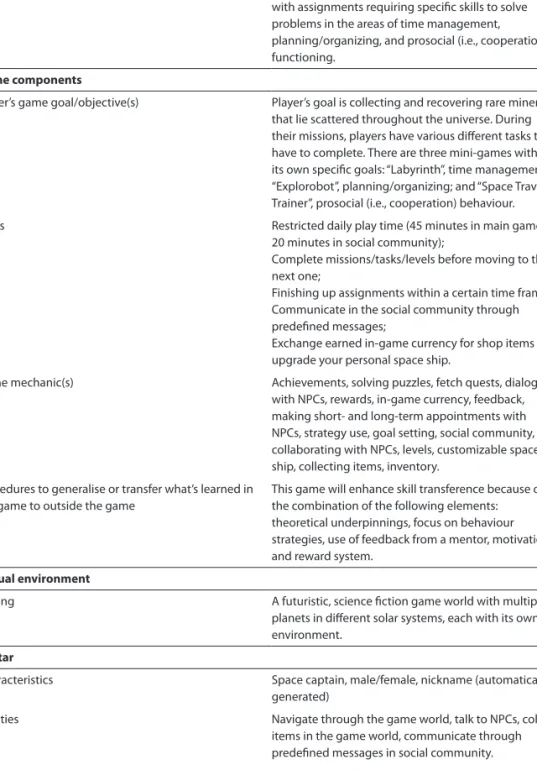
‘‘Plan-It Commander’’ is an online computer game with a futuristic and adventurous character consisting of two parts: (1) the mission game (a game environment with mis-sions and three isolated mini-games with embedded learning goals) and (2) a closed social community for interaction through predefined messages. Each mini-game has levels of increasing complexity and performance challenges. In the game the player is a space captain undertaking missions assigned by his or her mentor who guides the player, gives him or her feedback, and helps wherever he can. The player’s goal is to col-lect and recover rare minerals. Characteristics of ‘‘Plan-It Commander’’ are described in Table 1. To motivate and engage children throughout the game several special features were designed (see Table 2 and Figure 2).
table 1. Characteristics of a videogame for health: “Plan-It Commander”
characteristic focus
Health topic(s) Mental health
Targeted age group(s) 8–12 years of age
Other targeted group characteristics ADHD
Short description of game idea A serious game that promotes behavioural strategies in important domains of daily life functioning.
Target player(s) Individual
Guiding knowledge or behaviour change theory(ies), models, or conceptual framework(s)
Self-Regulation Model, Social Cognitive Theory, and Learning Theory.
Intended health behaviour changes Time management, planning/organizing, and prosocial (i.e., cooperation) skills.
Knowledge element(s) to be learned NA
Behaviour change procedure(s) (taken from Michie inventory) or therapeutic procedure(s) used
Reinforcement, immediate performance feedback from a mentor, goal setting through missions, modeling, social support, and comparison.
Clinical or parental support needed (please specify) No. This game is offered in the home context and can be played by children independently.
Data shared with parent or clinician No
Type of game Adventure, strategy, educational
story
Synopsis (including story arc) The player takes the role of a space captain who works for an interplanetary organization in search of rare minerals throughout the universe. The player is assigned various missions and side missions, each with its own adventurous story line and characters.
table 1. Characteristics of a videogame for health: “Plan-It Commander” (Continued)
How the story relates to targeted behaviour change During their missions players are confronted with assignments requiring specific skills to solve problems in the areas of time management, planning/organizing, and prosocial (i.e., cooperation) functioning.
game components
Player’s game goal/objective(s) Player’s goal is collecting and recovering rare minerals that lie scattered throughout the universe. During their missions, players have various different tasks they have to complete. There are three mini-games with its own specific goals: “Labyrinth”, time management; “Explorobot”, planning/organizing; and “Space Travel Trainer”, prosocial (i.e., cooperation) behaviour.
Rules Restricted daily play time (45 minutes in main game;
20 minutes in social community);
Complete missions/tasks/levels before moving to the next one;
Finishing up assignments within a certain time frame; Communicate in the social community through predefined messages;
Exchange earned in-game currency for shop items to upgrade your personal space ship.
Game mechanic(s) Achievements, solving puzzles, fetch quests, dialogs
with NPCs, rewards, in-game currency, feedback, making short- and long-term appointments with NPCs, strategy use, goal setting, social community, collaborating with NPCs, levels, customizable space ship, collecting items, inventory.
Procedures to generalise or transfer what’s learned in the game to outside the game
This game will enhance skill transference because of the combination of the following elements: theoretical underpinnings, focus on behaviour strategies, use of feedback from a mentor, motivation, and reward system.
virtual environment
Setting A futuristic, science fiction game world with multiple
planets in different solar systems, each with its own environment.
avatar
Characteristics Space captain, male/female, nickname (automatically
generated)
Abilities Navigate through the game world, talk to NPCs, collect
items in the game world, communicate through predefined messages in social community. Game platform(s) needed to play the game Computer
Sensor used NA
Estimated play time 20 hours
table 2. Description of special features in the game. Special feature Description
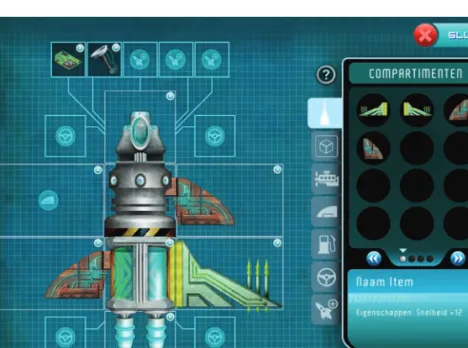
Space ship editor Once the player is able to access his/her space ship he/she will find the space ship editor. This is an application in the game in which the player is able to customise the ship to his/her liking. Through the game the player will find several items for his space ship, but he can also buy items in shops on the different planets.
Shops The player will find several shops on different planets in the game. In those shops he/ she is able to purchase and sell items. The player knows which items he/she can afford and will receive descriptions of the items so the player knows more about the item. Inventory In the game the player finds items which can be categorised into: minerals, Ico (the robot) upgrade, rocket parts and items. These items are stored in his/her inventory. The player can use these items in the shops to sell them or in the space ship editor. Player profile The player has a player profile within the game, which includes an avatar picture of the player, together with a list of all the missions the player has completed and the player’s current space ship is also visible.
missions and side missions
The game is divided into 10 different missions and several side missions. Missions guide the player’s behaviour throughout the game as he or she follows the story line and is confronted with assignments requiring specific skills to solve problems. Completing these assignments ensures skills concerning time management, planning/organizing, and prosocial (i.e., cooperation) behaviour are practiced and trained. Each mission has different tasks, and the player has a mission board to check which missions he or she has completed. Once a mission is completed the next mission becomes available. Side missions are independent missions, separate from the main story line, and are optional. Several side missions focus on triggering the player’s prosocial behaviour (e.g., play-ers can ask other playplay-ers for assistance [e.g., finding special items] and in turn decide whether to provide assistance). In addition, players can make short-term and long-term appointments with other Non-Playable Characters (NPCs; e.g., to retrieve items). Further general learning goals throughout the game include listening to the mentor, dealing with frustration, ignoring distraction, learning to concentrate, being attentive, and inhibiting impulses.
mini-games
A mini-game is a small, isolated game within the larger game environment that integrates unique game elements offering tools to improve strategic behaviour. Players begin with an explanatory tutorial level and progress through the game by accomplishing levels within the mini-games and missions. Three mini-games with assignments addressing time management, planning/organizing, and prosocial (i.e., cooperation) behaviour are embedded in the game (see Figure 3).
Mini-game 1: Labyrinth
Within this mini-game the player learns to manage time and to estimate time needed. In addition, players learn that it may be helpful to break down an assignment into pieces
Mini-game 1: Labyrinth Mini-game 2: Explorobot Mini-game 3: Space Travel Trainer
or to relax before making decisions. The labyrinth game is divided into two different parts. In the first part the player collects minerals in a maze within a limited time frame. In the second part the player estimates the time needed to collect all the minerals. In both parts of the game several strategies can be used to optimise performance, such as (1) the player planning optimal route on a map before entering cave, (2) clicking on the clock to check time, and (3) using the so-called ‘‘safe zones.’’ In these zones time pauses so the player can plan his or her next move or just relax. The player has to collect miner-als while facing distractions in the maze, thus learning to keep the main goal in mind. For both parts of this mini-game there are six different levels, increasing in difficulty. A level is completed when the player collects all the minerals within the restricted time frame or when the player finishes on time (i.e., within his or her estimated time frame). Mini-game 2: Explorobot
Players learn to plan ahead and break down the total assignment into pieces. The player has to collect several minerals that lie scattered in a sewer, using the robot Ico. The player determines the shortest route for Ico and then gives Ico this route description by means of a series of commands. If the player makes a mistake in planning the route, all commands will be deleted, and the player has to plan the route again. As a strategy to optimise performance, players can use checkpoints. If a player makes a mistake after a checkpoint, the robot will jump back to the last checkpoint, and the route can be adjusted from there on. The player can choose to use a limited amount of checkpoints per level. In total, there are 51 levels of difficulty with several tutorial levels. As it may be too hard for some players to find the ideal route, a margin is determined, which is the number of steps needed for the optimal route plus 30 percent (with a maximum of 10 steps). A level is completed when the optimal route (i.e., minimum number of steps) is planned for Ico.
Mini-game 3: Space Travel Trainer
Here players learn to help their team members and to behave in a more prosocial and cooperative manner toward others. The player flies his or her space ship from planet to planet to reach the target planet with three team members. These team members (named Nika, Vesto, and Kortar) are not real players, but are computer generated, and called Non-Playable Characters (NPCs). The team members depend on the player when handling obstacles, such as a star rain, while they follow their predefined route. If the player does not help his or her team members by giving the right commands (e.g., shield, boost, cloak) in time, they inevitably get stuck with low energy levels, which the player has to replenish. Team members ask for help and express their emotions when in dangerous situations. The player can thus use more than one channel to interact with
the team members. In total, there are 31 different levels of difficulty. A level is completed when all team members and the player have finished together.
social community
To stimulate prosocial behaviour, a social community was developed in which play-ers can see each other’s profiles and space ships and communicate with each other through pre-defined messages, for example, with a ‘‘thumbs up’’ or ‘‘thank you’’ button (see Figure 4). In addition, players can see each other’s rank and current mission status. This aims to stimulate game-play and generates some competition between players. Achievements are related to the learning goals of the intervention and to rewarding players for prosocial behaviour within the social community, such as helping other play-ers or giving compliments.
accePtance anD usability stuDy
The initial prototype had three mini-games focusing on time management, planning/or-ganizing, and prosocial (i.e., cooperation) behaviour. The player’s mission was to collect as many minerals as possible. The above mentioned social community, missions, side missions, and special features had not yet been developed. From October 2011 to March 2012 a pilot study was conducted to test the feasibility of conducting a randomised trial figure 4. Social community (called Space Club).
on the full game. As part of the pilot study, participants also filled out questionnaires designed to assess acceptance and usability of several game elements. Acceptance and usability were assessed to inform design decisions for further development of the game to a final version to be evaluated in a RCT for outcome effectiveness.
Participants
Candidates for the pilot study were identified and informed by their therapist. The therapists were all members of the consortium consisting of ADHD specialised mental healthcare services. Once a potential participant was identified, children and parents received information letters from the researcher, allowing them to make an informed consent about voluntary participation in the pilot study. Inclusion criteria were (a) hav-ing a clinical DSM-IV-TR ADHD diagnosis (all subtypes were included) set by a certified healthcare professional, (b) between 8 and 12 years of age, (c) being stable on pharma-cological and/or psychological ADHD treatment for at least 2 months prior to baseline assessment (determined by healthcare professionals on the basis of medication data and behavioural observation), and (d) availability of a computer workstation at home with Internet and sound facilities. Children were excluded if they had an estimated total IQ of 70 or lower and had a physical and/or cognitive disability (i.e., deafness, blindness) that would predict great difficulties in playing the serious game and would be problem -atic for standardised measurements.
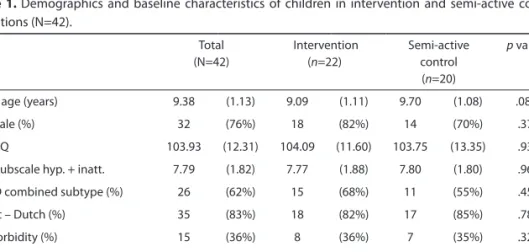
In total, 66 children were referred by their therapist and informed about the studies’ purposes. The final sample consisted of 42 clinically referred children with a primary di-agnosis of ADHD. Children’s age ranged from 8 to 11 years with a mean age of 9.4 years. Children participating in the study had average intelligence (M=104, SD=12.3). This was tested with the Wechsler Intelligence Scale for Children III short version (Wechsler, 1991). There was an absence of any neurological, sensory (blindness, deafness), or motor disorder as stated by the clinicians and parents. All children except for two were taking ADHD medication at study entry. Comorbidity of dyslexia was present in four children.
Procedure
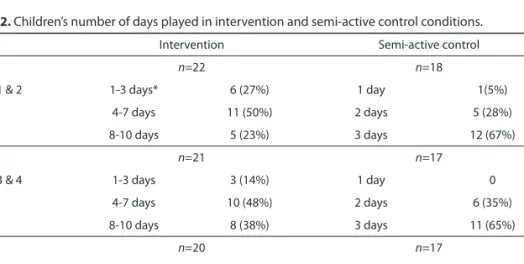
As part of the pilot study we decided to randomise children to one of the two conditions for playing the ‘‘Plan-It Commander’’ prototype. Twenty children were allowed to play the game for a maximum of three times per two weeks. Twenty-two children were asked trying to play the game about eight times per two weeks. However, as there appeared to be no significant differences (p>0.05) among children’s and parents’ satisfaction scores between the two groups, we decided to present the results for the total group of children. Children played the game at home for eight weeks, divided into four periods of two weeks, with a free choice in playing one of the preferred mini-games during the last two weeks. Every two weeks a different mini-game was unlocked in predefined order.
Children had their own password and ID to log on from their home. Children were asked to play the game for a minimum of 30 minutes and a maximum of 45 minutes each time. Two children were lost to follow-up, and one child dropped out because of acute psychiatric problems.
Ethical approval was obtained from the Committee of Medical Ethics for Mental Health Care in Utrecht, The Netherlands. Written informed consent was obtained from both par-ents. Questionnaires were developed specifically for this study to assess expectations and satisfaction. Parents filled out questionnaires measuring expectations at baseline (pre-test measurement) and satisfaction at follow-up (post-test measurement). Children filled out a questionnaire at follow-up to assess their satisfaction with the prototype ‘‘Plan-It Commander’’ game.
Pre-test parent expectations
Parents rated their expectations about the game in different domains during pre-test measurement (see Table 3). Ratings were collected on questionnaires specifically de -signed for this study. Questionnaires were filled out at the study location on a laptop. Questions included, ‘‘How much improvement do you expect with regard to the time management skills of your child?’’ Parents rated their answers on a 10-point Likert scale in which 1 = ‘‘none’’ and 10 = ‘‘a lot”.’ Scores from 6 to 10 were combined and interpreted as a positive response. As shown in Table 3, parents had overall high expectations of the game, except where it concerned learning prosocial behaviour and reducing ADHD core symptoms. This might be explained by the fact that parents feel prosocial behaviour is hard to target in a game. Learning prosocial behaviour through a game requires multi-player options and a different game structure than proposed in this first prototype (Van Rooij, Jansz, & Schoenmakers, 2010). For these reasons, a social community aspect was integrated in the final version of the game. Furthermore, the game was not focused on table 3. Proportion of parents providing ratings of positive expectations with regard to the goals of the
game.
Expectation (n=42; positive percentage)
General learning effect 42 (100%)
Improvement of time management 30 (71%)
Improvement of planning skills 29 (69%)
Improvement of prosocial skills 22 (52%)
Improvement of frustration tolerance 28 (67%)
Reduction of ADHD symptoms 26 (62%)
Responses were provided as ratings on a Likert scale ranging from 1 = “none” to 10 = “a lot”. Participants who provided a rating of 6 or above were categorised as having positive expectations. ADHD, Attention Deficit Hyperactivity Disorder.
diminishing ADHD core symptoms but on improving behavioural skills. Therefore, lower expectation scores regarding this topic reflect a realistic insight into the capabilities of this game intervention.
Post-test parent satisfaction
At post-test measurement, parents answered questions on a 10-point Likert scale (1 = ‘‘not at all’’ and 10 = ‘‘totally’’) concerning parental perceptions about the burden of playing the ‘‘Plan-It Commander’’ game on the child and family. Mean scores ranged from 2.5 to 4.3, indicating that most parents did not feel offering such game interven-tion was troubling for the family. Furthermore, results demonstrated that parents were overall positive about the game. Their average overall satisfaction with the game was 6.7 (SD=1.4) (on a scale from 1 to 10). In addition, a majority of the parents (88 percent) reported they would recommend the game to other parents. All parents (100 percent) indicated (on a yes/no question) they would like access to the game once further devel -oped. These findings assured us that our current approach was acceptable for parents and helped us in deciding on how and to which degree children should be exposed to the game.
Post-test child satisfaction
We also asked the children who played the game to rate their game satisfaction in dif-ferent areas (see Table 4). Ratings were collected on a paper-and-pencil questionnaire specifically designed for this study. Colours and smiley faces were used to highlight the different answer categories on a 5-point Likert scale (from 1 = ‘‘not at all’’ to 5 = ‘‘very’’). Table 4 shows the number (percentage) of children who gave a positive opinion (i.e., a combination of the two highest scores) on the satisfaction questionnaire. Although only 44 percent of the children indicated they were motivated to play the game, 67 percent table 4. Proportion of children’s ratings of satisfaction after playing the game.
Satisfaction (n=39; positive percentage)
Did you like playing the game? 25 (64%)
How motivated were you to play the game? 17 (44%)
Would you like to play more often? 21 (54%)
How do you feel after finishing the game? 17 (44%)
Have you learned anything? 26 (67%)
Should other children with ADHD also be able to play the game? 30 (77%) Would you like to play this game with friends together? 25 (64%)
Responses were provided as ratings on a Likert scale ranging from 1 = “not at all” to 5 = “very”. A combi-nation of the two highest scores were categorised as having a positive opinion. ADHD, Attention Deficit Hyperactivity Disorder.
of the children indicated they had learned from the game, and 77 percent were positive about making the game available for other children with ADHD. A social community, several side missions, and special features were added to the ‘‘Plan-It Commander’’ pro-totype, making it more attractive and thereby more motivating and challenging for chil-dren. This is relevant as motivation is thought to be an important mediator for changing behaviour (Boller, 2012; Jaeggi et al., 2014; Prins et al., 2011; Van Rooij et al., 2010).
Qualitative user experience
At post-test measurement, both parents and children answered an open question con -cerning changes to the game. They provided useful suggestions and recommendations for improvements, such as requests by children for more characters, travel to different planets, and other characters in the game world. Some parents indicated the game could be made more challenging for their child, especially if they already had broad gaming experience. These important responses and feedback were very supportive in finalising the full game.
summary anD future PersPectives
In this chapter we outlined important aspects of developing a serious game to impact daily life functioning of children with ADHD. We described how developing a serious game is a collaborative project among various experts and users and how that process was carried out in this project. We outlined the theoretical basis for the game as a therapeutic intervention and described how the theory was implemented in various game components. This was followed by a description of the mini-games and structural components of the game in which game components were embodied. The information we provided supports the need in the literature on serious games to provide detailed descriptions on the game themselves, theories that guide them, and the components of the game intended to change behaviours that lead to intended positive outcomes. The information provided is also valuable as a description of a method and approach that represents a significant effort to move beyond serious games aimed at improv-ing neurocognitive functionimprov-ing, but functionimprov-ing in important domains of daily life for children with ADHD. The description of our development process was supplemented by a presentation of results for parents and child acceptability and usability ratings of a prototype of the game. We discussed the findings in light of their implications for game development.
Overall, the usability findings indicated positive acceptance of this game intervention by children with ADHD and their parents. These preliminary results, based on a prototype version of the final game, directed further development of the game by including
sev-eral aspects children proposed themselves (e.g., travel to other planets, more characters, special features). Parents’ feedback also helped us in making well-informed decisions about children’s play frequency. The advantage of our survey questionnaire approach compared with a more qualitative approach such as a focus group is that the opinions from larger groups of people can be summarised in a standardised way through ratings. A drawback to this approach is that we may have lost the opportunity to gain some important opinions and feedback from participants due to the structured format of the questions and responses. We did, however, also include open-ended questions, which allowed participants to provide their feedback in a less structured approach.
Both parents and children were quite satisfied with the first prototype and indicated they would recommend the game to other parents of children with ADHD. As parents’ high expectations might have influenced their ratings, further research should try to control for these expectations by including teacher ratings and more objective mea-sures such as neuropsychological tasks. In the current study, only two children did not use medication as their treatment as usual (TAU). It may well be that medication use is a necessary condition for optimal learning from the current intervention. Future research could examine the effects of this game in a non-medicated sample to further explore the necessity of medication as TAU. With regard to development, it should be considered to extend the game or to create an add-on with different learning goals relevant for different age groups. Games could be made more individualised by creating the option to choose learning modules to suit individual developmental trajectories. This project has created a platform from which future goals could be implemented.
Although these first results regarding expectations and satisfaction are promising, a randomised clinical trial is necessary in order to test the effectiveness of this serious game. As serious games become more popular within mental healthcare, more research is needed on the implementation of such electronic mental health interventions into the primary process of care. This game format presents an alternative to traditional behav-ioural interventions currently available for children with ADHD that are often presented in school settings by therapists, making them time consuming, costly, and less acces-sible compared to digital tools (Boyer, Geurts, Prins, & Van der Oord, 2014; Evans, Schultz, DeMars, & Davis, 2011; Kazdin & Blasé, 2011).In sum, the description of the approach and process used in developing ‘‘Plan-It Commander,’’ along with the usability findings that led back into the development process, provides an example for developing serious games for similar target groups and outcomes. The findings have implications for defin-ing and describdefin-ing the complex processes of designdefin-ing and developdefin-ing serious games that involve collaborations among diverse stakeholder groups that include structured input from target users and family members.
Chapter 3
Effectiveness of an initial prototype
serious game for children with
Attention Deficit Hyperactivity
Disorder on behavioural outcomes:
A pilot Randomised Controlled Trial.
abstract
objective: This study evaluated the effectiveness of an initial prototype serious game for children with Attention Deficit Hyperactivity Disorder (ADHD). We examined whether this initial prototype improved children’s functional outcomes in different areas of daily life, namely time management, planning/organizing and prosocial (i.e., cooperation) skills, in addition to their treatment as usual (TAU).
methods: A total of 42 children with ADHD aged 8 to 12 years were randomly assigned to the serious game intervention group (n=22) or to a semi-active control group (n=20). Children in the intervention condition were asked to play the initial prototype game about eight times per two weeks, whereas children in the semi-active control group were allowed to play a maximum of three times per two weeks. Parental and self-report measures concerning executive function and social behaviour skills were administered before starting the intervention (T0) and after receiving an eight-week intervention (T1). results: Both groups showed improvements in time management and planning/ organizing skills over time. Children in the intervention condition showed more im-provement (borderline significant) in time management than those in the semi-active control group. More frequent game-play was correlated with better learning outcomes concerning time management and prosocial (i.e., cooperation) behaviour.
Discussion: This pilot study demonstrates that this initial prototype serious game might be potentially effective for children with ADHD. The implications of the findings are dis-cussed, including further game development and the need for a randomised controlled trial (RCT) to examine final game format effectiveness.
introDuction
Several reviews indicate that Internet-based interventions are feasible and efficacious in treating mental disorders among adults (Andersson & Cuijpers, 2009; Baumeister, Reichler, Munzinger, & Lin, 2014). Furthermore, there is an increasing number of studies demonstrating the effectiveness of Internet-based mental healthcare interventions for anxiety and depression in children and adolescents (Ye et al., 2014). Generally, these novel interventions have been proven to be effective in alleviating symptoms but issues with user engagement and attrition do exist, implying a need for more attractive and engaging treatment tools. As such, gamified interventions and serious games for mental healthcare have been developed and are beginning to be explored (Cheek et al., 2015).
Gamified interventions (e.g., using game mechanics or game-like interfaces) appear to be specifically engaging for children with externalizing disorders like Attention Deficit Hyperactivity Disorder (ADHD) as they have difficulties with staying motivated to finish “boring” and repetitive training tasks (Dovis et al., 2012; Frutos-Pascual et al., 2014; Granic, Lobel, & Engels, 2013). Moreover, despite their poor attention span and distract-ibility, children with ADHD are able to demonstrate sustained concentration and en-gagement when playing digital games (Emes, 1997; Tannock, 1997; Van der Oord, 2012). This knowledge stimulated the development of several gamified training programs focusing on improving working memory and executive functioning, thereby addressing specific cognitive deficits in ADHD children (Cortese et al., 2015; Sonuga-Barke, Brandeis, Holtmann, & Cortese, 2014). Gamified training formats currently available do promote children’s engagement in the task over time and improve short term effects on targeted working memory outcomes (as measured by neurocognitive tests that are similar to the ones presented in the training) but they lack a demonstration of generalisation effects to other important domains of daily life functioning (Chacko et al., 2014; Melby-Lervåg & Hulme, 2012; Rapport et al., 2013; Shipstead et al., 2012). Children with ADHD could profit from an intervention impacting “real world” behaviours given their widespread difficulties in time management, planning/organizing and prosocial (i.e., cooperation) skills. These executive functioning and social problems not only affect the daily life of children and their families, but also predict a poor prognosis of ADHD even into ado-lescence and adulthood (Abikoff et al., 2009; 2013; Conners, 2003; Nijmeijer, Minderaa, Buitelaar, Mulligan, Hartman & Hoekstra, 2008; Sonuga-Barke et al., 2010).
A serious game could provide an engaging tool for targeting functional outcomes in different areas of daily life. Compared to gamified training tools, serious games offer an overall game environment that allows for exploration and meaningful ongoing “journey narrative” instead of offering a “casual” game-like interface. Examples of such programs that have been evaluated are Camp Cope-A-Lot (Khanna & Kendall, 2010)and SPARX (Merry et al., 2012). For school-aged children with ADHD a gamified executive function