Ed.D. Dissertations in Leadership for
Educational Justice Theses, Dissertations, and Honors Projects 12-31-2019
The Effect of Math-E-Motion on Children’s Mental Rotation
The Effect of Math-E-Motion on Children’s Mental Rotation
Abilities and Spatial Perspective Taking Abilities
Abilities and Spatial Perspective Taking Abilities
Honey Sacro SwemUniversity of Redlands
Follow this and additional works at: https://inspire.redlands.edu/eddissertations
Part of the Curriculum and Instruction Commons, Early Childhood Education Commons, Educational Assessment, Evaluation, and Research Commons, Educational Leadership Commons, Educational Methods Commons, Elementary and Middle and Secondary Education Administration Commons, Elementary Education Commons, Elementary Education and Teaching Commons, Health and Physical Education Commons, Junior High, Intermediate, Middle School Education and Teaching Commons, Pre-Elementary, Early Childhood, Kindergarten Teacher Education Commons, Science and Mathematics Education Commons, Secondary Education Commons, and the Secondary Education and Teaching Commons
DOI:
DOI: https://doi.org/10.26716/redlands/doctor/2019.13
Recommended Citation Recommended Citation
Sacro Swem, Honey, "The Effect of Math-E-Motion on Children’s Mental Rotation Abilities and Spatial Perspective Taking Abilities" (2019). Ed.D. Dissertations in Leadership for Educational Justice. 100. https://doi.org/10.26716/redlands/doctor/2019.13
https://inspire.redlands.edu/eddissertations/100
This work is licensed under a Creative Commons Attribution 4.0 License. This material may be protected by copyright law (Title 17 U.S. Code).
This Open Access is brought to you for free and open access by the Theses, Dissertations, and Honors Projects at InSPIRe @ Redlands. It has been accepted for inclusion in Ed.D. Dissertations in Leadership for Educational Justice by an authorized administrator of InSPIRe @ Redlands. For more information, please contact [email protected].
The Effect of Math-E-Motion on Children’s
Mental Rotation Abilities and Spatial Perspective Taking Abilities
A Dissertation submitted in partial fulfillment of the requirements for the degree of Doctorate in Leadership for Educational Justice
By
Honey Sacro Swem 2019
Dissertation Committee:
James Valadez, Ph.D., Committee Chair Phil Mirci, Ph.D.
Copyright © by Honey Sacro Swem All rights Reserved
iv
Abstract
The Effect of Math-E-Motion on Children’s
Mental Rotation Abilities and Spatial Perspective Taking Abilities Honey Sacro Swem
Doctor of Educational Justice, 2020 University of Redlands Advisor: James Valadez, Ph.D.
The demand for Science, Technology, Engineering, and Mathematics (STEM)-related jobs is increasing, while the number of educated and skilled people in this field is decreasing. Uttal, Meadow et al. (2012) emphasized that the development of a person’s spatial skills contributes to an individual’s success in STEM-related fields. In addition, Uttal, Meadow et al. recommended the investigation of the impact of spatial training on younger students. The purpose of this research was to determine the effect of a dynamic, fully-embodied learning activity on the development of elementary school students’ spatial skills; in particular, their mental rotation and spatial perspective taking abilities. Based on the difference between the students’ pre-test and post-test scores in the Object Rotation Test and the Perspective Taking Test, it was concluded that a dynamic, fully-embodied learning activity improves the students’ object rotation abilities and spatial perspective taking abilities.
Keywords: embodied cognition theory, cognitive modifiability, spatial abilities, object rotation abilities, spatial perspective taking abilities, Science, Technology, Engineering, and Mathematics (STEM)
v
Dedication
This dissertation is dedicated to the greatest blessings of my life,
my five beautiful children - .
Thank you for your love and understanding
when I needed to focus on my writing and could not spend time with you. I dedicate this to my loving husband, , who is also my prayer partner.
Thank you for patiently supporting me during my dissertation journey. I also dedicate this dissertation to my father,
I believe that he has been preparing a place for me in heaven since I was three years old. Thank you, Daddy, for giving me
beautiful and lasting memories of a father’s great love for his daughter. Finally, this dissertation is dedicated to my beautiful mother, ,
someone who exudes with quiet elegance.
As the Principal when I was in high school, she instilled in me lifelong lessons on SC, CS + I: self-control, common sense, and integrity.
Thank you, Momsy, for never giving up on your belief that one day, I would become a teacher like you
despite my insistence that I wasn’t going to become an educator. You were a dissertation away from a doctoral degree
but you had to give up pursuing that dream to raise your ten children. Momsy, this is your dissertation as much as it is mine.
It is your doctoral degree as much as it is mine. Despite your fading memory,
you haven’t stopped teaching me to always be the best-version-of-myself; to do my share in making this world a better place;
to be grateful for all the blessings and even the challenges in my life; and to remember that without God, I am nothing.
vi
Acknowledgements
Thank you, , and the elementary students, for
giving me the opportunity to work with and learn from you.
Thank you, Cohort 9, for being like a family - supportive, collaborative, and fun. Thank you to all the professors especially Dr. Chris Hunt and Dr. Jose Lalas, who
believed in me, challenged me, and taught me
to advocate for the marginalized and to give voice to the voiceless. Thank you, Dr. Andrew Wall, for your leadership and for ensuring that I would complete my dissertation and graduate from the program. Thank you, Dr. Gary Scott and Dr. Steven Moore, for mentoring me, providing the resources and materials I needed, and patiently supporting me throughout my journey.
Thank you, Dr. James Valadez, Dr. Phil Mirci, and Dr. Greg Hamilton, for not giving up on me, believing in me,
and patiently supporting me until I completed this journey.
Thank you, Yessenia Yorgesen, for conscientiously and patiently answering my questions and supporting me from the time I took the comprehensive exam until the day I
completed my dissertation. Truly appreciate you.
Finally, thank you, , for emailing me back right away when I needed your help. I appreciate the time and effort you gave to help in editing my dissertation.
vii
Table of Contents
Chapter One: Introduction ...11
Background ...11
Problem Statement ...12
Significance of the Study ...12
Purpose ...13 Research Question ...13 Hypothesis 1: ...13 Hypothesis 2: ...13 Hypothesis 3: ...14 Definition of Terms...14
Chapter Two: Literature Review ...15
Theoretical Framework – Embodied Cognition Theory ...15
Asher’s Total Physical Response ...18
Learning by Doing ...19
Physical Activity and Intelligence ...23
Feuerstein’s Structural Cognitive Modifiability ...25
Bruner’s Three Stages of Cognitive Development ...27
Spatial Thinking Skills ...28
The Malleability of Spatial Skills ...32
The Role of Spatial Thinking in STEM Learning and Achievement ...32
Spatial Thinking Skills and Mathematical Skills ...34
viii
Chapter Three: Methodology ...37
Chapter Four: Results ...43
Results for Hypothesis 1 ...44
Results for Hypothesis 2 ...47
Results for Hypothesis 3 ...51
Chapter Five: Conclusions ...53
Conclusion for Hypothesis 1 ...53
Conclusion for Hypothesis 2 ...53
Conclusion for Hypothesis 3 ...54
Implications...54
Limitations ...56
Recommendations ...57
References ...59
Appendix A: Math-E-Motion Description ...64
Appendix B: Object Rotation...69
ix
List of Tables
Table 1 Object Rotation Test Results ...44
Table 2 Object Rotation Test ...47
Table 3 Spatial Perspective Taking Test Results ...48
x
List of Figures
Figure 1 The 2 x 2 Classification of Spatial Skills 31 Figure 2 Student Grouping and Schedule of Activities 38
Chapter One: Introduction Background
More than half of the students from the United States do not pass mathematics (Boaler, 2015). In addition, the United States cohort of 15-year-old students ranked low among the countries that participated in the 2012 Programme for International Student Achievement (PISA), a test that assesses students’ ability to formulate, interpret, and apply mathematics in real-world context. From 34 countries that participated in the 2012 PISA, the United States ranked 26th (National Council of Teachers of Mathematics, NCTM, 2014). Moreover, the California Department of Education (2019) reported that the score on the Smarter Balanced Summative Assessment-Mathematics of the 3,166,312 students who took the test in 2018 was 36.4 points below standard. This score means that in 2018, students in grades 3 through 8 and 11 did not meet the grade-level standards in mathematics.
Furthermore, U. S. Department of Education (as cited in NCTM, 2014) reported that “only 16 percent of high school seniors in the United States are proficient in
mathematics and interested in a Science, Technology, Engineering, and Mathematics (STEM) career” (p. 2).
Seemingly related to this low percentage of high school seniors interested in STEM is the decreasing number of people who are educated enough to perform jobs in this field. In contrast, there is a growing demand for workers in STEM. Uttal and Cohen (2012) described this challenge as “a concern of great national priority” (p. 148). On September 27, 2010 in a White House Press Release, President Obama stated that “strengthening STEM education is vital to preparing our students to compete in the 21st
century economy and we need to recruit and train math and science teachers to support our nation’s students” (Uttal & Cohen, 2012, p. 148).
Problem Statement
There is a growing demand for jobs related to Science, Technology, Engineering, and Mathematics (STEM). Unfortunately, the United States is not able to adequately fill the need for educated and skilled human resources for STEM jobs (Uttal, Meadow et al., 2012). Eventually, this problem will only worsen (Kuenzi, Matthews, & Mangan, 2007; Mayo, 2009 as cited in Uttal, Meadow et al., 2012; Sanders, 2009 as cited in Uttal, Meadow et al., 2012). If only 16% of high school seniors in the United States are interested in STEM careers, then the country will definitely fail to produce the needed workforce for this field (NCTM, 2014).
Uttal, Meadow et al. (2012) identified spatial thinking as an essential factor in determining an individual’s success in STEM-related fields. In addition, they
recommended the investigation of the impact of spatial training on younger students (Uttal, Meadow et al., 2012).
Significance of the Study
This research focused on the effect of Math-E-Motion on the spatial thinking abilities of elementary students. Dr. G. Scott (2016) created Math-E-Motion (see Appendix A), a dynamic, fully embodied learning activity, for the Inventatorium, a STEM program for elementary and middle school students.
There have not been many studies investigating embodied cognition and its potential effect on the development of children’s spatial thinking abilities. This study will contribute to the knowledge on the correlation between embodied cognition and
spatial thinking abilities among elementary age children with a focus on mental rotation and spatial perspective taking skills. Specifically, this study will prove that when students engage in a dynamic, fully embodied learning activity, their spatial thinking abilities will develop.
Purpose
The purpose of this study was to determine whether or not Math-E-Motion can develop elementary students’ mental rotation and spatial perspective taking abilities, two major determinants of spatial skills (Sorby, 1999; Uttal & Cohen, 2012).
Research Question
What is the effect of Math-E-Motion, a dynamic, fully-embodied learning activity, on the development of elementary school students’ mental rotation and spatial perspective taking abilities?
Hypothesis 1:
H0: The use of a dynamic fully embodied learning activity (Math-E-Motion) has no
effect on the students’ mental rotation abilities.
H1: The use of a dynamic, fully embodied learning activity (Math-E-Motion)
improves students' mental rotation abilities. Hypothesis 2:
H0: The use of dynamic, fully embodied learning activity (Math-E-Motion) has no
effect on students' spatial perspective taking abilities.
H1: The use of dynamic, fully embodied learning activity (Math-E-Motion) improves
Hypothesis 3:
H0: There is no difference in the effect of Math-E-Motion on the students’ mental
rotation abilities and their spatial perspective taking abilities.
H1: Math-E-Motion improves the students’ spatial perspective taking abilities more
than their mental rotation abilities. Definition of Terms
1. Math-E-Motion - the game created by Dr. Gary Scott (2016) in which a student jumps forward or backward and left or right on a coordinate plane painted or drawn on the floor starting from the center (0,0) and three other students determine the jumper’s moves
2. Mental rotation ability - a person’s ability to mentally move a whole object 3. Spatial perspective taking ability - a person’s ability to mentally see an object or a
scene from different viewpoints
4. Spatial skills - a person’s skills in being able to manipulate information about things in the environment
5. STEM – refers to “a curriculum based on the idea of educating students in four specific disciplines – science, technology, engineering, and mathematics – in an interdisciplinary and applied approach” (Hom, 2014, para 1)
Chapter Two: Literature Review
This chapter begins with the explanation of the Embodied Cognition Theory, the theoretical framework on which this research was based. After the discussion of the theoretical framework is the discussion of the literature review on the following topics: Asher’s Total Physical Response; Dewey’s learning by doing, mind-body dualism, physical activity, and intelligence; Feuerstein’s Structural Cognitive Modifiability; and Bruner’s three stages of cognitive development.
In addition, the following are also discussed: spatial thinking skills, malleability of spatial skills, the role of spatial thinking in STEM learning and achievement, spatial thinking skills and mathematical skills, and the development of spatial skills.
Theoretical Framework – Embodied Cognition Theory
The theoretical framework for this research was based on the Embodied
Cognition Theory. Embodied cognition challenges Descartes’ (as cited in Claxton 2015) theory on the dualism of the mind and the body. According to the Cartesian (as cited in Claxton 2015) view, the mind is apart from the body and that the brain is more valuable than what the body is able to do. Claxton (2015) argued that the body and the brain do not function separately. The brain, contrary to common knowledge, is not superior over the body. Instead, one cannot do without the other. Without the body, the brain cannot execute what it is thinking. The brain does not control the body, but the body cannot function without the brain (Claxton, 2015). Embodied cognition does not consider people’s ability to explain what they are doing and why they are doing something. Unlike school learning, what matters to embodied learning is the development of the ability to do something rather than being able to explain something. For example, even if
football players can explain an offensive play from end to end, this does not help them score a touchdown. What matters is that they run fast, pass or catch efficiently, and make it to the goal with the football (Claxton, 2015).
In fact, embodied cognition recognizes that the body plays a central role in shaping the mind. Traditionally, the mind is the starting point for cognition, but for this new movement in cognitive science, the starting point is the body that needs the mind to make it work (Wilson, 2002). Evidently, this contradicts the Cartesian philosophy that has influenced education for generations.
Unlike mind-body dualism, embodied cognition does not consider the mind superior over the body. Rather, the body, hands, and their movements harmonize with thinking and emotions, resulting in the learning of a concept or a skill. The mind and body “work together like an experienced jazz combo, sometimes playing solo, sometimes in harmony or counterpoint, sometimes feeding each other lines to be developed in each instrument’s characteristic tones” (Claxton, 2015, p. 239).
Furthermore, Wilson (2002) explained that human cognition is deeply rooted in sensorimotor processing and it is not limited to the mental activity occurring in the brain. She also identified the six most prominent claims of embodied cognition:
(1) Cognition is a combination of perception plus action and this happens in a real-world situation.
(2) Cognition is time-bound. It means that the way to comprehend cognition should be in the context of the interaction with the environment when the cognition is happening.
(3) As a result of the limitations of attention span and working memory, people utilize the environment to keep or change the information they get, and then they eventually retrieve this information as needed.
(4) Because of the influx and continuous exchange of information between the mind and its environment, scientists have learned not to limit themselves to the analysis of the mind alone. Beer, 1995; Greeno & Moore, 1993; Thelen & Smith, 1994 (all cited in Wilson, 2002) asserted that cognition is the interaction among the mind, body, and the environment.
(5) The mind is responsible for guiding the action, so perception and memory, which are examples of cognitive mechanisms, need to be understood regarding how they will help in the behavior appropriate for the situation. (6) Considered the most powerful even if it has received the least attention in the literature on embodied cognition, the sixth claim asserts that when the mind is separated from the environment, its activity relies on the
interaction of the body with the environment.
For embodied cognition, therefore, thinking is no longer limited to the abstract but rather it involves the interaction between the body and the environment, which in turn, provides a stimulus to the brain.
The interaction between the mind and body was called by Michael Ondaatje (as cited in Claxton, 2015) as “thinkering” in his book The English Patient (p. 230).
Thinkering refers to the hand feeding the mind and mind feeding the body. Michele and Robert Root-Bernstein further explained that “hands-on thinkering leads to minds-on thinkering” (as cited in Claxton, 2015, pp. 230-231).
“Thinkering” in art classes impressed Seymour Papert (as cited in Claxton, 2015), co-founder of the Robotics Lab at the Massachusetts Institute of Technology (MIT). The Robotics Lab co-founder was amazed at how the art students were engaged and were learning much more than the students in the mathematics class because the former was using their hands when they were engaged in the learning activities. The art students were doing a physical activity, while they were thinking of possibilities for their artwork. Moreover, while creating and collaborating, these students were reflecting on what they were doing. Inspired by the kind of learning in the art class, Papert advocated for
students in the mathematics class to learn by using their hands. This experience inspired Papert to provide learning opportunities for students to use their hands through robotics at MIT in order to develop a better understanding of mathematics and the applications (Claxton, 2015).
Asher’s Total Physical Response
An application of the embodied cognition theory is a teaching technique called Total Physical Response (TPR). James Asher (1966) studied the effects of TPR to learn a language. In Asher’s five pilot studies, one group of adults and children was learning Japanese and the other group was learning Russian. The experimental groups listened to a command in the target language and after each command, the instructor modeled a physical response. The participants did exactly what the instructor did. The control groups, on the other hand, listened to commands in the target language but the instructor did not model any physical response. For both languages, the experimental groups that learned the commands by doing the corresponding physical response significantly showed better retention in contrast to the control group that did not do any physical
response after the commands. Based on the results of the pilot studies, Asher concluded that acting out the command helped with retention although he pointed out that the effect might be limited to short-term training. He also explained that for trainings that extend for many weeks, the Total Physical Response technique keeps students interested and motivates them to exert effort in learning the target language.
There is an obvious similarity between embodied cognition and Asher’s Total Physical Response. For both, moving the body plays a central role in learning. Learning by Doing
Embodied cognition is also manifested in John Dewey’s (1910, 1916, 1938 as cited in Ord, 2012) theory of education – learning by doing. Also called experiential learning, Dewey’s theory was based on these three assumptions. First, the best way people learn is to directly involve them in the learning experience. Second, in order for the learning to be significant or for people’s behavior to change as a result of their learning, they need to have ownership for their learning. Third, when people are given the opportunity to choose their own learning goals within a given framework, they show a high level of commitment to learn (Smith, 1980 as cited in Ord, 2012). Kolb (1984 as cited in Ord, 2012) described experiential learning using a cyclical four-stage model with the following stages: concrete experience, observations and reflections, formation of abstract concepts and generalizations, and testing implications of concepts in new situations. Embodied cognition and learning by doing prescribed using the body, movement, or something concrete before attempting to learn something abstract. Mind-Body Dualism
If embodied cognition is on one end of the spectrum for learning through
movement, Descartes’ (as cited in Claxton, 2015) mind-body dualism is on the opposite end. Before discussing Descartes’ theory, it is important to describe the unintended consequences of mind-body dualism that are prevalent today.
Elementary school children sit between four to five hours each day in the
classroom especially if the teacher does not facilitate activities that make children move around or outside the room. This statistic seems trivial and harmless until Dr. James Levine, inventor of the treadmill desk, revealed that people may lose two hours of their lives for every hour they sit (MacVean, 2014). If this is the case, then the school system is unknowingly harming the children’s health when the students are not given
opportunities to exercise, move, or do something physical for at least a few minutes every hour. Levine seriously warned his readers on how sitting for long hours results in the deterioration of one’s health. He equated sitting with eating a horrible diet (Levine, 2014). Levine (as cited in Gerstacker, 2014) coined the phrase, “Sitting is the new smoking” (para. 3). People today sit for several hours both in the office and at home.
The lifestyle that has evolved from watching cable TV, playing video games, Internet shopping, and even online dating may be reflective of how society does not value the body as much as it values the mind. Claxton (2015) asserted, “we have become mind rich and body poor” (p. 2). Disney Movies (n.d.) Wall-E is a hyperbole of a mind rich and body poor society as shown by the obese characters who just sit, eat, and look at a computer monitor the whole day.
In addition to the lack of physical activity for students in the classroom, the disparity in pay between white collar workers and blue-collar workers may also be
reflective of how society does not value manual labor as much as it values intellectual pursuits. According to the 2009 data from the Bureau of Labor Statistics (as cited in Wroblewski, 2019), the annual wage of white-collar workers ranged from $76,000 to as much as $113,000 . In contrast, the annual wage of blue-collar workers is less than half of the lowest pay among the professionals. The pay of manual workers ranged from $16,000 to $26,000 annually (Wroblewski, 2019).
Besides the discrepancy in pay, people seem to perceive professionals like doctors, lawyers, and professors as intelligent. However, they don’t seem to think the same about manual workers like farmers, fishermen, or janitors. Consequently, society seems to highly esteem the former but not the latter.
Claxton (2015) traced the higher regard for intelligence back to the fifth century BC when Xenophanes, a philosopher, considered it unfair to value strength more than wisdom. Prior to the Xenophanes’ devaluing of physical abilities, the Golden Age of Greece equally honored intellectual pursuits and physical prowess. After Xenophanes’ declaration, intelligence continued to be more prestigious than physical competence. The perception that the mind and the body are two different entities was gradually taking shape.
Inevitably, society considers the mind as separate from the body (Claxton, 2015; Liu, Wu, & Ming, 2015; Sparking Life, n.d.). In fact, for Christians, the mind and body were not only different, but they were also opposing entities. The body eventually became the enemy of the mind because Christians believed that the former could cause them to commit a sin. It is possible that this belief was learned from the Bible verse that
stated, “if your right hand causes you to sin, cut it off and throw it away” (Christian Community Bible: Catholic Pastoral Edition, Matthew 5:30).
In addition to what the Christians believed about the relationship between the mind and the body, a common thought in Europe seemed to be that Descartes was the philosopher who completely cleaved the mind from the body. Descartes (as cited in Claxton, 2015) explained that there was nothing in the mind that belonged to the body and vice-versa. Called the mind-body dualism, the Cartesian philosophy also purported that the mind controlled the body but not necessarily the other way around (Claxton, 2015).
Arnheim (1980) contradicted the belief based on Descartes’ mind-body dualism that perception (visual thinking) is inferior to reasoning (cognitive thinking). He stated that visual thinking and cognitive thinking are both essential to the thinking process. To consider cognitive thinking as higher than visual thinking is to disregard how the human mind truly functions. Arnheim asserted that much of the thinking process is visual thinking.
Despite the research of psychologists like Arnheim (1980) who challenged Descartes’ dualism, society seemed to continue perceiving verbal and analytical thinking as superior over visual thinking. Sommer (1978 as cited in Sorby, 1999) deplored the way the educational system does not emphasize the importance of visualization and visual thinking skills. In fact, Sommer (as cited in Sorby, 1999) asserted that educators not only oppose the development of visual thinking but also consider visualization as “childish, primitive, and prelogical” (p. 23).
Physical Activity and Intelligence
Embodied cognition seems to gradually veer people away from the traditional notion that the body has nothing to do with the development of the brain. The body is designed to stand up and walk. History shows that people were hunters and gatherers who seldom sat down and were continually moving, walking, or running (Illinois Public Health Institute, 2003; Levine, 2014).
Engaging in a physical activity increases the ability of students to learn and protects the brain from declining (Cotman & Engesser-Cesar, 2002). Students who exercise regularly enhance their self-esteem (Babic et al., 2014; Liu et al., 2015). Integrating a 30-minute physical activity each day for three days per week can improve fluid intelligence in elementary children as shown in the increase in some of the students’ test scores (Reed et al., 2010). However, Taras (2005) recommended further study on the effect of physical activity on the academic achievement of students. He observed short-term improvements like concentration when students engaged in a physical activity but was not able to find evidence for long-term improvements on the academic achievement.
Furthermore, the mind and body work together and what happens to the body affects the mind and vice-versa. According to Sibley and Etnier (2003) and Ratey (2013), physical activity has a positive effect on the cognitive development of children. Exercise also stimulates more brain cells than any other human activity. People make their brains active when they move (Ratey, 2013; Sibley & Etnier, 2003). In fact, regular exercise may treat depression as well as improve a person’s mental health (Fox, 1999). In addition, aerobic exercise improves the brain and results in a high level of intellectual performance (Ratey, 2013).
Claxton (2015) agreed with Ratey (2013) that physical activity positively impacts intelligence in at least three ways. First, regular running results in the growth of neurons in the areas of the brain like the hippocampus that are involved in learning and memory. One study proved that the participants were able to learn new words faster by 20% after doing an intense physical activity. Exercise also protects the brain from deterioration caused by ageing. Second, exercise maintains an efficient and effective communication among the systems in the body as well as the organs that are part of these systems. When all organs are able to clearly communicate with the different parts of the body, the person stays healthy and mentally alert. Third, an exercise like Tai chi increases interoceptive awareness that prevents people, especially the elderly peoples, from falling and fracturing their bones. Tai chi also improves the memory and problem-solving skills.
Educators may not be able to overcome all the adverse effects of the mind-body dualism on society. However, the integration of movement in the academic classes and in mathematics is within the control of all educators. Making every student stand up from the chair, exercise, move, or walk around is of paramount importance. Gazzaniga and Swogger (2016) said it best when they advised teachers, “No child left on their behind” during the Southern Region Wellness Conference (SRWC).
In Naperville, Illinois, Physical Education teacher, Paul Lawler (Illinois Public Health Institute, 2003), made sure that no child was left on their behind. He redesigned the Physical Education program from a focus on team sports to a focus on cardiovascular fitness. He graded his students based on the length of time they were in their target heart rate zones. Students ran a mile once a week, and then they had zero period, called Learning Readiness Physical Education, that allowed them to exercise before school.
Counselors suggested to students that they choose the most challenging subject to come after zero-period Learning Readiness P. E. By purchasing stationary bikes, the school gave students the opportunity to earn extra credit in Physical Education. Instead of team sports, students played “small-sided sports” that involved playing basketball with three players per team or soccer with only four players per team. Because the teams were much smaller, all students were constantly running and moving. It is worth noting that only 3% of the class of sophomores was overweight which is much lower than the 30% national average. Compared with other countries, Naperville ranked 6th in the Trends in International Mathematics and Science Study (TIMSS) in mathematics and first in the world in science (Ratey & Manning, 2014; Sparking Life, n.d.).
Feuerstein’s Structural Cognitive Modifiability
If embodied cognition theory contradicted Descartes’ mind-body dualism (Claxton, 2015), Feuerstein et al.’s (1981) structural cognitive modifiability theory (SCM) challenged the myth that intelligence is fixed and cannot be changed. Feuerstein et al. (1981) defined cognitive modifiability as learning how to learn. Contrary to what educators believe about students’ learning disabilities, the authors asserted that the locus of the problem is neither the student nor the teacher; rather, the “disability may reside in the nature of the interaction” between the teacher and the learner (Feuerstein et al., 1981, p. 270). After acknowledging that learning is a result of the interaction between teacher and learner, educators also need to understand that the learner is separate from his/her ability or inability to learn. This implies that the learner’s condition is special and not him/her, per se. Furthermore, the curriculum, not the teacher, disables the learner. Consequently, Feuerstein et al. stated that Mediated Learning Experience (MLE), in
which the teacher mediates between the learner and the environment, is aimed to help the student learn how to learn.
Between 1950 and 1954, Feuerstein and his colleagues conducted a study of 218 Israeli adolescents between the ages of 12 and 15 years (Hobbs, 1980). Based on IQ tests, these Israeli youth “ranged from borderline to educable mentally retarded” (Feuerstein et al., 1981, p. 281). Hobbs (1980) explained that the adolescents did not have adequate opportunities to learn, experienced challenges in their lives, and had various cultural backgrounds. Feuerstein et al. (1981) noted that the tests given to the adolescents showed what they were not able to learn rather than what they could learn. In response to a need for a more appropriate assessment and formal instruction program, Feuerstein et al. created the Learning Potential Assessment Device (LAPD) and the “Feuerstein Instrumental Enrichment, or FIE, program designed to change the cognitive structure of the retarded performer and to transform him into an autonomous,
independent thinker, capable of initiating and elaborating ideas” (Hobbs, 1980, p. 567). When the 218 adolescents completed the FIE program, their test results showed that they improved not only in their performance on cognitive tasks but also in school achievement tests (Feuerstein et al., 1981). Moreover, learning how to learn or what Feuerstein et al. called cognitive modifiability results from the use of Mediated Learning Experience or MLE, a fundamental aspect of the interaction between parents and children as well as coaches and those being coached (Dawes, 2006; Feuerstein et al., 1981).
Hobbs (1980) recounted his experience in 1975 when Feuerstein accompanied him in Israeli classrooms that used the Feuerstein Instrumental Enrichment (FIE). He described FIE materials as noticeably interesting. Hobbs was impressed with the early
adolescent girls’ ability to think about their thinking and to purposefully construct concepts applicable in situations other than what they were learning. Further, Hobbs witnessed FIE in action the following day when he and Feuerstein visited a school for orphans who suffered from emotional and mental problems. Hobbs asked a 12-year-old extremely withdrawn child to share his “marvelously intricate and imaginative drawing of the city” (p. 568). He was impressed not only with the boy’s drawing but also with the way the young artist explained his work.
Bruner’s Three Stages of Cognitive Development
Although Jerome Bruner (1973) did not explicitly contradict Descartes’ dualism, he believed that a child’s cognitive development goes through three stages. In the first stage, the enactive mode of representation, the child explores the surroundings by touch, action, or movement. In the second stage, the iconic mode of representation, the child acquires and retains knowledge through imagery or visual representations of what has been learned through action or movement. In the third stage, the symbolic representation, the child learns through language. Bruner implied that when a child is not given
opportunities to learn through movement and symbolic representation, the child does not necessarily develop cognitively. It only means that the child’s brain processes the information through a different medium and in this case, language. It is interesting to note that the Concrete-Representational-Abstract (CRA) approach to teaching advocated by Singapore Mathematics was based on Bruner’s enactive, iconic, and symbolic modes of representations (Leong, Ho, & Cheng, 2015). Furthermore, Dewey’s (1897, 1916, 1938 as cited in Claxton, 2015) learning by doing and Bruner’s (1973 as cited in Claxton,
2015) three stages uphold the value of a concrete experience as a prerequisite to learning something abstract.
Based on these studies and through the lens of critical theory, Descartes’ (as cited in Claxton 2015) mind-body dualism is erroneous. The mind is not separate from the body. Both interact and the development of both is equally valuable (Claxton, 2015). The “hegemony of the intellect” (Claxton, 2015, p. 3) needs to be challenged. Embodied cognition theory may do just that by contending the value of facilitating physical and hands-on learning activities in the classroom.
Spatial Thinking Skills
Just as movement can improve intelligence, movement can also develop spatial skills. Before discussing this, it is important to consider Sorby’s (1999) differentiated spatial ability from spatial skills. She stated that the spatial ability is the person’s ability to visualize before going through any formal training, while spatial skills are developed through training. She also explained that for students at the university level, it is impossible to determine whether they demonstrate spatial skills or spatial abilities. On the other hand, based on Sorby’s definition, it can be said that most children have spatial abilities rather than spatial skills. For this research, however, children’s spatial abilities will also be labelled as spatial skills.
Educational psychologists have researched spatial skills since the 1920s or 30s, yet they define the term spatial visualization skills in different ways (Sorby, 1999). For example, Maier (as cited in Sorby, 1999) proposed that “spatial perception, spatial visualization, mental rotations, spatial relations, and spatial orientation” comprise spatial skills and some of these categories overlap (p. 22). In addition, Kahle (1982) defined
spatial visualization as the ability to use the imagination to see an object or pattern from different perspectives. Linn and Petersen (1985) asserted that spatial visualization requires manipulating spatial information in complex ways and multiple steps. In contrast, Tatre (1990 as cited in Sorby, 1999), who studied the work of McGee (1979), identified two categories of three-dimensional spatial skills – spatial visualization and spatial orientation. A person’s skill in mentally moving an object is spatial visualization. On the other hand, a person’s skill in mentally moving one’s viewpoint when the object is in an established position is spatial orientation. Under spatial visualization, there are two categories – mental rotation and mental transformation. Mental rotation refers to
mentally moving the whole object, while mental transformation refers to mentally moving only part of the object.
Most of the research that connects spatial abilities with STEM education uses Carroll’s (1993 as cited in Uttal & Cohen, 2012) definition of “spatial visualization, which is the process of apprehending, encoding, and mentally manipulating three-dimensional spatial forms” (p. 153).
This current research is on children’s spatial abilities with a focus on mental rotation abilities and spatial perspective taking abilities. Mental rotation abilities “require a spatial transformation of a perceived object,” while spatial perspective taking abilities “involve imagining how a scene looks like from different viewpoints” (Hegarty & Waller, 2004, p. 175).
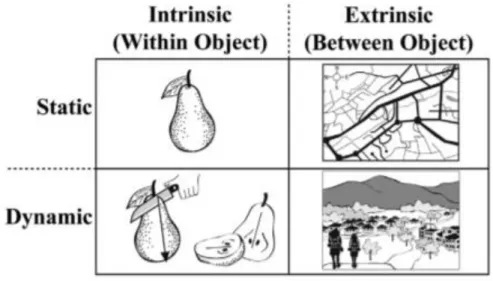
Uttal, Meadow et al. (2012) defined spatial skills by crossing two dimensions – intrinsic versus extrinsic information and static versus dynamic tasks (see Figure 1). Intrinsic information refers “entities” – parts of an object and how they fit together. For
example, how the legs of a dog determine the range of movements for that dog (Verdine et al, 2017a). Extrinsic information refers to how one entity is related to another entity or to an overall structure. For example, where the administration building is located
compared to the education building in a university campus. The second dimension refers to dynamic or static tasks (Verdine et al., 2017a). Figure 1 shows that a pear, by itself, is intrinsic and static, while the pear that’s being sliced is intrinsic and dynamic. People need to develop a distinct set of skills to track, anticipate, and visualize dynamic changes to spatial information. These are different from the skills needed to understand static entities (Kozhevnikov, Hegarty, & Meyer, 2002 as cited in Verdine et al., 2017a; Kozhevnikov, Kosslyn, & Shephard, 2005 as cited in Verdine et al., 2017a).
Furthermore, abilities that involve manipulating information about things in the environment compose spatial skills (Uttal, Meadow et al., 2013 as cited in Verdine et al., 2017a). Spatial thinking is ubiquitous in daily life, yet the educational system does not seem to consider it a top priority. People utilize spatial thinking when they look for their cars in the parking lot; when they pack their bags for a trip and travel to their destination; and when they install a child’s car seat with 70% of people committing critical errors (Decina & Lococo, 2004 as cited in Verdine et al., 2017a). Application of spatial skills ranges from analyzing data from a pie chart to building a sturdy bridge.
Figure 1: The 2 x 2 Classification of Spatial Skills. Uttal, Meadow et al. (2013) defined spatial skills by crossing two dimensions – intrinsic versus extrinsic information and static versus dynamic tasks. Adapted from The malleability of spatial skills: A meta-analysis of training studies by D. H. Uttal, N. G. Meadow, E. Tipton, L. L. Hand, A. R. Alden, C. Warren, & N. S. Newcombe, 2013, Psychological Bulletin, 139(2), 354. doi:10.1037/a0028446.
Unfortunately, there is a dearth of formal training in spatial skills. Consequently, not many people have developed spatial “muscles” for using a map to travel, following directions from a diagram, or drawing the interior of a building (Verdine et al, 2017a). With the ubiquity of spatial thinking in daily life, poor spatial skills can lead to failures like incorrectly reading a diagram on how to put together the parts of a table, getting lost while driving to a business meeting, or following directions on how to replace an ink cartridge. Similar to how people shamelessly admit that they cannot do mathematics, many unabashedly confess that they that they will get lost if they do not have a global positioning system (GPS) in their phones; or that they won’t be able to follow directions for putting together a chair, for example. In contrast, people will be mortified if they tell someone that they cannot read (Verdine et al., 2017a). Interestingly, Jo Boaler (2016)
said something similar when she wrote about how people openly declare that they don’t do mathematics.
The Malleability of Spatial Skills
Although there seems to be no consensus on an all-encompassing meaning of spatial skills, significant evidence from research supports that spatial skills are malleable. This means that through direct and vicarious experiences as well as formal and informal training, spatial skills can develop considerably (Baenninger & Newcombe, 1989 as cited in Uttal & Cohen, 2012; Terlecki, Newcombe, & Little, 2008 as cited in Uttal & Cohen, 2012; Uttal, Meadow et al., 2012; Wright, Thompson, Ganis, Newcombe, & Kosslyn, 2008 as cited in Uttal & Cohen, 2012). The effects of spatial skills training not only lasts over time but the training also helps increase STEM achievement (Uttal & Cohen, 2012).
Uttal and Cohen (2012) conducted a meta-analysis of 206 articles from 1984 to 2009. Of these articles, approximately 52 were unpublished and most of which were dissertations. The first finding from the meta-analysis of the articles that spanned 25 years was that training did improve spatial skills with a moderate effect size of .47. The second finding from this meta-analysis was that the training had lasting benefits based on the delays between the training and the test, some of which were up to four months. The third finding was based on whether the training influenced tasks that differed from the training, per se. The results showed that the overall effect size of the transfer tasks was similar to the overall effect of the training.
The Role of Spatial Thinking in STEM Learning and Achievement
A spatial training that promoted both spatial skills and STEM persistence was the course developed by Sheryl Sorby (1999) and a team of professors at the Michigan
Technological University (MTU). The 10-week course was designed to improve spatial visualization ability (Uttal & Cohen, 2012). After five years of offering this visualization course, the retention rate within the College of Engineering for women increased by 10% and by 6.75% for men (Sorby, 1999).
Inspired by the results of MTU’s visualization course in improving girls’ STEM skills, Sorby (2009) conducted a three-year study on middle school students. The data showed that the middle school students who participated in the visualization training showed higher gains in spatial skills compared with those who did not participate. Another important result was that the girls who had the visualization training chose to take courses in mathematics and science. However, when the study was done with high school students, there was hardly a difference in the number of girls who pursued
mathematics and science. This implied that the ideal time to train girls’ spatial skills is in elementary and middle school.
Further, for more than 11 years, Wai, Lubinski, and Benbow (2009) tracked a stratified random sample of 400,000 high school students and found a positive correlation between spatial abilities and the likelihood of pursuing advanced STEM degrees.
Another important finding from this longitudinal study was that students who have spatial abilities, but not mathematical or verbal abilities have the potential to succeed in STEM-related fields. Unfortunately, these students with spatial skills are overlooked because the current talent search focuses only on mathematical and verbal abilities. Wai et al.
recommended the addition of spatial ability in today’s talent searches to identify the many adolescents who have the potential to succeed in STEM fields but are missed in the current system that focuses on language and mathematics.
Spatial Thinking Skills and Mathematical Skills
For decades, number sense has been identified as essential to children’s
development of mathematics. If children are proficient in basic facts, can use benchmark numbers, and have a conceptual understanding of relationships among numbers, they develop fluency in mathematics. Studies have shown that the development of spatial abilities is extremely important in children’s proficiency in mathematics. To understand relationships between numbers, children need to make the meaning in their own minds. Explicitly teaching them number relationships does not necessarily lead to conceptual understanding of numbers. On the other hand, facilitating activities that require children to identify spatial structures or arrangements without counting the objects develops conceptual understanding of number relationships (Bobis, 2008).
Identifying spatial structures without counting or “instantly seeing how many” is called subitizing (Clements, 1999, p. 400). Although Fitzhugh (1978 as cited in
Clements, 1999) found that children need to learn to subitize first before they can count; Clements (1999) stated others such as Beckwith and Restle (1966), Brownell (1928), Silverman and Rose (1980) contradicted this by saying that children develop subitizing as a shortcut to counting. Regardless of whether subitizing develops before or after
counting, it is still considered fundamental to the students’ conceptual understanding of numbers (Baroody, 1987 as cited in Clements, 1999).
Tartre (1990) concluded in a study of 57 tenth-grade students that spatial
orientation skill seems to be used in solving mathematics problems in different ways such as estimating the size of a figure, mentally moving a figure, and using a visual
1990) hypothesized that the development of spatial skills might help students solve problems in mathematics by visually organizing the given information.
Verdine et al. (2017b) conducted a longitudinal study of three-year preschoolers to find out the following: (a) whether or not spatial skills in 3- and 4-year-olds can be reliably measured; (b) whether or not spatial skills measured at age three predict spatial skills at age five; (c) whether or not preschool spatial skills predict mathematical skills at age five; (d) the factors affecting differences in spatial skills such as socioeconomic status (SES), gender, fine motor skills, vocabulary, and executive function. The
participants took the Test of Spatial Assembly (TOSA) when they were three-, four-, and five-years old. The purpose of the TOSA (Verdine, Golinkoff et al., 2014 as cited in Verdine, 2017b; Verdine, B. N., Irwin, C. M., Golinkoff, R. M., & Hirsh-Pasek, K., 2014 as cited in Verdine, 2017b) was to “capture a spectrum of” the spatial skills of
preschoolers in a way that they can handle (Verdine, Golinkoff et al., 2014 as cited in Verdine et al., 2017b, p. 36). The following were the findings from the three-year study. First, using the TOSA, spatial skills measured at age three were predictive of spatial skills measured at age five. Second, the mathematical skills measured at age three were not predictive of spatial skills at age five. Third, spatial skills measured at age three were predictive of the mathematical skills at age five. These findings were consistent with the finding that training children’s spatial skills resulted in better mathematical skills but not the other way around (Verdine et al, 2017c).
In addition to these findings by Verdine et al. in 2017c, Cheng and Mix (2014) tested whether the mathematics performance of six- to eight-year-old children improved after going through training on mental rotation. The post-test results showed that the
children who participated in the spatial training group increased their performance on calculation problems.
An important implication of these findings is that mathematics instruction in preschool, kindergarten, and the primary grades needs to focus on the development of spatial skills.
The Development of Spatial Skills
Using the findings from the plethora of studies on spatial skills, it almost becomes a moral imperative to include spatial skills training in the curriculum especially in
elementary and middle school. Furthermore, children develop spatial skills when they use their body during the learning experience as purported by the embodied cognition theory, Total Physical Response, and learning by doing. Treagust (1980 as cited in Kahle, 1982) asserted that children with poorly developed spatial abilities need to be taught through movement or concrete ways rather than through abstract means like language.
Chapter Three: Methodology
The participants for this study were conveniently chosen from an elementary school in a nearby district in southern California. Forty-five students from grades 1, 2, and 3 participated in the research through an after-school program offered by the school.
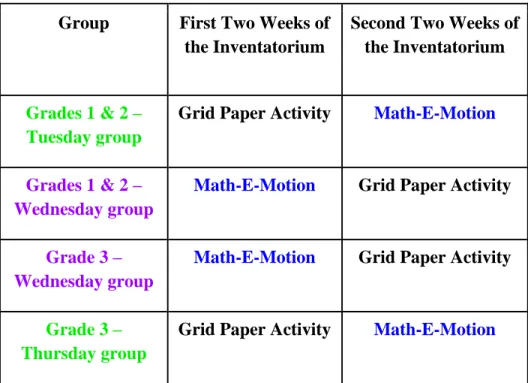
The students were divided into two groups by their grade levels. Grades 1 and 2 students comprised one group and grade 3 students comprised the other group. Within each grade, there were two subgroups. For grades 1 and 2, one group participated on Tuesdays and the other group participated on Wednesdays. For grade 3 students, one group participated on Wednesdays and the other group participated on Thursdays.
Grades 1 and 2 Tuesday group did Grid Paper, a static, non-embodied learning activity for weeks 1 and 2; then for weeks 3 and 4, they did Math-E-Motion, a dynamic, fully embodied learning activity. Grade 3 Thursday group had the same schedule.
Grades 2 and 3 Wednesday group did Math-E-Motion for weeks 1 and 2; and then Grid Paper for weeks 3 and 4.
On day one, all students took the pre-tests. The first test (see Appendix B) was the Object Rotation Test (Thurstone, 1938) and the second test (see Appendix C) was the Spatial Perspective Taking Test (Kozhevnikov & Hegarty, 2001; Hegarty & Waller, 2004).
Group First Two Weeks of the Inventatorium
Second Two Weeks of the Inventatorium
Grades 1 & 2 – Tuesday group
Grid Paper Activity Math-E-Motion
Grades 1 & 2 – Wednesday group
Math-E-Motion Grid Paper Activity
Grade 3 – Wednesday group
Math-E-Motion Grid Paper Activity
Grade 3 – Thursday group
Grid Paper Activity Math-E-Motion
Figure 2: Student Grouping and Schedule of Activities. Shows how the students were grouped and the schedule of the activities in which the students participated.
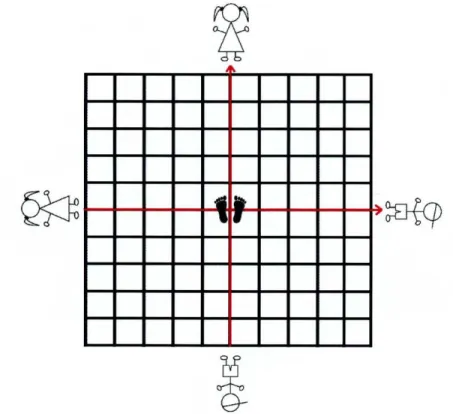
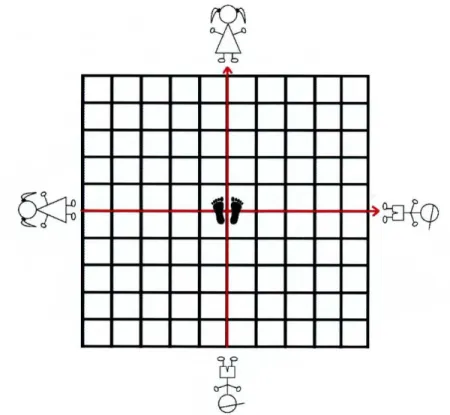
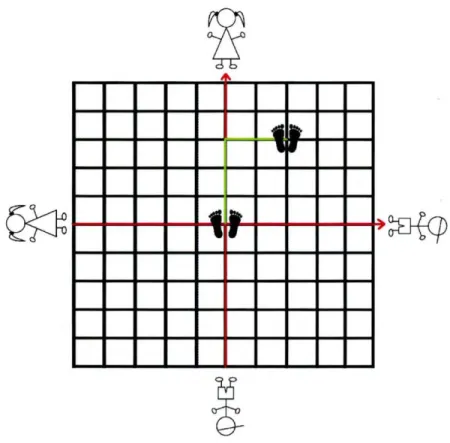
For eight weeks, one day per week, all the students participated in either of the two learning activities. One activity was a static, non-embodied activity called the Grid Paper in which the students participated for two weeks. The other one was a dynamic fully embodied activity called Math-E-Motion (see Appendix A) and the students participated in this learning activity for two weeks. Figure 3 shows the coordinate plane and positions of the four students around the coordinate plane for both Grid Paper and Math-E-Motion.
Figure 3: Math-E-Motion Grid. Is a diagram of the coordinate plane for both Grid Paper and Math-E-Motion. Copied from Inventatorium by Dr. Scott (2016), Manuscript in preparation.
For both Grid Paper and Math-E-Motion, students were in groups of four. One student was called the “jumper” and the other three were the “observers.” If there was a fifth student in the group, that student would be the fourth observer.
The purpose of the learning activity was for the observers to figure out how the jumper moved from the center of the coordinate plane or (0,0) point to where he or she stopped on the coordinate plane. Four students, one on each side, faced the coordinate plane. The three observers chose any of the four sides except the bottom of the y-axis where the jumper should stand.
In addition to one coordinate plane per group, each student had a small whiteboard and a marker. For Grid Paper, the jumper had a small object that he/she
moved on the coordinate plane. For this study, the students used a one-inch tall Lego person.
These were the directions for both learning activities:
1. Either the facilitator or the students choose a jumper from each group. 2. All the observers turn their backs from the grid, so they cannot see the
moves that the jumper makes.
3. The jumper then decides where he/she wants to stop on the coordinate plane and what directions he/she takes to get to that point.
4. The Lego person/jumper always starts on the (0,0) point and faces north on the grid. The jumper decides whether to go forward (F) or backward (B) and then left (L) or right (R); and how many points forward/backward and left/right.
5. The jumper records the directions and the number of points on his/her small whiteboard. For example, if the jumper chooses 3 jumps forward and 5 jumps to the left, he/she records on the whiteboard: 3F (forward)
5L (left) This is a precursor to geometry because the description of the jump has the same format as the slope = y
x
6. With the observers still not facing the grid, the jumper moves the Lego piece (Grid Paper) or jumps (Math-E-Motion) forward/backward or left/right on the coordinate plane. For Grid Paper, the jumper leaves the
Lego piece on the point where he/she has chosen to stop. For Math-E-Motion, the jumper stops on the point he/she has chosen.
7. The observers turn around, face the coordinate plane, and figure out the location of the Lego piece or the jumper.
8. Without changing the way they’re facing the coordinate plane; the
observers figure out the moves that the jumper made in order to reach the point where he/she is. Did the jumper move forward or backward? How many steps or points on y-axis? Did the jumper then move left or right? How many steps or points on the axis? (Note that the terms y-axis and x-axis were not used during the activity. It is used only for the purpose of clarity in this research.)
9. The observers record their guesses using the same format that the jumper used.
10. The jumper then moves the Lego piece or jumps from (0,0) point to reveal his/her answer.
11. The observers compare their answers.
12. The facilitator debriefs with the group to discuss mistakes, if there are any, and why an observer made those mistakes. It is important to discuss with students Jo Boaler’s (2016) research to help students change the way they perceive mistakes. Mistakes were commonly viewed as failures, so students lose confidence when they gave a wrong answer. Boaler explained that mistakes make the brain grow and if a student corrects his/her mistake, the brain grows even more (Boaler, 2016). One purpose
of the debrief session is to help students change the way they view mistakes. Consequently, they do not lose confidence when they fail to accurately identify the jumper’s moves. They look forward to the next round and stay engaged in figuring out the next jumper’s moves. 13. The students move clockwise (or counterclockwise) around the grid, so
the next jumper takes his/her position at the bottom of the y-axis.
After the eighth day of participating in the learning activities, students took the post-tests; the same tests that they took during the pre-test.
The researcher used the paired t test through the SPSS statistics program. By using the paired t test, the researcher was able to compare the means of the pre-test and post-test; then the correlation between the pre-test and post-test was analyzed.
Comparing the mean scores between the pre-test and post-test determined whether or not the use of a dynamic, fully embodied learning activity improves the students’ mental rotation abilities and their spatial perspective taking abilities. Analysis of the correlation between the pre-test and post-test scores determined whether or not the results supported the hypotheses. In addition, comparing the difference in the mean scores of both tests determined if Math-E-Motion improved the students’ spatial perspective taking abilities more than their mental rotation abilities.
Chapter Four: Results
From December 2016 to March 2017, forty-five students from grades 1, 2, and 3 of an elementary school in a nearby southern California district participated in this study through an after-school program. Approximately 92% of the students in this school are socioeconomically disadvantaged and 19% of the students are English Learners.
The researcher and a staff member of the after-school program collaborated in facilitating the activities. The students stayed after school every day and participated in different activities including Grid Paper and Math-E-Motion from December 2016 to March 2017.
This was a quantitative study of the effect of a dynamic, fully embodied learning activity on the development of elementary school students’ mental rotation abilities and spatial perspective taking abilities.
The participants did a static, non-embodied activity (Grid Paper) for two weeks and a dynamic, fully embodied activity (Math-E-Motion) for two weeks. Of the 45 students, only 21 students took both the pre-test and post-test of the Object Rotation Test (see Appendix A) because unlike the regular school day, the after-school program does not require students to attend every day. Therefore, 24 of the 45 students either took only the pre-test, the post-test, or neither of the two tests.
Of the 21 students who took both tests, 14 were girls and seven were boys; and of these students, four were first grade students, 11 were in second grade, and six were third grade students.
Results for Hypothesis 1
This section discusses the results for Hypothesis 1. As discussed in chapter 1, the null hypothesis for Hypothesis 1 was that the use of a dynamic, fully embodied learning activity (Math-E-Motion) has no effect on the students’ mental rotation abilities. The alternative hypothesis for Hypothesis 1 was that the use of a dynamic, fully embodied learning activity (Math-E-Motion) improves the students’ mental rotation abilities.
Table 1 shows the scores of all the students on the Object Rotation Test. Each student is identified by “L” to indicate the grade, a number, and an F for female or an M for male. Twenty out of the 21 students showed an increase in their scores for the Object Rotation Test and one student scored a ten in both pre-test and post-test.
Table 1
Object Rotation Test Results
Student Pre-Test (Dec 2016) Post-Test (March 2017) Difference L1-01-F 2 9 7 L1-02-M 8 No test N/A L3-03-M 7 11 4 L1-04-M No test 12 N/A L2-05-M 7 8 1 L2-06-M 13 13 0 L3-07-M 14 14 0
L2-08-F No test No test N/A
L2-09-F 9 12 3
Table 1 (Cont’d.)
Object Rotation Test Results
Student Pre-Test (Dec 2016) Post-Test (March 2017) Difference L2-11-F 12 No test N/A L3-12-F 10 10 0 L2-14-M 12 No test N/A
L1-15-M No test No test N/A
L3-16-F No test 16 N/A L2-17-F 8 10 2 L3-18-M 16 No test N/A L1-19-F 0 1 1 L3-20-F 12 No test N/A L1-21-F 5 8 3
L1-22-F No test No test N/A
L2-23-M No test No test N/A
L2-24-F 11 14 3
L2-25-F 7 No test N/A
L2-26-M 9 No test N/A
L1-27-M No test No test N/A
L3-28-F 14 16 2
L2-29-F 7 11 4
L2-30-F 12 14 2
L2-31-M 11 13 2
L1-32-M 12 13 1
Table 1 (Cont’d.)
Object Rotation Test Results
Student Pre-Test (Dec 2016) Post-Test (March 2017) Difference L3-34-M 10 No test N/A L2-35-M 11 14 3 L3-36-F No test 8 N/A L2-37-F 6 10 4 L3-38-F 12 15 3
L1-39-F No test No test N/A
L2-40-F 8 10 2
L2-41-F No test No test N/A
L2-42-M No test No test N/A
L1-43-M No test 9 N/A
L1-44-M 13 No test N/A
L3-45-F 6 No test N/A
Student 28, a third-grade female student, earned a perfect score of 16 on the post-test; her pre-test was 14. Student 16, a third-grade female student, also earned a perfect score; unfortunately, she was not able to take the pre-test. Student 10, a third-grade female student, showed the highest increase of 7 points when she got 8 on the pre-test and an almost perfect score of 15 on the post-test.
Table 1 shows that the mean score of the pre-test was 8.90 and mean score of the post-test was 11.4, so the mean score increased by 2.58. Furthermore, there was a high correlation of .855 (p = .000) between the pre-test and post-test.
The increase in mean score by 2.58 and the increase in the scores of 95% of the students support the hypothesis that the use of a dynamic, fully embodied activity (Math-E-Motion) improves the object rotation abilities of elementary students.
Table 2
Object Rotation Test
Paired Samples Statistics
Pair 1 Mean N Std. Deviation Std. Error Mean
Pre (Dec 2016) 8.90 21 3.714 .810
Post (Mar 2017) 11.48 21 3.371 .736
Paired Samples Correlations
Pair 1 N Correlation Sig.
Pre (Dec 2016) & Post (Mar 2017)
21 .855 .000
Results for Hypothesis 2
This section discusses the results for Hypothesis 2. As discussed in chapter 1, the null hypothesis for Hypothesis 2 was that the use of a dynamic, fully embodied learning activity (Math-E-Motion) has no effect on the students’ spatial perspective taking
abilities. The alternative hypothesis for Hypothesis 2 was that the use of a dynamic, fully embodied learning activity (Math-E-Motion) improves the students’ spatial perspective taking abilities.
In addition to the Object Rotation Test, the students also took the Spatial
Of the 45 students scheduled to participate in this study, only 30 students were able to take both the pre-test and post-test.
The other 15 students either took only the pre-test, the post-test, or neither of the tests. Out of the 30 students who took the pre-test and post-test, 17 were girls and 13 were boys. Of the 30 students, eight were first grade, 14 were second grade, and eight were third grade.
Twenty-seven of the 30 students showed an increase in their scores on the Spatial Perspective Taking Test. The difference between the pre-test and post-test ranged from 0 to 20. Because the scores of students 03, 06, 21, 25, and 44 showed a difference of 13 points and higher, for this study, these scores were considered outliers. Possible reasons for a big difference between the students’ pre-test and post-test could be that the student copied from someone or that the student guessed the right answers. With the outliers, the correlation between the pre-test and post-test was .198 (p = .293). Without the outliers, the correlation was .612 (p = .001), so there is a high correlation between the pre-test and post-test.
Table 3
Spatial Perspective Taking Test Results
Student Pre-Test (Dec 2016) Post-Test (March 2017) Difference L1-01-F 5 8 3 L1-02-M 6 No test N/A L3-03-M 2 15 13 L1-04-M 4 12 8
Table 3 (Cont’d.) Student Pre-Test (Dec 2016) Post-Test (March 2017) Difference L2-05-M 6 8 2 L2-06-M 3 17 14 L3-07-M 6 13 7
L2-08-F No test No test N/A
L2-09-F 4 7 3 L3-10-F 16 22 6 L2-11-F 12 No test N/A L3-12-F 3 7 4 L2-14-M 12 No test N/A L1-15-M 8 8 0 L3-16-F 5 8 3 L2-17-F 6 8 2 L3-18-M 16 No test N/A Ll-19-F 5 6 1 L3-20-F 12 No test N/A L1-21-F 1 17 16
L1-22-F No test No test N/A
L2-23-M No test No test N/A
L2-24-F 5 8 3
L2-25-F 3 16 13
L2-26-M 3 No test N/A
L1-27-M No test No test N/A
L3-28-F 8 13 5
Table 3 (Cont’d.) Student Pre-Test (Dec 2016) Post-Test (March 2017) Difference L2-30-F 3 8 5 L2-31-M 8 13 5 L1-32-M 5 10 5
L1-33-M No test No test N/A
L3-34-M 10 No test N/A
L2-35-M 4 14 10
L3-36-F 2 13 11
L2-37-F 2 8 6
L3-38-F 8 8 0
L1-39-F No test No test N/A
L2-40-F 8 8 0
L2-41-F No test No test N/A
L2-42-M 2 7 5
L1-43-M 3 8 5
L1-44-M 4 24 20
L3-45-F 6 No test N/A
Table 4 shows that the mean score of the pre-test on the Spatial Perspective Taking Test was 5.24 and the mean score for the post-test was 9.64. The mean score increased by 4.40 points.
The increase in mean score by 4.40 and the increase in the scores of 90% of the students support the hypothesis that the use of a dynamic, fully embodied activity (Math-E-Motion) improves the spatial perspective taking abilities of elementary students.
Table 4
Spatial Perspective Taking Test
Paired Samples Statistics
Pair 1 Mean N Std. Deviation Std. Error Mean
Pre (Dec 2016) 5.24 25 3.126 .625
Post (Mar 2017) 9.64 25 3.487 .697
Paired Samples Correlations
Pair 1 N Correlation Sig.
Pre (Dec 2016) & Post (Mar 2017)
25 .612 .001
Results for Hypothesis 3
This section discusses the results for Hypothesis 3. As discussed in chapter 1, the null hypothesis for Hypothesis 3 was that there is no difference in the effect Math-E-Motion on the students’ mental rotation abilities and their spatial perspective taking abilities. The alternative hypothesis for Hypothesis 3 was that Math-E-Motion improves the students’ spatial perspective taking abilities more than their mental rotation abilities.
The difference between the pre-test and post-test mean scores of the Object Rotation Test was 2.58, while the difference between the pre-test and post-test mean scores of the Perspective Taking Test was 4.40. The difference in the Perspective Taking Test was 1.82 points higher than the Object Rotation Test. This supports the hypothesis that Math-E-Motion improves the students’ spatial perspective taking abilities more than their object rotation abilities.