© 2014. K. Punnam Chandar & Dr. T. Satyasavithri. This is a research/review paper, distributed under the terms of the Creative Commons Attribution-Noncommercial 3.0 Unported License http://creativecommons.org/licenses/by-nc/3.0/), permitting all non-commercial use, distribution, and reproduction inany medium, provided the original work is properly cited.
Global Journal of Computer Science and Technology:
FGraphics & Vision
Volume 14 Issue 5 Version 1.0 Year 2014
Type: Double Blind Peer Reviewed International Research Journal Publisher: Global Journals Inc. (USA)
Online ISSN: 0975-4172 & Print ISSN: 0975-4350
Pose Invariant Face Recognition using DT-CWT Partitioning and
KPCA
By K. Punnam Chandar & Dr. T. Satyasavithri
Kakatiya University, India
Abstract-
In this paper the suitability of Dual Tree Complex Wavelet Transform for pose invariant Face
Recognition is studied and a feature extraction frame work is proposed. This proposed framework will
aid in design of Face Recognition system to address the challenging issue like Pose Variation. In
contrast to the discrete wavelet Transform (DWT) the design of Dual Tree Complex Wavelet
Transform is rugged to shift Invariance and poses good directional properties. These features of
DT-CWT motivated to study their suitability for Face Feature Extraction, as the features of face are
oriented in different directions. In this proposed frame work the Image is decomposed using DT-CWT
and the features are extracted from low frequency band using Kernel Principal Component analysis
(KPCA). To show the performance, the proposed method is tested on ORL Database. Satisfactory
results are obtained using proposed method compared to existing state of art.
Keywords:
dual tree complex wavelet transform, KPCA, and euclidian classifier.
GJCST-F Classification:
I.4.8 I.7.5
PoseInvariantFaceRecognitionusingDT-CWTPartitioningandKPCA
K. Punnam Chandarα & Dr. T. Satyasavithriσ
In this paper the suitability of Dual Tree Complex Wavelet Transform for pose invariant Face Recognition is studied and a feature extraction frame work is proposed. This proposed framework will aid in design of Face Recognition system to address the challenging issue like Pose Variation. In contrast to the discrete wavelet Transform (DWT) the design of Dual Tree Complex Wavelet Transform is rugged to shift Invariance and poses good directional properties. These features of DT-CWT motivated to study their suitability for Face Feature Extraction, as the features of face are oriented in different directions. In this proposed frame work the Image is decomposed using DT-CWT and the features are extracted from low frequency band using Kernel Principal Component analysis (KPCA). To show the performance, the proposed method is tested on ORL Database. Satisfactory results are obtained using proposed method compared to existing state of art.
Keywords: dual tree complex wavelet transform, KPCA,
and euclidian classifier.
I.
I
ntroductioniometrics comprises methods for unambiguously recognizing individuals based upon physical and behavioral attributes. Face recognition is one of the biometric systems that takes image or video of a person and compares it with images in database to grant access to secure areas. Many researchers showed that the features extracted from face images aid in designing robust security/authentication systems. Successful face recognition system [1] is proposed utilizing Eigen face approach. This method is conventional, considers frontal and clear faces for implementing the system, but in real time faces may not be frontal and device intrinsic capture (illumination variation) properties pose difficulties in the process of detection. Thus in security and other computer vision applications, pose and variation in illuminations plays a critical role.
Conventional Face feature extraction suffers mainly from a. Pose and expression variation ,
b. Resolution variation and c. Illumination problems
In this paper pose problem is addressed using Complex Wavelets [9-10][13] and KPCA to extract Multi scale features towards secure Face Recognition system. Author α: Asst. Professor, Dept. Of ECE, University College of Engineering (KU), Warangal-15, INDIA.
e-mail: [email protected]
To aid the process of recognition, nearest neighborhood classifier [16] is used; this method finds an image to the class whose features are closest to it with respect to the Euclidean norm.
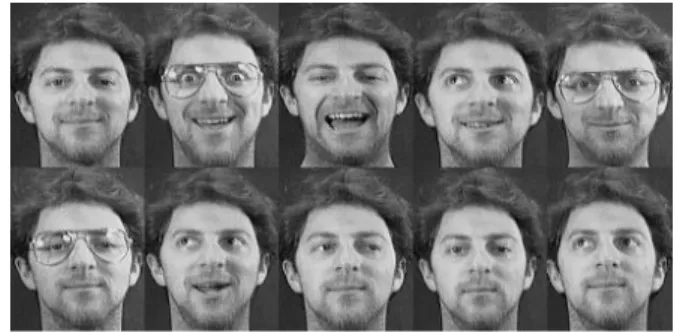
This work uses Dual tree Complex wavelet [15] transform mainly to reduce the computation complexity. In the ORL face database [7] all the images are of size 112 X92, we worked on approximation details of first level decomposition using DT-CWT. The size in first level decomposition reduces to 56 X46.
Figure 1 : Different poses of a subject from ORL face
database
In this paper we used Kernel Principal Component Analysis (KPCA) as feature extraction method [1, 2, 3]. For comparing results Eigenface approach is used for low dimensional representation of faces by applying Principal Component Analysis (PCA). The system functions by projecting face images onto a feature space that spans the significant variations among known face images. The significant features are known as “eigenfaces” because they are eigenvectors (principal components) [1].
The performance of the proposed algorithm is verified on available databases on the internet, such as ORL face database [7]. ORL face database consists of 400 images of 40 individuals; each subject has 10 images in different poses.
This paper is organized into six sections in section II we discussed Dual Tree Complex Wavelet Transform, in section III Feature Extraction and classifier, in section IV proposed face recognition system, in section V, experimental results & discussions, and conclusion in the last section.
B
Global Journal of Computer Science and Technology Volume XIV Issue V Version I
15 (DDDDDDDD ) Year 2014 F
II.
D
ualT
reeC
ompexW
aveletT
ransformThe defects in DWT can be eliminated by using an expansive wavelet transform in place of a
critically-Abstract-
Pose Invariant Face Recognition using DT- CWT
Partitioning and KPCA
sampled one. (An expansive transform is one that converts an N-point signal into M coefficients with M > N).DT-CWT provides N multi scales, can be implemented using separable efficient Filter Banks.
Figure2:Dual Tree Complex Wavelet Transform
working principle for 1D signal
Here two sets of Filter banks are used, consists of low pass and high pass filters. Down sample the input signal by 2 through a filter of H (Z) transfer function and again through G (z) filter. The filters should be Hilbert transform pairs
y
g( )
t
= H
{
y
h( )}
t
(1)The filters in the upper and lower DWTs should not be the same, the filters used in the first stage of the dual-tree complex DWT [4] should be different from the filters used in the remaining stages. The sub band signals of the upper DWT can be interpretedas the real part of a complex wavelet transform, and sub band signals of the lower DWT can be interpreted as the imaginary part. Equivalently, for specially designed sets of filters, the wavelet associated with the upper DWT can be an approximate Hilbert transform of the wavelet associated with the lower DWT. Then designed, the dual-tree complex DWT is nearly shift-invariant and strong directional in contrast with the critically-sampled DWT. The designed filter complex wavelet should be analytic and it is
ψ
c( ) :
t
=
ψ
h( )
t
+
j
ψ
g( )
t
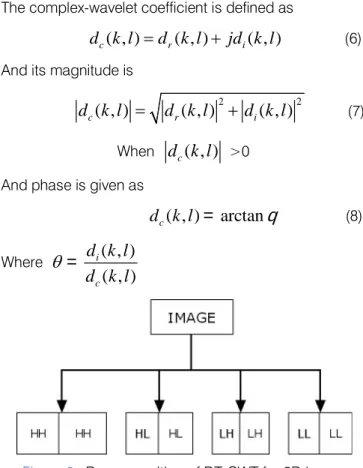
(2)The wavelet coefficients w are stored as a cell array. For j = 1..J, k = 1..2, d = 1..3, w{j}{k}{d} are the wavelet coefficients produced at scale j with an orientation d. The dual-tree complex DWT outperforms well compared to the critically-sampled DWT for applications like image de-noising and enhancement. DT-CWT for image provides six (d=1…..6) directional high frequency sub bands and two (d=1, 2) low frequency sub bands asshown in fig 5.
The 2-D wavelet is defined as
( )
( , )
x y
( )
x
y
y
=
y
y
(3)
y
( )
x
=
y
r( )
x
+
j
y
i( )
y
(4) similarly
ψ
r is real and even and is imaginary and odd. The complex-wavelet coefficient is defined as
d k l
c( , )
=
d k l
r( , )
+
jd k l
i( , )
(6) And its magnitude is2 2
( , )
( , )
( , )
c r id k l
=
d k l
+
d k l
(7) Whend k l
c( , )
>0And phase is given as
d k l
c( , )
=
arctan
q
(8) Where( , )
( , )
i cd k l
d k l
=
θ
Figure3:Decomposition of DT-CWT for 2D image
Key features of DT-CWT are 1. Better directionality 2. Anti-aliasing effect 3. Good shift-invariant
4. Geometry of the image features retained from phase
5. Better robustness for smooth varying
6. Low computation compared with DWT, 3 times that of maximally decimated DWT.
III.
F
eatureE
xtractionandC
lassifiera) Principal Component Analysis
A 2-D facial image can be represented as 1-D vector by concatenating each row (or column) into a long thin vector. Let’s suppose we have M vectors of size N (= rows of image×columns of image)
( ) ( )
( ) ( )
( ) ( )
( , )x y r( ) ( )x r y i x i y j r x i y i x r y
y =y y - y y + éëy y +y y ùû
Global Journal of Computer Science and Technology Volume XIV Issue V Version I
16 (DDDD ) Year 2014 F
representing a set of sampled images.pj’s represent the pixel values.
xi = [p1 : : : pN]T ; i = 1, . . . . , M where
y
( )
x
is complex analytic wavelet, given asThe images are mean centered by subtracting the mean image from each image vector. Let m represent the mean image.
1 1 M i i m x M = =
∑
(9) And let wi be defined as mean centered imagei i
w = −x m
Our goal is to find a set of ei’s which have the largest possible projection onto each of the wi’s. We wish to find a set of M orthonormal vectors ei for which the quantity 2 1 1 ( ) M T i i n n e w M λ = =
∑
(10) is maximized with the orthonormality constraintT
l k lk
e e =δ
It has been shown that the ei’s and ¸λi’s are given by the eigenvectors and eigenvalues of the covariance matrix
C=WWT (11)
where W is a matrix composed of the column vectors wi placed side by side. The eigenvectors corresponding to nonzero eigenvalues of the covariance matrix produce an orthonormal basis for the subspace within which most image data can be represented with a small amount of error. The eigenvectors are sorted from high to low according to their corresponding eigenvalues. The eigenvector associated with the largest eigenvalue is one that reflects the greatest variance in the image. That is, the smallest eigenvalue is associated with the eigenvector that finds the least variance. They decrease in exponential fashion, meaning that the roughly 90% of the total variance is contained in the first5% to 10% of the dimensions.
A facial image can be projected onto M’ ( M)
dimensions by computing Ω = [v1, v2 , , , VM’ ]T b) Kernel Principle Component Analysis
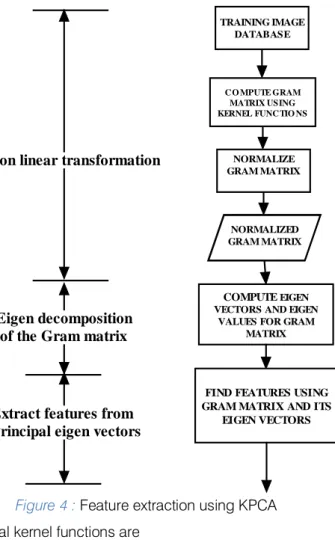
Kernel Principal Component Analysis is another technique used for dimensionality reduction when the data lie on the non-linear manifold .In KPCA data X are first mapped into a high dimensional space F via non linear mapping
Φ
[3]. Assuming that the mapped data are centered, i.e., i1
( )
0
M ix
=Φ
=
∑
, where is M the number of input data (the centering method in F can be found in [10] and [13]). Kernel PCA diagonalizes the estimate of the covariance matrix of the mapped dataΦ
( )
x
i defined as, i i 11
( ). ( )
M iF
x
x
M
==
∑
Φ
Φ
.Polynomial, Exponential and Sigmoid functions are most widely used non linear functions. In this paper we considered only polynomial functions. If the new data set is ‘K’. PCA is now performed in this K.
COMPUTEEIGEN VECTORS AND EIGEN
VALUES FOR GRAM MATRIX TRAINING IMAGE
DATABASE
FIND FEATURES USING GRAM MATRIX AND ITS
EIGEN VECTORS Extract features from
Principal eigen vectors Non linear transformation
Eigen decomposition of the Gram matrix
C O MPUTE GRAM MATRIX USING KERNEL FUNC TIO NS
NORMALIZED GRAM MATRIX
NORMALIZE GRAM MATRIX
Figure 4:Feature extraction using KPCA
Typical kernel functions are
(a) The radial basis function (RBF), defined as K(x, y)= 2 2 0
exp
x
y
(4)
P
−
Where P0 is a user-defined parameter that specifies the rate of decay of k(x, y) toward zero, as y moves away from x and
(b) The polynomial function, defined as K(x, y) =
(
T)
P21
x y P
+
(5)
Global Journal of Computer Science and Technology Volume XIV Issue V Version I
17 (DDDDDDDD ) Year 2014 F
Where P1and P2 are user defined parameters. The following Table.1 gives the effect of kernel
parameters on recognition rate for given number of features.
We used (1, 2) as kernel parameters P1, P2 for
polynomial kernel function. In the paper [3] by Kwangin Kim et.al they used (1, 4) as kernel parameters. Any P2 from 1 to 4 is considerable.
c) Classifier
In this work we have used nearest neighborhood classifier [16] to recognize the image. This classifier comes under minimum distance classifiers. It is also called as Euclidean classifier. In this method the minimum the distance from test feature vectors totrain feature vectors the correct the image is. If Xi, Yj represents test and train image features then
(
) (
T)
i i i i i i i j
X
−
Y
≡
X
−
Y
X
−
Y
<
X
−
Y
(12) *Where||. || represents Euclidean normBecause of its simplicity, it finds an image to the class whose featuresare closest to it with respect to the Euclidean norm.
IV.
P
roposedF
aceR
ecognitionS
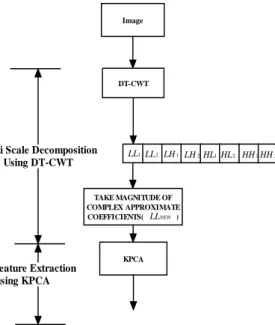
ystemFirst aspect of this work is to use Dual Tree Complex Wavelet transform [9, 10, 13] where multiscale analysis is possible. The decomposition level of the wavelet transform is decided by the imagery details which we need. In this work first level decomposition is satisfactory to preserve the details. The Second and important aspect of this work is to extract the features from the LLNEW using KPCA.
Image
KPCA
Feature Extraction using KPCA Multi Scale Decomposition Using DT-CWT DT-CWT 1 LL LL2LH1 LH2HL1HL2 HH1HH2 TAKE MAGNITUDE OF COMPLEX APPROXIMATE COEFFICIENTS( )LLNEW
Figure 5:DT-CWT Multiscale Feature Extraction
(Proposed Algorithm)
The general procedure of the proposed technique is as follows. As a first step we divide database into testing and training database. Each database consists of 200 images of 40 subjects and 5 different poses. As next step Approximation details of all train images in database including test image are calculated using DT-CWT. The approximation coefficients of first level decomposition are complex numbers. Then we formed new database
LL
NEW withmagnitudes of these complex numbers.
Now the
LL
NEWis processed using KPCA toextract the features Fig.2 shows all the steps of the proposed algorithm and feature Extraction.
Third aspect of this work which is the decision making step to find suitable image. After extracting features for all train images and test image, nearest neighborhood classifier is used to recognize the correct image from database. Face recognition system with proposed algorithm rugged to pose variation is shown in Fig.7. TEST IMAGE PROPOSED ALGORITHM TRAIN IMAGE RESULT CLASSIFIER PROPOSED ALGORITHM FACE DATABASE
Figure 6 : Block diagram of face recognition system
V.
E
xperimentalR
esults &D
iscussionsa) Database
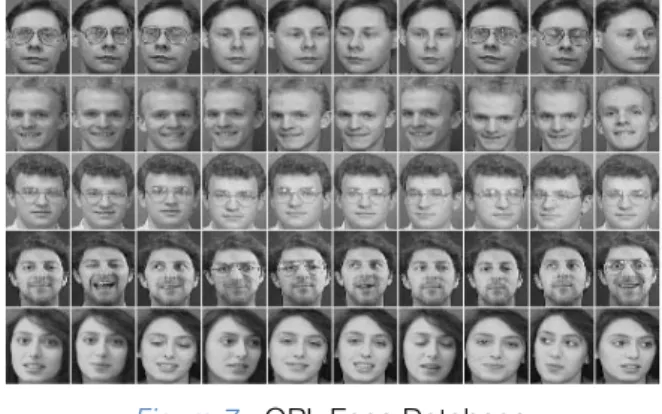
In this work experimentation is carried ORL face databases [7]. The ORL database consists of 400 images of 40 individuals in different poses. Sample images from ORL database are shown in below figure.7, ,Which shows 10 different poses of 5 subjects.
Global Journal of Computer Science and Technology Volume XIV Issue V Version I
18 ( DDDD ) Year 2014 F
Figure 7 : ORL Face Database b) Experimental Results
For evaluating the performance of the proposed algorithm we have used ORL database. Recognition rate was calculated on this database and results are shown in Table 1. The Results are also plotted in figure 7.It is observed from figure that as the number of features increasing the recognition rate is also increasing.
Figure 8 : Recognition Rate vs. Features for ORL face
database
Table 1 : Recognition Rate Calculation On ORL
Database using DT-CWT and KPCA Recognition Rate Calculation by Using Various
Kernel Parameters Features Database (1, 2) (1, 5) (1, 10) (1 , 15) 1 ORL 14.5 12.5 12.5 13.5 3 ORL 69.5 67.5 56.0 49.0 5 ORL 85.0 81.5 68.5 64.0 10 ORL 91.0 89.0 85.0 76.5 20 ORL 91.5 90.5 88.5 82.5 50 ORL 93.5 93.0 89.5 84.5 100 ORL 93.5 92.5 90.5 86.5 VI.
C
onclussionIn this paper we proposed a novel approach for face recognition for pose variant case by extracting the multi scale features by using DT-CWT, KPCA, the algorithm follows top-down approach which process the
image data in each level. In next step, the wavelet decomposition is applied to the entire database to reduce memory occupation. Here only the Low frequency information is used in the identification of the face and the mapping from input space of data to high dimensionality feature space is done by KPCA method along with nearest-neighbor distance classifier which can speed up the recognition process.
Experimentation is carried on openly available challenging face database. The experimental results show that as the feature space increases, the performance increases but the same time computational cost of the algorithm increases. The recognition rate is improved on ORL database. We are working out to find best suitable classifier to enhance the performance again, which is our future work remains.
R
eferencesR
éférencesR
eferencias1. Patil, A.M.; Kolhe, S.R.; Patil, P.M.;"Face Recognition by PCA Technique" Emerging Trends in Engineering and Technology (ICETET), 2009,Page(s): 192 - 195
2. E. Kokiopoulou and Y. Saad "PCA and kernel PCA using polynomial filtering: a case study on face recognition" 2004
3. D.A. MEEDENIYA, D.A.A.C. RATNAWEERA, "Enhanced Face Recognition through Variation of Principle Component Analysis (PCA)", Industrial and Information Systems, 2007. (ICIIS 2007), Page(s): 347 – 352,2007
4. Bruce poon1, m. ashraful amin2, hong yan, "pca based face recognition and testing criteria" Machine Learning and Cybernetics 09 , Page(s): 2945 - 2949,2009
5. Yuzuko UTSUMI, Yoshio IWAI, Masahiko YACHIDA, "Performance Evaluation of Face Recognition in the Wavelet Domain"2006
6. H. Demirel and G. Anbar jafari, “Pose invariant face recognition using probability distribution function in different color channels,” IEEE Signal Process. Lett., vol. 15, pp. 537–540, May 2008.
7. AT&T Laboratories Cambridge, The Database of Faces, formerly ORL face database ,available at www.cl.cam.ac.uk/research/dtg/attarchive/facedata base.html
8. Georghiades, A.S. and Belhumeur, "From Few to Many: Illumination Cone Models for Face Recognition under Variable Lighting and Pose", "IEEE Trans. Pattern Anal. Mach. Intelligence", 2001,vol.23,number 6,pp.643-660.
9. Eleyan, A.; Ozkaramanli, H.; Demirel, H." Dual-tree and single-tree complex wavelet transform based face recognition "IEEE 17th Signal Processing and Communications Applications Conference, 2009. SIU 2009.Page(s): 536 - 539,2009.
Global Journal of Computer Science and Technology Volume XIV Issue V Version I
19 (DDDDDDDD ) Year 2014 F
10. Guo-Yun Zhang; Shi-Yu Peng; Hong-Min Li" Combination of dual-tree complex wavelet and SVM for face recognition" International Conference on Machine Learning and Cybernetics, 2008 .Volume: 5,Page(s): 2815 - 2819,year 2008.
11. Chen, G.Y.; Bui, T.D.; Krzyzak, A," Palmprint Classifi- cation using Dual-Tree Complex Wavelets"IEEE International Conference on Image Processing, 2006 .Page(s): 2645 - 2648,2006.
12. Chen, G.Y.; Xie, W.F."Pattern recognition using dual-tree complex wavelet features and SVM" Canadian Conference on Electrical and Computer Engine- ering, 2005. Page(s): 2053 - 2056,2005.
13. Yigang Peng; Xudong Xie; Wenli Xu; Qionghai Dai,"Face recognition using anisotropic dual-tree complex wavelet packets", 19th International Conference on Pattern Recognition, 2008. ICPR 2008. Page(s): 1 - 4,2008.
14. Celik, T.; Tjahjadi, T." Image Resolution Enhanc- ement Using Dual-Tree Complex Wavelet Transform", IEEE Geo science and Remote Sensing Letters. Page(s): 554 - 557,2010.
15. WAVELET SOFTWARE AT POLYTECHNIC UNIVERSITY, BROOKLYN, NY http://taco.poly.edu/ Wavelet Software/
16. Shi-Qian Wu Li-Zhen Wei Zhwun Fang Run-Wu Li Xiao-Qin Ye "Infrared face recognition based on blood perfusion and sub-block dct in wavelet domain "International Conference on Wavelet Analysis and Pattern Recognition, 2007.VOL 3 PP-1252.
Global Journal of Computer Science and Technology Volume XIV Issue V Version I
20 (DDDD ) Year 2014 F