1 Nelson B. Watts, MD, FACP, MACE; John P. Bilezikian, MD, MACE;
Pauline M. Camacho, MD, FACE; Susan L. Greenspan, MD, FACP, FACE; Steven T. Harris, MD, FACE; Stephen F. Hodgson, MD, FACP, MACE;
Michael Kleerekoper, MD, MACE; Marjorie M. Luckey, MD, FACE; Michael R. McClung, MD, FACP, FACE;
Rachel Pessah Pollack, MD; Steven M. Petak, MD, JD, FACE, FCLM
American Association of Clinical Endocrinologists Medical Guidelines for Clinical Practice are systematically developed statements to assist health-care professionals in medical decision making for specific clinical conditions. Most of the content herein is based on literature reviews. In areas of uncertainty, professional judgment was applied.
These guidelines are a working document that reflects the state of the field at the time of publication. Because rapid changes in this area are expected, periodic revisions are inevitable. We encourage medical professionals to use this information in conjunction with their best clinical judgment. The presented recommendations may not be appropriate in all situations. Any decision by practitioners to apply these guidelines must be made in light of local resources and indi-vidual patient circumstances.
AACE Osteoporosis Task Force
Chair
Nelson B. Watts, MD, FACP, MACE Task Force Members John P. Bilezikian, MD, MACE Pauline M. Camacho, MD, FACE Susan L. Greenspan, MD, FACP, FACE
Steven T. Harris, MD, FACE Stephen F. Hodgson, MD, FACP, MACE
Michael Kleerekoper, MD, MACE Marjorie M. Luckey, MD, FACE Michael R. McClung, MD, FACP, FACE
Rachel Pessah Pollack, MD Steven M. Petak, MD, JD, FACE, FCLM
Reviewers
Donald A. Bergman, MD, FACP, FACE Neil Binkley, MD
Abbreviations:
AACE = American Association of Clinical Endocrinologists; BEL = “best evidence” level; BMD = bone mineral density; DXA = dual-energy x-ray absorptiometry; EL = evidence level; FDA = US Food and Drug Administration; GI = gastrointestinal; ISCD = International Society for Clinical Densitometry; LSC = least significant change; 25(OH)D = 25-hydroxyvitamin D; ONJ = osteonecrosis of the jaw; OPG = osteoprotegerin; PA = posteroanterior; PTH = parathyroid hormone; R = recommendation; RANK = receptor activator of nuclear factor-kb; RANKL = RANK ligand; SD = standard deviation; WHI = Women’s Health Initiative; WHO = World Health Organization
1. INTRODUCTION
Osteoporosis is a growing major public health prob-lem with impact that crosses medical, social, and eco-nomic lines. These guidelines have been developed by the American Association of Clinical Endocrinologists (AACE) with hopes of reducing the risk of osteoporosis-related fractures and thereby improving the quality of life for people with osteoporosis. The guidelines use the best evidence, taking into consideration the economic impact of the disease and the need for efficient and effec-tive evaluation and treatment of postmenopausal women with osteoporosis. The intent is to provide evidence-based
information about the diagnosis, evaluation, and treatment of postmenopausal osteoporosis for endocrinologists, phy-sicians in general, regulatory bodies, health-related organi-zations, and interested laypersons.
2. METHODS FOR DEVELOPMENT OF AACE CLINICAL PRACTICE GUIDELINES FOR POSTMENOPAUSAL OSTEOPOROSIS
Evidence was obtained through MEDLINE searches and other designated reference sources. Expert opinion was used to evaluate the available literature and to grade references relative to evidence level (EL) (Table 1), based on the ratings of 1 through 4 from the 2010 AACE protocol for standardized production of clinical practice guidelines (1). In addition, recommendations were graded A through D, in accordance with methods established by AACE in 2004 (Table 2) (2). Information pertaining to cost-effec-tiveness was included when available.
3. EXECUTIVE SUMMARY OF RECOMMENDATIONS
Each recommendation is labeled “R” in this summary. 3.1. What Measures Can Be Taken to Prevent Bone Loss?
• R1. Maintain adequate calcium intake; use calcium supplements, if needed, to meet minimal required intake (Grade A; “best evidence” level or BEL 1). Table 1
2010 American Association of Clinical Endocrinologists Criteria for Rating of Published Evidencea
Numerical descriptor Semantic descriptor
(evidence level) (reference methods)
1 Meta-analysis of randomized controlled trials
1 Randomized controlled trial
2 Meta-analysis of nonrandomized prospective or case-controlled trials
2 Nonrandomized controlled trial
2 Prospective cohort study
2 Retrospective case-control study
3 Cross-sectional study
3 Surveillance study (registries, surveys, epidemiologic study)
3 Consecutive case series
3 Single case reports
4 No evidence (theory, opinion, consensus, or review) a 1 = strong evidence; 2 = intermediate evidence; 3 = weak evidence; 4 = no evidence.
• R2. Maintain adequate vitamin D intake; supplement vitamin D, if needed, to maintain serum levels of 25-hydroxyvitamin D [25(OH)D] between 30 and 60 ng/mL (Grade A; BEL 1).
• R3. Limit alcohol intake to no more than 2 servings per day (Grade B; BEL 2).
• R4. Limit caffeine intake (Grade C; BEL 3). • R5. Avoid or stop smoking (Grade B; BEL 2). • R6. Maintain an active lifestyle, including
weight-bearing exercises for at least 30 minutes daily (Grade B; BEL 2).
3.2. What Nonpharmacologic Measures Can Be Recommended for Treatment of Osteoporosis? All the foregoing measures plus the following:
• R7. Maintain adequate protein intake (Grade B; BEL 3).
• R8. Use proper body mechanics (Grade B; BEL 1). • R9. Consider the use of hip protectors in individuals
with a high risk of falling (Grade B; BEL 1).
• R10. Take measures to reduce the risk of falling (Grade B; BEL 2).
• R11. Consider referral for physical therapy and occu-pational therapy (Grade B; BEL 1).
3.3. Who Needs to Be Screened for Osteoporosis? • R12. Women 65 years old or older (Grade B; BEL 2).
• R13. Younger postmenopausal women at increased risk of fracture, based on a list of risk factors (see sec-tion 4.5) (Grade C; BEL 2).
3.4. How Is Osteoporosis Diagnosed?
• R14. Use a central dual-energy x-ray absorptiometry (DXA) measurement (Grade B; BEL 3).
• R15. In the absence of fracture, osteoporosis is defined as a T-score of -2.5 or below in the spine (anteroposte-rior), femoral neck, or total hip (Grade B; BEL 2). • R16. Osteoporosis is defined as the presence of a
fracture of the hip or spine (see section 4.4.2) (in the absence of other bone conditions) (Grade B; BEL 3). 3.5. How Is Osteoporosis Evaluated?
• R17. Evaluate for secondary osteoporosis (Grade B; BEL 2).
• R18. Evaluate for prevalent vertebral fractures (see section 4.7.1) (Grade B; BEL 2).
3.6. Who Needs Pharmacologic Therapy?
• R19. Those patients with a history of a fracture of the hip or spine (Grade A; BEL 1).
• R20. Patients without a history of fractures but with a T-score of -2.5 or lower (Grade A; BEL 1).
• R21. Patients with a T-score between -1.0 and -2.5 if FRAX (see section 4.5) major osteoporotic fracture probability is ≥20% or hip fracture probability is ≥3% (Grade A; BEL 2).
Table 2
American Association of Clinical Endocrinologists Criteria for Grading of Recommendations Recommendation
grade Description
A Homogeneous evidence from multiple well-designed randomized controlled trials with sufficient statistical power
Homogeneous evidence from multiple well-designed cohort controlled trials with sufficient statistical power
≥1 conclusive level 1 publications demonstrating benefit >> risk
B Evidence from at least 1 large well-designed clinical trial, cohort or case-controlled analytic study, or meta-analysis
No conclusive level 1 publication; ≥1 conclusive level 2 publications demonstrating benefit >> risk
C Evidence based on clinical experience, descriptive studies, or expert consensus opinion No conclusive level 1 or 2 publications; ≥1 conclusive level 3 publications
demonstrating benefit >> risk
No conclusive risk at all and no conclusive benefit demonstrated by evidence
D Not rated
No conclusive level 1, 2, or 3 publication demonstrating benefit >> risk Conclusive level 1, 2, or 3 publication demonstrating risk >> benefit From Mechanick et al (2).
3.7. What Drugs Can Be Used to Treat Osteoporosis? Use drugs with proven antifracture efficacy:
• R22. Use alendronate, risedronate, zoledronic acid, and denosumab as the first line of therapy (Grade A; BEL 1).
• R23. Use ibandronate as a second-line agent (Grade A; BEL 1).
• R24. Use raloxifene as a second- or third-line agent (Grade A; BEL 1).
• R25. Use calcitonin as the last line of therapy (Grade C; BEL 2).
• R26. Use teriparatide for patients with very high frac-ture risk or patients in whom bisphosphonate therapy has failed (Grade A; BEL 1).
• R27. Advise against the use of combination therapy (Grade B; BEL 2).
3.8. How Is Treatment Monitored?
• R28. Obtain a baseline DXA, and repeat DXA every 1 to 2 years until findings are stable. Continue with follow-up DXA every 2 years or at a less frequent interval (Grade B; BEL 2).
• R29. Monitor changes in spine or total hip bone min-eral density (BMD) (Grade C; BEL 2).
• R30. Follow-up of patients should be in the same facility, with the same machine, and, if possible, with the same technologist (Grade B; BEL 2).
• R31. Bone turnover markers may be used at baseline to identify patients with high bone turnover and can be used to follow the response to therapy (Grade C; BEL 2).
3.9. What Is Successful Treatment of Osteoporosis? • R32. BMD is stable or increasing, and no fractures are
present (Grade B; BEL 2).
• R33. For patients taking antiresorptive agents, bone turnover markers at or below the median value for premenopausal women are achieved (see section 4.9) (Grade B; BEL 2).
• R34. One fracture is not necessarily evidence of fail-ure. Consider alternative therapy or reassessment for secondary causes of bone loss for patients who have recurrent fractures while receiving therapy (Grade B; BEL 2).
3.10. How Long Should Patients Be Treated?
• R35. For treatment with bisphosphonates, if osteopo-rosis is mild, consider a “drug holiday” after 4 to 5 years of stability. If fracture risk is high, consider a drug holiday of 1 to 2 years after 10 years of treatment (Grade B; BEL 1).
• R36. Follow BMD and bone turnover markers during a drug holiday period, and reinitiate therapy if bone
density declines substantially, bone turnover markers increase, or a fracture occurs (Grade C; BEL 3). 3.11. When Should Patients Be Referred to Clinical Endocrinologists?
• R37. When a patient with normal BMD sustains a fracture without major trauma (Grade C; BEL 4). • R38. When recurrent fractures or continued bone loss
occurs in a patient receiving therapy without obvious treatable causes of bone loss (Grade C; BEL 4). • R39. When osteoporosis is unexpectedly severe or has
unusual features (Grade C; BEL 4).
• R40. When a patient has a condition that complicates management (for example, renal failure, hyperpara-thyroidism, or malabsorption) (Grade C; BEL 4). 4. EVIDENCE-BASED DISCUSSION OF
RECOMMENDATIONS
4.1. Definition of Postmenopausal Osteoporosis
Postmenopausal osteoporosis is defined as “a (silent) skeletal disorder characterized by compromised bone strength predisposing to an increased risk of fracture. Bone strength reflects the integration of 2 main features: bone density and bone quality” (3). Although the idea of “bone quality” is conceptually useful (4 [EL 4], 5 [EL 4]), except for bone turnover markers, methods are not currently avail-able for the clinical assessment of other properties of bone that determine bone strength. Thus, for now and the near future, measurement of bone density remains the primary technique for the prefracture diagnosis of osteoporosis and for monitoring treatment.
In 1994, a Working Group of the World Health Organization (WHO) established an operational definition of postmenopausal osteoporosis based on BMD expressed as a T-score (Table 3) (4 [EL 4]). The T-score compares an individual’s BMD with the mean value for young normal persons and expresses the difference as a standard devia-tion (SD) score.
Although the WHO criteria were not intended to serve as references for treatment decisions, they are often used for this purpose. The WHO criteria are also useful for mak-ing public health and health policy decisions. In addition, the WHO criteria are commonly accepted as standards for research purposes in terms of criteria for inclusion in clini-cal trials.
4.2. Background of Postmenopausal Osteoporosis Osteoporosis is a well-defined and growing public health problem. More than 10 million Americans have osteoporosis, and more than 34 million others have low bone mass (6 [EL 4]) and are therefore at increased risk for developing osteoporosis and for fracturing. About 80% of these subjects are women, most of them postmenopausal. At age 50 years, the lifetime risk of developing fractures
is about 39% for white women and 13% for white men (7 [EL 3]). Although white women are most often affected, women of all races and all ethnic origins are at risk for osteoporosis and fracture. Although osteoporosis can also develop in men and younger women, these guidelines are limited to postmenopausal women.
By age 60 years, half of the white women in the United States have osteopenia (low bone mass) or osteoporosis (8 [EL 3]). Low BMD at the femoral neck (T-score of -2.5 or below) is found in 21% of postmenopausal white women, 16% of postmenopausal Mexican American women, and 10% of postmenopausal African American women (8 [EL 3]). The mean femoral neck T-score for 75-year-old women is -2.5 (9 [EL 3]). More than 20% of postmeno-pausal women have prevalent vertebral fractures (10 [EL 3]).
In 2005, 2 million fractures were attributed to osteo-porosis (Fig. 1) (11 [EL 3]). Of these, 71% occurred in women. The direct cost was approximately $17 billion, 94% of which was attributable to fractures at nonvertebral sites (Fig. 2); 57% was spent on inpatient care, 30% was spent on long-term care, and 13% was spent on outpatient care (11 [EL 3]). This figure does not include lost produc-tivity, unpaid caregiver time, transportation, and social
services. Many more women have osteoporotic fractures (1.4 million) (11 [EL 3]) than new strokes (373,000) (12 [EL 3]), heart attacks (345,000) (12 [EL 3]), or invasive breast cancer (213,000) (13 [EL 3]) combined, according to recent statistics (2004 to 2006) (Fig. 3).
Among all osteoporotic fractures, hip fractures are the most serious. The mortality during the first year after hip fracture is more than 30% for men and about 17% for women (14 [EL 2]). More than half of hip fracture survi-vors will require skilled care away from their homes, and many will have some degree of permanent disability (15 [EL 2]). Vertebral and forearm fractures are also associated with a major socioeconomic impact. Vertebral fractures cause about 70,000 hospital admissions annually (16 [EL 3]) and generate more than 66,000 office visits (17 [EL 3]). Chronic pain and deformity are common, and surgical intervention is sometimes required (7 [EL 3]). Fractures of the forearm generate about 530,000 office visits annually (17 [EL 3]) and also often result in substantial disability (18 [EL 3]).
By the year 2050, the number of people beyond age 65 years in the United States will increase from 32 mil-lion to 69 milmil-lion, and more than 15 milmil-lion people will exceed 85 years of age (11 [EL 3]). The incidence of hip Table 3
World Health Organization Criteria for Classification of Osteopenia and Osteoporosis
Category T-score
Normal -1.0 or above
Low bone mass (osteopenia)a Between -1.0 and -2.5
Osteoporosis -2.5 or below
a Fracture rates within this category vary widely. The category of
“osteopenia” is useful for epidemiology studies and clinical research but is problematic when applied to individual patients and must be combined with clinical information to make treatment decisions.
Fig. 1. Fractures attributable to osteoporosis in the United States in 2005. Distribution by skeletal site is shown. Adapted from Burge et al (11).
Fig. 2. Cost of osteoporosis-related fractures in the United States in 2005. The primary site of involvement was the hip, and the preponderance of cost was for inpatient care. Adapted from Burge et al (11).
and spine fractures increases with advancing age. From 2005 to 2025, investigators estimate that the number of osteoporosis-related fractures will increase from 2 million to 3 million, and the associated cost will increase from $17 billion to $25 billion (11 [EL 3]).
Early efforts to address osteoporosis and resulting fractures focused primarily on diagnosis, evaluation, and treatment, strategies that resulted in several major accom-plishments. Important risk factors and secondary causes of osteoporosis were identified, and diagnosis and case finding were improved when Medicare abandoned its pro-hibition against osteoporosis screening in the late 1990s. Bisphosphonate therapy was shown to reduce fracture incidence and to have a salutary effect on bone loss. More recently, the availability of an anabolic treatment (teripara-tide) has added to the therapeutic armamentarium.
Despite progress on several fronts, there is still room for improvement. Age-adjusted rates for hip frac-ture declined between 1980 and 2006, by 1.4% per year in women and 0.06% per year in men (19 [EL 3]). This decline seems even more significant in that the rate of fatal falls among elderly white women during the same period increased from 20.3 to 32.8 per 100,000 population—an increase of 61.6% (20 [EL 3]).
The reasons for these changes are not clear, but authors have speculated that the increase in falls was due to an increase in life expectancy (from 75.5 years in 1993 to 77.6 years in 2003) (20 [EL 3]) and therefore an increase in the susceptible population. They have further suggested that the dramatic decline in hip fracture admissions among white women is related, at least in part, to effective screen-ing and therapy (20 [EL 3]). Similar decreases in fracture
risk have been reported in Canada (21 [EL 3]), Finland (22 [EL 3]), Sweden, Australia, and Switzerland (23 [EL 3], 24 [EL 2], 25 [EL 3]).
Despite these advances, less than a third of the cases of osteoporosis have been diagnosed (26 [EL 2]), and only a seventh of the American women with osteoporosis receive treatment (27 [EL 3]).
4.3. Pathogenesis and Pathophysiology of Postmenopausal Osteoporosis
Low bone mass and skeletal fragility in adults may be the result of low peak bone mass in early adulthood, exces-sive bone loss in later life, or both.
The skeleton is constantly changing throughout life. During childhood and adolescence, it changes in size, shape, and constituents by a process known as model-ing. Change in shape and size is complete with epiphy-seal closure at the end of puberty, followed by a period of consolidation for 5 to 10 years (depending on the skeletal site) until peak adult bone mass is attained, which usually occurs in the late teens or early 20s (28 [EL 2], 29 [EL 3]).
Approximately 70% to 80% of peak bone mass is genetically determined. Several genetic markers have been identified (30 [EL 2], 31 [EL 4], 32 [EL 3], 33 [EL 2]). Many nongenetic factors contribute, including nutri-tion (for example, calcium, phosphate, protein, and vita-min D), load-bearing activity, and hormones involved in growth and puberty. In addition, certain genetic diseases, such as osteogenesis imperfecta, result in low peak adult bone mass and abnormal bone quality, but discussion of these uncommon disorders is outside the scope of these guidelines.
Fig. 3. Comparative incidences of osteoporosis-related fractures, new strokes, heart attacks, and invasive breast cancer in women in the United States, based on recent statistics (2004 to 2006). Data from Burge et al (11), Rosamond et al (American Heart Association Statistics Committee and Stroke Statistics Subcommittee) (12), and American Cancer Society (13).
Once peak adult bone mass has been reached, a process called skeletal remodeling takes over, in which old bone is replaced by new bone. Remodeling is governed by the actions of osteoclasts that resorb old bone and osteoblasts that produce new bone. Much is known about the recruit-ment and activity of these cells, including the involverecruit-ment of systemic hormones and local cytokines. Recently, the receptor activator of nuclear factor-kb (RANK), its ligand RANKL, and a decoy receptor, osteoprotegerin (OPG), have emerged as major local regulators of bone remodel-ing (34 [EL 4]). RANKL, synthesized by osteoblasts and stromal cells and present in the bone microenvironment, binds to RANK, expressed in osteoclast progenitor cells in the bone marrow, and promotes osteoclastogenesis. OPG is also synthesized by osteoblasts and stromal cells and serves as a decoy receptor for RANKL, preventing the binding of RANKL to RANK. Regulation of osteoclast activity depends, at least in part, on the balance between RANKL and OPG. The relative amount of these 2 molecules is governed, in turn, by systemic hormones (for example, estrogen), local factors (such as interleukin-6 and tumor necrosis factor), and perhaps other factors as well. The trig-gering mechanisms that stimulate the cascade of activities that lead to remodeling of site-specific quantities of bone are not known. It is well documented, however, that this bone remodeling process is in balance (that is, the rate of bone formation equals the rate of bone resorption) through at least the fifth decade of life in healthy individuals. Up to this age, there is generally little net loss or gain of bone. Wnt signaling is an important pathway that influences osteoblastic bone formation. It is complex and involved in many physiologic systems beyond just the skeleton. A detailed description of this pathway is beyond the scope of these guidelines, but the key components that have thus far been most studied with respect to skeletal physiology include the frizzled family of G protein-coupled receptor proteins, low-density lipoprotein receptor-related protein 5 encoded by the LRP5 gene and associated with high bone mass in affected families, cathepsin K, Dikkopf-related protein 1, and sclerostin.
In women, the hormonal changes that occur through-out perimenopause and the immediate postmenopausal years stimulate RANKL production (both directly and indirectly), leading to accelerated bone loss. Most data suggest that the bone turnover rate (and bone loss) acceler-ates 3 to 5 years before the last menstrual period and slows again 3 to 5 years after the last menstrual period. With the accelerated bone turnover rate, bone balance is disturbed because there is greater net loss than gain in each of the bone remodeling units that are activated. The mean rate of bone loss during this period is about 1% per year, or about 10% during the menopausal transition.
In contrast to menopause-associated bone loss, age-related bone loss begins in the sixth decade of life in men and women and proceeds at a slower rate, about 0.5% per year. Although age-related bone loss involves the same imbalance in the bone remodeling unit as occurs in the menopause-related bone loss, the initiating process is not as clear.
In conjunction with loss of bone mass due to meno-pause or aging, there are also changes in bone quality. The somewhat nebulous concept of bone quality includes dis-ruption of the microarchitectural elements of cancellous (trabecular) bone, expansion of the periosteal envelope and trabecularization of the endocortex (that is, cortical thin-ning), decrease in the degree of mineralization of individ-ual skeletal elements, and likely other as yet unknown fac-tors (5 [EL 4]). Newer technologies for monitoring these architectural changes are being introduced into the research arena but are not yet generally available. Additionally, although therapies that slow the bone remodeling pro-cess (antiresorptive drugs, also called anticatabolic drugs) appear to have a limited effect on cortical bone, anabolic therapies seem to minimize and possibly reverse these adverse effects of aging on the cortical envelope. As is the case with trabecular microarchitecture, techniques for monitoring these changes longitudinally are still limited to the realm of research. Nonetheless, the importance of this abnormality in cortical bone has been well established in cross-sectional studies.
Many factors, including nutrition, vitamin D, exercise, smoking, and the presence of other diseases and medica-tions (Table 4), can influence the rate of bone loss and the risk of fractures in individuals. Nutrition is important during aging as well as during bone growth. In particular, vitamin D deficiency, whether isolated or associated with more generalized undernutrition, has reached almost epi-demic proportions throughout the world. Although severe vitamin D deficiency impairs mineralization of the skel-eton, even mild to moderate vitamin D deficiency reduces calcium absorption and can lead to parathyroid hormone (PTH)-mediated increases in bone resorption. Vitamin D deficiency also causes impairment of muscle strength and balance, leading to an increased risk of falling.
Most osteoporosis-related fractures are the result of falls, which probably have as important a role in the patho-genesis of osteoporosis-related fractures as many of the pathways already discussed. Risk factors for falls are sum-marized in Table 5. A fragility fracture is defined as a frac-ture that results from trauma less than or equal to that from a fall from a standing height and almost always indicates decreased skeletal strength. There is increasing evidence that patients who have low bone mass are also at increased risk for fracture after more extensive trauma (35 [EL 2]).
4.4. Clinical Features and Complications of Postmenopausal Osteoporosis
4.4.1. Low Bone Mass
Low bone mass—as assessed clinically by measure-ments showing low BMD—is a major characteristic of postmenopausal osteoporosis. A strong inverse relation-ship exists between BMD and risk of fracture. Therefore, low BMD is a major indicator of fracture risk in women without fractures, although it is important to realize that individual patients may sustain fractures at different BMD levels and that factors other than bone density influence
fracture risk (Table 5). Low BMD and bone loss are not associated with symptoms before occurrence of a fracture.
4.4.2. Fracture
Fracture is the single most important manifestation of postmenopausal osteoporosis. Osteoporosis-associated fractures may occur in any bone but are most likely to occur at sites of low BMD and are usually precipitated by a fall or injury. Vertebral compression fractures, however, may occur during routine daily activities, without a spe-cific fall or injury. In clinical practice, it may be difficult or impossible to reconstruct the mechanical force applied to bone in a particular fall.
Hip fractures are the most serious complication of osteoporosis. Half of the patients who could walk indepen-dently previously are unable to do so 1 year after a hip frac-ture. Women with hip fracture have an increased mortal-ity of 12% to 20% during the subsequent 2 years, whereas Table 4
Some Factors That May Accelerate Bone Loss Endocrine disorders Hyperthyroidism Hypopituitarism Hypogonadism Cushing disease Primary hyperparathyroidism Gastrointestinal disorders Celiac disease
Short bowel syndrome
Hematologic disorders
Multiple myeloma Systemic mastocytosis
Renal disorders
Chronic renal failure Idiopathic hypercalciuria Neuromuscular disorders Muscular dystrophy Paraplegia, quadriplegia Proximal myopathy Medications Corticosteroids Proton pump inhibitors Antiepilepsy drugs
Medroxyprogesterone acetate (Depo-Provera) Selective serotonin reuptake inhibitors Thiazolidinediones
Thyroxine in supraphysiologic doses Excess vitamin A
Aromatase inhibitors
Androgen deprivation therapy
Nutritional deficiencies
Calcium Vitamin D Protein
Table 5
Some Factors That Increase Risk of Falling and Fracture Neurologic disorders Parkinson disease Proximal myopathy Peripheral neuropathy Prior stroke Dementia
Impaired gait or balance (or both)
Autonomic dysfunction with orthostatic hypotension Impaired vision
Impaired hearing
Frailty and deconditioning Sarcopenia
Medications
Sedatives and hypnotics Antihypertensive agents Narcotic analgesics Environmental factors Poor lighting Stairs Slippery floors
Wet, icy, or uneven pavement Uneven roadways
Electric or telephone cords Pets—small or large Throw rugs
men with hip fracture have an increased mortality of approximately twice that. More than 50% of the survivors are unable to return to independent living; many require long-term nursing home care (36 [EL 4]). Important sec-ondary complications of fractures are itemized in Table 6. Potential complications as well as physical manifestations of vertebral fractures are listed in Table 7 (37 [EL 3]). 4.5. Risk Factors for Postmenopausal Osteoporosis
For years, it has been quite clear that measurement of bone density is a good assessment technique but not enough. Clinical risk factors can be used to assess fracture risk, with or without bone density results. In February 2008, a tool called FRAX was released by WHO (38 [EL 4]) and is available online at www.shef.ac.uk/FRAX. FRAX is the best effort to date to incorporate risk factors into determi-nation of fracture risk and is more effective in conjunction with BMD than without. Important risk factors—risks that are amenable to intervention—can be determined easily. FRAX can be used for men as well as women and is vali-dated globally, with output and utility of results adaptable to individual populations or regional/national standards, but there are also major limitations (39 [EL 4], 40 [EL 4]).
4.5.1. Risk Factors for Low Bone Mass
Age and body weight (or body mass index) correlate with BMD in older adults. Algorithms that incorporate these indices are available to predict BMD but are not suf-ficiently sensitive for diagnosis or exclusion of osteopo-rosis (41 [EL 4]). Only BMD measurements can identify patients who have low bone mass. BMD testing is the best way to identify patients at risk for fracture before the first fracture occurs, but the use of BMD can be enhanced by the addition of information about clinical risk factors.
4.5.2. Risk Factors for Fractures
Assessment of risk factors for fractures may be useful for identifying individuals at high risk of fractures, height-ening clinical awareness of osteoporosis, and developing strategies for treatment of osteoporosis and prevention of fracture.
No single risk factor is sufficient for predicting total fracture risk. Only by assessing a combination of risk fac-tors can reliable estimates of fracture risk be made (42 [EL 2]). Important risk factors for osteoporosis-related frac-tures are outlined in Table 8.
A low-trauma fracture as an adult (45 years of age or older) is associated with a 1.8-fold increased risk of sub-sequent fracture (range, 1.6 to 1.9), after adjustment for BMD (43 [EL 2]). A prior vertebral fracture is associated with a 4-fold to 5-fold increased risk of subsequent fracture (44 [EL 4]).
For every SD decrease in age-adjusted BMD, overall fracture risk increases by about 2-fold (range, 1.6-fold to 2.6-fold) (45-47 [EL 2]). Hip BMD predicts hip fracture better than does BMD at other sites (relative risk = 2.6/ SD), but reduced bone density at any skeletal site predicts potential fracture not only at that site but also at other sites. The risk of most fragility fractures increases progressively with advancing age. The relationship between BMD and fracture risk is significantly affected by age. For any given BMD value, older adults are at higher risk of fracture than are younger adults, as shown in Figure 4 (48 [EL 1]). Many other factors have been found to correlate with an increased risk of fracture. Although the strength of these individual associations with fracture risk is small, they may be impor-tant in individual patients.
Because many patients with osteoporosis have coex-isting causes of bone loss (Table 9), the fracture risk profile must consider secondary osteoporosis (see section 4.8).
4.5.3. Risk of Falling
Falls magnify the risk of fractures due to other fac-tors and are the proximate cause of most fractures in older adults (49 [EL 2]). Factors that increase the risk of falls and fractures are shown in Table 5.
Table 6
Important Complications of Fractures Pain
Deformity Disability
Physical deconditioning attributable to inactivity Changes in self-image
Table 7
Potential Complications of Vertebral Fractures Loss of height
Increased occiput-to-wall distance Decreased rib-to-pelvis distance Kyphosis (dowager’s hump)
Crowding of internal organs (especially gastrointestinal and pulmonary) Back pain (acute and chronic) Prolonged disability
Poor self-image, social isolation, depression Increased mortality
4.6. Lifestyle and Nonpharmacologic Measures for Bone Health
A “bone healthy” lifestyle (adequate dietary calcium and vitamin D, exercise, avoidance of tobacco, and so forth) is important for everyone—babies, children, teenag-ers, young adults, and patients with osteoporosis. Patients with osteoporosis may also benefit from physical therapy and other nonpharmacologic measures to strengthen bones and reduce fracture risk. Goals include the following: • Optimize skeletal development and maximize peak
bone mass at skeletal maturity
• Prevent age-related and secondary causes of bone loss • Preserve the structural integrity of the skeleton • Prevent fractures
4.6.1. Good General Nutrition
In addition to ensuring adequacy of calcium and vita-min D, a balanced diet throughout life is important for bone health. Among young adults, anorexia nervosa and intense aerobic exercise have been associated with delayed menarche and delayed or lower peak bone mass (50 [EL 4]). This outcome may also prevail among adults who are consuming restrictive diets for weight loss or who have surgically induced weight loss. Adequate protein intake (the recommended daily protein dietary allowance in the United States is 0.8 g/kg) helps minimize bone loss among patients who have sustained hip fractures (51 [EL 4]). In one study, patients with hip fracture who received supple-mental protein had shorter hospital stays and better func-tional recovery (52 [EL 1]).
4.6.2. Calcium
Adequate calcium intake is a fundamental aspect of any osteoporosis prevention or treatment program and a
lifestyle issue for healthy bones at any age (Grade A; BEL 1). The recommended daily calcium intake for various populations is outlined in Table 10 (53). For women 50 years old or older, the recommended daily calcium intake is 1,200 mg. This represents the total calcium intake (diet plus calcium supplements, if applicable). When dietary intake is insufficient, calcium supplementation may be needed. Although many of the effects of increasing cal-cium intake on the developing skeleton are incompletely understood, it is well recognized that supplemental cal-cium increases bone mass in physically active children and adolescents (54-58 [EL 1-2]).
Examining a dietary history to assess calcium intake is important. The average calcium intake for adults is about half of what is recommended, with a median of approximately 600 mg/d in comparison with the goal of 1,200 mg daily (59 [EL 3]). Patients with insufficient dietary calcium intake should either change their diet or receive calcium supplements. Numerous calcium supple-ments are available. Calcium carbonate is generally the least expensive and necessitates use of the fewest tablets. Calcium carbonate, however, may cause gastrointestinal (GI) complaints (constipation and bloating) and, in the absence of secretion of gastric acid, must be taken with meals for adequate absorption. (All calcium preparations are generally better absorbed when taken with food.) Calcium citrate is often more expensive than calcium car-bonate and necessitates the use of more tablets to achieve the desired dose; however, its absorption is not dependent on gastric acid, and it may be less likely to cause GI com-plaints. For optimal absorption, the amount of calcium should not exceed 500 to 600 mg per dose, irrespective of the calcium preparation. For patients requiring more than 600 mg of calcium supplement daily, the dose should be divided.
Table 8
Selected Risk Factors for Osteoporosis-Related Fractures Prior low-trauma fracture as an adult Advanced age
Low bone mineral density
Low body weight or low body mass index (not significant if adjusted for bone mineral density) Family history of osteoporosis
Use of corticosteroids Cigarette smoking
Excessive alcohol consumption Secondary osteoporosis (for example,
rheumatoid arthritis)
Fig. 4. Ten-year probability of symptomatic osteoporotic frac-ture in adults 50 to 80 years old. The horizontal axis displays bone mineral density shown as T-scores. Adapted from Kanis et al (48).
Calcium requirements increase among older persons; thus, the elderly population is particularly susceptible to calcium deficiency. Factors that lead to calcium deficiency include decreased intestinal absorption of both calcium and vitamin D and renal insufficiency that leads to decreased activation of vitamin D. Patients with GI malabsorption, those who are taking high-dose glucocorticoids, those who have diminished gastric acid production (for example, with a history of gastric bypass, with pernicious anemia, or with use of proton pump inhibitors), those receiving anti-epilepsy drugs, and even those with asymptomatic celiac disease are particularly predisposed to calcium and vita-min D deficiency. Consideration should be given to labora-tory assessment of adequacy of calcium and vitamin D in patients who are candidates for pharmacologic therapy. Calcium supplementation has been shown to increase BMD slightly, but no scientific evidence supports its abil-ity to reduce fracture risk, independent of vitamin D. The lack of evidence of an independent effect of calcium on fracture risk reduction is likely due, in part, to problems with study design and patient compliance (60-63 [EL 1]). A large study raised concerns about the risk of nephrolithi-asis from calcium supplementation (62 [EL 1]); however, hypercalciuria may worsen with calcium supplementation,
and participants in the study were not evaluated for renal calcium wasting. Moreover, the absolute risk of kidney stones was small (2.5% in the calcium-supplemented group versus 2.1% in the control group). In addition, in these study subjects, the mean total calcium intake from diet and supplements was higher than currently recom-mended. Generally, healthy persons should not require more than 1,000 mg of calcium supplements daily. Patients with a history of nephrolithiasis should be evaluated for the cause of renal stone formation or hypercalciuria before a decision is made about calcium supplementation.
4.6.3. Vitamin D
It is important to ensure sufficiency of vitamin D among children and adults to prevent osteoporosis (Grade A; BEL 1). Most “healthy” adults have serum 25(OH)D levels that are lower than desirable (64 [EL 2]). Vitamin D is not widely available in natural food sources. It is pri-marily found in fish oils (including cod liver oil), forti-fied milk, cereals, and breads. Vitamin D is produced in the skin by exposure to sunlight that is not blocked by sunblock agents, but not in northern or southern latitudes during winter. The National Academy of Sciences recom-mends 400 IU of vitamin D per day for normal adults 51 Table 9
Some Causes of Secondary Osteoporosis in Adultsa
Nutritional/ Disorders of
Endocrine or gastrointestinal collagen
metabolic causes conditions Drugs metabolism Other
Acromegaly Alcoholism Antiepilepticsb Ehlers-Danlos syndrome AIDS/HIV
Diabetes mellitus Anorexia nervosa Aromatase inhibitors Homocystinuria due to Ankylosing spondylitis
Type 1 Calcium deficiency Chemotherapy/ cystathionine deficiency Chronic obstructive
Type 2 Chronic liver disease immunosuppressants Marfan syndrome pulmonary disease
Growth hormone deficiency Malabsorption syndromes/ Depo-Provera Osteogenesis imperfecta Gaucher disease
Hypercortisolism malnutrition (including Glucocorticoids Hemophilia
Hyperparathyroidism celiac disease, Crohn Gonadotropin-releasing Hypercalciuria
Hyperthyroidism disease, and gastric hormone agonists Immobilization
Hypogonadism resection or bypass) Heparin Major depression
Hypophosphatasia Total parenteral nutrition Lithium Myeloma and some
Porphyria Vitamin D deficiency Proton pump inhibitors cancers
Pregnancy Selective serotonin Organ transplantation
reuptake inhibitors Renal insufficiency/
Thiazolidinediones failure
Thyroid hormone (in Renal tubular acidosis
supraphysiologic Rheumatoid arthritis
doses) Systemic mastocytosis
Warfarin Thalassemia
a AIDS = acquired immunodeficiency syndrome; HIV = human immunodeficiency virus.
to 70 years old and 600 IU/d for those above 70 years old. Many experts now believe that these recommendations are too low (65 [EL 4]). For adults 50 years old or older, the National Osteoporosis Foundation recommends 800 to 1,000 IU of vitamin D per day, but many experts recom-mend more–1,000 to 2,000 IU per day (see http://www. aace.com/alert/alert11302010.php) [4,000 IU per day is the “safe upper limit” (53)]—and some patients require considerably more supplementation to achieve desirable levels. Home-bound individuals with limited mobility, patients who have intestinal malabsorption, or those who are receiving long-term anticonvulsant or glucocorticoid therapy are particularly at risk for vitamin D deficiency. The currently accepted minimal level for 25(OH)D ade-quacy is 30 to 32 ng/mL, on the basis of a growing body of evidence indicating that secondary hyperparathyroidism is increasingly common as 25(OH)D levels decline below 30 ng/mL (60 [EL 1]) and that fractional calcium absorp-tion improves with vitamin D supplementaabsorp-tion in patients with levels below 30 ng/mL but not in patients with levels above 30 ng/mL. A reasonable upper limit, based on levels in sun-exposed healthy young adults, is 60 ng/mL (66 [EL 3]).
A meta-analysis of studies in postmenopausal women found a significant reduction in hip and nonvertebral frac-tures with vitamin D supplementation at doses of 700 to 800 IU/d or more (67 [EL 2]). The Women’s Health Initiative (WHI) study showed a small but significant increase in hip BMD (1%) in the group of patients who received 1,000 mg of calcium and 400 IU of vitamin D per day (62 [EL 1]). In addition to the skeletal effects of vitamin D, studies have
also shown improvement in muscle strength, balance, and risk of falling (68-70 [EL 2]) as well as improvement in survival (71 [EL 2]).
Vitamin D supplements are available as ergocalciferol (vitamin D2) and cholecalciferol (vitamin D3) in strengths up to 50,000 IU per tablet. With daily dosing, vitamin D2 and D3 appear to be equally potent (72 [EL 1]), but with intermittent (weekly or monthly) dosing, vitamin D3 appears to be about 3 times more potent than vitamin D2(73 [EL 2]). Blood levels of 25(OH)D provide the best index of vitamin D stores. A desirable range is between 30 and 60 ng/mL, although levels up to 100 ng/mL are unlikely to result in vitamin D toxicity. Many people require vita-min D supplements of 2,000 IU per day or more to achieve desirable levels. (Cholecalciferol, 1,000 IU daily, will raise blood levels, on average, by approximately 10 ng/mL.)
4.6.4. Other Dietary Supplements
Patients frequently inquire about the need for mag-nesium supplementation. No randomized controlled study has been done to show that the intake of magnesium decreases fracture risk or increases BMD. One study showed that adding 789 to 826 mg of magnesium per day did not increase the rates of calcium absorption (74 [EL 1]). Individuals who are at risk for hypomagnesemia (for example, those who have GI malabsorption or chronic liver disease [alcoholics]), however, may benefit from magne-sium supplementation. Magnemagne-sium may help prevent constipation, which is sometimes associated with calcium supplementation.
Excessive intake of vitamin A (more than 10,000 IU daily) should be avoided because this has been shown to have detrimental effects on bone (75 [EL 4]). In contrast, published data have shown that vitamin K (1 mg/d) may reduce bone turnover and bone loss in postmenopausal women (76 [EL 1]). Further studies need to confirm this finding before this strategy can be part of the standard rec-ommendations for prevention of osteoporosis.
“Natural” estrogens (isoflavones) are promoted to pre-vent bone loss. No conclusive data, however, support the use of these agents for increasing bone density or decreas-ing fracture risk (77 [EL 1], 78 [EL 1], 79 [EL 2]).
4.6.5. Alcohol
Excessive intake of alcohol should be avoided because investigators have proved that alcohol has detrimental effects on fracture risk (Grade B; BEL 2) (80 [EL 2]). The mechanisms are multifactorial and include predisposi-tion to falls, calcium deficiency, and chronic liver disease. Chronic liver disease, in turn, predisposes to vitamin D deficiency. Postmenopausal women at risk for osteoporosis should be advised against consuming more than 7 drinks/ wk, with 1 drink equivalent to 120 mL of wine, 30 mL of liquor, or 260 mL of beer.
Table 10
Recommended Dietary Allowance for Calcium Recommended dietary allowance Age Sex (mg/d) 0-6 mo M + F 200 6-12 mo M + F 260 1-3 y M + F 700 4-8 y M + F 1,000 9-18 y M + F 1,300 19-50 y M + F 1,000 51-70 y M 1,000 51-70 y F 1,200 71+ y M + F 1,200
4.6.6. Caffeine
Patients should be advised to limit their caffeine intake to less than 1 to 2 servings (8 to 12 ounces in each serving) of caffeinated drinks per day (Grade C; BEL 3). Several observational studies have shown an association between consumption of caffeinated beverages and fractures (81 [EL 3], 82 [EL 3]). Caffeine intake leads to a slight decrease in intestinal calcium absorption and an increase in urinary calcium excretion, suggesting that a moderate intake of caffeine would not be harmful to bone health. The most important effect of caffeinated beverages is that, by replacing milk in the diet, they contribute to overall inad-equate calcium intake in the United States.
4.6.7. Smoking
Cigarette smoking is a risk factor that has been vali-dated by multiple studies to increase osteoporotic fracture risk and thus should be avoided (Grade B; BEL 2). The exact mechanism is unclear but may be related to increased metabolism of endogenous estrogen or direct effects of cadmium on bone metabolism. No prospective studies have been done to determine whether smoking cessation reduces fracture risk, but a meta-analysis showed a higher risk of fractures in current smokers than in previous smok-ers (83 [EL 2]). Smokers should be advised on smoking cessation.
4.6.8. Exercise
Regular weight-bearing exercise (for example, walking for 30 to 40 minutes per session), and back and posture exercises for a few minutes on most days of the week (see http://www.nof.org/aboutosteoporosis/preven tion/exercise) should be advocated throughout life (Grade B; BEL 2). Children and young adults who are active reach a higher peak bone mass than those who are not. In studies of young women, muscle strength appeared to cor-relate with BMD (84 [EL 2], 85 [EL 1]). Studies involving
early postmenopausal women have shown that strength training leads to small yet significant changes in BMD. A meta-analysis of 16 trials and 699 subjects showed a 2% improvement in lumbar spine BMD in the group that exercised in comparison with the group that did not (86 [EL 2]). Among elderly patients, these exercises help slow bone loss attributable to disuse, improve balance, increase muscle strength, and ultimately reduce the risk of falls (87 [EL 2], 88 [EL 2]). These outcomes may be as important as—or even more important than—the effects of exercise on BMD.
Patients with severe osteoporosis should avoid engag-ing in motions such as forward flexion exercises, usengag-ing heavy weights, or even performing side-bending exercises because pushing, pulling, lifting, and bending exert com-pressive forces on the spine that may lead to fracture. An initial visit with a physical therapist may help clarify what exercises are safe and unsafe to do.
4.6.9. Prevention of Falls
Falls are the precipitating cause of the majority of osteoporotic fractures, and an effective osteoporosis treat-ment regimen must include a program for fall prevention (Grade B; BEL 2). All patients should be counseled on fall prevention. Some measures that can be taken to avoid falls at home are outlined in Table 11. Particularly predisposed are persons who are older, are frail, have had a stroke, or are taking medications that decrease mental alertness. Although several interventions have been shown to reduce the risk of falling, none has been shown to reduce the risk of fractures, although it is logical that they would.
Hip protectors do not reduce the risk of falling. Intuitively, hip protectors should reduce the risk of frac-ture. Positive results have been seen in some trials, but not in all, and compliance is poor (89-94 [EL 1-3]). Hip pro-tectors may be considered for patients who have sustained a prior hip fracture, for slender or frail patients who have fallen in the past, and for patients who have major risk fac-tors for falling because of postural hypotension or diffi-culty with balance, whether they have osteoporosis or not (Grade B; BEL 1).
Elderly patients with severe kyphosis, back discom-fort, and gait instability could benefit from physical and occupational therapy referral. A treatment plan that focuses on weight-bearing exercises, back strengthening and bal-ance training, and selective use of orthotics could help reduce discomfort, prevent falls and fractures, and improve quality of life (95 [EL 1]). Lifestyle issues that could help prevent osteoporosis are summarized in Table 12.
4.7. Evaluation for Risk Factors for Postmenopausal Osteoporosis
Because the risk for osteoporosis-related fractures rises steeply in women beyond age 50 years, all post-menopausal women should undergo clinical assessment Table 11
Some Measures for Prevention of Falls Anchor rugs
Minimize clutter Remove loose wires Use nonskid mats
Install handrails in bathrooms, halls, and long stairways Light hallways, stairwells, and entrances
Encourage patient to wear sturdy, low-heeled shoes Recommend hip protectors for patients who are predisposed to falling
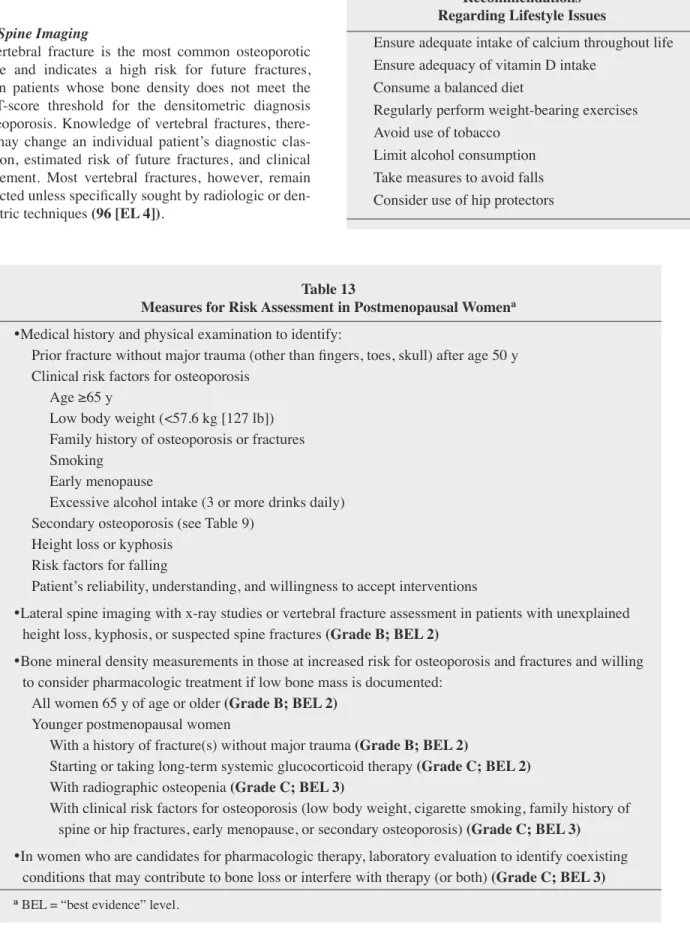
to identify risk factors for osteoporosis and fractures. This assessment should include the measures outlined in Table 13.
4.7.1. Spine Imaging
Vertebral fracture is the most common osteoporotic fracture and indicates a high risk for future fractures, even in patients whose bone density does not meet the
-2.5 T-score threshold for the densitometric diagnosis of osteoporosis. Knowledge of vertebral fractures, there-fore, may change an individual patient’s diagnostic clas-sification, estimated risk of future fractures, and clinical management. Most vertebral fractures, however, remain undetected unless specifically sought by radiologic or den-sitometric techniques (96 [EL 4]).
Table 12 Recommendations Regarding Lifestyle Issues
Ensure adequate intake of calcium throughout life Ensure adequacy of vitamin D intake
Consume a balanced diet
Regularly perform weight-bearing exercises Avoid use of tobacco
Limit alcohol consumption Take measures to avoid falls Consider use of hip protectors
Table 13
Measures for Risk Assessment in Postmenopausal Womena •Medical history and physical examination to identify:
Prior fracture without major trauma (other than fingers, toes, skull) after age 50 y Clinical risk factors for osteoporosis
Age ≥65 y
Low body weight (<57.6 kg [127 lb]) Family history of osteoporosis or fractures Smoking
Early menopause
Excessive alcohol intake (3 or more drinks daily) Secondary osteoporosis (see Table 9)
Height loss or kyphosis Risk factors for falling
Patient’s reliability, understanding, and willingness to accept interventions
•Lateral spine imaging with x-ray studies or vertebral fracture assessment in patients with unexplained height loss, kyphosis, or suspected spine fractures (Grade B; BEL 2)
•Bone mineral density measurements in those at increased risk for osteoporosis and fractures and willing to consider pharmacologic treatment if low bone mass is documented:
All women 65 y of age or older (Grade B; BEL 2) Younger postmenopausal women
With a history of fracture(s) without major trauma (Grade B; BEL 2)
Starting or taking long-term systemic glucocorticoid therapy (Grade C; BEL 2) With radiographic osteopenia (Grade C; BEL 3)
With clinical risk factors for osteoporosis (low body weight, cigarette smoking, family history of spine or hip fractures, early menopause, or secondary osteoporosis) (Grade C; BEL 3) •In women who are candidates for pharmacologic therapy, laboratory evaluation to identify coexisting
conditions that may contribute to bone loss or interfere with therapy (or both) (Grade C; BEL 3)
In patients with unexplained height loss, thoracic and lumbar spine radiography or vertebral fracture assessment by DXA is indicated if knowledge of vertebral fractures would alter clinical management (Grade B; BEL 2). Although height loss may occur for reasons other than vertebral fracture (97 [EL 2]), there is evidence to support radiography for measured height loss >2 cm (>0.8 inch) (98 [EL 2]) or historical height loss (loss from patient’s recalled maximal height) >4 to 6 cm (>1.5 to 2.4 inches) (99 [EL 2]). Although these thresholds of height loss have >90% specificity, the sensitivity for detecting prevalent vertebral fractures is low. Other indications for vertebral imaging include kyphosis and systemic glucocorticoid therapy, both of which are associated with increased ver-tebral fracture risk. Radiographic studies are also indicated for the evaluation of acute back pain suggestive of com-pression fracture. The sensitivity and reliability of standard radiography to assess BMD are poor, and in the absence of vertebral fractures, this technique cannot be used to diag-nose osteoporosis.
4.7.2. BMD Measurement
In women who are at risk for postmenopausal osteo-porosis, there are several potential uses of BMD measure-ments, as shown in Table 14.
4.7.2.1. Measurement techniques
DXA of the lumbar spine and proximal femur (hip) provides accurate and reproducible BMD measurements at important sites of osteoporosis-associated fracture (Grade B; BEL 1). Optimally, both hips should be measured dur-ing the initial visit to prevent misclassification that may result if only one hip is measured and to have a baseline for both hips in case a fracture or replacement occurs in one hip. These central sites are also more likely than periph-eral sites to show a response to treatment and are preferred for baseline and serial measurements. The most reliable comparative results are obtained when the same instru-ment and, ideally, the same technologist are used for serial measurements.
For BMD measurement, several other techniques are available, including quantitative computed tomography for measurement of both central and peripheral sites, quanti-tative ultrasonometry, radiographic absorptiometry, and single-energy x-ray absorptiometry. Of note, the diagnostic criteria established by WHO and recommended by AACE apply only to central DXA measurements (specifically, lumbar spine, femoral neck, and total hip) and to DXA of the 1/3 (33%) radius site. Thus, other technologies cannot be used to diagnose osteoporosis but may be used to assess fracture risk.
4.7.2.2. Bone density reports
Bone density results are reported as grams of min-eral per square centimeter of projected bone area but are
also expressed as T-scores and Z-scores. The T-score rep-resents the number of SDs from the normal young adult mean values, whereas the Z-score represents the number of SDs from the normal mean value for age-, race-, and sex-matched control subjects. Only T-scores are used for diagnosis. Low Z-scores may suggest a secondary cause of osteoporosis, but normal Z-scores do not rule out the pos-sibility of underlying disorders.
4.7.2.3. Measurement sites
Diagnostic criteria, therapeutic studies, cost analyses, and cost-effectiveness data have been based primarily on DXA measurements of the total hip, femoral neck, or total lumbar spine (or some combination of these sites), which are the preferred measurement sites (Grade B; BEL 3). Use of other subregions within the proximal femur or of an individual vertebra has not been validated and is not recommended.
Peripheral measurements can identify patients at increased risk for fracture; however, the WHO criteria for the densitometric diagnosis of low BMD (osteopenia) and osteoporosis do not apply to T-scores from peripheral devices. Currently, work is under way to define the appro-priate diagnostic thresholds for peripheral measurement devices. In the interim, peripheral measurements should be limited to the assessment of fracture risk.
4.7.2.4. Role in diagnosis and clinical decision making
A clinical diagnosis of osteoporosis and decision to initiate pharmacologic therapy can be made without BMD testing in postmenopausal women who have fragility frac-tures of the hip or spine. Nevertheless, BMD measurement
Table 14
Bone Mineral Density Measurements: Potential Uses in Postmenopausal Women Screening for osteoporosis
Establishing the severity of osteoporosis or bone loss in patients with suspected osteoporosis (for example, patients with fractures or radiographic evidence of osteopenia)
Determining fracture risk—especially when combined with other risk factors for fractures (see Table 8) Identifying candidates for pharmacologic intervention Assessing changes in bone mass over time in treated and untreated patients
Enhancing acceptance of, and perhaps adherence with, treatment
Assessing skeletal consequences of diseases, conditions, or medications known to cause bone loss
is useful in these patients to quantify fracture risk and to establish a baseline for monitoring the response to treatment.
For women without prior fractures (in the absence of major trauma), BMD is the single predictor of future frac-ture risk (for every 1-SD decrease in age-adjusted BMD, the relative risk of fracture increases 1.6-fold to 2.6-fold) (47 [EL 2]). The relationship between bone density and fracture risk, however, is a continuum, without a clear “fracture threshold.” WHO has defined T-score criteria for the classification of osteoporosis and low bone mass (osteopenia) (Table 3) on the basis of DXA measurements (Grade C; BEL 2). These criteria are useful for classifica-tion and risk stratificaclassifica-tion in individual patients, epidemio-logic studies, and therapeutic trial design, but they are not intended as treatment thresholds. Although there is good evidence that the risk for fractures is sufficiently high in most postmenopausal women with osteoporosis (T-scores ≤-2.5) to merit pharmacologic intervention, cost-effec-tive management of women with osteopenia (T-scores between -1.0 and -2.5) is less clear-cut. Although their overall rate of fractures is lower than that of patients with osteoporosis, more than 50% of fragility fractures occur in these patients with low bone mass. In order to identify those patients who are most likely to sustain a fracture, BMD results must be used in combination with other clin-ical risk factors for osteoporosis-related fractures (Table 8) for accurate assessment of fracture risk and appropriate treatment decisions. The FRAX tool integrates the contri-bution of BMD and other clinical risk factors and calcu-lates an individual patient’s absolute probability of frac-ture during a period of 10 years. It is now recommended that treatment decisions include consideration of fracture probability.
4.7.2.5. Indications
BMD testing is useful for screening people at high risk for osteoporosis (for example, postmenopausal women), for disease management in patients with hyperparathyroid-ism and other disorders or those taking medications (such as glucocorticoids) associated with bone loss (Table 4), if evidence of bone loss would result in modification of therapy, and for monitoring of pharmacologic therapy with bone-active agents. A list of indications for BMD testing is shown in Table 15.
The cost-effectiveness of BMD testing and its ben-efits to society are controversial (100 [EL 1]). Clinicians, politicians, patients, industry, and third-party payers all have different perspectives on the indications for and tim-ing of BMD measurements. The current recommendations are intended to outline reasonable use of this technology within the context of the endocrine specialty practice. Because universal BMD testing is not cost-effective, AACE recommendations for screening include women 65 years of age or older (Grade B; BEL 3) and younger post-menopausal women at increased risk based on fracture risk analysis (Grade C; BEL 2). Indications for screen-ing men for osteoporosis are outside the scope of these guidelines.
4.8. Medical Evaluation for Postmenopausal Osteoporosis
A comprehensive medical evaluation is indicated in all women with postmenopausal osteoporosis to identify coexisting medical conditions that cause or contribute to bone loss (Grade B; BEL 2). Some of these disorders may be asymptomatic and require laboratory testing for detec-tion. Some causes of osteoporosis in adults are summarized in Table 9.
Table 15
Indications for Bone Mineral Density Testing All women 65 y of age or older
All postmenopausal women
With a history of fracture(s) without major trauma after age 40 to 45 y With osteopenia identified radiographically
Starting or taking long-term systemic glucocorticoid therapy (≥3 mo) Other perimenopausal or postmenopausal women with risk factors for osteoporosis if willing to consider pharmacologic interventions
Low body weight (<127 lb or body mass index <20 kg/m2) Ever use of long-term systemic glucocorticoid therapy (≥3 mo) Family history of osteoporotic fracture
Early menopause Current smoking
Excessive consumption of alcohol Secondary osteoporosis (see Table 9)
Because of the high prevalence of secondary osteopo-rosis, even in apparently healthy postmenopausal women, some laboratory testing should be considered for all women with osteoporosis. In a retrospective study, the laboratory tests itemized in Table 16 were found to detect more than 90% of disorders in postmenopausal women with osteo-porosis who were otherwise asymptomatic (101 [EL 2], 102 [EL 4]). If the medical history, physical findings, or laboratory test results suggest the presence of secondary osteoporosis, additional laboratory evaluation is warranted and may include (but is not limited to) the tests listed in Table 17.
4.9. Biochemical Markers of Bone Turnover
Biochemical markers of bone turnover provide a dynamic assessment of skeletal activity and are useful modalities for skeletal assessment. Although they cannot be used to diagnose osteoporosis, elevated levels have been shown to predict more rapid rates of bone loss in groups of patients (103 [EL 1]) and to be associated with increased fracture risk independent of BMD at menopause and in elderly women (104 [EL 2]). In addition, these markers respond quickly to therapeutic intervention, and changes in markers have been associated with bone response to therapy and fracture risk reduction (105 [EL 1]). Their use in clinical practice, however, is limited by high in vivo and assay variability (resorption markers), poor predictive ability in individual patients, and lack of evidence-based thresholds for clinical decision making.
Nevertheless, biochemical markers of bone turnover may be useful in certain situations, including for assess-ment of fracture risk in elderly patients when the finding of elevated levels would influence the decision to begin phar-macotherapy, as an early indicator of therapeutic response to anabolic or antiresorptive therapy or in the laboratory evaluation of patients losing BMD despite antiresorptive therapy, and for assessment of medication compliance,
drug absorption, or therapeutic efficacy (Grade C; BEL 1).
4.10. Treatment of Osteoporosis 4.10.1. Goals of Treatment
The therapeutic goals in patients with osteoporosis are as follows:
• To prevent fractures by improving bone strength and reducing the risk of falling and injury
• To relieve symptoms of fractures and skeletal deformity
• To maximize physical function
Achieving these goals depends on commitment to therapy from the patient and the health-care provider and the potential for the chosen therapy to yield results. Measures to achieve these goals are shown in Table 18.
4.10.2. Candidates for Pharmacologic Treatment
AACE has endorsed the 2008 National Osteoporosis Foundation Clinician’s Guide to Prevention and Treatment of Osteoporosis (106 [EL 4]). The Guide recommends pharmacologic treatment for postmenopausal women with the following:
• A hip or spine fracture (either clinical spine fracture or radiographic fracture) (Grade A; BEL 1)
• A T-score of -2.5 or below at the spine, femoral neck, or total hip (Grade A; BEL 1)
• A T-score between -1.0 and -2.5 at high 10-year risk
of fracture with use of the US-adapted FRAX tool provided by WHO at www.shef.ac.uk/FRAX, where treatment is considered cost-effective if the 10-year risk is 3% or more for hip fracture or 20% or more for “major” osteoporosis-related fracture (humerus,
Table 16
Laboratory Tests to Consider in Screening for Secondary Osteoporosis Complete blood cell count
Serum chemistry, including calcium, phosphorus, total protein, albumin, liver enzymes, alkaline phosphatase, creatinine, and electrolytes
Urinalysis (24-h collection) for calcium, sodium, and creatinine excretion (to identify calcium malabsorption or hypercalciuria) Serum 25-hydroxyvitamin D