Syracuse University Syracuse University
SURFACE
SURFACE
Dissertations - ALL SURFACE
June 2018
multimedia transmission over wireless networks: performance
multimedia transmission over wireless networks: performance
analysis and optimal resource allocation
analysis and optimal resource allocation
Chuang YeSyracuse University
Follow this and additional works at: https://surface.syr.edu/etd Part of the Engineering Commons
Recommended Citation Recommended Citation
Ye, Chuang, "multimedia transmission over wireless networks: performance analysis and optimal resource allocation" (2018). Dissertations - ALL. 890.
https://surface.syr.edu/etd/890
This Dissertation is brought to you for free and open access by the SURFACE at SURFACE. It has been accepted for inclusion in Dissertations - ALL by an authorized administrator of SURFACE. For more information, please contact
Abstract
In recent years, multimedia applications such as video telephony, teleconferencing, and video streaming, which are delay sensitive and bandwidth intensive, have started to account for a significant portion of the data traffic in wireless networks. Such multimedia applications require certain quality of service (QoS) guarantees in terms of delay, packet loss, buffer underflows and overflows, and received multimedia quality. It is also important to note that such requirements need to be satisfied in the presence of limited wireless resources, such as power and bandwidth. Therefore, it is critical to conduct a rigorous performance analysis of multimedia transmissions over wireless networks and identify efficient resource allocation strategies.
Motivated by these considerations, in the first part of the thesis, performance of hierarchical modulation-based multimedia transmissions is analyzed. Unequal error protection (UEP) of data transmission using hierarchical quadrature amplitude mod-ulation (HQAM) is considered in which high priority (HP) data is protected more than low priority (LP) data. In this setting, two different types of wireless networks are considered. Specifically, multimedia transmission over cognitive radio networks and device-to-device (D2D) cellular wireless networks is addressed. Closed-form bit error rate (BER) expressions are derived and optimal power control strategies are determined.
Next, throughput and optimal resource allocation strategies are studied for mul-timedia transmission under delay QoS and energy efficiency (EE) constraints. A Quality-Rate (QR) distortion model is employed to measure the quality of received video in terms of peak signal-to-noise ratio (PSNR) as a function of video source rate.
Effective capacity (EC) is used as the throughput metric under delay QoS constraints. In this analysis, four different wireless networks are taken into consideration:
• First, D2D underlaid wireless networks are addressed. Efficient transmission mode selection and resource allocation strategies are analyzed with the goal of maximizing the quality of the received video at the receiver in a frequency-division duplexed (FDD) cellular network with a pair of cellular users, one base station and a pair of D2D users under delay QoS and EE constraints.
• A full-duplex communication scenario with a pair of users and multiple subchan-nels in which users can have different delay requirements is addressed. Since the optimization problem is not concave or convex due to the presence of in-terference, optimal power allocation policies that maximize the weighted sum video quality subject to total transmission power level constraint are derived by using monotonic optimization theory. The optimal scheme is compared with two suboptimal strategies.
• A full-duplex communication scenario with multiple pairs of users in which dif-ferent users have difdif-ferent delay requirements is addressed. EC is used as the throughput metric in the presence of statistical delay constraints since deter-ministic delay bounds are difficult to guarantee due to the time-varying nature of wireless fading channels. Optimal resource allocation strategies are deter-mined under bandwidth, power and minimum video quality constraints again using the monotonic optimization framework.
• A broadcast scenario in which a single transmitter sends multimedia data to multiple receivers is considered. The optimal bandwidth allocation and the optimal power allocation/power control policies that maximize the sum video quality subject to total bandwidth and minimum EE constraints are derived. Five different resource allocation strategies are investigated, and the joint
opti-mization of the bandwidth allocation and power control is shown to provide the best performance. Tradeoff between EE and video quality is also demonstrated.
In the final part of the thesis, power control policies are investigated for streaming variable bit rate (VBR) video over wireless links. A deterministic traffic model for stored VBR video, taking into account the frame size, frame rate, and playout buffers is considered. Power control and the transmission mode selection with the goal of maximizing the sum transmission rate while avoiding buffer underflows and overflows under transmit power constraints is exploited in a D2D wireless network. Another system model involving a transmitter (e.g., a base station (BS)) that sends VBR video data to a mobile user equipped with a playout buffer is also adopted. In this setting, both offline and online power control policies are considered in order to minimize the transmission power without playout buffer underflows and overflows. Both dynamic programming and reinforcement learning based algorithms are developed.
multimedia transmission over
wireless networks: performance
analysis and optimal resource
allocation
By
Chuang Ye
M.S., Zhejiang University, Zhengjiang, China, 2012
DISSERTATION
Submitted in partial fulfillment of the requirements for the degree of Doctor of Philosophy in Electrical and Computer Engineering
Syracuse University June 2018
Copyright c2018 Chuang Ye All Rights Reserved
Acknowledgements
First, I would like to thank my advisors, Prof. Mustafa Cenk Gursoy and Prof. Senem Velipasalar Gursoy, for their help and guidance during my entire Ph.D. study. In this period, I have gained much experience in research, and completed many studies in the area of multimedia wireless communication.
I would like to thank all my Ph.D. defense committee members Prof. Jianshun Zhang, Prof. Biao Chen, Prof. Qinru Qiu, Prof. Pramod Varshney and Prof. Sucheta Soundarajan for carefully reading my thesis.
I would also like to thank my parents, and my girlfriend Yaqi for supporting me to pursue my Ph.D. degree.
Finally, I would like to thank all my labmates and friends for their support during these years at Syracuse. I had really wonderful time studying and working with them.
Table of Contents
List of Figures xiii
List of Tables xix
1 Introduction 1
1.1 Resource Constrained Multimedia Wireless Transmissions . . . 1 1.2 Literature Review . . . 3
1.2.1 Multimedia Transmission over Cognitive Radio Channels under Sensing Uncertainty . . . 3 1.2.2 Multimedia Transmission over Device-to-Device Wireless
Net-works . . . 5 1.2.3 Quality-Driven Resource Allocation for Full-Duplex Wireless
Video Transmission under Delay Constraints . . . 6 1.2.4 Quality-Driven Resource Allocation for Wireless Video
Trans-missions under Energy Efficiency and Delay Constraints . . . 8 1.2.5 Power Control for VBR Video Streaming over Wireless Networks 11 1.3 Outline and Main Contributions . . . 12 1.4 Bibliographic Note . . . 17
2 Preliminaries 19
2.2 Delay QoS Constraints and Effective Capacity . . . 20
2.3 Video Quality-Rate Model . . . 22
2.4 Definitions used in Monotonic Optimization . . . 24
3 Multimedia Transmission over Cognitive Radio Channels under Sens-ing Uncertainty 25 3.1 System Model . . . 26
3.1.1 Channel Sensing . . . 26
3.1.2 Cognitive Channel Model . . . 27
3.1.3 Multimedia Transmission System . . . 28
3.1.4 Bit Error Rate Analysis . . . 30
3.2 Optimal Power Control . . . 34
3.2.1 Peak transmit and average interference power constraints . . . 34
3.2.2 Average transmit and average interference power constraints . 40 3.3 Numerical and Simulation Results . . . 44
3.3.1 Simulation Settings . . . 45
3.3.2 The impact of channel sensing performance on multimedia quality 46 3.3.3 The impact of imperfect CSI of interference link on multimedia transmission . . . 54
3.3.4 The impact of unequal error protection (HQAM) vs. equal error protection (conventional QAM) on multimedia quality . . . . 54
4 Multimedia Transmission over Device-to-Device Wireless Links 59 4.1 System Model . . . 60
4.2 Bit Error Rate Analysis and Power Control Strategy . . . 62
4.2.1 Bit error rate analysis . . . 62
4.2.2 Power control strategy . . . 64
4.3.1 Simulation Settings . . . 66
4.3.2 Constant transmit power . . . 67
4.3.3 Power control strategy . . . 69
5 Video Transmission over D2D Underlaid Wireless Networks under QoS and Energy Efficiency Constraints 70 5.1 System Model . . . 71
5.2 Throughput of Cellular Network with D2D Users . . . 74
5.2.1 Throughput in the Cellular Mode . . . 74
5.2.2 Throughput in the Dedicated Mode . . . 76
5.2.3 Throughput in Reuse Modes . . . 76
5.3 Resource Allocation . . . 77 5.3.1 Cellular Mode . . . 78 5.3.2 Dedicated Mode . . . 81 5.3.3 Reuse Modes . . . 82 5.4 Numerical Results . . . 85 5.4.1 Simulation Settings . . . 85 5.4.2 Simulation Results . . . 85
6 Optimal Resource Allocation for Full-Duplex Wireless Video Trans-missions under Delay Constraints 89 6.1 System Model . . . 90
6.2 Preliminaries . . . 91
6.2.1 Notations . . . 91
6.2.2 Effective capacity in the system model . . . 91
6.3 Weighted Sum Quality-Maximizing Policies . . . 92
6.3.1 Problem reformulation . . . 94
6.3.3 Monotonic optimization . . . 97
6.4 Simulation Results . . . 100
6.4.1 The impact of QoS exponent on multimedia quality . . . 100
6.4.2 The impact of weights on multimedia quality . . . 103
7 Quality-Driven Resource Allocation for Full-Duplex Delay-Constrained Wireless Video Transmissions 106 7.1 System Model . . . 107
7.2 Preliminaries . . . 108
7.2.1 Notations . . . 108
7.2.2 Delay QoS Constraints and Effective Capacity . . . 109
7.3 Weighted Sum Quality-Maximizing Policies . . . 110
7.3.1 Problem Reformulation as Monotonic Optimization . . . 112
7.3.2 Initialization of the Enclosing Polyblock . . . 114
7.3.3 Algorithms and Optimal Solution via Monotonic Optimization 119 7.4 Numerical and Simulation Results . . . 125
7.4.1 One Pair of Full-Duplex Users . . . 126
7.4.2 Two Pairs of Full-Duplex Users . . . 129
7.4.3 More than Two Pairs of Full-Duplex Users . . . 135
8 Quality-Driven Resource Allocation for Wireless Video Transmis-sions under Energy Efficiency and Delay Constraints 137 8.1 System Model . . . 138
8.2 Sum-Quality Maximizing Policies . . . 139
8.2.1 Bandwidth and Power Allocation with Statistical CSI . . . 140
8.2.2 Bandwidth Allocation and Power Control with Perfect CSI . . 143
8.2.3 Optimal Allocation Algorithm and Different Policies . . . 145
9 Power Control and Mode Selection for VBR Video Streaming in D2D Networks 154 9.1 System Model . . . 155 9.2 Problem Formation . . . 157 9.2.1 Cellular Mode . . . 157 9.2.2 Dedicated Mode . . . 158 9.2.3 Reuse Mode . . . 158
9.3 Optimal Power Control and Mode Selection Strategies . . . 160
9.3.1 Cellular Mode . . . 160
9.3.2 Dedicated Mode . . . 162
9.3.3 Reuse Mode . . . 163
9.4 Numerical and Simulation Results . . . 168
10 Power Control for Wireless VBR Video Streaming : From Dynamic Programming to Reinforcement Learning 171 10.1 System Model . . . 172
10.2 Optimal Offline Policies . . . 174
10.2.1 Minimizing power consumption . . . 174
10.2.2 Minimizing the time duration of video streaming . . . 183
10.3 Online Power Control Policies . . . 186
10.3.1 The Gauss-Markov Channel and prediction . . . 187
10.3.2 Online power allocation strategy 1 - Grouped water filling (GWF)187 10.3.3 Online power allocation strategy 2 - Reinforcement Learning . 189 10.4 Experiment Results . . . 197
10.4.1 Offline power control . . . 198
10.4.2 Online power control . . . 201
11.1 Summary . . . 207
11.2 Future Research Directions . . . 212
11.2.1 Bounded Interference in Wireless Video Transmission . . . 212
11.2.2 Deep Learning for Wireless Video Transmission over Full-Duplex Channels . . . 212
11.2.3 Improvement of RL on VBR Video Streaming . . . 213
A Appendix 214 A.1 Derivation of Equations (3.13) and (3.14) . . . 214
A.2 Proof of Proposition 3.1 . . . 215
A.3 Proof of Proposition 3.2 . . . 216
A.4 Proof of Theorem 7.1 . . . 217
A.5 Proof of the Required Conditions for Obtaining the Upper Bound ∂+G 220 A.6 Proof of Theorem 8.1 (Concavity of Rk with respect toPk) . . . 221
A.7 Proof of Theorem 8.2 (Concavity of Rk with respect toBk) . . . 222
List of Figures
2.1 Signal constellation diagram of Gray coded 16-HQAM . . . 19 2.2 Actual PSNR values vs. rate and fitted quality rate curves. . . 23
3.1 Cognitive radio channel model . . . 26 3.2 Block diagram of the multimedia transmission and reception system. 27 3.3 JPEG2000 codestream structure . . . 29 3.4 (a) Optimal transmission powersP0 and P1 vs. Pd; (b) number of
retrans-missions,Nre vs. Pd; (c) Peak signal-to-noise ratio, PSNR vs. Pd.. . . 44
3.5 (a) Optimal transmission powers P0 and P1 vs. Pf; (b) number of
retrans-missions,Nre vs. Pf; (c) Peak signal-to-noise ratio, PSNR vs. Pf. . . 44
3.6 (a) Average BER vs. probability of detection, Pd; (b) Average BER vs.
probability of false alarm,Pf. . . 49
3.7 Reconstructed images with (a) Pd = 0.5, Pf = 0, PSNR = 39.3902 and
Nre = 1013; (b) Pd = 1, Pf = 0, PSNR = 40.5357 and Nre = 452; (c)
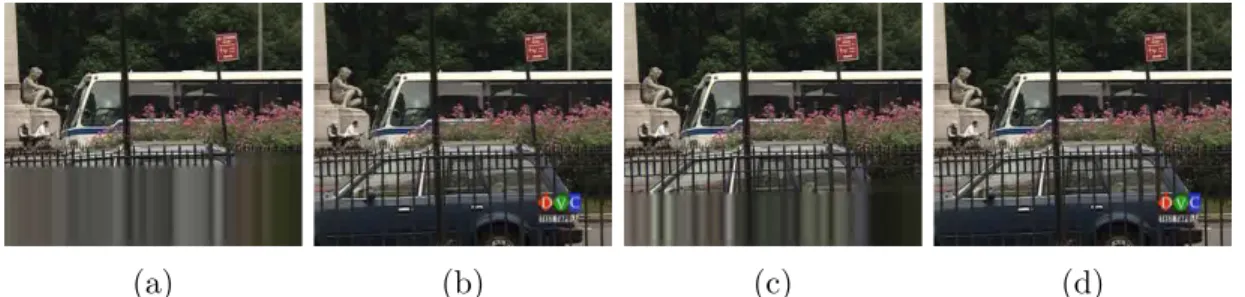
Pd = 1,Pf = 0.2, PSNR = 40.2706 andNre= 541. . . 50
3.8 Reconstructed images with (a)Pf = 0.2, Pd = 0.5, PSNR = 22.4303 and
Nre = 800; (b) Pf = 0.2, Pd = 0.7, PSNR = 22.7172 and Nre = 800; (c)
Pf = 0.2, Pd = 1, PSNR = 40.3389 and Nre = 545; (d)Pf = 0.1, Pd = 0.5,
PSNR = 22.5194 and Nre = 800; (e)Pf = 0.1, Pd = 0.7, PSNR = 24.6407
3.9 (a) Imperfect channel sensing with Pd = 0.8, Pf = 0.2, PSNR =
15.3170 dB and Nre = 3059 (b) Perfect channel sensing with Pd = 1,
Pf = 0, PSNR = 15.6711 dB and Nre= 889. . . 52
3.10 (a) Average energy and power consumption vs. probability of detection,Pd;
(b) Number of retransmissions/silent periods vs. Pd; (c) Peak signal-to-noise
ratio, PSNR vs. Pd. . . 53
3.11 (a) Number of retransmissions,Nre vs. Pd and Pf; (b) Peak signal-to-noise
ratio, PSNR vs. Pd and Pf. . . 53
3.12 Reconstructed images with(a) QAM,m= 1, PSNR = 18.8928 andNre=
410; (b) HQAM,m= 1, α0=α1 = 1, PSNR = 21.3205 andNre= 410; (c)
HQAM, m= 1, α0 =α1 = 2, PSNR = 22.4221 and Nre= 410; (d) QAM,
m= 2, PSNR = 19.1760 and Nre = 396; (e) HQAM,m = 2,α0 =α1 = 1,
PSNR = 35.6625 and Nre= 400; (f) HQAM,m= 2, α0 =α1 = 2, PSNR =
37.8730 andNre= 366. . . 55
3.13 Video transmission based on power control with (a) statistical CSI and conventional QAM, PSNR = 12.4644 and Nre = 3694; (b) statistical
CSI and hierarchical QAM, PSNR = 15.1463 and Nre = 3855; (c)
instantaneous CSI and conventional QAM, PSNR = 14.4713 andNre =
2492; (d) instantaneous CSI and hierarchical QAM, PSNR = 15.4607 and Nre= 2976. . . 56
3.14 Peak signal-to-noise ratio, PSNR as a function of α0. . . 58
4.1 System model for D2D communication. . . 60 4.2 BERs at different positions of DT in (a) cellular mode; (b) dedicated mode;
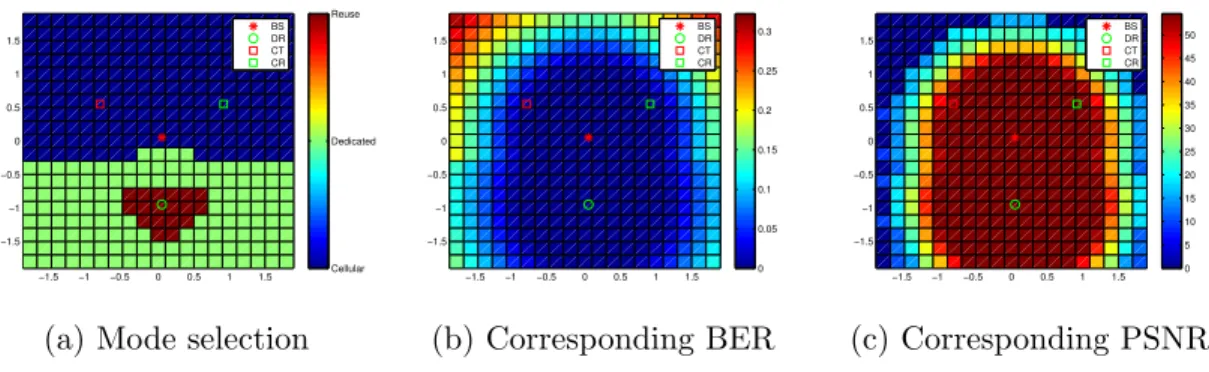
(c) reuse mode. . . 68 4.3 (a) Mode selection; (b) corresponding BER; (c) corresponding PSNR value
4.4 (a) Mode selection; (b) corresponding BER; (c) corresponding PSNR value at different positions of DT in power control case. . . 69 4.5 (a) BER comparison; (b) PSNR comparison between constant power case
and power control case at selected positions of DT. . . 69
5.1 System model with queueing constraints (Dashed lines represent inter-ference only links). . . 72 5.2 QD values for different locations ofD1 for (a) cellular mode; (b) dedicated
mode; (c) uplink reuse mode and (d) downlink reuse mode; (e) the optimal mode selection and (f) the correspondingQD values . . . 87
5.3 QD values for different locations ofD2 for (a) cellular mode; (b) dedicated
mode; (c) uplink reuse mode and (d) downlink reuse mode; (e) the optimal mode selection and (f) the correspondingQD values . . . 88
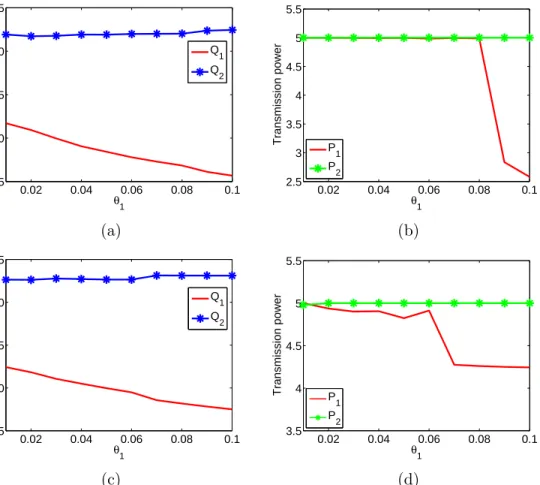
6.1 System block diagram for quality-driven resource allocation in full-duplex wireless networks . . . 90 6.2 (a) PSNR values, and (b) Power allocation with 2 subchannels; and
(c) PSNR values, and (d) Power allocation with 3 subchannels as θ1
increases. . . 102 6.3 PSNR values for different strategies with (a) 2 subchannels, and (b) 3
subchannels as θ1 increases. . . 103
6.4 (a) PSNR values, and (b) Power allocation with 2 subchannels; and (c) PSNR values, and (d) Power allocation with 3 subchannels as ω1
increases. . . 105 6.5 PSNR values for different strategies with (a) 2 subchannels , and (b)
3 subchannels when ω1 increases. . . 105
7.1 Wireless system model in which each pair of users communicates in full-duplex mode under quality and delay constraints. . . 108
7.2 Example of initialized enclosing polyblock . . . 118 7.3 Iterative procedure of projection onto the boundary and formation of
new set of vertices. . . 120 7.4 Actual PSNR values vs. rate and fitted quality rate curves. . . 126 7.5 (a) Optimal power allocation and (b) the corresponding qualityQ (or
equivalently PSNR) of video sequences as a function of θ1,1. . . 127
7.6 (a) Optimal power allocation and (b) the corresponding qualityQ (or equivalently PSNR) of video sequences as a function of θ1,1 =θ2,1. . . 128
7.7 (a) Optimal power allocation and (b) the corresponding qualityQ (or equivalently PSNR) of video sequences as a function of ω1,1. . . 129
7.8 (a) Optimal power allocation, (b) optimal bandwidth allocation, and (c) the corresponding quality of video sequences as θ1,1 =θ2,1 increase. 130
7.9 Quality of video sequences as a function of θ1,1 = θ2,1. Both optimal
and equal bandwidth allocation are considered. . . 132 7.10 (a) Quality of video sequences as a function of θ1,1 = θ2,1 and (b)
average power consumption as a function ofθ1,1 =θ2,1. . . 132
7.11 (a) Optimal power allocation, (b) Optimal bandwidth allocation, and (c) the corresponding quality of video sequences as a function ofω1,1 =
ω2,1. . . 133
7.12 Quality of video sequences as a function of ω1,1 =ω2,1. Both optimal
and equal bandwidth allocation are considered. . . 134 7.13 PSNR vs. QoS exponents θ1,1 = θ2,1 for both full-duplex and
half-duplex (HD) operations. Self-interference suppression factors are µ= 0.1, µ= 0.05, andµ= 0.01 in the three full-duplex curves, respectively. 135 8.1 Proposed system block diagram for quality-driven resource allocation and
rate adaptation of delay and energy efficiency constrained video streams . 139 8.2 Both sides of the EE constraint in (8.2) as a function of the power,P . . . 142
8.3 Actual PSNR values vs. rate and fitted quality rate curves . . . 148 8.4 (a) Bandwidth allocation, (b) Power levels and (c) Average quality of video
sequences whenθ2 is increasing . . . 150
8.5 QIR vs. bandwidth with differentθ in (a) BAPA, and (b) BAPC cases. . . 150 8.6 (a) Bandwidth allocation, (b) Power levels and (c) Average quality of video
sequences whenη2 is increasing . . . 152
8.7 QIR vs. bandwidth with differentη in (a) BAPA, and (b) BAPC cases.. . 152
9.1 Proposed system block diagram for VBR video streaming in D2D networks 156 9.2 Cumulative overflow and cumulative consumption curves and a feasible
transmission schedule for video. . . 157 9.3 Consumption curve inD2 . . . 169
9.4 The cumulative overflow, transmission, and consumption curves when trans-mittingNBC News at D2D link in (a) cellular mode; (b) dedicated mode; (c) reuse mode and; (d) the optimal mode selection and (e) the corresponding curves with optimal mode selection. . . 170 9.5 Buffer utilization inD2 . . . 170
10.1 System model for VBR video streaming over a wireless link with multiple subchannels. . . 173 10.2 Cumulative transmitted data in 2 different schemes . . . 199 10.3 The cumulative overflow, transmission, and consumption curves when
trans-mittingTokyo in two different time periods (a) frame time slot 275-475; (b) frame time slot 11600-11800. . . 199 10.4 The power consumption when transmittingTokyo in two different schemes
(a) power minimization (PM); (b) time minimization (TM). . . 200 10.5 The relation between buffer size at Rx and average power level at Tx . . . 201 10.6 Average power level with different ˆα values . . . 202
10.7 The average power level when transmitting Tokyo in (a) offline; (b) online strategies with different group sizes. . . 203 10.8 Maximum transmit power levels in GWF method . . . 204 10.9 Transmit power levels for differentα values . . . 204 10.10Underflow probability and overflow probability for differentα values . . . 205
List of Tables
2.1 Parameter values of the quality rate model for different video sequences 23
3.1 Peak signal-to-noise ratio, PSNR vs. λ. . . 45 3.2 Performance comparison of optimal power controls (exact and
approx-imate) . . . 58
6.1 Power allocations while changing θ1 in the case of 3 subchannels . . . 101
6.2 Power allocations while changing ω1 in the case of 3 subchannels . . . 104
7.1 Parameter values of the quality rate model for different video sequences 125 7.2 Performance with 3 pairs of full-duplex users . . . 136 7.3 Performance with 4 pairs of full-duplex users . . . 136
8.1 Parameter values of the quality rate model for different video sequences 147 8.2 Performance for received video sequences and different resource
allo-cation schemes . . . 153
9.1 Probability of underflow events . . . 169
Chapter 1
Introduction
1.1
Resource Constrained Multimedia Wireless
Trans-missions
With the significant improvements in wireless technology, multimedia applications such as video telephony, teleconferencing, and video streaming, which are delay sen-sitive and bandwidth intensive, have started to account for a significant portion of the data traffic over wireless networks. For instance, as revealed in [1], mobile video traffic was already 60% of the entire mobile data traffic in 2016, and it is predicted that three-fourths of the world’s mobile data traffic will be video by 2021. The over-whelming growth in the volume of multimedia content, multimedia traffic and wire-less multimedia applications is drastically increasing the demand for more bandwidth. With this and the fact that prime portion of the spectrum has already been allocated, bandwidth scarcity has become one of the major bottlenecks in wireless services. To satisfy the increasing demand for communication and provide better user experience, several technologies have been proposed according to different applications.
According to the report from the Spectrum-Policy Task Force of the Federal Com-munications Commission (FCC) [2], the spectrum scarcity is mainly caused by the
underutilization and inefficient usage in many portions of the spectrum rather than the limited range of usable frequencies. Cognitive radio has been proposed to re-alize dynamic spectrum access in order to overcome the spectrum underutilization problem by allowing the unlicensed users (i.e., cognitive or secondary users) to access the licensed spectrum without causing harmful interference to the licensed users (i.e., primary users) [3], [4]. In cognitive radio systems, the unlicensed (i.e., secondary) users can coexist with the licensed (i.e., primary) users by changing transmission power level according to primary user activity or transmit only when there is no pri-mary user activity. Additionally, device-to-device (D2D) communication is another technology that efficiently reuses the occupied spectrum. In D2D communications, device users (DUs) can communicate with each other directly rather than transmit-ting data through a cellular base station (BS) while potentially sharing the spectral resources with cellular users. Several benefits may be provided by enabling D2D communication. First, DUs can obtain high data transmission rate and low end-to-end delay due to the short communication distance, which is critical for real time video transmission. Secondly, DUs can more efficiently use resources such as band-width or transmission power when communicating directly with each other over a short distance even though the existence of interferences. Additionally, by offloading traffic from the BS, sharing the spectral resources and managing the interference, D2D communication can improve the spectral efficiency of cellular networks. More-over, in full-duplex (FD) transmission scheme, transmitter can transmit and receive data simultaneously using the same frequency band. Since the transmitter can send and receive data using the same spectral resources, the utilization of the spectrum is higher, which leads to higher transmission rates. However, operating in FD mode leads to self-interference that lowers the signal to interference plus noise ratio (SINR) inevitably. Therefore, how to balance the more efficient utilization of the spectrum with interference management in FD systems is a critical issue.
In addition to bandwidth, transmission energy/power also plays an important role in wireless communications since energy is a limited resource especially in mobile applications. Hence, a common type of resource adaptation is efficiently and opti-mally allocate the available transmission energy/power in order to enhance the system performance. Indeed, optimal power control policies are extensively studied in the context of wireless systems. However, most work concentrated on rate-maximizing policies without taking into account multimedia quality metrics, delay requirements, and energy efficiency constraints.
1.2
Literature Review
1.2.1
Multimedia Transmission over Cognitive Radio
Chan-nels under Sensing Uncertainty
Recently, cognitive radio (CR) has been proposed to realize dynamic spectrum access (DSA) in order to overcome the spectrum underutilization problem by allowing the unlicensed users (i.e., cognitive or secondary users) to access the licensed spectrum without causing harmful interference to the licensed users (i.e., primary users) [3], [4]. DSA strategies can be mainly categorized into three models, namely dynamic exclusive use model, open radio spectrum sharing, and hierarchical radio spectrum access model [5]. Dynamic exclusive use model provides dynamic spectrum alloca-tion and spectrum rights, which allow license holders to sell and trade the spectrum. Therefore, spectrum auction and market based policies for resource allocation lead to a profitable way of utilizing the spectrum [6] – [7]. While users can access the spectrum on a non-priority basis in the open sharing model, there is a hierarchy be-tween the access rights of the primary and cognitive users in the hierarchical spectrum access model. In particular, the primary users have priority in accessing the spec-trum, and cognitive users can either coexist with the primary users by varying their
transmission power according to primary user activity and interference constraints, or transmit only when there is no active primary user in the channel. Therefore, spectrum sensing is an essential functionality of CR systems in order to detect the temporarily unused frequency bands [8]. Along with this, efficient design of medium access control protocol has an important role for exploiting the spectrum opportuni-ties [9].
Existing literature mainly focuses on the performance of spectrum sensing meth-ods and the throughput of CR systems. There have been relatively limited number of studies on multimedia transmission in CR networks. The work in [10] mainly focused on the optimization of the overall received quality of MPEG-4 fine grained scalable video multicast by considering proportional fairness and also primary user protection from harmful interference in CR networks. In [11], the optimal channel and path selection strategy for streaming multiple videos over a multi-hop CR network was proposed in the presence of imperfect sensing decisions and a constraint on the col-lision probability. The authors in [12] proposed an optimal packet loading strategy for multimedia transmissions of secondary users by considering each channel with different primary user activity. The authors in [13] jointly optimized the quantization step size of source coding, modulation type and channel coding parameters in order to minimize the expected video distortion over CR networks subject to a packet delay constraint. In [14], an optimal subcarrier and antenna selection scheme that maxi-mizes the aggregate visual quality of the received video in downlink CR networks was proposed. In [15], a channel allocation scheme was introduced to meet the different quality of experience (QoE) requirements of the secondary users. The recent work in [16] proposed a cross-layer scheduling scheme for OFDM-based CR systems in which optimal subcarrier assignment, power and modulation allocation were performed for each incoming multimedia packet. The authors in [17] investigated the optimal as-signment of cognitive users to idle-sensed channels to maximize the visual quality of
downlink multiuser video streaming. Also, the work in [18] mainly focused on im-proving the quality of H.264/SVC video at the secondary receiver in multi-channel CR networks. Moreover, the authors in [19] studied joint adaptation of scalable video coding (SVC) and transmission rate to minimize the average energy consumption of cognitive users subject to quality of service (QoS) requirements.
1.2.2
Multimedia Transmission over Device-to-Device
Wire-less Networks
To satisfy the increasing demand for local device communication and provide better user experience, device-to-device (D2D) communications have been proposed as a promising technique for LTE-Advanced systems [20, 21]. In D2D communication, de-vice users (DUs) can communicate with each other directly rather than transmitting and receiving data through a cellular base station (BS). Several benefits may be pro-vided by enabling D2D communication. First, DUs can obtain high data transmission rate and low end-to-end delay due to the short communication distance. Secondly, DUs can save energy and resources when communicating directly with each other over a short distance under certain quality constraints. Finally, other users in the cellular network can have access to more spectral resources since DUs communicate just occupying one direct link rather than uplink and downlink, as used in cellular mode.
In [22], a base-station aided scheme was proposed for increasing the throughput of wireless video transmissions in D2D communication systems by exploiting the re-dundancy of user requests and the considerable storage capacity of smartphones and tablets. The authors in [23] proposed a joint channel and power allocation scheme in underlay multicast D2D communications in order to maximize the sum throughput of active cellular users (CUs) and feasible D2D groups in a cell under a certain level of signal-to-interference-plus-noise ratio (SINR) for both the CUs and D2D groups.
A maximum weight bipartite matching based scheme was developed to assign the optimal channel for each feasible D2D group. Joint mode selection, channel assign-ment and power control in D2D communications were addressed in [24] with the goal of maximizing the overall system throughput while guaranteeing the SINR of both D2D and cellular links. Three communication modes were considered for D2D users. In [25], energy-efficient uplink resource sharing for mobile D2D multimedia commu-nications underlaid with cellular networks with multiple potential D2D pairs and cellular users was studied. The problem was formulated as a nontransferable coali-tion formacoali-tion game and a distributed coalicoali-tion formacoali-tion algorithm based on the merge-and-split rule and the Pareto order was developed. In [26], optimal power con-trol for resource sharing between CUs and DUs was derived for maximizing the energy efficiency of a DU under throughput constraints for both the DU and the CU in a cel-lular network. A distributed algorithm for the implementation of the optimal power control was proposed and validated numerically. Traditional D2D schemes mainly focus on maximizing the system throughput without taking into account quality-of-service (QoS) provisioning. [27] developed a framework to investigate the impact of delay-QoS requirements on the performance of D2D and cellular communications over underlaying wireless networks, and proposed optimal power allocation schemes with statistical QoS provisioning for two channel modes.
1.2.3
Quality-Driven Resource Allocation for Full-Duplex
Wire-less Video Transmission under Delay Constraints
The authors in [28] proposed a strategy to maximize the sum quality of the received reconstructed videos subject to different delay constraints on different users and a total bandwidth constraint in a multiuser setup by allocating the optimal amount of bandwidth to each user in a downlink wireless network. A content-aware framework for spectrum- and energy-efficient mobile association and resource allocation in
wire-less heterogeneous networks was proposed in [29]. Two content-aware performance metrics, namely experience-aware spectral efficiency (QSE) and quality-of-experience-aware energy efficiency (QEE), were used to capture spectrum usage and energy consumption from the perspective of video quality. The goal was to obtain the optimal system level QSE and QEE by determining the mobile association and al-locating the resources optimally via nonlinear fractional programming approach and dual decomposition method. In this work, delay QoS constraints were not consid-ered. Reference [30] addressed the maximization of the system throughput subject to delay QoS and average power constraints for time-division multiple access (TDMA) communication links. [31] proposed a QoS-driven power and rate adaptation scheme that aims at maximizing the throughput of multichannel systems subject to a given delay QoS constraint over wireless links. The authors in [32] developed an optimal power allocation scheme for the cognitive network with the goal of maximizing the effective capacity of the secondary user link under constraints on the primary user’s outage probability and secondary user’s average and peak transmission power. The scheme also satisfied the QoS requirements of both secondary users and primary users simultaneously. Statistical QoS provisioning in next generation heterogeneous mobile cellular networks is investigated in [33]. The authors in [34] proposed a QoS-driven power allocation scheme for full-duplex (FD) wireless links with the goal of maxi-mizing the overall effective capacity (EC) under a given delay QoS constraint. Two models, namely local transmit power related self-interference (LTPRS) model and local transmit power unrelated self-interference (LTPUS), were built to analyze the full-duplex transmission, respectively. However, an approximation of the sum Shan-non capacity was used under the assumption that signal-to-interference-plus-noise ratio is much larger than 1. [35] considered the problem of distributed power allo-cation in an FD wireless network consisting of multiple pairs of nodes with the goal of maximizing the network-wide capacity. Shannon capacity was used as the
per-formance metric and the optimal transmission powers for the FD transmitters were derived based on the high SINR approximation.
The problem of joint subchannel allocation and power control was discussed in many studies. For instance, resource allocation in multicell uplink orthogonal fre-quency division multiple access (OFDMA) systems was considered in [36], and the problem was solved via noncooperative games for subcarrier allocation and trans-mit power control. [37] proposed a joint power control and subchannel allocation for OFDMA femtocell networking using distributed auction game in order to min-imize the total power radiated by the femtocell base station and guaranteeing the throughput. [38] considered the problem of joint subcarrier and power allocation for the downlink of a multiuser OFDM cellular network in order to minimize the power consumption subject to meeting the target rates of all users in the network. The authors in [39] considered the adaptive subcarrier assignment and fair power control strategy that minimize a cost function of average relay powers in multiuser wireless OFDM networks.
1.2.4
Quality-Driven Resource Allocation for Wireless Video
Transmissions under Energy Efficiency and Delay
Con-straints
The authors in [28] proposed a strategy to maximize the sum quality of the received reconstructed videos subject to different delay constraints at different users and a total bandwidth constraint in a multiuser setup by allocating the optimal amount of bandwidth to each user. They also derived user admission and scheduling policies that enable selecting a maximal user subset such that all selected users can meet their statistical delay requirements. In [40], a joint power and sub-carrier assignment polity under delay aware QoS requirement was proposed to improve power efficiency
in vehiche-to-roadside infrastructure communication networks in terms of minimiz-ing power consumption. A cross-layer transmission scheme for video streamminimiz-ing over the interference-infected ad hoc networks was presented and investigated in [?] to maximize the average video quality of the whole network. The quality of video was calculated by using distortion introduced by lossy video compression and packet loss. Problem of resource allocation was discussed in many previous studies. For in-stance, [41] built a video rate distortion model using a distortion metric called struc-tural similarity index to investigate the resource allocation and optimization issues for the multimedia transmission over downlink orthogonal frequency division multiple access (OFDMA) wireless networks. A cross-layer problem was formulated with the goal of achieving equal structural similarity of multi-resolution video sequences among users under a set of rate constraints. The authors in [42] developed an application-layer transmission scheme to effectively deliver mobile high-frame rate (HFR) video over multiple wireless access networks under the delay and total bandwidth con-straints. First, an unequal frame scheduling approach was proposed to minimize the total distortion. Second, an error resilience scheme was introduced at the receiver side to balance the out-of-order and overdue video packets to diminish the error propaga-tions. The proposed scheme reduced the probability of frame loss and frame drops. The authors in [43] addressed a utility-proportional optimization for multimedia ap-plications that are relying on scalable video coding (SVC)-encoded video signals. A smooth approximation of the utility function was used to come up with a convex formulation and a dual-based distributed algorithm was proposed for rate allocation and bandwidth sharing under the link capacity constraints in the system. In [?], the authors considered the power allocation of the physical layer and the buffer delay of the upper application layer in energy harvesting green networks. The problem is to minimize the mean buffer delay under battery and buffer constraints.
wireless networks. In [44], a learning-based and QoE-driven spectrum handoff scheme was proposed with the goal of maximizing the multimedia users’ satisfaction in cog-nitive radio networks. A mixed preemptive and non-preemptive resume priority MG1 queueing model was built for modeling the spectrum usage behavior for prioritized multimedia applications. The reinforcement learning was employed to maximize the quality of video transmission in the long term. A QoE-aware power allocation for device-to-device (D2D) video transmission was proposed with the target of maximiz-ing the video quality while minimizmaximiz-ing the data rate variations over the time-varymaximiz-ing wireless channels in [45]. A dual decomposition technique was used to solve the op-timization problem subject to the minimum rate requirement, maximum transmit power level and maximum allowable interference level constraints. The authors in [39] considered the adaptive subcarrier assignment and fair power control strategy that minimize a cost function of average relay powers for multiuser wireless OFDM networks. In [46], an enery-video aware multipath transport protocol was proposed to enable the energy-efficient and quality-guaranteed live video streaming over het-erogeneous wireless networks. To address the energy-efficient bandwidth aggregation with regard to the stringent delay and quality constraints imposed by wireless video transmission, [47] presented an energy quality aware bandwidth aggregation scheme. Energy efficiency (EE), measured by the data rate normalized by the transmis-sion power or equivalently the number of communicated bits per unit energy, is also considered as a key factor in wireless systems. However, improving EE may result in a decrease in the throughput, which in return leads to a degradation in the quality of the reconstructed video at the receiver. Motivated by these considerations, the authors in [48] addressed delay-QoS-driven spectrum and energy efficiency optimiza-tion in which effective capacity (EC) is maximized under transmission power and minimum energy efficiency constraints.
1.2.5
Power Control for VBR Video Streaming over Wireless
Networks
Recently, scheduling algorithms to transmit multiple video streams from a base sta-tion to mobile clients were investigated in [49]. With the proposed algorithms, the vulnerability to stalling was reduced by allocating slots to videos in a way that max-imizes the minimum “playout lead” across all videos with an epoch-by-epoch frame-work. The distribution of prefetching delay and the probability generating function of playout buffer starvation for constant bit rate (CBR) streaming was modeled in [50]. The framework to characterize the throughput variation caused by opportunistic scheduling at the BS, and the playback variation of variable bit rate (VBR) traffic were considered as an extension. The flow dynamics have dominant influence on QoE metrics compared to the variation of throughput caused by fast channel fading and that of video playback rate caused by VBR streaming. Authors in [51] proposed algorithms to find the optimal transmit powers for the base stations with the goal of maximizing the sum transmission rate while VBR video data can be delivered to mobile users without causing playout buffer underflows or overflows. A deterministic model for VBR video traffic that considers video frame sizes and playout buffers at the mobile users was adopted. [52], and reference [53] investigated effective admission control schemes for VBR videos over wireless networks in terms of bandwidth and QoS requirements.
A deterministic model for VBR video traffic that considers video frame sizes and playout buffers at the mobile users was adopted. In [54], the authors investigated an energy-efficient video downlink transmission by predicting the download rate at the receiver. An optimal packet scheduling problem in a single-user energy harvesting wireless communication system was proposed in [55]. The time by which all packets are delivered was minimized by adaptively changing the transmission rate according to the traffic load and available energy. The problem of online packet scheduling to
minimize the required conventional grid energy for transmitting a fixed number of packets given a common deadline was considered in [56]. The proposed algorithm tried to finish the transmission of each packet assuming that all future packets are going to arrive at equal time intervals within the left-over time. The authors in [57] considered online power control with the goal of maximizing the long-term average throughput in an energy harvesting system with random independent and identically distributed (i.i.d.) energy arrivals and a finite battery for data transmission. A simple online power control policy was proved to be universally near-optimal for all parameter values.
1.3
Outline and Main Contributions
In Chapter 3, we analyze the performance of multimedia transmission based on hierar-chical quadrature amplitude modulation (HQAM) with power control in CR systems. The main contributions of this chapter can be summarized as follows:
• Unlike the aforementioned works in [10] – [15], we have considered an error-resilient method called unequal error protection (UEP), which provides different levels of protection to different parts of the multimedia data in order to increase the robustness of transmission against wireless channel impairments, e.g., noise, interference from other users and fading. HQAM is an efficient UEP technique in which high priority (HP) data bits are mapped to the first two most significant bits (MSBs) of each constellation point whereas low priority (LP) data bits are mapped to the rest of the bits. We identify the optimal maximum a posteriori probability (MAP) decision rule for HQAM and new expressions for computing the bit error rates (BERs) of HP data bits and LP data bits in the presence of sensing errors for any given fading distribution. We further derive closed-form expressions for BERs of HP bits and LP bits for 16-HQAM averaged over
Nakagami-m fading, which is chosen due to its ability of representing a wider range of fading severities.
• HQAM based multimedia transmission without power control in non-cognitive context has been analyzed recently [58] – [59]. Different from these works, we obtain optimal power adaptation schemes to minimize the weighted sum of average BERs of HP bits and LP bits in sensing-based spectrum sharing CR systems subject to peak/average transmit power constraints along with average interference power constraint under imperfect sensing decisions. In sensing-based spectrum sharing CR systems, cognitive users sense the channel to determine the primary user activity and then adapt their transmission power levels according to the channel sensing decisions. It is assumed that either instantaneous channel side information (CSI) or statistical CSI is available to determine optimal power levels. We note that our results are also different from the work in [60], where the authors derived optimal power control schemes by assuming that the primary user always exists in the channel, and therefore secondary users do not perform any channel sensing.
• A low-complexity optimal power control algorithm under peak/average transmit power and average interference power constraints is proposed. Also, we ana-lyze and approximate the optimal power control schemes at high SNR levels, and obtain closed-form power expressions in terms of the Lambert-W function, which is easy to evaluate.
• We analyze the transmission of H.264/MPEG-4 coded video and JPEG200 coded image using conventional QAM and HQAM in terms of peak signal-to-noise ratio (PSNR) quality and number of retransmissions in a CR system. We further investigate the relations between sensing errors, optimal transmission powers, number of retransmissions and the received data quality.
In Chapter 4, with the motivation that prior studies in the literature have not considered the bit error rate (BER) performance metric in the context of multimedia wireless transmissions in a D2D network, we again employ an error resilient method called unequal error protection (UEP), which provides different levels of protection to different parts of the multimedia data in order to increase the robustness of transmis-sion against wireless channel impairments. The multimedia data is divided into two parts: 1) high priority (HP) bits, which are mapped to the two most significant bits (MSBs); and 2) low priority (LP) bits, which are mapped to the two least significant bits (LSBs). Hierarchical quadrature amplitude modulation (HQAM) is employed to give the MSBs of each constellation point more protection. Maximal-ratio combining (MRC) is used in order to maximize the SINR and optimal power control is proposed in order to minimize the weighted sum of average HP BERs and LP BERs.
In Chapter 5, we investigate video transmission over D2D underlaid wireless net-works under QoS and energy efficiency constraints. Three different transmission modes are considered in this chapter, and transmission mode selection and resource allocation with the goal of maximizing the quality of the received video at the receiver with a pair of cellular users, one base station and a pair of D2D users is studied. Ad-ditionally, in the cellular mode, a frequency-division duplexed based communication strategy is proposed, in which the uplink and downlink operate in two different fre-quency bands with different bandwidths. Moreover, throughput in the considered three different modes is derived, and the optimal mode is chosen under QoS and energy efficiency constraints.
In Chapter 6, wireless video transmission over full-duplex channels is studied. QoS requirements such as statistical delay constraints are considered in order to provide the desired performance levels to the end-users in real-time video transmissions. A communication scenario with a pair of users and multiple subchannels in which users can have different delay requirements is addressed. A logarithmic model of the
quality-rate relation is used for predicting the quality of the reconstructed video. Based on this, the optimal power allocation problem that maximizes the weighted sum video quality subject to total transmission power constraints is proposed and the policy is derived by using monotonic optimization theory. The optimal scheme is compared with two suboptimal strategies.
In Chapter 7, the literature works have not considered statistical QoS require-ments, bandwidth limitations, power limitations and interference jointly in full-duplex wireless networks. In this thesis, we address the problem of maximizing the weighted sum quality of reconstructed videos at the receivers subject to total bandwidth, min-imum video quality, maxmin-imum transmission power and delay QoS constraints by allocating the bandwidth and determining the optimal power level for each user when statistical channel side information (CSI) is available in the full-duplex wireless net-work. Since the optimization problem is neither a concave nor convex problem due to the existence of the interference, we employ the monotonic optimization (MO). Our more specific contributions include the following:
1. We reformulate the optimization problem as a monotonic optimization problem, and propose a framework to study full-duplex communication via monotonic optimization.
2. We derive several key properties of the optimal solution space.
3. We develop algorithms to efficiently determine the optimal resource allocation policies. In particular, we develop algorithms for enclosing polyblock initial-ization, projection onto the upper boundary, and iterative derivation of new enclosing polyblocks.
4. We analyze the impact of important system parameters (e.g., video quality parameters, QoS constraints, and weights) on the optimal resource allocation strategies and received video quality in terms of peak signal-to-noise ratio.
In Chapter 8, the literature works have not simultaneously addressed statistical delay QoS requirements, bandwidth limitations and EE constraints while also con-sidering the quality of wireless multimedia transmissions. In this thesis, we employ a holistic approach in a broadcast scenario and study the problem of maximizing the sum quality of reconstructed videos at the receivers subject to total bandwidth, EE and delay QoS constraints by 1) allocating the bandwidth and determining the optimal power level for each user when statistical channel side information (CSI) is available, and 2) allocating the bandwidth and adapting the instantaneous power for each user when the transmitter has instantaneous CSI.
In Chapter 9, we consider the problem of streaming VBR videos in D2D wireless networks. VBR video has stable video quality across frames at the cost of large variations in the frame size or bit rate, where CBR video has a stable bit rate but the visual qualities of the frames may vary significantly. We consider a deterministic traffic model for stored VBR video, taking into account the frame size, frame rate, and playout buffers as in [61] and [62]. We exploit power control and the transmission mode selection with the goal of maximizing the sum transmission rate while avoiding underflows and overflows under transmit power constraints in a D2D wireless network. In Chapter 10, we consider the VBR videos streaming in a point-to-point wireless network. We exploit power control with the goal of minimizing the transmission power level during the entire transmission session. The optimal offline power control strategy is proposed as a dynamic programming and two online power control strategies are presented. The initial online power control policies that minimize the transmit power consumption in the communication session is based on grouped water filling strategy. Subsequently, reinforcement learning (RL) based approach is employed for the second online power control policy.
1.4
Bibliographic Note
• The results in Chapter 3 appeared in the journal paper:
– C. Ye, G. Ozcan, M. C. Gursoy and S. Velipasalar, “Multimedia Transmis-sion Over Cognitive Radio Channels Under Sensing Uncertainty,” inIEEE Transactions on Signal Processing, vol. 64, no. 3, pp. 726-741, Feb 2016.
• The results in Chapter 4 appeared in the conference paper:
– C. Ye, M. C. Gursoy and S. Velipasalar, “Multimedia transmission over device-to-device wireless links,” inIEEE International Conference on Mul-timedia and Exop (ICME), Seattle, WA, 2016, pp. 1-6.
• The results in Chapter 6 appeared in the conference paper:
– C. Ye, M. C. Gursoy and S. Velipasalar, “Optimal Resource Allocation for Full-Duplex Wireless Video Transmissions under Delay Constraints,” inIEEE Wireless Communications and Networking Conference (WCNC), San Francisco, CA, 2017, pp. 1-6.
• The results in Chapter 7 appeared in the accepted journal paper:
– C. Ye, M. C. Gursoy and S. Velipasalar, “Quality-Driven Resource Allo-cation for Full-Duplex Delay-Constrained Wireless Video Transmissions,” inIEEE Transactions on Communication, 2018.
• The results in Chapter 8 are reported in the submitted journal paper:
– C. Ye, M. C. Gursoy and S. Velipasalar, “Quality-Driven Resource Alloca-tion for Wireless Video Transmissions under Energy Efficiency and Delay Constraints,” inIEEE Acess, 2018.
– C. Ye, M. C. Gursoy and S. Velipasalar, “Power Control and Mode Se-lection for VBR Video Streaming in D2D Networks,” in IEEE Wireless Communications and Networking Conference (WCNC), Barcelona, Spain, April 2018.
Chapter 2
Preliminaries
2.1
16-HQAM Constellation
16-HQAM, which provides two priority layers, HP and LP. In particular, HP data bits occupy the two most significant bits of each symbol point while LP data bits occupy the rest of the bits of the symbol. On the other hand, the conventional 16-QAM is non-hierarchical with each layer having the same reliability. Fig. 2.1 shows the constellation diagram of Gray-encoded 16-HQAM, in which neighboring signal points differ only by one bit and the signal points in the same quadrant have the same HP bits. In the figure, 2d1,i and 2d2,i represent the minimum distance between each
quadrant and the minimum distance between the signal constellation points within each quadrant, respectively. Let us define the ratio αi = d1,i/d2,i. By changing the
value ofαi, we can control the protection level for HP and LP bits. More specifically,
for a given average signal power, increasing the value of αi increases the distance
between quadrants, which leads to diminished BER for HP bits. On the other hand, the distance between the constellation points within the quadrant decreases, and hence BER for LP bits increases. As a result, HP data is protected more against errors than LP data.
The minimum distance between the quadrants and the minimum distance between the signal constellation points within the quadrants can be written respectively as
d1,i= s α2 iPi 2(αi+ 1)2+ 2 , d2,i= s Pi 2(αi+ 1)2+ 2 (2.1)
where Pi denotes the average transmission power.
2.2
Delay QoS Constraints and Effective Capacity
In wireless video transmissions, queue length in the buffer is subject to limitations in order to control the queueing delay in wireless transmissions is addressed in [63]. More specifically, the stationary queue length in the buffer is required to decay exponentially for large buffer threshold as follows:
Pr{Q≥qmax}=. e−θqmax, (2.2)
whereQand qmaxare the queue length and buffer overflow threshold, respectively. θ,
referred to the QoS exponent, is defined as
θ =− lim
qmax→∞
ln Pr{Q≥qmax}
qmax
and describes the decay rate of the buffer overflow probability. It is obvious that larger θ leads to more stringent QoS requirements while smaller θ represents looser QoS requirements. Effective capacity characterizes the maximum constant arrival rate which can be supported by the service process (or the wireless transmission rate) subject to the statistical buffer overflow constraint specified by the QoS exponent θ. For an ergodic and stationary service processc[i], the asymptotic logarithmic moment generating function (LMGF) is defined as
Λc(θ) = lim qmax→∞
logE{eθPn i=1c[i]}
n , (2.4)
and for an arrival process a[i], the asymptotic LMGF Λa(θ) defined as
Λa(θ) = lim qmax→∞
logE{eθPn i=1a[i]}
n . (2.5)
According to theory of effective capacity, for a transmitter with constant arrival rate a[i] = R, time-varying service rate c[i], and QoS exponent θ, the maximum constant arrival rate is determined from the solution of
Λa(θ) + Λc(−θ) = 0. (2.6)
For constant arrival process, a[i] = R, the LMGF can be easily verified as Λa(θ) =
logE{eθa[i]}=θR. Therefore, the effective capacity for a single hop is defined as
C=− lim
n→∞
logE{e−θPn i=1c[i]}
nθ . (2.7)
Therefore, the constant source rate can be expressed as follows:
R= C
T =−
1
θT logE{e
where T is the channel coherence time and r is the instantaneous transmission rate.
2.3
Video Quality-Rate Model
Lossy data compression, which focuses on the tradeoff between the distortion and bit rate, is used in video coding algorithms, where an increased distortion leads to a decreased rate and vice-versa. Rate-distortion (R-D) theory addresses the problem of determining the minimal bit rate of the data transmission over a channel so that the distortion of the reconstructed data at the receiver does not exceed a given distortion value. Thus, the R-D function can estimate the bit rate at given distortion, or estimate the distortion at a given bit rate. Moreover, operational R-D (ORD) theory is applied to lossy data compression with finite number of possible R-D pairs, and the ORD function shows that the bit rate is a convex function of distortion. In [64], the quality of video is measured in terms of the reversed difference mean opinion score (RDMOS), and a rate-quality model to predict qu(t) using the video data rate ru(t)
is employed as follows:
qu(t) = αu(t) log(ru(t)) +βu(t) (2.9)
where model parameters αu(t) and βu(t) can be determined by minimizing the
pre-diction error. Also several R-D models are proposed in [65], in which the quality is measured in terms of the peak signal-to-noise ratio (PSNR). The exponential model for the rate-PSNR curve is used in this thesis. Thus, PSNR-rate curve is described by a logarithmic model and can be expressed as follows:
0 500 1000 1500 2000 2500 15 20 25 30 35 40 45 50 55 60
Bit rate (kbit/s)
Peak signal−to−noise ratio, PSNR
News News, fitted Akiyo Akiyo, fitted Bus Bus, fitted Coastgurad Coastgurad, fitted Foreman Foreman, fitted
Figure 2.2: Actual PSNR values vs. rate and fitted quality rate curves.
where R and Q are the source rate and PSNR, respectively, and α and β are the parameters that can be determined by minimizing the prediction error.
Five CIF video sequences namely ‘Akiyo’, ‘Bus’, ‘Coastguard’, ‘Foreman’ and ‘News’ are used for the simulation results [66]. Size of each frame is 352×288 pixels. FFMPEG is used for encoding the video sequences and GOP is set as 10. Frame rate is set as 15 frames per second. Table 2.1 shows the parameters α and β that make the rate-distortion function of the five video sequences fit the quality rate model in (2.10), where the unit of R is kbit/s.
Table 2.1: Parameter values of the quality rate model for different video sequences Akiyo Bus Coastguard Foreman News
α 5.0545 4.7205 3.5261 4.5006 5.6218
β 17.1145 5.4764 13.8425 13.0780 10.0016
Fig. 2.2 shows the actual PSNR values as a function of the source bit rate for different video sequences, where we see that the increasing concave quality rate model fits the actual values very well.
2.4
Definitions used in Monotonic Optimization
We introduce some definitions used in monotonic optimization (MO) from [67].
Definition 2.1 (Box) For two vectors a∈ Rn, b ∈ Rn with a≤b, the box [a,b] is
the set of all vectors x∈ Rn satisfying a≤x≤ b. In other words, a hyperrectangle
[a,b] ={x|aj ≤xj ≤bj, j = 1,2, ..., n} is referred to as a box. Definition 2.2 (Normal set) A set G ⊂ Rn
+ (the n-dimensional nonnegative real
domain) is normal if for any elementx∈ G, all other elementsx0such that0≤x0 ≤x
are in the same set G. In other words, G ⊂ Rn
+ is normal if for any x ∈ G, the set
[0,x]⊂ G.
Definition 2.3 (Conormal set)A setH ⊂ Rn
+ is conormal if for any elementx∈ H,
all other elements x0 such that x0 ≥ x are in the same set H. In other words, a set
H is conormal in[0,b] if for any x∈ H, [x,b]⊂ H.
Definition 2.4 (Upper boundary)An element¯xof a normal closed setG is an upper boundary point of G if G ∩ {x∈ Rn
+|x>¯x}=∅. The set of all upper boundary points
of the set G is called its upper boundary and denoted by ∂+G.
Definition 2.5 (Polyblocks) A setS ⊂ Rn
+ is a polyblock if it is a union of a finite
number of boxes [0,z], where z ∈ T and |T | < +∞. The set T is the vertex set of the polyblock.
Definition 2.6 (Proper)An element ¯x∈ T is said to be proper if there is no x0 ∈ T
such that x0 6=x and x0 ≥ x. If every element x0 ∈ T is proper, then the set T is a proper set.
Chapter 3
Multimedia Transmission over
Cognitive Radio Channels under
Sensing Uncertainty
This chapter studies the performance of hierarchical modulation-based multimedia transmission in cognitive radio (CR) systems with imperfect channel sensing results under constraints on both transmit and interference power levels. Unequal error protection (UEP) of data transmission using hierarchical quadrature amplitude mod-ulation (HQAM) is considered in which high priority (HP) data is protected more than low priority (LP) data. In this setting, closed-form bit error rate (BER) expres-sions for HP data and LP data are derived in Nakagami-m fading channels in the presence of sensing errors. Subsequently, the optimal power control that minimizes weighted sum of average BERs of HP bits and LP bits or its upper bound subject to peak/average transmit power and average interference power constraints is derived and a low-complexity power control algorithm is proposed. Power levels are deter-mined in three different scenarios, depending on the availability of perfect channel side information (CSI) of the transmission and interference links, statistical CSI of both
links, or perfect CSI of the transmission link and imperfect CSI of the interference link. The impact of imperfect channel sensing decisions on the error rate performance of cognitive transmissions is also evaluated. In addition, tradeoffs between the num-ber of retransmissions, the severity of fading, and peak signal-to-noise ratio (PSNR) quality are analyzed numerically. Moreover, performance comparisons of multime-dia transmission with conventional quadrature amplitude modulation (QAM) and HQAM, and the proposed power control strategies are carried out in terms of the received data quality and number of retransmissions.
3.1
System Model
3.1.1
Channel Sensing
We consider a CR system in which a secondary transmitter sends multimedia data i.e., image and/or video to a secondary receiver by utilizing the spectrum licensed to the primary users as illustrated in Fig. 3.1. To peacefully coexist with the pri-mary users, secondary users should initially learn the pripri-mary users’ activity through channel sensing. Channel sensing can be formulated as a binary hypothesis testing problem in which hypotheses H0 and H1 denote that the primary users are inactive
and active in the channel, respectively. Several spectrum sensing methods
includ-Figure 3.1: Cognitive radio channel model
Figure 3.2: Block diagram of the multimedia transmission and reception system.
have been developed in the literature [68] and the corresponding sensing performance is characterized by two parameters, namely the probabilities of detection and false alarm, which are defined as
Pd = Pr{Hˆ1|H1}, Pf = Pr{Hˆ1|H0}, (3.1)
where ˆH0 and ˆH1 correspond to the events that the channel is detected as idle and
busy, respectively. In a missed detection event, secondary users fail to detect active primary users and hence secondary users can collide with the primary users’ transmis-sion while in a false alarm event, secondary users detect the channel as busy while in fact there is no active primary user, resulting in the underutilization of the channel.
3.1.2
Cognitive Channel Model
After performing channel sensing, the secondary transmitter starts sending multime-dia data to a secondary receiver over a flat-fading channel. It is assumed that the secondary users are allowed to transmit under both idle and busy sensing decisions.
Under this assumption, the channel input-output relation is given by y=
hs+n in the absence of primary user activity
hs+n+w in the presence of primary user activity
. (3.2)
Above, sand yare the complex-valued transmitted and received signals, respectively and w denotes the primary users’ received faded signal distributed according to a circularly symmetric complex Gaussian distribution with zero mean and varianceσw2. Also, n represents the circularly symmetric complex Gaussian noise with zero mean and variance σ2
n. In addition, h is the channel fading coefficient of the transmission
link between the secondary transmitter and the secondary receiver as shown in Fig. 3.1.
3.1.3
Multimedia Transmission System
The block diagram of the multimedia transmission system is depicted in Fig. 3.2. Input image or video is first compressed before transmission. JPEG2000 image coder is chosen as the compression technique for image transmission. In the case of video transmission, H.264/MPEG-4 codec is employed to compress the video content [69].
Following compression, data partitioning is applied. In particular, the com-pressed data is divided into two priority levels, namely HP and LP. The structure of JPEG2000 codestream is shown in Fig 3.3, which consists of a sequence of marker segments and layers with unequal importance [70]. Main header and tile-part header have a sequence of marker segments which contain important coding parameters and the layers in the packet data have different sensitivity to the corruption of the data. Therefore, for the images, the codestream header (i.e., main header and tile-part header) and lower layers are classified as HP data whereas the rest of the codestream is assigned as LP data. In the case of videos, there are three types of frames, namely
Figure 3.3: JPEG2000 codestream structure
I, P and B frames. I frame is the key frame in the coded video sequence. It can be encoded independently from other frames by using only its own information. There-fore, this frame is used as a reference frame for coding inter-coded frames such as P frames and B frames, and it is also employed for indexing and prevention of error propagation [69]. Any loss of I frames has more devastating impact on video quality than loss in other frames. Therefore, I frame is regarded as HP data while the rest of the frames are assigned as LP data.
After identifying HP data and LP data, the compressed data sequence is divided into N packets of equal size. Each packet contains both HP data and LP data in such a way that the ratio of HP bits and LP bits is the same. Subsequently, channel coding based on Turbo codes [71] is employed in order to enhance the resilience of the compressed data to wireless channel impairments, e.g., noise, interference from other users, and fading. Finally, HP bits and LP bits within packets are modulated using 16-HQAM and transmission power is determined based on the sensing decision, as further discussed in the following sections, and then each packet is transmitted over the wireless channel. At the receiver, ARQ mechanism is employed. More specifically, if the received power of the packet is less than a certain threshold, the secondary receiver requests the retransmission of the packet. On the other hand, if the received power of the packet is greater than the threshold, the output data is obtained by performing the inverse operations i.e., demodulation, turbo decoding, bit combining, and source decoding as shown in Fig. 3.2.