P
APER
S
INTRODUCTION
■
W
hat knowledge and skills are essential for a competent project manager in the present-day context? To address this question, one can start by looking at two well-recognized definitions of project management. On the one hand, the Project Management Institute (PMI) defines project management as “the application of knowl-edge, skills, tools, and techniques to project activities to meet project requirements” (PMI, 2004). On the other hand, the International Project Management Association (IPMA) states: “Project Management (PM) is the planning, organising, monitoring, and controlling of all aspects of a project and the management and leadership of all involved to achieve the proj-ect objproj-ectives safely and within agreed criteria for time, cost, scope, and per-formance/quality. It is the totality of coordination and leadership tasks, organisation, techniques, and measures for a project. It is crucial to optimise the parameters of time, cost and risk with other requirements and to organ-ise the project accordingly” (IPMA, 2006). Although these are useful defini-tions, they are rather wide and therefore do not give a comprehensive answer to the question of what knowledge and skills must be mastered by the project manager in the future in order to excel—an issue that is of impor-tance not only for project managers, project sponsors, clients, customers, contractors, and other project stakeholders, but especially for everyone who is training future project managers.The project management profession has in the past strongly emphasized technically supported methods of planning and execution as a core compe-tence, and continues to do so today. However, while project management today remains firmly focused on this traditional “objective” or “hard” per-spective, there seems now to be an increasing focus on the more “subjective” and “soft” factors—leadership, motivation, group dynamics, interpersonal communication, culture, and ethics—that could be regarded as essential to all professional endeavors.
In light of this, we see that the PMI and IPMA definitions of project man-agement do not provide a comprehensive or all-inclusive description of project management as such, and that they do not take into consideration the development that project management has undergone and the extent to which it has changed since it was first formally defined in the middle of the twentieth century. This development has, however, been discussed in a number of textbooks and papers.
Kerzner (2006) gives an overview of project management from 1945 to 2006 and highlights the development, over three different periods, of non-project-driven enterprises into hybrid enterprises that are primarily production-driven but also include numerous projects. The present-day situation and the future will, according to Kerzner, focus on project-driven enterprises, where the project manager has profit-and-loss responsibilities and where
Contemporary Knowledge and Skill
Requirements in Project Management
Helgi Thor Ingason, University of Iceland, Reykjavik, Iceland
Haukur Ingi Jónasson
, University of Iceland, Reykjavik, Iceland
ABSTRACT
■
This article provides an overview of some recent developments within the field of project manage-ment and presents metrics used to assess current trends within the discipline in order to identify its future direction. Graphical tools are introduced to measure the span and areas of emphasis within project management, such as radar diagrams and the recently introduced International Project Management Association (IPMA) “Eye of Competence.” The research shows that the discipline seems to focus increasingly on interpersonal competences, relationship management, resource manage-ment, and strategic alignment. The results are evaluated and discussed, and the article con-cludes with some ideas about the future devel-opment of project management.
KEYWORDS:metrics; eye of competence; categories of project management
Project Management Journal, Vol. 40, No. 2, 59–69 © 2009 by the Project Management Institute Published online in Wiley InterScience (www.interscience.wiley.com) DOI: 10.1002/pmj.20122
P
APER
project management is a recognized profession.
Milton D. Rosenau Jr.’s textbook on project management, Successful Project Management: A Step-by-Step Approach (Githens & Rosenau, 2005), is a well-established work in its field. In connec-tion with the release of the fourth ediconnec-tion of the book, an interview with the author was published in C2M Journal under the title “What’s New in Project Management?” (Scanlan, 2006). Asked about what changes had actually taken place since the release of the third edi-tion in 1998, Rosenau replied that little, in fact, had changed in project manage-ment as such. He observed, however, that project management as a profes-sion has undergone tremendous growth in the past few years, as can be seen, for example, in the increased number of project management profes-sional (PMP®) credential holders certi-fied by PMI, rising from 10,000 in 1998 to 100,000 in 2004.
Jugdev and Müller (2005) discuss the way our perception of project suc-cess has changed over the past 40 years, and they retrospectively identify three distinct periods: The first (1960s–1980s) was the “project implementation and handover period”; the second (1980s– 1990s) was the “project critical success factor (CSF) list period”; and the third (1990s–present) is the “CSF framework period.” They suggest that the next one will be the “strategic project manage-ment period.”
The applications of project man-agement methodology seem, therefore, to be expanding. It is increasingly being used as a general management tool, as suggested by Kerzner (2006) and as supported in the findings of Jugdev and Müller (2005), and is being used by an increasing number of people in all sec-tors of business, as pointed out by Rosenau (Scanlan, 2006). This means, though, that project management, if it is to be viewed as a general toolbox for the manager, must be well equipped enough to be applicable in all business sectors and must include a wider range
of dynamic management tools than it did in the earlier days.
A recent publication, Competencies in Project Management, National Competence Baseline for Scandinavia (Fangel, 2005), points in this direction; according to its author, the competen-cies of modern project managers are now to be based on the intertwining of leadership behavior, project manage-ment experience, and competence in traditional project management meth-ods. This new way of thinking is sup-ported by the IPMA Competence Baseline v. 3(2006), issued in June 2006, which illustrates the necessary compe-tences of the modern project manager by the innovative “Eye of Competence” and where contextual, behavioral, and technical competences are all repre-sented. This diagram has been an eye-opener for the field.
Other standards, such as A Guide to the Project Management Body of Knowledge (PMBOK® Guide—Third edition) (PMI, 2004) and ISO10006:2003 (International Standards Organization, 2003), do certainly define project man-agement in terms of a coherent body of knowledge; however, they seem to reflect somewhat outdated viewpoints. This is undesirable, as project manage-ment as a discipline is, and should be, dynamic and in a state of incessant development. For this reason also, the question of what knowledge and skills will be needed in the future for the proj-ect manager to excel can probably never be fully answered. The history of project management points to an ongo-ing maturation process, requirongo-ing our answers to this important question to be modified from one period to the next. The objective of the present arti-cle, however, is to answer this question for the current period.
Previous Research and This
Study
Many researchers have attempted to define measurements to identify the most crucial elements of project man-agement and have done so by analyzing
various sources of information. Zobel and Wearne (2000) analyzed the relative frequency of attention to different proj-ect management body of knowledge topics in some of the papers presented at PMI and IPMA seminars, symposia, and congresses during the period 1996–1998. A total of 44 important topics were identified and used as a ref-erence guide. Urli and Urli (2000) used a “scientometric method” of text in order to identify tendencies in the asso-ciation of keywords in the electronic database ABI-INFORM in all papers published between 1987 and 1996 that were considered relevant to project management. The method, which was not based on any previous classifica-tion, was meant to illustrate what the presenters themselves deemed the most significant elements.
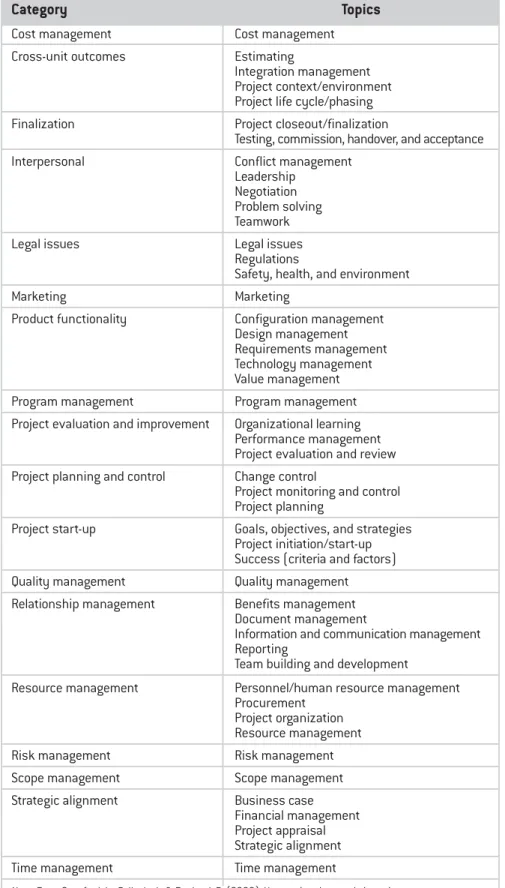
In a paper by Crawford, Pollack, and England (2006), the highlighted trends within project management literature in the period 1994–2003 were identified based on an analysis of articles in the International Journal of Project Manage-ment and in the Project Management Journal.Their objective was to provide an overview of how the discipline might be changing by using as a basis for analysis a list of 48 project management topics covering 18 main topic cate-gories. These categories and topics are shown in Table 1.
Following in the footsteps of these studies, our main purpose here, howev-er, is to explore the use of a new metrics that can be used to assess the current status of the discipline of project man-agement. We have, therefore, developed some graphical representational tools for this purpose. We believe that these tools can be applied to gauge different information sources in order to provide a more holistic view of project manage-ment as a discipline in both the present and the future. One reason for the study (other than to contribute something of interest for the Project Management Journal and our interested colleagues) was to create a comprehensive over-view of information in order to be
better equipped to continue our devel-opment of a new graduate program in project management (Master of Project Management) at the Faculty of Engi-neering at the University of Iceland (further information can be obtained at www.mpm.is). The graphical tools that we developed are principally used to assess the current status of the disci-pline of project management in terms of education and demands for compe-tence in the year 2008, by analyzing the following three sources of information: • selected textbooks on the subject
published in or after 2003;
• papers published in the Project Mana-gement Journal and the International Journal of Project Managementin the period 2003–2008, and
• 17 Master of Project Management (MPM) programs, in the United States, Australia, and Europe.
Research Method
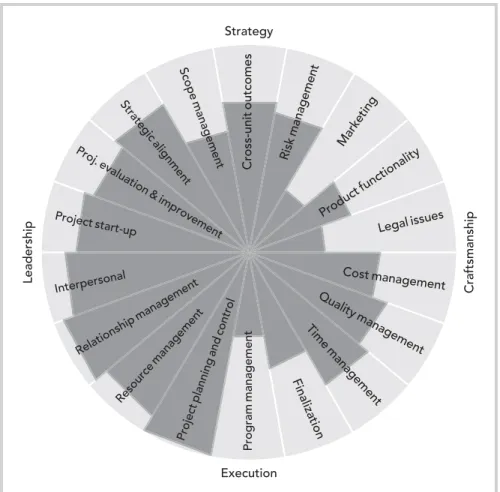
For this purpose, two different measure-ments were used. The first metric is based on the 18 categories suggested by Crawford, Pollack, and England (2006). In addition to the 48 topics listed in Table 1, however, more references were needed in order to map the data into the 18 categories, and in order to obtain this objective, Kerzner (2006), PMI (2004), PMI (2005), and Wideman (2006) were used. These categories were then trans-formed into a graphical diagram based on two main dimensions used to sug-gest the further arrangement of the cat-egories: (a) the horizontal leadership– craftsmanship dimension reflects the balance between leading the project and the project work itself, and (b) the vertical strategy-execution dimension reflects the balance between setting strategy and executing it.
In order to locate the different cate-gories within the dimensions, we called on a panel of 24 project management experts, all of whom had at least a master’s degree in the field and were actively working as project managers in businesses or in the public sector. By using a data sampling through a simple
Category
Topics
Cost management
Cost management
Cross-unit outcomes
Estimating
Integration management
Project context/environment
Project life cycle/phasing
Finalization
Project closeout/finalization
Testing, commission, handover, and acceptance
Interpersonal
Conflict management
Leadership
Negotiation
Problem solving
Teamwork
Legal issues
Legal issues
Regulations
Safety, health, and environment
Marketing
Marketing
Product functionality
Configuration management
Design management
Requirements management
Technology management
Value management
Program management
Program management
Project evaluation and improvement
Organizational learning
Performance management
Project evaluation and review
Project planning and control
Change control
Project monitoring and control
Project planning
Project start-up
Goals, objectives, and strategies
Project initiation/start-up
Success (criteria and factors)
Quality management
Quality management
Relationship management
Benefits management
Document management
Information and communication management
Reporting
Team building and development
Resource management
Personnel/human resource management
Procurement
Project organization
Resource management
Risk management
Risk management
Scope management
Scope management
Strategic alignment
Business case
Financial management
Project appraisal
Strategic alignment
Time management
Time management
Note:From Crawford, L., Pollack, J., & England, D. (2006). Uncovering the trends in project management: Journal emphases over the last 10 years. International Journal of Project Management, 24(2). Reprinted [or Adapted] with permission.
P
APER
Web-based survey, the participants were asked to place each category within each of the two dimensions. The graph-ical instrument used is the 360⬚ radar diagram and is shown with the survey’s results in Figure 1. Only the 18 main cat-egories are shown, but the remaining 48 topics, mentioned before, were used as a reference guide for arranging the data from each information source in the apposite place within the diagram.
The data was then mirrored into the radar diagram in such a way that the most important category for each of the three sources of information scored 100% (full slice), and the other cate-gories scored relatively on this basis (i.e., their relative importance is repre-sented on the basis of their area within the slice). In this way, the radar diagram represents the internal relative
impor-tance of all the categories for each source of information used in the study: journal articles, master’s programs, and recent textbooks.
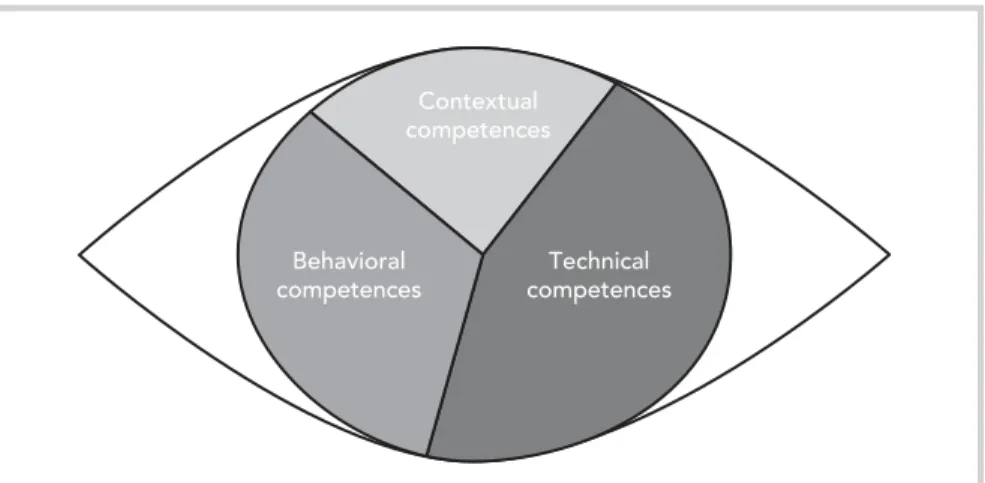
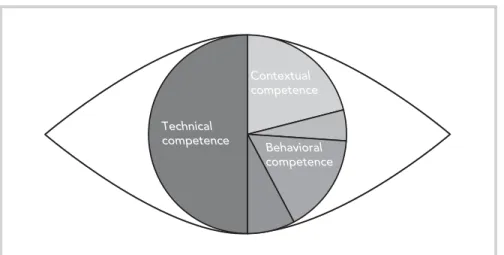
The second metric is based on the “Eye of Competence” (EOC) intro-duced in 2006 by the IPMA. The EOC is shown in Figure 2.
The subjects that fall under each of the three competences are as follows: •Behavioral competences: Leadership,
engagement and motivation, self-control, assertiveness, relaxation, openness, creativity, results of orien-tation, efficiency, consulorien-tation, nego-tiation, conflict and crisis, reliability, value appreciation, and ethics. •Contextual competences: Project
ori-entation, program oriori-entation, port-folio orientation, project program and portfolio implementation, permanent organization, business, systems prod-ucts and technology, personnel man-agement, health, security, safety and environment, finance, and legal. •Technical competences: Project
man-agement success, interested parties, project requirements and objectives, risk and opportunity, quality, project organization, teamwork, problem res-olution, project structures, scope and deliverables, time and project phases, resources, cost and finance, procure-ment and contracts, changes, control and reports, information and docu-mentation, communication, start-up, and closeout.
Based on these three main areas of competences and their corresponding
Craftsmanship
Leadership
Execution Strategy
Program management
Project planning and control
Resource managem ent Relationship management Interpersonal Project start-up Proj. evalua
tion & improve ment
Strategic align
ment
Scope manag
ement
Cross-unit outcomes Risk management
Marketing Product functionality Legalissues Cost managem ent Quality management Time manag ement Finalization
Figure 1:Project management categories and dimensions.
Contextual competences Behavioral competences Technical competences
subjects, the data (i.e., the defined categories identified in the survey described above) were then further mapped into the proper competences and subjects of the EOC. The relative balance between the competences was calculated and represented in a pie chart, which revealed our findings in a specific corresponding version of the EOC for each source of infor-mation.
Results
Papers in the Project Management JournalandInternational Journal of Project Management
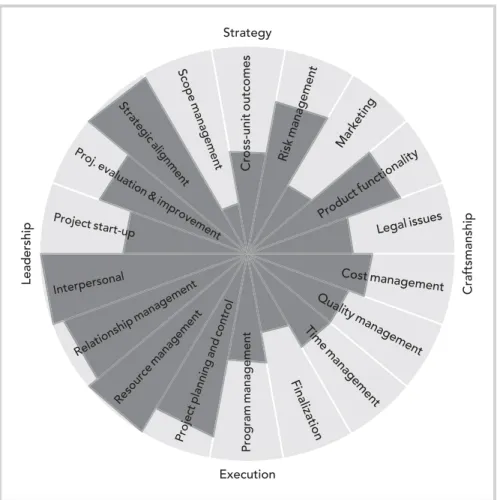
All papers published in the Project Management Journaland the Interna-tional Journal of Project Management during the period June 2003–February 2008 were registered, including titles, authors, and keywords. A total of 2,338 keywords were found in 484 papers. Keywords that were too general or too broad were omitted—for example, “project management” (81 occur-rences), “studies” (47 occuroccur-rences), and “managing projects” (56 occur-rences)—as were keywords indicating countries and specific project types. In all, 687 keywords were omitted, and the analysis was based on the remain-ing 1,651 keywords. The mappremain-ing is shown in Figure 3.
The mapping of the article key-words into the 18 categories shows that three categories were dominant: interpersonal competences, resource management,and strategic alignment, followed by relationship management. These seem, according to our findings, to be the areas in which most active research is currently occurring within project management. This focus in research will probably influence the direction that project management will take during the coming years, and its impact can already be seen in the focus of some cutting-edge master’s-degree programs in project management. We discuss this focus in research in the next section.
Graduate Programs in Project Management
The MPM is far from being as estab-lished as an MBA degree. Increasing numbers of universities are, however, offering specific graduate programs that focus on project management. In order to obtain some indication of the educa-tional focus of these programs, 17 pro-grams were selected for evaluation. The selection was based on an extensive Web exploration in which the selection criteria were that the program was on a master’s-degree level, that it was offered by a recognized university, and that suf-ficient information on the program was available online for the analysis. The fol-lowing programs were included: • Euro Master of Project Management.
University of Applied Sciences Dortmund (Germany), University of the Basque Country (Spain), Norwegian
University of Science and Technology (Norway), University of Zaragoza (Spain), ESC (France), and University of Maribor (Slovenia) (EuroMPM, 2008);
• Master of Project Management, Pennsylvania State University (United States) (Pennsylvania State University, 2008);
• Master of Project Management, Uni-versity of Iceland (Iceland) (UniUni-versity of Iceland, 2008);
• Master of Project Management, Bond University (Australia) (Bond University, 2008);
• Master of Project Management, Edith Cowan University (Australia) (Edith Cowan University, 2008);
• Master of Project Management, Keller Graduate School of Management (United States) (Keller Graduate School of Management, 2008); Craftsmanship Leadership Execution Strategy Program management
Project planning and control
Resource managem ent Relationship management Interpersonal Project start-up Proj. evalua
tion & improve ment
Strategi c alignment
Scope manag
ement
Cross-unit outcomes Risk management
Marketing Product functionality Legalissues Cost managem ent Quality management Time manag ement Finalization
P
APER
• Master of Project Management, Queensland University of Technology (Australia) (Queensland University of Technology, 2008);
• Master of Project Management, University of Queensland (Australia) (University of Queensland, 2008); • Master of Project Management,
Uni-versity of South Australia (Australia) (University of South Australia, 2008); • Master of Science in Project
Man-agement, City University of Seattle (United States) (University of Seattle, 2008);
• Master of Science in Project Man-agement, George Washington Univer-sity (United States) (George Washington University, 2008);
• Master of Science in Project Management, Royal Institute of Technology (Sweden) (Royal Institute of Technology, 2008);
• Master of Science in Project Man-agement, University of Alaska (United States) (University of Alaska, 2008); • Master of Science in Project
Man-agement, University of San Francisco (United States) (University of San Francisco, 2008);
• Master of Project Management, Syddansk Universitet (Denmark) (Syddansk Universitet, 2008);
• Stanford Advanced Project Man-agement (United States) (Stanford University, 2008); and
• Master of Science in Strategic Project Management, Heriot-Watt University (Scotland), Politecnico di Milano (Italy), Umeå School of Business and Economics (Sweden) (Anonymous, 2008).
A total of 24 universities in Europe, Australia, and the United States are involved, in one way or another, in run-ning the 17 graduate programs listed. The analysis of the programs was based on both course descriptions and the number of credits given for the completion of each course, which then combined to yield the weight of the dif-ferent categories in each program. All of the programs have an equal weight
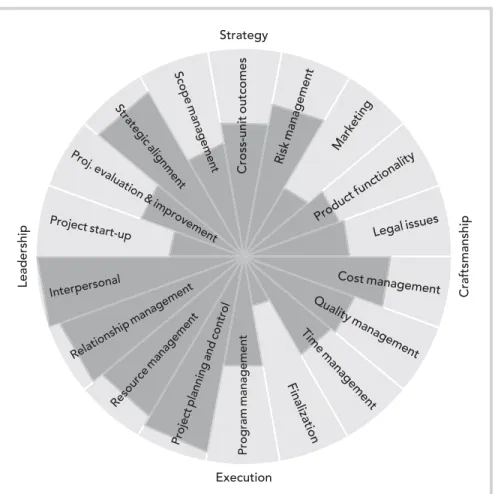
in the outcome. Their coalesced educa-tional focus in terms of our 18 cate-gories is represented in Figure 4.
The radar diagram shows that three categories are dominant: interpersonal, strategic alignment, and project plan-ning and control, followed closely by relationship management. There is, interestingly, a low score in the category finalization. These results are quite consistent with those demonstrated in Figure 3, which illustrated the focus of research topics in journal articles. It is not unreasonable to expect that in the future these master’s-degree programs will increase their focus on resource management and product functionality and that the research being conducted in these areas will be disseminated in those programs.
Textbooks on Project Management The last source of information that we examined was professional books on project management. A large number of works on project management are avail-able and many of them are university textbooks. For the purpose of this study, we selected a number of these text-books based on a search on the www.amazon. co.uk Web site on May 1, 2008. The search term was “project management,” and the search was lim-ited to books published in 2003 or later. Books that were too specific or too spe-cialized were omitted from the list, such as books on specific project manage-ment software, and only books that were over 200 pages in length were included. The final list consisted of the following 21 books: Craftsmanship Leadership Execution Strategy Program management
Project planning and control
Resource managem ent Relationship management Interpersonal Project start-up Proj. evalua
tion & improve
ment
Strategic alignment
Scope manag
ement
Cross-unit outcomes Risk management
Marketing Product functionality Legalissues Cost managem ent Quality management Time manag ement Finalization
•A Guide to the Project Management Body of Knowledge(PMBOK®Guide; PMI, 2004),
•Project Management for Dummies (Portny, 2007),
•Project Management(Maylor, 2005), •Software Project Management for
Dummies(Luckey & Phillips, 2006), •Information Technology Project
Management(Schwalbe, 2005), •Guide to Project Management(Roberts,
2007),
•IT Project Management: On Track from Start to Finish(Phillips, 2004), •Project Management(Lock, 2007), •Project Management in Construction
(Walker, 2007),
•Project Manager: Mastering the Art of Delivery in Project Management (Newton, 2005),
•Reinventing Project Management: The Diamond Approach to Successful Growth and Innovation (Shenhar & Dvir, 2007),
•Software Project Management(Hughes & Cotterell, 2006),
•The Definitive Guide to Project Man-agement: The Fast Track to Getting the Job Done on Time and on Budget (Nokes, 2003),
•The Handbook of Project Man-agement: A Practical Guide to Effective Policies, Techniques and Processes (Young, 2007),
•Project Management: A Managerial Approach(Meredith & Mantel, 2006), •Project Management—A Systems
Approach to Planning, Scheduling, and Controlling(Kerzner, 2006), •Project Management—Planning and
Control Techniques(Burke, 2003), •The Fast Forward MBA in Project
Management(Verzuh, 2005),
•PRINCE2 Revealed: Including How To Use PRINCE2 for Smaller Projects (Bentley, 2006),
• Project Management: The Managerial Process(Gray & Larson, 2006), and •Project Management: A Strategic
Planning Approach(Gardiner, 2005). Once the list was defined, the con-tent of each of the 21 books was
mapped into the 18 categories on the basis of chapter and subchapter titles and their lengths. Each book was given the same weight in the final representa-tion, and their focus in terms of content mirrored in our 18 categories is shown in Figure 5.
This diagram indicates that the selected textbooks put the strongest emphasis on project planning and con-trol, relationship management, and resource management. There is little focus on program management, mar-keting,and legal issues.These findings also fit well with the previous findings. The strong emphasis on project plan-ning and control in project manage-ment textbooks is not unexpected, and, based on what seems to be the trend in research, we might expect a stronger focus on strategic alignment and interpersonal competences in project
management textbooks in the coming years.
Holistic View
The information presented thus far can further be consolidated in such a way as to provide us with an overview of the entire current situation. By drawing a single radar diagram that includes all of our findings as illustrated in the previous diagrams, we get the representation demonstrated by Figure 6, which shows the entire picture covering all of our three sources mirrored in the 18 categories.
The variation in emphasis on the 18 different categories is striking: interper-sonal, relationship management, resource management, project planning and con-trol,andstrategic alignmentare all areas of strong focus, whereas there is much less focus on marketing, legal issues, final-ization,andprogram management.
Craftsmanship
Leadership
Execution Strategy
Program management
Project planning and control
Resource managem ent Relationship management Interpersonal Project start-up Proj. evalua
tion & improve ment Strategi c align ment Scope manag ement
Cross-unit outcomes Risk management
Marketing Product functionality Legalissues Cost managem ent Quality management Time manag ement Finalization
P
APER
Another way to represent our find-ings is to produce a still new perspec-tive by reflecting the information from the three sources into the three compe-tences of the newly introduced EOC. The results are shown in Table 2.
Combining the three diagrams thus obtained yields the representation given in Figure 7.
In the picture, the shaded areas rep-resent an overlap between the different
sources. In general, however, this view is quite consistent with the relative weight of competences as exhibited in the original IPMA EOC (Figure 2). Technical competence is still the most important feature of professional proj-ect management, followed closely by behavioral competences and then con-textual competence—which is interest-ing in view of the fact that the original weighting of competences in the IPMA’s
EOC was based on the intuitive impres-sion of its authors (according to our conversation with one of the authors, Gerrit C. L. Koch, at the IPMA Congress in Shanghai in October 2006).
In general, the IPMA EOC can be used as a tool to provide a holistic impression of project management. For those, however, who like to play with more specific categorization, the 18-category view, based on the work of Crawford and her coworkers, might give a somewhat more detailed notion. The measurement tool provided in our study, however, might benefit from some improvements with respect not only to mirroring our sources in the numbers and description of Crawford’s categories, but also to the Leadership– Craftsmanship and the Vertical Strategy– Execution dimensions that were used to place the categories within the radar diagram in the first place.
Conclusion
The combined view of project manage-ment in Figure 6 indicates that there is a stronger focus on “leadership” than “craftsmanship” and a somewhat stronger focus on “execution” than “strategy.” The “leadership–execution” section of the radar diagram is, there-fore, strong. This may support the general impression that many organi-zations do better in defining their objectives and strategy than in actually executing them in a proficient and effective way. A renewed focus on tradi-tional project management themes in the “craftsmanship” section could assist in adjusting this balance.
There is an overall consistency between the essential focal views of project management represented in Figures 3 through 5, and this can clearly be seen in the combined illustration shown in Figure 6. Journals have the strongest focus on resource manage-ment, interpersonal competence, and strategic alignment, and MPM pro-grams show a very similar focus, although with the three strongest cate-gories being interpersonal competence,
Craftsmanship Leadership Execution Strategy Marketing Legal issues Finalization Pro t start-up alu ge m it o y ma me mana P t alu ge u ma ana roj man ost Quality m Time m m ment oss-un nag m ro n y m me ag m i Reso Re Resour Relat Reso Rel I p alu ation
& im uct funcuctc
St m ent Inter Strateg ana oject planning and contr
ol ource management lationship management rpersonal & improvement ent tegic alignment Cro Risk ma Produc Co Qu r ateg ma In ourc lat
& im uctuct
Str oje m Re unc Co Qu up alu o na
Figure 6:Combined view of project management.
Competence
Journal
MPM
Areas
Papers
Programs
Textbooks
Technical
48%
49%
57%
Behavioral
26%
24%
21%
Contextual
25%
26%
22%
Table 2:Relative focus of journal papers, MPM programs, and textbooks in the competence areas of the IPMA 3.0 competence baseline.
project planning, and control and strategic alignment. The two strongest categories of textbooks are project planning and control and relationship management, and the third most focused-on category is resource man-agement. It is reasonable to assume that there is a certain time lag between the three sources considered in this study. The journals represent active research in the discipline that is often connected with universities and disseminated to business through the Master of Project Management programs. The time lapse before research results are incorporated into project management textbooks is likely to be longer. Naturally, traditional project management themes will con-tinue to be strongly emphasized in MPM programs and textbooks, regard-less of research and development on new frontiers. But given the strong focus in both journals and MPM programs on strategic alignment and interpersonal competence, these will very likely be more visible themes in the project man-agement textbooks in the future.
In view of the strong trends identi-fied in the data studied, we conclude that the traditional baseline used to describe the discipline of project man-agement could be improved. The IPMA’s recent EOC and the Compet-encies in Project Management, National Competence Baseline for Scandinavia
(Fangel, 2005) represent a step in this direction. Further development of the 360⬚ radar diagram presented in this article may also be of use. Such devel-opments, however, would necessarily involve not only a review of the cate-gories used, but also a more sophisti-cated analysis—both of the dimensions that were defined for this study and of their links to the categories within the radar diagram. This is an interesting subject for further research aimed at getting a still-clearer picture of the cur-rent eye-opening undertakings of the project management field.
Acknowledgments
We thank Thorbjörg Sæmundsdóttir, MSc, for her help in the processing of data for this study. We also thank Professor Hans J. Thamain, PhD, for his valuable comments. ■
References
Anonymous. (2008).Master of science in strategic project management. Retrieved April 1, 2008, from www. polimi.it/english/academics/english_ courses/master_mspme.php?id_nav⫽ -289&apri⫽-300
Bentley, C. (2006).PRINCE2 revealed: Including how to use PRINCE2 for smaller projects.Oxford, UK: Elsevier.
Bond University. (2008).Master of project management. Retrieved April 1,
2008, from www.bond.edu.au/study/ courses/btsd/pg/m-p-m-structure.html
Burke, R. (2003).Project management— Planning and control techniques (4th ed.). Chichester, UK: Wiley.
Crawford, L., Pollack, J., & England, D. (2006).Uncovering the trends in proj-ect management: Journal emphases over the last 10 years. International Journal of Project Management, 24, 175–184.
Edith Cowan University. (2008).Master of project management. Retrieved April 1, 2008, from http://www.aipm.com.au/ html/0802-aetp-edithcowan.cfm
Euro MPM. (2008).Retrieved April 1, 2008, from http://www.eurompm.net
Fangel, M. (2005).Competencies in project management—National com-petence baseline for Scandinavia. Hilleroed, Denmark: Associations of Project Management in Denmark, Norway and Sweden.
Gardiner, P. D. (2005).Project manage-ment: A strategic planning approach. London: Palgrave McMillan.
George Washington University. (2008).
Retrieved April 1, 2008, from
http://business.gwu.edu/grad/mspm/ index.html
Githens, G. D., & Rosenau, M. D. (2005).Successful project management: A step-by-step approach with practical examples(4th ed.). Hoboken, NJ: Wiley.
Gray, C. F., & Larson, E. W. (2006).
Project management: The managerial process.New York: McGraw-Hill Irwin.
Hughes, B., & Cotterell, M. (2006).
Software project management. Maidenhead, UK: McGraw-Hill Education.
International Project Management Association. (2006).ICB IPMA compe-tence baseline version 3.0.Nijkerk, The Netherlands: Author.
International Standards Organization (ISO). (2003).10006:2003(E) quality management systems—Guidelines for quality management in projects. Geneva: ISO Copyright Office.
Contextual competence Behavioral competence Technical competence
P
APER
Jugdev, K., & Müller, R. (2005). Retrospective look at our evolving understanding of project success. Project Management Journal, 36(4), 19–31.Keller Graduate School of
Management. (2008).Master of project management. Retrieved April 1, 2008, from http://www.devry.edu/keller/ programs/m_project_management/ courses.jsp
Kerzner, H. (2006).Project manage-ment—A systems approach to plan-ning, scheduling and controlling(9th ed.). Hoboken, NJ: Wiley.
Lock, D. (2007).Project management (9th ed.). Burlington, VT: Gower.
Luckey, T., & Phillips, J. (2006).
Software project management for dum-mies.Hoboken, NJ: Wiley.
Maylor, H. (2005).Project management (3rd ed.). Edinburgh: Pearson
Education.
Meredith, J., & Mantel, S. J. (2006).
Project management—A managerial approach(6th ed.). Hoboken, NJ: Wiley.
Newton, R. (2005).Project manager: Mastering the art of delivery in project management.Edinburgh: Pearson Education.
Nokes, S. (2003).The definitive guide to project management: The fast track to getting the job done on time and on budget(2nd ed.). Edinburgh: Pearson Education.
Pennsylvania State University. (2008).
Master of project management. Retrieved April 1, 2008, from www. worldcampus.psu.edu/MasterinProject Management_Degree_Map.shtml
Phillips, J. (2004).IT project manage-ment: On track from start to finish. Emeryville, CA: McGraw-Hill Education.
Portny, S. (2007).Project management for dummies(2nd ed.). Indianapolis, IN: Wiley.
Project Management Institute. (2004).
A guide to the project management body of knowledge (PMBOK®Guide) —Third edition. Newtown Square, PA: Author.
Project Management Institute. (2005).
Organizational project management maturity model.Newtown Square, PA: Author.
Queensland University of Technology. (2008).Master of project management. Retrieved April 1, 2008, from http://www. courses.qut.edu.au/cgi-bin/WebObjects/ Courses.woa/wa/selectMajorFromMain? structureID⫽16258&courseID⫽4935#1 6258
Roberts, P. (2007).Guide to project management: Achieving lasting benefit through effective change.London: Profile Books.
Royal Institute of Technology. (2008).
Retrieved April 1, 2008, from www.kth. se/studies/master/programmes/sth/ Project%2BManagement%2Band% 2BOperational%2BDevelopment?l⫽en
Scanlan, J. (2006).What’s new in proj-ect management—Janice Scanlan interviews Milton D. Rosenau, Jr. Consulting to Management (C2M) Journal, 19(2), 35–36.
Schwalbe, K. (2005).Introduction to project management(4th ed.). Boston: Thomson Course Technology.
Shenhar, A. J., & Dvir, D. (2007).
Reinventing project management: The diamond approach to successful growth & innovation.Boston: Harvard
Business School Press.
Stanford University. (2008).Retrieved April 1, 2008, from http://apm.stanford. edu/courses.htm
Syddansk Universitet. (2008).Master i projektledelse. Retrieved April 1, 2008, from http://www.sdu.dk/Uddannelse/ Uddannelsesoversigt/Master/Master_ i_projektledelse.aspx
University of Alaska. (2008).Master of science in project management. Retrieved April 1, 2008, from http:// soe.uaa.alaska.edu/espm/introduction/ programs/project_management/index. html
University of Iceland. (2008).Retrieved April 1, 2008, from http://www.hi.is/ page/mpm
University of Queensland. (2008).
Master of project management. Retrieved April 1, 2008, from http://www.uq.edu.au/study/pro-gram.html?acad_prog⫽5289
University of San Francisco. (2008).
Master of science in project manage-ment. Retrieved April 1, 2008, from http://www.usfca.edu/catalog/cps_ grad_pmgt.html
University of Seattle. (2008).Master of science in project management. Retrieved April 1, 2008, from http:// www.cityu.edu/som_gd_ms_projmgmt. htm
University of South Australia. (2008).
Master of project management. Re-trieved April 1, 2008, from http://www. unisanet.unisa.edu.au/programs/ program.asp?Program⫽IMPJ&Year⫽ 2008
Urli, B., & Urli, D. (2000).Project man-agement in North America, stability of the concepts. Project Management Journal, 31(3), 33–43.
Verzuh, E. (2005).The fast forward MBA in project management(2nd ed.). Hoboken, NJ: Wiley.
Walker, A. (2007).Project management in construction.Oxford, UK: Blackwell.
Wideman, M. (2006).Web page of Max Wideman. Retrieved November 15, 2006, from http://www.maxwideman. com
Young, T. (2007).The handbook of project management: A practical guide to effective policies, techniques and processes.London: Kogan Page Limited.
Zobel, A. M., & Wearne, S. H. (2000).
Project management topic coverage in recent conferences. Project
Management Journal, 31(2), 32–37.
Helgi Thor Ingasonholds a PhD in process metallurgy from the Norwegian Institute of Technology and an MSc in mechanical and industrial engineering from the University of Iceland. He is an associate professor of industri-al engineering at the University of Iceland and
lectures in project management, quality man-agement, and facilities planning. He is the head of the Master of Project Management program at the university (www.mpm.is). He is a member of the Nordica Consulting Group in Iceland and cofounder and chairman of Alur, alvinnsla hf, a recycling company that works with the alu-minum industry in Iceland. He is the coauthor of three books on quality management, product development, and project management. His research fields range from quality and project management to renewable energy, production,
transport, and utilization. He is an IPMA-certified senior project manager.
Haukur Ingi Jónassonholds a PhD in psychiatry and religion from Union Theological Seminary in New York. He is an assistant professor in man-agement at the School of Engineering and Natural Sciences and a research fellow at Cooper Union for the Advancement of Science and Arts in New York. He is an associate director of the Master of Project Management program at the
university, a partner with the Nordica Consulting Group ehf, and an associate with HLP-Hirzel Leder & Partner consultants in Frankfurt, Germany. His research interests include organi-zational behavior and development, manage-ment and project managemanage-ment, industrial and organizational psychology, communication, negotiation, conflict management, group dynam-ics, human growth and development, coaching, higher-order thinking (critical/creative/ethical), psychoanalytical and depth psychological theo-ries, religion, culture, and project ethics.