TEN YEARS LATER: A STUDY OF THE EXPERIENCES OF NON-TRADITIONAL WOMEN STUDENTS WHO SUCCEEDED IN A COMMUNITY COLLEGE SETTING
WITH THE HELP OF A MENTOR PROGRAM
by
Gyndolyn Bradford
B.S., Pennsylvania State University, 1974 M.A., Framingham State College, 1988
Submitted to the Graduate Faculty of the School of Education in partial fulfillment
of the requirements for the degree of Doctor of Education
UNIVERSITY OF PITTSBURGH SCHOOL OF EDUCATION
This dissertation was presented by
Gyndolyn Bradford
It was defended on March 13, 2017
Jean Ferketish, Associate Professor, Administrative and Policy Studies Stewart Sutin, Clinical Professor, Administrative and Policy Studies
Charlene Trovato, Clinical Associate Professor, Administrative and Policy Studies Dissertation Advisor: John C. Weidman, Professor, Administrative and Policy Studies
Copyright © by Gyndolyn Bradford 2017
The idea of mentoring in higher education is considered a good thing for students and faculty. What is missing in the research is how does mentoring influence and shape the student experience, does mentoring help retention, and how does it contribute to student development? (Crisp, Baker, Griffin, Lunsford, Pifer, 2017). The mentoring relationship has existed as a framework within which established members of a social structure guide the development of new members. In the United States, post-secondary educational institutions adopted mentoring as one of a group of student services to promote retention and academic success. The subject of this study is a group of nontraditional women students who participated in a mentoring cohort at a community college in Pennsylvania. Members of the same cohort participated in an earlier study (Phase I), which revealed after graduating from the community college with associates’ degrees the students felt their mentoring experience was a major contributor to their retention and prepared them to pursue additional academic credentials for professional careers.
The current research revisited the cohort participants ten years after graduation from the community college to document their current perspective on their experiences in the mentor
TEN YEARS LATER: A STUDY OF THE EXPERIENCES OF NON-TRADITIONAL WOMEN STUDENTS WHO SUCCEEDED IN A COMMUNITY
COLLEGE SETTING WITH THE HELP OF A MENTOR PROGRAM Gyndolyn Bradford, EdD
program. The study provided insight into the positive effects of the mentoring program; and how the students’ views about mentoring evolved over time with experience; and how this information can be used to identify opportunities for improving future mentoring programs for nontraditional women students at the community college. The results identify important factors to be addressed in the design of future programs. The participants recommended the cohort format be emphasized to promote peer support, establish academic study groups, and alleviate barriers that hinder degree completion.
The author recommends for consistent quality of a program the criteria be collected as performance metrics, a management team work with a shifting population of mentors and student participants. Implications for the community college include expanding the availability of mentoring and addressing the needs of nontraditional women students with a comprehensive package of student services that complement the program, including life skills, academic preparedness, career advisement, orientation, decision-making skills, time management personal counseling.
TABLE OF CONTENTS
PREFACE ... XIV
1.0 OVERVIEW ... 1
1.1 INTRODUCTION ... 1
1.2 BACKGROUND OF THE STUDY ... 3
1.3 STATEMENT OF THE PROBLEM ... 5
1.4 THEORETICAL FRAMEWORK ... 6
1.5 RESEARCH QUESTIONS FOR THIS STUDY ... 9
1.6 OBJECTIVES OF THE STUDY ... 9
1.7 SIGNIFICANCE OF THE STUDY ... 10
1.8 DEFINITION OF TERMS ... 11
1.9 STUDY PARTICIPANTS AND LIMITATIONS... 13
1.10 METHODOLOGY ... 14
1.11 SUMMARY ... 15
2.0 REVIEW OF THE LITERATURE ... 16
2.1 INTRODUCTION TO LITERATURE REVIEW ... 16
2.2 THEORETICAL FRAMEWORKS... 17
2.2.1 The “Nontraditional” Student ... 17
2.2.3 The Community College Context ... 21
2.2.4 Conflict between Community of Origin and College Environment... 24
2.2.5 Academic Preparedness ... 29
2.2.6 Self-Knowledge and Self-Efficacy ... 33
2.2.7 Previous College Experience and Role Models ... 35
2.2.8 Retention and Persistence Factors ... 39
2.2.9 Model Programs to Promote Retention and Persistence ... 41
2.2.10 The Mentorship Program Model: Theoretical Approach ... 43
2.3 PRIOR COHORT RESEARCH AND PHASE I STUDY ... 48
2.3.1 Characteristics of Subject Cohort ... 48
2.3.2 Phase I Study: “Mentoring Non-Traditional Women Students Who Succeeded in a Community College Setting”... 49
2.4 SUMMARY AND SIGNIFICANCE ... 555
3.0 METHODOLOGY ... 57
3.1 INTRODUCTION ... 57
3.2 SELECTION OF QUALITATIVE RESEARCH DESIGN ... 58
3.3 CASE FORMAT ... 59
3.4 CRITERIA FOR RESEARCH QUESTIONS ... 60
3.5 DATA COLLECTION PROCEDURES ... 62
3.6 STUDY PARTICIPANTS ... 63
3.7 INTERVIEW FORMAT ... 64
3.8 INTERVIEW QUESTIONNAIRE... 65
3.10 SUMMARY ... 71
4.0 RESULTS ... 73
4.1 INTRODUCTION ... 73
4.2 CASE DEMOGRAPHICS ... 74
4.2.1 Demographic Summary of Study Participants ... 74
4.3 CASE INTERVIEWS ... 76 4.3.1 Cher... 76 4.3.2 Gina ... 82 4.3.3 Lisa ... 85 4.3.4 Penny... 87 4.3.5 Tyra ... 90
4.4 ANALYSIS OF EACH CASE ... 93
4.4.1 Questionnaire Section 1.0 EDUCATION ... 93
4.4.1.1 Question 1.1 What other degrees did you earn after graduating from the community college? ... 93
4.4.1.2 Question 1.2 Have you achieved any additional educational goals? ………94
4.4.1.3 Question 1.3 Why did you attend the community college and other schools you have mentioned? ... 95
4.4.2 Questionnaire Section 2.0 WORK ... 97
4.4.2.1 Question 2.1 What organization do you work for now? ... 97
4.4.2.3 Question 2.3 As part of your job who do you manage or supervise? ………99 4.4.3 Questionnaire Section 3.0 CHALLENGES ... 99 4.4.3.1 Question 3.1 What were your greatest challenges when you were a student at the community college? ... 99 4.4.3.2 Question 3.2 What methods did you use to overcome these challenges? ... 101 4.4.3.3 Question 3.3 What challenges have you found most difficult to overcome and why? ... 102 4.4.4 Questionnaire Section 4.0 MENTORING ... 103
4.4.4.1 Question 4.1 What were the advantages of having a mentor when you were a student at the community college? ... 103 4.4.4.2 Question 4.2 What positive experiences do you have about the mentoring program at the college? ... 105 4.4.4.3 Question 4.3 How could the mentoring experience been improved to help you as a student and as a professional? ... 106 4.4.4.4 Question 4.4 If you were going to design a mentoring program for the nontraditional women attending the community college what important aspects would you include in this program? ... 107 4.4.4.5 Question 4.5 What criteria would you use to evaluate the success of a mentoring program for nontraditional community college students? ... 108 4.4.4.6 Question 4.6 How have you mentored anyone since in school, work, or any other way since graduating from college? ... 109
4.4.4.7 Question 5.1 What other support systems are needed for women to
complete their degrees? ... 111
4.5 SUMMARY OF FINDINGS ... 112
4.5.1 Families and Friends ... 112
4.5.2 Mentoring ... 113
4.5.3 Time management ... 113
4.5.4 Finding a Job ... 114
4.5.5 Educational Goals ... 114
4.5.6 Characteristics of an Effective Mentor Program ... 115
5.0 CONCLUSIONS ... 118
5.1 COMMON THEMES ... 119
5.1.1 Family and friends ... 119
5.1.2 Mentoring ... 121
5.1.3 Time Management ... 123
5.1.4 Finding a Job ... 124
5.1.5 Educational Goals ... 125
5.1.6 Important Factors in the Design of an Effective Mentor Program. ... 127
5.2 RESEARCH QUESTIONS ... 129
5.2.1 Research Question 1: Understanding ... 129
5.2.1.1 How do nontraditional women understand the concept of mentoring in a community college setting? ... 129
5.2.2.1 To what extent do you believe mentoring by others has helped in
changing the educational lives of community college students? ... 130
5.2.3 Research Question 3: Aspects ... 131
5.2.3.1 What important aspects should be included in the design of a mentor program for it to be effective? ... 131
5.2.4 Research Question 4: Mentors ... 132
5.2.4.1 What important characteristics should mentors possess in order for them to be effective? ... 132
5.2.5 Research Question 5: Other Supports ... 132
5.2.5.1 What other support systems are needed for women to complete their degree? ... 132
5.3 LIMITATIONS OF RESEARCH ... 134
5.4 IMPLICATIONS OF RESEARCH ... 135
5.5 CONCLUSION AND SUMMARY ... 135
5.6 RECOMMENDATIONS ... 136
6.0 PERSONAL NOTE ... 138
APPENDIX A ... 141
APPENDIX B ... 142
LIST OF TABLES
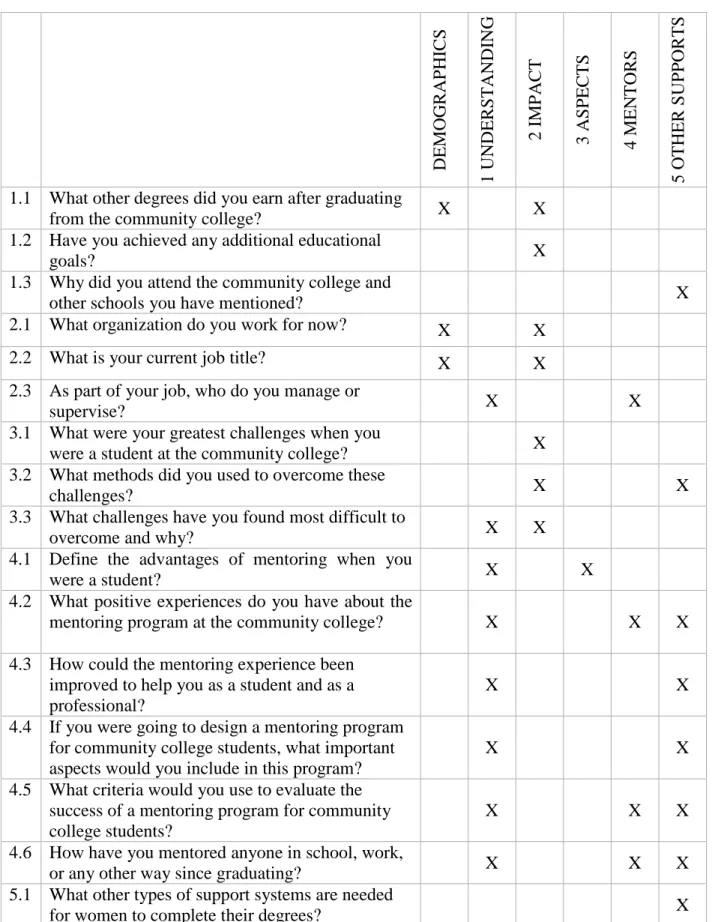
Table 1. Matrix: Research Questions and Questionnaire... 68 Table 2. Current Demographics of the Participants Interviewed (Phase II) ... 75 Table 3. Current Self Descriptive Demographic by the Woman Interviewed (Phase II) ... 75
LIST OF FIGURES
PREFACE
The completion of this dissertation was made possible through the support, guidance, and prayers of many people who encouraged me in my journey. I thank my Lord and Savior, Jesus Christ from whom all blessings flow. I acknowledge God with all praise, honor and glory. I know without GOD I am nothing but without me HE is still GOD. He opened the doors for me to accomplish a very important dream.
I thank Dr. John Weidman for being a patient mentor and serving as my Dissertation Advisor and Chair through this process. His guidance and recommendations kept me on track and were tremendously helpful. I thank my dissertation committee members which included Dr. Charlene Trovato, Dr. Jean Ferketish, and Dr. Stewart Sutin for supporting my research topic and sharing their expertise with me.
To my mom, Mamie, I thank her for being my biggest supporter and prayer partner while encouraging me to complete my degree and always remember to get understanding along with knowledge. I have love, respect and gratitude for my mom for sacrificing her time so I could be the trailblazer in our family by completing my doctorate degree. I will carry what I learned about the power of prayer, unconditional love, and persistence passed from my family members to me.
I thank my editors Paula Shubock and Sarah Capello for their support and assistance. I am very grateful for the encouragement from colleagues and friends. I pay homage for the people placed in my life as mentors and shared in my dream. What I learned from my mentors continue
to impact my life. My calling is to help others to succeed in their educational journey and for this I am forever grateful.
1.0 OVERVIEW
1.1 INTRODUCTION
“Mentors play a clear role in student success. Mentoring is one of those concepts in higher education that few disagree is a “good” thing for students and faculty. What is often missing, however, is how mentoring actually influences and shapes the student experience. Does mentoring help with student retention?” (Crisp, Baker, Griffin, Lunsford, and Pifer, 2017) pgs. 3-4.
From 2005 through 2008, a cohort of fourteen women students participated in a mentoring program sponsored by a large community college in western Pennsylvania. These women students, who all graduated from the community college with associates’ degrees, were “nontraditional” in the sense that they were older than typical undergraduates, had extensive family responsibilities, were the first in their families to attend college, and were socioeconomically disadvantaged at the time they began their post-secondary academic work. After graduating, the women continued their academic pursuits, with many earning baccalaureate and graduate degrees, and found employment in professional capacities related to their fields of study. An earlier non published supervised research paper dated December 6, 2015 by me, Gyndolyn Bradford, reported the results of a qualitative study that evaluated these students’ experiences with that mentoring program after they graduated from the community college and as they were completing their undergraduate and advanced degrees and beginning their careers. The research showed that the students believed the mentoring program helped them persist
through to graduation from the community college. The research also indicated that they credited their ability to move beyond their associates’ degrees into four-year college programs and professional careers to the knowledge, leadership skills, and confidence they developed through the mentoring program.
The present study was designed to revisit this same cohort of students ten years later who now consider themselves successful because they have obtained a degree(s) and have a career related to their goals. The purpose of the study were to gain insight into the lasting positive effects of the mentoring program; to identify how the students’ views about mentoring may have evolved with greater work and academic experience; and to use this information to identify opportunities for improving future mentoring programs for nontraditional women students at the community college.
The information produced as a result of this study expands on the limited research examining the influences on program completion of women in community college, and will add to the current body of knowledge about mentoring women in a community college setting. This study contributes to the literature by evaluating the residual effects of a community college mentoring program a decade beyond graduation and providing guidance to community college administrators as they endeavor to make mentoring programs for non-traditional women students more effective both during the community college experience and beyond. The results will be available to share with nontraditional women students and the community college administrators and faculty who work with them.
What will the future hold for nontraditional women enrolling in the community college? In order for them to be able to find a career and compete in the global economy, they will need to learn the technical skills and earn the degree and or certificate required in a high demand global
market. These women will still have families to support and limited time and funds. What is needed to help the women to be successful in achieving a degree in their fields of study? How can community colleges provide the help and support of women in the advancement of future generation?
1.2 BACKGROUND OF THE STUDY
I have twenty-five years of professional experience in public and higher education, working and living in areas where the environment is supportive of lifelong learning and education. My overarching concern is to learn more about how nontraditional women can succeed in attaining their educational goals.
I attended and graduated from a Pennsylvania college with over 25,000 students; the young men overwhelmingly outnumbered the young women. Fewer than 3% of students were minorities, and a very small number were nontraditional women. At that time, an important goal of mainstream institutions of higher education was to recruit more young women and maintain a more diverse student population.
Despite the efforts of these institutions, many of my peers experienced a frustrating time as an undergraduate student also. Only two of the four women recruited with me registered for a second semester. They said that the university was too strict with rules and they did not fit into life on campus because they had family responsibilities. Students had their own peer groups and they showed no interest in crossing the color line to make friends. Throughout my undergraduate years, I had only one professor of color during my freshman year and he disappeared immediately after class.
When I began this area of research, I wanted to understand the reasons why so many nontraditional women dropped out of college before the end of their first year. In particular, I wanted answers to these questions below because as an undergraduate and graduate student I had never heard the word “mentor” and based on the various definitions, I needed to better understand how mentoring could help support women struggling to complete their degree. These are the questions from the Phase 1 study.
1. How did the community college experiences differ for the women who stayed and eventually graduated?
2. Did these women have additional help, and if so, what kind of help did they receive and who helped them?
3. How had other students managed to stay in school and cope with the stresses of life on campus?
4. What other support systems were needed in order to keep the nontraditional women in college?
As an undergraduate student, I had never heard the word “mentor”. For a significant number of people in the United States, their post-high school story begins at the community college, a specially designed institution where individuals find the education and supports necessary to achieve success in the modern economy.
For women attending colleges there is still the lack of supports from family, in funding and academic help. Historically, getting a college degree is considered the road to success and a better life for all families. A significant number of these families are led by women (Hackett, 2002).
According to Johnson (2001), colleges and universities in America are aware of the lack of social support systems for African American women students attending college. This researcher is aware that there are numerous reasons as to why the problem has not changed today. Some colleges are not trying harder to provide the support networks to all nontraditional women so they can be more successful in getting their degree, getting a good job, providing for their families, being a positive role model for their children, and making a significant contribution to the government.
1.3 STATEMENT OF THE PROBLEM
As community colleges are registering more nontraditional women they need to address the issues that have a significant impact on the low completion rate of these students. New strategies and programs need to be developed in order to alleviate the barriers encountered by women who need to complete their degree and become financially independent. Strategies such as mentoring programs help to provide the support services to help ensure successful completion of the educational goals for these women.
This study addresses what aspects of the mentor program at the community college identified by nontraditional women graduates worked to retain nontraditional women who wanted to be successful in changing their life. These women were able to complete their college degree and move into a careers related to their degree to support their families. It also explores other supports and skills these students learned that kept them in college.
The problem is women are enrolling at the community college but not being retained so they do not complete their degree programs. Remaining in college to complete a degree is critical
if you want the women to be able to move into higher paying and more rewarding employment opportunities. Students need to learn about all the support services available to them such as tutoring, advising and supportive services, and veteran office in order to have access from the start and not fall behind.
The challenges of nontraditional students vary as they participate in the college experience. These women do not understand the importance of the support systems put into place at the college to help students maintain social and academic success (Hackett, 2002). Further explanation by the author (Hackett, 2002) shows that support mechanism are in place to assist the student in achieving their academic goals. If the support systems are not used by students they have little to no value to the student. If the student is not aware of the services due to lack of sufficient marketing to students then they cannot be expected to seek out what they need if they do not know what they need.
1.4 THEORETICAL FRAMEWORK
Phase I of the study produced by the researcher showed that the students who were interviewed believed the mentoring program they participated in ten years ago helped them to persist through to graduation from the community college. The research also indicated that they credited their ability to move beyond their associates’ degrees into four-year college programs and professional careers to the knowledge, leadership skills, and confidence they developed through the mentoring program.
In retention models such as in Tinto’s (1987, 1993) theory he discusses the predictors of persistence which are academic integration or performance and social integration or participating
in college activities. There are numerous types of college retention programs. The retention programs are different in the way they are structured, the focus of the program, and how the program is operated (Tinto, 1987). Tinto discussed the principles of effective retention. The three principles of effective retention include; the institutions commitment to the student, which means the welfare of the student comes first, the educational commitment means the programs are committed to the education of every student and learning is not left to chance, and the last principle of effective retention emphasizes how importance of community. All of these principles apply to the retention of nontraditional students such as women and minority groups. Weidman (1985) applied Tinto’s theory to women welfare recipients in a community college that included women of all races. The findings recommended that this model go beyond the college setting and consider external issues also. Other issues can be personal or institutional not in the control of the student.
Adaptation to the unfamiliar surroundings of college by establishing a different self-knowledge in order to “fit’ into the college environment can take precedent over academic expectations for a new student. Nontraditional women in the community college are first generation students and have little if any previous college experience or role models to mirror. The retention and models and mentorship programs are addressed in the latter part of the literature review to explain how current community college research has tried to address the influx of the nontraditional women who comes with numerous obstacles for completing a program and getting a college degree.
There are personal and institutional barriers that negatively influence the women’s persistence to complete her degree also. Some of these may have low self-confidence and previous negative educational experiences. There may also be other factors which may include
lacking time management skills, family and work problems, economics, adding a new role conflict with your current responsibilities.
Cox and Ebbers (2010) found that nontraditional women felt more comfortable registering in the community college environment due to the diversity in demographics. There are several reasons that make the community college more acceptable to women who delayed in attending post-secondary education. Open enrollment, lower tuition and the location of the campus or center in the community (Cohen& Brawer, 2008).
The simple fact of being a woman no longer defines a student as non-traditional. In 2016, 57% of community college students were women (AACC, 2016); this gender proportionality has been relatively stable for 15 years. Nonetheless, the services traditionally rendered by community colleges have not until recently recognized the special needs of women in the academic environment. Programs that specifically address the completion rates for graduation of nontraditional women in the community college need information to share through research. One such program where the success of graduates depended upon the participants was the mentor program.
The term mentor has numerous definitions which makes it hard to define (Brown). The literature reviewed shows that the term is not easy to define. The mentor as advisor model is advantageous in helping a student to understand and navigate through academic systems and procedures, but can have several disadvantages. When the mentor emphasizes following instructions rather than providing informed guidance, the student can be discouraged from questioning the ideas and reasons presented by the advisor. Extensive direction, sometime known as “handholding”, can discourage the student from developing his/her own views and making independent decisions. (Gupton & Slick, 1996).
Additional theories which are being addressed in the literature review will address the reasons why and how the nontraditional women define themselves as being successful ten years after they participated in the mentor program at the community college and consider themselves successful.
1.5 RESEARCH QUESTIONS FOR THIS STUDY
Question 1: How do nontraditional women understand the concept of mentoring in a community college setting?
Question 2: To what extent do these nontraditional women community college students believe mentoring by others has helped in changing their educational lives?
Question 3: What important aspects should be included in the design of a mentoring program for nontraditional college students for it to be effective?
Question 4: What important characteristics should mentors possess in order for them to be effective?
Question 5: What other support systems are needed for these nontraditional women community college students to complete their degree?
1.6 OBJECTIVES OF THE STUDY
This study was designed to investigate the same cohort of nontraditional women students ten years later who participated in an informal mentoring in a community college. When asked about
their relationship experience in the mentor program at the college, they all stated the importance of the mentor relationships as a prominent factor in the completion of getting their degree and graduating. Upon further investigation, other important information was found during these interviews. These participants all went on to complete a bachelor’s degree and two students completed a doctorate in medicine and law. Two students completed a MSW and all the participants of the study are working in a field related to their degrees.
These women now consider themselves successful because they have obtained a degree(s) and have a career related to their goals. In order to gain insight into the lasting positive effects of the mentoring program; to identify how the students’ views about mentoring may have evolved with greater work and academic experience; and to use this information to identify opportunities for improving future mentoring programs for nontraditional women students at the community college.
To meet this purpose ,the original study: (a)asked about the influence of having a mentor, (b) understanding the concepts of mentor and mentoring; (c) the amount of time participation in the program; (d) and influences of the mentor program; (e) and characteristics of needed for a mentor program to be effective.
1.7 SIGNIFICANCE OF THE STUDY
This qualitative study about the pursuit and completion of a college degrees by nontraditional women in the community college with the help of a mentor is essential for the retention persistence and successful women nationwide. This study can be used as a resource for other colleges that have a need to retain women in college for degree attainment.
The literature suggests that the more educated the population the more economic benefits, less criminal activity, less government services needed to supplement incomes and individuals are more likely to participate with the nation’s governance (Institute for Higher Education Policy, 1998). This study will also inform community college leaders, faculty and staff that this population of nontraditional women can succeed when positive mentoring relationships provide the supportive social and academic services needed for students to complete their degree.
Looking beyond the relationship factors of a mentoring program the information can also be used to add to the body of knowledge of effective strategies for retention and success of nontraditional women in a community college setting.
1.8 DEFINITION OF TERMS
Community college. A very common definition of the community college is “any institution
regionally accredited to award the associate degree in arts or science as its highest degree” (Cohen & Brawer, 2008, p. 5) It also is defined as a two year institutions that offer a variety of vocational, career technical, community education, non-degree course, enrichment classes and associate degree that can be transferred to a four-year college or university.
Community college students. Students enrolled in 2-year institutions of higher education through the nation.
Delayed Enrollment. Students who do not enroll and attend college, immediately, within the same year they completed and or graduated from high school.
First generation student. Students who have not had another family member who
Goal setting is deciding what you what you want to accomplish and developing a plan on how you will get the results.
Informal mentoring. An agreed upon one -to -one relationship that is spontaneous established between a college employee and a student for the primary purpose of achieving the student’s academic goals.
Mentor. An individual who has been identified as an influential and important person in the educational journey of a college student.
Mentoring. A mutually agreed upon one –to –one relationship established between a mentor and his or her mentee.
Nontraditional women college students. Over the age of 24 with children or other dependents to support; financially independent with little or no financial support from any other source employed full time; enrolled part-time; first generation college student; member of a minority or underrepresented group; and /or hold a GED rather than a high school diploma (NCES, 2015).
Persistence. An educational institution’s ability to maintain a student’s enrollment from the time they enroll and are admitted to graduation or transfer to a 4-year college or university.
Retention. Students who continue on from one semester to the next semester even though they may have received failing grades they continue to return until they complete their coursework.
Success. Students who complete their community college education by completing and
receiving a specific program diploma, certificate or an associate degree.
Traditional college student. The traditional college undergraduate- defined as one who earns a high school diploma, enrolls full time immediately after finishing high school, depends
on parents for financial support, and either does not work during the school year or works part-time is the exception rather than the rule in the U.S. colleges and universities. (NCES, 2016)
Transfer. When a student completes their general education requirements and/ or have graduated with an associate degree, they transition from a community college to a bachelor degree granting college or university to continue their education.
1.9 STUDY PARTICIPANTS AND LIMITATIONS
Study Participants:
1. All nontraditional women in the study participated in the same community college cohort mentor program for a minimum of one year.
2. All participants were women who met at least one definition of nontraditional. 3. All participants completed an associate degree.
4. All the participants were currently employed.
The study limitations that may have affected the results are as follow: 1. The number of women participants are limited to a small sample of 5. 2. Some study participants were selected from the Phase 1 study.
3. The nontraditional women students were participants in a cohort mentor group. 4. All the nontraditional women students had graduated from college
1.10 METHODOLOGY
The study includes the experiences of nontraditional women that completed their education and received an associate degree from a community college by participating in a cohort mentor program. I am very interested in finding out more about the experiences of the participants, how the program help with retention, what other factor may have contributed to the success of the group’ and what characteristics are needed in designing an effective mentor program. Qualitative work allows for a view that is fluid and personal. This study is a qualitative research design where I, as the researcher am the key for collecting the data through personal phone interview questions.
Creswell (2009) states” narrative research is a qualitative strategy in which the researcher studies the lives of individuals and asks one or more individuals to provide stories about their lives. This is then retold by the researcher into a narrative chronology” (p.231). The narrative is as old as storytelling which we learn is an old form of sharing information which people have handed down over time.
The narrative research consists of individual case studies. The research questions were answered via analysis of the stories described in each case. There are many variations on a case study and I used multiple case studies because all of the participants are members of the same cohort with varying responses to the same questions.
The research design was submitted to, and approved by, the Institutional review Board at the University of Pittsburgh where the study was conducted. The participants are all graduates from the same mentoring program at the community college. All the participants finished their associate degree and went on to earn at least a bachelor’s degree. The students who participated
in the confidential phone interviews. Emails were sent to the Phase I cohort group members to arrange interviews.
1.11 SUMMARY
A cohort of fourteen nontraditional women students participated in a mentoring program sponsored by a large community college in western Pennsylvania. These women students, who all graduated from the community college with associates’ degrees, were “nontraditional” in the sense that they were older than typical undergraduates, had extensive family responsibilities, were the first in their families to attend college, and were socioeconomically disadvantaged at the time they began their post-secondary academic work. After graduating, the women continued their academic pursuits, with many earning baccalaureate and graduate degrees, and found employment in professional capacities related to their fields of study. In Phase 1 or the previous study the results of the study indicated the participants explained the important impact of the mentor program and how the relationships was a key factor in the success of their graduation. The mentor program was described as so much of key factor for retention that the cohort participants went on to further their education by obtaining additional degrees and better jobs related to their degrees. This research study or Phase II will collect additional information to clarify other factors which may have contributed to the findings such as the women’s understanding of the definition of the word mentoring, if mentoring helped in how they were able to handle challenges, and other support factors used by these women to help them with their studies and share this information with other community college retention program developers
2.0 REVIEW OF THE LITERATURE
2.1 INTRODUCTION TO LITERATURE REVIEW
This review of the literature is an exploration of research pertaining to nontraditional women in the community college setting and how their participation in a mentoring program had a positive, long term impact upon their academic and professional achievement. The value of this qualitative study relates to a commitment of the community college in providing the support services needed to develop and implement a new program or improve the nontraditional women mentoring program currently operating.
The literature review is designed to inform college educators and program developers about the important factors needed to mentor and support nontraditional women who attend the community college. These important factors in the program will be used to support the women from matriculation, through retention, to completion of their academic goals, which can include obtaining a certificate or a degree. The literature review addresses the characteristics of nontraditional women as students in the community college; the factors that influence their adaptation to the college environment and perseverance in college; and issues related to the negotiation of conflicts between the home and school environments. The review of the literature also addresses the academic skills required to succeed in college, and examines the important characteristics of the individuals who serve as mentors.
2.2 THEORETICAL FRAMEWORKS
2.2.1 The “Nontraditional” Student
The college experience has long been defined by the “traditional” undergraduate. The National Center for Education Statistics (NCES, 2016) defines a traditional student as one who earns a high school diploma, enrolls in college full time immediately after finishing high school, depends on parents for financial support, and either does not work during the school year or works part time. The traditional student is the exception rather than the rule in U.S. community colleges today. In 1999–2000, just 27 percent of undergraduates met all of these criteria; 73 percent – almost three-quarters - of all undergraduates were in some way “nontraditional.” Exactly what demographic characteristics constitute a nontraditional student has been the source of much discussion in recent research.
NCES (2015) defines “nontraditional college students” as meeting one or more of the following criteria: over the age of 24 with children or other dependents to support; financially independent with little or no financial support from any other source; employed full-time; enrolled part-time; first-generation college student; member of a minority or underrepresented group; and/or hold a GED rather than a high school diploma. These seven characteristics have sometimes been called “risk factors” because they are negatively related to staying in school and earning a degree. (NCES, 2002)
The NCES nontraditional scale represents a simple sum of all nontraditional characteristics (from 0 to 7), with 0 representing traditional students. Minimally nontraditional: only one characteristic (14-15% of all students) moderately nontraditional: two or three characteristics (25-31% of all students), tended to be older than typical, independent, and attend
part-time. Highly nontraditional: Having four or more characteristics in addition to the typical characteristics of moderately nontraditional students, two-thirds either had dependents or worked full-time, and 25% were single parents. (NCES, 2006)
NCES (2002) reports that in the 1999-2000 academic year, only 17 percent of traditional students chose a public 2-year institution (community college). The enrollment pattern of nontraditional students is different. Students who were even minimally nontraditional (just a few of the seven defining characteristics) were much more likely than traditional students to attend a 2-year institution (39 percent), and the more nontraditional they were, the more likely they were to do so. Among highly nontraditional students, 64 percent attended a public 2-year institution. The average age of a community college student is 29, and two thirds of community college students attend part-time while they work or fulfill other responsibilities Two-thirds of all highly nontraditional students consider themselves primarily employees (NCES IES, 2000).
The majority of Black and Hispanic undergraduate students in this country study at community colleges. (AACH, 2005). Diversity continues to increase as students are motivated by enabling legislation, new technologies, and global economic shifts that bring new immigrants and require retraining for displaced citizens. These non-traditional college students embark upon their academic careers with vastly different personal histories, life experiences, academic skills, personal supports, and expectations. (AAAU, 2011)
Overall, nontraditional students are more likely to be women, belong to a racial-ethnic minority group, and to have less educated parents than traditional students. In this article, NCES recommends supports to include flexible class scheduling, child care arrangements, part-time job placement, and similar services. (NCES, 2006)
2.2.2 Women as Nontraditional Community College Students
Since 1985, more than half of all community college students have been women. Since 1970, the enrollment rate for women started to increase and by 1978 women undergraduate’s outnumbered men on college campuses. By 2011, 57 percent of all undergraduates were woman, and only 43 percent were male. The enrollment of women is projected to increase by 16 percent between 2011 and 2021, while the enrollment of men is projected to increase by only 7 percent.
About half of the women student population at community colleges is comprised of adult women aged 25 or older. The simple fact of being a woman no longer defines a student as non-traditional. In 2016, 57% of community college students are women (AACC, 2016); this gender proportionality has been relatively stable for 15 years. Nonetheless, the services traditionally rendered by community colleges have not until recently recognized the special needs of women in the academic environment.
These women tend to be nontraditional in ways that directly affect their college experience and success: they were older when they enrolled as freshmen; academic inactivity for many years may require them to undertake supplementary coursework to develop academic skills sufficient for college work; and they may continue to hold multiple roles in the workplace, community, and family while they are in college. (NCES-IES, 2008)
The reasons non-traditional women students give for enrolling in a community college are largely economic. Some of the women are trying to learn the skills needed to get their first job while others are changing careers due to downsizing at the workplace, or loss of a spouse, or bearing the costs of their children going off to college. (Johnson, Schwartz, & Bower, 2000) Some women with workplace experience enroll in college to acquire the knowledge they need
for job mobility and the credentials they must have to assume leadership roles in the workplace. (NCES-IES, 2008)
Adult women typically enter higher education to achieve work and financial goals. Enrollment is often event-driven (job loss, divorce, death of spouse, children leaving home.) Attendance behaviors are highly dependent upon circumstances outside the college, such as caregiving and other family demands, job conflicts, and economic concerns. The primary challenge for adult women is managing multiple and conflicting roles (wife, mother, employee) create real conflicts and may lead to discomfort or guilt feelings (White, 2001).
In summary, we find that as a group, adult women have a set of special needs that must be met for them to persist in the academy and to achieve their academic goals. Although any specific student, at a specific point in time, may individually have a smaller or larger subset of these needs, a range of targeted services must be available and applied as required to fairly support them.
For the purpose of this study the definition for nontraditional student refers to the adult woman who is a new student or returning to school after working or serving in the military. They are defined as anyone 24 years of age or older; single or married; a parent; or out of school for at least five years or more. Also for this study, the age of a nontraditional student or “adult learner” 25 years and over; students between the ages of 18 -24 are considered to be of traditional age. National Center for Educational Statistics (2013) uses 24 years as the boundary age for determining whether a student is more or less traditional.
2.2.3 The Community College Context
The standard definition of a community college is “any institution regionally accredited to award the associate degree in arts or science as its highest degree” (Cohen & Brawer, 2008, p. 5). For a significant number of people in the United States, their post-high school story begins at the community college, a specially designed institution where individuals find the education and supports necessary to achieve success in the modern economy. During the Depression of the 1930s, a small number of 2-year “junior” colleges began offering job-training programs to ease widespread unemployment. After World War II, the conversion of military industries to consumer goods created new, skilled jobs. This demand, combined with the GI Bill, created the need for more options in higher education. In 1948, the Truman Commission suggested the creation of a network of public, community-based colleges to serve local needs.
The community colleges became a national network in the 1960s with the opening of 457 public community colleges - more than the total in existence before that decade. Baby boomers fueled enrollment growth, and construction was funded by a strong post-war economy and supported by social activism.
The influx of women and minorities into community colleges began with the civil rights movements of the late 1960s and 70s. During that period, students on predominantly white college campuses protested for changes that included an increase in the number of black students, faculty, programs, and administrators, and increased financial aid support (Mosley, 1980). Black women were hired for college faculty and administrative positions in response to the national cry to address the needs of the increasing minority population on predominately white campuses. Between 1976 and 1988, the number of racial/ethnic minority students enrolled
almost doubled (NCES IES, 2006). For the first time in history, women now outnumber men in the community colleges in Pennsylvania.
Today there are 1,108 community colleges in the United States. Of these, 982 are public, 90 are independent, and 36 are tribal. (AACC, 2016) Together, they serve 45% of all U.S. undergraduates and 41% of all first-time freshmen. Community colleges serve 62% of all Native American undergraduates, 57% of all Hispanic undergraduates, 52% of all black undergraduates, and 43% of all Asian/Pacific Islander undergraduates.
Community colleges provide the student a choice of vocational career -technical training or academic equivalent of attending freshman and sophomore years in college (Cohen & Brawer, 2008). Older students attend community college to attain a specific degree of certification, while traditional students expect to transfer to a four year college. (Dougherty & Kienzl, 2006; Handel, 2013: Miller, Pope & Steinmann, 2005).
The reasons for choosing community college vary based upon the needs of the individual and the norms of the community. Some students take one or more classes to transfer to another school, to find a job, or to advance in their present job. Other students graduate first, and then transfer to another school, find a job, or advance in their present job. Another group of students take classes for personal enrichment. (NCES IES, 2000).
Post-secondary, community college education is typically an economic decision. According to the United States Census Bureau (2011a), women and children make up the largest number of people living below the line of poverty. No matter what the age of the women or the social demographics of women they represent more than men the largest group living below poverty. (Cawthorne, 2008: United States Census Bureau, 2011a). Women earned 81% hourly wage for each dollar earned by men in 2010 according to the Bureau of Labor Statistics (Levi,
2012). According to the United States Census Bureau (2011b), women earn less than men at all levels of educational degrees. Women with a high school diploma earned a wage of 59% of the wage for a man with a high school diploma.
Community colleges now enroll 12.3 million students, of which 7.3 million (60%) are enrolled in credit programs and 5.0 million (40%) are enrolled in non-credit programs. 4.5 million (62%) are part-time students, and only 2.8 million (38%) are full-time students. The average age of a community college student is 28, and the median age is 24. 37% are 21 or below, 49% are from 22 to 39, and 14% are 40 or above NCES IEC (2015). The ethnicity of the 7.3 million students enrolled in for-credit programs is primarily white. The ethnicity of the 7.3 million students enrolled in for-credit programs is primarily white (49%), Hispanic (22%), and black (14%), with 6% Asian/Pacific Islander, 3% of two or more races, 1% Native American, 1% Non-resident alien, and 4% other or unknown. 36% of students are the first generation in their families to attend college. 17% are single parents, 4% are veterans, 12% have disabilities, and 7% are non-U.S. students.
Women outnumber men in community colleges; as mentioned above; in 2016 women comprise 57% of community college students. This number has not varied significantly over fifteen years, when White (2001) found that women comprised 58% of community college students. She reported that about half of the women are age 25 or older. Thus, about 25% of the community college student body consists of adult women. White also found that three-quarters of adult women are enrolled part-time.
2.2.4 Conflict between Community of Origin and College Environment
A theory fundamental to the study of students who persist in college to receive a degree is Tinto’s model of social group transition. (Tinto, 1984). Tinto’s theory is based upon the work of Arnold Van Gennep’s study in the book The Rites of Passage. According to Tinto, (1984) new college students must undergo a transition through three psychosocial stages when they leave high school and enter college. Stage one is the separation from active membership in their communities of origin, including friendships, affiliations with the high school, families, and other social groups. The values, norms, and behaviors of the new college environment can differ significantly from those held by their original communities.
The second stage occurs during the shift from the original environment into the academic environment, as the student adapts to the norms and behaviors acceptable to the college community. (Tinto, p.94). Stage three occurs when the student has psychosocially adapted to the college communities that he or she is required, or has chosen, to join. The major transition has concluded. (Tinto, p.98).
The extent to which changes must occur, and thus the level of stress a student experiences, depends upon how different the original norms and behavioral patterns are from those demanded by the college community (Tinto, p. 94). Past experiences may not have equipped the student with the social and intellectual skills needed to succeed in a college environment. The difficulty of the transition also depends upon whether the student had any prior exposure to the transition to college based upon the experiences of family members or friends.
Nora & Cabrera (1993) conducted a study of the fall 1990 freshmen class at a large public, predominantly white Midwestern institution. Participation was limited to first time
sampling or 52 percent of the target population. The composition of the sample was 50.4 percent white and 10.7 percent African American, 21.5 percent Asian American, 17.2 percent Hispanic, and 0.1 percent Native American. Comparisons between the total population in gender and academic ability represented the total population.
The student surveys were taken from items or adapted from instruments developed by Pascarella and Terenzini (2004), Nettles, et al. (2000), Tracey and Sedlacek (1986), Bean and Metzner (1985). The survey measured the following seven dimensions of the student experience:
1. perceptions of prejudice / discrimination, 2. parental encouragement,
3. academic experiences, 4. social integration,
5. academic and intellectual development, 6. goal commitment, and
7. institutional commitment.
The variables associated with persistence were parental encouragement, social integration, academic and intellectual development and grade point average.
In his “Model of Institutional Departure”, Tinto identifies three major sources of student attrition: academic difficulties, the inability of individuals to resolve their educational and occupational goals, and their failure to become or remain incorporated within the intellectual and social life of the institution. To persist, students need to be integrated into formal (academic performance) and informal (faculty/staff interactions) academic systems and formal (extracurricular activities) and informal (peer-group interactions) social systems. (Tinto, 1993)
Some colleges have traditional ceremonies and rituals to engage students in life on campus, including the “Greek” system of fraternities and sororities and other social, service, and academic organizations. These opportunities for student interaction are formalized by the college and become fixtures on the college calendar. Students who participate in these activities adapt to the organizations they join and to the friendships and other personal affiliations that follow. While student participation in academic work is mandatory, most extra-curricular memberships are not. Some students who do not establish these memberships may become isolated and dropout (Tinto, p. 98-99).
Nontraditional students at community college are typically commuters with limited time on campus and must negotiate the transition to the academic environment even as they fulfill their simultaneous roles of mother, wife and/or employee in other environments. Nationally, only 26% of community colleges offer on-campus housing (NCES, 2016) so even if a non-traditional women student chose to stay on campus to enforce the separation of her worlds, this would not usually be an option. Students in-residence at college experience an actual physical transition from one world into another, but commuter students can find separation more difficult because they live in two (or more) worlds simultaneously; they spend less time at the college and may not yet understand the college environment, and they remain bound to their original environment. At home, family and friends may continue to operate as if nothing has changed and may not be capable of effective support. At work, employer demands seldom change when an employee chooses to enter college and become a student.
In 1985, Bean and Metzner proposed a model of nontraditional undergraduate student attrition. In 1987, Metzner and Bean tested their model and found that, for nontraditional students, dropout was a function of GPA and credit hours enrolled, as well as the usefulness of
education for future employment, satisfaction with being a student, opportunity to transfer, and age. In addition, absence from class, age, high school performance, and ethnicity had indirect effects on dropout through GPA. Their results indicated that nontraditional students dropped out of school for academic reasons or lack of commitment, but were unrelated to social factors at school.
Based upon the experience of this author, nontraditional women students do require a level of social integration that supports achievement of their goals within the context of the college. Because their association with school is only one part of a multi-dimensional environment, their social integration at school is necessarily time-limited and the social function may well be served by a mentor who helps them select and create links to appropriate people, organizations, and resources, for either the short- or long-term.
The field of cross-cultural psychology offers research that helps illuminate the plight of minority students enrolled in predominantly white colleges. The psychology of acculturation predicts that the work required for them to adapt is more complex (Berry, 1990). Jewelle Gibbs studied the adaptation patterns of Black students on white campuses. She found that black students experience identity conflicts and stress related to adapting to a new culture using four modes of adaptation to the cultural norm. Students who moved away from the cultural norm were withdrawn, and separation was the descriptive used for Black students who moved away from the culture all together. Many of the Black students did not find a sense of belonging by making a connection with others in a group. This is in direct conflict with Abraham Maslow’s hierarchy of the need to belong. These students did not have participation and success in higher education because they could not find the informal and formal networks of support needed for college retention. (Gibbs, 1974 p.734-736).
It is impossible for traditional student cultures to meet the needs of all the minority social cultures which students bring to predominantly white colleges. Since the Civil Rights movement of the 1960’s, minority students have insisted on programs to meet their specific needs. Student cultures are a very important role of the retention process. The peer group helps to educate and support the new minority student on campus. Student affairs administrators need to include minority representatives in addressing research on student satisfaction, retention, and expectations from the institution. Focus groups, interviews, and surveys can be used to understand the influences and the importance of student cultures and relationships needed for student retention in higher education.
Students need to feel that they participate through an active role in the campus community. There are acceptable social norms for all students to follow, but minority students who come from a community which is with different norms are often left outside the college community of acceptance. The way in which students commit themselves to a higher institution through acceptance, registration, and financial obligation is a form of contractual agreement (Freeman, p. 130). A lack of commitment to the contract and a sense of detachment from the community they encounter are other reasons why students who enter into the academic contract agreement drop out before they complete their first year. Each student brings his/her own ethical, moral, social, set of norms previously established in their home environment. When students are not able to agree with the standards of norms required by the college community it can lead to failure. The failure may be due to limited faculty and staff support, lack of self-knowledge, lack of academic skill preparation, lack of minority role models, and a sense of not fitting into the new community or isolation.
2.2.5 Academic Preparedness
When students are academically unprepared for college-level work, the likelihood of successful completion is doubtful. Boylan and Saxon (2006) cite Cross (1976) in noting that fewer than 10% of those requiring remediation are likely to survive in college without it. Although many four-year colleges assume that freshman are academically prepared, community colleges have taken the lead role in pre-college level, “remedial” courses due to the “open admissions” policy that admits students who may never have been academically prepared or who may be returning to school after an extended absence. As public institutions subsidized with tax dollars, community colleges are governed by local, state, and federal legislation and accountable to government regulators. They are required to document the retention rates and activities that serve all student populations. The attrition rates data for all underrepresented groups on campus must also be collected and reported to the state department.
Jenkins (2011) found that many new students enroll in community college without clear goals for college and careers and are sometimes sidetracked by remedial courses, never enrolling in a program of study that leads to a credential. Analysis shows that students who declared a major in the first year performed substantially better than those who became concentrators in the second year or later, and completed their programs sooner. Older students tended to be more successful when applying for limited entry programs. Jenkins recommended that although community colleges rely on students ‘declared majors to indicate enrollment in a program, actual course-taking patterns are a better indicator of student concentrations. When difficult “gatekeeper” courses may prevent students from entering a program, the author recommends supports to help students pass these classes. College faculty, staff and administrators from across silos should work together to review processes and services at each stage of the student’s
experience with the college, and redesign or realign college practices to accelerate entry into and completion of programs of study leading to credentials of value.
Mandatory courses for academic skill development are generally available to incoming community college freshman whose needs for academic skills enhancement have been assessed through placement-testing, ACT or SAT scores, and writing samples. The skills assessed are typically math, reading comprehension, and academic writing. These remedial courses, which are required but do not earn credit toward an academic degree, are often filled with nontraditional students; although they are necessary, they extend the time a student must persist until earning a degree. In addition, nontraditional students are not always prepared to seek out supplementary resources that are available to them, such as study skill courses, tutorial assistance, academic advisory help, and other support systems established to increase the probability of satisfactory academic achievement.
Strayhorn (2011) explored the use of Summer Bridge programs as a strategy for helping underrepresented (nontraditional) students prepare for college. Quantitative analyses suggested that summer bridge program participation positively affects specific academic skills (use of technology, interpreting syllabi) and academic self-efficacy. Further, a student’s positive beliefs about his or her own academic skills and aptitude positively predicted first-semester grades, explaining approximately 30% of the variance in first-semester GPA.
Boylan and Saxon, in their 2006 meta-analysis of effective practices in college-level remediation, found two general research trends: exploration of method and techniques for effective instructional activities in remedial courses, and the exploration of program components and organizational structures that characterized successful programs. Early work by John Roueche and colleagues and later work are addressed. Key research findings make the following
recommendations for remedial learning, which may be reasonably extended to mentoring programs for nontraditional students who must undertake remedial work.
Clear-cut Goals and Objectives. Establishing clear-cut goals and objectives for remedial courses is important, and leads to a clear course structure
Master learning. Utilizing small units of instruction and frequent testing, is beneficial to students in remedial courses because it provides regular reinforcement of concepts through testing.
Highly Structured Learning Experiences. The provision of highly-structured learning experiences appears to be effective because students lack experience with organizing information; a highly-structured learning experience helps students compensate for this and teaches them how to create learning structures.
Visual and/or Hands-On Learning Approaches. Because lecturing has proven unsuccessful for these students in the past, a variety of teaching methods is recommended; community college students are much more likely to be either iconic (visual) or hands-on learners than other students.
Theory-based Coursework: Remedial courses should be systematic and clearly based upon learning theory.
Centralized program. Remedial education should be strongly coordinated and provide for abundant communication among those who teach.
Program evaluation. The use of formative evaluation for program improvement is associated with program success.
Program Definition. Programs seeking certification must specify their operational philosophy and describe program goals and objectives based upon the philosophy.
Assessment and Placement. Early identification is associated with successful remediation; however, mandatory placement has a significant negative retention of students in remedial programs (possibly because these weaker students may not enter a voluntary program.)
Counseling Component. Counseling is associated with success, and should be integrated into the overall structure of the remedial program, based upon the goals of the program, and undertaken early in the semester by counselors specifically trained to work with developmental students using sound principles of student development theory.
Tutoring. The effectiveness of tutoring is influenced by the quality and training of tutors. Computer-Based Instruction. CBI is most successful when used as a supplement to regular classroom activities in remedial courses; students are more likely to complete more learning in less time, earn slightly higher grades on post-tests, and improve student attitudes toward learning.
Classroom/laboratory Integration. Instructors and laboratory personnel work together to ensure course objectives are directly supported by lab activities.
Institution-wide Commitment. Commitment is reflected through administrative support, allocation of resources, and acceptance of remediation as a mainstream academic activity.
Consistency of Academic Standards. Remediation standards must fit with entry standards for curriculum courses.
Learning Communities and Paired Courses. Learning communities have combined courses and groups of students organized as cohorts. Tinto (1997) found that underprepared students organized around principles of learning communities had better attitudes and course completion rates.
Supplemental Instruction. Participants in small group sessions in support of a remedial course consistently outperform those who do not. Video-based supplemental instruction is particularly effective for remedial students.
Courses and Workshops on Strategic Thinking. Students taught how to acquire and process information became more effective learners, obtained higher grades, and were retained over longer periods.
Professional Training. Staff training leads to increased effectiveness of program components such as instruction, counseling, and tutoring as well as overall program effectiveness.
Student Orientation. College orientation courses for remedial, and particularly for first-generation college students, are useful tools for helping students learn what is expected of them and assisting them in adjustment to the college environment.
Critical Thinking. Participation in courses, programs, and activities designed to enhance critical thinking has improved reading and writing performance, improved attitudes, and contributed to higher grades and retention.
2.2.6 Self-Knowledge and Self-Efficacy
Adaptation to the unfamiliar surroundings of college is often difficult, and the question, “how do I fit”, and even “do I fit”, into the college environment can take priority over academic expectations for the new college student. Although college is usually a time of self-discovery, confusion and conflict can be debilitating when a basis for a reasonable response to an unfamiliar situation is unavailable.