May 2010 Page 1 of 17
Staff Satisfaction
Survey Tools
Advancing Excellence in America’s Nursing Homes is a national campaign that began in September 2006. Our goal is to improve the quality of care and life for the 1.5 million people served by nursing homes in the United States. Nursing homes and their staff, along with residents and their families and consumers can join in this effort by working on the campaign goals that are designed to improve quality. We do this by providing tools and resources to help nursing homes achieve their quality improvement goals. To learn more about the campaign, visit www.nhqualitycampaign.org.
CORE DOMAINS OF THE STAFF SURVEY
Letter Domain A Training B Supervision C Management D Work Environment/Culture E Self-Empowerment
F Wages and Benefits
May 2010 Page 2 of 17 A SAMPLE OF SURVEY TOOLS – NON-PROPRIETARY SURVEYS*
Survey Name Author Reliability Domains Methods of Admin Additional
Details Two dimensions of job
satisfaction (intrinsic job satisfaction,
extrinsic job satisfaction *Appendix 1)
-Intrinsic/Extrinsic job satisfaction
Lynch & Plant
Professional Psychology: Research and Practice 2005 .83 .87 G Survey (can be self administered by mail, drop-off box or online)
Items were asked on a 5 point Likert scale
Employee Opinion Survey 9 satisfaction facets + 1 overall satisfaction
*Appendix 2
-47 field tested opinion items
Kavanaugh, Duffy, & Lilly Management Research News, 2006
.60-.90 C,E,D,F Survey
(can be self administered by mail, drop-off box, or online)
Items were asked on a 5 point Likert scale
Job Satisfaction Questionnaire (Celluci & Devries, 1978) : 5 factors & 16 questions *Appendix 3
Satisfaction with supervisors, co-workers, pay, promotion and work
Tsai & Huang
Journal of Business Ethics 2008
.39-.82 C Survey
(can be self administered by mail, drop-off box or online)
Items were asked on a 5 point Likert scale
Swedish Satisfaction with Nursing Care and Work Assessment Scale (SNCW: Hallberg, Welander, & Axelsson, 1994)
: 35 items
*Appendix 4
Brodaty, Draper, & Low Journal of Advanced Nursing 2003
.857 C Survey
(can be self administered by mail, drop-off box or online)
Items were asked on a 5 point Likert scale
May 2010 Page 3 of 17
Job Description Index *Appendix 5
Original JDI domain
*Appendix 6 lists job satisfaction instruments used in previous studies in long-term care settings
Castle, Degenholtz, & Rosen
BMC Health Services Research 2006
.81 C Survey
(can be self administered by mail, drop-off box or online)
Items were asked on a 7 point Likert scale
HomeHealthcare Nurses’ Job Satisfaction Scale (HHNJS) & Mueller and McCloskey Satisfaction Scale (MMSS) *Appendix 7
-Extrinsic/Intrinsic characteristics and job satisfaction scale
Ellenbecker & Byleckie Journal of Advanced Nursing 2005
.64-.85 Survey
(can be self administered by mail, drop-off box or online) Items were asked on a 5 point Likert scale Kiefer et al (2005)
Report of worker surveys available at
http://aspe.hhs.gov/daltcp/report s/dcwguide.htm
STAFF SURVEY TOOLS – PROPRIETARY* Survey Name Organization and Contact
Information Reliability
Domain s
Methods of
Admin Additional Details
The Eden Warmth Survey – Employees
Eden Alternative
Survey available for use by non-member facilities upon request Contact: [email protected] Denise Hyde 512-557-1514 Information not available as of 9/15/09
D,C,E Paper survey or online
Cost: Free for Eden Homes; $1 per online survey for non-Eden Homes
Survey is designed to measure the “climate” of a facility on a scale of “cold” to “warm”. “Cold” organizations are characterized by cynicism, pessimism, and stinginess, while “warm” organizations show optimism, trust, and generosity.
May 2010 Page 4 of 17
Total number of items =46 Response scale: 5 point Likert
scale
Consumer and family Warmth Surveys are also available
Gallup Consulting Contact
[email protected] website https://www.gallup.com specific to survey A, B, C, D,E,F Mode varies based on need. Outbound Phone, IVR phone and mail most common
Total number of items: varies – average is 20 items
Completion time varies- Average 4 minutes
Readability: specific to survey Response scale: not available
as of 9/15/09 Life Services Network
Confidence Satisfaction Surveys
Website
http://www.lsni.org
Confidence Satisfaction program
at www.confidence-surveys.com
Overall = 0.966
A, C, D, E, F
Mail Total number of items= 54
Completion time = 15 minutes Response scale: 5 point Likert Readability Flesch-Kincaid = 6.9 cost of the surveys varies as to
whether or not the customer is an LSN member or an AAHSA member, or neither
MyInnerview
Note: acquired by NRC but continues to use MyInnerview name Web site: www.myinnerview.com Overall = 0.55; 0.87 -0.91 across 5 subscales A, B, C, D, F plus addition al Mail/electroni c
Total number of items =29 Average time is 15-30 minutes Readability: 6.5
May 2010 Page 5 of 17
Developed by Vivian Tellis-Nayak and Leslie Grant
Reference: Grant (2007)
domains Response scale: 4 point Likert
NRC Picker Note: now uses MyInnerview
nursing home surveys in the US Press Ganey Employee Partnership Survey www.pressganey.com Overall =0.96; 0.75 – 0.94 across 5 subscales B, D, G Mail, phone, internet, hand out
Total number of items =45 Average time is 10 minutes Readability: between 7th and 8th
grade
Response scale: 4 point Likert Vital Research
Work Life Satisfaction and Engagement Survey
Contact: Harold N. Uman, PhD, [email protected], (888) 848-2511 Web site: www.vitalresearch.com Overall= 0.96; 0.69-0.93 across subscales A, B, C, D, Self Completion in Small Groups/Onlin e
Total number of items =29 Average time is 20-30 minutes Readability: 7.7
Response scale: 4 point Likert
May 2010 Page 6 of 17
References:
Grant, L. (2004) “A Person-centered Workplace: The Foundation for Person-centered Caregiving in Long Term Care,”
Journal of the American Medical Director Association 12 (1):3-
13.Kiefer, K. M., L. Harris-Kojetin, et al. (2005). Measuring Long-Term Care Work: A Guide to Selected Instruments to Examine Direct Care Worker Experiences and Outcomes, April, 2005. Washington, DC, Institute for the Future of Aging Services under contract #HHS-100-01-0025 with the U.S. Department of Health and Human Services, Office of the Assistant Secretary for Planning and Evaluation, Office of Disability, Aging and Long-Term Care Policy and the U.S. Department of Labor: 116 pages (plus Appendices)
Page 7 of 17 Appendices
*Appendix 1
Martin F. Lynch Jr., Robert W. Plant, (2005), Psychological Needs and Threat to Safety:
Implications for Staff and Patients in a Psychiatric Hospital for Youth, Professional Psychology: Research and Practice, Vol. 36, No. 4, 415–425
- Intrinsic Job Satisfaction
1. Most days I find my job to be extremely satisfying. 2. I often wish I had a different job. (reverse scored) 3. I feel very positively about my job at [name of hospital]. - Extrinsic Job Satisfaction
1. I am satisfied with my current level of pay and benefits. 2. [Name of hospital] pays its employees fairly.
Page 8 of 17
*Appendix 2
Joe Kavanaugh, Jo Ann Duffy, and Juliana Lilly, (2006), The relationship between job satisfaction and demographic variables for healthcare professionals, Management Research News, Vol. 29, No. 6, 304-325
Scale Item name Items Definition
My JOB
ENJOY JOBIMP INTEREST
I usually enjoy the type of work I do
My job is important to the hospital’s success The work I do is generally interesting
SAFETY JOBSAFE
SAFEPROB
Sufficient attention is given to job safety at this school Management attempts to eliminate safety hazards COMPOSITE SATISFACTION SATISFY OVERALL SATWRK QUALSTAT
Overall, I am generally satisfied with how the hospital is managed Overall, I am generally satisfied with my job at (the hospital)
Overall, I am generally satisfied with my working conditions at (the hospital) Overall, I am generally satisfied with the quality of supervision I receive
FEELINGS ABOUT THE HOSPITAL RECOM HR COND WELL MORALE FUTURE
If an acquaintance were to be looking for work, I would suggest applying at this hospital
Human resource policies and practices here are good or better than at most hospital Physical working conditions (heat, light, dust, noise, clearness, etc) are generally satisfactory
The hospital is generally well thought of by its employees Employee morale is generally good
This hospital has a good future
SUPPORT FOR QUALITY MGTSUP SERVICE PROF POLCLR FREEDOM
Management is generally supportive of the applicable work standards which govern my area
Management usually places the delivery of quality professional services ahead of financial considerations
With few exceptions, management decisions support professional standards for patient care
The polices and procedures for quality patient care in the hospital are clear
I have the freedom to make timely decisions in order to fulfill my job responsibilities SUPERVISION
EXPECT SUGGEST ANSWER SUPJOB
I usually understand what is expected of me on the job My suggestions are usually given consideration
My supervisor gives complete answers to questions or complaints My supervisor handles his or her job well
Page 9 of 17 ORGANIZE WORK FAVOR JOBS LISTEN BREAKS
The work here is pretty well organized My work responsibilities are generally clear
Decisions of hospital supervisors are seldom affected by favoritism Job assignments are made fairly at the hospital
Job problems are usually solved because supervisors listen and implement an adequate solution
I am given an adequate break-in time or training for new job assignments
COMMUNICATIONS
BENEFITS INFORMED PAYROL CHANGE
I have a good understanding of employee benefits such as vacation, medical coverage, etc.
The hospital keeps me informed about things that concern me and my job The hospital pay policy is well understood by employees here
Management usually tells people in advance that changes are coming WORKING
RELATIONSHIPS
COOP SPIRIT COOPDPT
The members of my department are generally cooperative
There is a good spirit of cooperation between employees and management Cooperation among the various departments in the hospital is good
QUALITY OF MANAGEMENT RULEQUAL PROMISE WELLBE GRIPE
Hospital rules and policies are equally applied to all employees Promises made by hospital management are usually kept Management believes the well being of employees is important Complaints and problems are handled fairly here
PAY AND BENEFITS PAY PROMOTE PAYFAIR BENGOOD
Pay here is about average or better when compared with wages at most local hospital
Promotional opportunities here are good, compared with other hospitals this size The hospital policy on pay increases is administered fairly
Page 10 of 17
*Appendix 3
Ming-Tien Tsai, Chun-Chen Huang, (2008), The Relationship among Ethical Climate Types, Facets of Job Satisfaction, and the Three Components of Organizational Commitment: A Study of Nurses in Taiwan, Journal of Business Ethics, Vol. 80, 565-581
Facets of job satisfaction Cronbach’s alpha
Satisfaction with supervisors 08232
The managers I work for back me up The managers I work for are “top notch” My superiors do not listen to me*
My management does not treat me fairly*
Satisfaction with co-workers 0.8118
I enjoy working with the people here I work with responsible people
The people I work with do not give me enough support* When I ask people to do things, the job gets done
Satisfaction with pay 0.7411
My hospital pays better than competitors
My pay is adequate, considering the responsibilities I have My fringe benefits are generous
Satisfaction with promotion 0.6289
I do not like the basis on which my hospital promotes people* Promotions are infrequent in my hospital*
Satisfaction with work itself 0.3961
I would rather be doing another job*
I get little sense of accomplishment from doing my job* My job is interesting
Page 11 of 17
*Appendix 4
Brodaty, Henry, Draper, Brian, and Low, Lee-Fay, (2003), Nursing home staff attitudes towards residents with dementia: strain and satisfaction with work, Journal of Advanced Nursing, Vol. 44, No. 6, 583-590.
1. My duties at work are stimulating 2. My duties at work are varied
3. I am able to organize my working conditions so that I can work at a pace which is comfortable to me
4. I often find that I do not complete everything that I should in my job 5. My opinions are considered when changes are made at work
6. I worry that my own job situation will change because of changes to the organization 7. I am satisfied with the independence I have in my job
8. I am satisfied with the responsibility I have in my job 9. Our work organization is good
10. Our staff work well together
11. There is a friendly atmosphere at work
12. I often feel that I know too little about the patients’/residents’ disease and treatment 13. I often feel that I know too little about the patients’/residents’ personal background, habits and wishes
14. There are enough opportunities at work to discuss the psychological stress of the job 15. The patients/residents at work nearly always receive good care
16. The patients are given enough information about their disease
17. The patients/residents are given enough information before examinations and treatment 18. Newly admitted patients/residents are given enough information about the routine in the place where I work
19. Relatives are given enough information about care and treatment
20. It is important to try and enter into the way patients experience what happens to them 21. It is too much to expect that I can involve myself with every patient/residents
22. It is difficult to manage the job if you get too involved myself with the patients/residents 23. I seldom have time to try and understand what the patients/residents think about our care 24. It is boring to work with the same patients/residents every day
25. I enjoy my current work situation
26. I feel that I am developing a person from my work here 27. I feel that I am developing professionally from my work here
28. I often receive constructive (i.e. helpful) criticism about the work I do 30. My colleagues value what I do at work
31. My colleagues often ask me for information I can give about particular patients
32. We often discuss ways of improving the care we give (e.g. alternative care methods, setting care goals, changing the work routine)
Page 12 of 17
*Appendix 5
Nicholas G Castle, Howard Degenholtz, and Jules Rosen, (2006), Determinants of staff job satisfaction of caregivers in two nursing homes in Pennsylvania, BMC Health Services Research, Vol. 6, No. 60, 1-11
Items (Original JDI domain) Positively Worded Items:
After a day’s work, I really feel like I have accomplished something (w) Working for this Facility is like being part of a family (w)
I am paid fairly for the work I do (c)
Salary and wage increases are given to those who do a good job (c) My pay is better than that for similar jobs in other nursing homes (c) My chances for getting ahead in this facility are good (p)
The people I work with are stimulating (cw) Negatively Worded Items:
I just hate to get up in the morning to go to work (w) I am in a “dead end” job (p)
My opportunities for getting promoted in this facility are somewhat limited (p) The people I work with are unpleasant (cw)
Management is quick to criticize poor performance (m) Management is hard to please (m)
Page 13 of 17
*Appendix 6
Nicholas G Castle, Howard Degenholtz, and Jules Rosen, (2006), Determinants of staff job satisfaction of caregivers in two nursing homes in Pennsylvania, BMC Health Services Research, Vol. 6, No. 60, 1-11
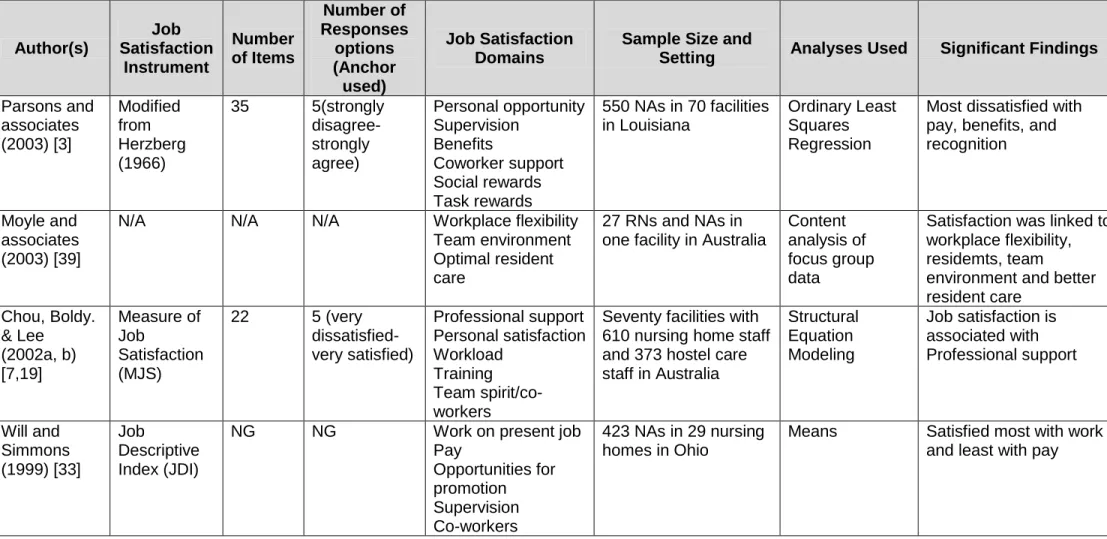
Table 1: Studies of job satisfaction in long-term care settings
Author(s) Job Satisfaction Instrument Number of Items Number of Responses options (Anchor used) Job Satisfaction Domains
Sample Size and
Setting Analyses Used Significant Findings Parsons and associates (2003) [3] Modified from Herzberg (1966) 35 5(strongly disagree-strongly agree) Personal opportunity Supervision Benefits Coworker support Social rewards Task rewards 550 NAs in 70 facilities in Louisiana Ordinary Least Squares Regression
Most dissatisfied with pay, benefits, and recognition
Moyle and associates (2003) [39]
N/A N/A N/A Workplace flexibility
Team environment Optimal resident care
27 RNs and NAs in one facility in Australia
Content analysis of focus group data
Satisfaction was linked to workplace flexibility, residemts, team
environment and better resident care Chou, Boldy. & Lee (2002a, b) [7,19] Measure of Job Satisfaction (MJS) 22 5 (very dissatisfied-very satisfied) Professional support Personal satisfaction Workload Training Team spirit/co-workers
Seventy facilities with 610 nursing home staff and 373 hostel care staff in Australia Structural Equation Modeling Job satisfaction is associated with Professional support Will and Simmons (1999) [33] Job Descriptive Index (JDI)
NG NG Work on present job
Pay Opportunities for promotion Supervision Co-workers 423 NAs in 29 nursing homes in Ohio
Means Satisfied most with work
Page 14 of 17 Job in general Atchison (1998) [20] Job Diagnostic Survey 14 5 (extremely dissatisfied-extremely satisfied) Satisfaction Job Security Coworkers Sense of accomplishment Helping other people Dissatisfaction Pay/benefits Potential for job growth
Management Autonomy
283 NAs in 24 nursing homes
Chi square Job satisfaction lowest for security, growth/development, socialization, and challenges Kiyak, Namazi, & Kahana (1997) [27] Job Descriptive Index (JDI)
NG NG Work on present job
Pay Opportunities for promotion Supervision Co-workers Job in general
308 nursing home and community agency staff Ordinary Least Squares Regression Higher dissatisfaction associated with turnover
Gillies, Foreman, & Pettengill (1996) [22] Index of Work Satisfaction (IWS)
44 7 (not given) Autonomy
Interaction Agency policies Pay
Professional status Task requirement
44 nurse directors and nurse educators working in long-term care facilities Repeated Measures ANOVA
Job satisfaction highest for interactions, autonomy, and professional status Grieshaber, Parker, & Deering (1995) [1] Work environment Job content
Two nursing homes
Irvine & Evans (1995)+ [40]
N/A N/A N/A Routinization
Autonomy Feedback Role conflict Role ambiguity Work overload Meta-analyses with combined sample size of 5,352
Meta-analyses Work content and work environment are more strongly associated with job satisfaction than economic variables
Page 15 of 17 Coward and associated (1995) [29] Modified Stamps and Piedmonte (1986) scale [IWS] 18 5(strongly disagree-strongly agree) Professional status Task requirement Autonomy Interaction with other nurses Pay 281 RNs and LPNs from 26 nursing homes
Multivariate regression analysis
Five factors associated with job satisfaction (race, income,
supervisor, initial intent to stay, current intent to leave)
Monahan & Carthy (1992) [41]
N/A N/A N/A Attachment
Gratification Demands Monetary needs Decision-making 75 NAs at 7 nursing homes Content analysis
Attachment most related to retention of NAs Grau and associates (1991) [42] Combined several scales 44 5 different scales Job process Attitudes toward administration Social atmosphere Job benefits Job tasks 219 NAs in one nursing home Hierarchical regression analysis
Social atmosphere and job benefits associated with institutional loyalty
Anderson, Aird, & Haslam (1991) [43] NG 12 5(strongly disagree-strongly agree)
None 212 nursing staff in 6
nursing homes
Means Nursing staff have high
levels of satisfaction, but is associated with absenteeism Humphris & Turner (1989) [44] Porter (1962) scale 13 6 (extremely satisfied-extremely unsatisfied) Working conditions Emotional climate General
84 nurses at a unit for the elderly severely mentally infirm
Chi square Low satisfaction was associated with turnover from unit Mullins and associates (1988) [45] Job Satisfaction Survey (JSS) 36 NG Pay Promotion Supervision Benefits Rewards/appreciatio n Working conditions Coworkers Nature of job Communication Heads of departments (n=439) from 46 nursing homes Regression analyses
Most satisfied when individual efforts are rewarded
Page 16 of 17 Deckard, Hicks & Rountree (1986) [46] Job Diagnostic Survey (JDS) NG NG Skill variety Task identity Task significance Autonomy Job feedback 340 nurses from a nursing home chain
Means Job satisfaction was
similar to norms in other occupations Waxman and associates (1984) [47] Minnesota Satisfaction Scale 20 5 (very dissatisfied-very satisfied) Job Satisfaction Scale 234 NAs in 7 facilities, uses 20 questions for overall job satisfaction score
Kendal’s Rank Order
Correlation
Positive association between job satisfaction and turnover Berman et al. (1984) [2] None 19 4 (none-very much) Job Knowledge, skill, and attitudes Autonomy Stress 12 long-term care facilities and 432 RNs, LPNs, and NAs
ANOVA Descriptive results
provided
NA = Nurse Aide; RN = Registered Nurse; LPN = Licensed Practical Nurse
+ = This study ia a meta-analysis, and does not include only long-term care studies NG = Not given; N/A = Not applicable
Page 17 of 17
*Appendix 7
Ellenbecker, Carol H., Byleckie, James J., (2005), Home Healthcare Nurses' Job Satisfaction Scale: refinement and psychometric testing, Journal of Advanced Nursing, Vol. 52, No. 1, 70-78 Nine Home Healthcare Nurses Job Satisfaction Scale (HHNJS) subscales from the
psychometric study
Characteristics Subscales Number of
items α
Intrinsic characteristics
Autonomy and independence 4 0.81
Professional growth 5 0.76
Group cohesion, peers 3 0.69
Group cohesion, physicians 2 0.72
Characteristics of organization 5 0.82
Intrinsic total 19 0.87
Extrinsic characteristics
Stress and work load 3 0.64
Autonomy and flexibility in working scheduling 2 0.65
Autonomy and control of work activities 2 0.69
Salary and benefits and perception opportunities
elsewhere 4 0.65
Extrinsic total 11 0.75
Job satisfaction total 30 0.89
Component items
Satisfied with relationship with administration My salary is satisfactory
Have the power to change It would be difficult to find job
Opportunity to grow Benefits package is not as good
Authority to adopt standards of care Overwhelmed by all the work I have Administration decision interfere If I had more time I could do better
Patients satisfied with care Able to cope with documentation
Have helped patients Good amount of collegiality
Patients relationship are rewarding Have peers I can rely on
Care adheres to professional standards Open lines of communication with team Independence is required in my job Treated as a professional
Proud to talk of work Physicians value my input
Work is important and worthwhile More flexibility than others
Would recommend my job Have control over scheduling my time
Would choose home care again Frustrated because of programmed activities
Pay scale needs to be upgraded Have little control over work
©2012 Advancing Excellence in Long Term Care Collaborative
Advancing Excellence welcomes the use of any and all of its materials with appropriate attribution. Where such uses would alter the original content or be used for profit, users must notify Advancing Excellence and request permission to do so.