Abstract: This is a survey paper .In this paper, watermarking
using DCT, DWT Haar wavelet is discussed. Watermarking is used to hide images is used here in Telemedicine to hide patients documents and medical report.
Watermarkin is providing copyright protection, authentications, encryption etc. Watermarking is performed along with DWT Haar Wavelet to prevent data from several types of attack such as speckle noise, salt and pepper noise, gaussian noise that are found in channel DWT Haar Wavelet is used to compresse one image for high value of PSNR (peak signal to noise ratio).PSNR for Host image, watermarked images along with Embedded watermark, retrieved watermark are compared for different kind of malicious attacks. PSNR values are compared. There is a tradeoff between imperceptibility and robustness in almost all kind of transfomed domain watermarking techniques.
Key word; - DCT, DWT Haar wavelet, MSE, PSNR.
I. INTRODUCTION:- a).Introduction to Tele-medicine
There are several definitions of Telemedicine. According to World Health organization, Telemedicine is defined as “The delivery of healthcare services, where distance is a critical factor ,by all healthcare professionals using information and communication technologies for the exchange of valid information for prevention of disease and injuries,diagnosis,treatment,research and evaluation,and for contuning education of healthcare providers,all in the interest of advancing the health of individuals and their
Manuscript received June, 2014.
Shweta Jaiswal Electronics and telecommunication department Chhattisgarh swami Vivekananda university /shri Shankaracharya college of Engineering and technology Bhilai, Bhilai, India.
Himani Agrawal ,Electronics and telecommunication department,
csvtu University/ shri shankaracharya college of engineering and technology, Bhilai, India.
communities. The Telemedicine is defined by the institution of Medicine as the use of electronic information technologies to support and provide health related issues information and care when distance separated the participants. The application that is most common today is transmission of high resolution X- rays , orthopedics, psychiatry, dermatology. Originally Telemedicine arose to serve population of rural areas or to any people who are isolated geographically, where cost of travel and time make access to the best medical care difficult. Now in mainstream medicine it is increasingly being used ,to allow doctors the world over to share recourses that are expensive and valuable experience. Hence, the demands of health care industry is secure, and more information hiding techniques and robust techniques promising strict and secured communication and authentication through mobile phones and internet.
b). Advantages of Telemedicine
To provide healthcare facilities to remote areas and rural areas (health for all) by crossing the geographical barrier is the main objective of Telemedicine so it is beneficial for the population living in isolated communities.
Other advantages of telemedicine are:-
Applications of Telemedicine are Tele-home health care, Disaster Management, Tele-education, Tele-health care.
It improve access to quality health services by eliminating distance barriers
In emergency and critical care situations where moving a patient may be undesirable and/or not feasible
Facilitate patients and rural practitioners‟ access to specialist health services and support
Lessen the cost and inconvenience of patient transfers Reduce unnecessary travel time for health professionals It upgrade the knowledge of rural practice through Tele-education and hencet Reduce their isolation
Robustness
Of
Watermarking
Against
Different Type of Attacks Using DWT Haar
Wavelet In Telemedicine
c). Telemedicine and watermarking:
Health care industry demands secure,robust and more information hiding techniques that gives secured authentication and communication through internet or mobile phones.The information is also carried in the copy if the signal is copied.The information may be text,image,audio,video.For this purpose watermarking is used to hide the patients document or other medicinal report using DCT,DWT ,DWT haar wavelet or any other algorithm to prevent datas from attacks.
INTRODUCTION TO ATTACKS:
According to the watermarking jargon, an attack is any processing that may mess up communication provided by the watermark or detection of the watermark. The processed, watermarked data is then called attacked data. Robustness against attacks is an important issue for watermarking schemes. Attacks are generally the information occur during transmission of the watermarking image. There are many major attacks and they are tested in the proposed work.
Removal Attacks:
It aims for complete removal of watermarking.Attacker copies many copy of given data set with diffferent key.success can be cahieved by taking average of copies. Sophisticated removal attacks try to optimize operations like denoising or quantization to impair the embedded watermark as much as possible while keeping the quality of the attacked document high enough. Usually, statistical models for the watermark and the original data are exploited within the optimization process.
Geometrical Attack
Do not actually remove the embedded watermark.Intend to distort the watermark detector synchronization with the embedded information.In this type of attack pixels are locally shifted, scaled, and rotated without significant visual distortion.However, it is worth noting that some recent methods are able to resist against this attack
Cryptographic Attack
Aim at cracking the security methods in watermarking schemes Finding a way to remove the embedded watermark information.Embed misleading watermarks. High computational complexity.
One such technique is the brute-force search for the embedded secret information. Another attack
in this category is the so-called Oracle attack, which can be used to create a non-watermarked signal when a watermark detector device is available. Practically, application of these attacks is restricted due to their high computational complexity.
Protocol Attacks
These attacks Aim at attacking the entire concept of the watermarking application.First proposed in framework of invertible watermark.The attacker subtracts his own watermark from the watermarked data and claims to be the owner.Another type is copy attack.
Salt anp pepper noise
Salt and pepper noise is typically seen on images and this noise occures mainly due to attack.salt and pepper noise is actually representing itself as randomly occuring pixels of white and black.The usage of a contra harmonic mean filter or a median filter is mainly used as an effective noise reduction method. When ever there is quick transients,such as faulty switching actions takes place in that situation salt and pepper noise creeps into images.
Speckle noise
Speckle noise is like a granular noise that exists inherently and the quality of the synthetic aperture radar (SAR) images and active radar images goes on degrading.In conventional radar speckle radar results due to randoam fluctuations in the return signal from an object that is not bigger than a single image processing element. The mean grey level of a local area gets increases by speckle and salt noise.Speclke noise causing difficulties for image interpretation in SAR which is generally more serious. It is caused by coherent processing of backscattered signals from multiple distributed targets. In SAR oceanography, for example, speckle noise is caused by signals from elementary scatterers, the gravity-capillary ripples, and manifests as a pedestal image, beneath the image of the sea waves
Gaussian noise
In Gaussian noise the probability density is equal to that of the normal distribution (also known as gaussian distribution).so Gaussian noise is a statistical noise.The values taken by noise are gaussian distributed.White Gaussian noise is a special case,in which the values are statistically independent(and uncorrelated) at any pair of times. Gaussian amplitude distribution exactly defines the gaussian noise.For the complete precision,it is necessary to use the term “white Gaussian noise”. Gaussian noise is sometimes misunderstood to be white Gaussian noise, but this is not the case.
2) Discrete Wavelet Transform (DWT) based Watermarking.
Wavelets are a mathematical tool for changing the coordinate system in which we represent the signal to another domain that is best suited for compression. Wavelet based coding is more robust under transmission and decoding errors. The discrete wavelet transform (DWT), on the other hand, provides sufficient information both for analysis and
synthesis of the original watermarked image, with a significant reduction in the computation time. When the signal in time for its frequency content is analyzed wavelet functions are used. DWT-based compression provides multi resolution hierarchical characteristics. Hence, an image can be compressed at different levels of resolution. It can be sequentially processed from low resolution to high resolution. Wavelets are localized in both time (space) and frequency (scale) domains. Hence it is easy to capture local features in a signal.
WAVELET DECOMPOSITION
Among all the advantages wavelet decomposition provide information that is independent of the original image resolution. Thus, a wavelet based scheme allows us to easily compare images of different resolutions. And finally, wavelet decompositions are fast and easy to compute, requiring linear time in the size of the image and very little code.
Discrete Wavelet analysis is computed using the concept of filter banks. Filters of different cut-off frequencies analyses the signal at different scales. Resolution is changed by the filtering the scale is changed by up sampling and down sampling. Signal is put through two filters.
(i) A high-pass filter, high frequency information is kept, low frequency information is lost.
(ii) A low pass filter, low frequency information is kept, high frequency information is lost.
The scale has now been doubled. The resolution has also been changed the filtering made the frequency resolution better, but reduced the time resolution. The approximation sub signal can then be put through a filter bank, and this is repeated until the required level of decomposition has been reached. These shown in figure. The DWT is obtained by collecting together the coefficients of the final approximation sub signal and all the detail sub signals. Overall the filters have the effect of separating out finer and finer detail, if all the details are added together then the original signal should be reproduced.Wavelet compression inherently results in a set of multi-resolution images; it is well suited to working with large imagery which needs to be selectively viewed at different
resolution, as only the levels containing the required level of detail need to be decompressed.
Fig: Wavelet decomposition level approximation and detail information
DECOMPOSITION PROCESS
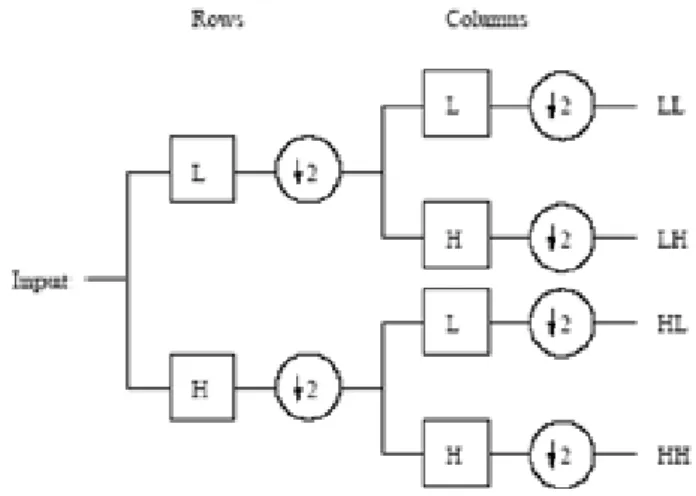
The image is high and low-pass filtered along the rows. The results of each filter are down sampled by two. Each of the sub-signals is then again high and low-pass filtered, but now along the column data and the results is again down-sampled by two. Hence, the original data is split into four sub-images each of size N/2 by N/2 and contains information from different frequency components. Figure shows the block wise representation of decomposition step.
Fig : One Decomposition Step of the Two Dimensional Images
Fig : One DWT Decomposition Step
The LL sub band contains a rough description of the image and hence called the approximation sub band. The HH Sub band contains the high-frequency components along the diagonals. The HL and LH images result from low-pass filtering in one direction and high-pass filtering in the other direction. LH contains mostly the vertical detail information, which corresponds to horizontal edges. HL represents the horizontal detail information from the vertical edges. The sub bands HL, LH and HH are called the detail sub bands since they add the high-frequency detail to the approximation image.
Fig - Second level decomposition of the input image COMPOSITION PROCESS
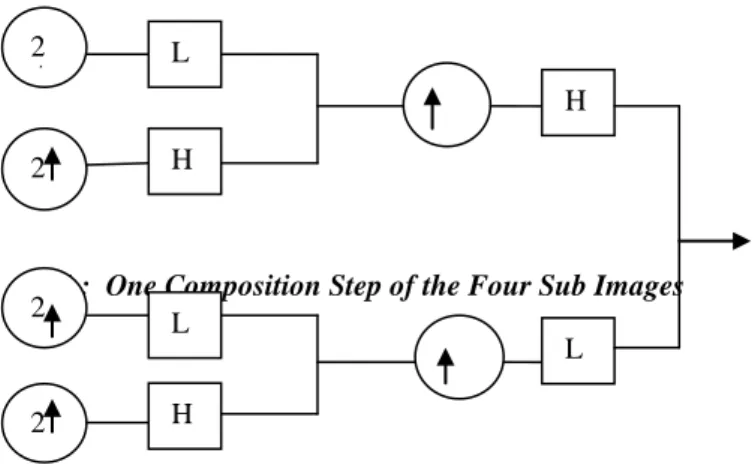
The four sub-images are up-sampled and then filtered with the corresponding inverse filters along the columns. The result of the last step is added together and we have the original image again, with no information loss. Wavelet analysis can be used to divide the information of an image into approximation and detail sub signals. The approximation sub signal shows the general trend of pixel values, and three detail sub signals show the vertical, horizontal and diagonal details or changes in the image.
OUTPUT
FIG : One Composition Step of the Four Sub Images
ADVANTAGES OF WAVELET THEORY
1) One of the main advantages of wavelets is that they offer a simultaneous localization in time and frequency domain.
2) The second main advantage of wavelets is that, using fast wavelet transform, it is computationally very fast.
3) Wavelets have the great advantage of being able to separate the fine details in a signal. Very
small wavelets can be used to isolate very fine details in a signal, while very large wavelets can identify coarse details. 4) A wavelet transform can be used to decompose a signal into
component wavelets.
5) In wavelet theory, it is often possible to obtain a good approximation of the given function by
using only a few coefficients which is the great achievement in compare to Fourier transform.
6) Wavelet theory is capable of revealing aspects of data that other signal analysis technique sometimes miss the aspects like breakdown points, trends, and discontinuities in higher derivatives and self-similarity.
7) It can often compress or de-noise a signal without appreciable degradation
II. PERFORMANCE EVALUATION PARAMETERS
Different criteria are used to evaluate the algorithms used in watermarking.Evaluation of the robustness of the watermarking scheme against various types of attacks and the quality of image are most important parameters among them. .
Signal to noise ratio and peak signal to noise ratio Among the most important distorting measures in image processing is the SNR that is signal to noise ration and PSNR (peak signal to noise ratio)
The PSNR and the SNR are respectively defined by the following formulas:
PSNR=20 log (MAX/MSE)...eq.1
Where MAX is the maximum pixel value in the image.
MSE is calculated by the formulae,
...eq.2
where I (i, j) and K (i, j) are original and watermarked image respectively. 2 2 2 2 L H L H 2 2 H L
SNR(signal to noise ratio) is evaluated by: ……eq.3 III. PROPOSED METHODOLOGY:-
In this we are calculating PSNR values and MSE values for different types of attacks,by applying DWT haar wavelet algorithm.The main task is to protect patients document and medical information for various types of attacks that occur mainly in the channel.the PSNR ans MSE have been calculated by applying the algorithm at encryption and decryption level by applying different alpha value where alpha is known as depth of weighing factor and it has calculated that DWT haar wavelet is giving high value of PSNR value.
STEPS OF THE PROPOSED METHOD:
These are the following steps to perform embedding and extraction of image:
Steps for applying watermark embedding process.
1.The intensity values of original image or Host image which is Nuclear Tele-Medicine image of size 256X256 (MXN) are obtained into matrix I
2. A patient record to be hidden is considered as watermark image of size 64x64. Coefficient matrix „B‟ is obtained. 3. Mid frequency values of coefficient matrix „A‟ are replaced with intensity values of „B‟ to obtain watermarked image in frequency domain.
4. Watermarked image is obtained by applying inverse DCT to the coefficient matrix „A‟.
Steps for extraction process
1. Read the watermarked image
2. Take the DWT transform for the image 3. Read the signature
4. Subtract the signature taken from the watermarked image 5. Take the inverse transform
6. Calculate the PSNR and MSE of the original and recovered image and the original and retrieved watermark .
IV. EXPECTED OUTCOME
The expected output of proposed algorithm not only keeps a high compression ratio but also gets a good image reconstruction. The image quality performance is evaluated using various image quality metrics like PSNR(peak signal to noise ratio) and MSE().
PSNR ranges should be >40 with attack . It has been reported that a minimum PSNR of 35 dB in the reconstructed medical image quality is required for accurate diagnosis.
PSNR in case of DWT for high frequency and mid frequency should be greater than DCT with complete removal of attack and noise.
Required time during transmission of medical images in DWT should be less compare to existing time period in DCT.
Aside note on the types of attacks will introduce in. These attacks easily allow any one to claim ownership of any images he or she has access to, whether those images have been watermarked or not using proposed algorithm.
V. CONCLUSION
An extensive literature survey on various watermarked images is performed in this paper by using DWT haar wavelet.
1. DWT haar Wavelet-based compression provides multi-resolution hierarchical characteristics. Hence an image can 2. be compressed at different levels of
resolution and can be sequentially processed from low resolution to high resolution.
3. High robustness to common signal processing. Real time signals are both time-limited (or space limited in the case of images) and band-limited.
4. Band limited signals on the other hand can be efficiently represented by a Fourier basis. DWT haar Wavelets are localized in both time (space) and frequency (scale) domains. Hence it is easy to capture local features in a signal.
5.
VI. ACKNOWLEDGEMENTS
The authors wish to express their heartfelt gratitude to Hon‟ble Shri I.P Mishra, Chairman, Gangajali Educational Society, Bhilai; Respected Shri Abhishek Mishra, Director Systems, SSGI, Bhilai; Respected Shri P.B. Deshmukh, Director Administration, SSGI, Bhilai; Respected Dr. G.R Sinha, Associate Director, SSGI, Bhilai for providing the facilities for the research and development work and for constant encouragement.
VII. REFERENCE
1).Ehsan Nezhadarya, Z. Jane Wang, Rabab Kreidieh Ward,
2011,‟ Robust Image Watermarking Based on Multiscale Gradient Direction Quantization‟ IEEE transactions on information forensics and security, 6(4):1200-1213.
2).Yasunori Ishikawa, Kazutake Uehira, Kazuhisa
Yanaka,2012,‟ Optimization of Size of Pixel Blocks for Orthogonal Transform in Optical Watermarking technique‟journal of display technology, 8 (9):505-510. 3).Yinglan Fang, Lin Tian , Bing Han,2013,‟ An Improved Watermarking
Algorithm to Colour Image Based on Wavelet Domain‟ Journal of Engineering Science and Technology Review 6
(2):139-144.
4).Gursharanjeet Singh Kalra1,*, Rajneesh Talwar2, Harsh
Sadawarti3,2013,‟ Comparative Analysis of Blind Digital Image Watermarking Utilising Dual Encryption Technique in Frequency Domains‟ World Journal of Computer Application and Technology 1(2): 35-40.
5) Marc Joye 2012,‟ „A Method for Preventing “Skipping” Attacks‟ Under license to IEEE 1109(10):12-15.
6) Athanasios Nikolaidis 2012,‟ „Local distortion resistant image watermarking relying on salient feature extraction‟
Nikolaidis EURASIP Journal on Advances in Signal
Processing 2012(97):1-17.
7)Jingbing Li,Suimiao 2013, „The Medical Image Watermarking Using Arnold Scrambling and DFT‟ the 2nd International Conference on Computer Science and
Electronics Engineering (ICCSEE ):0192-0195.
8).1M.Gowthami Reddy, 2 K. Pradeep Kumar 2013,
„Watermarking of tele-medicine images using discrete cosine transform with attacks) ‟ International Journal of Recent Advances in Engineering & Technology (IJRAET)
1(1):2347-2812.
9).Remya Elizabeth Philip1,Sumithra M.G.2 2013,‟ Development Of A New Watermarking Algorithm For Telemedicine Applications‟ International Journal of Engineering Research and Applications (IJERA) ISSN 3(1):
2248-9622 .
10) Abdellatif MTIBAA, Mohamed Ali HAJJAJI, El-bey
BOURENNANE 2011, „A Watermarking of Medical Image Method Based „LSB‟‟ Journal of Emerging Trends in Computing and Information Sciences 2(12):2079.
Shweta Jaiswal was born in 1989 in Ambikapur c.g. she gratuated B.E. in 2011 from MP Christian College OF Engineering And Technology,Bhilai in electronics and communication engineering. She is pursuing her M.E. from shri Shankaracharya College of engineering bhilai in communication.
Himani Agrawal (IEEE 2012
MEMBERSHIP No. :
92215541) was born in 1981.she is work as an asso. Professor in shri Shankaracharya College of engineering and technology. She was done her M.E. in communication from shri Shankaracharya College. of engineering and technology. She was pass her B.E. from Govt. Engineering College, Raipur (C.G.), India in 2003.her branch in B.E. was electronics and telecommunication. She was published her papers in 11: International Journal, 4 National Journal and also give presentation in 4 international Conference, 6 National Conference