IJSRSET162654 | Received: 20 Nov-2016 | Accepted: 30 Nov-2016 | November-December-2016 [(2)6: 225-241 ]
© 2016 IJSRSET | Volume 2 | Issue 6 | Print ISSN: 2395-1990 | Online ISSN : 2394-4099 Themed Section: Engineering and Technology
225
A Sub Set Selection Algorithm for A High Dimensional Data
Using a Fast Cluster Based Feature
Syeda Meraj Bilfaquih
1, Sabahat Khatoon
2King Khalid University, Saudi Arabia
ABSTRACT
Feature selection involves identifying a subset of the most useful features that produces compatible results as the
original entire set of features. A feature selection algorithm may be evaluated from both the efficiency and
effectiveness points of view. While the efficiency concerns the time required to find a subset of features, the
effectiveness is related to the quality of the subset of features. Based on these criteria, a fast clustering-based feature
selection algorithm, FAST, is proposed and experimentally evaluated in this paper. The FAST algorithm works in
two steps. In the first step, features are divided into clusters by using graph-theoretic clustering methods. In the
second step, the most representative feature that is strongly related to target classes is selected from each cluster to
form a subset of features. Features in different clusters are relatively independent, the clustering-based strategy of
FAST has a high probability of producing a subset of useful and independent features. To ensure the efficiency of
FAST, we adopt the efficient minimum-spanning tree clustering method. The efficiency and effectiveness of the
FAST algorithm are evaluated through an empirical study. Extensive experiments are carried out to compare FAST
and several representative feature selection algorithms, namely, FCBF, ReliefF, CFS, Consist, and FOCUS-SF, with
respect to four types of well-known classifiers, namely, the probability-based Naive Bayes, the tree-based C4.5, the
instance-based IB1, and the rule-based RIPPER before and after feature selection. The results, on 35 publicly
available real-world high dimensional image, microarray, and text data, demonstrate that FAST not only produces
smaller subsets of features but also improves the performances of the four types of classifiers.
Keywords:
FCBF, ReliefF, CFS, Consist, FOCUS-SF, FAST, RIPPER, CMIM
I.
INTRODUCTION
With the aim of choosing a subset of good features with
respect to the target concepts, feature subset se-lection
is an effective way for reducing dimensionality,
removing irrelevant data, increasing learning accuracy,
and improving result comprehensibility [43], [46].
Many feature subset selection methods have been
proposed and studied for machine learning applications.
They can be divided into four broad categories: the
Embedded, Wrapper, Filter, and Hybrid approaches.
The embedded methods incorporate feature selection as
a part of the training process and are usually spe-cific to
given learning algorithms, and therefore may be more
efficient than the other three categories[28]. Traditional
machine learning algorithms like decision trees or
artificial neural networks are examples of em-bedded
approaches[44]. The wrapper methods use the
predictive accuracy of a predetermined learning
algo-rithm to determine the goodness of the selected sub-sets,
the accuracy of the learning algorithms is usually high.
However, the generality of the selected features is
limited and the computational complexity is large. The
filter methods are independent of learning algorithms,
with good generality. Their computational complexity is
low, but the accuracy of the learning algorithms is not
guaranteed [13], [63], [39]. The hybrid methods are a
combination of filter and wrapper methods [49], [15],
[66], [63], [67] by using a filter method to reduce search
space that will be considered by the subsequent wrapper.
computationally expensive and tend to overfit on small
training sets [13], [15]. The filter methods, in addition to
their generality, are usually a good choice when the
number of features is very large. Thus, we will focus on
the filter method in this paper.
With respect to the filter feature selection methods, the
application of cluster analysis has been demonstrated to
be more effective than traditional feature selection
algo-rithms. Pereira et al. [52], Baker et al. [4], and Dhillon
et al. [18] employed the distributional clustering of
words to reduce the dimensionality of text data.
In cluster analysis, graph-theoretic methods have been
well studied and used in many applications. Their
re-sults have, sometimes, the best agreement with human
performance [32]. The general graph-theoretic
cluster-ing is simple: Compute a neighborhood graph of
in-stances, then delete any edge in the graph that is much
longer/shorter (according to some criterion) than its
neighbors. The result is a forest and each tree in the
forest represents a cluster. In our study, we apply
graph-theoretic clustering methods to features. In particular,
we adopt the minimum spanning tree (MST) based
clustering algorithms, because they do not assume that
data points are grouped around centers or separated by a
regular geometric curve and have been widely used in
practice.
Based on the MST method, we propose a Fast
clustering-bAsed
feature
Selection
algoriThm
(FAST).The FAST algorithm works in two steps. In the
first step, fea-tures are divided into clusters by using
graph-theoretic clustering methods. In the second step,
the most repre-sentative feature that is strongly related
to target classes is selected from each cluster to form the
final subset of features. Features in different clusters are
relatively independent; the clustering-based strategy of
FAST has a high probability of producing a subset of
useful and independent features. The proposed feature
subset se-lection algorithm FAST was tested upon 35
publicly available image, microarray, and text data sets.
The experimental results show that, compared with
other five different types of feature subset selection
algorithms, the proposed algorithm not only reduces the
number of features, but also improves the performances
of the four well-known different types of classifiers.
The rest of the article is organized as follows: In Section
2, we describe the related works. In Section 3, we
present the new feature subset selection algorithm
FAST. In Section 4, we report extensive experimental
results to support the proposed FAST algorithm. Finally,
in Section 5, we summarize the present study and draw
some conclusions.
II.
METHODS AND MATERIAL
Related Work
Feature subset selection can be viewed as the process of
identifying and removing as many irrelevant and
redun-dant features as possible. This is because: (i) irrelevant
features do not contribute to the predictive accuracy
[33], and (ii) redundant features do not redound to
getting a better predictor for that they provide mostly
information, which is already present in other feature(s).
Of the many feature subset selection algorithms, some
can effectively eliminate irrelevant features but fail to
handle redundant features [23], [31], [37], [34], [45],
[59], yet some of others can eliminate the irrelevant
while taking care of the redundant features [5], [29],
[42], [68]. Our proposed FAST algorithm falls into the
second group.
Traditionally, feature subset selection research has
fo-cused on searching for relevant features. A well-known
example is Relief [34], which weighs each feature
ac-cording to its ability to discriminate instances under
dif-ferent targets based on distance-based criteria function.
However, Relief is ineffective at removing redundant
features as two predictive but highly correlated features
are likely both to be highly weighted [36]. Relief-F [37]
extends Relief, enabling this method to work with noisy
and incomplete data sets and to deal with multi-class
problems, but still cannot identify redundant features.
However, along with irrelevant features, redundant
features also affect the speed and accuracy of learn-ing
algorithms, and thus should be eliminated as well [36],
[35], [31]. CFS [29], FCBF [68] and CMIM [22] are
examples that take into consideration the redundant
features. CFS [29] is achieved by the hypothesis that a
analysis. CMIM [22] iteratively picks features, which
maximize their mutual information with the class to
predict, con-ditionally to the response of any feature
already picked. Different from these algorithms, our
proposed FAST algorithm employs clustering based
method to choose features.
Recently, hierarchical clustering has been adopted in
word selection in the context of text classification (e.g.,
[52], [4], and [18]). Distributional clustering has been
used to cluster words into groups based either on their
participation in particular grammatical relations with
other words by Pereira et al. [52] or on the distribution
of class labels associated with each word by Baker and
McCallum [4]. As distributional clustering of words are
agglomerative in nature, and result in sub-optimal word
clusters and high computational cost, Dhillon et al. [18]
proposed a new information-theoretic divisive algorithm
for word clustering and applied it to text classification.
Butterworth et al. [8] proposed to cluster features using
a special metric of Barthelemy-Montjardet distance, and
then makes use of the dendrogram of the resulting
cluster hierarchy to choose the most relevant attributes.
Unfortunately, the cluster evaluation measure based on
Barthelemy-Montjardet distance does not identify a
fea-ture subset that allows the classifiers to improve their
original performance accuracy. Furthermore, even
com-pared with other feature selection methods, the obtained
accuracy is lower.
Hierarchical clustering also has been used to select
features on spectral data. Van Dijk and Van Hullefor
[64] proposed a hybrid filter/wrapper feature subset
selec-tion algorithm for regression. Krier et al. [38]
presented a methodology combining hierarchical
constrained clus-tering of spectral variables and
selection of clusters by mutual information. Their
feature clustering method is similar to that of Van Dijk
and Van Hullefor [64] except that the former forces
every cluster to contain consecutive features only. Both
methods
employed
ag-glomerative
hierarchical
clustering to remove redundant features.
Quite different from these hierarchical clustering based
algorithms, our proposed FAST algorithm uses
minimum spanning tree based method to cluster
fea-tures. Meanwhile, it does not assume that data points are
grouped around centers or separated by a regular
geometric curve. Moreover, our proposed FAST does
not limit to some specific types of data.
3
Feature Subset Selection Algorithm
3.1
Framework and definitions
Irrelevant features, along with redundant features,
severely affect the accuracy of the learning machines
[31], [35]. Thus, feature subset selection should be able
to identify and remove as much of the irrelevant and
re-dundant information as possible. Moreover, “
good
feature
subsets contain features highly correlated with
(predictive of) the class, yet uncorrelated with (not
predictive of) each other.
” [30]
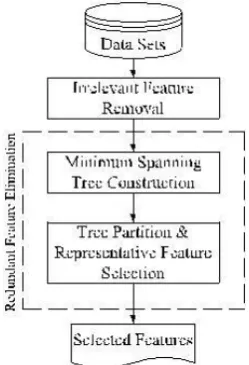
Figure 1.
Framework of the proposed feature subset
selec-tion algorithm
Keeping these in mind, we develop a novel algorithm
which can efficiently and effectively deal with both
irrel-evant and redundant features, and obtain a good
feature subset. We achieve this through a new feature
selection framework (shown in Fig.1) which composed
of the two connected components of
irrelevant feature
removal
and
redundant feature elimination
. The former
obtains features
relevant to the target concept by
eliminating irrelevant ones, and the latter removes
redundant features from relevant ones via choosing
representatives from different feature clusters, and thus
produces the final subset.
The
irrelevant feature removal
is straightforward once
the right relevance measure is defined or selected, while
the
redundant feature elimination
is a bit of
representing a cluster; and (iii) the selection of
representative features from the clusters.
In order to more precisely introduce the algorithm, and
because our proposed feature subset selection
framework involves irrelevant feature removal and
re-dundant feature elimination, we firstly present the
tra-ditional definitions of relevant and redundant features,
then provide our definitions based on variable
correla-tion as follows.
John et al. [33] presented a definition of relevant
features. Suppose to be the full set of features,
∈
be a
feature, =
−{ }
and
′⊆
. Let
′be a value-assignment of
all features in
′, a value-assignment of feature , and a
value-assignment of the target concept . The definition
can be formalized as follows.
Definition
1: (Relevant feature)
is relevant to the
target
concept if and only if there exists some
′, and , such
that, for probability (
′=
′,
= )
>
0,( =
∣
′=
′,
= )
∕
=
( =
∣
′=
′). Otherwise, feature is an
irrelevant feature
.
Definition 1 indicates that there are two kinds of
relevant features due to different
′: (i) when
′= , from
the definition we can know that is directly relevant to
the target concept; (ii) when
⊊
, from the
definition we may obtain that (
∣
,
) = (
∣
). It seems that
is irrelevant to the target concept.
However, the definition shows that feature is relevant
when using
′∪
{ }
to describe the target concept. The
reason behind is that either is interactive with
′or is
redundant with
−
′. In this case, we say is indirectly
relevant to the target concept.
Most of the information contained in redundant
fea-tures is already present in other feafea-tures. As a result,
redundant features do not contribute to getting better
interpreting ability to the target concept. It is formally
defined by Yu and Liu [70] based on Markov blanket
[36]. The definitions of Markov blanket and redundant
feature are introduced as follows, respectively.
Definition
2: (Markov blanket)
Given a feature
∈
,
let
⊂
(
∈
∕
), is said to be a Markov blanket for if and
only if
(
− −
{ },
∣
,
) = (
− −
{ },
∣
).
Definition
3: (Redundant feature)
Let be a set of
features, a feature in is redundant if and only if it has a
Markov Blanket within. Relevant features have strong
correlation with target concept so are always necessary
for a best subset, while redundant features are not
because their values are completely correlated with each
other. Thus, notions of feature redundancy and feature
relevance are normally in terms of feature correlation
and feature-target concept correlation.
Mutual information measures how much the
distribu-tion of the feature values and target classes differ from
statistical independence. This is a nonlinear estimation
of correlation between feature values or feature values
and target classes. The
symmetric uncertainty
( ) [53] is
derived from the mutual information by normalizing it
to the entropies of feature values or feature values and
target classes, and has been used to evaluate the
goodness of features for classification by a number of
researchers (e.g., Hall [29], Hall and Smith [30], Yu and
Liu [68], [71], Zhao and Liu [72], [73]). Therefore, we
choose symmetric uncertainty as the measure of
corre-lation between either two features or a feature and the
target concept
The
symmetric uncertainty
is defined as follows
(
,
) =
2
×
(
∣
)
.
(1)
Where,
( ) + ( )
1)
( ) is the entropy of a discrete random variable .
Suppose ( ) is the prior probabilities for all
values of , ( ) is defined by
∑
( ) =
−
( ) log
2( )
.
(2)
∈
2)
Gain
(
∣
)
is the amount by which the entropy of
decreases. It reflects the additional information about
provided by and is called the informa-tion gain [55]
which is given by
(
∣
) = ( )
−
(
∣
)
(3)
= ( )
−
(
∣
)
.
variable given that the value of another random variable
is known. Suppose ( ) is the prior probabilities for all
values of and (
∣
) is the posterior probabilities of given
the values of , (
∣
) is defined by
(
∣
) =
−
∑
∑
( )
(
∣
) log
2(
∣
)
.
(4)
∈
∈
Information gain is a symmetrical measure. That is the
amount of information gained about after observing is
equal to the amount of information gained about after
observing . This ensures that the order of two variables
(e.g.,(
,
) or (
,
)) will not affect the value of the measure.
Symmetric uncertainty treats a pair of variables
sym-metrically, it compensates for information gain’s bias
toward variables with more values and normalizes its
value to the range [0,1]. A value 1 of (
,
) indicates that
knowledge of the value of either one completely
predicts the value of the other and the value 0 reveals
that and are independent. Although the entropy-based
measure handles nominal or discrete variables, they can
deal with continuous features as well, if the values are
discretized properly in advance [20].
Given (
,
) the symmetric uncertainty of vari-ables and ,
the relevance
T-Relevance
between a feature and the
target concept , the correlation
F-Correlation
between a
pair of features, the feature re-dundance
F-Redundancy
and the representative feature
R-Feature
of a feature
cluster can be defined as follows.
Definition
4: (T-Relevance)
The relevance between the
feature
∈
and the target concept is referred to as the
T-Relevance
of and , and denoted by (
,
).
If (
,
) is greater than a predetermined threshold , we
say that is a strong
T-Relevance
feature.
Definition
5: (F-Correlation)
The correlation
between
any pair of features
and(
,
∈
∧
∕
= ) is
called the
F-Correlation
of
and , and denoted by
(
,
).
Definition
6: (F-Redundancy)
Let =
{
1,
2
, ..., ,
...,
<∣ ∣}
be a cluster of
features. if
∃
∈
,
(
,
)
≥
(
,
)
∧
(
,
)
>
(
,
)
is
always corrected for each
∈
(
∕
= ),
thenare
redundant features with respect to the given
(i.e.
each
is a
F-Redundancy
).
Definition
7:
(R-Feature)
A feature
∈
=
{
1,
2, ..., }
(
<
∣
∣
)
is a representative feature of
the cluster (
i.e.is a
R-Feature
) if and only if,
= argmax
∈
( , ).
This means the feature, which has the strongest
T-Relevance
, can act as a
R-Feature
for all the features in
the cluster.
According to the above definitions, feature subset
selection can be the process that identifies and retains
the strong
T-Relevance
features and selects
R-Feature
s
from feature clusters. The behind heuristics are that
1)
irrelevant features have no/weak correlation with
target concept;
2)
redundant features are assembled in a cluster and a
representative feature can be taken out of the
cluster.
3.2
Algorithm and analysis
The proposed FAST algorithm logically consists of tree
steps: (i) removing irrelevant features, (ii) constructing a
MST from relative ones, and (iii) partitioning the MST
and selecting representative features.
For a data set with features =
{
1,
2, ...,
}
and class , we
compute the
T-Relevance
(
,
) value
for each feature (1
≤ ≤
) in the first step. The features
whose (
,
) values are greater than a predefined
threshold comprise the target-relevant
feature subset
′=
{
1′,
2′
, ...,
′
}
(
≤
).
In the second step, we first calculate the
F-Correlation
(
′,
′)
value for each pair of features
′and
′(
′,
′
∈
′
∧
= ). Then, viewing features
′and
′∕
as vertices and(
′,
′
) ( = ) as the weight of the
∕
edge between vertices
′and
′, a weighted complete
graph
= (
,
) is constructed where
=
{
′∣
′
∈
′
∧
∈
[1
,
]
}
and
=
{
(
′,
′
)
∣
(
′,
′
∈
′
∧
,
∈
further the
F-Correlation
(
′,
′) is symmetric as well, thus
is an undirected graph.
The complete graph reflects the correlations among
all the target-relevant features. Unfortunately, graph has
vertices and (
−
1)/2 edges. For high dimensional data, it
is heavily dense and the edges with different weights are
strongly interweaved. Moreover, the decom-position of
complete graph is NP-hard [26]. Thus for graph , we
build a MST, which connects all vertices such that the
sum of the weights of the edges is the minimum, using
the well-known Prim algorithm [54]. The weight of
edge (
′,
′) is
F-Correlation
(
′,
′).
After building the MST, in the third step, we first
remove the edges =
{
(
′,
′
)
∣
(
′,
′
∈
′
∧
,
∈
[1
,
]
∧
∕
=
}
, whose weights are smaller than both of the
T-Relevance
(
′,
) and (
′,
), from the MST. Each deletion
results in two disconnected trees
1and
2.
Assuming the set of vertices in any one of the final trees
to be ( ), we have the property that for each pair
of vertices (
′,
′
∈
( )),
(
′,
′
)
≥
(
′,
)
∨
(
′,
′)
≥
(
′,
) always holds. From Definition 6 we know
that this property guarantees the features in ( ) are
redundant.
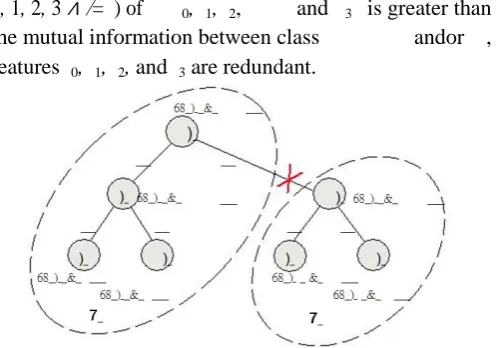
This can be illustrated by an example. Suppose the MST
shown in Fig.2 is generated from a complete graph . In
order to cluster the features, we first traverse all the six
edges, and then decide to remove the edge (
0,
4) because
its weight (
0,
4) = 0
.
3 is smaller than both (
0,
) = 0
.
5 and
(
4,
) = 0
.
7. This makes the MST is clustered into two
clusters denoted as (
1) and (
2). Each cluster is a MST as
well. Take (
1) as an example. From Fig.2 we know that
(
0,
1)
>
(
1,
),
(
1,
2
)
>
(
1,
)
∧
(
1,
2
)
>
(
2,
),
(
1,
3
)
>
(
1,
)
∧
(
1,
3
)
>
(
3,
). We also observed that there is no edge exists
between
0and
2,
0and
3, and
2and
3. Consid-ering that
1is a MST, so the (
0,
2) is greater than
(
0,
1) and
(
1,
2
), (
0,
3
)
is greater than
(
0,
1) and
(
1,
3
),
and(
2,
3
) is greater
than(
1,
2
)
and(
2,
3
). Thus,
(
0,
2
)
>
(
0,
)
∧
(
0,
2
)
>
(
2,
),
(
0,
3
)
>
(
0,
)
∧
(
0,
3
)
>
(
3,
), and(
2,
3
)
>
(
2,
)
∧
(
2,
3
)
>
(
3,
) also hold. As the
mutual information between any pair
(
,
)(
,
=
0
,
1
,
2
,
3
∧
∕
= ) of
0,
1,
2,
and
3is greater than
the mutual information between class
andor ,
features
0,
1
,
2
,
and
3are redundant.
Figure 2.
Example of the clustering step
After removing all the unnecessary edges, a forest
For-est
is obtained. Each tree
∈
Forest
represents a cluster
that is denoted as ( ), which is the vertex set of as well.
As illustrated above, the features in each cluster are
redundant, so for each cluster ( ) we choose a
representative feature whose
T-Relevance
(
,
) is the
greatest. All ( = 1
...
∣
Forest
∣
) comprise the final feature
subset
∪
.
The details of the FAST algorithm is shown in
Algorithm 1.
Algorithm 1
: FAST
inputs
:
D(
1,
2, ..., , )
- the given
data set
- the
T-Relevance
threshold.
output
:
S
- selected feature subset .
//==== Part 1 : Irrelevant Feature Removal ====
1 for
i = 1 to m
do
2
T-Relevance
=
SU
( , )
3
if
T-Relevance
>
then
4
S
=
S
∪
{ }
;
//==== Part 2 : Minimum Spanning Tree
Construction ====
5
G
= NULL;
//G is a complete graph
6 for
each pair of features
{
′
,
′
}
⊂
S
do
7
F-Correlation
=
SU
(
′
,
′)
8
′
/
′ℎ
F-Correlation
ℎ
ℎ
;
9
minSpanTree
=
Prim
(
G
);
//Using Prim
Algorithm to generate the
minimum
spanning tree
//==== Part 3 : Tree Partition and Representative
Feature Selection ====
10
Forest
=
minSpanTree
11
for
each edge
∈
Forest
do
12
if
SU(
′
,
′
)
<
SU(
′
,
)
∧
SU(
′
,
′
)
<
SU(
′
,
)
then
13
Forest
=
Forest −
14
S
=
15
for
each tree
∈
Forest
do
16
= argmax
′
∈SU(
′,
)
17
S
=
S
∪
{ }
;
return
S
Time complexity analysis. The major amount of work for
Algorithm 1 involves the computation of values for
T-Relevance and F-Correlation, which has linear com-plexity in terms of the number of instances in a given data set. The first part of the algorithm has a linear time complexity ( ) in terms
of the number of features . Assuming (1 ≤ ≤ ) features are
selected as relevant ones in the first part, when = 1, only one feature is selected. Thus, there is no need to continue the rest
parts of the algorithm, and the complexity is ( ). When 1 <≤ ,
the second part of the algorithm firstly constructs a complete
graph from relevant features and the complexity is ( 2), and
then generates a MST from the graph using Prim algorithm
whose time complexity is ( 2). The third part partitions the
MST and chooses the representative features with the
complexity of ( ). Thus when 1 < ≤ , the complexity of the
algorithm is ( + 2). This means when ≤
√
, FAST has linearcomplexity ( ), while obtains the worst complexity
( 2) when = . However,is heuristically set
to be √
∗lg ⌋ in the
implementation of FAST. So
⌊ 2
)
the complexity is ( ∗lg , which is typically less
2
since
2
than ( ) < . This can be explained
as follows. Let ( ) =− lg2 , so the derivative
′
( ) = 1 − 2 lg / , which is greater than zero when >1. So( )
is a increasing function and it is greater than (1) which is
equal to 1, i.e., >lg2 , when >1. This means the bigger the is,
the farther the time complexity of FAST deviates from ( 2).
Thus, on high dimensional data, the time complexity of FAST
is far more less than ( 2). This makes FAST has a better
runtime performance with high dimensional data as shown in Subsection 4.4.2.
III. RESULTS AND DISCUSSION
4
E
MPIRICAL STUDY4.1 Data source
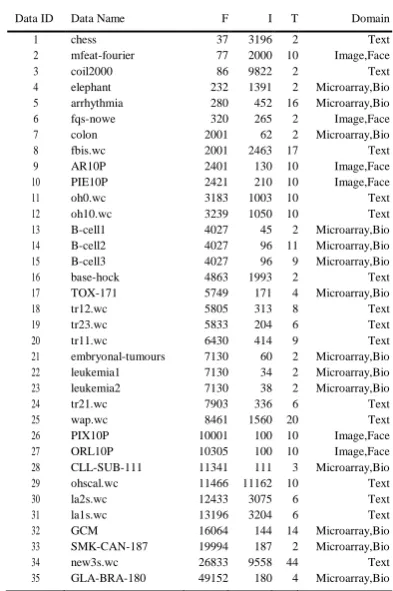
For the purposes of evaluating the performance and effectiveness of our proposed FAST algorithm, verify-ing whether or not the method is potentially useful in practice, and allowing other researchers to confirm our results, 35
publicly available data sets1 were used.
The numbers of features of the 35 data sets vary from 37 to 49152 with a mean of 7874. The dimensionality of the 54.3% data sets exceed 5000, of which 28.6% data sets have more than 10000 features.
The 35 data sets cover a range of application domains such as
text, image and bio microarray data classifica-tion. Table 12
shows the corresponding statistical infor-mation.
Note that for the data sets with continuous-valued features, the well-known off-the-shelf MDL method [74] was used to discretize the continuous values.
4.2 Experiment setup
To evaluate the performance of our proposed FAST algorithm and compare it with other feature selection algorithms in a fair and reasonable way, we set up our experimental study as follows.
1) The proposed algorithm is compared with five different
types of representative feature selection algorithms. They are (i) FCBF [68], [71], (ii) ReliefF [57], (iii) CFS [29], (iv) Consist [14], and (v) FOCUS-SF [2], respectively.
FCBF and ReliefF evaluate features individually. For FCBF, in the experiments, we set the relevance
threshold to be the value of the ⌊/log ⌋ℎ ranked feature
for each data set ( is the number of features in a given data set) as suggested by Yu and Liu [68], [71]. ReliefF searches for nearest neigh-bors of instances of different classes and weights features according to how well they differentiate instances of different classes.
the evaluation of a subset that contains features highly correlated with the tar-get concept, yet uncorrelated with each other. The Consist method searches for the minimal subset that separates classes as consistently as the full set can under best-first search strategy. FOCUS-SF is a variation of FOCUS [2]. FOCUS has the same evaluation strategy as Consist, but it examines all subsets of features. Considering the time efficiency, FOUCS-SF replaces exhaustive search in FOCUS with sequential forward selection.
For our proposed FAST algorithm, we heuristically set to
be the value of the ⌊
√
∗lg ⌋ℎ ranked feature for each dataset.
TABLE 1: Summary of the 35 benchmark data sets
Data ID Data Name F I T Domain
1 chess 37 3196 2 Text
2 mfeat-fourier 77 2000 10 Image,Face
3 coil2000 86 9822 2 Text
4 elephant 232 1391 2 Microarray,Bio 5 arrhythmia 280 452 16 Microarray,Bio
6 fqs-nowe 320 265 2 Image,Face
7 colon 2001 62 2 Microarray,Bio
8 fbis.wc 2001 2463 17 Text
9 AR10P 2401 130 10 Image,Face
10 PIE10P 2421 210 10 Image,Face
11 oh0.wc 3183 1003 10 Text
12 oh10.wc 3239 1050 10 Text
13 B-cell1 4027 45 2 Microarray,Bio 14 B-cell2 4027 96 11 Microarray,Bio 15 B-cell3 4027 96 9 Microarray,Bio
16 base-hock 4863 1993 2 Text
17 TOX-171 5749 171 4 Microarray,Bio
18 tr12.wc 5805 313 8 Text
19 tr23.wc 5833 204 6 Text
20 tr11.wc 6430 414 9 Text
21 embryonal-tumours 7130 60 2 Microarray,Bio 22 leukemia1 7130 34 2 Microarray,Bio 23 leukemia2 7130 38 2 Microarray,Bio
24 tr21.wc 7903 336 6 Text
25 wap.wc 8461 1560 20 Text
26 PIX10P 10001 100 10 Image,Face
27 ORL10P 10305 100 10 Image,Face
28 CLL-SUB-111 11341 111 3 Microarray,Bio
29 ohscal.wc 11466 11162 10 Text
30 la2s.wc 12433 3075 6 Text
31 la1s.wc 13196 3204 6 Text
32 GCM 16064 144 14 Microarray,Bio
33 SMK-CAN-187 19994 187 2 Microarray,Bio
34 new3s.wc 26833 9558 44 Text
35 GLA-BRA-180 49152 180 4 Microarray,Bio
2) Four different types of classification algorithms are
employed to classify data sets before and after feature selection. They are (i) the probability-based Naive Bayes (NB), (ii) the tree-based C4.5, (iii) the instance-based lazy learning algorithm IB1, and (iv) the rule-based RIPPER, respectively.
Naive Bayes utilizes a probabilistic method for classification by multiplying the individual prob-abilities of every feature-value pair. This algorithm assumes independence among the features and even then provides excellent classification results. Decision tree learning algorithm C4.5 is an exten-sion of ID3 that accounts for unavailable values, continuous attribute value ranges, pruning of de-cision trees, rule derivation, and so on. The tree comprises of nodes (features) that
are selected by information entropy.
Instance-based learner IB1 is a single-nearest-neighbor algorithm, and it classifies entities taking the class of the closest associated vectors in the training set via distance metrics. It is the simplest among the algorithms used in our study.
Inductive rule learner RIPPER (Repeated Incremen-tal Pruning to Produce Error Reduction) [12] is a propositional rule learner that defines a rule based detection model and seeks to improve it iteratively by using different heuristic techniques. The constructed rule set is then used to classify new instances.
3) When evaluating the performance of the feature subset
selection algorithms, four metrics, (i) the proportion of selected features (ii) the time to ob-tain the feature subset, (iii) the classification accu-racy, and (iv) the Win/Draw/Loss record [65], are used.
The proportion of selected features is the ratio of the number of features selected by a feature selec-tion algorithm to the original number of features of a data set.
The Win/Draw/Loss record presents three values on a given measure, i.e. the numbers of data sets for which our proposed algorithm FAST obtains better, equal, and worse performance than other five feature selection algorithms, respectively. The measure can be the proportion of selected features, the runtime to obtain a feature subset, and the classification accuracy, respectively.
4.3 Experimental procedure
In order to make the best use of the data and obtain stable results,
a (M = 5)×(N = 10)-cross-validation strat-egy is used. That is,
for each data set, each feature subset selection algorithm and each classification algorithm, the 10-fold cross-validation is repeated M = 5 times, with each time the order of the instances of the data set being randomized. This is because many of the algorithms ex-hibit order effects, in that certain orderings dramatically improve or degrade performance [21]. Randomizing the order of the inputs can help diminish the order effects.
In the experiment, for each feature subset selection
algorithm, we obtain M×N feature subsets Subset and the
corresponding runtime Time with each data set. Average
∣Subset∣ and Time, we obtain the number of selected features further the proportion of selected fea-tures and the corresponding runtime for each feature selection algorithm on each data set. For each classifica-tion algorithm, we obtain
algorithm and each data set. Average these Accuracy, we obtain mean accuracy of each classification algorithm under each feature selection algorithm and each data set. The
procedure ExperimentalProcess shows the details.
Procedure Experimental Process
1 M = 5, N = 10
2 DATA ={ 1, 2, ..., 35}
3 Learners ={NB, C4.5, IB1, RIPPER}
4 FeatureSelectors ={FAST, FCBF, ReliefF, CFS, Consist, FOCUS-SF} 5 for eachdata∈DATA do
6 for eachtimes∈[1, M] do 7 randomize instance-order for data
8 generate N bins from the randomized data
9 for eachfold∈[1, N] do 10 TestData = bin[fold] 11 TrainingData = data - TestData
12 for eachselector∈FeatureSelectors do 13 (Subset, Time) = selector(TrainingData)
14 TrainingData′= select Subset from TrainingData
15 TestData′= select Subset from TestData
16 for eachlearner∈Learners do
17 classifier = learner(TrainingData′)
18 Accuracy = apply classifier to TestData′
4.4 Results and analysis
In this section we present the experimental results in terms of the proportion of selected features, the time to obtain the feature subset, the classification accuracy, and the Win/Draw/Loss record.
For the purpose of exploring the statistical significance of the results, we performed a nonparametric Friedman test [24] followed by Nemenyi post-hoc test [47], as advised by Demsar[17] and Garcia and Herrerato [25] to statistically compare algorithms on multiple data sets. Thus the Friedman and the Nemenyi test results are reported as well.
4.4.1 Proportion of selected features
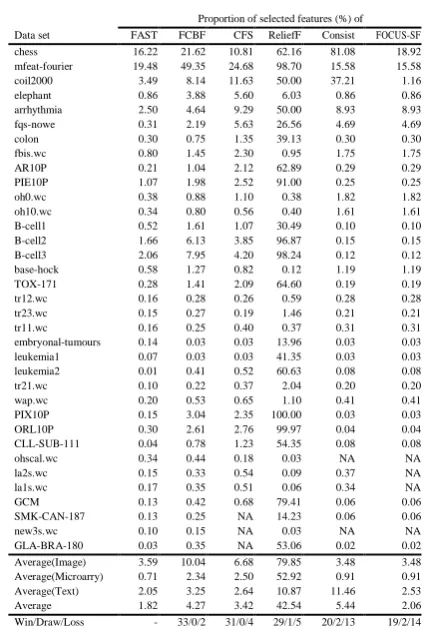
Table 2 records the proportion of selected features of the six feature selection algorithms for each data set. From it we observe that
1) Generally all the six algorithms achieve significant
reduction of dimensionality by selecting only a small portion of the original features. FAST on average obtains the best proportion of selected fea-tures of 1.82%. The Win/Draw/Loss records show FAST wins other algorithms as well.
2)
For image data, the proportion of selected features ofeach algorithm has an increment compared with the
corresponding average proportion of selected features on the given data sets except Consist has an improvement. This reveals that the five algorithms are not very suitable to choose features for image data compared with for microarray and text data. FAST ranks 3 with the proportion of selected features of 3.59% that has a tiny margin of 0.11% to the first and second best proportion of selected features 3.48% of Consist and FOCUS-SF, and a margin of 76.59% to the worst proportion of selected features 79.85% of ReliefF.
3) For microarray data, the proportion of selected features
has been improved by each of the six algorithms compared with that on the given data sets. This indicates that the six algorithms work well with microarray data. FAST ranks 1 again with the proportion of selected features of 0.71%. Of the six algorithms, only CFS cannot choose features for two data sets whose dimensionalities are 19994 and 49152, respectively.
4) For text data, FAST ranks 1 again with a margin of
0.48% to the second best algorithm FOCUS-SF.
TABLE 2: Proportion of selected features of the six feature selection algorithms
Data set
Proportion of selected features (%) of FAST FCBF CFS ReliefF Consist FOCUS-SF chess 16.22 21.62 10.81 62.16 81.08 18.92 mfeat-fourier 19.48 49.35 24.68 98.70 15.58 15.58 coil2000 3.49 8.14 11.63 50.00 37.21 1.16
elephant 0.86 3.88 5.60 6.03 0.86 0.86
arrhythmia 2.50 4.64 9.29 50.00 8.93 8.93
fqs-nowe 0.31 2.19 5.63 26.56 4.69 4.69
colon 0.30 0.75 1.35 39.13 0.30 0.30
fbis.wc 0.80 1.45 2.30 0.95 1.75 1.75
AR10P 0.21 1.04 2.12 62.89 0.29 0.29
PIE10P 1.07 1.98 2.52 91.00 0.25 0.25
oh0.wc 0.38 0.88 1.10 0.38 1.82 1.82
oh10.wc 0.34 0.80 0.56 0.40 1.61 1.61
B-cell1 0.52 1.61 1.07 30.49 0.10 0.10
B-cell2 1.66 6.13 3.85 96.87 0.15 0.15
B-cell3 2.06 7.95 4.20 98.24 0.12 0.12
base-hock 0.58 1.27 0.82 0.12 1.19 1.19
TOX-171 0.28 1.41 2.09 64.60 0.19 0.19
tr12.wc 0.16 0.28 0.26 0.59 0.28 0.28
tr23.wc 0.15 0.27 0.19 1.46 0.21 0.21
tr11.wc 0.16 0.25 0.40 0.37 0.31 0.31
embryonal-tumours 0.14 0.03 0.03 13.96 0.03 0.03 leukemia1 0.07 0.03 0.03 41.35 0.03 0.03 leukemia2 0.01 0.41 0.52 60.63 0.08 0.08
tr21.wc 0.10 0.22 0.37 2.04 0.20 0.20
wap.wc 0.20 0.53 0.65 1.10 0.41 0.41
PIX10P 0.15 3.04 2.35 100.00 0.03 0.03
ORL10P 0.30 2.61 2.76 99.97 0.04 0.04
CLL-SUB-111 0.04 0.78 1.23 54.35 0.08 0.08
ohscal.wc 0.34 0.44 0.18 0.03 NA NA
la2s.wc 0.15 0.33 0.54 0.09 0.37 NA
la1s.wc 0.17 0.35 0.51 0.06 0.34 NA
GCM 0.13 0.42 0.68 79.41 0.06 0.06
SMK-CAN-187 0.13 0.25 NA 14.23 0.06 0.06
new3s.wc 0.10 0.15 NA 0.03 NA NA
GLA-BRA-180 0.03 0.35 NA 53.06 0.02 0.02 Average(Image) 3.59 10.04 6.68 79.85 3.48 3.48 Average(Microarry) 0.71 2.34 2.50 52.92 0.91 0.91 Average(Text) 2.05 3.25 2.64 10.87 11.46 2.53
Average 1.82 4.27 3.42 42.54 5.44 2.06
Win/Draw/Loss - 33/0/2 31/0/4 29/1/5 20/2/13 19/2/14
The Friedman test [24] can be used to compare k al-gorithms
separately. The algorithm obtained the best performance gets the rank of 1, the second best ranks 2, and so on. In case of ties, average ranks are assigned. Then the average ranks of all algorithms on all data sets are calculated and compared. If the null hypothesis, which is all algorithms are performing equivalently, is rejected under the Friedman test statistic, post-hoc tests such as the Nemenyi test [47] can be used to determine which algorithms perform statistically different.
The Nemenyi test compares classifiers in a pairwise manner. According to this test, the performances of two classifiers are
significantly different if the distance of
the average ranks exceeds the critical distance CD =
√ ( +1)
, where the is based on the Studentized
6
√
2. range statistic [48] divided by
In order to further explore whether the reduction rates are significantly different we performed a Friedman test followed by a Nemenyi post-hoc test.
The null hypothesis of the Friedman test is that all the feature selection algorithms are equivalent in terms of
proportion of selected features. The test result is p = 0. This
means that at = 0.1, there is evidence to reject the null hypothesis and all the six feature selection al-gorithms are different in terms of proportion of selected features.
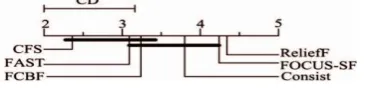
Fig. 3: Proportion of selected features comparison of all feature selection algorithms against each other with the Nemenyi test.
In order to further explore feature selection algorithms whose reduction rates have statistically significant dif-ferences, we performed a Nemenyi test. Fig. 3 shows the results with = 0.1 on the 35 data sets. The results indicate that the proportion of selected features of FAST is statistically smaller than those of RelieF, CFS and FCBF, and there is no consistent evidence to indicate sta-tistical differences between FAST , Consist, and FOCUS-SF, respectively.
4.4.2 Runtime
TABLE 3: Runtime (in ms) of the six feature selection algorithms
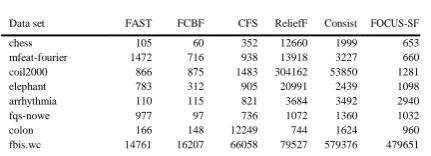
Data set FAST FCBF CFS ReliefF Consist FOCUS-SF
chess 105 60 352 12660 1999 653
mfeat-fourier 1472 716 938 13918 3227 660
coil2000 866 875 1483 304162 53850 1281
elephant 783 312 905 20991 2439 1098
arrhythmia 110 115 821 3684 3492 2940
fqs-nowe 977 97 736 1072 1360 1032
colon 166 148 12249 744 1624 960
fbis.wc 14761 16207 66058 79527 579376 479651
AR10P 706 458 57319 3874 3568 2083
PIE10P 678 1223 77579 7636 4149 2910
oh0.wc 5283 5990 59624 4898 488261 420116 oh10.wc 5549 6033 28438 5652 428459 402853
B-cell1 160 248 103871 1162 2476 1310
B-cell2 626 1618 930465 4334 5102 2556
B-cell3 635 2168 1097122 7001 4666 2348
base-hock 8059 21793 146454 728900 999232 1017412 TOX-171 1750 1558 1341345 9757 17185 8446 tr12.wc 3089 3585 51360 2558 53304 34270 tr23.wc 4266 2506 32647 1585 29165 16649 tr11.wc 5086 5575 136063 4418 111073 79000 embryonal-tumours 754 314 10154 1681 5045 1273
leukemia1 449 278 10900 790 5708 1263
leukemia2 1141 456 216888 894 10407 3471 tr21.wc 4662 5543 218436 4572 89761 55644 wap.wc 25146 28724 768642 33873 1362376 1093222 PIX10P 2957 9056 25372209 11231 9875 4292 ORL10P 2330 12991 30383928 11547 13905 5780 CLL-SUB-111 1687 1870 6327479 12720 17554 12307 ohscal.wc 353283 391761 981868 655400 NA NA la2s.wc 70776 99019 2299244 118624 7400287 NA la1s.wc 79623 107110 2668871 128452 7830978 NA
GCM 9351 4939 3780146 32950 39383 26644
SMK-CAN-187 4307 5114 NA 34881 67364 38606
new3s.wc 790690 960738 NA 2228746 NA NA
GLA-BRA-180 29854 17348 NA 97641 220734 152536 Average(Image) 1520 4090 9315452 8213 6014 2793 Average(Microarry) 1468 1169 1152695 8059 9590 5385 Average(Text) 6989 8808 137232 107528 381532 327341 Average 3573 4671 2456366 45820 149932 126970 Win/Draw/Loss - 22/0/13 33/0/2 29/0/6 35/0/0 34/0/1
1) Generally the individual evaluation based feature selection algorithms of FAST, FCBF and ReliefF are much faster than the subset evaluation based algorithms of CFS, Consist and FOCUS-SF. FAST is consistently faster than all other algorithms. The runtime of FAST is only 0.1% of that of CFS, 2.4% of that of Consist, 2.8% of that of FOCUS-SF, 7.8% of that of ReliefF, and
76.5% of that of FCBF, respectively. The
Win/Draw/Loss records show that FAST outperforms other algorithms as well.
2) For image data, FAST obtains the rank of 1. Its runtime is
only 0.02% of that of CFS, 18.50% of that of ReliefF, 25.27% of that of Consist, 37.16% of that of FCBF, and 54.42% of that of FOCUS-SF, respectively. This reveals that FAST is more efficient than others when choosing features for image data.
3) For microarray data, FAST ranks 2. Its runtime is only
0.12% of that of CFS, 15.30% of that of Consist, 18.21% of that of ReliefF, 27.25% of that of FOCUS-SF, and 125.59% of that of FCBF, respectively.
4) For text data, FAST ranks 1. Its runtime is 1.83% of
that of Consist, 2.13% of that of FOCUS-SF, 5.09% of that of CFS, 6.50% of that of ReliefF, and 79.34% of that of FCBF, respectively. This indicates that FAST is more efficient than others when choosing features for text data as well.
Fig. 4: Runtime comparison of all feature selection algo-rithms against each other with the Nemenyi test.
In order to further explore whether the runtime of the six feature selection algorithms are significantly different we performed a Friedman test. The null hypothesis of the Friedman test is that all the feature selection algo-rithms are
equivalent in terms of runtime. The test result is p = 0. This
means that at = 0.1, there is evidence to reject the null hypothesis and all the six feature selection algorithms are different in terms of runtime. Thus a post-hoc Nemenyi test was conducted. Fig. 4 shows the results with = 0.1 on the 35 data sets. The results indicate that the runtime of FAST is statistically better than those of ReliefF, FOCUS-SF, CFS, and Consist, and there is no consistent evidence to indicate statistical runtime differences between FAST and FCBF.
4.4.3 Classification accuracy
Tables 4, 5, 6 and 7 show the 10-fold cross-validation
accuracies of the four different types of classifiers on the 35 data sets before and after each feature selection algorithm is performed, respectively.
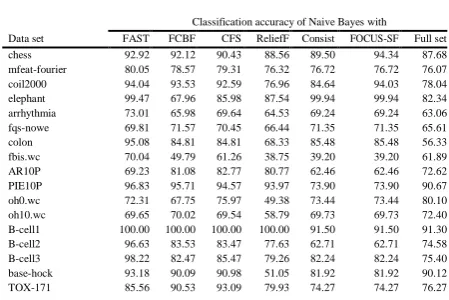
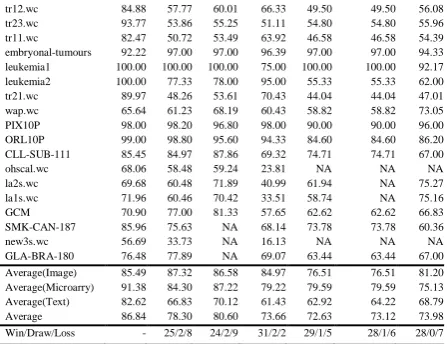
Table 4 shows the classification accuracy of Naive Bayes. From it we observe that
1) Compared with original data, the classification accuracy of Naive Bayes has been improved by FAST, CFS, and FCBF by 12.86%, 6.62%, and 4.32%,
respectively. Unfortunately, ReliefF, Consist, and FOCUS-SF have decreased the classification accu-racy by 0.32%, 1.35%, and 0.86%, respectively. FAST ranks 1 with a margin of 6.24% to the second best accuracy 80.60% of CFS. At the same time, the Win/Draw/Loss records show that FAST outper-forms all other five algorithms.
2) For image data, the classification accuracy of Naive
Bayes has been improved by FCBF, CFS, FAST, and ReliefF by 6.13%, 5.39%, 4.29%, and 3.78%, re-spectively. However, Consist and FOCUS-SF have decreased the classification accuracy by 4.69% and 4.69%, respectively. This time FAST ranks 3 with a margin of 1.83% to the best accuracy 87.32% of FCBF.
3) For microarray data, the classification accuracy of
Naive Bayes has been improved by all the six algorithms FAST, CFS, FCBF, ReliefF, Consist, and FOCUS-SF by 16.24%, 12.09%, 9.16%, 4.08%, 4.45%, and 4.45%, respectively. FAST ranks 1 with a mar-gin of 4.16% to the second best accuracy 87.22% of CFS. This indicates that FAST is more effective than others when using Naive Bayes to classify microarray data.
4) For text data, FAST and CFS have improved the classification accuracy of Naive Bayes by 13.83% and 1.33%, respectively. Other four algorithms Re-liefF, Consist, FOCUS-SF, and FCBF have decreased the accuracy by 7.36%, 5.87%, 4.57%, and 1.96%, respectively. FAST ranks 1 with a margin of 12.50% to the second best accuracy 70.12% of CFS.
TABLE 4: Accuracy of Naive Bayes with the six feature selection algorithms
tr12.wc 84.88 57.77 60.01 66.33 49.50 49.50 56.08 tr23.wc 93.77 53.86 55.25 51.11 54.80 54.80 55.96 tr11.wc 82.47 50.72 53.49 63.92 46.58 46.58 54.39 embryonal-tumours 92.22 97.00 97.00 96.39 97.00 97.00 94.33 leukemia1 100.00 100.00 100.00 75.00 100.00 100.00 92.17 leukemia2 100.00 77.33 78.00 95.00 55.33 55.33 62.00 tr21.wc 89.97 48.26 53.61 70.43 44.04 44.04 47.01 wap.wc 65.64 61.23 68.19 60.43 58.82 58.82 73.05 PIX10P 98.00 98.20 96.80 98.00 90.00 90.00 96.00 ORL10P 99.00 98.80 95.60 94.33 84.60 84.60 86.20 CLL-SUB-111 85.45 84.97 87.86 69.32 74.71 74.71 67.00
ohscal.wc 68.06 58.48 59.24 23.81 NA NA NA
la2s.wc 69.68 60.48 71.89 40.99 61.94 NA 75.27 la1s.wc 71.96 60.46 70.42 33.51 58.74 NA 75.16 GCM 70.90 77.00 81.33 57.65 62.62 62.62 66.83 SMK-CAN-187 85.96 75.63 NA 68.14 73.78 73.78 60.36
new3s.wc 56.69 33.73 NA 16.13 NA NA NA
GLA-BRA-180 76.48 77.89 NA 69.07 63.44 63.44 67.00 Average(Image) 85.49 87.32 86.58 84.97 76.51 76.51 81.20 Average(Microarry) 91.38 84.30 87.22 79.22 79.59 79.59 75.13 Average(Text) 82.62 66.83 70.12 61.43 62.92 64.22 68.79 Average 86.84 78.30 80.60 73.66 72.63 73.12 73.98 Win/Draw/Loss - 25/2/8 24/2/9 31/2/2 29/1/5 28/1/6 28/0/7
.
TABLE 5: Accuracy of C4.5 with the six feature selection algorithms
Classification accuracy of C4.5 with
Data set FAST FCBF CFS ReliefF Consist FOCUS-SF Full set chess 94.02 94.02 90.43 97.83 99.44 94.34 99.44 mfeat-fourier 71.25 75.74 77.80 76.40 71.06 71.06 75.93 coil2000 94.03 94.03 94.03 94.03 93.97 94.03 93.93 elephant 99.90 99.94 99.94 99.90 99.94 99.94 95.27 arrhythmia 71.53 70.05 69.21 66.15 66.59 66.59 65.23 fqs-nowe 69.81 73.35 69.13 66.46 68.42 68.42 66.96 colon 90.40 90.76 89.14 82.38 86.90 86.90 82.33 fbis.wc 69.41 69.35 77.52 57.03 68.70 68.70 NA AR10P 77.69 75.54 79.54 71.54 64.92 64.92 70.92 PIE10P 84.13 82.95 86.10 80.32 81.33 81.33 79.14 oh0.wc 71.88 75.45 84.20 57.43 83.47 83.47 81.37 oh10.wc 69.33 73.75 74.65 67.65 75.60 75.60 72.38 B-cell1 87.33 81.80 82.90 78.17 88.60 88.60 74.90 B-cell2 71.00 63.24 64.07 65.85 60.80 60.80 64.31 B-cell3 78.07 81.07 77.02 83.04 72.84 72.84 77.96 base-hock 92.02 89.81 89.57 49.92 90.57 90.57 91.54 TOX-171 76.85 64.92 68.69 60.24 68.66 68.66 58.44 tr12.wc 81.68 85.43 31.96 74.02 43.76 84.47 81.19 tr23.wc 89.87 94.80 46.38 86.78 67.07 96.57 92.93 tr11.wc 80.22 82.04 36.95 69.25 46.81 84.11 79.09 embryonal-tumours 87.78 97.00 97.00 88.89 97.00 97.00 87.50 leukemia1 100.00 97.00 97.00 61.11 97.00 97.00 89.17 leukemia2 100.00 75.00 78.00 88.89 81.33 81.33 60.33 tr21.wc 90.47 88.32 69.23 80.26 68.76 88.21 80.72 wap.wc 62.26 67.60 32.87 64.32 21.86 63.27 NA PIX10P 97.00 95.40 98.80 93.33 92.20 92.20 93.00 ORL10P 90.33 82.60 90.20 74.67 84.00 84.00 72.40 CLL-SUB-111 83.64 73.85 74.36 64.80 78.76 78.76 60.89
ohscal.wc 67.73 66.69 68.42 27.30 NA NA NA
la2s.wc 72.40 72.53 79.08 51.52 75.53 NA NA
la1s.wc 72.45 72.57 77.63 47.05 75.33 NA NA
GCM 58.73 59.16 60.92 52.73 45.79 45.79 51.81 SMK-CAN-187 85.19 71.42 NA 66.14 77.83 77.83 62.17
new3s.wc 55.64 60.51 NA 17.83 NA NA NA
GLA-BRA-180 71.30 68.22 NA 65.00 64.56 64.56 63.22 Average(Image) 81.70 80.93 83.60 77.12 76.99 76.99 76.39 Average(Microarry) 83.77 79.48 79.85 74.35 78.68 78.68 72.35 Average(Text) 81.38 83.15 66.16 72.59 69.09 83.94 85.84 Average 82.44 81.17 75.43 74.25 74.69 80.33 77.74 Win/Draw/Loss - 17/2/16 21/1/13 28/2/5 27/0/8 19/1/10 30/0/5
Table 5 shows the classification accuracy of C4.5. From it we observe that
1) Compared with original data, the classification accuracy of
C4.5 has been improved by FAST, FCBF, and FOCUS-SF by 4.69%, 3.43%, and 2.58%, respectively. Unfortunately,
ReliefF, Consist, and CFS have decreased the
classification accuracy by 3.49%, 3.05%, and 2.31%, respectively. FAST obtains the rank of 1 with a margin of 1.26% to the second best accuracy 81.17% of FCBF.
2) For image data, the classification accuracy of C4.5 has
been improved by all the six feature selection algorithms FAST, FCBF, CFS, ReliefF, Consist, and FOCUS-SF by 5.31%, 4.54%, 7.20%, 0.73%, 0.60%, and 0.60%, respectively. This time FAST ranks 2 with a margin of 1.89% to the best accuracy 83.6% of CFS and a margin of 4.71% to the worst accuracy 76.99% of Consist and FOCUS-SF.
3) For microarray data, the classification accuracy of C4.5
For text data, the classification accuracy of C4.5 has been decreased by algorithms FAST, FCBF, CFS, ReliefF, Consist and FOCUS-SF by 4.46%, 2.70%, 19.68%, 13.25%, 16.75%, and
1.90% respectively. FAST ranks 3 with a margin of 2.56% to the best accuracy 83.94% of FOCUS-SF and a margin of 15.22% to
the worst accuracy 66.16% of CFS.
TABLE 6: Accuracy of IB1 with the six feature selection algorithms
Classification accuracy of IB1 with
Data set FAST FCBF CFS ReliefF Consist FOCUS-SF Full set chess 90.18 91.47 84.78 96.86 95.09 90.79 90.60 mfeat-fourier 77.87 81.69 83.72 80.00 77.71 77.71 80.13 coil2000 88.42 89.27 89.42 89.16 89.96 67.62 89.87 elephant 98.97 99.99 99.99 100.00 99.97 99.97 99.31 arrhythmia 64.48 60.10 63.67 54.35 55.22 55.22 53.27 fqs-nowe 56.59 66.20 70.48 70.74 63.02 63.02 65.32 colon 91.90 78.76 84.38 82.54 85.95 85.95 76.14 fbis.wc 60.09 61.91 72.94 43.69 60.83 60.83 NA AR10P 73.33 79.08 86.77 71.79 80.46 80.46 49.54 PIE10P 99.21 99.90 99.05 99.37 92.19 92.19 99.62 oh0.wc 67.33 63.19 75.53 48.12 68.34 68.34 20.64 oh10.wc 64.06 63.56 66.46 56.67 63.41 63.41 8.40 B-cell1 100.00 94.90 95.40 92.17 93.30 93.30 73.00 B-cell2 97.00 87.02 86.42 71.78 58.00 58.00 70.20 B-cell3 98.96 95.02 95.02 83.48 80.20 80.20 83.98 base-hock 89.06 92.24 92.60 50.86 92.95 92.95 78.81 TOX-171 75.60 95.92 97.90 96.32 65.14 65.14 86.44 tr12.wc 82.11 83.43 84.92 61.02 84.91 84.91 40.13 tr23.wc 90.18 86.55 88.90 67.62 86.80 86.80 56.11 tr11.wc 78.43 79.65 81.89 59.81 81.26 81.26 49.58 embryonal-tumours 90.56 97.00 97.00 90.56 97.00 97.00 89.50 leukemia1 100.00 97.00 97.00 67.22 97.00 97.00 76.50 leukemia2 100.00 84.33 75.00 79.72 71.00 71.00 59.67 tr21.wc 87.98 85.34 91.23 76.41 87.23 87.23 67.85 wap.wc 56.47 57.31 68.49 61.03 58.74 58.74 NA PIX10P 99.00 99.00 99.00 99.00 95.00 95.00 99.00 ORL10P 100.00 97.60 95.20 94.67 95.00 95.00 94.40 CLL-SUB-111 79.09 74.94 81.62 68.66 65.83 65.83 NA
ohscal.wc 52.94 49.52 57.98 19.67 NA NA NA
la2s.wc 68.33 68.16 79.88 39.95 73.43 NA NA
la1s.wc 67.44 67.01 76.41 33.98 71.42 NA NA
GCM 68.49 66.71 69.50 58.59 52.54 52.54 58.87 SMK-CAN-187 76.28 66.08 NA 70.40 70.58 70.58 63.57
new3s.wc 49.46 52.38 NA 8.82 NA NA NA
GLA-BRA-180 72.96 73.89 NA 68.33 73.00 73.00 61.78 Average(Image) 84.33 87.25 89.04 85.93 83.90 83.90 81.34 Average(Microarry) 88.75 85.97 86.91 78.78 76.76 76.76 75.17 Average(Text) 77.66 77.63 81.56 64.66 79.05 76.63 55.78 Average 83.63 83.07 85.32 74.90 79.11 78.19 69.88 Win/Draw/Loss - 18/1/16 14/1/20 25/2/8 20/0/15 23/0/12 27/1/7
Table 6 shows the classification accuracy of IB1. From it we observe that
1) Compared with original data, the classification ac-curacy
of IB1 has been improved by all the six fea-ture selection algorithms FAST, FCBF, CFS, ReliefF, Consist, and FOCUS-SF by 13.75%, 13.19%, 15.44%, 5.02%, 9.23%, and 8.31%, respectively. FAST ranks 2 with a margin of 1.69% to the best accuracy 85.32% of CFS. The Win/Draw/Loss records show that FAST outperforms all other algorithms except for CFS, winning and losing on 14 and 20 out of the 35 data sets, respectively.
Although FAST does not perform better than CFS, we observe that CFS is not available on the three biggest data sets of the 35 data sets. Moreover, CFS is very slow compared with other algorithms as reported in Section 4.4.2.
2) For image data, the classification accuracy of IB1 has been
improved by all the six feature selection algorithms FAST, FCBF, CFS, ReliefF, Consist, and FOCUS-SF by 3.00%, 5.91%, 7.70%, 4.59%, 2.56%, and 2.56%, respectively.
FAST ranks 4 with a mar-gin of 4.70% to the best accuracy 89.04% of CFS.
3)
For microarray data, the classification accuracy of IB1has been improved by all the six algorithms FAST, FCBF, CFS, ReliefF, Consist, and FOCUS-SF by 13.58%, 10.80%, 11.74%, 3.61%, 1.59%, and 1.59%, respectively. FAST ranks 1 with a margin of 1.85% to the second best accuracy 86.91% of CFS and a margin of 11.99% to the worst accuracy 76.76% of Consist and FOCUS-SF.
4) For text data, the classification accuracy of IB1 has
been improved by the five feature selec-tion algorithms FAST, FCBF, CFS, ReliefF, Consist, and FOCUS-SF by 21.89%, 21.85%, 25.78%, 8.88%, 23.27%, and 20.85%, respectively. FAST ranks 3 with a margin of 3.90% to the best accuracy 81.56% of CFS.
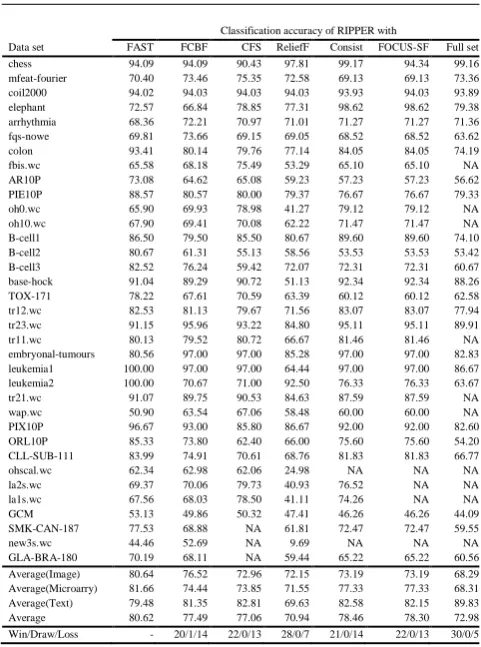
TABLE 7: Accuracy of RIPPER with the six feature selection algorithms
Data set
Classification accuracy of RIPPER with
FAST FCBF CFS ReliefF Consist FOCUS-SF Full set chess 94.09 94.09 90.43 97.81 99.17 94.34 99.16 mfeat-fourier 70.40 73.46 75.35 72.58 69.13 69.13 73.36 coil2000 94.02 94.03 94.03 94.03 93.93 94.03 93.89 elephant 72.57 66.84 78.85 77.31 98.62 98.62 79.38 arrhythmia 68.36 72.21 70.97 71.01 71.27 71.27 71.36 fqs-nowe 69.81 73.66 69.15 69.05 68.52 68.52 63.62 colon 93.41 80.14 79.76 77.14 84.05 84.05 74.19 fbis.wc 65.58 68.18 75.49 53.29 65.10 65.10 NA AR10P 73.08 64.62 65.08 59.23 57.23 57.23 56.62 PIE10P 88.57 80.57 80.00 79.37 76.67 76.67 79.33
oh0.wc 65.90 69.93 78.98 41.27 79.12 79.12 NA
oh10.wc 67.90 69.41 70.08 62.22 71.47 71.47 NA B-cell1 86.50 79.50 85.50 80.67 89.60 89.60 74.10 B-cell2 80.67 61.31 55.13 58.56 53.53 53.53 53.42 B-cell3 82.52 76.24 59.42 72.07 72.31 72.31 60.67 base-hock 91.04 89.29 90.72 51.13 92.34 92.34 88.26 TOX-171 78.22 67.61 70.59 63.39 60.12 60.12 62.58 tr12.wc 82.53 81.13 79.67 71.56 83.07 83.07 77.94 tr23.wc 91.15 95.96 93.22 84.80 95.11 95.11 89.91 tr11.wc 80.13 79.52 80.72 66.67 81.46 81.46 NA embryonal-tumours 80.56 97.00 97.00 85.28 97.00 97.00 82.83 leukemia1 100.00 97.00 97.00 64.44 97.00 97.00 86.67 leukemia2 100.00 70.67 71.00 92.50 76.33 76.33 63.67 tr21.wc 91.07 89.75 90.53 84.63 87.59 87.59 NA
wap.wc 50.90 63.54 67.06 58.48 60.00 60.00 NA
PIX10P 96.67 93.00 85.80 86.67 92.00 92.00 82.60 ORL10P 85.33 73.80 62.40 66.00 75.60 75.60 54.20 CLL-SUB-111 83.99 74.91 70.61 68.76 81.83 81.83 66.77
ohscal.wc 62.34 62.98 62.06 24.98 NA NA NA
la2s.wc 69.37 70.06 79.73 40.93 76.52 NA NA
la1s.wc 67.56 68.03 78.50 41.11 74.26 NA NA
GCM 53.13 49.86 50.32 47.41 46.26 46.26 44.09
SMK-CAN-187 77.53 68.88 NA 61.81 72.47 72.47 59.55
new3s.wc 44.46 52.69 NA 9.69 NA NA NA
GLA-BRA-180 70.19 68.11 NA 59.44 65.22 65.22 60.56 Average(Image) 80.64 76.52 72.96 72.15 73.19 73.19 68.29 Average(Microarry) 81.66 74.44 73.85 71.55 77.33 77.33 68.31 Average(Text) 79.48 81.35 82.81 69.63 82.58 82.15 89.83 Average 80.62 77.49 77.06 70.94 78.46 78.30 72.98 Win/Draw/Loss - 20/1/14 22/0/13 28/0/7 21/0/14 22/0/13 30/0/5
Table 7 shows the classification accuracy of RIPPER. From it we observe that
1) Compared with original data, the classification ac-curacy
78.46% of Consist. The Win/Draw/Loss records show that FAST outperforms all other algorithms.
2) For image data, the classification accuracy of RIP-PER has
been improved by all the six feature selec-tion algorithms FAST, FCBF, CFS, ReliefF, Consist, and FOCUS-SF by 12.35%, 8.23 %, 4.67%, 3.86%, 4.90%, and 4.90%, respectively. FAST ranks 1 with a
margin of 4.13% to the second best accuracy 76.52% of FCBF.
3) For microarray data, the classification accuracy of RIPPER
has been improved by all the six al-gorithms FAST, FCBF, CFS, ReliefF, Consist, and FOCUS-SF by 13.35%, 6.13%, 5.54%, 3.23%, 9.02%, and 9.02%, respectively. FAST ranks 1 with a
mar-gin of 4.33% to the second best accuracy 77.33% of Consist and FOCUS-SF.
4) For text data, the classification accuracy of RIPPER has
been decreased by FAST, FCBF, CFS, ReliefF, Consist, and FOCUS-SF by 10.35%, 8.48%, 7.02%, 20.21%, 7.25%, and 7.68%, respectively. FAST ranks 5 with a margin of 3.33% to the best accuracy 82.81% of CFS.
In order to further explore whether the classification accuracies of each classifier with the six feature selection algorithms are significantly different, we performed four Friedman tests individually. The null hypotheses are that the accuracies are equivalent for each of the four classifiers with
the six feature selection algorithms. The test results are p = 0.
This means that at = 0.1, there are evidences to reject the null hypotheses and the accuracies are different further differences exist in the six feature selection algorithms. Thus four post-hoc Nemenyi tests were conducted. Figs. 5, 6, 7, and 8 show the results with = 0.1 on the 35 data sets.
Fig. 5: Accuracy comparison of Naive Bayes with the six feature selection algorithms against each other with the Nemenyi test.
Fig. 6: Accuracy comparison of C4.5 with the six fea-ture selection algorithms against each other with the Nemenyi test.
Fig. 7: Accuracy comparison of IB1 with the six fea-ture selection algorithms against each other with the Nemenyi test.
Fig. 8: Accuracy comparison of RIPPER with the six feature selection algorithms against each other with the Nemenyi test.
From Fig. 5 we observe that the accuracy of Naive Bayes with FAST is statistically better than those with ReliefF, Consist, and FOCUS-SF. But there is no consis-tent evidence to indicate statistical accuracy differences between Naive Bayes with FAST and with CFS, which also holds for Naive Bayes with FAST and with FCBF.
From Fig. 6 we observe that the accuracy of C4.5 with FAST is statistically better than those with ReliefF, Con-sist, and FOCUS-SF. But there is no consistent evidence to indicate statistical accuracy differences between C4.5 with FAST and with FCBF, which also holds for C4.5 with FAST and with CFS.
From Fig. 7 we observe that the accuracy of IB1 with FAST is statistically better than those with ReliefF. But there is no consistent evidence to indicate statistical accuracy differences between IB1 with FAST and with FCBF, Consist, and FOCUS-SF, respectively, which also holds for IB1 with FAST and with CFS.
From Fig. 8 we observe that the accuracy of RIPPER with FAST is statistically better than those with ReliefF. But there is no consistent evidence to indicate statistical accuracy differences between RIPPER with FAST and with FCBF, CFS, Consist, and FOCUS-SF, respectively.
For the purpose of exploring the relationship between feature selection algorithms and data types, i.e. which algorithms are more suitable for which types of data, we rank the six feature selection algorithms according to the classification accuracy of a given classifier on a specific type of data after the feature selection algorithms are performed. Then we summarize the ranks of the feature selection algorithms under the four different clas-sifiers, and give the final ranks of the feature selection algorithms on different types of data. Table 8 shows the results.
for all data, FAST ranks 1 and should be the undisputed first choice, and FCBF, CFS are good alternatives.
From the analysis above we can know that FAST performs very well on the microarray data. The reason lies in both the characteristics of the data set itself and the property of the proposed algorithm.
Microarray data has the nature of the large number of features (genes) but small sample size, which can cause “curse of dimensionality” and over-fitting of the training data [19]. In the presence of hundreds or thousands of
features, researchers notice that it is common that a large number of features are not informative because they are either irrelevant or redundant with respect to the class concept [66]. Therefore, selecting a small number of discriminative genes from thousands of genes is essential for successful sample classification [27], [66].
Our proposed FAST effectively filters out a mass of irrelevant features in the first step. This reduces the possibility of improperly bringing the irrelevant features into the subsequent analysis. Then, in the second step, FAST removes a large number of redundant features by choosing a single representative feature from each cluster of redundant features. As a result, only a very small number of discriminative features are selected. This coincides with the desire happens of the microarray data analysis.
4.4.4 Sensitivity analysis
Like many other feature selection algorithms, our pro-posed FAST also requires a par