Original Research Article
Socio-demographic and obstetric risk factors of anaemia among
pregnant women in rural Tamil Nadu
Abiselvi A.
1, Gopalakrishnan S.
1*, Umadevi R.
1, Rama R.
2INTRODUCTION
Pregnancy is one of the most important and unique periods in a woman’s life. The care given by the health care provider to a pregnant woman during her pregnancy period (a period of 280 days) is known as antenatal care.1 World Health Organization considers anaemia a severe public health problem when its prevalence is equal to or greater than 40% in the population.2 Iron deficiency is
highest in population subgroups that are at peak growth rates such as infants, children and pregnant mothers.3 Anaemia in pregnancy, the most common micro nutritional deficiency disorder in the world, is one of the risk factors in pregnancy that is identified and confirmed during antenatal visits by means of simple haemoglobin estimation.3 It is estimated that more than 50% of pregnant women are anaemic and majority (90%) are due
ABSTRACT
Background: Anaemia in pregnant women remains one of the most intractable public health problems in developing countries because of various socio-cultural factors like illiteracy, poverty, lack of awareness, cultural and religious taboos, poor dietary habits, and high prevalence of parasitic infestation. The study was aimed at determining the factors associated with anaemia among rural pregnant women in the field practice area of our medical college in Tamil Nadu.
Methods: This is a community based cross sectional study among 270 pregnant women registered at our rural health training centre. Ethical approval and informed consent were obtained prior to the data collection. A pilot tested structured interview schedule was used to elicit questions related to socio-demographic and obstetric factors and hemoglobin levels were recorded from their mother child protection card. Various factors associated with anaemic status of the pregnant mothers were analysed using chi square for significance at 95% confidence interval.
Results: Among the study participants, 41.5% were found to be anaemic. Passive smoking [kitchen smoke, cigarette/beedi smoke] (p<0.004 and X2-8.2), dietary habits (p<0.009 and X2-6.8), irregular iron folic acid tablet consumption (p<0.0001 and X2-59.1) and deworming (p<0.0001 and X2-12.4) were found to be significantly associated with anaemia.
Conclusions: Anaemia is a social problem, wherein the knowledge and attitudes of the pregnant women deeply influence the disease burden. The results suggest that pregnant women and their family members should be educated to understand the importance of anaemia and its associated risk factors.
Keywords: Iron deficiency, Haemoglobin, Antenatal women
1Department ofCommunity Medicine, Sree Balaji Medical College and Hospital, Bharath University, Chrompet,
Chennai, Tamil Nadu, India
2John and Jenner Center for Research, Agraharam Street, Erode, Tamil Nadu, India
Received: 08 December 2017
Accepted: 03 January 2018
*Correspondence:
Dr. Gopalakrishnan S., E-mail: [email protected]
Copyright: © the author(s), publisher and licensee Medip Academy. This is an open-access article distributed under the terms of the Creative Commons Attribution Non-Commercial License, which permits unrestricted non-commercial use, distribution, and reproduction in any medium, provided the original work is properly cited.
to iron deficiency.4,5 Women often become anaemic during pregnancy because the demand for iron increases due to physiological burden of pregnancy.
The inability to meet the required level for these substances either due to dietary deficiencies, inadequate absorption or infection in conjunction with blood loss during pregnancy gives rise to anaemia.6 The major health consequences of anaemia (maternal and infant mortality and morbidity) include not only poor pregnancy outcome like premature birth and low birth weight, but also responsible for about 20% of all maternal death.7 It is estimated that about 20%-40% of maternal deaths in India are due to anaemia. India contributes to about 50% of global maternal deaths due to anaemia.8 According to NFHS 3 (2005-2006) about 55.3% of pregnant women in India were anaemic. Prevalence of anaemia in the South Indian States recorded was in Andhra Pradesh 62.9%, Tamil Nadu 53.2%, Karnataka 51.5% and Kerala 32.8%.9 Various nutritional programmes have been advocated by the government and despite the use of iron and folic acid supplementation, the prevalence of anaemia is quite high which shows that various other factors might be contributing to it. According to the United Nations (UN), 56% of pregnant women in low-income countries suffer from anaemia compared to 18% in high-income countries.10 Its prevalence in pregnancy varies considerably because of the differences in, for example, socioeconomic conditions, lifestyles, and health-seeking behaviours across different cultures.
So this study was intended to identify and assess the role of various socio demographic and obstetric factors associated with anaemia among pregnant women in a rural community in Tamil Nadu.
METHODS
Study design
This is a community based cross sectional descriptive study
Study area
The rural field practice area of our medical college, Sripuram in Kancheepuram district, is the study area.
Study population
All the pregnant mothers attending the Rural Health Training Centre, Sripuram were defined as the study population.
Sample size
According to NFHS 3 Data, about 53.2% of pregnant women in Tamil Nadu were found to be anaemic.9 Therefore 53.2% was taken as prevalence for calculation
of sample size. At 95% confidence limits and with 10% limit of accuracy, the sample size was estimated as 234. Accounting 15% for non-response, the sample size derived was 269. The final sample size was rounded off to 270.
Study period
Three months from October to December 2015.
Sampling method
All the pregnant mothers who were registered in the Rural Health Training Centre, Sripuram, Kancheepuram district from January to December 2015 were listed out from the antenatal register available at RHTC. From among the list of the antenatal women prepared, 270 participants were selected by simple random sampling method.
Ethical committee approval
Institutional ethics committee of our medical college has approved to carry out this study.
Informed consent
Informed consent in the local language (Tamil) was obtained from the study participants before administering the questionnaire.
Pilot study
Pre-testing was carried out for standardizing the questionnaire. Based on the observations made during the pilot testing, necessary changes were made in the questionnaire. The results of the pilot study were not included in the final analysis.
Tool for data collection
A structured interview schedule was prepared to elicit questions related to socio-demographic and obstetric factors. Data related to haemoglobin level were recorded from the mother child protection card available with the antenatal women. All the hemoglobin values were recorded and mean value for each participant was calculated. The mean hemoglobin level was later categorized for the estimation of prevalence of anaemia.
Inclusion criteria
All the willing pregnant mothers residing in the rural field practice area (Sripuram) of the medical college at the time of survey were included in the study.
Exclusion criteria
Data collection methods
This community based cross sectional study was carried out among 270 pregnant mothers by making house visits to the identified and willing study participants. The purpose of the study was clearly explained to them. Informed consent was obtained in local (Tamil) language before administering the structured interview schedule. The questions related to socio-demographic and obstetric factors were collected from the mother and all the Haemoglobin values were recorded from the mother child protection card.
Statistical analysis
The data was collected and entered in an excel sheet. Then data was analysed using SPSS version 16. Prevalence of anaemia was expressed in frequencies. Various factors associated with anaemic status of the pregnant mothers were analysed using chi square for significance at 95% Confidence interval.
Operational definition
According to World Health Organization, anaemia in pregnancy was defined as hemoglobin levels less than 11g/dl.11
Table 1: Grading of anaemia among pregnant women according to WHO.
S. No Grading of anaemia Hemoglobin level (g/dl)
1 Mild 10-10.9
2 Moderate 7.0-9.9
3 Severe <7.0
RESULTS
This study was carried out among 270 pregnant mothers residing in the rural field practice area of Sripuram. The study participants were between the age group of 15 to 35 years. Majority of the respondent belonged to the age group of 15 to 24 years (48.5%) It is to be noted that 8 [3%] of the pregnant women were in their late adolescent age between 15 to 17 years, indicative of the prevalent early marriages.
Table 1 illustrates the socio-demographic information of the respondents. About 89.9% of them belonged to Hindu religion. Majority of the respondent (40.4%) have completed their middle school. About 98.9% of the study participants are home workers. About 56.7% of them were from nuclear family. Majority of the study participants were belonging to the upper middle class (54.4%) as per Modified BG Prasad’s Social Classification. About 78.9% of them lived in pucca houses. Majority (70.7%) of them had their own toilet facility and 19.6% of the houses had open sullage drainage system.
Among the study group, multi gravida’s were about 33%. The total abortions were only among 3.7%. Out of the total abortion 2.6% was spontaneously aborted and 2.2% was induced legally and there was no illegal abortions. About 90% of them were passive smokers [exposed to kitchen smoke, cigarette/beedi smoke] and 80% of them were de-wormed; only 13% received parenteral iron. Around 93.3% did not have any complications while only two participants had pregnancy induced hypertension, fever, and six were having mal-presentation and seven had gestational diabetes (Table 2).
Figure 1: Grading of anaemia among the pregnant women studied.
Among the study participants it was observed that anaemia (Hb <11 g/dl) was prevalent among 41.5% of the pregnant women. 69% of the participants had mild anaemia, 26% had moderate anaemia and 5% had severe anaemia (Figure 1).
Association of socio demographic factors with anaemia
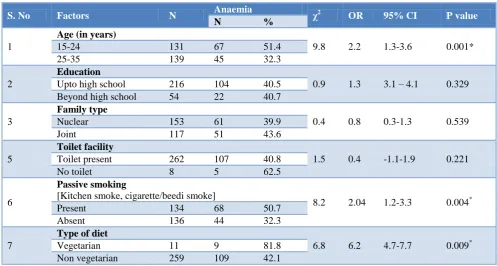
The prevalence of anaemia in the study population is likely to be influenced by various socio demographic factors described. In this study, the association of anaemia with various socio demographic factors has been brought out. Pregnant women who have been exposed to passive smoking [kitchen smoke, cigarette/beedi smoke] are 2 times at risk of getting anaemia (p<0.004 and X2- 8.2). Study participants those who were vegetarians are 6.2 times more prone for anaemia than non-vegetarians (p<0.009 and X2- 6.8) (Table 3).
Association of obstetric factors with anaemia
The prevalence of anaemia in the study population is likely to be influenced by various obstetrics factors described. In this section the association of anaemia with various obstetric factors has been brought out. Table 4 shows the association between certain obstetric factors and anaemia. During the analysis while comparing the risk factors with anaemic mothers revealed that those pregnant women who have been on irregular IFA tablet consumption are 14.5 times more prone for anaemia than
69% 26%
5%
Grading of anaemia [%]
those who are on regular tablet consumption, where the p<0.0001 with 95% CI [0.03 to 0.1] and chi square 53.9. A strong association also exist between those who have
been dewormed and those who have not with a p<0.001 and 95% CI [0.14 to 0.6] with chi square 12.4.
Table 2: Obstetric History of the study participants.
S. No Characteristics Frequency (N=270) Percentage (%)
1 Marriage age
<21 yrs 95 35.2
≥21 yrs 175 64.8
2 Gravidity
Primi-gravida 181 67.0
Multipara 89 33.0
3 Number of live children (n=89)
None 4 4.5
One 84 94.4
Two 1 1.1
4 Number of abortion
None 257 95.2
One 10 3.7
Two 3 1.1
5 Abortion type
Spontaneous 7 2.6
Legally induced 6 2.2
Illegally induced 0 0
Not applicable 257 95.2
6 Diet history
Vegetarian 11 4.1
Mixed diet 243 90.0
Eggeterian 16 5.9
7 Early registration of pregnancy
Yes 270 100.0
No 0 0
8 Number iron & folic acid (IFA)
tablet received
100 tablet 218 80.7
200 tablet 52 19.3
9 Regular intake of IFA tablet
Yes 218 80.7
No 52 19.3
10 De-worming done
Yes 216 80.0
No 54 20.0
11 Parenteral iron received
Yes 35 13.0
No 235 87
12 Any pregnancy related complications
None 252 93.3
Gestational diabetic 7 2.6
Mal-presentation 6 2.2
Pregnancy Induced Hypertension 2 0.7
Fever 2 0.7
Table 3: Association of socio demographic factors with anaemia.
S. No Factors N Anaemia χ2 OR 95% CI P value
N %
1
Age (in years)
9.8 2.2 1.3-3.6 0.001*
15-24 131 67 51.4
25-35 139 45 32.3
2
Education
0.9 1.3 3.1 – 4.1 0.329 Upto high school 216 104 40.5
Beyond high school 54 22 40.7 3
Family type
0.4 0.8 0.3-1.3 0.539
Nuclear 153 61 39.9
Joint 117 51 43.6
5
Toilet facility
1.5 0.4 -1.1-1.9 0.221 Toilet present 262 107 40.8
No toilet 8 5 62.5
6
Passive smoking
[Kitchen smoke, cigarette/beedi smoke]
8.2 2.04 1.2-3.3 0.004*
Present 134 68 50.7
Absent 136 44 32.3
7
Type of diet
6.8 6.2 4.7-7.7 0.009*
Vegetarian 11 9 81.8
Non vegetarian 259 109 42.1
*Statistically significant at 95% CI level.
Table 4: Association of obstetric factors with anaemia.
S. No Factors N Anaemia χ2 OR 95% CI P value
N %
1
Parity
0.0005 0.993 -0.3-1.5 0.981
Multipara 87 36 41.4
Primi 183 76 41.5
2
Intake of IFA tablets
53.9 14.5 13.7-15.3 0.001*
Irregular 52 45 86.5
Regular 218 67 30.7
3
De-worming
12.4 0.3 -0.4 – 1 0.001*
Not done 54 11 20.4
Done 216 101 46.8
*Statistically significant at 95% CI level.
DISCUSSION
Pregnant women are one of the most vulnerable groups in a population to develop anaemia particularly in developing countries. Therefore, the aim of this study was to determine the various factors associated with occurrence of anaemia.
Overall prevalence of anaemia in the current study was 41.5%. This prevalence is comparable to the studies conducted by Larocque et al (47.31%) and Suega et al, (46.2%).12,5 High prevalence was observed in the studies conducted by Sharma et al (63%) and Madhavi et al, (66.7%).13,14 Higher prevalence of anaemia was also observed in studies done by Gautam et al (96.5%) and Ivan et al (83%).15,16 The possible reasons for the difference may be due to the geographical variation of the
influencing factors across different areas. The comparatively lower prevalence in this study may be due to better lifestyle and active implementation of the government in the anaemia control measures.
In the present study, 69% were found to have mild anaemia. In a study done by Bivalkar, around 40% of the study participants had mild anaemia, which was much lower to our results.17 Another study done by Balgir to assess the prevalence of anaemia in Odisha found that 29.4% of the participants had mild anaemia, much lower than our study findings.18
among the pregnant mothers exposed to passive smoking.19 In this study there was a significant association exists between dietary habits and anaemia (p<0.009). Those who were on vegetarian diet were more prone for anaemia when compared to those on mixed diet. This goes hand in hand with a study done by Nadeem Ahmad et al, in India. (χ2=2.37, p<0.05).3
An association has been revealed between those who were on iron and folic acid tablet consumption and anaemic status (p<0.0001). Those who were on irregular IFA tablet consumption were more prone for anaemia than those on regular consumption of tablet. An earlier study by Gopalakrishnan et al, found that about 90% of pregnant women consumed 100 or more IFA tablets which had a direct relationship to their anaemia status.20 This is been supported by the studies done by Aliene et al, (AOR=1.54 (95% CI =1.04–2.27), Mirzaie et al, (p<0.001) and Viveki et al, (p<0.01).21-23
This study also shows a statistically significant association existing between worm infestation and prevalence of anaemia. Those who had regular deworming were found to be less prone to become anaemic. Melku et al and Brooker et al also reported similar findings in their studies.24,25
CONCLUSION
This study carried out among 270 pregnant mothers residing in the rural area of Sripuram shows varied relationship between certain socio-demographic and obstetrical factors associated with the prevalence of anaemia among them. Passive smoking, dietary habits, irregular consumption of iron and folic acid tablets and worm infestation were found to be statistically significant factors associated with anaemia among pregnant women. Several national health programs have been implemented to alleviate this problem, which has been largely successful in bringing down the prevalence of anaemia among pregnant women, but still further aggressive measures are required to minimize the magnitude of anaemia. Awareness creation about deworming, nutrition education and nutritional counselling, importance of taking iron supplementation and consumption of iron-rich foods during pregnancy is recommended to prevent anaemia in the pregnant women.
ACKNOWLEDGEMENTS
The authors acknowledge the role played by Dr. Hemalatha, Medical Officer, Mr. Mannar, Mrs. Prema, Mrs. Subbulakshmi and Mrs. Mary, the field staff of the RHTC, for their sincere and untiring effort to successfully carry out this study in the Field practice area.
Funding: No funding sources Conflict of interest: None declared
Ethical approval: The study was approved by the Institutional Ethics Committee
REFERENCES
1. Park K. Park’s Text book of Preventive and Social Medicine. M/S Banarsidas Bhanot Publishers, 22nd edition. 2013: 480-483.
2. WHO Global Database on Anaemia.Worldwide prevalence of anaemia 1993–2005. Available from: http://whqlibdoc.who.int/publications/2008/978924 1596657_eng.pdf. Accessed on 24 March 2017. 3. Ahmad N, Kalakoti P, Bano R, Syed MMA. The
prevalence of anaemia and associated factors in pregnant women in a rural Indian community. AMJ 2010;3(5):276-80.
4. Ghimire N, Pandey N. Knowledge and practice of mother regarding the prevention of anaemia during pregnancy, in teaching hospital, Kathmandu. J Chitwan Med Coll. 2013;3(5):14-7.
5. Suega K, Dharmayuda T, Sutarga I, Bakta I. Iron-deficiency anemia in pregnant women in Bali, Indonesia: a profile of risk factors and epidemiology. Southeast Asian J Trop Med Public Health. 2002;33(3):604-7.
6. Idowu OA, Mafiana CF, Sotiloye D. Anaemia in pregnancy: a survey pregnant women in Abeokuta, Nigeria. Afr Health Sci. 2005;5(4):295–9.
7. WHO. Micronutrient deficiencies. IDA . 2014. Available at: http://www.who.int/nutrition/ topics/ida/en/. Accessed on 24 March 2017.
8. Agarwal KN, Agarwal DK, Sharma A. Nutrition Foundation of India Anaemia in pregnancy – interstate difference. Project funded by Department of Family Welfare, Government of India. Scientific Report 16 2005. Available at: http://nutritionfoun dationofindia.res.in/pdfs/Scientific-report-16.pdf. Accessed on 24 March 2017.
9. National Family Health Survey (NFHS-3), 2005–06: India: Volume I. Nutrition and Anaemia. Table 10.25, P 313. Available at: http://rchiips.org
/nfhs/NFHS-3%20Data/VOL-1/India_volume_I_corrected_17oct08.pdf. Accessed on 24 Mar 2017.
10. 4th Report − The World Nutrition Situation: Nutrition Throughout the Life Cycle. United Nations Administrative Committee on Coordination. Sub−Committee on Nutrition (ACC/SCN) in collaboration with International Food Policy Research Institute (IFPRI). 2000. Available from: https://www.unscn.org/web/archives_resources/files /rwns4.pdf. Accessed on 24 March 2017.
11. World Health Organization. Haemoglobin Concentrations for the diagnosis of anaemia and assessment of severity. Available from http://www.who.int/vmnis/indicators/haemoglobin.p df?ua=1. Accessed on 24 March 2017.
12. Larocque R, Casapia M, Gotuzzo E, Gyorkos T. Relationship between intensity of soil transmitted helminth infection and anaemia during pregnancy. Am J Trop Med Hyg. 2005;73(4):783-9.
with anemia among pregnant women attending antenatal Hospital in Jaipur City, India. IOSR-JPBS. 2013;6(3):1-5.
14. Madhavi LH, Singh HKG. Nutritional Status of Rural Pregnant Women. Peoples J Sci Res. 2011;4(2):20-3.
15. Gautam VP, Bansal Y, Taneja DK, Saha R. Prevalence of anaemia amongst pregnant women and its socio-demographic associates in a rural area of Delhi. Ind J Com Med. 2002;27(4):157-60. 16. Amel EI, Mangaiarkkarasi A. Evaluation of
Anaemia in Booked Antenatal Mothers During the Last Trimester. J Clinical Diagnos Res. 2013;7(11):2487-90.
17. Neha YB, Wingkar KC, Joshi AG, Swati J. Assessment of severity & types of anaemia during pregnancy in rural population in Western Maharashtra. Indian J Basic Applied Med Res. 2014;4(1):160-3.
18. Balgir RS, Panda J, Panda AK, Ray M. A cross sectional study of anaemia in pregnant women of eastern coast of Odisha. Tribal Health Bulletin. 2011;17(1&2):1-7.
19. Goel P, Radotra A, Singh I, Aggarwal A, Dua D. Effects of passive smoking on outcome inpregnancy. J Postgrad Med. 2004;50:12-6. 20. Gopalakrishnan S, Rama R. Assessment of
knowledge regarding ‘essential obstetrics care’ among rural pregnant women in Kancheepuram District of Tamil Nadu, India. Int J Community Med Public Health. 2015;2:526-30.
21. Addia AK, Mohamad DA. Prevalence of Anemia and Associated Factors among Pregnant Women in an Urban Area of Eastern Ethiopia. Anemia. 2014;(2014);561-7.
22. Mirzaie F, Eftekhari N, Goldozeian S, Mahdainia J. Prevalence of anaemia risk factors in pregnant women in Kerman, Iran. Iranian J Reprod Med. 2010;8 (2):66-69.
23. Viveki RG, Halappanavar AB, Viveki PR, Halki SB, Maledand VS, Deshpande PS. Prevalence of Anaemia and its Epidemiological Determinants in Pregnant women. Al Ameen J Med Sci. 2012;5(3):216-23.
24. Melku M, Addis Z, Alem M, Enawgaw B. Prevalence and Predictors of Maternal Anemia during Pregnancy in Gondar, Northwest Ethiopia: An Institutional Based Cross-Sectional Study.Anemia. 2014:108593:9.
25. Brooker S, Hotez PJ, Bundy DAP. Hookworm-Related Anaemia among Pregnant Women: A Systematic Review. PLoS Negl Trop Dis. 2008;2(9):e291.