Deterministic Recurrent Communication and
Synchronization in Restricted Sensor Networks
Antonio Fern´andez Anta
1†Miguel A. Mosteiro
2,3‡Christopher Thraves
3,4§1Institute IMDEA Networks, Spain 2Department of Computer Science, Rutgers University, USA 3
LADyR, GSyC, Universidad Rey Juan Carlos, Spain 4ASAP Project team, IRISA/INRIA Rennes, France
received 24thSeptember 2010,revised 23rdFebruary 2011,accepted 15thApril 2011.
Monitoring physical phenomena in Sensor Networks requires guaranteeing permanent communication between nodes. Moreover, in an effective implementation of such infrastructure, the delay between any two consecutive communica-tions should be minimized. The problem is challenging because, in a restricted Sensor Network, the communication is carried out through a single and shared radio channel without collision detection. Dealing with collisions is cru-cial to ensure effective communication between nodes. Additionally, minimizing them yields energy consumption minimization, given that sensing and computational costs in terms of energy are negligible with respect to radio com-munication. In this work, we present a deterministic recurrent-communication protocol for Sensor Networks. After an initial negotiation phase of the access pattern to the channel, each node running this protocol reaches a steady state, which is asymptotically optimal in terms of time efficiency, and optimal (0) or constant (for a worst-case adversary) in terms of transmissions overhead, which we use as energy efficiency metric. As a by-product, a protocol for the synchronization of a Sensor Network is also proposed. Furthermore, the protocols are resilient to an arbitrary node power-up schedule and a general node failure model.
Keywords:Sensor networks, Recurrent communication, Synchronization, Radio networks, Distributed computing.
1
Introduction
A Sensor Network is an infrastructure deployed in a hostile or remote area for monitoring purposes. The basic entities of a Sensor Network are called sensor nodes, small devices provided with radio-communication, processing, and sensing capabilities. Upon being distributed at random in the area of interest, sensor nodes have to build a communication system from scratch. A strong shortcoming in Sen-sor Networks is the energy supply of senSen-sor nodes. Consequently, one of the main challenges is the effi-cient administration of such resource, extending the usability of the network. In sensor nodes, sensing and
†Email:[email protected]. ‡Email:[email protected].
§Email:[email protected].
A preliminary version of this work is included in Fern´andez Anta et al. (2010a).
This research was supported in part by NSF grant no. 0937829, Comunidad de Madrid grant S2009TIC-1692 and Spanish MICINN grant TIN2008–06735-C02-01, and French ANR project Shaman. The authors would like to thank the anonymous referees for their useful comments and suggestions.
computational costs in terms of energy consumption are negligible with respect to radio communication. Thus, it is crucial to optimize the communication schedule. In a harshly restricted Sensor Network, the communication is carried out by means of a single and shared radio channel where nodes may broadcast messages to all neighboring nodes but no collision detection mechanism is available. Therefore, special mechanisms to effectively transmit or receive a message are required. Indeed, a nodebreceives a message transmitted from a neighboring nodeaonly if neitherbnor the other neighbors ofbtransmit at the same time. Otherwise, a collision occurs and the messages are garbled. Furthermore,bis not able to recognize the difference between this garbled message received and the background noise present in the channel if no transmission is produced.
The mechanism used by a node to decide to transmit or receive at any time is called thetransmission schedule. Some transmission schedules use randomness to avoid collisions, but frequently involve a large number of redundant transmissions, consequently incurring in excessive energy consumption. On the other hand, deterministic transmission schedules, although efficient in terms of energy consumption, usu-ally provide only large time guarantees for successful communication. Therefore, the problem addressed in this work, i.e., to find a deterministic transmission schedule with optimal time and energy guarantees of successful communication, is a fundamental question in Sensor Networks.
The rest of the document is organized as follows. In Sections 2, the model and problem definition are presented. In Section 3, our results are presented and contextualized with the previous results. Section 4 contains synchronization algorithms of independent interest. Deterministic recurrent communication algorithms are introduced in Section 5. Finally, conclusions are presented in section 6.
2
Model and Problems Definition
Regarding network topology and connectivity, and node constraints, we use the restrictive model in Fer-n´andez Anta et al. (2007), FerFer-n´andez Anta et al. (2009), and Farach-Colton et al. (2009) summarized here as follows.
NETWORK ANDNODES: Let us denote withV the set of sensors. Each sensor node is assumed to have a unique identification number (ID) in {0, . . . , n−1}. Sensors are expected to be deployed at random in the area of interest, which is represented by the2-dimensional Euclidean spaceR2 together with their Euclidean metric. Each sensor is provided with a radio system to communicate with the rest of the network, but each radio system has only a limited range for transmissions and receptions. It is assumed that the transmission range and the reception range are the same, and it is referred as the communication range. Consequently, each node is able to communicate with a restricted number of other sensors, the ones deployed within its communication range. In this work, we use an undirected graphG= (V, E)to model the topology of the network. Each node inV represents a sensor node, and the link(u, v)∈Erepresents that nodesuandvare in communication range(i). Let us denote withN(v)the set of neighbors of nodev. Letn=|V|denote the number of nodes in the network, and let∆ = maxv∈V |N(v)|be the maximum degree of a node inG(i.e., the network). Finally, we useDto denote the diameter of the network. Unless otherwise stated, we assume thatn,∆ andD are known by all the nodes in the system. (We assume the precise values are known for clarity, but limiting that knowledge to asymptotically tight upper bounds yield the same results asymptotically.) Regarding computational resources of sensor nodes, node-memory size is restricted only toO(∆ + logn)bits. Were the deployment of nodes uniform (random geometric
graph) as it is popularly assumed in the Sensor Networks literature (cf. Doherty et al. (2001) and Song et al. (2005)), our protocols would work even if the node-memory size is restricted to justO(logn)bits.
LOCALSYNCHRONY: Time is assumed to be slotted in equal-lengthtime slotsorsteps.It is assumed that the length of a slot is sufficient to transmit one message, i.e., each transmission occurs in a given slot. As in other Radio Networks work, we assume that the slots of all nodes are in phase, i.e., they all start and finish at the same time instants. For convenience, we assume aglobal timethat takes non-negative integer values and advances one unit per step. Note that this is a virtual device and that the nodes do not have access to its value. For convenience we assume that the global time is the number of time steps since the first nodes in the system have been powered up orawakened. We assume the availability of a hardware clock mechanism at each node, denotedlocal-clock, such that, starting from0when the node is awakened, the clock is incremented by one automatically at the end of each time slot(ii). Then, for alli ∈ V and
t∈Z+,local-clock
i(t)denotes the value oflocal-clockof nodeiat time steptbefore being incremented. In the first steptexecuted by a nodei,local-clocki(t) = 0.
NODEAWAKENING ANDTYPES OFADVERSARIES: Nodes are in two possible states, sleepingand awake. It is assumed that initially all nodes are sleeping. The nodes are assumed to be awakened by an adversary.(iii) Without loss of generality, it is assumed that every node of the network is eventually awakened. In the rest of the paperxwill be used to denote the first node awakened by the adversary, breaking ties arbitrarily. Asxis always awake (see below),∀t ≥ 0 : local-clockx(t) = t. Regarding node reliability, as customary in the Sensor Networks literature, we assume that nodes may fail. I.e., a node may crash and stop working. The adversary decides when to crash and recover (awake again) nodes. However, if crashes and recoveries occur arbitrarily, due to determinism, there exist topologies for which the adversary may stop a node from receiving any message, even if connectivity is required.(iv) Thus,
limitations to the crash/recovery schedule are in order. In this work, we consider node failures as long as: (i) nodexis always awake (in fact it would be enough if there is always some node that has the global time up and running), (ii) a node that is awakened at timetis awake and connected (possibly indirectly) to node
xat least the whole period[t, t+S], whereSis the length of the stabilization time (as defined below). Failure models where multi-hop communication is provided along time as links become available (as in opportunistic networkingPelusi et al. (2006) ordelay-tolerant networksFall (2003)) are also feasible for the stabilization phase of the present problem. The extension of the present analysis to those models is left for future work. In this work, we consider two types of adversaries.
Definition 1 Aτ-adversaryis an adversary that awakens all the nodes of the network within a window time of sizeτ, i.e., no node is awakened at a timet ≥τ. Additionally, aτ-adversary does not recover crashed nodes. The parameterτis assumed known by the nodes.
Definition 2 An∞-adversaryis an adversary that has no restriction on when nodes are awakened. COMMUNICATION: Each radio system transmits and receives in a single and shared radio channel. Therefore, at each step, each node decides between transmission mode or reception mode. Moreover, nodevreceivesfrom nodeuin a slot if and only if nodeuis the only neighbor ofvtransmitting in that slot, andvis in reception mode at that slot. In the case that two or more neighbors of nodev transmit
(ii) Observe that, if not readily available, the described mechanism can be implemented as a software counter.
(iii) In contrast with the wake-up problem studied in the literature, we do not assume that sleeping nodes may additionally be awaken by the transmission of a neighboring node.
in the same slot a collision occurs at nodev. A nodevis not able to distinguish between silence (none of the nodes inN(v)transmits) and collision. We denote the communication range asr. A customary assumption in Sensor Networks (cf. Doherty et al. (2001) and Song et al. (2005)) is that nodes can adjust the power of transmission to a smaller level. Such an assumption introduces only a constant factor in the number of nodes that have to be deployed to maintain connectivity, as long as the reduction factor is constant. The following geometric argument shows why. A circle of radiusrcan be inscribed in a square of side2r. For anyc >0, a square of side2rcan be completely covered byc2squares of side2r/claid down as a grid. A square of side2r/ccan be inscribed in a circle of radius√2r/c. Hence, to guarantee connectivity, a constant reduction in the radius can be compensated with a constant increase in the node density. For the sake of clarity, in this work we assume instead that nodes can duplicate their transmission range to2r. Such an assumption does not yield an extra asymptotic cost due to the same argument. Notice that, independently of this assumption, the maximum degree∆and diameterDdefined before correspond to the underlying graphGdefined for ranger.
Deterministic Recurrent Communication ProblemThe problem solved in this paper is called determin-istic recurrent communication. The goal in solving this problem is to provide a communication service that can be used by the components of a distributed application residing in different nodes to exchange ap-plication messages. Thus, the service must allow a component in a node to recurrently communicate with the components in neighboring nodes. For the sake of clarity, we assume that all nodes run application components that have an infinite supply of application messages to transmit.
Definition 3 A distributed protocol solves thedeterministic recurrent communication(DRC) problem if it guarantees that, for every steptand every pair(u, v)∈E, there is some stept0 ≥tsuch that, in step
t0,vreceives an application message fromu.
The protocols proposed in this paper are adaptive, in the sense that when nodes are awakened, they run astart-up phase. During this phase, nodes usecontrol messagesto agree on a periodic transmission schedule. After the start-up phase, astable phasestarts in which they use the agreed transmission schedule to exchange application messages. For some of the protocols, control messages still have to be used in the stable phase. We use three goodness parameters to evaluate these protocols. The first one is the maximum number of steps of the start-up phase for any node, called thestabilization time. Then, we define the following metrics to evaluate energy and time efficiencyin the stable phase. For any(u, v)∈Eand any
i > 1, letMi
u(v)be the number of transmissions ofubetween the(i−1)thand theithreceptions of application messages fromuatv, andMu(v) = supiMui(v). In order to measure time we denoteRiu(v) the time (number of time slots) that are between the(i−1)thand theithreceptions of application messages fromuatv, andRu(v) = supiRiu(v). We define thedelayof a protocol for DRC asmax(u,v)∈ERu(v). We define thetransmissions-overhead rate of a protocol for DRC as max(u,v)∈EMu(v). In words, with respect to any pair of nodes{u, v}, the transmissions-overhead rate is the maximum (throughout the network) of the number of transmissions fromuthatv either does not receive due to collisions or does not use for the application (control messages), between any consecutive application messages thatvdoes receive fromu.
tou. Such an oblivious deterministic protocol that solves DRC exists, an example is the communication protocol proposed in Fern´andez Anta et al. (2007). In the rest of the paper, the oblivious deterministic recurrent communication protocol that solves DRC will be modeled as a binary functionORConV×Z+. Then, for allu ∈ V and allj ∈ Z+ we have ORC(u, j) ∈ {transmit, receive}. SinceORCsolves DRC, thenORCprovides a time delay such that every pair of nodes connected by a link in the network communicate without collision with each other within this delay. The delay of this protocol will be denoted byT. Since oblivious protocols have no start-up phase, this means that if nodesuandv, such that(u, v)∈E, are awake and runORC, in every interval ofTsteps they will receive from each other.
In this paper, the goal is to derive protocols that solve DRC with asymptotically optimal delay and optimal or constant transmissions-overhead rate, even if they incur in significant stabilization times. We design our protocols assuming the existence of anoblivious deterministic recurrent communication pro-tocolthat solves DRC with bounded delay and no start-up phase.
The Synchronization ProblemAs a by-product of the protocols proposed in this paper for DRC, we propose also deterministic protocols that solve thesynchronization problemunder both classes of adver-saries defined. In the synchronization problem it is assumed that each node has a slot counterglobal-clock (incremented in every step) and a Boolean variablesyncedindicating whether it is synchronized or not. The slot counters of all synchronized nodes must have the same value. For each nodei ∈ V and time slott, letglobal-clocki(t)andsyncedi(t)be, respectively, the slot counter and the Boolean variable of node
iat the beginning of time slott. We say that a network issynchronizedat a time stept ∈Z+if, for all
i, j∈V, such thatsyncedi(t) =syncedj(t) =true, it holds thatglobal-clocki(t) =global-clockj(t). We say that a nodei ∈V issynchronizedat time stept ∈Z+if the network is synchronized at time step t and syncedi(t) =true.
Definition 4 We say that a protocol solves thesynchronization problemif there exists a timetfrom which the protocol guarantees that the network is synchronized at all times aftert, and for any node that awakes at timet0, there exists a timet00≥t0when the node is synchronized. The maximum time between a node awaking and getting synchronized is thesynchronization timeof the protocol.
In the synchronization protocols proposed here each node initializes its counterglobal-clockto 0 and incre-ments it by 1 every step. A node can also adopt a largerglobal-clockvalue from another node. Then, since
xis the first node awake and it never fails, it will always have the largestglobal-clockcounter, i.e., for each nodeu∈ V and eacht ≥0, ifuis awake at timet thenglobal-clocku(t) ≤global-clockx(t). Moreover, ∀t≥0 :local-clockx(t) =global-clockx(t) =t.
3
Framing Our Results with Related Work
To the best of our knowledge, deterministic recurrent communication under a restricted Sensor Network model was only studied in Fern´andez Anta et al. (2007) and later improved in Fern´andez Anta et al. (2009). It was shown in the latter an oblivious protocol with optimal transmissions-overhead rate and delay at most∆(n+ ∆)(ln(n+ ∆) + ln ln(n+ ∆)), which was shown to be optimal delay-wise for a subclass of non-adaptive protocols for most values of∆. For adaptive protocols, it was shown in that work a delay ofO(∆2log ∆)relaxing memory size constraints and an asymptotically optimal delay of
The question of how to disseminate information in Radio Networks has led to different well-studied important problems such asBroadcast(cf. Bar-Yehuda et al. (1992), Kushilevitz and Mansour (1998), and Dessmark and Pelc (2007)),Selection(cf. Kowalski (2005)), andGossiping(cf. Liu and Prabhakaran (2002) and Chlebus et al. (2001)). These problems differ in the number of nodes that hold a possibly different message to disseminate to all nodes in the network. Although these are one-shot communication primitives, some of the results obtained could be used repeatedly to achieve recurrent communication.
Deterministic solutions for Broadcast and Gossiping (cf. Chrobak et al. (2000) and Czumaj and Rytter (2003)) include assumptions such as simultaneous startup or the availability of a global clock, which are not feasible in Sensor Networks. The selection problem, on the other hand, was studied in Kowalski (2005) under a model where the node awakening schedule is adversarial, proving the existence of aO(∆2logn) algorithm and showing constructively how to obtain an algorithm that achievesO(∆2polylogn). These results are obtained for a model where nodes turn off upon successful transmission. Thus, they do not apply to our setting.
In Alon et al. (1992), the authors show a deterministic distributed protocol to simulate the message pass-ing model in radio networks. Uspass-ing this technique, each node receives a transmission of all its neighbors afterO(∆2log2
n/log(∆ logn))steps. Again, simultaneous awakening of nodes is required, a feature
that can not be assumed in restricted models of Sensor Networks. In the same paper, lower bounds for this problem are also proved by showing bipartite graphs that requireΩ(∆ log ∆)rounds. Bipartite graphs with maximum degreeω(1)are not embeddable in geometric graphs therefore these bounds do not apply to our setting.
Related lines of work from combinatorics includeselectors,selective-andstrongly-selective families (cf. Indyk (2002), Clementi et al. (2001), Dyachkov and Rykov (1983), Bonis et al. (2003), and Chlebus and Kowalski (2005)). The application of any of these combinatorial objects to recurrent communication in Radio Networks would require simultaneous awakening of the participating nodes. Within the scope of thewake-upproblem, the existence of a combinatorial structure calledradio-synchronizerwas shown in Chrobak et al. (2004), later explicited in Chlebus and Kowalski (2004). The existence of an extension of radio-synchronizers, calleduniversal-synchronizers, was also shown in the latter, and a constructive proof of universal-synchronizers was given in Chlebus et al. (2005). In Radio Networks terminology, a radio-synchronizer is ann-set of schedules of transmissions (one for each node) such that, for any node awakening schedule and for any subset of∆ nodes, there is a time step when exactly one of the
∆nodes transmits. Synchronizers (radio- or universal-) are of the utmost importance in Radio Networks because they tolerate arbitrary rotations of each schedule of transmissions. In other words, they can be used obliviously without assuming any specific node awakening schedule, as opposed to the present work where we assume an initial “stable” phase each time a node is activated. Furthermore, due to the same reason, synchronizers could be used repeatedly to implement a recurrent communication primitive. An extension of synchronizers that guarantees a successful transmission within certain interval forever was studied in Chlebus et al. (2006) with the name oftransmitters. Transmitters and synchronizers can be used as a communication primitive as long as it is enough for each node to receive messages from someneighboring node infinitely many times. In the present paper, we study a recurrent communication primitive that requires each node to receive from eachneighboring node infinitely many times. (See Definition 3.)
(2009), but their model includes a single-hop network and many channels of communication.
The application of Radio Network wake-up protocols to global synchronization was studied in Chrobak et al. (2004), Chlebus and Kowalski (2004), and Chlebus et al. (2005). In their model, nodes may be awaken adversarially, but additionally they may be also awaken by the transmission of another node. The synchronization technique proposed takes advantage of the latter and works only after all nodes have been awaken. Thus, it can only be applied to our setting under aτ-adversary, adding an initial waiting phase to ensure that all nodes are awake before running that protocol. Extending the best running time obtained in Chlebus et al. (2005) by the additionalτwaiting steps givesO(τ+min{n, D∆}∆ polylogn). Whereas the synchronization algorithm of Gouda and Herman (1990), suited here for aτ-adversary and using the
ORCprotocol of Fern´andez Anta et al. (2007), yields a running time ofτ+Dn∆ logn. Although which of these protocols is more efficient depends on the parameters instance, we propose the latter for clarity of the presentation towards the more general adversary.
A study of the impact of using collision detection in wireless networks is presented in Schneider and Wattenhofer (2010). The authors compare lower and upper bounds for algorithms with and without colli-sion detection. They use as comparison criterion three different problems in the context of wireless net-works, Maximal Independent Set, Broadcasting, and Coloring. Schneider and Wattenhofer (2010) prove that the benefit of using collision detection in the time complexity depends on the task that is performed. Particularly, on one extreme the authors show that in the case of coloring problem there is no asymptotic gain at all with using collision detection. In the opposite extreme, the authors present a deterministic al-gorithm that solves broadcasting problem in timeO(Dlogn), which is an exponential improvement over prior work for some particular cases ofD.
A different line of research, but related with synchronization in distributed systems, is the line that studies Gradient Clock Synchronization (GCS) problem. GCS problem search for the minimum worst-case clock skew between neighboring nodes. Locher and Wattenhofer (2006) studied oblivious clock synchronization algorithms. They prove that, when oblivious algorithms are used, the clock skew between neighboring nodes can be significantly larger than the proven lower bound. On the other hand, they present an oblivious clock synchronization algorithm with worst-case skew ofO(d+√D)between any two nodes at distanced, whereDdenotes the diameter of the network. The same problem was studied in a dynamic setting by Kuhn et al. (2010). In their work, dynamics comes from the fact that communication links can appear and disappear at any time. The authors show that, as far as two nodes remain at the same distance forO(D)time, then bounds for the static case apply to the dynamic case. For instance, if two nodes remain at distancedfrom each other forO(D)time, then it is possible to synchronize their clocks to withinO(dlog(D/d)). Since, that value is known to be the optimal for the static case, then it is also the optimal for the dynamic case. The authors also prove that theO(D)time required for their algorithm to achieve the best possible clock synchronization is the smallest possible. Nevertheless, GCS problem and their bounds do not apply in our framework because in our setting better conditions are assumed. Therefore, whereas in GCS problem it is possible to synchronize clocks of two nodes at distancedto withinO(dlog(D/d)), in our setting the whole network is synchronized.
be solved, and explore the complexity of the solutions. The main difference between the models used in these papers and the model assumed here is that they assume a single hop network. A review of more related literature can be found in Fern´andez Anta et al. (2010b).
Our ResultsIn this work, we present an adaptive protocol that solves DRC with asymptotically opti-mal delay, and optiopti-mal or constant transmissions-overhead rate depending on the wake-up adversary. We model the arbitrary node awakening schedule, and node failures, with the two types of adversaries pre-viously defined,τ-adversary and∞-adversary. As a building block of our deterministic computation of an optimal transmission schedule, we include a synchronization algorithm for each of type of adversary. Once nodes are synchronized, we provide a27(∆ + 1)coloring of the network, where∆is the maximum degree with communication ranger. Thus, the transmission schedule guarantees, in the case of the first adversary, that for every time interval of length27(∆ + 1)slots, each node has at least one successful transmission to all its neighbors. In the case of the less restricted∞-adversary, the transmission schedule has to be resilient to the awakening of new nodes. Thus, after synchronization, each time step is doubled extending the length of that interval to54(∆ + 1) slots. Due to the pigeonhole principle, these delays between reception of each neighboring node are asymptotically optimal.
Given that the efficient use of energy is crucial to extend the life-cycle of a sensor node, and that the radio-communication cost in terms of energy dominates other consumption factors, it is extremely important to minimize the number of transmissions produced that do not achieve effective application communication. The protocols presented in this paper are shown to have optimal transmissions-overhead rate of0 for the restricted adversary. (Recall that we measure the energy efficiency in terms of trans-missions produced between consecutive successful receptions of application messages. Hence, when no transmission is lost or use for control messages, the transmissions-overhead rate is0.) For the unrestricted adversary, the protocol presented achieves a transmissions-overhead rate of27(∆ + 1)/n∈O(1).
4
Synchronization Protocols
In this section, we present the protocol that solves the synchronization problem under an∞-adversary. For aτ-adversary, the synchronization protocol used is a re-creation of the algorithm presented in Gouda and Herman (1990). The interested reader may find the details in Fern´andez Anta et al. (2010b).
We present now the protocol CONTMAXSPREAD, designed to solve the synchronization problem against an∞-adversary. Observe that, due to the nature of an∞-adversary, any synchronization pro-tocol has to keep sending synchronization messages during all its execution, even after the network has been synchronized. In this way, any new node awakened after the network is synchronized recognizes this fact, and joins the network adopting the common value of the global clock.
Hence, the synchronization protocol CONTMAXSPREADhas two phases, asynchronization phase,and anapplication phase. In the synchronization phase, the largestglobal-clockis spread through the network. However, as mentioned above, CONTMAXSPREADkeeps sending synchronization messages in the appli-cation phase. The protocol CONTMAXSPREADsets up the synchronization flagsyncedto communicate the current synchronization state of the network (from a node’s point of view). Roughly speaking, during the firstT1 = 3n2+ 2nT (v) steps of the synchronization phase, a node listens for messages from the network. That listening part is devoted to provide the node with the current synchronization state of the network. If the network is synchronized, and some node hassynced=true, when the node wakes up, it
will know about it before the listening period is over and, without having to send any message will get synchronized. If that does not happen, during the nextT2 = 2nT steps of the synchronization phase, the node transmits to its neighbors its valueglobal-clockand its synchronization flagsyncedfollowingORC. As will be shown, at the end of this subphase the network (and hence the node) has to be synchronized. During the application phase, a node transmits its valueglobal-clockand its synchronization flagsynced (perhaps, piggybacked in an application message), but this time, the transmission is done in a round robin fashion, i.e., if the identifier of the node is equal to the valueglobal-clockmodulon, then the node transmits. More details of the CONTMAXSPREADprotocol are presented in Algorithm 1.
Algorithm 1: CONTMAXSPREAD pseudocode for node v. local-clockisv’s hardware clock, T1 =
3n2+T
2,T2= 2nT, andT is the delay of theORCprotocol.
1 initialization
2 setglobal-clockto0
3 setsyncedto false
4 start tasks1and2concurrently
5 task1
// synch phase
6 whileglobal-clock< T1+T2andsynced=false once for each time slotdo
7 ifORC(v,local-clock) =transmitandglobal-clock≥T1then
8 transmit (global-clock,synced) with radiusr
9 incrementglobal-clock 10 setsyncedto true 11 stop task2
// application phase
12 foreachtime slotdo 13 ifglobal-clock=vthen
14 transmit (global-clock,synced) with radiusr
15 incrementglobal-clockmodn
16 task2
17 uponreception of(global-clock0,synced0)from other nodedo 18 ifnotsyncedthen
19 setsyncedtosynced’
20 setglobal-clocktomax{global-clock,global-clock0}
Lemma 1 The global clock of a nodeuawakened beforeT1+T2satisfies that eitherglobal-clocku(T1+
T2)≤T2, orglobal-clocku(T1+T2) =global-clockx(T1+T2) =T1+T2.
Proof: Recall that the adversary is restricted so that once a node is awakened, it is awake and connected tox(recall thatxis the first node awake) for at least the stabilization time. This means that, up to time
call thedistancefromutoxas the smallest number of edges of any of these time ordered paths. Since all the time steps, and hence global clocks, considered in this proof are smaller thanT1+T2, then no node fails, and all awake nodes are in the synchronization phase of the algorithm, have a time ordered path to
x, and havesynced=f alse.
We show that a nodeuthat at timeT1+T2has a global clock different fromx’s must haveglobal-clocku(T1+
T2) ≤ T2. Let us consider a nodeuawakened beforeT1+T2 and whose global clock at that time is
global-clocku(T1+T2)< T1+T2. A node that is awakened beforeT1and whose distance toxisdhas the same global clock asxby timeT1+d·T, as formalized in the following claim.
Claim 1 A nodeuthat is awakened beforeT1and whose distance toxisdhas the same global clock as
xby timeT1+d·T, i.e.,global-clocku(T1+d·T) =global-clockx(T1+d·T).
Proof: From the condition of Line 7, at time T1 nodexstarts transmitting with the schedule defined byORC, and will do so for at leastT2 = 2nT steps (from the condition of Line 6). Consider a time ordered pathx=v0, v1, . . . , vd=ufromxtou. Since the delay ofORCisT, nodev1will receive from
xbefore stepT1+T. When that happens, v1 updates itsglobal-clockvariable as shown in Lines 18 to 20. Hence,global-clockv1(T1+T) =global-clockx(T1+T). Then, from the condition of Line 7, at time
T1+Tnodev1starts transmitting with the schedule defined byORC, and will do so for at least(2n−1)T steps (from the condition of Line 6). A simple induction shows that nodevi,1 < i ≤ d, will satisfy global-clockv
i(T1+iT) =global-clockx(T1+iT). The claim follows sincevd=u. 2 Thus, given that the distance is always less thann, a node awakened beforeT1has the the same global clock asxby timeT1+nT ≤T1+T2. Therefore, to complete the proof, it remains to consider the case whereuwas awakened at some time within the global-time interval[T1, T1+T2). To prove the claim in that case, it is enough to prove thatglobal-clocku(T1+T2) =local-clocku(T1+T2)because, given thatu did not wake up beforeT1, it holds thatlocal-clocku(T1+T2)≤T2.
Let us assume, by way of contradiction, thatuhasglobal-clocku(T1+T2)6=local-clocku(T1+T2). This means thatuhas received a message before timeT1+T2with a fieldglobal-clock0larger than its own global clock, and has adopted it. The valueglobal-clock0is received because some nodevhadglobal-clockv(t) =
local-clockv(t) ≥ T1 at some timet < T1+T2, and transmitted this value (using schedule ORC). Let us denote the propagation path (not necessarily time ordered) of this value before reaching uas v =
q0, q1, ..., qs=u.
Fromt < T1+T2,local-clockv(t)≥T1, andT1> T2, it is derived thatvwas awakened beforeT1. Let
dbe the distance fromvtox. Then, nodevhas the same global clock asxby timeT1+d·T, as shown in the claim above. Then, by timeT1+d·T vtransmits, using theORCschedule, the same global clock asx. Furthermore, it does this for at least(2n−d)Tsteps.
Returning to the pathv=q0, q1, ..., qs=u, we have thatq1must have received (and hence was awake) some message fromv=q0(in particular, the global clock that was later propagated asglobal-clock0) before
T1+d·T. Furthermore,q1has received fromva message with the global clock ofxbyT1+ (d+ 1)T. Applying the same argument, we conclude thatq2received (and hence was awake) fromq1beforeT1+ (d+ 1)Tand has received the global clock ofxby timeT1+ (d+ 2)T. Inductively,qs=uhas received the global clock ofxby timeT1+ (d+s)T. Sinced+s < 2n, this mean thatuhas the same global
clock asxby timeT1+T2, which is a contradiction. 2
Proof (Sketch of the proof): To prove the theorem, it is enough to prove that, at any global time step
t≥T1+T2, any node in the network is either synchronized withx, or it is still in the listening part of the synchronization phase.
Claim 2 For any nodev∈V and any time stept≥T1+T2, ifvis continuously connected tox, it takes
at most3n2time steps forvto have the global time (be synchronized), even under failures (as defined in
Section 2), unlessvgoes back to sleep before.
Proof:Consider a nodevthat is awake in[t, t+3n2)but does not have the global time at timet≥T 1+T2. From the condition thatvis connected tox, untilvbecomes synchronized, within each consecutive3n
steps a new node must be synchronized: at mostnsteps to synchronize some non-synchronized node, at mostnsteps when those newly synchronized nodes may maintain connectivity without synchronizing other nodes, and, if all the synchronized nodes that are neighbors of non-synchronized nodes fail before synchronizing any of them, at most n further steps to synchronize at least one new node that has to awake to maintain connectivity, which is possible because at least one synchronized (x) node must stay awake. Due to failures, the same node may be re-synchronized, but not more than twice during the period[t, t+T1+T2)due to the stable-time requirement, and the above cost already accounts for both
synchronizations. Thus, the claim follows. 2
Lemma 1 shows that at global timeT1+T2 aglobal-clockin the network is either synchronized with
x’s global clock, or its value is smaller than T2, which is smaller thanT1 by3n2time steps. Since the stabilization time isT1+T2, from the failure model (as defined in Section 2), a node whose global clock is smaller thanT2has been awake no more thanT2time steps, and will be awake and connected toxat least3n2additional time steps. Consequently, from Claim 2, at global timeT
1+T2, every node who is transmitting messages does it withx’s global clock. Then, any node with global clock smaller than
T2receivex’s global clock before its own global clock reaches the valueT1. Finally, due to the same reason, if a node is awakened at global timet≥T1+T2, before its local clock reaches the value3n2, it receives a message withx’s global clock. Then, that node is synchronized without transmitting itself in
the synchronization phase. 2
5
Communication Scheme
In this section, we show how to solve DRC forτ- and∞- adversaries. Both protocols are algorithmically similar and can be broadly described for each nodev ∈ V as follows. Upon waking up, v runs three phases: synchronization, coloring, and application. During the first phase,vsynchronizes itself (as defined in Section 2) with the nodexthat woke up first in the network. During the second phase,v chooses a color that has not been chosen by any neighboring node. Finally, by mapping colors to time slots (thanks to the global synchronization achieved), the application phase oficorresponds to its stable phase. Given that the color chosen byvis unique within radius2rofv, but the application messages are transmitted with radiusr, all nodes within distancerofvreceivev’s application messages.
Algorithm 2:DRCpseudocode for nodevunderτ-adversary. local-clockis the hardware node clock.
T is the delay of theORCprotocol.
1 initialization
2 setglobal-clockto0
3 setcolorto null 4 setsyncedto false
5 setavailable-colorsto{0,1, . . . ,27(∆ + 1)−1} 6 start tasks1and2concurrently
7 task1
// synchronization phase
8 whileglobal-clock< D·T+τandsynced=false once for each time slotdo 9 ifORC(v,local-clock) =transmitandglobal-clock≥τthen
10 transmit (global-clock,color,synced) with radius2r
11 incrementglobal-clock 12 setsyncedto true
// coloring phase
13 whileglobal-clock< D·T+τ+nonce for each time slotdo 14 ifglobal-clock≡v(modn)then
15 setcolorto one of theavailable-colors
16 transmit (global-clock,color,synced) with radius2r
17 incrementglobal-clock 18 stop task2
// application phase
19 foreachtime slotdo
20 ifglobal-clock=colorthen
21 transmit (application-message) with radiusr
22 incrementglobal-clockmod 27(∆ + 1)
23 task2
24 uponreception of(global-clock0,color0,synced0)from other nodedo 25 setavailable-colorstoavailable-colors− {color0}
26 ifnotsyncedthen 27 setsyncedtosynced’
28 setglobal-clocktomax{global-clock,global-clock0}
problem). To avoid collision of transmissions and simultaneous choice of the same color, taking advantage of the global synchronization achieved in the previous phase, each colored node chooses an available color and announces its choice in a time slot selected in a round-robin fashion according to ID. For the application phase, again thanks to the global synchronization achieved, each node transmits its application messages in a round-robin fashion, but now according to its color. (We refer curious readers to Clementi et al. (2004), where the authors prove that round-robin is optimal for fault tolerant broadcasting in wireless networks.)
begin-ning of the synchronization phase, the above described phases are executed synchronously by all nodes in the network. In other words, all nodes in the network finish the synchronization (resp. coloring) phase and begin the coloring (resp. application) phase at the same time. For the∞-adversary (see Algorithm 3) on the other hand, new nodes may be woken up while others are already in the coloring or application phases. Thus, control messages have to be sent always to handle these late arrivals. The transmissions corresponding to those control messages are produced in a round-robin fashion according to ID. The co-existence of both types of messages during the application phase is handled by devoting even slots (w.r.t. global time) to control messages and odd slots (w.r.t. global time) to application messages, at the cost of duplicating the time delay. The slots for control messages, let us call themcontrol slots, are reserved one for each of thennodes in sequence. Likewise, the slots for application messages, let us call them applica-tion slots, are reserved for each of the27(∆ + 1)colors in sequence. Given that those two classes of slots are interleaved, a complete sequence of control slots, one for each node, takes2ntime slots, let us call this quantitytc. Likewise, a complete sequence of application slots, one for each color, takes54(∆ + 1)time slots, let us call this quantityta. A global-time counter increased in each round of communication is used to synchronize these slots, but it can not be increased forever due to physical limitations. So, it has to be periodically reset. However, in order to guarantee the delay claimed, it can be reset only synchronically with the above described sequences of control and application slots, which is guaranteed resetting the counter modulotcta= 108(∆ + 1)n.
Regarding the space complexity of these protocols, a node needs to store its own ID (O(logn)bits) and after the coloring phase one ofO(∆)colors (O(log ∆)bits), where ∆is the maximum degree of the network with communication ranger. Additionally, each node has to keep track of the colors still available (O(∆)bits), and maintains a counter that reaches a maximum count inO(∆n)(O(logn)bits). Thus, the overall space complexity for each node isO(∆ + logn)bits. The stabilization time, delay, and transmissions-overhead rate of the protocols described can be proved applying the results of Section 4 and standard analysis of the round-robin algorithms used. We establish those bounds in the following theorems.
Theorem 2 Given a Sensor Network of nnodes, the protocol presented in Section 5 solves the DRC problem under aτ-adversary with stabilization time at mostD·T +τ+n, whereT is the delay of the
ORCprotocol. The delay of this DRC protocol is27(∆ + 1)which is asymptotically optimal, and the transmissions-overhead rate is0which is optimal.
Proof: First, we show correctness and time efficiency of the stabilization phase. (Refer to Algorithm 2.) According to the failure model assumed (Section 2), nodes do not fail during the stabilization phase. Hence, correctness and time efficiency of the stabilization phase are studied in a scenario without failures. For any node, the synchronization phase lasts at mostD·T+τsteps. Furthermore, it was proved in Fer-n´andez Anta et al. (2010b) that withinD·T +τ steps after the first node is woken up, all nodes have been synchronized. I.e., all nodes have the same global-clockandsyncedvalues. Thus, all nodes finish the synchronization phase and start the coloring phase at the same time (when the condition in Line 8 of Algorithm 2 is false). After that, the coloring phase takes exactlynfurther steps (see Algorithm 2 Line 13) yielding a total stabilization time ofD·T+τ+nas claimed.
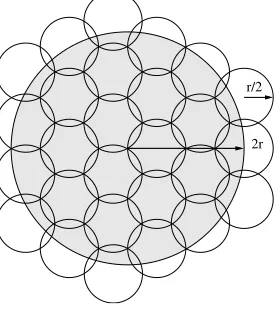
r/2
2r
Fig. 1:Illustration of Theorem 2.
Given that∆is the maximum degree ofG, a disk of radiusr/2contains at most∆ + 1nodes. (Notice that for a disk of radiusrthis is not necessarily true.) Then, there are at most27(∆ + 1)nodes inDv. So,
27(∆ + 1)colors are enough to ensure that all nodes inDvcan choose a different color. Given that nodes
choose a color in a round-robin fashion according to ID (thanks to the global synchronization achieved), after thensteps of the coloring phase all nodes have chosen a color.
Defining some ordering among the 27(∆ + 1) colors, the coloring provided defines a transmission schedule such that every node receives a message from each of its neighboring nodes every27(∆ + 1)
slots. Thus, the DRC problem is solved with delay27(∆ + 1)−1, which is asymptotically optimal given that, in the worst case, all nodes have∆neighbors and must receive a message from each of them. Given that all transmissions of every node are received by all of its neighbors within radiusr, the transmissions-overhead rate is0, which is optimal. Finally, given that aτ-adversary cannot recover crashed nodes, then
failures do not affect the recurrence on the communication protocol. 2
Theorem 3 Given a Sensor Network ofnnodes, upon being woken up by a∞-adversary, the protocol presented in Section 5 solves the DRC problem under an ∞-adversary with stabilization time at most
6n2+ 4nT+ 4n, whereTis the delay of theORCprotocol. The delay of this DRC protocol is54(∆ + 1)∈
O(∆)and the transmissions-overhead rate is27(∆ + 1)/n∈O(1).
Algorithm 3:DRCpseudocode for nodevunder∞-adversary.local-clockis the hardware node clock.
T is the delay of theORCprotocol.
1 initialization
2 setglobal-clockto0
3 setsyncedto false 4 setcolorto null
5 setavailable-colorsto{0,1, . . . ,27(∆ + 1)−1} 6 start tasks1and2concurrently
7 task1
// synchronization phase
8 whileglobal-clock<6n2+ 4nT andsynced=false once for each time slotdo 9 ifORC(v,local-clock) =transmitandglobal-clock≥6n2+ 2nTthen 10 transmit (global-clock,color,synced) with radius2r
11 incrementglobal-clock 12 setsyncedto true
// coloring phase
13 whilecolor=null once for each time slotdo
14 ifglobal-clock≡2v(mod 2n)andglobal-clock≥6n2+ 4nT+ 2nthen 15 setcolorto one of theavailable-colors
16 transmit (global-clock,color,synced) with radius2r
17 incrementglobal-clock 18 stop task2
// application phase
19 foreachtime slotdo
20 ifglobal-clock≡2v(mod 2n)then
21 transmit (global-clock,color,synced) with radius2r
22 ifglobal-clock≡(2color+ 1)(mod 54(∆ + 1))then 23 transmit (application-message) with radiusr
24 incrementglobal-clockmod 108(∆ + 1)n
25 task2
26 uponreception of(global-clock0,color0,synced0)from other nodedo 27 setavailable-colorstoavailable-colors− {color0}
28 ifnotsyncedthen 29 setsyncedtosynced’
30 setglobal-clocktomax{global-clock,global-clock0}
for this will be clear soon) followed by a period of2nsteps when nodes choose colors in a round-robin fashion using only even steps (w.r.t. global time). Nodes leave the coloring phase as soon as they get colored, but the whole2nsteps are needed for the node with IDn. Thus, the total stabilization time is at most6n2+ 4nT+ 4nas claimed.
The correctness of the coloring obtained can be proved as in Theorem 2. Defining some ordering among
used for application messages, every node receives a message from each of its neighboring nodes every
54(∆+1)slots. Thus, the delay of this protocol is54(∆+1)−1as claimed. Regarding the
transmissions-overhead rate, all transmissions of every node are received by all of its neighbors, i.e. there are no collisions. However, only the transmissions produced in the odd steps correspond to application messages. The transmission in even steps correspond to control messages. Then, for any nodev ∈ V running the application phase, the transmissions-overhead rate is the number of control messages transmitted byv
between any consecutive application messages transmitted byv, which are the same for any node, hence, the maximum. The rate of transmissions ofvdue to control messages is1/2n(see Algorithm 3). Whereas the rate of transmissions ofv due to application messages is1/(54(∆ + 1)). Then, the transmissions-overhead rate is27(∆ + 1)/n, which is inO(1)because∆< n.
To complete the proof, we consider now the impact of a nodev ∈ V that is woken up “late” with respect to the first node woken up in the network (global time). As shown in the proof of Theorem 1,
vis globally-synchronized seamlessly (beforevproduces any transmission) thanks to the waiting period of6n2+ 2nTsteps, as long as the already synchronized nodes keep transmitting the global time forever as done in Lines 10, 16, and 21 in Algorithm 3. Furthermore, it was proved in the same theorem that within at most6n2+ 4nTsteps aftervis woken up, it becomes synchronized (w.r.t. global time). After becoming synchronized,vwill produce transmissions in a round-robin fashion according to the protocol avoiding any collisions. After entering the coloring phase, thanks to the initial waiting period of2nsteps,
vupdates properly its set of available colors after receiving transmissions of all synchronized neighbors within distance2r. Thus, after at most4nstepsvhas been colored properly and has announced its color choice. Thus, the claimed stabilization time, delay, and transmissions-overhead rate also holds forv. Finally, notice that a node that fails and then rejoins the network can be considered as a node that is woken up “late”. Consequently, failures do not affect the behavior of the communication protocol. 2
6
Conclusions
In this work, the addressed problem is how to guarantee permanent communication between nodes in Sensor Networks. The proposed solution is a distributed deterministic protocol that works in two phases. The first phase provides the network with synchrony, while the second phase provides each node with a color, that determines its transmission schedule for its subsequent steady state. The protocol, in its strongest version, is designed such that it works no matter when nodes are awakened. Nodes that awake after the protocol started do not affect the progress already achieved by the protocol. Actually, those nodes, due to the design of the protocol, are able to recognize the present state of the computation and join the network seamlessly. It is proved that the introduced protocol achieves asymptotically optimal delay and constant transmission-overhead rate. Furthermore, since the proposed solution is deterministic, each node knows (or may know) its transmission and reception pattern. Therefore, every node can turn off their radio system when there is not a transmission or reception scheduled, and then achieve an efficient usage of energy.
reach such state may be too long for some applications. Therefore, a second open challenge is how to improve the initial phase in order to reduce the stabilization time. In fact, it is important to know what is the minimum time required for a network to reach an steady state with (asymptotically) optimal permanent communication in terms of delay minimizing transmission-overhead rate.
References
N. Alon, A. Bar-Noy, N. Linial, and D. Peleg. Single round simulation in radio networks.J. Algorithms, 13:188–210, 1992.
R. Bar-Yehuda, O. Goldreich, and A. Itai. On the time-complexity of broadcast in multi-hop radio networks: An exponential gap between determinism and randomization.J. Comput. Syst. Sci., 45:104–126, 1992.
M. Bienkowski, M. Klonowski, M. Korzeniowski, and D. R. Kowalski. Dynamic sharing of a multiple access channel. In J.-Y. Marion and T. Schwentick, editors,STACS, volume 5 ofLIPIcs, pages 83–94. Schloss Dagstuhl - Leibniz-Zentrum fuer Informatik, 2010. ISBN 978-3-939897-16-3.
A. D. Bonis, L. Ga¸sieniec, and U. Vaccaro. Generalized framework for selectors with applications in optimal group testing. InProc. of 30th Intl. Colloquium on Automata Languages and Programming, pages 81–96, 2003. B. Chlebus and D. Kowalski. A better wake-up in radio networks. InProc. 23rd Ann. ACM Symp. on Principles of
Distributed Computing, pages 266–274, 2004.
B. Chlebus and D. Kowalski. Almost optimal explicit selectors. InFundamentals of Computation Theory, 15th international symposium, volume 3623 ofLecture Notes in Computer Science, pages 270–280. 2005.
B. Chlebus, L. Ga¸sieniec, A. Lingas, and A. Pagourtzis. Oblivious gossiping in ad-hoc radio networks. InProc. of the 5th Intl. Workshop on Discrete Algorithms and Methods for Mobile Computing and Communications, pages 44–51, 2001.
B. Chlebus, L. Ga¸sieniec, D. Kowalski, and T. Radzik. On the wake-up problem in radio networks. InProc. of 32nd Intl. Colloquium on Automata Languages and Programming, pages 347–359, 2005.
B. S. Chlebus, D. R. Kowalski, and M. A. Rokicki. Adversarial queuing on the multiple-access channel. In Pro-ceedings of the Twenty-Fifth Annual ACM Symposium on Principles of Distributed Computing, pages 92–101, 2006.
M. Chrobak, L. Ga¸sieniec, and W. Rytter. Fast broadcasting and gossiping in radio networks. InProc. of the 41st IEEE Ann. Symp. on Foundations of Computer Science, pages 575–581, 2000.
M. Chrobak, L. Ga¸sieniec, and D. Kowalski. The wake-up problem in multi-hop radio networks. InProc. of the 15th Ann. ACM-SIAM Symp. on Discrete Algorithms, pages 992–1000, 2004.
A. Clementi, A. Monti, and R. Silvestri. Selective families, superimposed codes, and broadcasting on unknown radio networks. InProc. of the 12th Ann. ACM-SIAM Symp. on Discrete Algorithms, pages 709–718, 2001.
A. E. F. Clementi, A. Monti, and R. Silvestri. Round robin is optimal for fault-tolerant broadcasting on wireless networks.J. Parallel Distrib. Comput., 64(1):89–96, 2004.
A. Czumaj and W. Rytter. Broadcasting algorithms in radio networks with unknown topology. InProc. of the 44th IEEE Ann. Symp. on Foundations of Computer Science, pages 492–501, 2003.
J. Czyzowicz, L. Gasieniec, D. R. Kowalski, and A. Pelc. Consensus and mutual exclusion in a multiple access channel. In I. Keidar, editor,DISC, volume 5805 ofLecture Notes in Computer Science, pages 512–526. Springer, 2009. ISBN 978-3-642-04354-3.
L. Doherty, K. S. J. Pister, and L. E. Ghaoui. Convex optimization methods for sensor node position estimation. In
Proc. of the 20th IEEE International Conference on Computer Communications (INFOCOM), pages 1655–1663, 2001.
S. Dolev, S. Gilbert, R. Guerraoui, F. Kuhn, and C. Newport. The wireless synchronization problem. InProc. of the 28th Ann. ACM Symp. on Principles of Distributed Computing, pages 190–199, 2009.
A. Dyachkov and V. Rykov. A survey of superimposed code theory.Probl. Contr. Inform. Theor., 12(4), 1983. K. Fall. A delay-tolerant network architecture for challenged internets. InProceedings of the 2003 conference on
Applications, technologies, architectures, and protocols for computer communications, SIGCOMM ’03, pages 27–34, New York, NY, USA, 2003. ACM. ISBN 1-58113-735-4. doi: http://doi.acm.org/10.1145/863955.863960.
URLhttp://doi.acm.org/10.1145/863955.863960.
M. Farach-Colton, R. J. Fernandes, and M. A. Mosteiro. Bootstrapping a hop-optimal network in the weak sensor model.ACM Trans. Alg., 5(4):1–30, 2009.
A. Fern´andez Anta, M. A. Mosteiro, and C. Thraves. Deterministic communication in the weak sensor model. In
Proc. 11th Intl. Conf. Principles of Distributed Systems, pages 119–131, 2007.
A. Fern´andez Anta, M. A. Mosteiro, and C. Thraves. Deterministic recurrent communication in restricted sensor networks. INRIA RR 00486270, 2009.
A. Fern´andez Anta, M. A. Mosteiro, and C. Thraves. Deterministic recurrent communication and synchronization in restricted sensor networks. InProceedings of the 6th International Workshop on Algorithms for Sensor Systems, Wireless Ad Hoc Networks and Autonomous Mobile Entities (ALGOSENSORS), volume 6451 ofLecture Notes in Computer Science, pages 62–73. Springer-Verlag, 2010a.
A. Fern´andez Anta, M. A. Mosteiro, and C. Thraves. Deterministic recurrent communication and synchronization in restricted sensor networks. INRIA RR 00486277, 2010b.
M. G. Gouda and T. Herman. Stabilizing unison.Information Processing Letters, 35(4):171–175, 1990.
P. Indyk. Explicit constructions of selectors and related combinatorial structures, with applications. InProc. of the 13th Ann. ACM-SIAM Symp. on Discrete Algorithms, pages 697–704, 2002.
D. R. Kowalski. On selection problem in radio networks. InProc. 24th Ann. ACM Symp. on Principles of Distributed Computing, pages 158–166, 2005.
F. Kuhn, C. Lenzen, T. Locher, and R. Oshman. Optimal gradient clock synchronization in dynamic networks. In A. W. Richa and R. Guerraoui, editors,PODC, pages 430–439. ACM, 2010. ISBN 978-1-60558-888-9.
E. Kushilevitz and Y. Mansour. AnΩ(Dlog(N/D))lower bound for broadcast in radio networks.SIAM J. Comput., 27(3):702–712, 1998.
D. Liu and M. Prabhakaran. On randomized broadcasting and gossiping in radio networks. InAnn. Conference on Computing and Combinatorics, pages 340–349, 2002.
T. Locher and R. Wattenhofer. Oblivious gradient clock synchronization. In S. Dolev, editor,DISC, volume 4167 of
Lecture Notes in Computer Science, pages 520–533. Springer, 2006. ISBN 3-540-44624-9.
L. Pelusi, A. Passarella, and M. Conti. Opportunistic networking: data forwarding in disconnected mobile ad hoc networks. Communications Magazine, IEEE, 44(11):134 –141, Nov. 2006. ISSN 0163-6804. doi: 10.1109/ MCOM.2006.248176.
J. Schneider and R. Wattenhofer. What is the use of collision detection (in wireless networks)? In N. A. Lynch and A. A. Shvartsman, editors,DISC, volume 6343 ofLecture Notes in Computer Science, pages 133–147. Springer, 2010. ISBN 978-3-642-15762-2.