INTRODUCTION
Cefixime trihydrate (CEF) is an orally active third generation semi synthetic cephalosporin. Chemically, CEF is (6R,7R)- [(Z)-2-(2-aminothiazol-4-yl) -2-[(carboxymethoxy) imino] acetyl]amino]-3-ethenyl-8-oxo-5-thia-1-azabicyclo [4.2.0]pet-2-ene-2-carboxylic acid trihydrate, [Figure1.a] CEF is official in USP,1 BP,2 and EP.3Moxifloxacin (MOX)
(1-cyclopropyl-6-fluoro-1,4-www.orientjchem.org
Est. 1984
An International Open Free Access, Peer Reviewed Research Journal CODEN: OJCHEG 2012, Vol. 28, No. (4): Pg. 1743-1750
Simultaneous Estimation of Cefixime and Moxifloxacin in
Bulk and its Pharmaceutical Dosage form by RP-HPLC
G.S. DEVIKA
1*, M. SUDHAKAR
1and J. VENKATESHWARA RAO
21Department of Pharmaceutical Chemistry, Malla Reddy College of Pharmacy, Maissamaguda, Dullapally, Secunderabad -14, India.
2Departmentof Pharmaceutical Chemistry, Sultan Ul Uloom College of Pharmacy, Banjara Hills, Secunderabad - 500 034, India.
*Corresponding author E-mail: [email protected] (Received: October 15, 2012; Accepted: November 20, 2012)
ABSTRACT
A simple, efficient and reproducible reverse phase high performance liquid chromatographic method was developed and validated for the Simultaneous determination of cefixime (CEF) and moxifloxacin (MOX) in combined dosage form. Chromatographicseparationofthetwo drugswasperformedonaPurospherBDSC18 column(250mm×4.6mmid, 5µm particlesize). The mobile phase comprising of acetonitrile and 0.01M KH2PO4 in a ratio of 40:60 v/v at a flow rate of 1.0ml/min. The detection was made at 276 nm. The retention time of cefixime and moxifloxacin was found to be 3.140± 0.007min and 7.007± 0.006min. Calibration curve was linear over the concentration range of 20-120 µg/ml for both cefixime and moxifloxacin .All the analytical validation parameters were determined and found in the limit as per ICH guidelines, which indicate the validity of the method. The developed method is also found to be precise, accurate, specific, robust and rapid for the simultaneous determination of cefixime and moxifloxacin in tablet dosage forms.
Key words: Cefixime, Moxifloxacin, Method development and validation, RP-HPLC.
aeruginosa and Staphylococcus aureus7-8.The Innovative tablet combination of Cefixime trihydrate and moxifloxacin was recently approved by DCGI and CDSCO. The present investigation carried out on tablet mixture prepared from commercially available individual tablet dosage form of above mentioned drugs. Literature survey shows that various analytical methods have been reported for estimation of cefixime9-12 and moxifloxacin13-17 individually and combination with other drugs18-21. Only one UV-Visible Spectrophotometric method22 was reported for its simultaneous estimation. HoweverthereisnoRP-HPLC method reported for the simultaneous estimation of these drugs in combined dosage forms. In this communication, a simple, precise, reproducibleand accuratereverse-phase high performance liquid chromatographic method to estimate cefixime and moxifloxacin in tablet dosage for misreported.
MATERIAL AND METHODS Chemicaland Reagents
The gratis samples of Cefixime (CEF)and Moxifloxacin (MOX) were obtained from Alembic limited, Vadodara and Torrent Pharmaceutical Industries Ltd., Ahmedabad. HPLC grade water and acetonitrile were purchased from E.Merck (India) Ltd., Mumbai. Potassiumdi hydrogen phosphate and orthophosphoric acid of ARGrade were obtained from S.D. Fine Chemicals Ltd., Mumbai.The marketed tablet formulations Suprax®having 400 mg of CEF from Lupin, Mumbaiand Moxif®having 400mg MOX from TorrentPharmaceuticalIndustriesLtd., Ahmedabad were purchased from the local market.
Chromatographicconditions
Theanalysisofthedrug wascarriedoutona Waters HPLC systeme quipped with a reverse phase PurospherBDSC18 column (250mm ×4.6mmid, 5µm particlesize), 2695 binary pump, a20µl injection loop and a 2487dual absorbace detect or and running on Waters Empower software. Standard preparation
Standard stock solution
Standard stock solutions were prepared by dissolving separately 100 mg of each drug in
and phosphate buffer in the ratio of 40:60v/v to get concentration of 1000µg/ml.
Working standard solution
Working standard solutions were prepared by taking dilutions ranging from 20-120µg/ml for both CEF and MOX, respectively.
Validation of the method
The developed method was validated as per ICH guidelines[21] in terms of specificity, linearity, accuracy, precision, limits of detection (LOD) and quantification (LOQ) and system suitability. The accuracy was expressed in terms of percent recovery of the known amount of the active pharmaceutical ingredient in presence of excipients. The precision (%relative standard deviation, %RSD) was expressed with respect to the intraday and interday variation in the expected drug concentrations. Minor changes in pH of the mobile phase, flow rate, column temperature and detector wavelength were studied to evaluate the robustness of the developed assay method.
RESULTS AND DISCUSSION Optimization of the method
Table 1: System Suitability parameters
S. No Parameters Cefixime Moxifloxacin Acceptance criteria
1 Retention time 3.12 7.04
2 RSD of replicate injections 0.115 0.225 Not more than 2%
3 Asymmetric factor 1.16 0.92 Not more than 2
4 Theoretical plates 6178 5210 Not less than 3000
5 Resolution factor 7.41 More than 2
Table 2: Linearity Study
S.No Parameters Cefixime Moxifloxacin
1 Linearity range 20-120µg/mL 50-300 µg/mL
2 Slope 6273.7 8110.4
3 Intercept 6841.1 10790
4 Correlation coefficient(R2) 0.9996 0.9991 5 Limit of Detection 0.50 µg/mL 0.82 µg/mL 6 Limit of Quantification 2µg/mL 2.5µg/mL
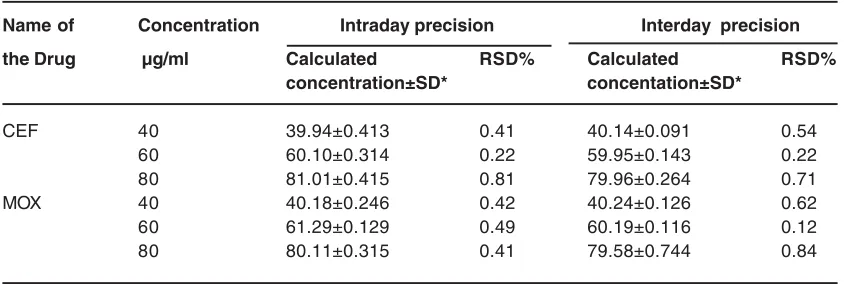
Table 3: Intraday and interday precision data for the quantitative determination of Cefixime and Moxifloxacin
Name of Concentration Intraday precision Interday precision
the Drug µg/ml Calculated RSD% Calculated RSD%
concentration±SD* concentation±SD*
CEF 40 39.94±0.413 0.41 40.14±0.091 0.54
60 60.10±0.314 0.22 59.95±0.143 0.22
80 81.01±0.415 0.81 79.96±0.264 0.71
MOX 40 40.18±0.246 0.42 40.24±0.126 0.62
60 61.29±0.129 0.49 60.19±0.116 0.12
80 80.11±0.315 0.41 79.58±0.744 0.84
*Average of six determinations
was3.140min and 7.001min, respectively. A typical chromatogram showing the separation of the drug is given in [Figure 2]
Method validation
The developed method was validated as per ICH guidelinesin terms of specificity, linearity, accuracy, precision, limits of detection (LOD) and quantification (LOQ) and system suitability. System suitability test
The system suitability test performed
according to ICH guidelines. The observed RSD values at 1% level of analyte concentration were well within the usually accepted values (≤ 2%). Theoretical plates, tailing factor, resolution between CEF and MOX were determined for both assay and dissolution. The results are all within acceptable limits summarized in [Table1].
Specificity
Table 4: Accuracy of the Method
Name of Amount Theoretical Conc.found Recovery RE RSD
the (%) of drug content (µg/ml)±SD* (%) (%) (%)
Drug added (µg/ml)
CEF 0 40 39.52±0.222 98.8 0.54 0.562
50 60 59.97±0.325 99.95 0.89 0.541
100 80 80.65±0.564 100.81 0.11 0.699
150 100 99.97±0.245 99.97 0.45 0.245
MOX 0 40 40.46±0.354 101.15 0.36 0.874
50 60 59.95±0.324 99.91 0.76 0.540
100 80 79.93±0.356 99.92 0.26 0.445
150 100 100.45±0.698 100.45 0.79 0.694
*SD= standard deviation(n=3),*RSD=SD/Mean×100,
RE(%)=%Relative Error =(Mean assayed concentration-Added Concentration/ Added Conentration×100)
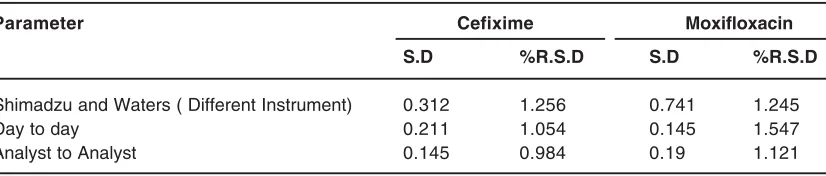
Table 5: Statistical data for Ruggedness
Parameter Cefixime Moxifloxacin
S.D %R.S.D S.D %R.S.D
Shimadzu and Waters ( Different Instrument) 0.312 1.256 0.741 1.245
Day to day 0.211 1.054 0.145 1.547
solution of 20 µg/mL was injected into the column, underoptimized chromatographic conditions, to demonstrate the separationo f both CEF andMOX from any of the impurities, if present. As the rewasno interference of impurities and also no change in there tention time,the method was found to be specificand also confirmed with theresults of analysis of formulation.
Linearity study
The peak areas of CEF and MOX were linear with respect to the concentrations over the range of 20-120µg/mL for both respectively. The slope and intercept value for calibration curve Y =6243.7X—6841.1 (R2= 0.9996) for CEF and 8110.4X—10790(R2= 0.9991) for MOX.The results showed that excellent correlation exists between peak area and concentration of the drugs within the concentration range indicated previously. The data was analyzed by “linear regression least squares fit”, and the parameters are listed in [Table2].
Limit of detection and Limit of quantification The linearity for CEF and MOX were performed from 20-120µg/ml. Linearity graph was plotted and the correlation coefficient (R2) determined. The limit if detection (LOD) was calculated from the linearity curve using the formula LOD= 3.3× {Residual Standard deviation/Slope}.
The LOD for CEF was confirmed to be 0.5µg/mL and for MOX it was confirmed to be0.82 µg/ml.
The Limit of quantification (LOQ) was calculated from the linearity curve using the formula. LOQ= 10× {Residual Standard deviation/Slope}
Precision
Intraday and Interday precision were evaluated by determining the corresponding responses three times on the same day and on 3 different days for CEF and MOX(40,60,80 µg/ ml).The results of intra- and inter-day variations are shown in [Table3]. The results obtained from intermediate precision also indicated a good method precision. All the data were within the acceptance criteria.
Accuracy
The accuracy of the method was determined by recovery experiments. It was confirmed by studying the recovery at three different concentrations, 50%, 100%,and 150% of those expected by spiking a previously analyzed test solution with additional drug standardsolutions, the analysis being done inreplicate. The %RSD and %relative error in allcases were within the acceptable limit (≤2%). Itis evident fromtheresults of accuracy study, reported in [Table 4] that the proposed method enablesvery accurate quantitative simultaneous estimation of CEF and MOX
Robustness and Ruggedness
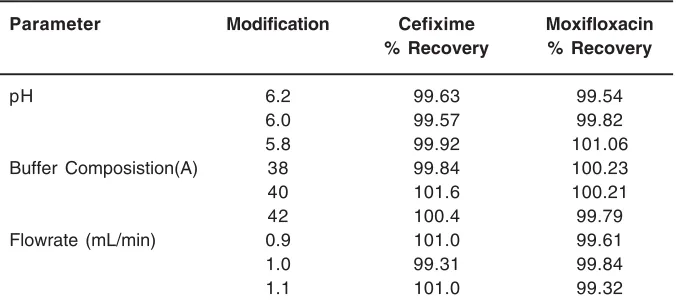
Robustness studies were carried out after deliberate alterations of flow rate and mobile phase compositions and pH. It was observed that the small changes in these operational parameters did not lead to changes of retention time of the peak interest. The degree of reproducibility of the results has proven that the method is robust and the data are summarized in [Table 5]. The ruggedness of the method was determined by carrying out the experiment on different instrument like Waters HPLC and Shimadzu HPLC and by two different operators using different columns of similar type like Phenomenex C18,HypersilC18 and the results were shown in [Table 6],the low RSD values confirms the ruggedness of the method.
Estimation of cefixime and moxepril in tablet dosage form
Twenty tablets of each brand Suprax® and Moxif®were weighed individually and ground to a fine powder. An accurately weighed powder sample equivalent to 100 mg of both CEF and MOX were transferred to 100 ml of volumetric flask
Table 6: Robustness testing of the method
Parameter Modification Cefixime Moxifloxacin
% Recovery % Recovery
pH 6.2 99.63 99.54
6.0 99.57 99.82
5.8 99.92 101.06
Buffer Composistion(A) 38 99.84 100.23
40 101.6 100.21
42 100.4 99.79
Flowrate (mL/min) 0.9 101.0 99.61
1.0 99.31 99.84
1.1 101.0 99.32
Table 7: Analysis of formulation
Drug Labeled amount(mg) Amount of mg/tab found* %Label claim %RSD
Cefixime 40 39.8 99.53 0.312
Moxifloxacin 40 40.21 100.02 0.115
Fig. 1: Structure of Cefixime trihydrate and Moxifloxacin
Fig. 2: Typical chromatogram of Cefixime and Moxifloxacin
anddissolvedin25mL of a 45:60 v/v mixture of acetonitrile and phosphate buffer. The contents of the flask were sonicated for 15 min and a further 25mL of the diluent was added, the flask was shaken continuously for 15 min to ensure complete solubility of the drug. The volume was made up with the diluent and the solution was filtered through a0. 45µ membrane filter.This solution was further diluted toget the required concentrations. The solution containing 40µg/ml was injected in to the column sixtimes. The average peak area of the drugs was computed from the chromatograms and the amount of the drug present in the tablet dosage form was calculated by using the regression equation obtained for the pure drug. The relevant results are furnished in[Table7].
CONCLUSION
REFERENCES
1. The United States Pharmacopoeia, 29/NF 24. The official compendia of standard Asian Edition, p. 1654(2007).
2. British Pharmacopoeia, British Pharmacopoeia Commission. Vol. 1. London: Her Majesty’s Stationary Office;.p.397.(2009) 3. European Pharmacopoeia, Council of Europe. 3rd ed. Strasbourg, France: EDQM Publications; p. 504(2000)
4. J. A. B. Balfour and L. R. Wiseman, Moxifloxacin, Drugs,57:363–374(1999). 5. BudavariS, eds, In;The MerckIndex.13thed.
Merck and Co., Inc; Ruchway USA; p.1125 (2001).
6. Ajay Patel, U.K. Jain, Nilesh Gupta and Ajay Raghuwanshi, Orient J. Chem., 26(2): 637-641 (2010).
7. Zhanel GG, Ennis K, Vercaigne L, et al. A critical review of the fluoroquinolones: focus on respiratory infections. Drugs.62: 13-59.(2002).
8. Karlowsky JA, Thornsberry C, Jones ME, Evangelista AT, Critchley IA, Sahm DF. Factors associated with relative rates of antimicrobial resistance among Streptococcus pneumoniae in the United States: results from the TRUST Surveillance Program (1998-2002). Clin Infect Dis 36:963-70.(2003)
9. Nahata MC. Measurement of Cefixime in serum and cerebrospinal fluid by high performance liquid chromatography. J Liq Chromatogr. 14: 3755–60(1991).
10. Hafiz Muhammad Arshad, Shahnaz Gauhar, Raheela BanoandIyad Naeem Muhammad., Development of HPLC-UV method for analysis of Cefixime in raw materials and in capsule. Jordan Jou of Pharm sci. 2: 53-65(2009)
11. Shah PB and Pundarikakshudu. K. Spectrophotometric, difference spectros copic and high performance liquid chromato graphic methods for determination of cefixime in pharmaceutical formulations. American Jou of Ana Chem. 89: 987-94 (2006).
12. Khaja Pasha,DrC.S Patil, Dr.K. Vijaykumar,
Dr.Sadath Ali andDr.V.B.Chimkod.,Reverse phase HPLC methd for determination of cefixime in Pharmaceutical dosage forms.Research J.Pharma.Bio.Chem.Sci: 3: 226-228 (2010).
13. Motwani SK, Khar RK, Ahmad FJ, Chopra S, Kohli K, et al. Application of a validated stability-indicating densitometric thin-layer chromatographic method to stress degradation studies on moxifloxacin. Anal Chim Acta.; 582: 75-82.(2007).
14. SA Shah, IS Rathod, BN Suhagia, MV Baladaniya An HPTLC method was developed and validated for the estimation of Moxifloxacin in its tablet formulation. Indian J Pharm Sci; 67: 112-115 (2005). 15. B. B. Ba, R. Etienne, D. Ducint, C. Quentin,
and M. C. Saux, Determination of moxifloxacin in growth media by high-performance liquid chromatography.Journal of Chromatography B,754: 107-112 (2001). 16. A. Laban-Djurdjeviæ, M. Jelikiæ-Stankov, and P. Djurdjeviæ.Optimization and validation of the direct HPLC method for the determination of moxifloxacin in plasma. Journal of Chromatography B, 844: 104–111 (2006).
17. Bilal Yibmaz, Vedat Akbar and Murat Cavus, Orient J. Chem., 27(4): 1337-1343 (2011). 18. Madhura V. Dhoka. Vandana T. Gawande,
Pranav P. Joshi. Simultaneous estimation of Cefixime Tr ihydrate and Erdostein in Pharmaceutical dosage form by using RP-HPLC. Int. Jou of Chem Tech Res. 2: 79-87 (2010).
19. M.K Kumudhavalli, Sandeep Sahu, K. Abhiteja, Dr.B. Jayakar. Development and validation of RP-HPLC Method for Simultaneous Determination of cefixime and potassium Clavulanate in tablet dosage form. International Journal of Pharma Recent Research. 2: 57-60 (2010).
Inter Jou of Pharm & Bio Arch., 1: 317-320 (2010).
21. H. Liang, M. B. Kays, and K. M. Sowinski, Separation of levofloxacin, ciprofloxacin, gatifloxacin, moxifloxacin, trovafloxacin and cinoxacin by high-performance liquid chromatography: application to levofloxacin determination in human plasma, Journal of Chromatography B,772: 53-63 (2002) 22. Ronak K. Patel, Rajesh R. Parmar,Vishnu M
Patel, Dushyant A. Method Development and Validation of Cefixime and
MoxifloxacinIn Pharmaceutical Dosage Form By UV Spectrophotometric Method.Int Jou Pharma Res and Bio-Sci: 2: 81-93 (2012) 23. ICH,Q2B,Validation of analytical procedures: Methodology, In proceedings of the International Conference on Hormonisation: Geneva, 1-8 (1996).