3965
Worksheet Development Design To Improve
Student Problem Solving Ability And Learning
Motivation
Ika Amirin, SuparmanAbstract: This study aims to develop the design of student worksheets with the CTL Approach to improve students' problem solving skills and learning motivation in Indonesia. This research is a development research with the ADDIE development model. The steps with the ADDIE development model include analysis, designing, developing, evaluating, and implementing. The subject of this study was second grade students of Muhammadiyah 3 Wates Vocational School, Indonesia. The object of this research is curriculum, student character in school, and evaluation of teaching materials. The data analysis technique used in this study uses data reduction, presentation, and conclusions. This study resulted in the results of the Student Worksheet needs analysis using the CTL approach that was in accordance with student characteristics, the curriculum used in the school, and the material and learning objectives to improve students' problem solving skills and learning motivation. The results of the design of the student worksheet consist of cover parts, Core Competencies, Basic Competencies, Competency Achievement Indicators, learning objectives, learning instructions, sample questions, and steps of activities as exercises. This research can be developed into the stages of development, implementation and evaluation.
Index Terms:Problem Solving Skill, Student Worksheet, Learning Motivation
—————————— ——————————
1 I
NTRODUCTION In the 21st century, problem solving abilities occupy important positions in life. One proof of the importance of problem solving skills is clearly seen in learning in schools [1-3]. Problem solving abilities are important in learning because problem solving skills are needed to build up new mathematical knowledge, to create many ideas, to solve the mathematics problems and another problems, to solve the problems with various problem solving strategies, to monitor and to reflect on mathematical problem solving processes [4-7]. In addition, problem solving abilities are also important in everyday life. In this era, technology development also requires high problem solving capabilities [8]. Learning that is done by utilizing problem solving algorithms not only increases students 'mathematical thinking skills, but also increases students' skills in the field of engineering which ultimately can increase their potential in the workforce [9]. As a result, students who have high problem-solving abilities will naturally get good achievements [9-10]. In addition to problem solving abilities, student learning motivation also plays an important role in learning. Efficient learning is very dependent on student learning motivation. [11]. A student's learning motivation is indicated by the desire for student participation in various learning and training activities [11]. Therefore, students who have high learning motivation have a higher ability to solve problems compared to students who have low learning motivation [12]. The results of observations conducted by researchers at Muhammadiyah 3 Wates Vocational School showed that existing learning resources were not maximally utilized.This is because the learning resources are not in accordance with the curriculum used. Learning resources do not include learning materials that are in accordance with Core Competencies/Basic Competencies. Learning resources for first grade class only contain some material that must be delivered in first grade class. In addition, the results of research that conducted in first grade class of Muhammadiyah 3 Wates Vocational School on Linear Program material gives information that first grade students of Muhammadiyah 3 Wates Vocational High School had problem solving skills and low learning motivation. This is indicated by: (1) Some students did not do the tasks that given by the teacher, (2) Some students are unable to make mathematical models, (3) Some students can make mathematical models, but they can not solve the questions given by the teacher, (4) No students can solve the questions correctly, and (5) Some students do not take part in the learning that directed by teacher. Linear Program material is appropriate if delivered with the Contextual Teaching and Learning Approach (Contextual Approach). This is because contextual learning connects the lesson material with the daily activities students in their family, community, environment, and the working world. So students can make connections between knowledge and their everyday life [13]. Eight components of contextual learning are: (1) making meaningful relationships; (2) free learning; (3) carrying out meaningful work; (4) work together; (5) critical and creative thinking; (6) help someone to grow and develop; (7) achievement with high standards; (8) use authentic assessment [14]. Meaningful learning will provide opportunities for students to solve their own problems. Learning resources are something that must be exist in learning activities in school. Without learning resources, learning activities will not be directed because they do not have clear standards. Moreover, if learning resources are available in schools, but the utilization of existing learning resources is not optimal. It also will not be effective to improve ————————————————
• Ika Amirin is currently pursuing master’s degree program in mathematics education in University Ahmad Dahlan, Indonesia • Suparman is an associate professor in mathematics at University of
3966 student learning skills, especially the ability to solve problems
and student motivation. One form of learning resources is the Student Worksheet. Student Worksheet consists of instructions and steps to complete the tasks that can built students conceptual understanding [15-16]. Indirectly, Student Worksheet can improve problem solving skills and low student motivation because students are given guidelines to solve the problems given. In this study, researchers used the ADDIE learning method. ADDIE learning methods are also used to design Student Worksheet to improve mathematical connection skills [17-18]. Furthermore, this research is used by researchers as the basis for using the ADDIE learning method in designing Student Worksheets to improve students' problem solving skills and learning motivation.
2
M
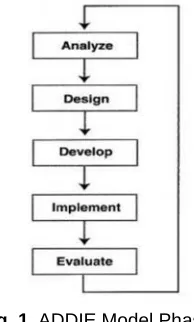
ETODSThis type of research is development research. The research method used in this study is ADDIE. The first phase used in this model is analysis, the second phase is design, the third phase is development, the fourth phase is implementation and tje last phaase is evaluation [19]. The research method used in this study can be seen in Figure 1.
Fig. 1. ADDIE Model Phase
In Figure 1 it can be seen that the ADDIE model phase consist of analysis, design, development, implementation, and evaluation. In the analysis phase, researchers analyze existing problems and determine student needs to solve existing problems. In the design phase, researchers design learning resources (Student Worksheets) that students need to improve students' problem solving skills and learning motivation with the CTL approach. At the development stage, Student Worksheets are presented in more detail. In the implementation phase, the researchers tested the product on a small scale. Finally, at the evaluation stage the researcher received feedback from the results of the trial. Next the researcher updates the worksheet according to the results of the feedback. The subjects of this study were second class students of Muhammadiyah 3 Wates Vocational School, teachers, material experts, and media experts. The instruments used in this study include validation sheets, tests, questionnaires, interview guide guidelines, and observation sheets. A validation sheet is destined to material experts and media experts. Tests are used to determine problem solving abilities before and after using Student Worksheets. This test
is used to determine whether there is an increase in students' problem solving abilities. Questionnaires are used to determine student learning motivation before and after using Student Worksheets. With this questionnaire it is known whether there is an increase in student motivation or not. Interview guidelines and observation sheets are used to determine the curriculum and character of students in the school. The data analysis technique used in this study is research that uses data reduction [20]. Data that obtained from observations and interviews are summarized and concluded. From the results of the analysis obtained a clear picture of the things that need to be done in the development of student worksheets. After data reduction, the next technique is presentation and conclusions.
3 R
ESULT ANDD
ISCUSSION 3.1 Analysis3967 worksheets that are arranged in simple language but can
provide more understanding to students
3.2 Preface
One of the parts that composes the Student Worksheet is the Preface. The Preface consists of 4 paragraphs. First paragraph contains thanks giving to God, second paragraph contains a gratitudes to the parties who have helped to finish the Student Worksheet, third paragraph contains apologies for all fraud, and the last paragraph contains expectations that Student Worksheet can be beneficial for all parties. The Preface can be seen in Figure 3.
Fig. 3. Preface
In Fig. 3 It can be seen that the Preface not only expresses gratitude to God and the people who helped the author in completing the Student Worksheet, but also apologizes for any shortcomings accompanied by descriptions that encourage others to read the Student Worksheet.
3.3 List of Content
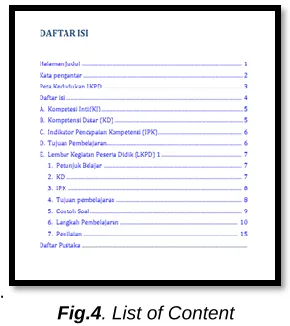
The purpose of the list of contents is to make it easier for students to find the material that they want to learn. The table of contents is arranged based on the page order in the Student Worksheet. The table of contents can be seen in Figure 4.
.
Fig.4. List of Content
In Figure 4 it appears that there are five core parts of the Student Worksheet compiled. The five sections are Core Competencies, Basic Competencies, Competency Achievement Indicators, Learning Objectives, and Student Worksheet. The Student Worksheet is divided into several part
of Student Worksheet, where each part of Student Worksheet contains Learning Guidelines, Basic Competencies, Competency Achievement Indicators, Learning Objectives, examples of questions, learning steps, and assessments on the part of Student Worksheet to be studied.
3.4 Core Competencies and Basic Competencies
The purpose of Core Competencies and Basic Competencies delivered in the Student Worksheet is to provide information to readers regarding the minimum abilities that must be possessed by students after studying the Linear Program material. Core Competencies and Basic Competencies that will be studied in general are presented in Figure 5.
Fig. 5. Core Competencies and Basic Competencies
In Figure 5 It can be seen that Core Competencies and Basic Competencies that must be mastered by students in the Linear Program material include knowledge and skills.
3.5 Competency Achievement Indicators and Learning Objectives
Student Worksheet contains the Competency Achievement Indicators as a minimum indicator that must be mastered by students. In addition, the Student Worksheet also included learning objectives after students studied the Linear Program with the CTL approach. Competency Achievement Indicators and Learning Objectives in general can be seen in Figure 6.
Fig. 6. Competency Achievement Indicators dan Learning Objectives
3968 same number as the proposed learning objectives. Three
points for knowledge and one point for skills.
3.6 Student Activity Sheet
The Student Activity Sheet contains general information, namely material, class/semester, and time allocation. In addition, the Student Worksheet also contains Learning Instructions, Basic Competencies, Competency Achievement Indicators, Learning Objectives, sample questions, learning steps, and assessment. Student Worksheet contains the learning syntax with the CTL approach because the Student Worksheet was developed using the CTL approach. In addition, the Student Worksheet was also developed by developing students' problem solving skills and learning motivation. The initial page of the Student Worksheet is shown in following Figure 7.
.
Fig. 7. First Student Worksheet
In Figure 7 it is known that First Student Worksheet contains Basic Competencies and Competency Achievement Indicators which will be studied in the Linear Program submersion. In Fig. 8 the following is known that First Student Worksheet also contains learning objectives and sample questions in the sub-material of the Linear Program.
Fig. 8. Learning Objectives and Question Example
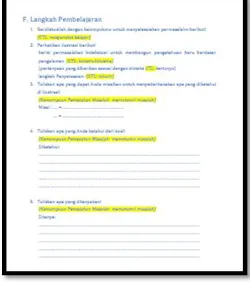
In Figure 8 it appears that in the question example it contains the CTL syntax in the form of modeling.At the Learning Step students can know the CTL learning syntax and indicators of problem solving abilities that are passed. Part of First Student Worksheet in the form of Learning Steps is presented in Figure 9.
Fig. 9. Learning Steps
In Fig. 7 it is known that the syntax of the CTL approach (learning society, constructivism, questioning, and inquiry) and problem solving abilities (understanding problems) are included in the learning step. Design this step of learning is realized on two pages. On the second page, the syntax of the CTL approach and indicators of problem solving ability are presented. The second page of this Learning Step is presented in Fig. 10.
Fig. 10. Authentic Assessment
In Figure 10 it is known that the Student Worksheet contains the syntax of the CTL approach (authentic reflection and assessment) and one indicator of problem solving ability (looking back). A good Student Worksheet requirement is to include a bibliography. In preparing the Student Worksheet, the compiler must use learning resources that are in accordance with the readability level of First Grade Class Vocational School students. The reading sources used as the basis for the preparation of the Student Worksheet are presented in Figure 11.
3969 In Fig. 11 submitted the Bibliography form which will be filled
with information about reading sources that form the basis of the preparation of the Student Worksheet. One of the abilities that will be improved after students use Student Worksheet is learning motivation. In this Student Worksheet Design indicators of student learning motivation are not included in writing such as indicators of problem solving abilities. However, indicators of learning motivation will be manifested in the appearance of attractive Student Worksheet designs so as to increase students' learning motivation. The Student Worksheet design that the author composed was then validated. Validation was conducted to find out how valid the design of the Student Worksheet was developed. The lattice of instrument design validation sheet can be seen in Table 1.
TABLE1
GRID OF DESIGN INSTRUMENT
Based on Table 1 it is known that there are five things that must be in the Student Worksheet design, including material, design, learning approach, and ability to be measured. Validation is carried out by experts. In this case the validator are Ms. Marlina Budi Wahyuni, S.Pd. as Teacher of Mathematics Subject of Muhammadiyah Wates High School and Mr. Adil Wicaksono, S.Pd as Teacher of Mathematics Subject of Muhammadiyah 3 Wates Vocational School. The comments and suggestions that the validator provides for the development of Student Worksheet are summarized in Table 2.
TABLE2
VALIDATOR COMENT
Based on comments and suggestions from the validator, the Student Worksheets was subsequently revised to obtain a valid and appropriate Student Worksheets to be used to improve students' problem solving skills and learning motivation. The eligibility criteria for the Student Worksheet design are assessed from the results of the questionnaire calculations by the material experts. The results of design validation calculations are shown in Table 3 below.
TABLE3
CALCULATION RESULT DESIGN VALIDATION
Based on Table 3, it can be seen that the average score of the Student Worksheet design is 32.5. So it can be concluded that the design of the developed Student Worksheet belongs to the excellent category.
4
C
ONCLUSIONThis study resulted in the design of Student Worksheets learning mathematics with the CTL approach to improve students' problem solving skills and learning motivation. The expected results are that students have high problem solving abilities and students can be motivated to learn mathematics, especially in linear program material. The results of this study are the revised Student Worksheet design according to the comments and suggestions given by the validator.
5
A
CKNOWLEDGMENTThank you, the authors, convey to all those who have helped the author in completing this paper, including friends of teachers who have taken the time to become Student Worksheet design expert validators.
6
R
EFERENCES[1] R. D. E. Prismana, T. A. Kusmayadi, & I. Pramudya, ―Analysis of difficulties in mathematics problem solving based on revised Bloom’s Taxonomy viewed from high self-efficacy,‖ In Journal of Physics: Conference Series, vol. 1008, no. 1, pp. 012-063, 2018. (IOP Publishing)
A. Muniroh, B. Usodo, and S. Subanti, ―Algebraic form Problem Solving Based on Student Abstraction Ability,‖ In Journal of Physics: Conference Series, vol. 895, no.1, pp. 1-8, 2017. (IOP Publishing)
[2] Karatas, and A. Baki, ―The Effect of Learning Environments Based on Problem Solving on Students’ Achievements of Problem Solving,‖ International Electronic Journal of Elementary Education, vol. 5, no. 3, pp 249-268, 2017. (Journal)
A. Kuzle, ―Patterns of Metacognitive Behavior During Mathematics Problem-Solving in a Dynamic Geometry Environment,‖ International Electronic Journal of Mathematics Education – IΣJMΣ, vol. 8, no.1, pp. 20-40, 2013. (Journal)
[3] S. A. Widodo. ―Development comic based problem solving in geometry,‖ International Electronic Journal of Mathematics Education, vol. 12, no. 3, pp. 233-241, 2017. (Journal)
[4] N. A. Dina, & S. M. Amin, ―Flexibility in Mathematics Problem Solving Based on Adversity Quotient,‖ In Journal of Physics: Conference Series, vol. 947, no. 1, pp. 012-025, 2018. (IOP Publishing)
[5] D. Yulianawati, L. Hasanah, & A. Samsudin, ―A case study of analyzing 11th graders’ problem solving ability on heat and temperature topic,‖ In Journal of Physics: Conference Series, vol. 1013, no. 1, pp. 012-042), 2018. (IOP Publishing)
3970 from Vygotskyian Social Constructivism to
Critical Thinking, Problem Solving and Siemens’ Digital Connectivism,‖ International Journal of Higher Education, vol. 3, no. 3, pp. 81-91, 2014. (Jurnal)
[6] R. G. Gabdrakhmanova, V. V. Utemov, and Z. S. Shavaliyeva, ―S. Malkin’s Algorithm of Inventive Problem Solving as an Instrument to Mastering Technical Systems in Supplementary Mathematical Education of School Students,‖ Mathematics Education, vol. 10. no. 3, pp. 189-198, 2015. (Jurnal)
A. Carmeli, R. Gelbard, and R.R. Palmon, ―Leadership, creative problem-solving capacity, and breative performance: the importance of knowwledge sharing,‖ Human Resource Management, vol. 52. no. 1. pp. 95–122, 2013. (Jurnal)
[7] S. R. Harandi, ―Effects of e-learning on students' motivation,‖ Procedia - Social and Behavioral Sciences, vol. 181, pp. 423 – 430, 2015. (Jurnal) [8] S. Harttati, Rukayah, S. Subiyantor, ―Influence of
contextual learning model and learning motivation in the ability to solve the comparison story,‖ International Journal of Multicultural and Multireligious Understanding, vol. 5, no. 3, pp. 159-166, 2018. (Jurnal)
A. D. Samo, Darhim, and B. G. Kartasasmita, ―Culture-Based Contextual Learning to Increase Problem Solving Ability of First Year University Student,‖ Journal on Mathematics Education, vol. 9. no. 1, pp. 81-94, 2018. (Jurnal)
B. Surya, F. A. Putri, and Mukhtar, ―Improving Mathematical Problem-Solving Ability and Self-Confidence of High School Students Through Contextual Learning Model,‖ Journal on Mathematics Education, vol. 8, no. 1, pp. 85-94, 2017. (Jurnal)
[9] K. Mahardika, A. Harijanto, and M. S. Winata. ―Fluid Dynamic Learning Assisted By Student Worksheet Based Rvm with Setting PBL,‖ The International Journal of Social Sciences and Humanities Invention, vol. 4, no. 8, pp. 3830-3833, 2017. (Jurnal)
[10]T. Akma and Suparman. ―The Design of Student Worksheet Problem Based Learning to Improve Problem Solving Ability of the Eighth-Grade Students Junior High School in Indonesia,‖ International Journal of Engineering & Technology, vol. 7, no. 4.30, pp. 11-15, 2018. (Jurnal)
[11]R. Handayani and Suparman. ―Design of Mathematics Student Worksheet based on Realistic Mathematics Education Approach to Improving the Mathematical Communication Ability Students of Class VII Junior High School in Indonesia,‖ International Journal of Engineering & Technology, vol. 7. no. 4.30, pp. 31-35, 2018. (Jurnal)
[12]R. N. Afifah and Suparman. ―Design of Student Worksheets based on Learning Cycle 5E Learning Model for VIII Junior High School Students in Indonesia,‖ International Journal of Engineering & Technology, vol. 7. no. 4.30, pp. 16-20, 2018. (Jurnal)
[13]M. Allen, ―Leaving ADDIE for SAM: An agile model for developing the best learning experiences,‖ American Society for Training and Development, 2012. (Book) [14]M. B. Miles, A. M. Huberman, and J. Saldana,