recrystallization
Thesis by
Abbas Davud Tutcuoglu
In Partial Fulfillment of the Requirements for the Degree of
Doctor of Philosophy
CALIFORNIA INSTITUTE OF TECHNOLOGY Pasadena, California
2019
© 2019
Abbas Davud Tutcuoglu ORCID: 0000-0003-2360-706X
ACKNOWLEDGEMENTS
The first time I visited Caltech was during the summer of 2014 when I was working on my Master’s thesis with Prof. Carmel Majidi at Carnegie Mellon University in Pittsburgh, PA. Almost five years later, in this thesis, I am summarizing the research I conducted both at Caltech, in the sunny state of California, and ETH Zurich, in the picturesque country of Switzerland. To get to this point, however, necessitated the continuous motivation and support from my colleagues, friends, and family.
First, I would like to thank Prof. Dennis Kochmann for the myriad opportunities he has granted me. As an advisor, he helped me to structure the way I am conducting research and provided essential feedback, guidance, and ideas. His course on continuum mechanics provided a profound basis, which assisted me throughout my studies. Finally, tasks such as the administration of the group server and the code repository allowed me to get substantial practical experience. I would also like to thank Prof. Kaushik Bhattacharya for the ideas shared with me in our meetings along with the invaluable feedback in the writing of my first contribution. Prof. Chiara Daraio’s and Prof. Guruswami Ravichandran’s suggestions during my candidacy in December 2017 led me to the topic of my second contribution for which I would like to express my gratitude. I thank the chair of my thesis, Prof. Michael Ortiz, for the feedback he gave Siddhant Kumar and me for our respective third contribution.
I always felt lucky to be part of a fun group of people that were continuously helpful, and that made coming to work on a Monday morning enjoyable. As pronounced proponents of a constructive feedback culture, I would like to guide particular gratitude to my former office mates and close friends, Bastian and Raphael. Research in computational solid mechanics is seldom the result of the work of one, and therefore I also thank Andrej, Greg, Siddhant, Vidyasagar and Yannick for stimulating discussions. Outside the lab, I would like to thank Jorge, Marcel, Vin, Amanda, Gautham, Magnus, Simon, Thomas, Maria and Arthur for more than three most delightful years. This collaboration was made possible through the support of the Army Research Laboratory under Cooperative Agreement Number W911NF-12-2-0022, for which I am deeply grateful.
ABSTRACT
Materials by designis a core driver in enhancing sustainability and improving effi-ciency in a broad spectrum of industries. To this end, thermo-mechanical processes and many of the underlying phenomena were studied extensively in the context of specific cases. The goal of this thesis is threefold: First, we aim to establish a novel numerical model on the micro- and mesoscale that captures dynamic recrys-tallization in a generalized framework. Based on the inheritance of the idea of state switches, we term this schemeField-Monte-Carlo Potts method. We employ a fi-nite deformation framework in conjunction with a continuum-scale crystal plasticity formulation and extend the idea of state switches to cover both grain migration and nucleation. We introduce physically-motivated state-switch rules, based on which we achieve a natural marriage between the deterministic nature of crystal plastic-ity and the stochastic nature of dynamic recrystallization. Using a novel approach to undertake the states-switches in a transient manner, the new scheme benefits from enhanced stability and can, therefore, handle arbitrary levels of anisotropy. We demonstrate this functionality at the example of pure Mg at room temperature, which experiences strong anisotropy through the different hardening behavior on the
hc+ai-pyramidal and prismatic slip systems as opposed to the basal slip systems as well as through the presence of twinning as an alternative strain accommodating mechanisms. Building on this generalized approach, we demonstrate spatial con-vergence of the scheme along with the ability to capture the transformation from single- to multi-peak stress-strain behavior.
recrystallization. For low temperatures, the Taylor model fails to replicate the nucleation-dominated recrystallization process, whereas, at high temperatures, it shows compelling agreement with experiments and the two higher-fidelity models both in terms of the homogenized stress-evolution and the microstructural evolution.
PUBLISHED CONTENT AND CONTRIBUTIONS
• A. Vidyasagar, A.D. Tutcuoglu, and D.M. Kochmann. Deformation patterning in finite-strain crystal plasticity by spectral homogenization with application to magnesium.Computer Methods in Applied Mechanics and Engineering, 335: 584 – 609, 2018. ISSN 0045-7825. doi: https://doi.org/10.1016/j.cma.2018. 03.003. URLhttp://www.sciencedirect.com/science/article/pii/ S0045782518301208.
A. D. T. participated in the development of the numerical methods.
• A.D. Tutcuoglu, A. Vidyasagar, K. Bhattacharya, and D.M. Kochmann. Stochas-tic modeling of discontinuous dynamic recrystallization at finite strains in hcp metals. Journal of the Mechanics and Physics of Solids, 122:590 – 612, 2019. ISSN 0022-5096. doi: https://doi.org/10.1016/j.jmps.2018.09. 032. URL http://www.sciencedirect.com/science/article/pii/ S0022509618303569.
A. D. T. developed the theory, performed numerical simulations and partici-pated in the writing of the manuscript.
• A.D. Tutcuoglu, Y. Hollenweger, A. Stoy, and D.M. Kochmann. High- vs. low-fidelity models for dynamic recrystallization in copper. Under review, 2019.
A. D. T. developed the theory, performed numerical simulations and partici-pated in the writing of the manuscript.
• A.D. Tutcuoglu, S. Kumar, Y. Hollenweger, and D.M. Kochmann. A multiscale meshfree approach to modeling ECAE. In Preparation, 2019.
TABLE OF CONTENTS
Acknowledgements . . . iii
Abstract . . . iv
Published Content and Contributions . . . vi
Table of Contents . . . vii
List of Illustrations . . . ix
List of Tables . . . xviii
Chapter I: Introduction . . . 1
1.1 Motivation . . . 1
1.2 Physical classification of recrystallization . . . 2
1.3 Numerical approaches to modelling dynamic recrystallization on the mesoscale . . . 6
1.3.1 Grain-homogenized methods . . . 7
1.3.2 Phase-field method . . . 9
1.3.3 Monte-Carlo Potts. . . 13
1.3.4 Cellular automata . . . 16
1.4 Modeling of thermo-mechanical processes on the macroscale . . . . 18
1.5 Outline of this thesis . . . 19
Chapter II: Stochastic modeling of discontinuous dynamic recrystallization using the Field Monte Carlo Potts Method – Application to Magnesium . 22 2.1 Introduction . . . 22
2.2 RVE-level constitutive model and discretization . . . 26
2.2.1 Finite-strain crystal plasticity continuum model . . . 26
2.2.2 Polycrystal response and FFT-based homogenization . . . . 30
2.3 A stochastic model for recrystallization . . . 33
2.3.1 Monte-Carlo-Potts model: probability of state switching . . 34
2.3.2 Monte-Carlo-Potts model: state switches. . . 36
2.3.3 Monte-Carlo-Potts model: Incremental realization of a state switch . . . 38
2.3.4 Alternative definitions of state switches due to GBM . . . . 41
2.4 Verification of the numerical scheme: Scaling and Convergence . . . 43
2.4.1 Scaling of the number of MCP sampling points with chang-ing grid size for GBM. . . 43
2.4.2 Scaling of the number of MCP sampling points with chang-ing grid size for NCL . . . 45
2.4.3 Dependence of the homogenized behavior on statistical MCP sampling . . . 46
2.5 Results: Microstructural evolution and resulting stress–strain re-sponse during ECAE . . . 47
2.6.1 Numerical temperature . . . 53
2.6.2 Critical nucleation and migration thresholds . . . 53
2.6.3 Number of MCP sampling points . . . 55
2.7 Discussion . . . 57
2.8 Conclusions . . . 59
Chapter III: Validation and comparison with computationally inexpensive alternatives – Application to Copper . . . 61
3.1 Introduction . . . 61
3.2 Crystal plasticity model for single-crystalline Cu . . . 65
3.3 Taylor model for polycrystalline Cu . . . 67
3.3.1 Theory . . . 67
3.3.2 Model calibration and convergence study without recrystal-lization . . . 70
3.3.3 Simulated material response with recrystallization . . . 73
3.4 Field Monte-Carlo Potts Models . . . 77
3.4.1 FMCP model for DRX . . . 77
3.4.2 FMCP model under the Taylor assumption (FMCP×Taylor) . 79 3.4.3 FMCP under full field simulation (FMCP×FFT) . . . 83
3.5 Discussion . . . 87
3.6 Conclusions . . . 90
Chapter IV: Modeling thermo-mechanical processes involving dynamic re-crystallization – Application to ECAE . . . 91
4.1 Introduction . . . 91
4.2 Max-ent and updated-Lagrangian . . . 96
4.3 Computational challenges in ECAE modeling . . . 100
4.3.1 Time integration . . . 100
4.3.2 ECAE process & boundary conditions . . . 103
4.3.3 Simulation protocol . . . 104
4.4 Results . . . 105
4.4.1 Convergence . . . 105
4.4.2 Strain homogeneity . . . 107
4.4.3 Reorientation excluding recrystallization effects . . . 109
4.4.4 Grain refinement . . . 110
4.4.5 Plunger force and homogenized energy evolution . . . 110
4.4.6 Reorientation including recrystallization . . . 113
4.4.7 Multipass . . . 114
4.5 Conclusion . . . 116
Chapter V: Conclusions & Outlook . . . 119
5.1 Summary . . . 119
5.2 Future directions . . . 120
5.2.1 Retrieving parameters from the lower scale . . . 121
5.2.2 Coupling the Field Monte Carlo Potts scheme to a vertex method . . . 122
5.2.3 Improved Taylor model . . . 123
LIST OF ILLUSTRATIONS
Number Page
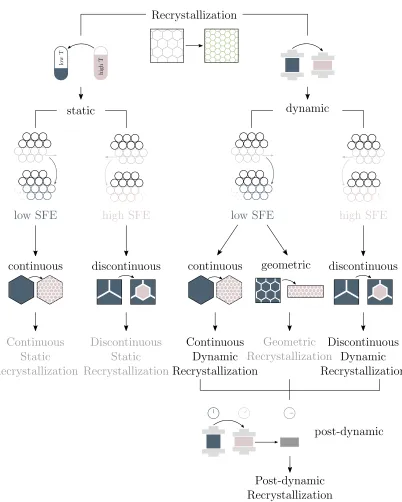
1.1 Categorization of recrystallization mechanisms. (i) Based on the processing conditions, recrystallization can be categorized into static (temperature-driven) and dynamic (simultaneous to loading) recrys-tallization. (ii) Furthermore, depending predominantly on material parameters such as the stacking fault energy (SFE), these two cate-gories can be sub-categorized into continuous (referring to the con-tinuous transformation of low-angle subgrain subgrain boundaries into high-angle grain boundaries), discontinuous (sudden nucleation of a grain endowed with a high-angle grain boundary), geometric (referring to the emergence of high-angle boundaries after the ini-tial grains’ smallest dimension reaches around two to three subgrain sizes) and post-dynamic (posterior to loading) recrystallization. . . . 3 1.2 Illustration of discontinuous and continuous dynamic
recrystalliza-tion. Initially, the deformation drives the generation and motion of dislocations. (a) During discontinuous dynamic recrystallization, this eventually causes local instabilities that allow for the emergence of pristine nuclei. Further deformation leads to the growth of these nuclei based on the favorable difference in stored energy compared to the surrounding plastically distorted grains. Simultaneously, new grains nucleate along the boundary of the initial grain and around the newly nucleated grains to form the necklace structure characteristic for discontinuous dynamic recrystallization. (b) In the case of contin-uous dynamic recrystallization, strain heterogeneity within the grains causes the evolution of subgrain structures equipped with low-angle grain boundaries. Continuous application of deformation ultimately allows these low-angle grain boundaries to transform into high-angle grain boundaries. . . 6 1.3 Illustration of a set of generalized interpretations concerning grain
1.4 Illustration of the phase-field method, including a depiction of the diffuse interface between grains as well as grain boundary migration and nucleation. . . 11 1.5 Illustration of the implementation of a Monte-Carlo Potts model in
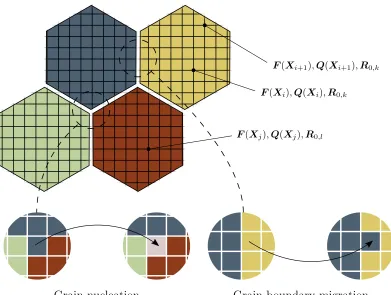
a finite deformations framework, including the interpretation of both grain boundary migration and nucleation through state-switches. . . . 15 2.1 Schematic overview of the presented model, which uses an extended
crystal plasticity formulation whose FFT-based discrete solution al-lows for the coupling to a Monte-Carlo-Potts description of recrys-tallization. . . 25 2.2 Schematic view of the state switch procedure: nMC,GBM MCP
sam-pling points are chosen from only those grid points adjacent to GBs, andnMC,NCLsampling points from allngrid points. For each chosen
grid point, possible options for state switches include the nucleation of a new grain (shown in yellow) or the adaption of the grain orienta-tion of one of the neighboring points across a GB. In the latter case, the current energyIof each chosen sampling point is compared to its energy ˜Iafter a possible state switch, by adopting the orientation of a neighboring grid point lying within an adjacent grain; the probability of switching depends on the energy difference E = I − I˜ . Shown is also the definition of volume element∆V and surface element∆S. . . 34 2.3 Acceptance threshold w as a function of the (normalized) energy
difference for various values of TS and ∆Ecr (normalized by some
reference temperatureTsr). . . 36 2.4 Visualization of the update process for NCL (a-c) and GBM (d-f):
2.5 Schematic illustration of the time stepping scheme: at each time step the RVE is equilibrated, internal variables are updated, andnMC
sam-pling points are checked for grain nucleation or migration. If either is initiated (step b from Figure 2.4), then the scheme of Figure 2.4 starts, including a gradual adjustment of Fe through adjusting Fr overn∗time steps. . . 39 2.6 Comparison of GBM for a newly nucleated grain (shown in blue)
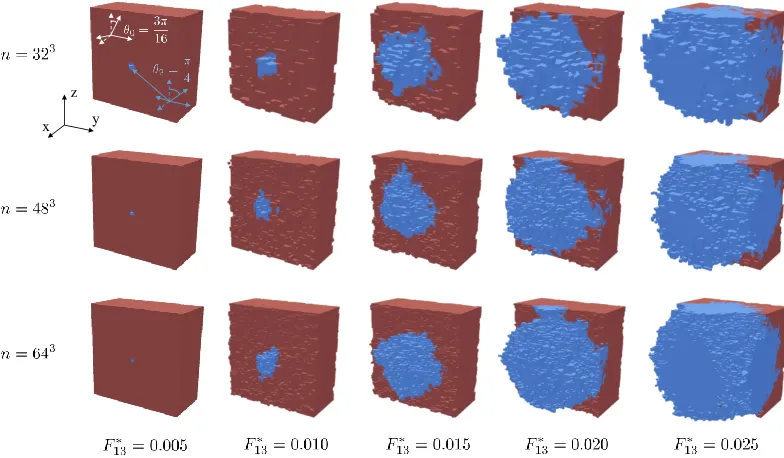
embedded within a bicrystal (only one of the two original crystals is shown in red) for n = 323 (top), n = 483 (center) and n = 643 (bottom), when using the scaling relations introduced in Section 2.3.1. The five snapshots capture different average strain levels, using the aforementioned simple shear setup. . . 44 2.7 Quantitative comparison of the volume and surface area of the newly
nucleated grain in Figure 2.6, demonstrating grid size-independent GBM kinetics across three different RVE discretizations with n = 323, 483, 643. . . 45 2.8 Comparison of the average shear stressP13∗ = hP13ivs. average shear
strain F13∗ forn = 323, 483, 643, using the scaling of the number of MCP sampling points withnas introduced in Section 2.3.1. . . 47 2.9 Evolution of the grain size distribution shown as histograms of RVE
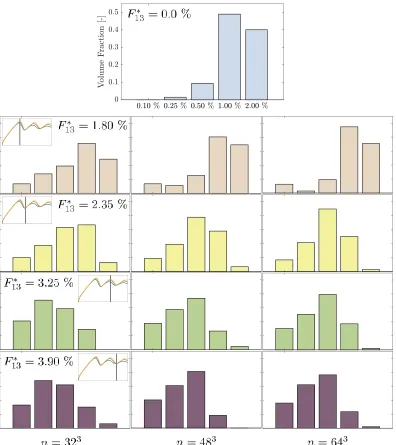
volume fractions of the grain volumes, thresholded by 0.10%, 0.25%, 0.50%, 1.0%, and 2.0% for average shear strain levels of 1.80% (red), 2.35% (yellow), 3.25% (green) and 3.90% (purple) as compared to the initial distribution (blue, on the top) for n = 323 (left), n = 483 (center) andn= 643(right). . . 48 2.10 Illustration of the (negligible) influence of the random seed used for
MCP sampling point selection under otherwise identical conditions including the same initial microstructure comprising 128 grains with two misorientation ranges of thec-axis with respect to the[101]-pole, viz. π/16 (top) andπ/8 (bottom). Each set of four curves corresponds to four repeated runs (we have computed relative errors with respect to a fifth run whose homogenized stress levels are referred to ashP13† i). 49 2.11 Evolution of the P13∗ = hP13ishear stress vs. the applied shear strain
2.12 Evolution of the P13 shear stress distribution at the ten strain levels
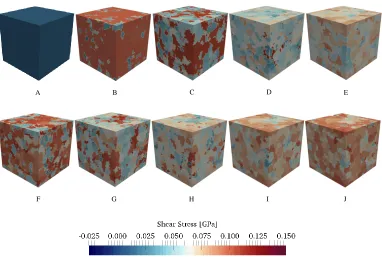
marked in Figure 2.11. The initiation and completion of each recrys-tallization wave agrees well with the, respectively, highest and lowest stresses found across the RVE. . . 51 2.13 Evolution of the grain distribution, shown at the strain levels marked
by points A through J in Figure 2.11: the color code emphasizes the microstructural evolution from the initial grain structure (gray) through a first recrystallization wave (new grains shown inred) and a second recrystallization wave (new grains in blue). The observed recrystallization waves correlate well with the stress–strain behavior of Figure 2.11. . . 52 2.14 Evolution of the inelastic strain energy density Wsl + Wtw at the
ten strain levels marked in Figure 2.11. Each recrystallization wave relates to a decrease in the accumulated stored energy density through the nucleation and growth of grains. . . 53 2.15 Evolution of volume fraction of recrystallized material as obtained
from the simulations in Section 2.5, shown both on a linear (left) as well as on a double-logarithmic scale (right) with three representative slopes pcomputed att−tRX =100s, 300s, 750s. . . 54
2.16 Influence of variations in the simulation temperatureTSon the multi-peak stress–strain behavior. . . 55 2.17 Effects of variations in ∆Ecr,NCL and ∆Ecr,GBM on the homogenized
stress–strain behavior (all energy densities given in units of GPa). Unless otherwise indicated, we used the critical energy thresholds listed in Table 2.2. . . 56 2.18 Effects of variations in nMC,NCL and nMC,GBM on the homogenized
stress–strain behavior for highcritical energy thresholds ∆Ecr,NCL =
−10−3Jm−3and∆Ecr,GBM =−6·10−4Jm−3, and in like mannerlow
critical energy thresholds∆Ecr,NCL =−5·10−4Jm−3and∆Ecr,GBM =
−10−4Jm−3. . . 57 2.19 Evolution of the temperature-dependent single-to-multi-peak
3.1 Illustration of the optimized fitting process for informing high-fidelity models through computationally inexpensive models. . . 64 3.2 Homogenized stress-strain behavior for a uniaxial compression test up
to 100% true compressive strain in 100,000 load steps for grain counts of 10 (blue), 50 (orange), 100 (yellow), 200 (red), and 1000 (green) and temperatures of 725 K (left), 775 K (right), and 875 K (bottom). Each data point is based on 100 repetitions with each run charac-terized by a different random initial texture. The one-sigma stress band correspond to the interval around the mean (emphasized using solid lines) with a total width of two standard deviations. Results are compared to experimental data (dashed) from Blaz et al. [18]. (We note that results are plotted up to slightly different maximum strain levels for better differentiability.). . . 71 3.3 One-sigma band of the true compressive stress vs. true compressive
strain as obtained from our Taylor model with DRX (averaged over 200 random initial textures), compared to experimental data from Blaz et al. [18] (dashed) and numerical results from Mellbin et al. [110] (dash-dotted) forT ∈ {725,775,875} K. . . 73 3.4 Evolution of the non-recrystallized volume fraction for all initial
grains (solid line) and for all grains nucleated within the outlined ranges of strains (dashed lines) for temperatures of 725, 775 and 875 K. The initial average grain diameter is at 78 µm in the exper-iments. The experimental and numerical final average diameter at 875 K lie at 34 µmand 30µm, respectively. Blue crosses for 775 K denote the experimentally estimated fraction of material that has not yet undergone recrystallization. . . 74 3.5 Pole figures of the [111]-pole forT ∈ {725, 775, 875} K with point
sizes scaled by the respective grain volume fractions at five different true compressive strain levelsεtrue. Colors indicate initial grains (red)
and grains nucleated up to a true compressive strain of 25% (bright-blue), 50% (purple), 75% (dark-(bright-blue), and 100% (bright-green). . . . 76 3.6 Stress evolution captured by the FMCP×Taylor model including
3.7 Volume fraction evolution of recrystallization waves defined in 20 % true strain intervals for T ∈ {725 K,775 K} including and ex-cluding surface contributions to the energetic nucleation criterion in the FMCP×Taylor model. Crosses correspond to the estimated data from the experimental microstructure evolution at 775 K reported by Blaz et al. [18]. Also reported in the diagrams are predicted average grain diameters based on average grain volume fractions and the total volumeV0we have introduced before. . . 81
3.8 Illustration of the difference in migration behavior due to necklace formation as obtained from the FMCP models and the Taylor model. Once a nucleated grain (green) is surrounded by newly nucleated grains (red), that grain experiences an impediment to GB migration despite a possibly lower energy state compared to the original grains (white). On the contrary, in the Taylor model (c.f. Section 3.2) a nucleated grain will grow as long as its energy density is lower than the unweighted average energy density (see (3.15)) without any constraint from neighboring grains. . . 82 3.9 Evolution of the σ33 distribution over the deformed RVE across five
true strain levels for a) 10 grains, b) 200 grains as well as c) 200 grains including recrystallization. We amplifiy local deviations from the affine deformation by a factor of 100 for visualization purposes. . 84 3.10 Mean stress evolution from 20 RVE realizations of the FMCP×FFT
model (solid) compared to experimental data from Blaz et al. [18] (dashed). Conducted with the original values for Q and G0 from
3.11 Pole figure of the h111i-pole family for 725 K (top) and 775 K (bottom), illustrated using a de la Vallée Poussin orientation dis-tribution function). We display the pole data from FMCP×FFT simulations at five different levels of true compressive strain, viz. εtrue ∈ {−0.2,−0.4,−0.6,−0.8,−1.0}, and complement them by the
corresponding pole data for the Taylor model at true = −1.0 for
comparison. The shown intensities (with blue and yellow values cor-responding, respectively, to the minimum and maximum intensities) were obtained by weighting the orientation associated with (i) each grid point by 1/nin the FMCP model and (ii) each grain by its volume fraction in the Taylor model. . . 86 3.12 Tracking the misorientation of the[111]poles with the compression
axis within a large grain inside the RVE (shown as two bodies due to the periodic boundary conditions) reveals the formation of two subgrains within the grain. The colors of the transparent grains do not refer to the misorientation – they solely represent different grains. 87 4.1 Illustration of the vertical homogenization framework coupling
max-ent at the macroscale with the Taylor model at the mesoscale and a crystal plasticity model on the subgranular microscale. . . 95 4.2 Illustration of the influence ofβon the support of the shape functions.
We randomly generated 7000 nodes in a two-dimensional space and endowed each one with a shape functionNaas per (4.6). The column at each node corresponds to the value of the associated shape function at x = (0,0)T. The different choices in β reflect growing levels of anisotropy starting from an isotropic approximation in (b) to a severely anisotropic representation in (c). . . 98 4.3 Illustration of the differences between the total- and the
updated-Lagrangian formulation using the example of ECAE. Nodes and ma-terial points are visualized by black and red points, respectively. In the total-Lagrangian setting (dashed), the total deformation gradi-entFn+1is a mapping from the initial configuration to the deformed
configuration, while the updated-Lagrangian setting interprets Fn+1
4.4 Illustration of the time-integration on the macro-, meso- and mi-croscale. We note, that subscripts denoting the association of a grain with a macroscale point were omitted everywhere but in the descrip-tion of the first step in favor of improved readability. . . 102 4.5 Schematic depiction of the initial configuration of the billet along with
boundary conditions and dimensions. We used Dirichlet boundary conditions for imposing the plunger displacement (1) and to constrain the nodes on all surfaces with normal parallel to the in-plane z-component as well as the walls above the chamfers (2). Further, we modelled the outer and inner chamfer with dimensions w1 and w2,
respectively, using wall potentials. Wall potentials also describe the lower and upper wall past the bend (3). . . 105 4.6 Temporal convergence as depicted via four different timestepsdt
ex-cluding recrystallization. For comparison, we also provide the energy evolution for the case that includes both migration and nucleation ca-pabilities. . . 107 4.7 Illustration of the deformation of the billet via the displacement of
nodes (red) and material points. The coloring of material points scales with the local in-plane shear strainF12. TheF12distribution is
further illustrated using a 2D view on the xy-plane at z = 0.5 based on an interpolation using radial-basis function kernels (rbf) attmax/2
andtmax. . . 108
4.8 Reorientation evolution of the h111i pole family illustrated via a stereographic projection onto the (001)-plane at 0, tmax/4, tmax/2,
3tmax/4, andtmax. The blue and yellow labels next to each pole figure
represent, respectively, the minimum and maximum intensity. The reorientation evolution in each of the three columns labelled A, B and C correspond to the associated material points marked in the leftmost column. This analysis excludes recrystallization. . . 111 4.9 Interpolation of the distribution of the average grain volume across
the z = 0.5 plane using radial-basis function kernels (rbf) attmax/2
andtmax. . . 112
4.11 Reorientation evolution of theh111ipole family illustrated via a stere-ographic projection onto the (001)-plane at tmax/4, tmax/2, 3tmax/4,
andtmaxfor scenarios excluding (top) and including (bottom)
recrys-tallization effects. The blue and yellow labels next to each pole figure represent, respectively, the minimum and maximum intensity. The pole figures correspond to the current orientation of all grains at the material point marked in red.. . . 115 4.12 Evolution of the material points during a multipass idealizing a 180◦
turn including the impact on the texture and of theh111ipole family in stereographic projection onto the (001)-plane at tmax/8, tmax/4,
3tmax/8, tmax/2, 5tmax/8, 3tmax/4, 7tmax/8, andtmax. The blue and
LIST OF TABLES
Number Page
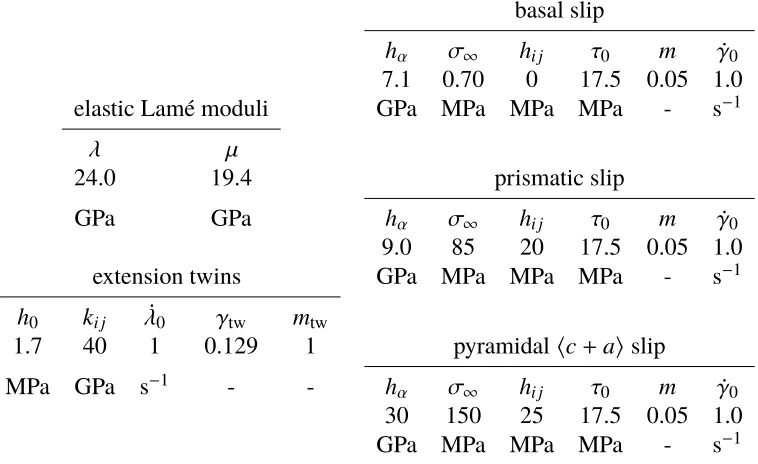
2.1 Material parameters used in the extended crystal plasticity model for Mg after Chang and Kochmann [26]. We note that parameter τ0,
the critical resolved shear stress, has been modified from the original model, since we used the formulation of Chang and Kochmann [26] in an implicit context, whereas here we use an explicit formulation that does not suffer from numerical complications by introducing a hard threshold into the rate-dependent model (c.f. Chang et al. [27]). . 31 2.2 MCP model parameters chosen for the subsequent simulations of
dynamic recrystallization, unless otherwise noted. . . 36 3.1 Parameters defining the Cu material model introduced in Section 3.2
as well as the two recrystallization constants from Sections 3.3 and 3.4. 68 3.2 Further parameters used for the Taylor, the FMCP models (both
FMCP×Taylor and FMCP×FFT). . . 82 3.3 Difference in computational expenses for one simulation at 725 K,
using 24 physical cores and description of the flow for the reduced-order based parameter fitting. . . 89 4.1 Macroscale parameters defining the geometry, boundary conditions,
and the meshfree solver. Variables marked with a†refer to variables normalized with respect to length. For a description of the shape function cut-off tolerance cut and the initial connectivity cut-off
re-gion Mp
C h a p t e r 1
INTRODUCTION
1.1 Motivation
formability. This illustrative example demonstrates the difficulty in tailoring certain classes of metals. The example also emphasizes the need mentioned above for a numerical framework on the micro- and macro-scale to gain a better understand-ing of the evolution of grain size and texture, which can then be used to optimize processing routes.
1.2 Physical classification of recrystallization
For certain classes of metals – including iron, titanium, cobalt, and their respective alloys – the restructuring of the microscale is possible by inducing phase transfor-mations through cooling [35]. This method does, however, not apply to copper, nickel, and aluminum as well as their alloy derivatives. Here, a complete change of the microstructure – in the sense of both modified average grain size and shape – is only possible after deformation through a process termed recrystallization. Do-herty et al. [35] define recrystallization as "the formation and migration of high angle grain boundaries driven by the stored energy of deformation", where high angle boundaries are generally defined through a misorientation of at least 10-15◦ [35,60,68].
Occurring at higher loading rates,dynamic recrystallization1emerges from the com-petition between recrystallization and continued plastic deformation such as during equal channel angular extrusion. Similar to static recrystallization, we further cat-egorize dynamic recrystallization based on the microstructural processes into two main subcategories. Generally present in high-stacking-fault-energy metals such as aluminum, continuous dynamic recrystallizationdescribes the gradual transfor-mation of subgrain structures formed from dislocation networks into new grains, resulting in grain refinement [14,56,167].
Discontinuous dynamic recrystallizationdescribes the process ofgrain nucleation at high-energy sites and the subsequent grain growth bygrain boundary migration [30, 42, 43], which predominantly occurs in metals with low to medium stacking fault energy such as copper [9, 18,50] or magnesium [144]. While it is generally acknowledged that the reduction of stored elastic and plastic strain energy density [155,169] drives nucleation, the exact criterion for the onset of nucleation remains a subject of debate: [144,164] propose a critical dislocation density ansatz which pos-tulates that nucleation is only possible if the local dislocation density surpasses this critical threshold. Other reports concentrate on a critical (plastic) strain [28, 30] or a critical inelastic strain energy density [110], instead. As a competing mechanism, the difference in stored strain energy between neighboring grains with differing plastic histories [60,68] results in the migration of grain boundaries. Thus, discon-tinuous dynamic recrystallization involves the interplay between three phenomena – severe plastic deformation of a polycrystal, grain boundary migration, and grain nucleation. The availability of active recovery processes explains the dependence of dynamic and static recrystallization on the stacking fault energy. Atomic lattices endowed with a high stacking-fault energy generally allow recovery processes, such as dislocation climb, to act sufficiently fast and to keep the dislocation density or the inelastic strain energy density below the threshold mentioned above. In low-to-medium stacking fault metals, however, this recovery process is relatively slow compared to the accumulation and motion of dislocation, which ultimately requires the discontinuous nucleation of a pristine grain to attain a thermodynamically stable state. The general perception sees continuous and discontinuous dynamic recrys-tallization as the main recrysrecrys-tallization processes co-occurring with deformation. Figure 1.2 illustratively summarizes the underlying physics, while Doherty et al. [35], Hallberg [60], Huang and Logé [68], Sakai et al. [144] provide in-depth
re-1Note thatdynamicrefers to the fact that the recrystallization mechanisms occur during continued
views of the respective fields.
Owing to its relatively late discovery,geometric recrystallizationhas – to this point – experienced the least attention among the three dynamic recrystallization types, both from an experimental and a numerical point of view (see,e.g., Sakai et al. [144]). Observed at high strains, it describes the grain-refinement through the formation of equiaxed grains with high-angle grain boundaries during hot deformation [68]. The origin of these new grains lies in the elongation of the original grains and the simultaneous generation of local serrations due to a pronounced subgrain structure. Despite little influence at small strains, these serrations allow for the formation of new grain boundaries endowed with high angle misorientations as high angle boundaries belonging to the original grains approach each other. This transformation into a new microstructure is observable around the time when the thickness of the elongated grains reaches around one to two times the size of a subgrain [68].
Figure 1.2: Illustration of discontinuous and continuous dynamic recrystallization. Initially, the deformation drives the generation and motion of dislocations. (a) Dur-ing discontinuous dynamic recrystallization, this eventually causes local instabilities that allow for the emergence of pristine nuclei. Further deformation leads to the growth of these nuclei based on the favorable difference in stored energy compared to the surrounding plastically distorted grains. Simultaneously, new grains nucleate along the boundary of the initial grain and around the newly nucleated grains to form the necklace structure characteristic for discontinuous dynamic recrystalliza-tion. (b) In the case of continuous dynamic recrystallization, strain heterogeneity within the grains causes the evolution of subgrain structures equipped with low-angle grain boundaries. Continuous application of deformation ultimately allows these low-angle grain boundaries to transform into high-angle grain boundaries.
physics behind precipitation and solidification is therefore out of scope.
1.3 Numerical approaches to modelling dynamic recrystallization on the
mesoscale
we note that those three methods do not exhaust available recrystallization models. We merely based our choice on their impact on the field as well as their contributions to this work. Hallberg [60] provides a general review on methods including cellular automata [11, 55, 127, 191], vertex methods [110, 152], and the level-set method [15, 37]. Sakai et al. [144] and Huang and Logé [68] further complement this contribution by a more in-depth physical analysis of recrystallization including a summary of numerical developments2.
1.3.1 Grain-homogenized methods
Numerous methods build on the assumption that the entire entity of a grain can be deprived of the notion of space and summarized through a homogenized set of states. We refer to this set of schemes asgrain-homogenized methods. Although the various approaches that belong to this category differ significantly from one to another, the set of states usually comprises a volume fractionηi∈{1,...,Ng}, a set of internal variables
Qi∈{1,...,Ng}as well an orientation tensorRi∈{1,...,Ng}or a related measure which allows distinguishing grains. Based on the viscoplastic self-consistent model [181, 182] – which affords a compromise between the Taylor model [168] (upper bound on stress) and the Sachs model [140] (lower bound on stress) – the scheme presented in Wenk and Tomé [183] realizes grain migration through a time-evolution law of the volume fraction. Assuming a linear dependence on the difference between the energy of a grain and the system’s average energy, they postulate a the volume fraction rate through
∂ηi
∂t = −κGBM
©
«
Wi− 1
Ng
Ng Õ
i=1 Wiª
®
¬
η2/3
i , (1.1)
with migration rate coefficient κGBM and grain-specific stored energy densityWi. The scaling of the change in volume fraction by its volume fraction raised to the power of 2/3 hinges on the assumption of a spherical growth of the associated grain boundary area. Although this is a reasonable assumption during the growth stage of a nucleus, it is not representative of a grain’s consumption by its surrounding grains, as shown in analyses of Adam et al. [1]. We note that thead-hocevolution principle from (1.1) requires normalization of all grains by the total volume. Further, every
2We note that the nomenclature we use in this section may differ significantly from the ones employed
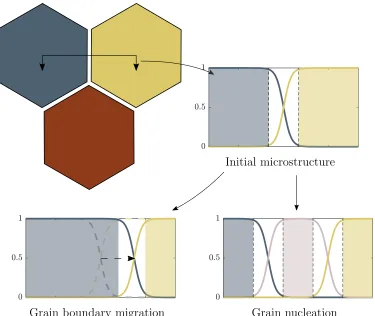
Figure 1.3: Illustration of a set of generalized interpretations concerning grain boundary migration and grain nucleation in the framework of grain-homogenized methods such as the one presented in Wenk and Tomé [183].
grain entails a parent and a recrystallized volume fraction viaηi =ηi,par ent+ηi,nucleus, withηi,nucleusinitially set to 0. The nucleation criterion is deterministic and occurs as soon as the equivalent strain reaches a threshold. At this point, ηi,nucleus is set to the size of a nucleus at the expense of ηi,par ent. The size of a nucleus varies linearly with the grain’s size as well as the equivalent strain rate. ηi,nucleus then evolves according to (1.1) with the nucleus being at zero accumulated energy since, by design, it does not harden. The orientation of the nucleus is set to the orientation of the parent grain. Asηi,nucleusreaches a specific fraction ofηi,par ent, the nucleated volume fraction is transferred into the original volume fraction of the parent grain, which updates the inelastic strain accordingly.
Figure1.3 illustrates the main idea of migration and nucleation in the framework of a grain-homogenized method, such as the one presented in Wenk and Tomé [183]. Although this type of model allows the inclusion of both nucleation and grain growth, the lack of spatial resolution causes various challenges:
growth in a phenomenological fashion to include the additional surface area due to the subgrains in the nucleation model for discontinuous dynamic re-crystallization. The growth of grains again appears in linear dependence to the change in stored energy without any information on the surface area. However, the component of the subgrain growth stemming from capillary effects is inversely proportional to the grain boundary area, thus effectively penalizing subgrains endowed with a large surface. The necklace-formation characteristic for discontinuous dynamic recrystallization (see, e.g., Huang and Logé [68]) is another phenomenon that models of this class in general do not capture due to the lack of a notion of space.
• To this point, models that fall into this category tend to isolate their analysis on specific parts of dynamic recrystallization without trying to capture dynamic recrystallization as a whole. While Wenk and Tomé [183] managed to verify experimental findings from Zhang and Karato [196] concerning the qualitative influence of recrystallization onto texture evolution, the nature of their nucle-ation model forbade the capturing of any realistic grain refinement. Although the notion of a homogenized stress does exist in their model, they provide no information concerning its evolution, and it is likely that thead-hocstructure did not permit the replication of experimental stress evolutions. The work of Cram et al. [30] – which replaced the viscoplastic self-consistent model from Wenk [181, 182] by an iso-work-increment assumption [19] – allowed recovering experimental results concerning the evolution of grain refinement and stress with a satisfactory agreement. However, lacking the explicit notion of a grain rotation, they could not track texture evolution.
1.3.2 Phase-field method
Among the methods that attracted most attention in the modeling of recrystallization stands the phase-field method [28, 113, 155, 197, 198]. In this approach, each one of the Ng grains is associated with a continuous order parameter ηi∈{1,...,Ng} :
[0,tmax] ×Ω → [0,1]defined throughout the time interval[0,tmax]and across space in the form of a representative volume element (RVE) Ω. The order parameter
andηk∈{1,...,Ng}/{i,j} = 0. The phase-field method further imposes
Ng Õ
i=1
ηi(t,X)=1 ∀t ∈ [t,tmax],X ∈Ω. (1.2)
A general form for the total energy stored in the system is provided by Hallberg [60] as I= ∫ Ω
f({ηi,Fi,Qi}i∈{1,...,Ng})+
Ng Õ
i=1
γ
2 (∇ηi) 2
dV. (1.3)
Here, the first term accounts for the internal energy at some point in space through an interpolation function f, which takes into account the local volume fraction of all grains, as well as their respective deformation gradient F and a set of internal variables Q. In the case of phase-field methods, the notion of an internal energy entails the elastic energy, inelastic energy as well as a chemical potential. A Ginzburg-Landau term generally accounts for the chemical potential, which creates a driving force for the individual order parameters towards 0 or 1. The second term includes information on the curvature and acts as a penalization of grain boundary surface with surface penalization constantγ. Allen-Cahn kinetics of the form [6]
∂ηi
∂t =−κ
δI
δηi =
−κ
∂
I
∂ηi
−∆ηi
, (1.4)
naturally integrate grain boundary migration into such a diffuse-interface description through. We note that in distinction to the Cahn-Hilliard equation, (1.4) does not preserve the global total volume of an order parameter, which is appropriate given the nature of grain boundary migration. Figure 1.4 illustrates a crude depiction of the above theory. While the phase field method is ideal for the modeling of microstructures via migration, its structure poses a number of challenges:
Figure 1.4: Illustration of the phase-field method, including a depiction of the diffuse interface between grains as well as grain boundary migration and nucleation.
which they interpolated individual grain parameters, which we then used in the aforementioned energetic interpolation rule f from (1.3). The exact choice of interpolation functions often owes to mathematical convenience more than physics [155].
stress distribution across grains and therefore prevents the capturing of any heterogeneities.
• The nucleation of grains requires an ad-hoc introduction of a new order parameter. To overcome the adversary effects of the surface penalizing term as well as the Ginzburg-Landau potential, Chen et al. [28] hold the newly introduced grains at a constant level for a specified period of time until their favorable energy state (they initially possess a pristine state) allows them to stabilize or to grow.
• Our general assumption is that nuclei inhibit a significantly reduced dislocation density compared to their parent grains. A high stress state surrounding the area of nucleation, however, poses a challenge to both the update of the local inelastic state as well as the elastic solver. Chen et al. [28] and Zhao et al. [197, 198] mitigate this issue by assuming that recrystallized grains do not undergo further inelastic deformation. This simplification in return prevents recrystallized grains from undergoing subsequent recrystallization, which prevents them from capturing,e.g., the steady state. We note, that Chen et al. [28] considers static recrystallization, where this assumption is valid as nucleation and migration are temperature-driven, and no further deformation occurs at this point.
1.3.3 Monte-Carlo Potts
Based on the idea of energy-dependent state switching, the Monte-Carlo Potts method affords a natural implementation of both grain boundary migration as well as of nucleation and is, therefore, one of the most widely used numerical methods for discontinuous dynamic recrystallization [1, 8, 25, 72, 135, 138, 157, 184]. Every point in the RVE Ω is uniquely associated with exactly one grain via s : Ω →
[1, ...,Ng]withNg denoting the number of grains. Initially, every grain association
is linked to exactly one orientation through the rotation tensor Ri∈{1,...,Ng}. In all generality, u = u(X) and Q = Q(X) describe the deformation field and internal variables, respectively, acrossΩ3. The total energy for a Monte-Carlo Potts method in a finite deformations framework comprises contributions from the strain energy densityW =W(F(X),Q(X))as well as the surface tension via
I =
∫
Ω
W(∇u(X),Q(X))dV +
∫
Γ
γ(s(X−),s(X+))dS, (1.5)
where Γ is the set of all grain boundaries and X+, as well as X−, are convenient ways of referring to the two orientation associations on both side of the grain. The misorientation between the two grains at the boundary, which R(X+) and R(X−)
readily provide, can then influence the contribution to the surface penalization function γ. The Monte-Carlo Potts method requires a discretization Ω∆ of Ω.
Historically, this discretization adopts a regular grid with square cells in 2D and cubic cells in 3D (see,e.g., Hallberg [60]), although non-regular grids are possible. Discretizing the energy formulation from (1.5) yields
I = Õ
Xi∈Ω∆
W(∇u(Xi),Q(Xi))∆V +
Õ
j∈Si
γ(s(Xi),s(Xj))∆S, (1.6)
with unit cell volume ∆V, unit cell surface ∆S and the set of all neighbor cells of Xi, Si. A stochastic model, which accepts and rejects state switches based on their energetics, naturally realizes the energy-minimizing nature of grain migration. During one time step – which owing to the lack of a characteristic time-scale is also often referred to as a Monte-Carlo step [60] –nMC points in Ω are randomly chosen, for each one of which a state switch is considered. A state switch at a point Xi in its most general sense describes a change of grain association, namely froms(Xi)tos(Xj∈Si), the grain association of any of the neighbors. Studies which use this lean definition of a state switch concentrate solely on curvature-driven
3We note that many of the early works relied on a phenomenologically distributed internal energy,
migration (see,e.g., Anderson et al. [8], Cetinel et al. [25]). The notion of a state switch can, however, also comprise the elastic and inelastic state, in which case we would need to define both a deformation state in the form of ∇u∗(Xi) and a new set of internal variables Q∗(Xi). Their respective new states can in general depend on the (in)elastic state of the neighbor with whom a state switch is considered. In favor of compatibility, the total deformation state is in general not subjected to changes, i.e., ∇u∗(Xi) = ∇u(Xi). For every one of the nMC points and every potential state switch, the difference in energy ∆I across the hypothetical state switch follows from the energy in the non-switched stateI and the switched state
˜
I. Using an energy-change-dependent threshold wth(∆I) alongside a randomly
generated numberw ∼ U([0,1]), the formerly hypothetical state switch is accepted ifw < wth(∆I)and rejected otherwise. While the exact form of threshold functions varies greatly among contributions [132], most of them derive from the well-known Glauber dynamics [60]
wth(I)= κGBM
2
1−tanh
∆I
2kbTs , (1.7)
with migration rate coefficientκGBM, Boltzmann constantkband numerical temper-atureTS. Atomic jump probabilities in the form of an Arrhenius law inspired the above form, which satisfies the condition of higher thresholds for more favorable energy changes (i.e., more negative energy changes). We further note, that – in general – the numerical temperature does not equate to the process temperature [60]. Nucleation generally describes the choice of a number of sites per time-step at which one defines a new orientation along with a new set of inelastic variables. The nucleation condition and rates resemble their respective counterparts in many other numerical methods and we therefore discuss them no further at this introductory level.
In contrast with the phase-field method, the Monte-Carlo Potts method provides a natural implementation for both nucleation and migration and further accomplishes to incorporate the stochastic nature of recrystallization. Like for the previous two models, various challenges arise due to its inherent structure:
Figure 1.5: Illustration of the implementation of a Monte-Carlo Potts model in a finite deformations framework, including the interpretation of both grain boundary migration and nucleation through state-switches.
[36], Lebensohn and Needleman [95], Lebensohn et al. [96], Vidyasagar et al. [176, 177]) is a natural choice in this framework. The unique association of cells to grains, however, leads to sharp interfaces, which sine- and cosine functions cannot reconstruct, ultimately causing ringing artifacts (Gibbs phe-nomena). For a discussion of the application of FFT-based solvers in crystal plasticity, the associated effects of discontinuities, and possible ways of miti-gating them, we refer to Eisenlohr et al. [36], Shanthraj et al. [148], Vidyasagar et al. [177].
the curvature. We note that the phase-field method readily accomplishes this through the Laplacian in (1.4).
• Similar to the phase-field method, the instantaneous change of the inelastic state in an environment subjected to high stresses can be challenging. Despite the frequent employment in the modeling of recrystallization, to the author’s best knowledge, the work of Adam et al. [1] is the only Monte-Carlo Potts method capable of satisfying linear momentum conservation. Recrystallized grains are, however, again not capable of undergoing further inelastic defor-mation. Consequently, recrystallized grains grow without undergoing further nucleation as the nucleation criterion does not account for the elastic contri-bution to the stored energy term. This simplifying approach circumvents the issue of the high stresses which cause difficulties for the update of the inelastic variables but do not allow for the modeling of significant grain refinement as the large equiaxed grains in their work show.
The Monte-Carlo Potts model provides a suitable environment for the modeling of dynamic recrystallization including both migration and nucleation, along with favorable conditions for the employment of an efficient FFT-based solver [1]. Rollett et al. [138] achieved qualitative replication of recrystallization behavior in terms of the strain-rate- and temperature-dependent transition from single- to multi-peak flow. Concerning static recrystallization, Monte-Carlo Potts has helped to obtain valuable insights into the different stages – from primary recrystallization up to the evolution of large equiaxed grains, including information on the grain size [1,184] and texture evolution [1]. The inherent assumption that recrystallized grains do not undergo subsequent nucleation, however, largely prevents the extension of this model to dynamic recrystallization, despite its favorable properties.
1.3.4 Cellular automata
The Monte-Carlo method presents a numerical means of incorporating the stochas-tic nature of recrystallization in an energy-based fashion. Cellular automata are an alternative means of adopting a stochastic framework for the modeling of recrystal-lization on regular grids. Although the differences are marginal, we introduce this method as it complements the phase-field and the Monte-Carlo Potts model as one of the more popular means to simulate recrystallization.
domain, we consider a state switch with a node belonging to the set of boundary nodes S(Xi), for which a popular choice consists in the nearest neighbor model. Using the most favorable change in energy related to every node Xi ∈ Ω∆, we
evaluate a corresponding grain boundary speed via
v(Xi)= ∆I(Xi). (1.8)
Since we endow each node with a discrete state, we cannot readily include the notion of a continuous velocity. To circumvent this issue, we define a maximum velocity as
vmax= max
Xi∈Ω∆
v(Xi), (1.9)
and use this maximum velocity along with the local velocityv(Xito infer a threshold of the form wth(Xi) = κGBMv(Xi)/vmax. Finally, we generate a random number w(Xi) ∼ U([0,1]), based on which we accept the formerly hypothetical state change atXi ifw(Xi)< wth(Xi)and reject otherwise.
the two other methods we addressed, they did not allow recrystallized grains to undergo further inelastic deformation of any kind, which explains the limitation of their analysis to 35% strain.
In this short description of cellular automata, we have demonstrated the similarity to the Monte-Carlo Potts model. We note that Monte-Carlo Potts methods historically tended to use Glauber dynamics in close relation to atomic jump probabilities. Dif-ferent to that, cellular automata generally build on a simple linear law regarding the dependence of migration speed and stored energy difference. Cellular automata fur-ther distinguish themselves from Monte-Carlo Potts methods through an increased computational expense as all boundary nodes at each time-step require simultaneous treatment. Given the minuscule differences and the simple translation between these two schemes, in subsequent studies, we focus on state-switch based rules according to the convention used in Monte-Carlo Potts methods without loss of generality.
1.4 Modeling of thermo-mechanical processes on the macroscale
Many of the above studies were constrained to the micro- or mesoscale, as either the focus lay in the modeling of the recrystallization mechanisms on the (sub)granular scale, or as the computational expense associated with these high-fidelity approaches made integration into a macroscale simulation unfeasible. The urge for optimiz-ing the design of thermo-mechanical processes, however, motivated various studies dedicated fully or partially to the macroscale. We can divide these approaches into two categories: One group of investigations aims towards a mostly qualita-tive understanding of the influence of process and design parameters – particularly on the strain and stress distribution – without explicitly accounting for the under-lying microstructural evolution. Since, however, the softening induced through slip-based deformation and recrystallization affects the macroscale stress response, phenomenological power-law constitutive relations serve as crude approximations. Applications include asymmetric rolling [77, 102], differential speed-rolling [78], equal channel angular extrusion [4,47,63,103], and high-pressure torsion [44]. The results from these studies grant qualitative insights,e.g., into the influence of friction [103], the strain homogeneity of the final sample [4,77,78] or the optimization of processes to achieve such [47], but also into more quantitative aspects including the force or torque required to perform the processing [44,77].
microstruc-tural changes on the macrostructure is negligible. The reach of these works ranges from predominantly academic interest including contributions on non-uniform com-pression [165] or plane-strain comcom-pression [125], to applications of industrial inter-est, including cold rolling [61], hot rolling [110, 190], and equal channel angular extrusion [150]. While some approaches hinge on a material point analyses before and after processing [150], others rely on the notion of a grain size as a phenomeno-logical concept without introducing grains as an individual entity with their own set of (in)elastic states [61,63]. In the idea of vertical homogenization, Pinna et al. [125], Soho et al. [153], Yamaguchi et al. [190] coupled macro- and mesoscale to allow for an analysis of texture evolution, while Takaki et al. [165] used this approach to track the evolution of the average grain size.
The surmount part of recrystallization works draws from the well-established finite element method (see, e.g., Figueiredo et al. [44], Hallberg et al. [63], Ji and Park [77]). Yet severe plastic deformation processes inherently comprise large defor-mations, which raises concerns regarding accuracy and stability of their respective findings. In light of those shortcomings, mesh-free methods recently gained at-tention in the modeling of process simulations as the absence of a mesh mitigates the need to account for, e.g., rising error bounds with heavily distorted elements or negative volume. The smooth particle hydrodynamics methodhas provided in-sights into,e.g., equal channel angular extrusion [41,89,104] or extrusion processes [129]. Despite its advantages, smooth particle hydrodynamic methods face other challenges such as the inclusion of boundary conditions, which – to this end – they solely achieve through restrictive, ad-hoc measures (see, e.g., Ma and Hartmaier [104]). Alternative mesh-free methods that alleviate these shortcomings comprise maximum information-entropy [75] based meshfree methods presented in Arroyo and Ortiz [10], Kumar et al. [91], Sukumar [160], which yet remain to be tested in the framework of severe plastic deformation techniques.
1.5 Outline of this thesis
a novel method, which naturally combines the stochastic nature of recrystallization with the deterministic principles of crystal plasticity. Using this approach, which we term Field-Monte-Carlo Potts method, we demonstrate the ability to track dy-namic recrystallization in metals with moderate anisotropy, such as copper, but also with severe anisotropic inelasticity including magnesium. We abandon the simpli-fying assumption of small strains, which many adopt for convenience and provide information on the evolution of flow stress, grain size, and texture. A common shortcoming in this field of research consists in the lack of transparency concerning the gain in accuracy of the ever-increasing fidelity. By providing two models that derive from the Field-Monte-Carlo Potts method without including all of its details, we attempt to enhance transparency. In order to concentrate on a comparison of recrystallization kinetics, we fit the Field-Monte-Carlo Potts model and its deriva-tives to experimental data for pure copper, as we have a good understanding of the purely slip-based behavior for this particular metal. We use the results from this analysis to assess in which cases computationally less expensive alternatives suffice to capture the central measures of dynamic recrystallization, namely texture evo-lution, grain refinement, and the homogenized stress evolution. Lastly, we benefit from the availability of this computationally inexpensive alternative and provide a novel multiscale framework for the analysis of severe plastic deformation processes. Combining the micro-, meso-, and macroscale, this new model allows gaining in-formation on the local evolution of the three central measures we mentioned above across the processed sample. The new framework alleviates the restriction of previ-ous works on severe plastic deformation (c.f.Section 1.4) and affords a framework to realize one of the major goals of materials by design, namely the tailoring of thermo-mechanical processes for individual applications.
C h a p t e r 2
STOCHASTIC MODELING OF DISCONTINUOUS DYNAMIC
RECRYSTALLIZATION USING THE FIELD MONTE CARLO
POTTS METHOD – APPLICATION TO MAGNESIUM
A.D. Tutcuoglu, A. Vidyasagar, K. Bhattacharya, and D.M. Kochmann. Stochastic modeling of discontinuous dynamic recrystallization at finite strains in hcp metals. Journal of the Mechanics and Physics of Solids, 122:590 – 612, 2019. ISSN 0022-5096. doi: https://doi.org/10.1016/j.jmps.2018.09.032. URLhttp://www. sciencedirect.com/science/article/pii/S0022509618303569.
Preamble
The author (A.T.) established the recrystallization model on the mesoscale and conducted simulations for different scenarios, while A. Vidyasagar (A.V.) and A.T. implemented the FFT-based solver.
2.1 Introduction
or FFT-based approaches [1,28,197,198]. Although these works investigated both static and dynamic recrystallization, they share the assumption that recrystallized grains do not undergo inelastic deformation, which automatically impedes further nucleation. Particularly for processes involving large strains, this assumption poses a significant restriction to the modeling of dynamic recrystallization, as an entirely recrystallized material can only accommodate strain via elastic deformation. Along with several physical phenomena, which this approach cannot capture, the effective stress-strain response inhibits a much stiffer response vis a vis experimental results and multi-peak stress-strain behavior is entirely unrecoverable.
In like manner, the range of inelastic models employed in these studies covered var-ious levels of fidelity. A number of approaches build on the Kocks-Mecking model [106] for the evolution of the dislocation density [11,32,62,122,164]. This method, however, hinders the analysis of metals that possess a strongly inhomogeneous set of slip systems. The framework of finite strain crystal plasticity affords more involved approaches [1, 28,110,127, 197,198]. Models using this continuum level way of capturing slip-based deformation generally hinge on power law updates with high exponents to approximate the rate-independence inherent to slippage [69]. These power laws, in return, render the inelastic updates vulnerable to instability, as the large exponents require small timesteps to attain sufficient accuracy [85]. It is evi-dent that the combination of a crystal plasticity model which is prone to instabilities along with recrystallization kinetics – which involve nearly instantaneous changes of the deformation state of the microstructure – poses a challenge. Consequently, many of these models impose assumptions to cope with this short-coming which generally include the perception of recrystallized grains deforming in an exclusively elastic way or the renunciation from fully-resolved methods.
com-plements the qualitative understanding of recrystallization. While extensive work exists on the analysis of materials with a face-centered cubic (fcc) crystallography such as copper (see,e.g., Mellbin et al. [110], Zhao et al. [197, 198]), the work on metals endowed with a hexagonal closed packed (hcp) crystallography currently has limitations. To understand this circumstance, we note that the anisotropy inherent to the hcp structure generally permits for a relatively simple activation of slip on the basal plane, whereas strain accommodation on other planes is not as easy to accom-plish. Although this discrepancy is not as pronounced at higher temperatures, at room temperature, it yields poor formability. This class of metals would, therefore, be predominantly subjected to die-casting and other casting methods [2,115,192], which may not lead to the desirable ultra-fine grains, but which allow circumventing the formability issues through elevated temperatures (c.f. Chapter1). The lack of dynamic recrystallization in this type of process therefore at least partially explains the inertia in the numerical analysis of hcp metals. Among the most prominent met-als that posses a hcp crystallography stands magnesium (Mg) and its alloys. With a density below that of all other structure metal [195], favorable bio-degradability [187] and damping properties [31] along with a competitive specific strength [189], Mg alloys are a promising candidate to replace aluminum, titanium, and steel [192]. Pure Mg, however, suffers under poor corrosion resistance [38] and flammability properties – shortcomings that could only recently be overcome by appropriate al-loying with (expensive) rare-earth metals such as gadolinium, yttrium or zirconium and to some extent using less expensive alternatives including calcium, tin, and zinc [38, 100, 120, 192]. With an ever-growing spectrum of applications, however, requirements on the processed metal alloys increase [195]. For the scales at which medical devices operate, for example, a fine-grained microstructure is indispensable; further, the increase in strength through processing is more desirable compared to the addition of (generally heavy) rare earth metals. Addressing this need for tailored processing routes requires an improved numerical framework for the modeling of dynamic recrystallization in hcp metals.
automaton to model dynamic recrystallization in Mg alloy ZM21; however, that model neglected linear momentum conservation on the microscale and hence did not capture the heterogeneous deformation within grains. Gentry and Thornton [52] investigated recrystallization in titanium, a metal which also possesses hcp crystal-lography at room temperature. Their model, however, does not capture twinning and – similar to Chen et al. [28] – introduces nucleation in a simplified, numerically convenient way (new grains emerge as spherical, dislocation-free regions and their associated order parameters are held constant for a period of time to prevent the interface energy from forcing the recrystallized grain to disappear). We note that none of the above models provided the means to capture deformation twinning [29] whose finite twinning shears are not representable by small-strain models. Popova et al. [127] were the first to include a notion of a twin in the numerical simulation of dynamic recrystallization of Mg. Using a crystal plasticity-based approach, they incorporated the anisotropy between the various slip planes, without accounting for the different hardening mechanisms, however (see,e.g., Chang and Kochmann [26]). Further, they tailored the recrystallization model towards the capturing of severe grain enlargement, with the average grain size rising from an initial value of 14 µmto 120 µmat the final tensile strain of 35 %.
a1 a2 a3 c {0001}<1120> basal a1 a2 a3 c {1011)<1012> tensile twin + + + + + + + + + + + + + + + + + + + + + + + + + + + + + + + + + + + + + + + + + + + + + + + + + + + + + + + + + + + + + + + + + + + + + + + + + + + + + + + + + + + + + + + + + + + + + + + + + + + + + + + + + + + + + + + + + + + + + + + + + + + + + +
NCL: nucleation of new grains
GBM: grain boundary migration
extended crystal plasticity model
a1 a2 a3 c {1011}<1120> pyramidal
description on a discrete, regular grid
combining effects of slip and twinning
Monte-Carlo-Potts (MCP) model of recrystallization FFT-based solver MCP algorithm + + + + + + + + + + + + + + + + + + + + + + + + + + + + + + + + + + + + + + + + + + + + + + + + + + + + + + + + + + + + + + + + + + + + + + + + + + + + + + + + + + + + + + + + + + + + + + + + + + + + + + + + + + + + + + + + + + + + + + + + + + + + +
Figure 2.1: Schematic overview of the presented model, which uses an extended crystal plasticity formulation whose FFT-based discrete solution allows for the cou-pling to a Monte-Carlo-Potts description of recrystallization.
ex-tended crystal plasticity model in conjunction with a Fast-Fourier-transform (FFT) based solver. The fully resolved simulation allows us to capture the non-uniformity of plastic deformation at the subgranular level and appropriately mimics the de-terministic nature at the time-scale of interest. Simultaneously, we model grain boundary migration and grain nucleation using a statistical MCP model. Since the latter requires a regular grid, we use the FFT-based continuum mechanics solver to blend the continuum and discrete approaches. Each grid point corresponds to a particular grain and carries information about the crystallographic orientation as well as elastic and plastic states. At each Monte-Carlo time step, we either migrate the grain boundary or nucleate a new grain based on probabilities that depend on the elastic and plastic states of the grid point. We subsequently update the elastic and plastic states and iterate. For the time scale of interest, this allows us to couple the deterministic nature of plastic deformation with the stochastic nature of grain nucleation and migration. Representative of the highly anisotropic inelastic defor-mation mechanisms in hcp metals, we choose an extended crystal plasticity model for pure Mg Chang and Kochmann [26], Chang et al. [27], which includes twinning in an effective, volume-fraction based sense.
The structure of the remainder of this contribution is as follows: Section2.2briefly summarizes the constitutive model for Mg as a representative hcp material and the FFT-based homogenization scheme which turns the continuum RVE problem into a discrete grid-based problem. Within this framework, Section2.3introduces the model for recrystallization, for which Section 2.4 provides a verification of proper convergence and scaling of the numerical scheme. Once we have laid out the theory and verified the numerics, we present simulations of the microstructural evolution and resulting effective response of Mg during ECAE in Section 2.5. To demonstrate the versatility of the model, Section2.6 addresses the influence of its various parameters on the material response. Finally, Sections2.7 and2.8discuss the findings and conclude our investigation, respectively.
2.2 RVE-level constitutive model and discretization
2.2.1 Finite-strain crystal plasticity continuum model
processes, which in the case of hcp metals constitutes deformation twinning [29]. Although recent studies relying on density functional theory (DFT) suggest the presence of eleven twin systems [161], we here constrain ourselves to the two most easily activated systems, viz. compression and extension twins (with the respective names referring to the loading along the c-axis). Also, we restrict our model to the inclusion of the basal, prismatic andhc+ai-pyramidal systems, while neglecting
hai-pyramidal systems following the discussion in Chang and Kochmann [26]. The notion ofslip activities γ = {γ1, . . . , γns} ∈ R
ns quantifies plastic slip. To capture
hardening, we define the accumulated plastic slips ε = {ε1, . . . , εns} ∈ Rns
+ via the
evolution law (with initial conditionε = 0)
Û
α = | Ûγα| ∀ α∈ {1, ...,ns}. (2.1)
Since twin lamellae may form on length scales far below the granular scale, we follow the strategy of [3, 57, 67, 159, 193] and define the homogenized notion of a twin volume fraction λ = {λ1, . . . , λntw} ∈ [0,1]
ntw, capturing the local effective
volume fraction1of the twinned crystal at any point on the polycrystalline mesoscale, wherentw denotes the number of twin systems. We further impose the constraint
Íntw
β=1λβ ≤ 1.
Following Kalidindi [81], we neglect the effect of kinematic interactions between slip and twinning but instead include relaxation due to both slip and twinning into Fin so as to yield the multiplicative decomposition F = FeFin with F = Gradϕ denoting the deformation gradient. The additive decomposition of the velocity gradient,
l = F FÛ −1 = le+lin = le+Fel˜in(Fe)−1 (2.2)
with
le =FÛe(Fe)−1 and l˜in = FÛin(Fin)−1, (2.3)
introduces the effects of slip and twinning via the inelastic velocity gradient with an
1Theeffectivetwin volume fractionsλβ ∈ [0,1]capture only the effects of crystallographic reorien-tations at the relevant mesoscopic scale in a homogenized sense (by reorienting the slip and twin systems), without describing individual twin lamellae at lower scales. This model thus captures stress concentrations at twin boundaries only in case of macro-twins on the level of the numerical
discretization (and analogous to GBs) while local concentrations near,e.g., nanoscale twin lamellae

![Figure 1.3: Illustration of a set of generalized interpretations concerning grainboundary migration and grain nucleation in the framework of grain-homogenizedmethods such as the one presented in Wenk and Tomé [183].](https://thumb-us.123doks.com/thumbv2/123dok_us/8616417.1406125/26.612.108.505.62.308/illustration-generalized-interpretations-concerning-grainboundary-nucleation-homogenizedmethods-presented.webp)