ISSN (e): 2250-3021, ISSN (p): 2278-8719 Vol. 08, Issue 8 (August. 2018), ||V (I) || 08-15
Facial Features Based Emotion
Recognition
Bharati Dixit
1, Arun Gaikwad
21
Sinhgad College Of Engineering, Pune, India [email protected]
2
Zeal College Of Engineering And Research, Pune, India Corresponding Author: Bharati Dixit
Abstract: Non verbal communication has its own benefits and importance from the perspective of many applications. Facial expressions are one of the significant forms of non verbal communication amongst other major non verbal communication indicators like brain signals, body posture, gesture and actions etc. used prominently to convey the emotional state/ mood of a person. Emotion recognition serve wide range of applications like healthcare, patient pain monitoring, driver alert system, cognitive assessment, e- learning, animation etc. Emotion classifier is modeled around the features fed to the model in the form of feature vector i.e. set of prominent features/attributes. The correctness in extracting the facial features has tremendous impact on classifier accuracy. The paper presents the study of various popular and unique techniques used so far for facial feature extraction and emotion classification. Various techniques of facial expressions analysis are compared over the performance parameters like recognition accuracy, number of emotions addressed, Database used for experimentation, classifier used etc.
Keywords: -Facial features, Feature vector, Emotion classification, non verbal communication, Feature extraction
--- Date of Submission: 20-07-2018 Date of acceptance: 04-08-2018
---I. INTRODUCTION
Emotions are integral part of human personality. Scientific findings have established universality of human emotions across the globe. Scientists have established that emotions can play pivotal role in rational intelligence (memory, decision making etc) and social intelligence (Communication, adaption etc). Study of emotions/moods of any person can be interlinked with learning capabilities, behavioral aspect of that person [1].
Emotion recognition can be categorized in verbal and non verbal category. Verbal category uses voice as input and non verbal category can use facial expressions, EEG signals, Gait, gestures and body posture etc. as input. Depending upon the application requirement single modality of input can be used or expanded to bi-modal, multi- modal inputs [2]-[3].
The study undertaken is focused to facial expressions as input. The scope of the study is limited to symmetric facial expressions whereas asymmetric facial expressions [4] are not part of the study. Extraction of facial features from facial expressions is the most crucial step towards achieving emotion recognition. The extracted features can be local [5]-[6], global [7]-[8] or hybrid in nature[9].
Researchers have experimented many methods based on local features as well as global features. Both local and global features have their own merits and combination of both local and global features which is called hybrid features possesses merits of both local and global features. Some of the representative methods are discussed in details in further section of the paper.
Rest of the paper is developed under various sections. Section II discusses the related work done in the area of facial features extraction for emotion classification. Section III discusses basics of Facial features extraction. Section IV provides the details of some of the facial features extraction techniques. Section V provides analysis of facial features extraction techniques and emotion recognition. Conclusion is part of section VI.
II. RELATEDWORK
This section discusses the work done so far by various researchers in the field of emotion recognition through facial expressions. Propositions of some of the authors is presented in this section.
dimension reduction and good recognition performance in comparison with traditional entire Gabor filter bank. The best average recognition rate achieves 97.33% for JAFFE facial expression database.
Shishir Bashyal et al. [11] have proposed an efficient approach for facial expression recognition using Gabor filters as feature extractor and linear vector quantization as classifier. JAFFE database is used for experimentation and obtained accuracy is more than 90%.
Xuding Xie et al. [12] have proposed SMOM – Spatial maximum occurrence model based on statistical parameters and used ESTM – elastic shape based texture matching algorithm for shape and texture based facial expression recognition.
Ligang Zhang et al. [13] take the basis as variety in representing features of face as static, dynamic, point based geometric or region based appearance features. Author focuses on static images and experimented for distance features. These features are extracted using patch based Gabor Filters. The method provides good results.
Ahmad Poursaberi et al. [14] have proposed a new method which utilizes both texture and geometric information of facial fiducial points. Gauss Laguerre transform is used for extraction of texture information for various facial expressions.
Allaert, B. et al.[15] have experimented on non frontal images. Authors have proposed experiments to quantify the impact of free head movements using representative expression recognition approaches (LBP, LBP-TOP, HOOF).Authors have proposed an experimental protocol (SNaP-2DFe) that records facial expressions under controlled light. Two cameras are used for capturing facial expressions, one attached on the head and one placed in front of the subject.
This study reveals various approaches followed by researchers for emotion recognition. Detailed analysis is carried out in further sections of the paper.
III.BASICSOFFACIALFEATURESEXTRACTION
Facial expressions are one of the most popularly used mode of emotion recognition. Extraction of facial features from face is crucial step towards designing of emotion classifier. This section discusses the categories of facial expressions, steps involved in facial features extraction.
3.1. Categories of Facial Expressions
Universality of six basic emotions and neutral mood are acknowledged and accepted worldwide. So the facial expressions are categorized in seven basic classes. The emotions are labeled as happy, fear, anger, surprise, disgust sad and neutral. Sample images from JAFFE-Japanese Female Face Expression database [16] for all seven classes are as shown in Fig 1.
Fig. 1:JAFFE database expressions [16]
3.2. Steps of Facial Feature Extraction
Automatic recognition of facial expressions from static face image is quite complex in view of the challenges like variations in orientation of face, occlusion, illumination variation, age etc, The basic steps involved in facial features extraction are as displayed in Fig. 2. The extracted features are further fed to classifier for facial expressions/emotion classification.
Pre processing is the intermediate step which is used to eliminate noise effect and adjust the contrast and brightness of the image by using appropriate filters. Pre processing can also deal with pose and occlusion etc. prior to face detection.
The important step in this process is face detection and one of the popular methods used for this is Color Based Segmentation. Color based segmentation method works on the principle that color of the skin is not white, green, red, or any unnatural color of that nature. While different ethnic groups have different levels of melanin and pigmentation, the range of colors that human facial skin takes on is clearly a subspace of the total color space. This face -color correlations helps in limiting face search/detection in input image. In pursuing this goal, various color spaces can be explored. Three color spaces which are commonly used are RGB, HSV and YCbCr space [17].
While RGB may be the most commonly used basis for color description, it has the negative aspect that each of the coordinates (red, green, and blue) is subject to luminance effects from the lighting intensity of the environment, an aspect which does not necessarily provide relevant information about whether a particular image patch is skin or not skin. The range for blue color is suggested as 0:836G –14 to 0:836G + 44 . If the value for B falls in this range then the image patch is skin otherwise not skin.
The HSV color space is much more intuitive and provides color information in a manner more in line to humans perception of colors and the way artists typically mix colors. Hue describes the basic pure color of the image, saturation gives the manner by which this pure color (hue) is diluted by white light and value provides an achromatic notion of the intensity of the color. H-hue and S-saturation provide useful discriminating information regarding skin. H values tend to occupy very narrow ranges towards both the bottom and top of its possible values. This is the most noticeable trend and is used to derive the range for H as 19-240. If the H value falls in this range then it is considered as not skin otherwise skin.
YCbCr color space is analyzed to remove areas that are likely not to be skin. After experimenting with various thresholds, researchers have stated that the best results are found by using the range for Cb between 102 to 128 for skin and if values do not fall in this range then the image patch is considered as not skin.
The approaches used for facial features extraction and facial expressions recognition are discussed in following subsection.
3.3. Approaches of Facial Expression Recognition
Most of the existing research work and literature on facial expression recognition and analysis classify the numerous methodologies used for static images as well as image sequence roughly into three categories: 1) Appearance based method, represented as Eigen faces, Fisher Faces and other machine learning techniques such as neural networks and Support Vector machine etc. 2) Model Based methods represented as graph matching, optical flow based method etc. 3) Hybrid of Appearance based and model based methods, such as AAM – Active Appearance Model .Appearance based methods which uses mostly global features are superior to model based methods, the one which uses local features, in terms of system complexity and performance reproducibility [18] - [19].
Facial expressions extraction algorithms are classified in two categories in terms of the approach adapted by them: Holistic approach and local approach. In holistic approach the complete face is considered as input and then corresponding features of expressions are extracted using PCA - Principal Component Analysis or Eigen faces, ICA - Independent Component Analysis and LDA - Linear Discriminant Analysis or Fisher faces, Gabor filters, Wavelet transform etc.. The Local approach divides the face image into certain small blocks and the feature extraction algorithms are applied on the same. Some of these algorithms are LBP - Local Binary Pattern, SIFT -Scale Invariant Feature Transformation, LDN-Local Directional Number, HOG-Histogram of Oriented Gradients etc.
The extracted features are further fed to model the classifier for facial expression classification. Some of the popularly used classifiers are SVM - Support Vector Machine, NN- Neural Networks and its variants, kNN - k Nearest Neighbors, random forest, rule based techniques etc.
IV.DETAILSOFFACIALEXPRESSIONRECOGNITIONTECHNIQUES
This section reveals the details of some of the facial expressions recognition techniques experimented by different authors.
4.1. Discrete Wavelet Transform Technique
The process of sub band decomposition is carried out through row and column wise processing with decimation by 2. Representation of first level decomposition is as shown below in Fig. 3 and steps followed to implement DWT are revealed through the flow diagram shown in Fig. 4.
M/2 M/2
N/2 LL LH
N/2 HL HH
Fig. 3:First Level Decomposition [20]
Fig. 4:Flow diagram using DWT [20]
4.2. Gabor Filters and SVM Technique
This technique follows the conventional approach of extracting the facial expressions through Gabor filters and further classification is done using support vector machine. The technique provides very good recognition rate and very low FAR- False Acceptance Rate and FRR- False Rejection Rate [21].
4.3. Genetic Algorithms and Neural Network Technique
This technique uses the approach of Genetic Algorithm[22] which plays the important role of optimization of feature selection with the use of appropriate fitness function and further enhances the performance of emotion classifier. This technique uses the highly relevant image processing techniques for identifying facial features under uneven lighting condition. The steps involved are revealed through Fig 5.
Fig. 5:Process flow using Genetic Algorithm [22]
The fitness function used is ellipse as shape of eyes and mouth resembles with ellipse. Mouth and eye region play significant role in emotion recognition. Edge detected eye and Lip regions are as shown in Fig. 6 and Fig. 7. Neural network of configuration 3 x 20 x 3 is used for classification.
Fig 6: Sobel edge detected eye region[22]
4.4. Gabor Filters and Neural Networks Technique
The strong reason to use Gabor filters [23] is due to the biological relevance that the receptive field profiles of neurons in the primary visual cortex of human being are oriented and have spatial frequencies. Important visual properties like spatial localization, orientation, selectivity and spatial frequency characteristics are well exploited by Gabor filters. In this study Gabor filter coefficient based neural network approach is proposed for face recognition as well as expression recognition. Design and use of fuzzily skewed filter for noise elimination is one of the key elements of this technique. Various methods like EBGM, log-polar and rms scaling Gabor are experimented to evaluate the performance parameters like correct recognition and correct rejection.
These Facial feature extraction techniques focus on various performance parameters like Recognition rate, Recognition accuracy, FRR, FAR etc. The detailed analysis is done in section V of the paper.
V. ANALYSISOFEMOTIONRECOGNITIONBASEDONFACIALFEATURES
Prominent performance parameters which can be used to evaluate the facial features classification techniques are recognition rate, accuracy, Image size considered, false rejection rate, classification technique, database used, no. of emotions detected etc.
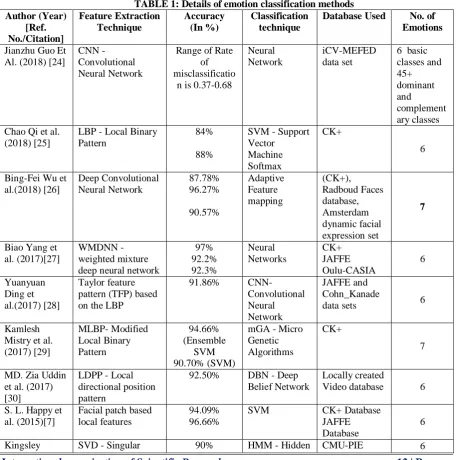
Details of different techniques experimented by various researchers for facial feature extraction and emotion classification are as tabulated in Table 1.
TABLE 1: Details of emotion classification methods Author (Year) [Ref. No./Citation] Feature Extraction Technique Accuracy (In %) Classification technique
Database Used No. of Emotions
Jianzhu Guo Et Al. (2018) [24]
CNN - Convolutional Neural Network
Range of Rate of misclassificatio
n is 0.37-0.68
Neural Network
iCV-MEFED data set
6 basic classes and 45+ dominant and complement ary classes Chao Qi et al.
(2018) [25]
LBP - Local Binary Pattern
84%
88%
SVM - Support Vector
Machine Softmax
CK+
6
Bing-Fei Wu et al.(2018) [26] Deep Convolutional Neural Network 87.78% 96.27% 90.57% Adaptive Feature mapping (CK+), Radboud Faces database, Amsterdam dynamic facial expression set 7
Biao Yang et al. (2017)[27]
WMDNN - weighted mixture deep neural network
97% 92.2% 92.3% Neural Networks CK+ JAFFE Oulu-CASIA 6 Yuanyuan Ding et al.(2017) [28] Taylor feature pattern (TFP) based on the LBP
91.86% CNN- Convolutional Neural Network
JAFFE and Cohn_Kanade
data sets 6
Kamlesh Mistry et al. (2017) [29] MLBP- Modified Local Binary Pattern 94.66% (Ensemble SVM 90.70% (SVM)
mGA - Micro Genetic Algorithms
CK+
7
MD. Zia Uddin et al. (2017) [30]
LDPP - Local directional position pattern
92.50% DBN - Deep Belief Network
Locally created
Video database 6
S. L. Happy et al. (2015)[7]
Facial patch based local features
94.09% 96.66%
SVM CK+ Database JAFFE Database
Oryina Akputu et al. (2013) [31]
Value
Decomposition
Markov Model
Wenfei Gu et al. (2012) [19]
Radial encoding of local Gabor Features 89.67% 91.51% Hierarchical Classifier JAFFE CK 7
Usman Tariq et al. (2012) [32] HG(Hierarchical Gaussianianization - Patch based SIFT(Scale Invariant feature transform) and MF(Motion Features) - Point Based
80% SVM GEMEP - Geneva Multimodal Emotion Portrayals - Facial Recognition and Analysis database 6 Ligang Zhang et al (2011) [13]
Patch based Gabor Features
92.93 % (Linear Kernel) 94.48% (RBF
Kernel)
SVM JAFFE CK
6
Emily Mower et al. (2011) [2]
Geometry based facial points
68.2% SVM (RBF Kernel)
IEMOCAP
4
Seyed Mehdi Lajevardi et al. (2010) [33]
Zernike moments (order 10)
92.8% 73.2%
NB - Naive Base Classifier JAFFE Database CK+ Database 7 Filareti Tsalakanidou et al (2010) [34]
Geometry based features
75.42% Rule Based Classification
Real Time Images
5
R. Ramnathan et al. (2009) [21]
2D Gabor Filters 83.3% SVM JAFFE
7 M. Karthigayam et al.(2008) [22] Geometry based Features
(15 facial points and 27 Action Units)
87% GA - Genetic Algorithm and NN-Neural Network
SEA - South East Asian
Face Database 7
Frank Y. Shin et al. (2008) [20]
DWT - Discrete Wavelet Transform
94.13% SVM
(RBF Kernel)
JAFFE
Database 7
Matthew S. Ratliff et al. (2008)[18]
AAM-Active Appreance Model
82.48% ANN FEEDTUM - Locally created database
7
Shishir Bashyal et al. (2007) [11]
Gabor Wavelets 87.51% LVQ-Linear Vector Quantization
JAFFE
7
Al-Amin Bhuiyan et al. (2007) [23]
VI.CONCLUSION
Emotion recognition has tremendous potential in application domains like cognitive assessment, healthcare, clinical practices, e-learning, animation, driver alert systems, interactive Television etc. The study carried out provides details of various facial feature extraction and classification techniques which can be used as ready reference by researcher community for further development in this area.
The significant building block of emotion recognition is extraction of facial features. Efficient implementation of this step helps in achieving reduction in classification time while improving the classification accuracy. There is a need to select appropriate combination of facial feature extraction technique and emotion classifier to obtain desired performance parameters in relevance to the application under consideration.
The papers summarized under this study do not provide much details of algorithms to address occlusion and pose variation, as most of the authors have dealt with frontal faces. The study can be further extended for inclusion of algorithms used to address pose variation and occlusion as well as asymmetric facial features.
REFERENCES
[1]. K. Oatley, and E. Duncan, The Experience of Emotions in Everyday Life, Journal of Cognitive Emotions, 8,1994, 369-381.
[2]. Emily Mower, and Maja J. Mataric, A Frame work for Automatic Human Emotion Classification Using Emotion Profiles IEEE Transactions on Audio, Speech and Language Processing, 19(5), 2011, 1057-1070.
[3]. Pohsiang Tsai, Longbing Cao, Tom Hintz, and Tony Jan, A bi modal face framework integrating facial expression with facial appearance, Elsevier Journal on pattern recognition letters, 30, 2009, 1096–1100. [4]. Mingli Song, and Xuelong, Image ratio Features for facial Expression Recognition Application, EEE
Transaction on Systems, Man and Cybernetics, 40(3), 2010, 779 –788.
[5]. A. Timo, H. Abdenour, and P. I. Matti, Face Description with Local Binary Patterns: Application to Face Recognition, IEEE Transactions On Pattern Analysis And Machine Intelligence, 28(12), 2006, 2037-2041 [6]. Li Zhang, M. Kamlesh, C. N. Siew, and P. L. Chee, Intelligent facial emotion recognition using
moth-firefly optimization, Elsevier Publication of International Journal of knowledge based systems, 111, 2016, 248-267.
[7]. S. L. Happy, and R. Aurobinda, Automatic facial expression recognition using features of salient facial patches, IEEE transactions on Affective Computing, 6(1), 2015, 1-12.
[8]. F. Nacer, and H. Mahdi, Exemplar-Based Facial Expression Recognition, Elsevier Information Science, 460, 2018, 318-330.
[9]. C. Junkai, C. Zenghai, C. Zheru, and F. Hong, Facial Expression Recognition in Video with Multiple Feature Fusion. IEEE Transactions on Affective Computing, 2016, 1-13.
[10]. Hong-Bo, J. Lian-Wen,, Z. Li-Xin, and H. Jian-Cheng, A New Facial Expression Recognition Method Based on Local Gabor Filter Bank and PCA plus LDA, International Journal of Information Technology, 11(11), 2005, 86-96.
[11]. Shishir Bashyal and Ganesh K. Venayagamoorthy, Recognition of Facial Expressions using Gabor Wavelets and Learning Vector Quantization, Engineering Applications of Artificial Intelligence published by Elsevier, 2007, 1-9.
[12]. Xuding Xie and Kin Man Lam, Facial Expression Recognition Based on shape and Texture, Pattern Recognition Journal of Elsevier, 2008, 1003-101.
[13]. Ligang Zhang and Dian Tjondronegoro, Facial expression Recognition Using Facial Movement Features, IEEE Transaction on Affective Computing, 2(4), 2011, 219–228.
[14]. Ahmad Poursaberi, Hossein Ahmadi, Svetlana N. Yanushkevich and Marina Gavrilova, Gauss–Laguerre wavelet textural feature fusion with geometrical information for facial expression identification, Eurasip Journal on Image and Video Processing of Springer Open, 2012.
[15]. B. Allaert, J. Mennesson, I. M. Bilasco, and C. Djeraba, Impact Of Face Registration Techniques On Facial Expression Recognition, Research Article Signal Processing: Image Communication, 61, 2018, 44-53.
[16]. Standard Dataset Available: http://www.kasrl.org/jaffe_download.html. [17]. Stan Z. U. and Anil K. Jain, Handbook of Face Recognition ( Springer 2005).
[18]. Matthew S. Ratliff and Eric Patterson, Emotion Recognition using Expressions with Active Appearance Models, 2008
International organization of Scientific Research 15 | P a g e
[20]. Frank Y. Shin and Chao Fa Chuang , Performance Comparison of Facial Expression Recognition in JAFFE Database, IEEE Transaction on Pattern Recognition and Artificial Intelligence, 22(3), 2008, 445-459.
[21]. R. Ramnathan, and Dr. K. P. soman, A Support Vector Machines Approach for Efficient Facial Expression Recognition, International conference in Advances in Recent Technologies in communication and Computing, 2009.
[22]. M. Karthigayan, M. Rizon, R. Nagrajan and Sazali Yaacob, Genetic Algorithm and Neural Network For Face Emotion Recognition, IEEE Transcation on Affective computing, 2008.
[23]. Al-Amin Bhuiyan and Chang Hong Liu, On Face Recognition using Gabor Filters, World Academy of Science, 28, 2007, 51-56.
[24]. Jianzhu Guo, Zhen Lei, Jun Wan, Egils Avots, Noushin Hajarolasvadi, Boris Knyazev, Artem Kuharenk, Julio C. Silveira Jacques Junior, Xavier Baró, Hasan Demirel, Sergio Escalera , Jüri Allik And Gholamreza Anbarjafari, Dominant and Complementary Emotion Recognition From Still Images of Faces , IEEE Access Special Section On Visual Surveillance And Biometrics: Practices, Challenges And Possibilities, 6, 2018, 6391-26403.
[25]. Chao Qi, Min Li, Qiushi Wang, Huiquan Zhang, Jinling Xing, Zhifan Gao And Huailing Zhang, Facial Expressions Recognition Based On Cognition And Mapped Binary Patterns, EEE Access Special Section On Trends, Perspectives And Prospects Of Machine Learning Applied To Biomedical Systems In Internet Of Medical Things, 6, 2018, 18795-18803.
[26]. Bing-Fei Wu And Chun-Hsien Lin, Adaptive Feature Mapping For Customizing Deep Learning Based Facial Expression Recognition Model, IEEE Access, 6, 2018, 12451-12461.
[27]. Biao Yang, Jinmeng Cao, Rongrong Ni and Yuyu Zhang, Facial Expression Recognition Using Weighted Mixture Deep Neural Network Based On Double-Channel Facial Images, IEEE Access, 6, 2018, 4630-4640.
[28]. Yuanyuan Ding, Qin Zhao, Baoqing Li, And Xiaobing Yuan, Facial Expression Recognition From Image Sequence Based On Lbp And Taylor Expansion, IEEE Access Special Section On Sequential Data Modeling And Its Emerging Applications, 5, 2017, 19409-19419.
[29]. Kamlesh Mistry, Li Zhang, Siew Chin Neoh, Chee Peng Lim and Ben Fielding, A Micro-GA Embedded PSO Feature Selection Approach to Intelligent Facial Emotion Recognition, IEEE Transaction on Cybernetics, 47(6), 2017, 1496-1509.
[30]. Md. Zia Uddin, Mohammad Mehedi Hassan, Ahmad Almogren, Atif Alamri, Majed Alrubaian And Giancarlo Fortino, Facial Expression Recognition Utilizing Local Direction-Based Robust Features And Deep Belief Network, IEEE Access Special Section On Emotion-Aware Mobile Computing, 5, 2017, 4525- 4536.
[31]. Kingsley Oryina Akputu, Kah Phooi Seng and Yun Li Lee, Facial Emotion Recognition for Intelligent Tutoring Environment, International Conference on Machine Learning and Computer Science, 2013. [32]. Usman Tariq, Kai-Hsiang Lin, Zhen Li, Xi Zhou, Zhaowen Wang, Vuong Le, Thomas S. Huang, Xutao
Lv and Tony X. Han, Recognizing Emotions from an Ensemble of Features, IEEE Transaction on Systems, Man and Cybernetics, 42(4), 2012, 1017-1026.
[33]. Seyed Mehdi Lajevardi and Zahir M. Hussain, Higher Order Orthogonal moments for Invariant Facial Expression Recognition, Elsevier Digital Signal Processing, 20, 2010, 1771-1779.
[34]. Filareti Tsalakanidou and Sotiris Malassiotis, Real-Time 2D+3D Facial Action and Expression Recognition, Elsevier Pattern Recognition, 43, 2010, 1763-1775.
[35]. Zhengyou Zhang, Michael Lyons, Michael Schuster and Shigeru Akamatsu, Comparison Between Geometry-Based and Gabor-Wavelets-Based Facial Expression Recognition Using Multi-Layer Perceptron, IEEE International Conference on Automatic Face and Gesture Recognition, 1998, 454-459.
![Fig. 1: JAFFE database expressions [16]](https://thumb-us.123doks.com/thumbv2/123dok_us/7808754.1662219/2.595.148.494.658.711/fig-jaffe-database-expressions.webp)
![Fig. 5: Process flow using Genetic Algorithm [22]](https://thumb-us.123doks.com/thumbv2/123dok_us/7808754.1662219/4.595.85.531.454.509/fig-process-flow-using-genetic-algorithm.webp)