ISSN (e): 2250-3021, ISSN (p): 2278-8719
Vol. 09, Issue 4 (April. 2019), ||S (II) || PP 32-37
A Fuzzy Intelligent Advisor through Matlab under E-Learning
Environment
Tohida Rehman
Assistant Professor Department of Information Technology Jadavpur University
Plot No.8, Salt Lake Bypass, LB Block,Sector III, Salt Lake City, Kolkata – 700098 India Corresponding Author:Tohida Rehman
ABSTRACT:
The Internet and distance learning have created a new business and a new teaching pedagogy. The purpose of this paper is to show how the Fuzzy Logic can be used in an Intelligent Advisor System to give an encouragement to the self-paced learner. The core part of this paper is to design a fuzzy controller with the help of two input parameter such as score and time from computer aided assessment to measurement the actual level of a self-paced learner with respect to knowledge, understanding and skill, according to that value intelligent advisor gives proper advice to the learner.
KEYWORDS:
Fuzzy Logic, FLC, ICT, E-Learning, self-paced, Intelligent Advisor, ITS.--- ---
I.
INTRODUCTION
E-learning has become a relevant learning method these days. It has brought about the advantage of de-localization and flexibility, allowing a departure from the “classroom paradigm" and using the virtual space as a facilitator of knowledge and information exchange.
Our system will be useful in e-learning environment. It presents a scheme for intelligent advice generation for a self-instructional e-learner. Our proposed system operates within fuzzy rule based to recommend the learning path. The system generates advices to the self-paced learner to give him an encouragement. It detects actual position of a self-paced learner with respect to knowledge, understanding and skill of the subject and advices to take further steps for improvement.
Here we assume that the whole course, divided into modules and at the end of each module, there are multiple-choice questions (MCQ) over that module. These MCQ’s are properly distributed viz. knowledge, understanding and skill. After going through the text of a module learner take the test. Then the total time spent over the module and total score taken. These values converted on the scale of range from zero to ten [4].
Working of our system starts here, the value of score and time in the specified range supplied to the system. The system employs a fuzzy machine that takes input in form of score and time and generates some crisp measure as output in terms of diagnostic parameters: knowledge, understanding and skill. These crisp values then used to generate the advices to the learner [5]. As advice suggests user take necessary actions. This is where the system simulates a human instructor.
INTRODUCTION TO CONCEPT OF FUZZY LOGIC
The characteristic function of a crisp set assigns a value of either 1 or 0 to each individual in the universe set, thereby discriminating between members and nonmembers of the crisp set under consideration [1, 2, and 3]. This function can be generalized such that the values assigned to the elements of the universal set fall within a specified range and indicate the membership grade of these elements in the set [7, 8]. Larger values denote higher degrees of set membership. Such a function is called a membership function, and the set defined by it a fuzzy set [6].
The most commonly used range of values of membership functions is the unit interval [0, 1]. Let us consider your family member and their ages
Grandfather(80),Grandmother(75),papa(50),mama(45),uncle(40),aunty(38),brother(24),sister(10) From the above data you can easily defined a set of male members
A= {Grandfather, papa, uncle, brother}But if you want to defined a set of young members? Then how can you define this set using the conventional set theory? Then you have to use the fuzzy set. In fuzzy logic everything is a matter of degree [9].
PROPOSED WORK
are present in Matlab. In this research. I have used Mamdani algorithm to design FLC. FIS has basically five steps to design any fuzzy logic controller such as Fuzzification of the input values, Applications of fuzzy operators on the antecedent part of fuzzy rules, Evaluation of the fuzzy rules, Aggregation of fuzzy sets across the rules i.e. combines the result of the evaluation, Defuzzification of the aggregate fuzzy set to obtain the crisp output values .Here we used two input parameter such as score and time.
DESIGN METHODOLOGY
The inputs to each fuzzy inference system are score and time and outputs of each are crisp value corresponding to knowledge, understanding and skill .Hence we have five linguistic variables namely Score, Time, Knowledge, Understanding and Skill.
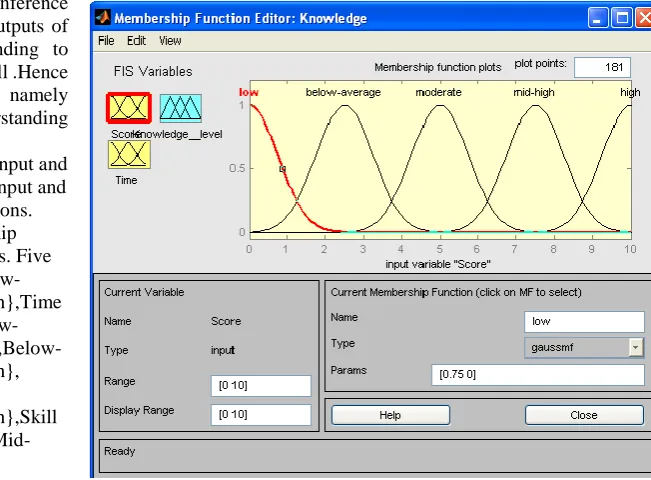
Here we assume that range of all input and output variables are [0, 10].Each input and output has five membership functions. Here we used Gaussian membership function to fuzzify the input values. Five broken parts are Score {Low,Below-Average,Moderate,Mid-High,High},Time {Fast,Medium-Fast,Medium,Below-Medium,Slow},Knowledge {Low,Below-Average,Moderate,Mid-High,High}, Understanding {Low,Below-Average,Moderate,Mid-High,High},Skill {Low,Below-Average,Moderate,Mid-High,High}.
Figure 1: Membership function editor
Values for Linguistic Variables Values for Linguistic Variables Low/Fast Score 1 If x=0
µ(x) = exp[-0.5{(x-0)/0.75}2] If 0<x<2.5 low 0 Otherwise
Mid-High/ Below-Medium
Score 1 If x=7.5 µ(x) = exp[-0.5{(x-7.5)/0.75}2]
if 5<x<7.5 &7.5<x<10 Mid-High 0 Otherwise
Below-Average/ Medium-Fast
Score 1 If x=2.5 µ(x) = exp[-0.5{(x-2.5)/0.75}2]
If 0<x<2.5 &2.5<x<5 Below-Average
0 Otherwise
High/ Slow Score 1 If x=10 µ(x) = exp[-0.5{(x-10)/0.75}2]
If 7.5<x<10 High 0 Otherwise
Moderate/ Medium
Score 1 If x=5 µ(x) = exp[-0.5{(x-5)/0.75}2]
If 2.5<x<5 &5<x<7.5 Moderate 0 Otherwise
Table1: Membership Functions for linguistic variables
Table 2: Rule Table for Knowledge
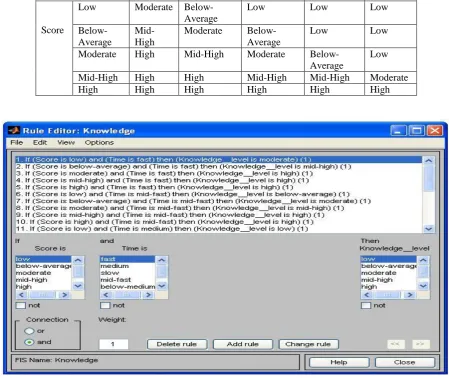
Figure 2: Rule Editor for knowledge
The Rule Viewer displays a roadmap of the complete fuzzy inference process and Based on the fuzzy inference diagram described in the previous section.
Knowledge
Time
Fast Medium-Fast
Medium Below-Medium
Slow
Score
Low Moderate Below-Average
Low Low Low
Below-Average
Mid-High
Moderate Below-Average
Low Low
Moderate High Mid-High Moderate Below-Average
Low
Figure 3: Rule Viewer for Knowledge
Fuzzy machine generates fuzzy outputs denoting performance on the three diagnostic parameters: Knowledge, Understanding and Skill termed as Knowledge level (Lk), Understanding level (Lu) and Skill level (Ls) respectively. From those output intelligent advisor infers advices to the learner. Base advices to a learner given by the intelligent advisor are of four types: Reread the text, Repeat the worked out examples, Solve more problems and Go through the next session. The actual advice given to the learner depends on the advice grade. To obtain advice grade we have considered two methods one is using Expert’s Knowledge (Simple Evaluation) and another using simple mathematics (Standard Evaluation) over the three diagnostic parameters.
Simple Evaluation
In simple evaluation, intelligent advisor considers some threshold value (α and β) to distinguish between forms of levels of each type that student achieve. There will be three forms of levels: low, medium and high. This is illustrated in table 4depending on the different achievements; intelligent advisor takes decision to advice as grades shown in the table 3. Since there are three categories of achievements of each level, there will total be 27 combinations (33=27).The final advice grade then categorized based on Expert’s Knowledge. I have shown some parts of those combinations in table 3.
Table 3: Achievements’ of each level vs. Advice Grade Table 4:
Levels vs. Achievements
a)
Standard EvaluationLevels Achievement Low Medium High
Knowledge level (Lk)
Lk≤α α< Lk<β Lk≥β
Understanding level (Lu)
Lu≤α α< Lu<β Lu≥β
Skil level (Ls) Ls≤α α< Ls<β Ls≥β SL Knowledge Understanding Skill Advice
the weights corresponding to the Knowledge, Understanding and Skill are K_W, U_W, S_W and crisp value corresponding to the Knowledge, Understanding and Skill are K_VALUE, U_VALUE, and S_VALUE then result value calculated as below
result = (K_W ∗ K_VALUE) + (U_W ∗ U_VALUE) + (S_W ∗ S_VALUE) K_W + U_W + S_W
Depending on the value of result, final advice grade generates.
The value of result and advice grade category has been below table no 5
Table 5: Values of Result vs. Advice Grade
RESULT ANALYSIS USING GUI
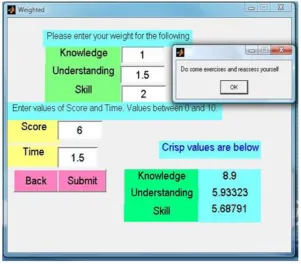
We have used two GUI in MATLAB named as pro and Weighted as shown in figure for normal evaluation and for standard evaluation respectively. Default run is pro, the main figure.
Taking example as our case, we have inputted the value of Score as 6 and the value of Time as 1.5 in first GUI (pro.fig). We got crisp value of Knowledge as 8.9 and Understanding as 5.93323 and Skill as 5.68791. This experimental result matches with our theoretical result corresponding to Knowledge. Figure number 4 shows this.
Figure 4: Result from simple evaluation
We also inputted the weights corresponding to Knowledge, Understanding and Skill as 1, 1.5 and 2 respectively. We got crisp value of Knowledge as 8.9 and Understanding as5.93323 and Skill as 5.68791. This experimental result matches with ourtheoretical result corresponding to Knowledge. Figure number 5 shows this.
result<2
A
II.
Conclusion
In our system, we assume that learner will supply the value of score and time, within range. If the learner does not input the actual value of score and time, our system will give advice corresponding to that value. Further, our advice grade is limited and pre-defined.
Further, we want to incorporate our system in an e-learning material where score and time will be taken automatically by our system after the learner complete each module and take the test of that module.
To conclude it can be said that the concept of fuzzy rule base intelligent advisor for self-paced learner will explore a new horizon in the arena of E-learning.
REFERENCES
[1]. S. Weon, J. Kim, "Learning achievement evaluation strategy using fuzzy membership function" Proceedings of 31 st ASEEIIEEE Frontiers in Education Conference, pp. 10-13, 2001. Handbook of Measuring System Design, edited by Peter H. Sydenham and Richard Thorn © 2005 John Wiley and Sons, Ltd. ISBN: 0-470-02143-8, pp. 910-912
[2]. Zadeh ,L.A. (1965) Fuzzy sets. Information and control.8, 338-353.
[3]. Abraham,A(2005)Adaptation of fuzzy inference system using neural learning. Fuzzy System Engineering: Theory and Practice. N. Nedjah Ed et al Berlin, Germany: Springer-Verlag,3,53-83
[4]. P Basu and Samir Roy “A Fuzzy Rule Based Intelligent Advisor for Self-Paced Learner in e-Learning Environment” 2nd International Conference on Education Technology and Computer (ICETC) in 2010 pages 302 -307
[5]. D. Sleeman., J. Brown., eds , "Introduction: Intelligent Tutoring System," in Intelligent Tutoring systems, Academic Press., pp. 1-11, 1982. [5]Ajith Abraham. “Rule-Based Expert System,” Oklahoma State University, OK, USA.
[6]. Fuzzy Logic with engineering applications second edition by Timothy J. Ross.
[7]. Fuzzy Sets And Fuzzy Logic(Theory and Application) by George J. Klir AndBo Yuan.
[8]. An Intelligent Advisor for an Interactive Learning Environment by AkiraTakeuchi,Tomoyuki Fujita(Dept.
of Artifi cial Intelligence Kyushu Instituteof Technology, Japan) and Kazuko Ishibashi, Hiroyuki Yoshida(KyushuMultimedia System Research Laboratory Matsushita Electric Industrial Co.,Ltd., Japan).
[9]. Tohida Rehman "Fuzzy Rule Based Candidate Selection Evaluator by Political Parties" International Journal of Advanced Research in Computer Science, Volume 8, No. 3, March - April 2017 with ISSN No. 0976-5697.
[10]. MATLAB Fuzzy Logic Toolbox by J.S. Roger Jang and Ned Gulley.