ISSN (Online) 2249 – 6084
ISSN (Print) 2250 – 1029
Int.J.Pharm.Phytopharmacol.Res.
2012, 1(5): 271-275
(Research Article)Development and Validation for Simultaneous Estimation of Budesonide and
Salmeterol Xinafoate in Metered Dose Inhalation Form by RP-HPLC
Katari Srinivasaro1, Vinayk Gorule2 , Venkata Krishna Akula
1
Hetero Labs Ltd, Analytical Development, Jeedimetla, Hyderabad-500055(A.P),India
2Bombay University, Matunga, Bombay Highway, Mumbai 400 019 (M.H.), India
Received on: 12/04/2012 Accepted on: 27/04/2012
ABSTRACT
A simple, sensitive, rapid and reproducible reversed- phase HPLC method has been developed and validated for estimation of Budesonide and Salmeterol xinafoate. The assay involved an isocratic elution of these two components on Kromosil C18 column (150 X 4.6 mm, 5μm) using a mobile phase composition of Buffer:
Acetonitrile: (65:35). The flow rate was 2.0 mL/min; Column oven temperature 30°C and the analytes monitored at 235nm.Calibration curves were linear with coefficient correlation between 0.99 to 1.0 over a concentration range of 0.402 to 12.072 μg/mL of Budesonideand 0.072 to 1.081 μg/mL for Salmeterol xinafoate respectively. All the validation parameters were within the acceptance range according to ICH norms. The Method has been successfully applied for analysis of drugs in pharmaceutical formulation. Results of analysis were validated statistically and by recovery studies.
Key Words:Budesonide, Salmeterol xinafoate, Reversed-phase HPLC, Method validation, LOQ and LOD.
INTRODUCTION
Budesonide, 16a(R), 17-(Butylidenebis(oxy)-11b,21-dihydroxypregna-1,4-diene-3,20-dione (Fig.1A), is a glucocorticoid used by inhalation in the management of asthma and allergic rhinitis1
Budesonide is official only in European pharmacopoeia (EP)1, which suggests a liquid chromatography method for the estimation of budesonide in bulk. The different analytical methods that are reported for its determination include ELISA 2-3and HPLC 4-5.
Salmeterol xinafoate (SX) is, (RS)-2-
(hydroxymethyl)-4-{1-hydroxy-2-[6-(4-phenylbutoxy) hexylamino] ethyl} phenol (Fig.1B). It is a long acting and highly selective β2 agonist
formulated as its 1- hydroxy-2-napthoate (xinafoate) salt used in the treatment of asthma and chronic obstructive pulmonary disease. Inhaled salmeterol works like other beta 2-agonists, causing bronchodilation by relaxing the smooth muscle in the airway so as to treat the exacerbation of asthma. The long duration of action occurs by the molecules initially diffusing into the plasma
membrane of the lung cells, and then slowly being released back outside the cell where they can come into contact with the beta-2 adrenoceptors, with the long carbon chain forming an anchor in the membrane 6.
The aim of this study Budesonide and Salmeterol xinafoate is latest combination of anti asthmatic drugs. It is available in dry powder inhalation and metered dose inhalation form. Both the drugs were individually official in Indian pharmacopoeia 7,
United States pharmacopoeia 8 and British pharmacopoeia 9.
dose inhalation. The proposed method was validated as per ICH guidelines 10.
(A)
(B)
Fig.1: Structure of Budesonide (A) and Salmeterol Xinofoate (B)
MATERIALS AND METHODS
Chemicals and Reagents
Working standards of pharmaceutical grade Budesonide and Salmeterol xinafoate were obtained as generous gifts from Hetero Labs Ltd (Hyderabad, India) and was used as such without further purification. The pharmaceutical dosage form used in this study was Hetero RandD Inhalation Aerosol (Budesonide and Salmeterol xinafoate) 120 Metered Dose. Acetonitrile (HPLC Grade), Sodium dihydrogen orthophosphate monohydrate (AR Grade), Decane sulphonic acid sodium salt (AR Grade), Orthophosphoric acid (AR Grade) purchased from Merck specialties Pvt.Ltd, (Mumbai, India) and double distilled water were used in analysis.
Instrumentation and Chromatographic Conditions
Shimadzu HPLC system LC-2010 CHT consisting of UV/VIS detector and LC solutions software was used for analysis. Separation was carried out on Kromosil C18 (150 x 4.6 mm i.d.) column using
Buffer pH 3.0: Acetonitrile in ratio of (65:35 v/v) as mobile phase at flow rate of 2.0 ml/min and Column oven temperature 30°C. Samples were injected using auto injector with 100µL loop and detection was carried out at 235 nm. All weighing were done on Shimadzu balance (Model AY-120).
Preparation of Buffer (pH 3.0)
Weighed and transferred 1.38 gm of of Sodium dihydrogen orthophosphate monohydrate into a beaker containing 1000 ml of water and 1.22 gm of decane sulphonic acid sodium salt and mix to
dissolve. Adjusted the pH of the solution to 3.0 with orthophosphoric acid.
Preparation of Standard Stock Solutions
Budesonide standard stock solution
Accurately weighed and transferred 40 mg of Budesonide working standard into a 100 ml volumetric flask. Added 50 ml of mobile phase and sonicate to dissolve. Dilute to volume with mobile phase and mix.
Salmeterol xinafoate standard stock solution Accurately weighed and transferred 18.5 mg of Budesonide working standard into a 100 ml volumetric flask. Added 50 ml of mobile phase and sonicate to dissolve. Dilute to volume with mobile phase and mix. Transferred 10 ml of the above solution in to a 100 ml volumetric flask and dilute to volume with mobile phase.
Preparation of Standard Solutions
Transferred 2.0 ml of Budesonide standard stock solution and 5.0ml of Salmeterol xinafoate standard stock solution into a 100 ml volumetric flask dilute to volume with mobile phase.
Preparation of Sample Solution-A
Took a container, fit in an actuator and prime the valve by wasting first two actuations. Shacked the container for at least five seconds in-between each actuation. Remove the container from its actuator and wash with methanol. Clean the valve and valve stem internally and externally with an airline fitted with a narrow jet. Place a disc in clean and dry 100 ml beaker; add about 50 ml of acetonitrile. Hold the container in inverted position, shake for 5 seconds and deliver one actuation in beaker through the hole provided in the center of the disc. Similarly deliver further nine actuations in the same beaker with constant shaking for at least five seconds in between each delivery.
Transferred the solution from beaker into a 100-ml volumetric flask. Wash the beaker and disc with acetonitrile and transferred into the same volumetric flask. Make up the volume up to the mark with acetonitrile. Transferred 10 ml of the above solution in to 25ml volumetric flask, dilute to volume with mobile phase and mix.
volumetric flask and then make up the volume up to the mark with mobile phase.
After setting the chromatographic conditions and stabilizing the instrument to obtain a steady baseline, the metered dose sample solution A and actuator retention B solution was injected, chromatogram was obtained and the peak areas were recorded. The injections were repeated six times and the amount of each drug present per inhalation was estimated from the respective calibration curves.
Content of Active Ingredient Delivered per actuation = µg of Sample A - µg of Sample B
% Labeled Amount of Active Ingredient Delivered per actuation
[µg of Sample A - µg of Sample B] x 100
= --- Label Claim
System Suitability
The system suitability was assessed by five replicate injections of the Budesonide containing 8.00 µg/ml and Salmeterol xinafoate containing 0.925 µg/ml of both the drugs. The peak asymmetry, number of theoretical plates, the percentage relative standard deviation of standard solution five injections were calculated as represented in Table-1. The values obtained demonstrated the suitability of the system for the analysis of these drugs in combination.
METHOD VALIDATION
The method was validated for linearity, accuracy, intra-day and inter-day precision and robustness, in accordance with ICH guidelines.
Linearity
To evaluate linearity of the method, six calibration standards of Budesonide containing 0.402, 2.012, 4.024, 8.048, 10.060, and 12.072 mg/mL and Salmeterol xinafoate containing 0.072, 0.144, 0.360, 0.721, 0.901, and 1.081 mg/mL were analyzed. A plot of peak areas versus Budesonide and Salmeterol xinafoate concentrations was linear in the range from 0.402 to 12.072 mg/mL of Budesonide and 0.072 to 1.081 mg/mL of Salmeterol xinafoate with a correlation coefficient of 0.9996 and 0.9996. This result demonstrates linearity of this method over the specified range.
Precision
One set of three different concentrations of mixed standard solutions of Budesonide and Salmeterol xinafoate were prepared. All the solutions were analyzed thrice, in order to record any intraday
variations in the results. For inter day variations study three different concentrations of the mixed standard solutions in linearity range were analyzed on three consecutive days. The peak areas were recorded and relative standard deviation (RSD) was calculated.
Accuracy
To check the accuracy of the method, recovery studies were carried out by addition of standard drug solution to pre-analyzed sample solution at three different levels 50%, 100% and 150%.The percentage of recoveries were calculated, results of which are represented in Table-2.
Limit of Detection and Limit of Quantification LOD and LOQ were calculated as 3.3 ∞/S and 10 ∞/S respectively; where ∞ is the standard deviation of the response (y-intercept) and S is the slope of the calibration plot.
Robustness
In the robustness study, the influence of small, deliberate variations of the analytical parameters on retention time of the drugs was examined. The following three factors were selected for change: flow rate of the mobile phase (2.0± 0.04 ml/min), a wavelength at which the drugs were recorded (235±1 nm).One factor at the time was changed to estimate the effect. A number of replicate analyses (n=3) were conducted at 3 levels of the factor (-, 0, +).It was observed that there were no marked changes in the chromatograms, which demonstrated that the RP-HPLC method developed is robust.
RESULTS AND DISCUSSION
For RP-HPLC method different mobile phases were tried and the mobile phase containing Buffer: Acetonitrile (65:35, v/v) was found to be optimal for obtaining well defined and resolved peaks with mean retention times and 7.680 ± 0.02 min, 8.291 ± 0.02 min and 5.236 ± 0.01 (Mean ± S.D.) for Budesonide (Epimer B and Epimer A) and Salmeterol xinafoate respectively. The representative chromatogram of the standard solution of mixture is shown in Figure-1.
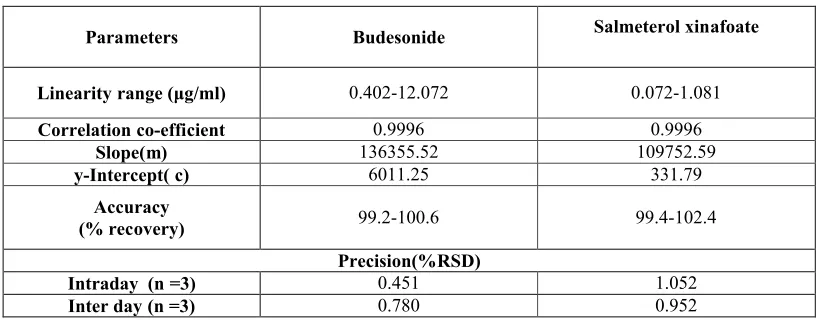
method was found to be accurate and precise, as indicated by recovery studies and % RSD not more than 2.Robustness of the method (data not shown), checked after deliberate alterations of the analytical parameters shown no marked changes in the chromatogram (RSD < 2), which demonstrated that the RP-HPLC method developed is robust. The summary of validation parameters of proposed HPLC method is given in Table-3.
CONCLUSION
The validated RP-HPLC method employed here proved to be simple, fast, accurate, precise and
robust, thus can be used for routine analysis of Budesonide and Salmeterol xinafoate in combined metered dosage inhalation form.
ACKNOWLEDGEMENT
The authors express their gratitude to Hetero Labs Ltd. (Hyderabad, India) for the gift sample of pure Budesonide and Salmeterol xinafoate. Thanks also extended to Dr. Vinayk Gorule, Bombay University for providing necessary facilities and constant support.
Table-1: System Suitability parameters for RP-HPLC method
Parameters Budesonide epimer B and Values
Budesonide epimer A Salmeterol xinafoate
Theoretical plates 5924 and 6161 5073
Asymmetry Factor 1.00 and 1.06 1.15
% RSD 0.05 and 0.12 0.79
Table-2: Recovery studies of Budesonide (BU) and Salmeterol xinafoate (SX)
Drug % Level Amount
added(µg/ml)
Amount
found(µg/ml) % Recovery* % RSD
BU
50 2.0079 2.0125 100.2 1.39
100 4.0157 4.0175 100.0 0.22
150 6.0236 5.9776 99.2 0.17
SX
50 0.1346 0.1342 99.7 0.47
100 0.2512 0.2492 99.2 0.56
150 0.3781 0.3742 98.9 0.35
*Average of three determinations.
Table 3: Summary of validation parameters of proposed RP-HPLC method
Parameters Budesonide Salmeterol xinafoate
Linearity range (μg/ml) 0.402-12.072 0.072-1.081
Correlation co-efficient 0.9996 0.9996
Slope(m) 136355.52 109752.59
y-Intercept( c) 6011.25 331.79
Accuracy
(% recovery) 99.2-100.6 99.4-102.4
Precision(%RSD)
Intraday (n =3) 0.451 1.052
Figure-1: Representative chromatogram obtained for standard mixture of Budesonide (Epimer B and Epimer A) (8.04 µg/ml, 7.680 ± 0.02 min, 8.291 ± 0.02 min) and Salmeterol xinafoate (0.925 µg/ml, 5.236 ± 0.02 min)
REFERENCES
1. European Pharmacopoeia, European department for quality of medicine, council of Europe, Strasbourg, 2012, 1516.
2. Kronkvit, K., Lovgren, U., Edholm, L. and Edholm, E., Determination of drugs in biosamples at picomolar concentrations using competitive ELISA with electrochemical detection: application to steroids, J. Pharm. Biomed. Anal., 1993, 11(6), 459-67.
3. Lovgren, U., Edholm, L., Edholm, E. and Johanson, G., Enzyme amplified immunoassay for steroids in biosamples at low picomolar concentrations, Anal. Chem. Acta., 1994, 288(3), 227-235. 4. Faouzi, M.A., Dine, T., Luyndex, M.,
Brunet, C., Gressier, b., Cazin, M., Walfert, B. and Cazin, J.C., High-performance liquid chromatographic method for the determination of budesonide in bronchoalveolar lavage of asthmatic patients, J. Chromatog. B.Blomed. Appl., 1995, 664(2), 463-467.
5. Brown, K.F. and Seale, J.P., Determination of epimers 22R and 22S of budesonide in human plasma by high-performance liquid chromatography-atmospheric pressure chemical ionization mass spectrometry, J. Chromatog.B. biomed. Appl., 1996, 683(2), 259-268. 6. Goodman and Gillman’s, The
Pharmacological Basis of Therapeutics, 2001, 10th Edition, 736-740.
7. Indian Pharmacopoeia, Ministry of Health and Family Welfare, Government of India, New Delhi, 2007,2090
8. United States Pharmacopoeia (2012) USA, 4603
9. British Pharmacopoeia (2012) London, Medicines and Health care products regulatory agency (MHRA); 1925, 307,2518-2520
10. ICH, Q2 (R1), Harmonized tripartite guideline, Validation of analytical procedures: text and methodology, International Conference on Harmonization ICH, Geneva, Nov 2005.
*Corresponding Author: Katari Srinivasaro,