R E S E A R C H
Open Access
Where there is light, there is dark: a dual
process model of high-performance work
systems in the eyes of employees
Xueqing Fan
1, Yan Liu
2*and Xi Zou
2* Correspondence:
2Department of Business Administration, Wuhan University, Wuhan, China
Full list of author information is available at the end of the article
Abstract
High-performance work systems have been widely adopted in the workplace. Previous research on high-performance work systems debated whether the generated effects are mutual gains or conflicting outcomes for employers and employees. Drawing on the job demands and resources model, this conceptual study proposes that high-performance work systems can be both beneficial and harmful by eliciting distinct perceptions in employees. Specifically, perceptions of job resources are the positive and perceptions of job demands are the negative mechanism whereby high-performance work systems affect employee job performance. This research further proposes that servant leadership strengthens the positive impact of high-performance work systems, whereas directive leadership strengthens the negative impact. Overall, this conceptual research provides new insights into the research on high-performance work systems.
Keywords: High-performance work systems (HPWS), Job demands, Job resources, Leadership, Job performance
Introduction
High-performance work systems (HPWS) have garnered much research attention over the past three decades and such attention seems to be increasing (Jackson, Schuler and Jiang 2014). It is argued that HPWS is commitment-oriented and can enhance em-ployees’competencies, motivation, and discretion at work when employees are treated as a source of sustainable competitive advantage (Sun, Aryee, and Law 2007). Extant literature suggests that organizations adopting HPWS tend to achieve better oper-ational and financial performance (e.g., Combs et al. 2006; Saridakis, Lai, and Cooper 2017; Sun et al.2007; Wu et al. 2015). It is also documented that employees exposed to HPWS tend to be proactive (Beltrán-Martín et al. 2017) and creative (Chang et al. 2014) and have high job performance (Aryee et al.2012, 2016; Liao et al. 2009). This line of research suggests that HPWS offers mutual gains for both employees and their organizations (van de Voorde, Paauwe, and Van Veldhoven2012).
However, another line of research indicates that HPWS raises conflicting outcomes for employees and their employers (e.g., Ehrnrooth and Björkman 2012; Jensen, Patel and Messersmith,2013; Wood et al.,2012). According to Ostroff and Bowen (2016), human resource practices serve as a signaling system that sends messages to employees about
what is valued and what are appropriate behaviors. By investing in employees and offering autonomy and flexibility at work, HPWS communicates an organization’s expectations for extra effort from its employees (Shaw et al.2009). Thus, under the practice of HPWS, em-ployees may be faced with work overload, high working speeds, and tight deadlines and feel that they are forced to intensify their work in order to comply with the organization’s interest (Balducci, Schaufeli, and Fraccaroli 2011; Boxall and Macky 2016; Macky and Boxall 2008). For example, certain HPWS practices such as performance appraisal and performance-contingent pay reflect employers’expectations for higher levels of perform-ance and productivity (Pohler and Schmidt 2015). Through these practices, employers place greater demands and responsibility on employees (Shaw et al., 2009). Employees thus experience increased stress and decreased control over the pace and amount of work (Anthony et al. 2013). In this light, HPWS contributes to organizational competitive advantages at the cost of employees’well-being in the way of increased emotional exhaus-tion and enhanced job anxiety (e.g., Jensen et al. 2013; Kroon, van de Voorde, and van Veldhoven2009; Macky and Boxall2008; van de Voorde and Beijer2015). Indeed, Godard (2004) criticizes studies stressing the contribution of HPWS as not only overestimating HPWS’positive effects but also underestimating potential costs.
Based on these competing perspectives, we expect that when HPWS is adopted in an organization, it has both bright and dark sides. Therefore, our understanding of HPWS would be incomplete if we take only one side into consideration. Indeed, Bamberger and Meshoulam (2000) suggest viewing the two competing aspects together to capture a complete picture of HPWS. Hence, our purpose is to conceptualize two opposite mecha-nisms through which HPWS promotes or prohibits three aspects of job performance and find out when such effects become more or less pronounced. We focus on job perform-ance (represented by task performperform-ance, organizational citizenship behavior, and counter-productive work behavior) (Colquitt, Lepine, and Wesson2011) for two reasons. First, it is crucial to firm success (Huselid1995). Second, as one of the major concerns of human resource management research (Alfes et al.2013), employees’individual performance has been given limited attention in studies on HPWS (Aryee et al.2012).
We further extend our theorizing by identifying two leadership styles (servant leader-ship and directive leaderleader-ship) that strengthen the positive or negative effect of HPWS. The role of managers in the functioning of HPWS has been increasingly recognized (Pak and Kim2016). Although they are not the sole deliverers of human resource prac-tices, line managers serve as important agents in their work groups by enforcing human resource policies, such as setting objectives, appraising performance, giving feedback, and providing mentoring (Den Hartog, Boselie, and Paauwe 2004). The way in which line managers implement human resource practices greatly influences employees’ per-ceptions of their working conditions (van de Voorde, Veld, and Van Veldhoven 2016). Therefore, line managers’skills and characteristics in performing these tasks play a cru-cial role in acting on HPWS. Whether the intended effects of HPWS can be generated is determined by line managers to a great extent. In this case, how employees perceive HPWS may be influenced by managers’leadership behaviors (Purcell and Hutchinson 2007). As Bowen and Ostroff (2004) suggest, managers who implement human re-source policies in a manner that elicits favorable attitudes in employees can contribute to the desired performance. We expect that HPWS evokes different perceptions of job demands and resources and then leads to discrepant performances depending on the leadership styles of line managers.
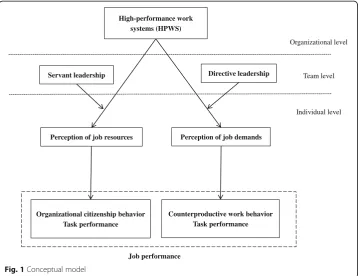
Overall, this paper makes three theoretical contributions. First, it advances our under-standing of HPWS’s effects on individual performance by considering both the bright and dark sides of HPWS. Second, this study extends the contingency view of strategic human resource management and enriches leadership research by exploring the interaction of HPWS with servant and directive leadership styles. Doing so responds to the call for attention to managers’role in the human resource management research (Huselid2011). Third, our research enriches the literature of the JD-R model by suggesting that whether employees interpret the company-level practice as job demands or job resources depends on managers’leadership styles. Figure1illustrates our conceptual model.
Theory and propositions
Job demands-resources (JD-R) model
The JD-R model posits that job demands and job resources are two sets of working conditions that can be distinguished in each organizational context (Schaufeli, Bakker, and Van Rhenen 2009). Job demands refer to those physical, psychological, social, or organizational aspects of a job that require physical or mental efforts and are therefore associated with certain physiological and psychological costs (Demerouti et al. 2001). Workload, time urgency, job responsibility, and emotional conflict are specific forms of physiological and psychological costs (Crawford, LePine, and Rich2010). Job resources refer to those physical, psychological, social, or organizational aspects of a job that may (1) be functional in achieving work goals, (2) reduce the physiological and psychological costs of job demands, and, (3) stimulate personal growth and development (Demerouti et al. 2001). Job autonomy, participation in decision-making, job security, performance feedback, job control, and superior support are all common forms of job resources (Crawford et al.2010; Demerouti et al.2001).
process, employees have to put sustained effort into coping with job demands (Bakker and Demerouti 2007). The increase in employees’efforts is accompanied by feelings of strain (Bakker and Demerouti2007), exhaustion (Bakker, Demerouti, and Verbeke2004), and burnout (Crawford et al.,2010). As a result, there is an increase in compensatory psy-chological and physiological costs that drain employees’ energy and impair their health (Bakker and Demerouti 2017). Regarding the motivational process, perceived job re-sources motivate employees to engage in work goal achievement (Bakker and Demerouti 2007). Job resources induce employees to dedicate their efforts and abilities to the job. Meanwhile, job resources also satisfy employees’ needs for autonomy and competence. According to the literature, job resources are positively associated with job engagement (Nahrgang, Morgeson, and Hofmann2011; Schaufeli and Bakker2004).
High-performance work systems (HPWS)
HPWS generally refers to a bundle of separate but interconnected human resource man-agement practices designed to enhance employees’skills, trigger discretionary effort, and provide opportunities for decision-making participation and ultimately contribute to superior firm performance and sustainable competitive advantage (Sun et al.2007). Spe-cific practices of HPWS include selective staffing, extensive training, internal promotion, flexible working time, enriched job design, information-sharing, participation in decision-making, job security, developmental performance appraisal, performance-contingent rewards, and self-management teams (Datta, Guthrie, and Wright2005; Huselid1995; Lepak et al.2006; Liao et al.2009; Sun et al.2007). Because all open systems include maintenance and production subsystems (Katz and Kahn1978), Gong et al. (2009) classify HPWS prac-tices into two subsystems: a performance-oriented subsystem and a maintenance-oriented
High-performance work systems (HPWS)
Perception of job demands Perception of job resources
Counterproductive work behavior Task performance Organizational citizenship behavior
Task performance
Job performance
Servant leadership Directive leadership
Organizational level
Team level
Individual level
subsystem. While the former primarily develops human resources and provides motivation and opportunities for productivity, the latter ensures employees’well-being and equality.
Investigating the impact of HPWS on performance outcomes has long been the focus of strategic human resource management. More recently, researchers have shifted their at-tention to the more proximal employee outcomes and pointed out the importance of em-ployees’ perceptions in determining behavioral outcomes (e.g., Kehoe and Wright2013; Liao et al.2009; Nishii, Lepak, and Schneider2008; Sanders, Shipton and Gomes2014). The performance effects of HPWS occur via individuals’perceptions (Den Hartog et al. 2013). As indicated by Bowen and Ostroff (2004), human resource practices contribute to desired consequences only to the extent that they are consistently perceived by employees in an intended manner. However, employees’ perceptions of HPWS may be divergent (Den Hartog et al.2013). On this basis, this paper aims to explore how employees’ percep-tions of job resources and job demands arising from HPWS affect individual job perform-ance. Although it is suggested that the practices included in HPWS are resources that organizations invest in employees (e.g., Bartram et al.2012; Cooke et al.2016), we posit that HPWS may not be perceived by employees only as resources. Employees exposed to HPWS also experience job demands. Divergent perceptions of job resources and job de-mands further lead to different job performance.
HPWS, job resources, and job demands
According to the JD-R model, autonomy, feedback, opportunities for development, re-wards and recognition, and job variety are all job resources that help to solve job-related problems, attain task goals, and achieve personal growth (Crawford et al. 2010; Demerouti et al.2001). From this standpoint, HPWS can be perceived as job re-sources. The provision of maintenance-oriented practices allows employees to gain job security (Gong et al. 2009). Moreover, the performance-oriented practices enable em-ployees to obtain prestige, skill development, career advancement, and recognition (Gong et al.2009).
involves practices that enhance employees’skills and competence, reduce psychological and physical costs, and are functional to the achievement of work goals. Therefore, we expect that:
Proposition 1a: HPWS increases employees’perceptions of job resources.
Although HPWS is a potential source of job resources, it can also raise perceived job demands. Based on Ostroff and Bowen’s (2016) study, HPWS conveys a message of expectation for increased productivity. By investing in employees and offering autonomy and flexibility at work, HPWS communicates an organization’s expectations of extra effort from its employees (Shaw et al. 2009). Thus, the application of HPWS leads to longer working hours, stress, and role overload (Jensen et al. 2013; Heffernan and Dundon 2016). Although the commitment-based view suggests that HPWS is aimed at enhancing positive employee experiences and commitment, the real situation is that it increases con-trol over employees via stricter rules, higher requirements, and rewards and punishment based on the organization’s interest (van de Voorde and Jensen2016). As Danford et al. (2008) assert, HPWS tightens the iron cage through a combination of compulsory and discretionary means. The performance-oriented practices function through work intensifi-cation and employees’satisfying the increased expectation of their organization.
For example, although self-management teams offer employees discretion to make decisions, the teams elicit more investment in organizations and increased responsibil-ity for the decisions, which are associated with greater levels of work intensresponsibil-ity (Gallie, White, and Cheng 1998). Self-management teams make team members develop values and principles themselves and thus place greater constraints on team members (Barker, 1993). With respect to performance-contingent pay, it is a double-edged sword. Despite the rewards for high performers, it sets performance objectives for employees and monitors their output (Pohler and Schmidt 2015). The pay-performance link impels employees to be more engaged in their work and boosts perceived pressure (Brief and Atieh 1987). Moreover, extensive training may lead to individual stress through enhan-cing task complexity, workload, and supervisor expectations (Topcic et al. 2016). Briefly, the practices embedded in HPWS are not perceived by employees as resources all the time. Operating through intensifying work, in reality, HPWS seems to place greater demands and pressure on employees. Indeed, Jensen et al. (2013) find that HPWS is associated with enhanced job demands. For these reasons, we expect that:
Proposition 1b: HPWS increases employees’perceptions of job demands.
HPWS, job resources, job demands, and job performance
Research has found positive relationships between HPWS and task performance and citizenship behavior through different intervening mechanisms. For example, HPWS is positively associated with individual service performance through psychological
em-powerment (Aryee et al. 2012). HPWS leads to high task performance via
organizational support (Liao et al. 2009) and elicits citizenship behavior through em-ployees’HPWS satisfaction (Zhang, Di Fan, and Zhu2014). Moreover, when perceiving a favorable social exchange in HPWS, employees tend to reciprocate with more citizen-ship behaviors and better task performance (Snape and Redman2010).
Different from the above perspectives, we posit that employees’perceptions of job re-sources link HPWS to task performance and citizenship behavior. As mentioned earlier, HPWS leads to employees’experiences of job resources because it is functional to em-ployees’achievement of work goals and personal growth. According to the JD-R model, job resources instill motivation in employees. Perceived resources, such as job control and skill development opportunities, can satisfy the needs for autonomy and compe-tence and thus increase employees’ willingness to devote to work (Crawford et al. 2010). When such intrinsic motivation is fueled, employees enjoy the process of per-forming tasks and keep working effectively and productively (Grant 2008). Further-more, job resources can increase employees’ job engagement (Nahrgang et al. 2011; Schaufeli and Bakker 2004). Because engaged employees tend to concentrate on their work with physical, cognitive, and emotional energy, they are able to exhibit high-quality task performance (Rich, Lepine, and Crawford 2010). The positive associ-ation between job resources and job performance has been substantiated by several studies (for review, see Bakker and Demerouti2017).
Moreover, intrinsically motivated individuals have been found to perform more organizational citizenship behaviors (Piccolo and Colquitt 2006). Individuals with greater autonomy and skills are in a better position to mobilize their knowledge, ability, time, and effort to display voluntary behaviors that are not directly or explicitly recog-nized by the formal reward system. When employees do possess resources, they are inclined to go beyond actual goal accomplishment and perform extra-role behaviors voluntarily (Wrzesniewski and Dutton 2001). Indeed, Bakker et al. (2004) demonstrate the positive relationship between job resources and individual extra-role behaviors. Additionally, job resources improve work engagement. Research on work engagement also suggests that job resources boost citizenship behavior because actively engaged employees are more likely to invest themselves and are more willing to step outside the bounds of their formally defined jobs (Rich et al.2010). Consistent with the above argu-ments, we develop the following propositions:
Proposition 2a: Employees’perceptions of job resources are the internal mechanism whereby HPWS increases task performance.
Proposition 2b: Employees’perceptions of job resources are the internal mechanism whereby HPWS increases citizenship behavior.
Demanding aspects of work that consume one’s time and energy can lead to constant over-taxing and exhaustion (Bakker et al. 2004). Empirical studies suggest that exhausted em-ployees under the influence of job demands have problems in investing sufficient effort into their tasks because of diminished energy (Cropanzano, Rupp, and Byrne2003). Moreover, a high level of stressors is an important predictor of sleeping problems (Litwiller et al.2017), cardiovascular diseases (Karasek et al. 1981), and psychiatric disorders (Stansfeld et al. 1999). These physiological responses may reduce employees’ task performance and even seriously interfere with work capacity in the long run (Lazarus 2006). Consistent with our view, Bakker and colleagues’ research (2004) shows that job demands are associated with low in-role performance. Admittedly, there is research indicating that whether job demands have negative or positive effects may depend on one’s overall perception, i.e., hindrances or challenges (Crawford et al.2010). However, according to two meta-analytic studies (Jamal 1984; Gilboa et al.2008), research on job demand stressors is more supportive of the nega-tive relationship between job demands and performance. Employees experiencing stress and feeling threatened are likely to reduce work effort and decrease work quality or quantity (Penney and Spector2005). Even though job demands may contribute to job performance over a short time, these marginal benefits will eventually disappear because of sustained de-cline in employees’physical and psychological well-being.
According to the JD-R model, employees who experience energy consumption due to job demands may distance themselves from further energy loss by with-drawing from work (Bakker et al. 2004) or even engaging in behaviors such as be-ing late, leavbe-ing early, takbe-ing longer breaks, and committbe-ing theft to conserve their resources (Krischer, Penney, and Hunter 2010). Previous studies have demonstrated a high frequency of deviant behavior resulting from job demands. For example, heavy workload is found to be related to absenteeism (Bakker et al. 2003) and a general index of counterproductive behavior (Balducci et al. 2011). Moreover, job demands give rise to emotional exhaustion, which is suggested to result in produc-tion deviance and withdrawal behaviors (Krischer et al. 2010). Burnout and strain derived from job demands can also increase counterproductive behavior (Luksyte, Spitzmueller, and Maynard 2011).
In summary, when employees experience job demands derived from HPWS, they are more likely to perform their tasks badly and engage in counterproductive behavior:
Proposition 3a: Employees’perceptions of job demands are the internal mechanism whereby HPWS decreases task performance.
Proposition 3b: Employees’perceptions of job demands are the internal mechanism whereby HPWS increases counterproductive behavior.
Servant leadership and direct leadership as boundary conditions
managers (Den Hartog et al. 2013; Shin and Konrad 2017). When delivering duties such as selecting, appraising, developing, communicating, and involving, managers provide information about what is expected and what is appropriate behavior (Huo, Boxall and Cheung 2018). To attain the desired effects of HPWS, managers as practice deliverers must communicate adequate and unambiguous information to create a perception of the human resource system as high in distinctiveness, consistency, and consensus (Bowen and Ostroff 2004). However, different percep-tions of HPWS may emerge among employees because line managers differ in how they implement human resources practices (Den Hartog et al. 2013). Man-agers may not be able to or be willing to send consistent messages because of their differentiated abilities, skills, and leadership styles (Khilji and Wang 2006; Wright and Nishii 2013; Zbaracki 1998). As a result, HPWS perceived or experi-enced may vary significantly with the information employees extract from man-agers’ behaviors. As Bowen and Ostroff (2004, p. 206) assert: “all human resource practices communicate messages constantly and in unintended ways, and mes-sages can be understood idiosyncratically, whereby two employees interpret the same practices differently.”
In accordance with the maintenance-performance subsystem of HPWS (Gong et al. 2009), there are two primary types of leader behaviors: consideration and initiat-ing structures (Stodgill and Coons 1951). By focusing their behavior on consider-ation, leaders show concern about followers, care about their welfare, and provide support for their growth. By initiating structure, leaders prescribe the roles of fol-lowers, set standards, and evaluate performance. From the perspective of consideration-initiating structure, we choose two relevant leadership styles, i.e., ser-vant leadership and directive leadership, and explore their roles in shaping em-ployees’ perceptions of HPWS.
attention to the bright side and accordingly generate a positive perception of HPWS. Thus we propose that:
Proposition 4: Servant leadership strengthens the positive association between HPWS and employees’perceptions of job resources.
Directive leadership is associated with a leader’s positional power and aims to actively structure subordinates’work through clear directions and expectations regarding com-pliance with instructions (House1971; Pearce et al.2003; Somech2006; Yukl and Falbe 1991). Directive leaders make virtually all decisions themselves, give detailed directions,
establish clear rules for behavior, and help followers be better aware of their own roles (Kahai, Sosik, and Avolio2004; Pearce et al.2003). In the process of delivering or per-forming human resource duties, directive leaders expect followers to carry out their commands with little freedom to express opinions, and to take actions in alignment
with the leaders’visions without deviation. To ensure followers’performance on track, directive leaders constantly monitor and offer direction to poorly performing followers (Martin, Liao, and Campbell 2013). Consequently, we expect that this task-orientated leadership will increase employees’ perceived stress and make them experience more
pronounced job demands when they are exposed to HPWS.
Specifically, employees under directive leadership may experience a discordance
be-tween messages from the human resource policies and those from the line managers.
For example, autonomy and decision-making participation are espoused by HPWS but
prohibited under directive leaders’close supervision and control. Such inconsistent and
conflicting signals about what is expected and supported would generate a high degree
of uncertainty and role conflict (Black and Gregersen 1991), a form of job demands.
Moreover, directive leaders tend to give instructions such as “work quickly” “work
ac-curately” and “work more,” emphasizing what employees need to do and monitoring
behaviors in case of deviation. Thus, directive leaders place employees under pressure
from target realization and rule compliance (Euwema, Wendt, and Van Emmerik2007),
which further strengthens the signal from HPWS that hard work and extra efforts are
expected. While employees are required to make hard effort and enhance performance,
they have no control over tasks that enable them to cope with stressful situations
(Baumgartel 1957). As a result, employees are more likely to perceive stressful job
de-mands (Jensen et al. 2013). In this light, directive leadership intensifies employees’
in-terpretations of HPWS as a source of job demands.
Proposition 5: Directive leadership strengthens the positive association between HPWS and employees’perceptions of job demands.
interests than their own and strives to promote followers’growth. Servant leadership makes it more likely for individuals to view HPWS as job resources that help to achieve success and pursue personal development. With perceived job resources, employees are more motivated to engage in their jobs and to take advantage of resources such as job control, participation opportunities, and expertise gained from training to fulfill work requirements. Furthermore, perceived job resources also enable employees to exert discretionary efforts to promote the welfare of others and the overall organization. Therefore, servant leadership strengthens the association between HPWS and task performance as well as citizenship behavior by increasing employees’perceptions of job resources.
In contrast, directive leadership provides clear instructions, requirements for per-formance goal achievement, and expectations regarding compliance with orders. However, employees have no opportunities to display discretion. What they experi-ence is demands, obligation, and duty fulfillment. Thus, HPWS is more likely to be perceived as stressful demands by employees. For example, performance-contingent pay included in HPWS can be regarded as higher performance requirements and heavier workload. Increased job demands consume so much time and energy that they lead to decreased physical and psychological well-being, which disable individ-uals from fulfilling tasks efficiently and persistently. Moreover, diminished energy also causes employees to display deviance for the purpose of resource conservation. Consequently, directive leadership strengthens employees’ perceptions of job demands arising from HPWS, which, in turn, elicits lower task performance and deviant behavior.
On the basis of the above reasoning, we expect that:
Proposition 6a: Servant leadership strengthens the indirect relationship between HPWS and task performance via employees’perceptions of job resources.
Proposition 6b: Servant leadership strengthens the indirect relationship between HPWS and citizenship behavior via employees’perceptions of job resources.
Proposition 7a: Directive leadership strengthens the indirect relationship between HPWS and task performance via employees’perceptions of job demands.
Proposition 7b: Directive leadership strengthens the indirect relationship between HPWS and counterproductive behavior via employees’perceptions of job demands.
Discussion
resources or demands is contingent on two leadership styles (directive leadership and servant leadership), providing new insights into the research on HPWS.
Theoretical contributions
This conceptual work contributes to the literature in the following ways. First, it enriches the understanding about HPWS’s impact on job performance. As a per-formance-oriented human resource system, HPWS has been widely claimed to con-tribute to both individual and firm performance through investment in employees (e.g., Aryee et al. 2012, 2016). In contrast, our theoretical framework adds to the literature by exploring the potential negative influence of HPWS on job perform-ance. Adopting the JD-R model, we theorize that employees may not perceive HPWS consistently. The job demand perception of HPWS burdens employees with intensified work and depletes their energy, reducing task performance and incur-ring counterproductive behaviors. Indeed, several studies have pointed out that HPWS may lead to emotional exhaustion, job strain, and anxiety (e.g., Jensen et al. 2013; van de Voorde and Beijer 2015; Boxall and Macky 2016), which are potential detriments to individual performance (Baer et al. 2015; Bakker and Demerouti 2017). Thus it is surprising that the possible damage of HPWS on job performance has long been overlooked. In line with our research, Wright and Boswell (2002, p. 269) note in their study that “(We) often hear of organizations that attempted to copy an HR practice or set of practices from a successful organization, only to find that the copied practices did not result in the same beneficial outcomes.” Also, the empirical study on HPWS-productivity conducted by Zatzick and Iverson (2006) does not support the “best practice” assertion. Furthermore, despite the suggested dark side of HPWS, only a few studies (e.g., Nishii et al. 2008; van de Voorde and Beijer 2015) consider the bright and dark sides simultaneously. As a result, current understandings about HPWS are limited and incomplete. Consequently, we inte-grate the existing, separate research streams by incorporating both positive and negative aspects and explore how the interpretation of HPWS as job demands or job resources affects employees’subsequent performance at work.
how leaders’ implementation of human resource practices influences employees’ per-ceptual and behavioral reactions.
Third, investigating the moderating roles of servant leadership and directive lead-ership extends the JD-R model. Most of the extant studies primarily employ the JD-R model as a frame to explain the consequences of job demands and resources, such as burnout and job engagement, but pay little attention to what accounts for the perception of job demands and resources. According to the JD-R model, all job characteristics can be classified into two categories (Demerouti et al. 2001), indicat-ing that job demands and resources only derive from and are affected by certain job characteristics. This paper enriches the literature on the JD-R model by specifying the contribution of managers to employees’interpretation of job demands and resources. In accordance with Schaufeli and Taris (2014), we assert that there is no clear boundary between job demand and resource perceptions. Concerning the same working condition, some employees’ perceptions may be completely distinct from that of their coworkers. Given the role of managers in delivering human resource practices, we introduce servant leadership and directive leadership as moderators to explain why the same work environ-ment does not necessarily lead to the same perceptions of job demands or job resources. Because of their proximity and relatively frequent interactions with employees, line man-agers can make a difference to individual experiences of job demands and resources under the same working conditions by displaying different leadership behaviors.
Practical implications
Our conceptual model raises practical implications for managers to consider as well. As we point out, HPWS can raise perceptions of both job demands and job resources. Despite the benefits from perceived job resources, managers need to be aware that the potential cost resulting from job demands may undermine the overall contribution of HPWS to performance. Considering the increasing coverage of HPWS in organizations, it is especially important for managers to keep the potentially dark side of HPWS in mind and take actions to reduce it. Organizations can mitigate potential negative ef-fects by implementing stress management programs to develop the ability of employees in dealing with job stressors (Richardson and Rothstein2008). Line managers also play a vital role in the implementation of HPWS by serving as human resource agents, whose behaviors determine the effects of HPWS to a great extent. Therefore, it is sug-gested that line managers provide more support to employees and show concern for employees’well-being.
Therefore, one way to minimize the negative side of directive leadership is for compan-ies to train their managers how to display more servant leadership behaviors and fewer directive behaviors so that employees could experience less job demand from HPWS.
Directions for future research
First, our research is a theoretical piece and we encourage scholars to test our propositions. Second, since scholars have not reached an agreement on the causal mechanisms linking HPWS and performance outcomes (Gittell, Seidner, and Wim-bush 2010), apart from the job demands/resources approach, we note that there may be other intervening mechanisms to explore both the bright and dark sides of HPWS. For example, Nishii and her coauthors (2008) draw on human resource attribu-tions and propose a typology of five human resource attribution dimensions. They con-tend that the varying attributions employees make for the same human resource practices are differentially associated with employees’attitudes and behaviors. Hence, we suggest re-searchers further integrate other potential theories into our model to advance knowledge concerning the mechanisms through which HPWS leads to divergent attitudinal and be-havioral outcomes.
Another fruitful avenue for future research would be to continue investigating the contingency view of strategic human resource management. In this paper, we incorpor-ate servant leadership and directive leadership into our model to investigincorpor-ate the moder-ating factors that affect the interpretation of HPWS. There might be other leadership styles that interplay with human resource practices in different ways and even play dif-ferent roles because of the outcomes of interest. For example, Han et al. (2015) theorize that team managers’contingent reward leadership positively moderates the relationship of pay-for-performance practice and employees’performance-reward expectancy, which then contributes to job performance. Hence, future studies are recommended to extend our research via examining how other leadership styles shape the effects of HPWS.
Furthermore, although not incorporated in our model, individual characteristics also play an important role in the functioning of human resource management. There may be several personal factors that influence whether employees perceive HPWS as job de-mands or job resources. For example, challenge appraisal might lead employees to view HPWS as job resources that help to achieve goals rather than as exploitation that de-mands extra effort, because appraising, as potentially promoting personal growth, can trigger positive emotions and reactions. As well, negative affectivity might affect indi-vidual experiences when employees are faced with job demands from HPWS, as people with high negative affectivity tend to be more sensitive to the stress caused by job de-mands and thus experience negative emotions, compared to those with low negative affectivity (Penney and Spector 2005). Thus, we advise future research to examine dif-ferent kinds of individual factors as moderators for the effects of HPWS so as to ad-vance our understanding about how individual differences impact the process and outcomes of human resource management.
Conclusion
resources, it can also impair job performance by inducing employees’ perceptions of job demands. Servant leadership strengthens the positive influence of HPWS, and directive leadership strengthens the negative influence of HPWS. In view of the prevalence of HPWS initiatives and the worldwide pursuit of improved per-formance, we hope this research will prompt some interesting work that provides more insights into HPWS.
Abbreviations
HPWS:High-performance work systems; JD-R model: Job demands and resources model
Acknowledgements
Not applicable.
Funding
Not applicable.
Availability of data and materials
Data sharing not applicable to this article as no datasets were generated or analysed during the current study.
Authors’contributions
In preparing for this manuscript, XF generated research ideas, did literature review, and drafted the manuscript. YL participated in the discussions on the research model and helped to draft the manuscript. XZ helped to update the literature and actively involved in the revising process of the manuscript. All authors read and approved the final manuscript.
Competing interests
The authors declare that they have no competing interests.
Publisher’s Note
Springer Nature remains neutral with regard to jurisdictional claims in published maps and institutional affiliations.
Author details
1Department of Organization and Human Resources, Renmin University of China, Beijing, China.2Department of Business Administration, Wuhan University, Wuhan, China.
Received: 11 April 2018 Accepted: 17 October 2018
References
Alfes, K., Truss, C., Soane, E. C., Rees, C., & Gatenby, M. (2013). The relationship between line manager behavior, perceived HRM practices, and individual performance: Examining the mediating role of engagement.Human Resource Management, 52(6), 839–859.
Anthony, G., Belanger, J., Lapointe, P. A., & Murray, G. (2013).Work and employment in the high performance workplace. London: Routledge.
Aryee, S., Walumbwa, F. O., Seidu, E. Y., & Otaye, L. E. (2012). Impact of high-performance work systems on individual-and branch-level performance: Test of a multibranch-level model of intermediate linkages.Journal of Applied Psychology, 97(2), 287–300. Aryee, S., Walumbwa, F. O., Seidu, E. Y., & Otaye, L. E. (2016). Developing and leveraging human capital resource to promote
service quality: Testing a theory of performance.Journal of Management, 42(2), 480–499.
Baer, M. D., Dhensa-Kahlon, R. K., Colquitt, J. A., Rodell, J. B., Outlaw, R., & Long, D. M. (2015). Uneasy lies the head that bears the trust: The effects of feeling trusted on emotional exhaustion.Academy of Management Journal, 58(6), 1637–1657. Bakker, A. B., & Demerouti, E. (2007). The job demands-resources model: State of the art.Journal of Managerial Psychology,
22(3), 309–328.
Bakker, A. B., & Demerouti, E. (2017). Job demands-resources theory: Taking stock and looking forward.Journal of Occupational Health Psychology, 22(3), 273–285.
Bakker, A. B., Demerouti, E., Taris, T. W., & Schreurs, P. J. G. (2003). A multi-group analysis of the job demands-resources model in four home care organizations.International Journal of Stress Management, 10(1), 16–38.
Bakker, A. B., Demerouti, E., & Verbeke, W. (2004). Using the job demands-resources model to predict burnout and performance.Human Resource Management, 43(1), 83–104.
Balducci, C., Schaufeli, W., & Fraccaroli, F. (2011). The job demands-resources model and counterproductive work behaviour: The role of job-related affect.European Journal of Work and Organizational Psychology, 20(4), 467–496.
Bamberger, P., & Meshoulam, I. (2000).Human resource strategy. Newbury Park: Sage.
Barker, J. R. (1993). Tightening the iron cage: Concertive control in self-managing teams.Administrative Science Quarterly, 38(3), 408–437.
Bartram, T., Casimir, G., Djurkovic, N., Leggat, S., & Stanton, P. (2012). Do perceived high performance work systems influence the relationship between emotional labour, burnout and intention to leave? A study of Australian nurses.Journal of Advanced Nursing, 68(7), 1567–1578.
Beltrán-Martín, I., Bou-Llusar, J. C., Roca-Puig, V., & Escrig-Tena, A. B. (2017). The relationship between high performance work systems and employee proactive behaviour: Role breadth self-efficacy and flexible role orientation as mediating mechanisms.Human Resource Management Journal, 27(3), 403–422.
Benson, G. S., Young, S. M., & Lawler III, E. E. (2006). High-involvement work practices and analysts’forecasts of corporate earnings.Human Resource Management, 45(4), 519–537.
Black, J. S., & Gregersen, H. B. (1991). Antecedents to cross-cultural adjustment for expatriates in Pacific rim assignments.
Human Relations, 44(5), 497–515.
Bowen, D. E., & Ostroff, C. (2004). Understanding HRM-firm performance linkages: The role of the“strength”of the HRM system.Academy of Management Review, 29(2), 203–221.
Boxall, P., & Macky, K. (2009). Research and theory on high-performance work systems: Progressing the high—Involvement stream.Human Resource Management Journal, 19(1), 3–23.
Boxall, P., & Macky, K. (2016). High performance work systems: Involvement versus intensification. In N. M. Ashkanasy, R. J. Bennett, & M. J. Martinko (Eds.),Understanding the High Performance Workplace: The Line between Motivation and Abuse
(pp. 85–102). London: Routledge.
Brief, A. P., & Atieh, J. M. (1987). Studying job stress: Are we making mountains out of molehills?Journal of Organizational Behavior, 8(2), 115–126.
Chang, S., Jia, L., Takeuchi, R., & Cai, Y. (2014). Do high-commitment work systems affect creativity? A multilevel combinational approach to employee creativity.Journal of Applied Psychology, 99(4), 665–680.
Colquitt, J., Lepine, J. A., & Wesson, M. J. (2011).Organizational behavior: Improving performance and commitment in the workplace. New York: McGraw-Hill.
Combs, J., Liu, Y., Hall, A., & Ketchen, D. (2006). How much do high-performance work practices matter? A meta-analysis of their effects on organizational performance.Personnel Psychology, 59(3), 501–528.
Cooke, F. L., Cooper, B., Bartram, T., Wang, J., and Mei, H. (2016). Mapping the relationships between high-performance work systems, employee resilience and engagement: A study of the banking industry in China.The International Journal of Human Resource Management, 1–22. Advance online publication.https://doi.org/10.1080/09585192.2015.1137618. Crawford, E. R., LePine, J. A., & Rich, B. L. (2010). Linking job demands and resources to employee engagement and burnout:
A theoretical extension and meta-analytic test.Journal of Applied Psychology, 95(5), 834–848.
Cropanzano, R., Rupp, D. E., & Byrne, Z. S. (2003). The relationship of emotional exhaustion to work attitudes, job performance, and organizational citizenship behaviors.Journal of Applied Psychology, 88(1), 160–169.
Danford, A., Richardson, M., Stewart, P., Tailby, S., & Upchurch, M. (2008). Partnership, high performance work systems and quality of working life.New Technology, Work and Employment, 23(3), 151–166.
Datta, D. K., Guthrie, J. P., & Wright, P. M. (2005). Human resource management and labor productivity: Does industry matter?
Academy of Management Journal, 48(1), 135–145.
Demerouti, E., Bakker, A. B., Nachreiner, F., & Schaufeli, W. B. (2001). The job demands-resources model of burnout.Journal of Applied Psychology, 86(3), 499–512.
Den Hartog, D. N., Boon, C., Verburg, R. M., & Croon, M. A. (2013). HRM, communication, satisfaction, and perceived performance: A cross-level test.Journal of Management, 39(6), 1637–1665.
Den Hartog, D. N., Boselie, P., & Paauwe, J. (2004). Performance management: A model and research agenda.Applied Psychology, 53(4), 556–569.
Ehrnrooth, M., & Björkman, I. (2012). An integrative HRM process theorization: Beyond signalling effects and mutual gains.
Journal of Management Studies, 49(6), 1109–1135.
Euwema, M. C., Wendt, H., & Van Emmerik, H. (2007). Leadership styles and group organizational citizenship behavior across cultures.Journal of Organizational Behavior, 28(8), 1035–1057.
Gallie, D., White, M., Cheng, Y., & Tomlinson, M. (1998).Restructuring the employment relationship. Oxford: Clarendon Press. Gilboa, S., Shirom, A., Fried, Y., & Cooper, C. (2008). A meta-analysis of work demand stressors and job performance:
Examining main and moderating effects.Personnel Psychology, 61(2), 227–271.
Gittell, J. H., Seidner, R., & Wimbush, J. (2010). A relational model of how high-performance work systems work.Organization Science, 21(2), 490–506.
Godard, J. (2004). A critical assessment of the high-performance paradigm.British Journal of Industrial Relations, 42(2), 349–378. Gong, Y., Law, K. S., Chang, S., & Xin, K. R. (2009). Human resources management and firm performance: The differential role
of managerial affective and continuance commitment.Journal of Applied Psychology, 94(1), 263–275. Grant, A. M. (2008). Does intrinsic motivation fuel the prosocial fire? Motivational synergy in predicting persistence,
performance, and productivity.Journal of Applied Psychology, 93(1), 48–58.
Greenleaf, R. K. (1977).Servant leadership: A journey into the nature of legitimate power and greatness. New York: Paulist Press. Griffin, R. W., Bateman, T. S., Wayne, S. J., & Head, T. C. (1987). Objective and social factors as determinants of task
perceptions and responses: An integrated perspective and empirical investigation.Academy of Management Journal, 30(3), 501–523.
Han, J. H., Bartol, K. M., & Kim, S. (2015). Tightening up the performance–pay linkage: Roles of contingent reward leadership and profit-sharing in the cross-level influence of individual pay-for-performance.Journal of Applied Psychology, 100(2), 417–430.
Heffernan, M., & Dundon, T. (2016). Cross-level effects of high-performance work systems (HPWS) and employee well-being: The mediating effect of organisational justice.Human Resource Management Journal, 26(2), 211–231.
House, R. J. (1971). A path goal theory of leader effectiveness.Administrative Science Quarterly, 16(3), 321–339.
Huo, M. L., Boxall, P., & Cheung, G. W. (2018). How does line-manager support enhance worker wellbeing? A study in China.
The International Journal of Human Resource Management, 1–19.
Huselid, M. A. (1995). The impact of human resource management practices on turnover, productivity, and corporate financial performance.Academy of Management Journal, 38(3), 635–672.
Huselid, M. A. (2011). Celebrating 50 years: Looking back and looking forward: 50 years of human resource management.
Human Resource Management, 50(3), 309–312.
Jamal, M. (1984). Job stress and job performance controversy: An empirical assessment.Organizational Behavior and Human Performance, 33(1), 1–21.
Jensen, J. M., Patel, P. C., & Messersmith, J. G. (2013). High-performance work systems and job control consequences for anxiety, role overload, and Turnover Intentions.Journal of Management, 39(6), 1699–1724.
Kahai, S. S., Sosik, J. J., & Avolio, B. J. (2004). Effects of participative and directive leadership in electronic groups.Group and Organization Management, 29(1), 67–105.
Karasek, R., Baker, D., Marxer, F., Ahlbom, A., & Theorell, T. (1981). Job decision latitude, job demands, and cardiovascular disease: A prospective study of Swedish men.American Journal of Public Health, 71(7), 694–705.
Katz, D., & Kahn, R. L. (1978).The social psychology of organizations. New York: Wiley.
Kehoe, R. R., & Wright, P. M. (2013). The impact of high-performance human resource practices on employees’attitudes and behaviors.Journal of Management, 39(2), 366–391.
Khilji, S. E., & Wang, X. (2006).“Intended”and“implemented”HRM: The missing linchpin in strategic human resource management research.International Journal of Human Resource Management, 17, 1171–1189.
Krischer, M. M., Penney, L. M., & Hunter, E. M. (2010). Can counterproductive work behaviors be productive? CWB as emotion-focused coping.Journal of Occupational Health Psychology, 15(2), 154–166.
Kroon, B., van de Voorde, K., & van Veldhoven, M. (2009). Cross-level effects of high-performance work practices on burnout: Two counteracting mediating mechanisms compared.Personnel Review, 38(5), 509–525.
Lado, A. A., & Wilson, M. C. (1994). Human resource systems and sustained competitive advantage: A competency-based perspective.Academy of Management Review, 19(4), 699–727.
Lazarus, R. S. (2006).Stress and emotion: A new synthesis. New York: Springer Publishing Company.
Lepak, D. P., Liao, H., Chung, Y., & Harden, E. E. (2006). A conceptual review of human resource management systems in strategic human resource management research.Research in Personnel and Human Resources Management, 25(1), 217–271. Liao, H., Toya, K., Lepak, D. P., & Hong, Y. (2009). Do they see eye to eye? Management and employee perspectives of
high-performance work systems and influence processes on service quality.Journal of Applied Psychology, 94(2), 371–391. Liden, R. C., Wayne, S. J., Zhao, H., & Henderson, D. (2008). Servant leadership: Development of a multidimensional measure
and multi-level assessment.The Leadership Quarterly, 19(2), 161–177.
Litwiller, B., Snyder, L. A., Taylor, W. D., & Steele, L. M. (2017). The relationship between sleep and work: A meta-analysis.
Journal of Applied Psychology, 102(4), 682–699.
Luksyte, A., Spitzmueller, C., & Maynard, D. C. (2011). Why do overqualified incumbents deviate? Examining multiple mediators.Journal of Occupational Health Psychology, 16(3), 279–296.
Macky, K., & Boxall, P. (2008). High-involvement work processes, work intensification and employee well-being: A study of New Zealand worker experiences.Asia Pacific Journal of Human Resources, 46(1), 38–55.
Martin, S. L., Liao, H., & Campbell, E. M. (2013). Directive versus empowering leadership: A field experiment comparing impacts on task proficiency and proactivity.Academy of Management Journal, 56(5), 1372–1395.
Morgeson, F. P. (2005). The external leadership of self-managing teams: Intervening in the context of novel and disruptive events.Journal of Applied Psychology, 90(3), 497–508.
Nahrgang, J. D., Morgeson, F. P., & Hofmann, D. A. (2011). Safety at work: A meta-analytic investigation of the link between job demands, job resources, burnout, engagement, and safety outcomes.Journal of Applied Psychology, 96(1), 71–94. Nishii, L. H., Lepak, D. P., & Schneider, B. (2008). Employee attributions of the“why”of HR practices: Their effects on employee
attitudes and behaviors, and customer satisfaction.Personnel Psychology, 61(3), 503–545.
Nyberg, A. J., Pieper, J. R., & Trevor, C. O. (2016). Pay-for-performance’s effect on future employee performance: Integrating psychological and economic principles toward a contingency perspective.Journal of Management, 42(7), 1753–1783. Ostroff, C., & Bowen, D. E. (2016). Reflections on the 2014 decade award: Is there strength in the construct of HR system
strength?Academy of Management Review, 41(2), 196–214.
Pak, J., & Kim, S. (2016). Team Manager’s implementation, high performance work systems intensity, and performance: A multilevel investigation.Journal of Management. Advance online publication.https://doi.org/10.1177/0149206316646829. Pearce, C. L., Sims Jr., H. P., Cox, J. F., Ball, G., Schnell, E., Smith, K. A., & Trevino, L. (2003). Transactors, transformers and beyond: A
multi-method development of a theoretical typology of leadership.Journal of Management Development, 22(4), 273–307. Penney, L. M., & Spector, P. E. (2005). Job stress, incivility, and counterproductive work behavior (CWB): The moderating role
of negative affectivity.Journal of Organizational Behavior, 26(7), 777–796.
Piccolo, R. F., & Colquitt, J. A. (2006). Transformational leadership and job behaviors: The mediating role of core job characteristics.Academy of Management Journal, 49(2), 327–340.
Pohler, D., & Schmidt, J. A. (2015). Does pay-for-performance strain the employment relationship? The effect of manager Bonus eligibility on non-management employee turnover.Personnel Psychology, 69(2), 395–429.
Purcell, J., & Hutchinson, S. (2007). Front-line managers as agents in the HRM-performance causal chain: Theory, analysis and evidence.Human Resource Management Journal, 17(1), 3–20.
Rich, B. L., Lepine, J. A., & Crawford, E. R. (2010). Job engagement: Antecedents and effects on job performance.Academy of Management Journal, 53(3), 617–635.
Richardson, K. M., & Rothstein, H. R. (2008). Effects of occupational stress management intervention programs: A meta-analysis.Journal of Occupational Health Psychology, 13(1), 69–93.
Sanders, K., Shipton, H., & Gomes, J. F. (2014). Guest editors’introduction: Is the HRM process important? Past, current, and future challenges.Human Resource Management, 53(4), 489–503.
Saridakis, G., Lai, Y., & Cooper, C. L. (2017). Exploring the relationship between HRM and firm performance: A meta-analysis of longitudinal studies.Human Resource Management Review, 27(1), 87–96.
Schaufeli, W. B., & Bakker, A. B. (2004). Job demands, job resources, and their relationship with burnout and engagement: A multi-sample study.Journal of Organizational Behavior, 25(3), 293–215.
Schaufeli, W. B., Bakker, A. B., & Van Rhenen, W. (2009). How changes in job demands and resources predict burnout, work engagement, and sickness absenteeism.Journal of Organizational Behavior, 30(7), 893–917.
Shaw, J. D., Dineen, B. R., Fang, R., & Vellella, R. F. (2009). Employee-organization exchange relationships, HRM practices, and quit rates of good and poor performers.Academy of Management Journal, 52(5), 1016–1033.
Shin, D., & Konrad, A. M. (2017). Causality between high-performance work systems and organizational performance.Journal of Management, 43(4), 973–997.
Shipton, H., Sanders, K., Atkinson, C., & Frenkel, S. (2013, September 6).The other side of the mirror: Signaling HRM in health-care. Dublin: Paper presented at the Improving People Performance in Healthcare seminar, DCU Business School. Snape, E., & Redman, T. (2010). HRM practices, organizational citizenship behaviour, and performance: A multi-level analysis.
Journal of Management Studies, 47(7), 1219–1247.
Somech, A. (2006). The effects of leadership style and team process on performance and innovation in functionally heterogeneous teams.Journal of Management, 32(1), 132–157.
Stansfeld, S. A., Fuhrer, R., Shipley, M. J., & Marmot, M. G. (1999). Work characteristics predict psychiatric disorder: Prospective results from the Whitehall II study.Occupational and Environmental Medicine, 56(5), 302–307.
Stodgill, R. M., & Coons, A. E. (1951).Leader behavior: Its description and measurement.Columbus: Ohio State University, Bureau of Business Research.
Sun, L. Y., Aryee, S., & Law, K. S. (2007). High-performance human resource practices, citizenship behavior, and organizational performance: A relational perspective.Academy of Management Journal, 50(3), 558–577.
Teo, S. T. T., & Rodwell, J. J. (2007). To be strategic in the new public sector, HR must remember its operational activities.
Human Resource Management, 46(2), 265–284.
Topcic, M., Baum, M., & Kabst, R. (2016). Are high-performance work practices related to individually perceived stress? A job demands-resources perspective.The International Journal of Human Resource Management, 27(1), 45–66.
Van De Voorde, K., & Jensen, J. M. (2016). High performance at the expense of employee health? Reconciling the dark side of high performance work systems. In N. M. Ashkanasy, R. J. Bennett, & M. J. Martinko (Eds.),Understanding the High Performance Workplace (pp. 81–102). Routledge.
Van De Voorde, K., & Beijer, S. (2015). The role of employee HR attributions in the relationship between high-performance work systems and employee outcomes.Human Resource Management Journal, 25(1), 62–78.
Van De Voorde, K., Paauwe, J., & Van Veldhoven, M. (2012). Employee well-being and the HRM-organizational performance relationship: A review of quantitative studies.International Journal of Management Reviews, 14(4), 391–407.
Van De Voorde, K., Veld, M., & Van Veldhoven, M. (2016). Connecting empowerment-focused HRM and labour productivity to work engagement: The mediating role of job demands and resources.Human Resource Management Journal, 26(2), 192–210.
Van Dierendonck, D. (2011). Servant leadership: A review and synthesis.Journal of Management, 37(4), 1228–1261. Wood, S., Veldhoven, M. V., Croon, M., & Menezes, L. M. D. (2012). Enriched job design, high involvement management and
organizational performance: The mediating roles of job satisfaction and well-being.Human Relations, 65(4), 419–445. Wright, P. M., & Boswell, W. R. (2002). Desegregating HRM: A review and synthesis of micro and macro human resource
management research.Journal of Management, 28(3), 247–276.
Wright, P. M., & Nishii, L. H. (2013). Strategic HRM and organizational behavior: Integrating multiple levels of analysis. In D. E. Guest, J. Paauwe, & P. Wright (Eds.),HRM and performance: Achievements and challenges(pp. 97–110). Chichester, Wiley. Wrzesniewski, A., & Dutton, J. E. (2001). Crafting a job: Revisioning employees as active crafters of their work.Academy of
Management Review, 26(2), 179–201.
Wu, N., Hoque, K., Bacon, N., Llusar, B., & Carlos, J. (2015). High-performance work systems and workplace performance in small, medium-sized and large firms.Human Resource Management Journal, 25(4), 408–423.
Yukl, G., & Falbe, C. M. (1991). Importance of different power sources in downward and lateral relations.Journal of Applied Psychology, 76(3), 416–423.
Zatzick, C. D., & Iverson, R. D. (2006). High-involvement management and workforce reduction: Competitive advantage or disadvantage?Academy of Management Journal, 49(5), 999–1015.
Zbaracki, M. J. (1998). The rhetoric and reality of total quality management.Administrative Science Quarterly, 43(3), 602–636. Zhang, M., Di Fan, D., & Zhu, C. J. (2014). High-performance work systems, corporate social performance and employee