Encrypted Data Hiding in Video Stream using
Code Word Substitution
E. Diana Jenifer G. Swetha
Student Student
Department of Information Technology Department of Information Technology Karpaga Vinayaga College Of Engineering And Technology,
Kanchipuram Dt. Tamil Nadu, India
Karpaga Vinayaga College Of Engineering And Technology, Kanchipuram Dt. Tamil Nadu, India
Abstract
The project proposes the enhancement of security system for secret data communication through video file using adaptive data hiding with cryptographic technique. A given input video file is converted into frame sequences and one of frame will be selected to conceal the secret data for secured data communication. The proposed technique uses public key cryptography for encrypting a secret text data into cipher text to avoid data hacking issues. After data encryption, the data hider will conceal the secret encrypted data into the selected frame using adaptive embedding algorithm. Although encryption achieves certain security effects, they make the secret messages unreadable and unnatural or meaningless. These unnatural messages usually attract some unintended observers‟ attention. The data hiding technique uses the LSB replacement algorithm for concealing the secret message bits into the image in frequency domain. An Integer wavelet transform is used to determine the high frequency components for effective data concealing for preserving image quality. In the data extraction module, the secret data will be extracted by using relevant key for choosing the pixel coefficient sand it will be decrypted to get original data using private key. Finally the performance of this proposal in data encryption and hiding will be analyzed based on image and data recovery. Keywords: Cryptography, Data Encapsulation, Feature Extraction, Image Motion Analysis, Video Coding, Cipher, Data Mining, Encryption Streaming Media, Video Coding, Watermarking
________________________________________________________________________________________________________
I.
INTRODUCTION
The main objectives of this project are to secure both data and image for secret data communication. This can be achieved by Adaptive Embedding Algorithm and Encryption Standard. The performance of this proposal in data encryption and hiding will be analyzed based on image and data recovery. Cloud computing has become an important technology trend, which can provide highly efficient computation and large-scale storage solution for video data. Given that cloud services may attract more attacks and are vulnerable to untrustworthy system administrators, it is desired that the video content is accessible in encrypted form. The capability of performing data hiding directly in encrypted H.264/AVC video streams would avoid the leakage of video content, which can help address the security and privacy concerns with cloud computing . For example, a cloud server can embed the additional information (e.g., video notation, or authentication data) into an encrypted version of an H.264/AVC video by using data hiding technique. With the hidden information, the server can manage the video or verify its integrity without knowing the original content, and thus the security and privacy can be protected. In addition to cloud computing, this technology can also be applied to other prominent application scenarios. For example, when medical videos or surveillance videos have been encrypted for protecting the privacy of the people, a database manager may embed the personal information into the corresponding encrypted videos to provide the data management capabilities in the encrypted domain. Till now, few successful data hiding schemes in the encrypted domain have been reported in the open literature. In cloud computing, a watermarking scheme in the encrypted domain using Paillier cryptosystem is proposed based on the security requirements of buyer-seller watermarking protocols.
II.
RELATED WORKS
W. J. Lu, A. Varna, and M. Wu [1], The application scenario of providing functionality over encrypted private videos stored online. We studied three representative processing tasks, namely, video search, classification, and summarization, and discussed related techniques and remaining challenges. Given the large size and rich information of video data, it is important to design highly efficient yet privacy-aware processing techniques. The future advancement in cryptography can open up possibilities for a complete range of secure processing and editing operations for private videos stored online.
P. J. Zheng and J. W. Huang [3], Reversible data hiding in encrypted images is a new topic drawing attention because of the privacy preserving requirements from cloud data management. Previous methods implement RDH in encrypted images by vacating room after encryption, as opposed to which reserving room before encryption is proposed. Thus the data hider can benefit from the extra space emptied out in previous stage to make data hiding process effortless. The proposed method can take advantage of all traditional RDH techniques for plain images and achieve excellent performance without loss of perfect secrecy. X. P. Zhang [4], A RDH method for encrypted images by shifting the encrypted histogram of predicted errors, and achieves excellent performance in three aspects: complete reversibility, higher PSNR under given embedding rate, separability between data extraction and image decryption. Our method can work on two schemes independently in order to suit different application prospects by extracting the data from the encrypted image or from the decrypted image.
Z. Shahid, M. Chaumont, and W. Puech [9], Encryption and data embedding would lead to increasing the bit-rate of H.264/AVC bitstream.
On the contrary, our proposed scheme can encrypt H.264/AVC video stream directly and then embeds data into encrypted H.264/AVC video stream to meet the privacy-preserving requirements. The bit-rate of the encrypted H.264/AVC video stream containing hidden data is exactly the same as the original H.264/AVC video stream.
III.
EXISTING SYSTEM
Data Embedding using Pixel Difference Expansion - The basic idea is to hide the secret data in the pixel differences between neighbourhood pixels of the cover image.
Bit modification and spread spectrum.
Discrete Cosine and wavelet transformation
Limitations of Existing System: A.
The data hiding capacity is low in this technique.
More distortion due to hiding process, so it may degrade the image quality
Floating point precision
IV.
PROPOSED SYSTEM
V.
ARCHITECTURE
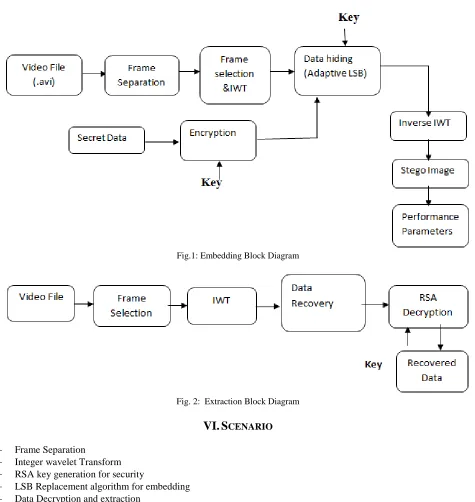
Fig.1: Embedding Block Diagram
Fig. 2: Extraction Block Diagram
VI.
SCENARIO
Frame Separation
Integer wavelet Transform
RSA key generation for security
LSB Replacement algorithm for embedding
Data Decryption and extraction
Frame Separation: A.
An Input Video (.avi files) is converted into still images for processing it and to detect the moving objects. These sequences of images gathered from video files by finding the information about it through „aviinfo‟ command. These frames are converted into images with help of the command „frame2im‟.Create the name to each images and this process will be continued for all the video frames.
Integer Wavelet Transform: B.
IWT decomposes the image into different sub band images, namely, LL, LH, HL, and HH for embedding the messages in the pixel coefficients of sub bands.
LL sub bands contain the significant part of the spatial domain image. High-frequency sub band contains the edge information of input image. Integer wavelet transform can be obtained through lifting scheme. Lifting scheme is a technique to convert DWT coefficients to Integer coefficients without losing information.
Cryptography Technique: C.
Cryptography allows secure transmission of private information over insecure channels (for example packet-switched networks).Cryptography also allows secure storage of sensitive data on any computer.
RSA – Public Key Cryptography
Public key (E) and Modulus N are known to all users
Private key (D) (secret key)
Provides Authentication/Encryption
Signing/Decryption operation
Verifying/Encryption operation
LSB Embedding: D.
A 8-bit gray scale image matrix consisting m × n pixels and a secret message consisting of k bits. The first bit of message is embedded into the LSB of the first pixel and the second bit of message is embedded into the second pixel and so on. The resultant Stego-image which holds the secret message is also a 8-bit gray scale image and difference between the cover image and the Stego-image is not visually perceptible. The quality of the image, however degrades with the increase in number of LSBs. The OPAP algorithm reduces the error caused by the LSB substitution method. In this method the pixel value is adjusted after the secret data is hidden.
Data Decryption and Extraction: E.
Decryption:
1)
De-embed Data: The data is extracted using the data hiding key used for the hiding the data into the image. By using the data hiding a user can access only to the data within the encrypted image.
Data Retrievel:
2)
VII.
OUTPUT ANALYSIS
Fig. 3: Original video frames.
Fig. 4: Encrypted video frames with hidden data.
Fig. 7: Decrypted video frames with hidden data.
VIII.
CONCLUSION
Data hiding in encrypted media is a new topic that has started to draw attention because of the privacy-preserving requirements from cloud data management. In this paper, an algorithm to embed additional data in encrypted H.264/AVC bit stream is presented, which consists of video encryption, data embedding and data extraction phases. The algorithm can preserve the bit-rate exactly even after encryption and data embedding, and is simple to implement as it is directly performed in the compressed and encrypted domain, i.e., it does not require decrypting or partial decompression of the video stream thus making it ideal for real-time video applications. The data-hider can embed additional data into the encrypted bit stream using code word substituting, even though he does not know the original video content. Since data hiding is completed entirely in the encrypted domain, our method can preserve the confidentiality of the content completely. With an encrypted video containing hidden data, data extraction can be carried out either in encrypted or decrypted domain, which provides two different practical applications. Another advantage is that it is fully compliant with the H.264/AVC syntax. Experimental results have shown that the proposed encryption and data embedding scheme can preserve file-size, whereas the degradation in video quality caused by data hiding is quite small.
REFERENCES
[1] W. J. Lu, A. Varna, and M. Wu, “Secure video processing: Problems and challenges,” in Proc. IEEE Int. Conf. Acoust., Speech, Signal Processing,
Prague, Czech Republic, May 2011, pp. 5856–5859.
[2] B. Zhao, W. D. Kou, and H. Li, “Effective watermarking scheme in the encrypted domain for buyer-seller watermarking protocol,” Inf. Sci., vol. 180,
no. 23, pp. 4672–4684, 2010.
[3] P. J. Zheng and J. W. Huang, “Walsh-Hadamard transform in the homomorphic encrypted domain and its application in image watermarking,” in
Proc. 14th Inf. Hiding Conf., Berkeley, CA, USA, 2012, pp. 1–15.
[4] X. P. Zhang, “Reversible data hiding in encrypted image,” IEEE Signal Process. Lett., vol. 18, no. 4, pp. 255–258, Apr. 2011.
[5] W. Hong, T. S. Chen, and H. Y. Wu, “An improved reversible data hiding in encrypted images using side match,” IEEE Signal Process. Lett., vol. 19,
no. 4, pp. 199–202, Apr. 2012.
[6] X. P. Zhang, “Separable reversible data hiding in encrypted image,” IEEE Trans. Inf. Forensics Security, vol. 7, no. 2, pp. 826–832, Apr. 2012.
[7] K. D. Ma, W. M. Zhang, X. F. Zhao, N. Yu, and F. Li, “Reversible data hiding in encrypted images by reserving room before encryption,” IEEE
Trans. Inf. Forensics Security, vol. 8, no. 3, pp. 553–562, Mar. 2013.
[8] A. V. Subramanyam, S. Emmanuel, and M. S. Kankanhalli, “Robust watermarking of compressed and encrypted JPEG2000 images,” IEEE Trans.
Multimedia, vol. 14, no. 3, pp. 703–716, Jun. 2012.
[9] Z. Shahid, M. Chaumont, and W. Puech, “Fast protection of H.264/AVC by selective encryption of CAVLC and CABAC for I and P frames,” IEEE
Trans. Circuits Syst. Video Technol., vol. 21, no. 5, pp. 565–576, May 2011.
[10] M. N. Asghar and M. Ghanbari, “An efficient security system for CABAC bin-strings of H.264/SVC,” IEEE Trans. Circuits Syst. Video Technol.,
vol. 23, no. 3, pp. 425–437, Mar. 2013.
[11] T. Stutz and A. Uhl, “A survey of H.264 AVC/SVC encryption,” IEEE Trans. Circuits Syst. Video Technol., vol. 22, no. 3, pp. 325–339, Mar. 2012
[12] D. K. Zou and J. A. Bloom, “H.264 stream replacement watermarking with CABAC encoding,” in Proc. IEEE ICME, Singapore, Jul. 2010,pp. 117–
[13] D. W. Xu and R. D. Wang, “Watermarking in H.264/AVC compressed domain using Exp-Golomb code words mapping,” Opt. Eng., vol. 50,no. 9, p. 097402, 2011.
[14] D. W. Xu, R. D. Wang, and J. C. Wang, “Prediction mode modulated data-hiding algorithm for H.264/AVC,” J. Real-Time Image Process.,vol. 7, no.
4, pp. 205–214, 2012.
[15] T. Shanableh, “Data hiding in MPEG video files using multivariate regression and flexible macroblock ordering,” IEEE Trans. Inf. Forensics