Abstract. The PHENIX experiment at RHIC has measured the dielectron continuum and theωandφ light vector mesons using hadronic and dielectron decay channels in √
sNN=200 GeV p+p, d+Au, Cu+Cu and Au+Au collisions. Theωandφmesons
expe-rience no strong cold nuclear matter effects but in central heavy ion collisions their yields are suppressed at high pT, extending to intermediate pT for theφ. The comparison of
theωandφsuppression to the suppression of other hadrons suggests parton energy loss for highpT mesons and favors a recombination production mechanism for intermediate
pTφmesons. The dielectron continuum shows a low mass excess in central Au+Au and
Cu+Cu collisions while the p+p and d+Au spectra agree with their respective cocktails. The low mass excess consists of a highpTthermal virtual photon component and a much
larger lowpTcomponent.
1 Introduction
Hadrons produced in relativistic heavy ion collisions provide a mechanism to study the quark gluon plasma. This proceeding discusses PHENIX’sωandφlight vector mesons measurements from both hadronic and dielectron decays and the dielectron continuum spectra that provides access to the ρ spectral function. The light vector mesons (ω,φ,ρ) are predicted to undergo mass and/or width mod-ifications by the medium created in the collision [1] and broadening of theρspectral line shape was measured by NA60 at SPS [2]. The dielectron decays of vector mesons provide electro-magnetic sig-nals without color charge that are not modified by the final state and sample a large time window during the collision’s evolution. With both the dielectron and hadron decay channels of theωandφ, we can extend the transverse momentum,pT, range of the measurements and compare decay channels to identify possible variations due to medium effects.
The nuclear modification factor,RAA, of theωandφin heavy ion collisions provides insight into energy loss and particle production mechanisms.RAA, Equation 1, is the ratio of the heavy ion spectrum to a p+p reference spectrum scaled by the average number of binary collisions,NColl.
RAA(pT)= d
2N
AA/dydpT
NColl/σinelpp
×d2σ
pp/dydpT
(1)
whered2N
AA/dydpTis the differential yield per event in A+A collisions,σinelpp is the total inelastic p+p cross-section, andd2σ
pp/dydpT is the differential p+p cross-section. In heavy ion collisions, a factor of five suppression of theπ0 andηmeson production with respect to the p+p scaled by the average number of binary collisions is seen [3] [4]. Protons [5] and other baryons [6] [7] do not experience this suppression particularly at intermediatepT where they are enhanced relative to binary scaled p+p collisions. Since theωmeson has the same quark content as theπ0but with a larger mass and intrinsic spin, it’s behavior can provide more information on energy loss in the quark gluon plasma. Theφ meson is ass¯state with a mass similar to the proton, it can also answer questions of energy loss and baryon-meson differences.
a e-mail:[email protected]
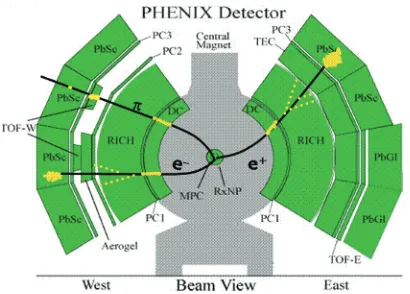
Fig. 1. The beam view of the central arms of the PHENIX detector with example tracks for a positron, an electron, and a charged pion.
First the PHENIX central arm detectors are presented. Then PHENIXωandφmeasurements are discussed. This is followed by PHENIX’s dielectron continuum measurements and a brief conclusion.
2 PHENIX detector
The central arms of the PHENIX detector, shown in Figure 1, consist of two spectrometers each with spanningπ/2 in azimuth and±0.35 in pseudorapidity. Charged particles bent by the magnetic field are tracked in the drift chamber (DC) and first pad chamber (PC1) with a momentum resolution of
δp/p = 0.7%⊕1.1%p [GeV/c] [8]. Two electro-magnetic calorimeters (PbSc and PbGl) measure photons and reconstruct photon pairs fromπ0 andηdecays. Electrons are identified by a Cherenkov ring in the ring imaging Cherenkov detector (RICH) and an electro-magnetic shower in the PbGl and PbSc. Particle identification of charged hadrons is possible using the momentum from the DC and PC1 and the time of flight information from the time-of-flight (TOF) and aerogel detectors. The TOF-East is used for kaon identification in theφ → K+K−channel presented in Section 3. It has a time resolution of 120 ps and aπ/K separation in thepTrange 0.3-2.2 GeV/c [9]. Beam-beam counters and zero degree calorimeters are located around the beam pipe to the north and south of the central arms [10]. They determine the position of the collision along the beam axis and the collision’s centrality, a measure of the collision’s nuclear overlap.
3 The
φ
and
ω
mesons
Theφandωmesons are measured in sNN = √
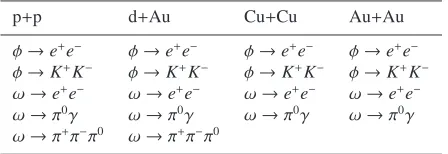
200 GeV p+p, d+Au, Cu+Cu and Au+Au collisions with a variety of decay channels, presented in Table 1. Raw yields are corrected for the acceptance and reconstruction efficiency, embedding efficiency to correct for occupancy effects, trigger bias or efficiency effects, and the decay’s branching ratio. By measuring theφandω pT spectra in different channels the pT range is extended. A smooth transition from the dielectron decays at low pT to the hadronic decays at high pT is seen with overlap in the intermediate pT range where they agree. This agreement is seen in theφfrom 1 to 3 GeV/c in p+p collisions, from 1 to 5 GeV/c in d+Au [11] and Au+Au collisions and in theωfrom 2 to 4 GeV/c in p+p collisions and from 2 to 6 GeV/c in d+Au collisions [12].
3.1 Nuclear modification
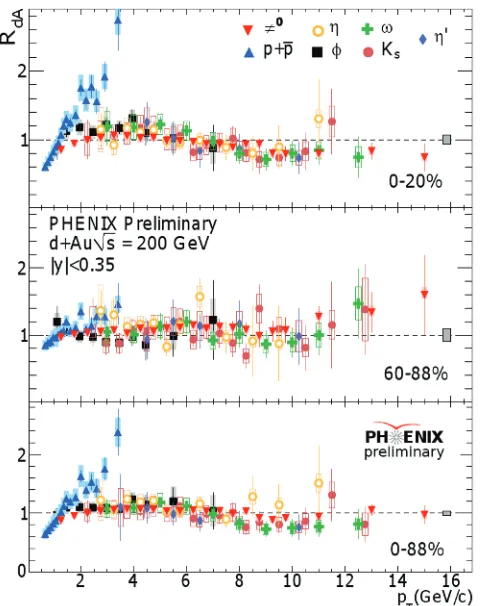
p+p spectrum scaled by NColl, whereNColl is calculated using a Glauber Monte Carlo simulation. When there are no nuclear effects this nuclear modification factor,RAA(Equation 1) orRdA, is one. A nuclear enhancement generates values greater than one and a suppression leads to values of less than one. TheRdAquantizes the cold nuclear matter effects in d+Au collisions relative toNColl-scaled p+p. Figure 2 shows theRdA as a function ofpT forωandφmesons in central 0-20%, peripheral 60-88% and minimum bias (MB) d+Au collisions. For comparison these are shown withRdAforπ0,η,η’,KS and protons. No strong cold nuclear matter effects are seen for theωorφmesons. No meson species dependence ofRdAis seen within the uncertainties. The peripheral d+Au meson spectra are consistent with theNCollscaled p+p spectra. For central d+Au collisions at intermediatepT, there is little to no Cronin enhancement ofω,φandπ0mesons. A small suppression ofωandπ0atp
Tabove 8 GeV/c is seen. The highpTRdAbehavior of theωandπ0mesons suggests that there may be a small energy loss at the parton level given the similarity of theRAAdespite different meson masses [12].
Heavy ion collisions considerRAAto identify modifications from the hot dense plasma created in the collision. Figure 3 presents theRAAofφandωmesons in central Au+Au collisions as a function ofpT. Theπ0,η,K+, J/ψ, direct photon, proton and non-photonic electrons are shown for comparison.
π0 andη mesons have a factor of five suppression at high p
T. At pT above 5 GeV/c, the φandω mesons show a flat suppression coincident withπ0 suppression. As thep
T is lowered theRAAof the
φincreases, the intermediatepT behavior of theφis similar to what is seen forK+, another strange quark meson [5].
The suppression patterns seen in the central Au+Au collisions are also apparent in mid-central Au+Au and Cu+Cu collisions. TheRAA as a function of pT in Cu+Cu and Au+Au collisions are compared for systems with the same number of participating nucleons, NPart. The suppression of the ωat high pT agrees with the level ofπ0 suppression in both Cu+Cu and Au+Au collisions at intermediateNPart. Similarly, in intermediateNPartCu+Cu and Au+Au collisions, theφsuppression at intermediatepT, 2-5 GeV/c, remains above theπ0and below the proton. AtpT above 5 GeV/c for the same collisions, theφsuppression agrees with theπ0suppression. For both intermediatep
T φand highpT ωtheNPartdependence of the integratedRAA is consistent in Cu+Cu and Au+Au collisions despite different collision geometries.
In peripheral collisions,ωandφmesons are consistent with binary scaling. Theφis also consistent with a small enhancement seen in the peripheral protonRAA[11]. The integratedRAAfor highpT ω mesons as a function ofNPart shows that the suppression starts at a NPart of 34 and increases with
NPart, a trend similar to theπ0 andη suppression. This highpT RAAvs NPart dependence is fit with a fractional energy loss function,RAA = (1−S0NParta )n−2, with the n parameter fixed to eight. The resultingaparameter is consistent with PQM [13] and GLV [14] model predictions of a roughlyN2Part/3
dependence. The similar suppression patterns seen inπ0,η andω mesons at high p
T suggests that energy loss in the medium occurs at the parton level [15].
Fig. 2.TheRdAvspT for particles in 0-20%, 60-88% and MB (i.e. 0-88%) d+Au collisions.π0,η,η,ω,φ,KS
andp+p¯are shown. The grey band around one provides the systematic error on theRdAfrom the uncertainty in
NCollfor each plot.
(GeV/c) T p
0 2 4 6 8 10 12 14 16 18 20
AA
R
0 0.2 0.4 0.6 0.8 1 1.2 1.4 1.6 1.8 2 2.2
2.4 = 200 GeV, 0-10% most central
NN s PHENIX Au+Au,
0-5% cent (arXiv:1205.5759)
γ
direct
(PRL101, 232301) 0
π
(PRC82, 011902)
η
(PRC83, 024090)
φ
p (PRC83, 064903)
0-20% cent. (PRL98, 232301)
ψ
J/
0-20% cent. (PRC84, 044902)
ω
(PRC84, 044905) HF
± e
(PRC83, 064903) +
K
Fig. 3.TheRAA vs pT for various
parti-cles in Au+Au central collisions. Theπ0,
in the mass spectrum due toρmodification can be identified. Since the dielectron continuum contains information collected over the full time evolution of the medium, additional physics signals are present in the dielectron continuum. These include direct virtual photons, hadron Dalitz (π0,η,η’) and leptonic (ω,φ, J/ψ) decays, and correlations from electron-positron pairs resulting from semi-leptonic decays of open heavy flavor mesons correlated by the pair production of heavy quarks.
4.1 Cocktail
A reference cocktail of the expected hadronic sources is generated to compare the data to the expected physics signals. This is done using EXODUS, a hadronic decay generator. EXODUS handles the decay kinematics for two- and three-body hadron decays and the dielectron pair spectrum is determined. It is parameterized with measured PHENIX data including meson-to-pion ratios and a fit to the pionpT spectrum with a modified Hagedorn exponential, Equation 2 where A, a, b, n, andp0are fit parameters [16].
Ed
3σ
dp3 =A
e−(apT+bp2T)+pT/p0
−n
(2)
ThepT spectra of the other mesons are extrapolated assumingmTscaling. ThemTscaling assumption is confirmed for theφbut deviations are seen at the higher mass J/ψ; the measured J/ψpT distribution is used instead. Additionally, meson-to-pion ratios are adjusted to reflect the suppression measured in heavy ion collisions and the J/ψandψ’ line shapes are altered to include radiative tails. The PHENIX cocktail includes electron-positron pairs from vacuumρdecays; additional dielectron yields due toρ production viaπ-πannihilation are not included.
Dielectron correlations in the mass spectrum from heavy quarks and Drell-Yan are calculated with PYTHIA. In the p+p case, the dielectron spectrum is precise enough to subtract the hadronic com-ponents and measure the charm cross section. A charm cross section of 544±39(stat)±142(sys)±
200(model) μb was determined by fitting the PYTHIA line shapes for the charm and bottom and
Drell-Yan components [17]. This agrees with the non-photonic single electron cross section of 567± 57(stat)± 193(sys) μb [18]. The heavy quark and Drell-Yan line shapes in p+p are scaled by the average number of collisions,NColl, for d+Au, Cu+Cu and Au+Au collisions. As a comparison a ran-domly correlatedc−c¯spectrum is also generated using the PYTHIA single electronpTspectrum and a randomly oriented opening angle between the electron-positron pairs [16]. The hadronic components from EXODUS and the heavy quark and Drell-Yan correlations are filtered in to the ideal PHENIX acceptance.
4.2 Analysis
parent hadron and are not included in the hadronic cocktail generated by EXODUS. These pairs, from pion double Dalitz decay andη→πππdecays with multiple pion Dalitz decays, are considered back-ground and can be statistically subtracted from the analysis. The like- and unlike-sign line shapes of these decays are simulated using an EXODUS-like code that is able to make pairs from multiple electron-positron pair decay chains. Jets are the remaining source of background since multiple pions within a jet may Dalitz decay creating lepton pairs that are correlated through the jet kinematics. The jet background is simulated using PYTHIA. Both the jet and double Dalitz backgrounds create unlike-and like-sign pairs at the same rates as a result of the pair production of leptons.
The combinatorial, double Dalitz and jet backgrounds can be removed with either of two subtrac-tion methods. This first method is a component by component subtracsubtrac-tion that uses the like-sign pairs to find the relative contributions of the three remaining backgrounds. The simulated backgrounds are then subtracted from unlike-sign spectrum. The second background subtraction method is like-sign subtraction where an acceptance correction has been applied to the like-sign pairs. This is done by adjusting the like-sign pair spectrum differentially in mass and pair pT to mimic the unlike-sign pair acceptance and then subtracting the like-sign pairs from the unlike-sign pairs. In p+p, Cu+Cu and Au+Au these two subtraction methods are performed separately and are consistent. The d+Au results are obtained with the acceptance corrected like-sign subtraction method.
After the backgrounds are subtracted the spectrum is corrected for the reconstruction efficiency and gaps in the ideal PHENIX acceptance. In the p+p and d+Au spectra a trigger efficiency correction is also applied.
4.3 Results
The dielectron mass spectra in sNN = √
200 GeV MB d+Au and Au+Au collisions are shown with their cocktails in Figure 4. The p+p and d+Au spectra agree with the cocktail within the systematic errors. No new cold nuclear matter effects are seen in the MB d+Au dielectron spectrum [19]. The MB Au+Au spectrum contains an enhancement above the cocktail in the low mass region, 0.15-0.75 GeV/c2, by a factor of 4.7±0.4(stat)±1.5(sys) [16]. Below each of these spectra the ratio of the data to the cocktail is shown. This ratio verifies that the known signals are in good agreement with the cocktail, particularly for theπ0and the J/ψwhere the signal-to-background ratio is large. Often when theπ0or J/ψare not in agreement with the cocktail this is the result of incorrect efficiency and dead area corrections that effect the entire spectrum.
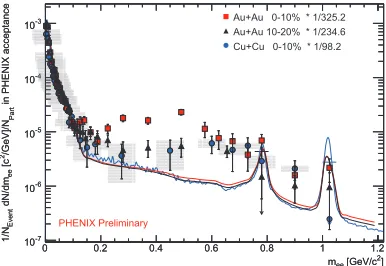
The 0-10% Cu+Cu and 0-10% and 10-20% Au+Au show an excess above the cocktail in the low mass region providing information on the onset of the excess [20]. Figure 5 allows for a shape comparison of the excess in 0-10% Cu+Cu and 0-10% and 10-20% Au+Au by overlaying these spectra scaled by 1/NPart. This excess increases at a rate faster thanNPart2 [16].
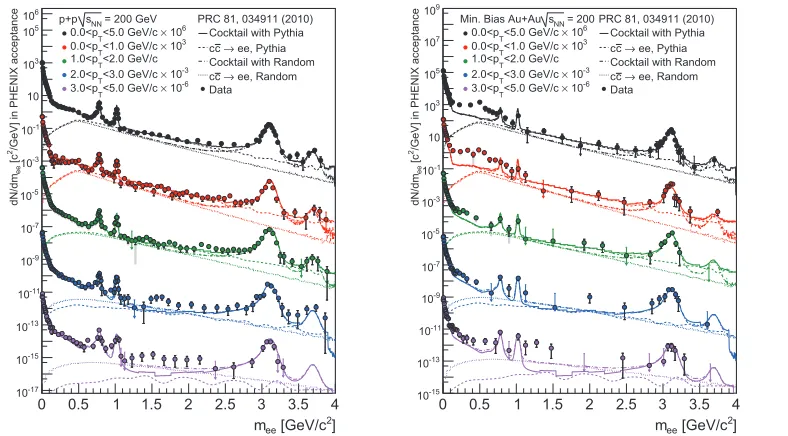
To further study the dielectron continuum, the mass spectrum is considered in differentpT ranges, as seen in Figure 6. The p+p spectrum at low pT matches the cocktail well. The MB Au+Au and 0-10% Cu+Cu (not shown) spectra show the majority of the low mass excess is located at low pairpT. At highpTand intermediate mass, between theφand J/ψ, the p+p, Cu+Cu and Au+Au data points are above the cocktail with the PYTHIAc−c¯component (solid line) and the cocktail with the randomly associatedc−c¯component (dash-dot line). This discrepancy may be because the single electronpT spectra does not agree with the PYTHIA pT spectra, because theb−b¯component is not included, or because of additional thermal photon contributions. At low mass and high pT a slight excess in p+p and larger excesses in the Au+Au and Cu+Cu spectra are seen. Since the mass of the pair is much smaller than the pair pT, this excess may be attributed to virtual thermal photons that convert into dielectron pairs.
Virtual photons are produced in the same processes that generate real photons. When the mass is much less than the pT, a virtual thermal photon component follows, d2Nee/dmeedpT ∝ 1/mee
dNγ/dpT. The thermal photon component is modeled in EXODUS, filtered into the PHENIX accep-tance including dead areas and smeared by the PHENIX resolution. The thermal photon contribution is obtained by fitting the data in the mass region, 0.15-0.3 GeV/c2, for differentp
dN/dm
-7 10
-6 10
) 2 (GeV/c ee m 0 0.5 1 1.5 2 2.5 3 3.5 4 4.5
Data/Cocktail 10-1 1 10
Fig. 4.The MB d+Au and Au+Au dielectron spectra compared to their respective cocktails. Under each plot the ratio of the data to the cocktail is shown.[16][19]
] 2 [GeV/c ee m 0 0.2 0.4 0.6 0.8 1 1.2
in PHENIX acceptance
Part
/GeV]/N
2
[c
ee
dN/dm
Event
1/N 10-7 -6 10
-5 10
-4 10
-3
10 Au+Au 0-10% * 1/325.2Au+Au 10-20% * 1/234.6
Cu+Cu 0-10% * 1/98.2
PHENIX Preliminary
] 2 [GeV/c ee m 0 0.2 0.4 0.6 0.8 1 1.2
in PHENIX acceptance
Part
/GeV]/N
2
[c
ee
dN/dm
Event
1/N 10-7 -6 10
-5 10
-4 10
-3 10
Fig. 5.The dielectron mass spectra for central heavy ion collisions scaled by the inverse of theNPart. The
0-10% Au+Au are shown as red squares, the 10-20% Au+Au are shown as black triangles and the 0-10% Cu+Cu are shown as blue circles. The scaled cock-tails for each of these spectra are presented in their respective colors.[16] [20]
d+Au, Cu+Cu and Au+Au spectra. The small excess at low mass and high pT in p+p collisions is fully described by a direct photon component that is consistent with NLO pQCD calculations. In MB Au+Au the thermal photon measurement is extrapolated to find the initial temperature of the fireball, projecting values of 300 to 600 MeV for thermalization times of 0.6 to 0.15 fm/c respectively [21].
The low mass region of the MB Au+Au dielectron continuum contains more modification than a photonic source can describe. A second source of mass modification exists at low mass and lowpT. The effective temperature of this low mass, lowpTexcess can be extracted by fitting themT−m0spectra in the mass region 0.3-0.75 GeV/c2after the data has been corrected into the full 2πangular acceptance, as seen in [16]. ThemT spectrum has a kink with a much softer component below 0.6 GeV/c2 and a harder trend above 0.6 GeV/c2corresponding to the two sources of the excess in this mass region. Fitting the low massmT spectrum with two exponentials or an exponential plus the thermal photon component results in low effective temperatures of 92.0±11.4±8.4 MeV and 86.5±12.7+11
−28.4MeV below 0.6 GeV/c2. This suggests that the excess below 0.6 GeV/c2, which is the majority of the excess, is very soft with a low effective temperature[16].
]
2
[GeV/c
ee
m
0 0.5 1 1.5 2 2.5 3 3.5 4
/GeV] in PHENIX acceptance
2 [c ee dN/dm -17 10 -15 10 -13 10 -11 10 -9 10 -7 10 -5 10 -3 10 -1 10 10 3 10 5 10 6
10 p+p sNN = 200 GeV 6 10 × <5.0 GeV/c T 0.0<p 3 10 × <1.0 GeV/c T 0.0<p <2.0 GeV/c T 1.0<p -3 10 × <3.0 GeV/c T 2.0<p -6 10 × <5.0 GeV/c T 3.0<p
PRC 81, 034911 (2010) Cocktail with Pythia
ee, Pythia
→
c c
Cocktail with Random ee, Random → c c Data ] 2 [GeV/c ee m
0 0.5 1 1.5 2 2.5 3 3.5 4
/GeV] in PHENIX acceptance
2 [c ee dN/dm -15 10 -13 10 -11 10 -9 10 -7 10 -5 10 -3 10 -1 10 10 3 10 5 10 7 10 9 10
= 200 GeV NN s Min. Bias Au+Au
6 10 × <5.0 GeV/c T 0.0<p 3 10 × <1.0 GeV/c T 0.0<p <2.0 GeV/c T 1.0<p -3 10 × <3.0 GeV/c T 2.0<p -6 10 × <5.0 GeV/c T 3.0<p
PRC 81, 034911 (2010) Cocktail with Pythia
ee, Pythia
→
c c
Cocktail with Random ee, Random
→
c c Data
Fig. 6.The dielectron mass spectra of p+p and MB Au+Au in the pairpT ranges: 0-5 GeV(¸black), 0-1 GeV/c
(red), 1-2 GeV/c (green), 2-3 GeV/c (blue) and 3-5 GeV/c (purple). The data are compared to their cocktail of the hadronic and charm contributions. A second cocktail using a randomly orientedc−c¯contribution is also shown as a dash-dot line.
use a chiral reduction formalism in vacuum and medium modifications are caused by of the hydrody-namic evolution. Cassing and Bratkovskaya applies a microscopic relativistic transport model. None of these theories are able to describe PHENIX’s large low mass excess in MB Au+Au, particularly in the lowpT region.
The STAR collaboration has measured the dielectron continuum in p+p and Au+Au collisions [27] [28]. The p+p results are consistent with the STAR cocktail within systematic uncertainty. STAR’s MB Au+Au preliminary results have a smaller excess over the STAR cocktail in the low mass region, a factor of 1.53±0.07(stat)±0.41(sys) compared to the cocktail without theρmeson [28]. One issue when comparing STAR and PHENIX’s excesses is the different acceptances in azimuth and rapidity of the two measurements. Another concern is the differences in the respective cocktails. STAR’s cocktail excludes theρmeson, while PHENIX’s cocktail includes it. The STAR cocktail uses a much larger the charm cross section, 0.92±0.10(stat)±0.26(sys) mb [27], which is almost twice the amount used in the PHENIX cocktail. These different cocktails are worrisome when interpreting results in the low mass region where theρis located and the correlated charm component peaks.
5 Conclusion
Theφandωmesons are suppressed in central and mid-central heavy ion collisions in thepTranges 4-7 GeV/c and 4-11 GeV/c respectively. They experience no strong cold nuclear effects in d+Au collisions. In central Au+Au collisions, the high pT ωandφare suppressed by a factor of five and coincide with theπ0suppression patterns. This suggests that the meson suppression at highp
and cocktails with the same charm cross section are necessary. PHENIX’s silicon vertex detector will help determine the correlated heavy quark contribution from data by identifying off-vertex electrons from open heavy flavor meson decays [30].
References
1. R. Rapp, Phys. Rev. C63(2001) 054907
2. R. Arnaldi et al., Phys. Rev. Lett.96(2006) 162302 3. A. Adare et al., Phys. Rev. Lett.101(2008) 232301 4. A. Adare et al., Phys. Rev. C82(2010) 011902 5. A. Adare et al., Phys. Rev. C83(2011) 064903 6. J. Adams et al., Phys. Rev. Lett.92(2004) 052302 7. J. Adams et al., Phys. Rev. C71(2005) 064902
8. K. Adcox et al., Nucl. Inst. and Meth. A499(2003) 489 9. M. Aizawa et al., Nucl. Inst. and Meth. A499(2003) 508 10. M. Allen et al., Nucl. Inst. and Meth. A499(2003) 549 11. A. Adare et. al., Phys. Rev. C83(2011) 024909 12. S. S. Adler et. al., Phys. Rev. C75(2007) 051902 13. C. Loizides, Eur. Phys. J. C49(2007) 339
14. M. Gyulassy, P. Levai and I. Vitev, Phys. Rev. Lett.85(2000) 5535 15. A. Adare et. al., Phys. Rev. C84(2011) 044902
16. A. Adare et. al., Phys. Rev. C81(2010) 02391 17. A. Adare et. al., Phys. Lett. B670(2009) 313 18. A. Adare, Phys. Rev. Lett.97(2006) 252002
19. Jason Kamin for the PHENIX Collaboration, J. Phys. G: Nucl. Part Phys.38124181 20. Sarah Campbell for the PHENIX Collaboration, J. of Phys: Conf. Series230012034 21. A Adare et. al., Phys. Rev. Lett.104(2010) 132301
22. W Lui and R. Rapp, Nucl. Phys. A796(2007) 101 23. Ralf Rapp, AIP Conf. Proc.1322(2010) 55
24. K. Dusling and I. Zahed, Nucl. Phys. A825(2009) 212
25. E. L. Bratkovskaya, W. Cassing and O. Linnyk, Phys. Lett. B670(2009) 428
26. O Linnyk, W. Cassing, J. Manninen, E. L. Bratkovskaya and C. M. Ko, arXiv 1111.2975 27. L. Adamczyk et al., arXiv:1204.1809