A FURTHER STUDY OF OPINIONS OF ESSEX
PRIMARY TEACHERS ABOUT RELIGIOUS EDUCATION AND SCHOOL ASSill•illLY IN THE CONTEXT OF
CONTEMPORARY CONTROVERSY
VOLill1E II : Appendices
Bernard George Burgess Ph. D. Thesis
Institute of Education University of London
C 0 N T E N T S
PAGE
Appendix 1: ·Text of the Essex questionnaire for
the previous study (B.G. Burgess, 1975),
and Response Frequencies
3
Appendix .2: Text of the Pilot Questionnaire for the
present study, and response frequencies
7
Appendix
3:
Covering letter, with Final Questionnaire 12Anpendix
4:
The Data 19APPENDIX 1
The text of the Essex Questionnaire for the previous study (B.G. Burgess, 1975) and Response Frequencies
1. Age: Please place a tick by the age-group of which you
are today a member: (Frequency)
A. Over 21 but not yet 26 52
B.
Over 26 but not yet 31 21c.
Over 31 but not yet 41 81 D. Over 41 but not yet 51 53 E. Over 51 but not yet 61 48 F. Over 61 but not yet 71 4 2. Sex: Please place a tick in the A. JYiale 63appropriate space: B. Female 196
3.
For Head Teachers: If you are a Head Teacher please place a tick in the appropriate space:A. Head of Infant School
7
B. Head of Junior School 5
C. Head of Inf. · & Junr. Sch. 20
4.
For Class Teachers (Including teaching Heads)(Please tick the appropriate space) A. Infant class 92 B. Junior class 135
C. Inf. & Junr. 7 5. Size of School:
A. ·1- 40 children 2
B. '41- 100 It 17
c.
101- 200 II 42D.
201- 300 It 78E. 301- 500 n 108
F. 501- 700 n 10
G. 701-1000 n 1
6. Collective Worship
The Education Act, 1944, provides that,. subject to the right of parents to withdraw their children, the school day in every county school and in every voluntary school shall begin with collective worship. Please tick One answer which best corresponds
to your own opinion on this provision of the Act concerning collective worship in primary
schools.
A.
I strongly agree with it.B.
I am in general agreement with it.c.
I do not know.D. I a 'II rather inclined against it. E. I am strongly inclined against it.
7. Please give briefly youx· reasons for your answer to question 6, and explain what general changes, if any, you would wish to be made in the law concern-ing collective worship, and in the act of collect-ive worship as you have experienced it.
8. Religious Education
The Education Act, 1944, provides that, subject to the right of :parents to withdraw their children, Religious Education shall be given in every county school and in every voluntary school.
Please tick ONE answer which best corresponds to your own opinion on this provision of the Act concerning religious education in primary schools ..
A.
I strongly agree with it.B. I am in general agreement V.li th it. n T do not know
...
./..D. I am rather inclined against it. E. I am strongly inclined against it. 9. ~~~at do you take to be the purpose or purposes of
Religious Education as intended by Parliament in the Education Act of 1944? Please tick ru"'ly of the &"'lswers which you think reflect what Parliament intended Religious Education to achieve.
To convert children to Christianity.
~o encourage certain moral attitudes.
70 130 2 36 19 35 178 A. B~
c ..
D.E.
To help children to make up their own mlnas about religion and
To teach a knowledge of the Bible. morals. 112 132
G.
To nurture an important aspect of
children's growth. To transmit an important element of the
cultural heritage. Other purposes, namely •••••
10. Agreed Syllabus of Religious Education
The· Education Act, -l944, provides that religious instruction in county primary schools and in controlled primary schools shall be given in accordance with an Agreed Syllabus approv.ed by an advisory council constituted by each local
education authority.
Please tick ONE answer which best corresponds to your own opinion about this provision of the Act, concerning an Agreed Syllabus.
A. I strongly agree with it.
B.
I am in gene.ral agreement with it.c.
I do not know.D. I am rather inclined against it. E. I am strongly against it.
11. \ihich of the following statements best describes your own opinion concerning the Agreed Syllabus of your local education authority?
A. I am very satisfied with it. 11
B.
I am satisfied with it on the whole. 100 C. I have no definite opinions about it. 38 D. I am rather dissatisfied with it. 56 E. I am very dissatisfied with it. 22 12 If you have any further comments about the AgreedSyllabus please make them here. (Teachers in Aided Schools may, in addition, like to comment on the suitability of the syllabus in use in their schools.)
13. Have you ever asked, on conscientious grounds, to be excused from giving lessons in Religious Education in a County primary school, or in a Controlled
pximary school?. Please tick ONE statement. A.
B.
Yes No 14. Do you yourself at present give ReligiousEducation in your school?·
A.
B. Yes No
15. \'/hat changes, if any 7 il'rould you like to be made
in the law and general practice concerning Religious Education?
16. (Please do not answer questions 16 and 17 unless you yourself at present give Religious Education in your school).
What ppecial difficulties, if any, do you encounter in glving Religious Education? If none, please write 'I-TONE'
17. If you yourself at present give Religious Education in your school, please tick the answer or answers below which correspond to your own aims in teaching the subject.
247 9
240 19
A. To convert children to Christianity. 14 B. To encourage certain moral attitudes. 163
c.
To help children to make up their own mindsabout religion and morals. 139
j)
.
To teach a knowledge of the Bible. - 126E. To nurture an importa~t aspect of
children's growth. 124 F. To transmit an important element of the
cultural heritage. 77
18. All Teachers
Do you think that Religious Education should be replaced by any other form of education?
Please tick ONE of the ansv1ers.
A. Yes B. No
C. Don't know If you wish to amplify your answer
to this question please do so here •.••
19.
Religious Beliefs and PracticePlease tick the statement below which best describes your own position:
28 202 24
A. I am a practising member of a Christian Church. 139 B. I am a practising member of another religion. 1
C. I am inclined towards Christianity, but am not
a practising member of a Church. 66 D. I have religious beliefs, but am not inclined
to Christianity in particular. 14
E. I have no religious beliefs. 9
F. I a."l!l an agnostic. 11
G. I am an atheist. 5
H. Other description, namely.... 14
APPENDIX 2
The text of the Pilot Questionnaire for the present study (B.G. Burgess, 1978) and Response Frequencies
(See Vol. I, p. 86)
1. Age: Please indicate the age-group of which you are today a member, by making a ring around the appropriate box.
1. Not yet 31 32
2. Over 31 but not yet 41. 3
3. 41 or over 0
2. Sex:
1. Hale 2. Female 3. Teaching Position:
4. Teaching Duties:
5. Size of Sch~dl:
1. Not a Head Teacher. 2. Head of Infant School. 3. Head of Inf.
&
Jr. School. 4o Head of Junior School.1. Non-teaching Head. 2. Infant class.
3. InfaDt and Junior class. 4. Junior class
1. 300 children or less. 2. 301 or more.
6. Status of Scnool:
1. Voluntary Aided School 2. County, or Vol. Controlled 7. Situation:
Please indicate whether your school is within a
New Tovm or not.
1. Inside Ne\v To\vn boundary. 2. Outside New Town boundary.
8. Collective Worship: The Education Act, 1944, provides that, subject to the right of parents to withdraw their children, the school day in every county school and in every voluntary school shall begin with collective worship. Please select O}ffi answer which best
corresponds to your ovm opinion on this provision of
2
33
35
0 0 0
0
12
0
23 24 11
5 29
24
11
the Act concerning C'Ollective worship in primary schools.
1. I strongly agree with it. 5
2. I am in general agreement with ito 22
3. I do not know. 2
4. I am rather inclined against it. 6
Opinions about Scho.ol Assemblies
Agree Neutral Disagree 9. I think that some form of school
assembly is desirable. If you anm'le:-ed Agree to 9 please ans\·rer questions 10-14 below. Otherwise, pass on to question 15.
10. A school assembly should be held
35
every day. 8 11. A school assembly should be held
al\..;ays at the beginning of the day. 11 12. A school assembly should always
include collective worship. 10 13. A school assembly should not
necessarily include collective
\vorship. 24 14. A school assembly should never
include collective worship. 0
Opinions about collective uorship 15. Collective worship is primarily
concerned with the adoration of a Supreme Being.
16. Collective worship is primarily concerned with corporate reflect-ion on the shared values and ideala of society.
17. Collective worship can help to make a sound foundation for the work of the school.
18. Collective worship is a meaning-less exercise for most children. 19. Collective worship should be
conducted only by a convinced religious believer.
20. Collective worship is a form of undesirable brain-washing. 21. Collective vrorship i.s an important
part of children's education. 22. Collective worship should be held
only for those children whose parents specifically request it=
11 19 17 7 1 1 0 22 5
0 0
15 12
8 16
5 20
4 7
10 25
10 14
10 6
12 6
10 18
7 17
9 26
9 4
23. Religious Education: The Education Act, 1944, provides that, subject to the right of parents to withdra"~:l
their children, Religious Education shall be given in every county school and in every voluntary school. Please select ONE answer which best corresponds to your own opinion on this provision of the Act
concerning religious education in primary schools.
1 • I strongly agree with it.
2. I am in general agreement with it. 3. I do not know.
I.
..,..
I am rather inclined against it.5.
I am strongly inclined against"-l-l v. 24. Agreed Syllabus of Religious Education
The Education Act, 1944, provides that religious instruction in county primary schools and in controlled primary schools shall be given in accordance with an Agreed Syllabus approved by an advisory council constituted by each local education authority.
·1 .. I strongly agree with it.
2. I am in general agreement with it. 3. I do not k.'low.
4 .. I am rather inclined against it.
5.
I am strongly against it.25. l'ihich of the following statements best describes your ow-n opinion concerning the Agreed Syllabus of your local education authority?
1 • I am very satisfied with it.
2. I am satisfied with it on the whole. 3 .. I have no definite opinions about it. 4. I am rather dissatisfied with it.
5.
I am very dissatisfied with it.(No reply: 6)
6 22 0 7 0 1 17 3 10 4 0 8 18 3 0
Oninions about R.E. Agree Neutral Disagree
26. R.E. of some kind is a desirable element of any syllabus of primary
education. 31
27. R.£. of any kind should be excluded from the primary school curriculum. 0
28. The object of R.E. should be to
bring children to the point of commit-ment to a religious belief. 0 29. R.E. should be confined to the
communication of information about
religion. 12
3 1
2 32
5
29
Agree Neutral Disagree 30. R.E. should give the child an
appreciation of various religious and non-religious stances for living, without promoting any particular
stance. 30
31. R.E. should be given only by a convinced religious believer. 32. R.E. could be given by a..YJ.y
competent teacher, irrespective of his/her religious beliefs.
33. Have you ever asked, on conscien"tJ.ous grounds, to be excused from giving lessons in Religious Education in a County primary school, or in a
Controlled primary
school-34. Do you yourself at present give Religious Education in your school?
3
23
2
8
7
Yes No
3 32
18 16
In Aided schools and in so~e Controlled schools, R.E.
syllabuses approved by the foundation (church) manager may be in us~.. The t·wo follovring questions (for ALL teachers) are concerned with the .Agreed Syllabus of R.E: at present; approved for use in County schools and Controlled schools.
35. Have you read the syllabus of religious education for Essex? (i.e. the 'West Riding' syllabus)
36. Have you read a recent Essex supplement to the Syllabus, entitled 'Interchange'?
Yes No
2 33
0 35
3 23
4
If you have any comments on 'Interchange' please write them below ••.••.••••••
Wnether or not you approve of (or carry out) religious education, please indicate your OVJN opinions concerning the desirability of the following possible teaching aims within the context of your own school.
Agree Neutral Disagree 37. To encourage concern for the
welfare of others. 35 0 0
38. To make knm.-m the Christian faith. 15 15 5 39. To promote tolerance of the religious
Agree Neutral Disagree 40. To encourage children to pray. 6 16 13 41. To encourage children to make up their
o\m minds about religion. 31 2 2
42. To build up the Christian faith of
the children. 4 18 13
43. To encourage children to form their
own moral judgements. 33 2 0 44. To impart a knowledge of the Bible. 16 12 7 45. To counteract a materie.listic
approach to living. 17 14 4
46. To encourage children to
worship God. 5 16 14
47. To encourage a critice.l approach
to all beliefs. 29 5 1
48. Religious Beliefs and l'racti.ce
.t'lease select the statement below which best describes your 0\'ln position.
Number
1
..
I 8lil a practising member of a Christ ia.rJ. Church.2. I am a practising member of another religion. 3. -r·
am inclined towards Christianity, but am not J.
a practising member of a Church. 4. I have religious beliefs, but am not inclined
12
0
14 to Christianity in particular. 3
5.
I have no religious beliefs.3
6. I am an agnostic.
7~ I a~ an atheist.
8. Other description, namely •••.•••
In the last two questions teachers are invited to explain their particular point of view more fully th~~ is possible in the ~~swers to the earlier questions. Please feel free to answer fully or briefly as you wish. If you have had
2
0
1
any particular problems in completing this pilot questionnaire it will useful to know about them, so that amendments may be made to the final questionnaire.
49. If you yourself give religious education please describe your teaching methods and any problems you face in
teaching this subject. Outline what special resources are available. to you in terms of facilities or personnel. 50. imat do you think should be the future of assembly and
Essex County· Council
EDUCATION DEPARTMENT
Covering letter with Final Questionnaire
PO Box 47 Threaar.eedle House Market Road Chelmsford CM11LD
J A Springett MA
County Education Officer
telephona 67222 ext 27o6 date September
1977
our ref S.8.PS your ref
Dear Sir or Madam
Attention nationally and locally is constantly drawn to the need to help primary schools in their provision of Religious Education. In order to establish the realities of the present situation, a.:P.d to enable the County Support Services to use their resources in the best possible way to help schools, we are seeking your co-operation in a two-part survey, each two-part complementary to the other.
One part, devis·ed by the Standing Advisory Council for Religious Education~
is particularly concerned with ai~~, schemes of work and resources.
~e other, dealing particularly with teachers' attitudes to R.E.,
is the responsibility of a researcher at Lov~on University Institute of Education, who has agreed to report his general fir~ings to the Council.
The recipients of the questionnaires have been selected by a process of random sampling, which is why we are-·asking you to assist in the investigation. We are aware that it is yet a.TJ.other demand upon your energies and time, but it is important that we have replies from every one of the sample in order to draw conclusions that will be valid and valuable. You will notice that the questionnaire is completely anonymous, and any information will be treated as-entirely confidential. Whichever questionnaire you receive we hope that
you will use the opportunity which is provided to give your own personal views concerning the issues involved, using additional sheets of paper if necessary.
It would be appreciated if you could return the completed questionnaire not later th~~ 30 November, ~Jt earlier if possible.
Tha~~ you for your help in thi~ matter. The Council will make the
findi:r>.gs a··:ailable to teachers through R.E. News, which is distributed to every school in the County.
Yours truly
?£Stvut-P.J.~
Senior Inspector
1. Year o~ Birth: Please indicate the year o~ your birth by completing the ~igures in the box.
>
Male (I]
2. Sex: Please indicate, by making a ring around the appropriate box.
@)
4,...F_e_m_a_l_e~_l2~·-l _~
e.g. 3. Teaching Position:
Please indicate by ringing around the appropriate box.
4. Teaching Duties:
Please indicate by ringing around the appropriate box.
5. Size cf School:
I
Il
1
Not a Head Teacher Head 0~ Infant School Head of lnf. & Jr. School Head 0~ Junior School
Non-teaching Head Teach Infant class Teach Inf. & Jr. class Teach Junior class
Please ring around appropriate l
!
300 children or less box. 11 301 children or more
I ________ _
6. Stat us of School: ,----··-·---·---; Please ring around
appropriate box.
/ Voluntary Aided School
I
I
Voluntarv Controlled Sch.~ounty S~hool
7 G Situation:
r---Please indicate vvhether your i Inside New Town boundary
school is viiithin a Nev; Town or i
m
not (i.e. Basildon or Harlow)
·~-~~ts~-~~-~~w
__ T_o_-v,_m _ _ _~~---~1_2_1
__8. Collectlve Worship:
The .Dducation Act, 1944, prov~de.s that, subject to the right of' parents to withdraw their children, the school day in e~
county school and in every volunta~ school shall begin with collective worship.
Please select ONE answer which best corresponds to your own opinion on this provision of the Act concerning collective worship in primary schools.
(Please ring around
appropriate box.j
I strongly agree with
.
l.v. .._I am in general agreement
I do not know.
--rTil
with i t .
0
I
f31
~
I am rather inclined against it. ;4; - · -'
I am strongly inclined against it.
0 inions about School Assemblies: Please elaborate your own views about school assemblies with or without collective \'J"Orship} by ringing around ONE of the three options after EACH of the following statements:
1~UTRAL DISAGREE
9 • I think that some form of
school assembly is desirable ..•...•..
[[1
13, 1If you answered 'Agree' to 9 please answer questions 10-14 below. OTHERWISE, pass on to question 15.
10. A school assembly should be held every day
11. A school assembly should be held always at the beginning of the day ••
12. A school assembly should always include collective worship •. 13. A school assembly shoul~ not necessarily include collective worship.
14. A school assembly should never include collective worship.
~ 111
I 11
f
1I
[!]
' l t
f2l
w
!21 ,__ @]
[gJ
@]'~
13! ...__,! 21 131 I
OPINIONS ABOUT COLLECTIVE V!ORSHIP: Please elaborate your own views about collective worship byringing around OUE of the three options after EACH of the following statements: ;---.
14
4 15
4 16 4 17
4 le
4 19
AGREE :NEUTRAL DISAGREE 15. Collective worship is essentially
concerned with the adoration of a
Supreme Being ••..•.•.
16. Gollective worship is essentially
concernec~ with corporate reflection on
the shared values and ideals of society.
17. Collective worship can help to make a
sound foundation for the work of the school
18. Collective worship is a meaningless
exercise for most children •..•.•
19. Collective worship sh~1ld be conducted only by a convinced religious believer •.
20. Collective worship is a form of
undesirable brain-washing •••...
21. vollective worship is an important
part of children1 s education ••..••
22. Collective worship should be held only for those children whose parents
specifically request i t •...
m
121,_
-w
I~ !.EJ.
m
..____,12'
..._jIT}
f2l
;.,__,:iT'
w
f21 ..._!ill
[1j
1m
12
.___.. iI
rn
l_gJ!
TURN OVER
I
i3il
--=--i
20131
- ·
-'
21
!31 22
@j 23
131 24
l3l
25rn
26subject to the right of ~rents to withdraw their children, Keligious Education shall be given in every county school
~~d in every voluntary school.
Please select ONE answer which best corresponds to your ovm opinion on this provision of the Act concerning religious education in primary schools.
I strongly agree with it.
I am in general agreement with it. (Please ring
around I do not lmow.
appropriate box.)
I am rather inclined against it. I am strongly inclined against it.
24. AGRL~D SYLLABUS OF RELIGIOUS EDUCATION
m
[[j
[[j
m
i5i
The Education Act, 1944, provides
that
religious instruction in county orima_IT~hools and .in controlled nrimary schools shall be giv·en in accord:'imce w!th an Agreed_~llabus anproved by an ac:J.visorv council constituted ~ach local education authority.Please ring ar01...md ONE option which best corresponds to your own opinion about this provision of the Act, concerning an Agreed Syllabus.
I strongly agree "'.7ith it.
I am in general agreement with it. (Please ring
around I do not lmow.
appropriate box.)
I am rather inclined against it. I am strongly against it.
25. 'N'nich of the .following statements best describes your ovm opinion concerning the Agreed Syllabus o.f your local
education authority?
I am very satisfied with it.
I am satisfied with it on the whole. I have read it but have no
m
""----'
[[]
~ ...J
m
151
(Please ring around
appropriate box.) definite opinions about it
131
----I have not read it and therefore
have no opinions about it.l41 I am rather dissatisfied with it.
l
I am very dissatisfied with it. Turn Over28
29
OPINIONS ABOUT R.E. (RELIGIOUS EDUCATION): Please elaborate your own vievrs about religious education by selecting O:NE of the three ontions after E A C H of tl'...e following statements.
(Please ring around the appropriate boxes.) --l AGREE NEUTRAL DISAGRE E
26. R.E. of some kind is a desirable element of any syllabus of primary education.
27. R.E. of any kind should be excluded from tre primary school curriculum.
2 8 • The object af .11. • E. shou lo b.:: to bring
children to the point of conrrn.itment to a religious be lief.
29. R.E. should be confined to the co:trL.-nunic-ation of informco:trL.-nunic-ation about religion.
00. R.E. should give the child an appreciation of various religious and non-religious stances for living, \rlthout nromoting any
particular stance. 31. R.E. should be given only by a
convinced religious believer.
32. R.E. could be given by any competent
teacher irre snect i ve of his/her religious be lief's. 33. Have you ever asked, on conscientious
grounds, to be excused from giving lessons in Heligious Education in a county primary school, or in a Controlled pr~uary school?
(Please ring around one box. )
34~ Do you yourself' at present give Religious Education in. your school·? (Ring one box.)
rn
0
OJ
[[]
I
m
[]]
I
rn
m
I
OJ
~
fll
ITJ
YEST
J L...J(]]
[]]
rn
w
QJ
[[]
i3l
@]
rn
no
In Aided schools and in some Contr>olled schools, H.E. syllabuses _?.-Dnroved by the fou..Tldatic~m ~church) managers !T'...a.v be in use. The two following ouestions lfor ALL teachers)_ are co!:lcerned vJ'ith the Agreed Syl::Labus of R . .b.:. at nresent apnroved for use in Count-y- and
Controlled schools. 35. Have you read the syllabus of religious YES NO
education far ~ssex (i.e. the ii"Jest Riding=
(Ring appropriate box.) syllabus.)?
rn
[ill
36. Have you read an Essex suoplement to thesyllabus, entitled 'INTERCHANGE'?
m
mJ
If you have any COnh~ents on 'INTERCHANGE' please write them below, continuing on sheet 6 if necessary:
30 34 35 3b 38 39 - 40 41
.
. .
. . . .
.
.
. .
.
.
.
.
.
. . .
.
.
. .
.
. .
.
. . .
.
.
.
. .
.
. .
.
.
.
.
.
.
. .
.
.
.
.
.
.
.
.
.
.
-
.
. . .
. . . .
. .
.
.
.
.
. . . .
. .
. . .
.
.
. .
. .
.
.
.
. .
. .
.
.
. . .
.
. . .
...
WHETB::ER OR NOT YOU APPROVE OF (OR CARRY OUT) RELIGIOUS EDUCATION~
ulease indicate your OWN ouinions concerning the desirability of the followinp; uossible teachi o- aims w·ithin tre context of your OWN
school. Please ring the appropriate boxes.
!
AGR"R"R NEUTRAL DISAG. REE
37. To encourage concern for the
we l.fare. o.f others ..••.•.••••
38. To make known the Christian .faith •...••
39. To promote tolerance of the religious or non-religi~~s beliefs of others ••••
40. To encourage children to pray •..•••••••
41. To encourage children to make up their
~nn minds about religion ••
42. To build up the Christian faith of the children •••
43. To encourage children to form their ovm moral judgements •.•
44. 'ro impe.rt a knoNledge of the Bible ••.•.•
45. To cou.nteraet a materialistic annroach to living ...•
46. To encourage children to worship God •••
47. To encourage a critical apnroach to all beliefs •...•••
48. RELIGIOUS BELIEFS AND PRACTICE
lll
(KI
[[]
m
~Iw
ITI
[21 ~~m
[[j
[[1
ITI
[[i
[[j
m
w
~! ·
-QJ
l_gJ ~
---··---m
[[]
L£J
----·- ---··---·
w
[gJ
w
---·-·-·-· . --·· ---~---·
DJ
l_gJrn
· ·
-ITJ
w
[[]
...
Please seJ.Bct the statement below vvhich best describes your ovvn position. (Please ring around the a.p9ropriate box.)
42
43
44
45
46
47 48
49
50
51 52
I am a practising member of a Christian Churc..h. Ill 53
I am inclined towards Christianity, but am not
a practising member of a Church.
QTI
Other description, namely...
1·31
...
IN THE LAST T'.'IO Q.UESTIONS PARTICUL.£\.R POINT OF VIEW MORE
TEACHERS AP~ I1~ITED TO EXPLAIN THEIR FULLY THAN IS POSSIBLE IN TEE ANSWERS TO THE EARLIER QUESTIONS. PLEASE FEEL FREE TO ANSWER FULLY OR BRIEFLY AS YOU WISH. IF YOU
COMPLETING THIS QUESTIONNAIRE
HAD ANY PARTICULl',R PROBLEMS IN WILL BE APPRECIATED IF YOU WILL HAVE
IT EXPLAIN THEM.
49. If you yourself give, or are resDonsible for, religious education please describe your teaching methods and any problems you face in teaching this subject. Outline what special resources are available to you in terms of facilities or personnel •
... ••e-f#••••o-••••···
...
.
... .
.
. . .
.
.
.
.
.
.
.
..
.
.
.
.
.
. .
. .
. .
.
.
. .
.
.
.
.
.
.
.
. . .
.
.
.
. .
.
..
. .
.
. .
.
. .
.
.
.
.
.
.
.
. .
. .
.
.
.
.
. .
. . .
.
. .
.
.
. . .
.
.
. . .
.
.
.
. .
.
.
. .
.
.
. .
. .
. .
.
. .
. .
.
.
.
.
.
.
.
. . . .
.
. .
.
.
.
. . .
.
.
.
.
. .
.
. .
.
. . . .
.
. .
.
. .
.
.
.
.
.
.
.
.
.
.
.
. . .
•·... .
«' • • • • • • • • • • • • • flo . . . .
• • • • • • • • • • • • • • t t • • o o • • • • • • • • • • • • • • • • • • • • • • • • • • • • • • • • • • • • • • • • • • • • • • • • • • •
• o • • • • • • • • • . , . • • • • o - • • • O • • • • • • • •CP•••••••••• • • • • • • • • • • • • • • • • • • • • • • • • • • • • • •
..
.
.
~... .
...
50. WHAT DO YOU THINK SHOULD BE RELIGIOUS EDUCATION IN YOUR
THE FUTURE
SCHOOL?
OF ASSEHBLY AND
...
• • • • • • • • • • .. • • ~ • /II . . . .
.
.
.
.
.
.
. . .
.
.
..
.
.
.
.
.,...
..,.... .
• • • • • • ~ • • • • • • • • • • • • • • • • • • • • • • • • • • • • • • • • • • • • • • • • 0 • • • • • • • • • • • • • • • • • • • • • 0
• • • ., 0 • • • • • • Ct . . . .
• • • .,. • • • • • Q • • • • • • • • • • • • • • • • • • • • • • • • • • • • • • • • • • • • • • • • • • • • • • • • • • • • • • • • • • • •
• • • • • • • • • • • • • • • • • • • • • • • • • • • • • • • • • • • • • • • • • • • • • • 0- • • • • • • • • •· • • • • • • • • • • • • • •
. . .
.
.
.
.
. .
.
. . . .
.
.
. .
.
.
.
.
. . .
.
. .
.
.
.
.
.
. .
.
. . .
. .
.
.
.
.
.
.
.
. . .
.
. . .
. . .
.
. .
.
.
. .
.
Please continue overleaf if necessary.
KINDLY CHECK THAT YOU HAVE NOT MISSED ANY SHEET. PLEASE AS
PL..A.CE THE RE0.UESTED IN 0UESTIONNAIRE
TEE COVERING
TN THE ENCLOSED EWJELO?E
LETTER.
THANK YOU VERY MUCH FOR
FOR RETURNs
Frequencies of Response
Comparisons with previous study
Crosstabulations with Independent Variables Var. 1: Year of Birth
Var.48: Religious Beliefs
&
Practice Var. 2: SexVar. 3: Teaching Position (Head or Class) Var.
4:
Teaching Duties (Ju...""l.ior or Infa...1J.t) Var. 5: Size of School (Large or Small) Va:r. 6·: Status of School (Aided e-cc.. '\ 1Var. 7: Situation (New Town or not)
Further Crosstabulations
Tables
1-
5
6- 54
55-
94 95-108 109-119 120-132 133-140 141-166 167-177Pages 20- 28 29- 31
32- 56. 57- 72 73- 76 77- 80 81- 84 85- 87 88- 96 97-100
Var.48: County School teachers only Var. 1: Practising Church l-1embers only Varo 1: 'L""lclined to Cb~istianity' only
178-217 101-115 218-229
230-241
Note on inclusion and .exclusion of crosstabulations
116-122 123-129
This study is concerned primarily with the relation of the Variables of Age and Religious B~lief
&
Practice to teaci:l.ers' opinions, so all the crosstabulations involving these. twovariables have been included (Tables 6-94). As the independent Variables 2-7 are concerned only with secondary hypotheses, the crosstabulations involving these variables (i.e. Tables 95-177) will normally include only those tables involving other independent variables, as well as tables showing significant differences of response in relation to the dependent variables 8-47. A few extra tables, upon which chi-square tests were not possible for technical reasons, are also included.
Crosstabulations analogous to Tables 178-217 but involving Controlled and Aided schools, and crosstabulations analogous to Tables 218-241 but involving the Other Description group have been avoided because of the small sizes of these groups and the impossibility of applying a chi-square test. For
similar reasons it was not considered statistically ~dvisable
Variable 1: Year of Birth (the data was arranged in 8
No.
%
categories)1912-20 57 8.2
1921-25 79 11.3
1926-30 85 12.2
1931-35 94 13.5
1936-40 93 13.3
1941-45 83 11.9
1946-50 90 12.9
1951-56 116 16.6
b97
100.0 (rtissing cases 15)Variable 2: Sex
No. %
1. iYiale 174 24.5
2. Female 536 75~5
710 100.0 (Nissing 2)
Variable ':i!;· ,.,. Teaching Position
No.
%
1 • Not Head Teacher 598 84.7 2. Head, Infant School 29 4.1
3.
Head, Inf. & Junior 45 6.44.
Head, Junior School 34 4.8706 100.0 (Missing
Variable 4: Teaching Duties No. %
1 • Nonteaching Head 84 11.8
2. Infant teacher 253 35.7
3. In-Tant
&
Junior 21 3.04. Junior teacher 351 49.5
709 100.0 (Missing * Calculated on London University Computer CDC 6600,
using the FREQUENCIES procedure.
6)
Variable 5: Si.ze o.f School
No.
%
1. 300 children or less 429 60.5 2. 301 children or more 280 39.5 (Missing cases 3) 709 100.0 Variable 6.: Status of School No.
%
1. Vol. Aided School 77 10.9
2. Vol. Controlled School 56 7.9
3o County School 572 81.1
(Missing cases 7) 705 100.0 Variable
7:
SituationNo. %
1. Inside New Town 113 16.4
2. Outside New Town 578 83.6
-(Hissing cases 21) 691 100.9 Variable 8: Statutory Collective Worship
No. o/ 70
1. Strong agreement 147 20.6
2. General agreement 417 58.6
3. I do not know 12 1. 7
4.
Inclined against 96 13.55. Strongly against 40 5.6
(Missing cases 0) 712 100.0 Variable 9: Some form of assembly desirable
No.
%
1 • Aocrree 688 96.6
2. Neutral 21 2.9
3. Disagree 3 A
•'T
(Missing cases 0) 712 100.0 Variable 10: Assembly every day
No.
%
1. Agree 354 51.4
2. Neutral 170 24.7
3. Disagree 165 23.9
No.
%
1. Agree 172 24.8
2. Neutral 228 32.9
3. Disagree 294 42.4
(Missing cases 18) 694 100.0
Variable 12: Should always include collective worship No.
"'
701 • Agree 300 44.1
2. Neutral 139 20.4
3. Disagree 241 35.4
(Nissing cases32) 680 100.0
Variable
.J2.:
Not necessarily collective wors ... J.lp v,·No. %
1. .Agree 329 50.2
2 .. Neutral 85 13.0
3. Disagree 242 36.9
(Missing cases 56) 656 100.0
Variable 14: Never. include collective worship
No.
%
L Agree 22 3.3
2. Neutral 49 7.4
3. Disagree 589 89.2
(Hissing cases 52) 660 100.0
Variable 15: l'lorsh~p is adoration of Supreme Being
No.
%
1 • Agree 253 36.7
2. Neutral 158 22.9
3. Disagree 279 40.4
(IJ'1issing cases 22) 690 100.0
Variable. 16: Ref'lection on Shared Values of Society
No.
%
1 • Agree 490 70.7
2. Neutral 121 17.5
3. Disagree 82 11.8
Variable 17: Foundation for work of school
No.
%
1 • Agree 518 73.7
2. Neutral 123 17.5
3. Disagree 62 8.8
(Missing cases 9) 703 100.0
Variable 18: Worship a meaningless ex
0
~rcise/o
1. Agree 119 17.2
2. Neutral 134 19.4
3.
:r;>~~agree 439 63.4(Missing cases 20) 692 100.0 Variable 19: Only by religious believer
No.
%
1. Agree 209 29.9
2. Neutral 203 29.0
3. Disagree 287 4:1.1
(Missing cases 13) 699 100.0
Variable 20: Undesirable brain-washing
No. %
1 0 Agree 31 4.4
2 .. Neutral 85 12. 1
3. Disagree 585 83.5
(Missing cases 1 1 ) 701 100o0 Variable 21: Important part of education
No.
%
1 • Agree 473 67.1
2. Neutral 151 21.4
3. Disagree 81 11.5
(Missing cases 7) 705 100.0 Variable 22: Only if parents request it
No.
%
1 • Agree 54 7.7
2. Neutral 127 18.0
3. Disagree 524 74.3
No.
%
1. Strong agreement 200 28.2
2. General agreement 384 54.2
3. I do not know 15 2.1
4. Inclined against. 80 11.3
5. Strongly against 30 4.2
(Hissing cases 3) 709 iOO.O
--Variable 24: Statutory Agreed Syllabus
No.
%
1 0 Strong agreement 39 5.6
2. General agreement 379 54.1
7;
I do not know 81 11.6
. / •
4. Inclined against 142 20.3
5. Strongly against 60 8&'6
(Missing cases 11) 701 100.0
Variable 25: Essex Agreed Syllabus
No. %
1 • Am very satisfied 19 2.7
2. Generally satisfied 238 34.3'
3. Read, but neutral 122 17.6
4-
..
Not read, neutral 235 33.95. Rather dissatisfied 74 10.7
6. Am very dissatisfied h _,. .7
(Missing cases 19) 693 100 .. 0
Variable 26: RE a desirable element of Syllabus
No.
%
1 • Agree 615 86.9
2. Neutral 54 7.6
3. Disagree 39 5.5
O·lissing cases 4) 708 100.0
Variable 27: RE should be excluded
No.
%
1 • Agree 22 3.1
2. Neutral 44 6.2
3. Disagree 639 90.6
Variable 28: Point of commitment to Religious Belief
No.
%
1 • Agree 84 12.0
2. Neutral 148 21.2
3. Disagree 467 66.8
(Missing cases 13) 699 100.0
Variable 29: Confine to communication of information
No.
%
1 • Agree 186 26.6
2. Neutral 105 1-5
.o
3. Disagree 408 58.4
(Missing cases 13) 699 100.0
---Variable 30: Appreciation of various stances
No.
%
1 • Agree 537 77e0
2. Neutral 75 10.8
3. Disagree 85 12.2
(J:vlissing cases 15) 697 100.0
Variable 31 : Only by convinced believer
No.
%
1 • Agree 150 21.3
2. Neutral 174 24.8
3. Disagree 379 53.9
(lYiissing cases 9) 703 100.0
Variable 32: .Any competent teacher could give RE
No. %
1 • Agree 430 61.5
2. Neutral 124 17.7
3. Disagree 145 20.7
(Missing cases 13) 699 100.0
Variable 33: Conscientious scruples
No. %
1 • Yes 14 2.0
2. No 697 98.0
Variable
34:
Do you give RE in your school? no.%
1 •
Yes615
86.9
2. No
93
13.1
(Iviissing cases
4)
708
100.0
Variable
35:
Have you read the Essex Syllabus?no.
%
1 •
Yes432
61.6
2.
No269
38.4
(r1issing cases
11}
701
100.0
Variable
36:
Have you read Interchange? no.%
1.
Yes160
23.0
2.
No535
77.0
(r1issing cases
17)
695
100.0
Variable
37:
Encourage concern for welfare of othersNo.
%
Variable
38:
Variable
39:
1 • .Agree 2. Neutral
(Missing cases 1)
Make known the Christian
1 •
Agree2.
Neutral3.
Disagree(I1issing cases 7)
707
4 711
faith no.
559
107
39
705
Tolerance of other beliefs No.
1 •
.Agree631
2. Neutral
66
3 ..
Disagree9.
(Iviissing cases
6)
706
99.4
.6100.0
%
79.3
15.2-5.5
100.0
%
89.4
9.3
1.3
Variable 40: Encourage children to
1 ~ Agree 2. Neutral 3. Disagree
(Missing cases 8)
pray No. 335 230 139
704
%
47.6 32.7 19.7100.0
about religion
No.
%
Variable 41: l'ilake up their ovm minds
1. Agree 551 78.4
2. Neutral 114 16.2
3.
Disagree 38 5.4703 100.0
Variable 42: Build up Christian faith of children
No.
%
1. Agree 312 44.4
2. Neutral 253 36.0
3. Disagree 137 19.5
(Missing cases 10)
702 100.0
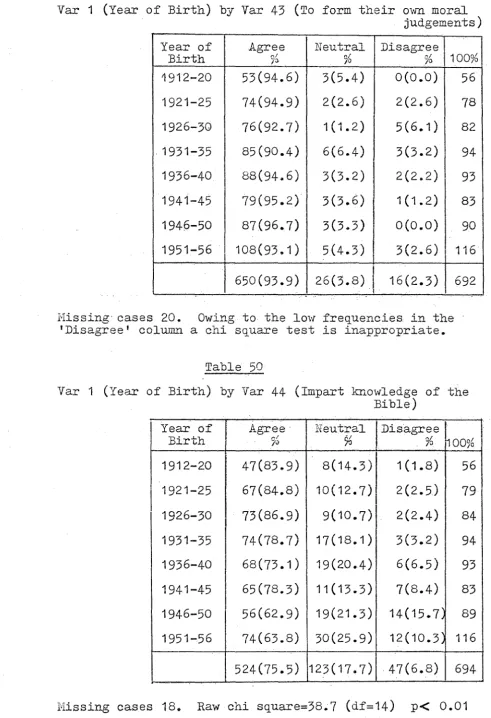
Variable 43: To form their ovm moral judgements
No.
%
1 • Agree 663 93.8
2. Neutral 28 4.0
3. Disagree 16 2.3
(rllissing cases 5) 707 100.0
Variable 44: To impart knowledge of the Bible
No. %
1 • Agree 535 75.6
2. Neutral 125 17.7
3. Disagree 48 6.8
(Missing cases 4) 708 100.0
Variable 45: To counteract a materialistic approach to Variable Variable Variable
*
(Forliving No. %
46:
47:
48:
1. Agree 2. Neutral 3. Disagree
(Missing cases 17)
To encourage children to
1 • Agree 2. Neutral 3. Disagree
(l\1issing cases 13)
To encourage a critical beliefs
1 • Agree 2. Neutral 3. Disagree
0·1issing cases 13)
485 162 48 695 worship No. 326 228 145 699 approach No. 433 179 84 696
Religious beliefs and practice No. 1 • Christian Church 284 2. Inclined to Christianity 325
3. Other
*
90699 detailed brea.l.{dovm of 'Other' see Vol.
God to I, 69.8 23.3 6.9 100.0
%
46.6 32.6 20.7 100.0 all%
62.2 25.7 12.1 100.0 % 40.6 46.5 12.9 100.0 p.133)Comparison with previous study (B.G. Burgess, 1975)
Variables 8, 23, 24, 33 and 34 are identical with five variables in the previous study. It is now proposed to apply chi-square tests to the two sets of data to
l
l
I
Variable 8~ Statutory Collective_Worship Collective WorshiP
The Education Act, 1944, provides that, subject to the right of parents to withdraw their children, the school day in every County school and in every volUL~tary school shall begin with collective worship.
I
Strong Agree Don't Incld Strongl
agrmt ment know agnst agnsti
Essex 147 ' 417 12 96 40 712
I
I
1977 sample
(20 .. 6) !(58.6) (01. 7) (13.5) (05.6) ( 100.0). I
I
Essex 1968 sample 64
I
145 2 36 12 259 (24.7) j(56.0) ( .8) (13 .9) (04. 6) (100.0)~
I
I
II I
I 2..,..,
l
562 14I
132 I52 971
..
!l
·-·--~'-.... --.--- I
Chi-square= 3.1 (df=4). Not significant.
*·
Table 2
Variable 23: Statutory Religious Education
Religious.Education: The Education Act, 1944, provides that, subject to the right of parents to withdraw their children, Religious Education shall be given in every county school and in every voluntary school.
~on't
Urn
ow,
Inclnd Strong
agnst agnst
I
l
!E.ssex 1977 sample 200 I 384
(28.2) (54.2) 15 (2.1)
I
(11.3~ 80I
. (4.2) 30 709i
( 1
oo.o)
i
I
i!Essex
l
70 130 (27.2)1 (50.6)
1968 sample 2 36
(0.8) (14.0~ 19 (7.4)
i
I
257
I
( 100 .o)l
I
270 514 17 116 49 966
Chi-square = 7.3 (df=4). Not significante
*
In these tables 'Not significant' means not significant at 5% level.p
<
0.05 means significant at 5% level.if
"
" 1% 11Table 3
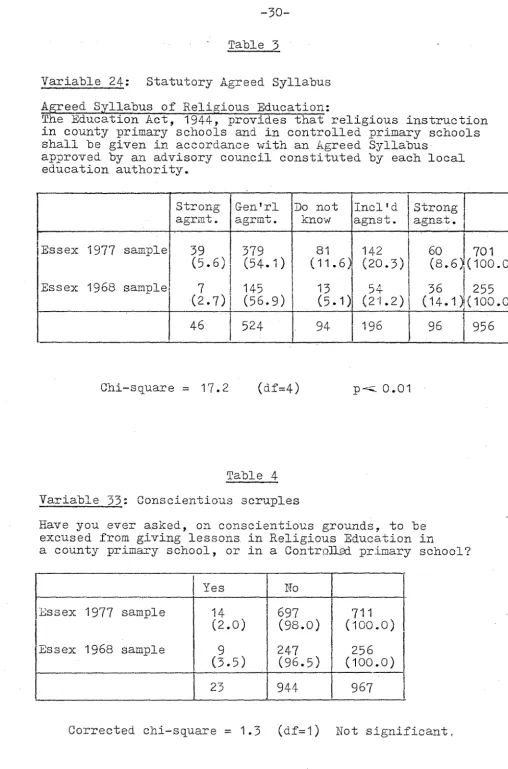
Variable 24: Statutory Agreed Syllabus Agreed Syllabus of Religious Education:
The Education Act, 1944, provides that religious instruction in county primary schools and in controlled primary schools shall be given in accordance with an Agreed Syllabus·
approved by an advisory council constituted by each local education authority.
.
Strong Gen'rl Do not agrmt.
I
Essex 1977 sample 39 (5.6). Essex 1968 sample1 7I
(2.7)1 I 46
Chi-square
=
17.2agrmt. 379 (54.1) ~ 14J (56.9) 524 ! I (df=4)
Table 4 Variable 33: Conscientious scruples
know 81
(11.6~
13
I
(5.1)' 94I
StrongI
Incl'dagnst.
l
agns.t. 1 142(20.3)
I
I
- 1
5'+ l (2 -~. 2) 1
196 1
p-<-0.01
'
60
J
701( 8 • 6 I ( 1 00 . 0 )
36
I
255I
( 14 • 1 ~ ( 1 00 • 0 ) 196 l I 956
I
Have you ever a.sked, on conscientious grou."lds, to be excused from giving lessons in Religious Educa.tion in
a county primary school, or in a Contrn"Jlro primary school?
I
Yes No
-1Bssex 1977 sample 14 697 711
(2.0) (98.0)
I ( 100 .o)
Essex 1968 sample 9 247 256
(3.5) (96.5) ( 100 .o)
23 944 967
l
I
Variable 34: Do you yourself at present give religious education in your school?
Yes No
I
Essex 1977 sample 615 93 1708 . (86.9) ( 1 3 • 1 ) i ( 1 00 • 0 ) Essex 1968 sample 238 16 1254
(93.7) (6.3) 1( 1
co .o)
I
I
853 h09 1962Missing cases 9. Chi-square= 8.7 (df=1) p< 0.01
I
In the fo1la:_ring tables, which relate exclusively to the 1977 sample, the first seven variables are
cross-tabulated with other variables. The chi-square tests have been calculated by computer. \Y.hen a test does not suggest any significant dif.ferences at the 5% level it will be followed by the words iNot significant'. Hhen significant differences are demonstrated this will be indicated by the usual method, i.e. p<0.05 or p< 0.01 9
(5% level) ( 1% level)
Variable 1 (Year of Birth) by Variable 2 (Sex) Year of Birth
1912-20
1921-25
1926-30
1931-35
1936-40
1941-45
1946-50
1951-56
Totq.l Raw chi square=49.2
(Missing cases
15)
Male
30(52.6%)
26(32.9}~)
14 ( 16.
5i))20(21.3%)
8(8.6%)
26(31.3%)
l
26(28.9%)
I
21(18.1%)
~·-·
I
171(24.5%)
(df=7)
Table 7
Female
27(47.456)
53(67.1%)
71(83.5%)
74(78.7%)
85(91.4%)
57(68.7%)1
64(71. 1%)
1
95(81.9)
1i
526(75.5%)
I57
79
85
94
93
83
90
116
697
Variable _ljYear of Birth) by Variable 3 (Teaching position)
i
I""
o e a d Heads of·I
---~--Year of Birth Teachers%
Schools%--r---31(56.4)
24(43o6)
l
55
I
1912-20
I
1921-25
II
1926.-30
II
1931-35
I
I
1936-40
1941-45
I
I
1946-50
49(63.6%)
28(36 .. 4%)
77
67(78.8%)
I
18(21.2%)!'
85
79(8~.9%)
14(15.1%) 93
l
I82(88.29'~)
I11 (11.8%)
193
74(90.2%).
t8(9 .. 8%)
I
82
~
88(97.8%)
2(2.2%)
I
90
11951-56
115(99.1%)
1(.9%)
1116
I
i---~----~.: ---~~
585(84.7%) :1o6(15.3%)i691
I
Total i I I
-Raw chi-s~uare=
95o9
(df=7) p<
0.01
Variable 1 (Year of Birth) by Variable 4 (Teaching Duties)
Infant
Junior
teacher
teacher
, ( I
/U /0
1912-20
13(38.2) 21(61.8) 34
1921-25
25(45.5) 30(54.5) 55
1926-30
40(55.6) 32(44.4) 72
I1931-35
I
36(43.9) 46(56.1) 82
1936-40
I
I36(45.0) 44(55.0) 80
1941-45
24(33.3) 48{66.7) 72
1946-50
30(34.9) 56(65.1) 86
I
1951-56
46(42.2)
63(57.8) 109
250(42.4) ·340(57.6) 590
.
Hissing cases 14. Raw chi square=10.3
(df=7) Not significant
Table 9
Variable 1 (Year of Birth) by Variable 5 (Size of School)
300 ch ... n 1301 chn
or less
or more
%
%1912-20
34(59 .. 6)
23(40.4) 57
1921-25
51(64.6) 28(35.4) 79
1926-30
55(65 .. 5)
29(34.5) 84
1931-35
53(56.4) 41(43.6) 94
1936-40
55(59.8) 37(40.2) 92
1941-45
52(62 .. 7)
31(37.3) 83
1946-50
51(56.7) 39(43.3) 90
1951-56
68(59 .. 1) 47(40 .. 9) 115
419(60.4) 275(39.6) 694
Variable 1 (Year of .Birth) by Variable 6 (Status of School) Year of 'Vol.Aid Vol.Con County
1100°~
Birth School School School
%·
%
%
1912-20 6(10.5) 6(10.5) 45(78.9) 57!
I
1921-25 13(16.5) 7(8.9) 59(74.7) 79
I
1926-30 11(13.1) 8(9.5) 65(77.4) 84 1931-35 8(8.6)
I
8(8.6)I
77(82.8) 93I
1936-40 7(7.8) 7(7.8) 76(84.4)I
90l
I 1941-45 6(7.2) 6(7.2) 71(85.5) 83 1946-50 11(12.4) 7(7.9) 71(79.8) 89 1951-56 13(11.3) 6(5.2) 96(83.5) 115
75(10.9) ~=:-(8 01
!:>?\ • ) 560(81.2) 690
Missing cases 22. Raw chi square=8.1 (df=14) Not significant. Table 11
Variable ·1 (Ye~r of Birth) by Variable 7 (Situation)
Year of Inside New
I
Outside New' !Birth Town . Town
noo%
I
1912-20 4(7.4) 50(92.6) 54I 1921-25 9(12.0) 66(88.0) 75
I
1926-30 12(14.3) 72(85.7) 84 19(20.7) I 73(79.3)
1931-35
I
92I
1936-40 17(18.7) 74(81.3) 91
l
I 1941-45 12(15 .. 0) 68(85.0) 80I
I
1946-50 14(15.9) 74(84.1) 88
!
21(18.6) 92(81.4)
l
1951-56 113 I
i
I
I
108(16.0) 569(84.0) j677
Var 1 (Year of Birth) by Var8(Statutory Collective Worship) Year ofiStrong !General
ji
do not !Inclined !Strongly Birth lAgrmt% jAgrmt %!
kno~%
---+-
Agns~.
Agns~
1 100% 1912-20! 22(38.6)1 30(52.6)
i
1(1.8)I
1(1.8) I 3(5.3)i
57!I
I ! II
l1921-25 · 27(34.2) i 42(53.2) 1 oco.o) 1 7(8.9) 1 3(3.8)
1 791 1926-30 24-(28.2)
I
49(57.6)l
0(0.0) 11(12.9)I
1(1.2) 185! 1931-35 15(16.0)160(63.8)! 2(2.1) 11(11.7)1 6(6.4-)I
94-1936-40 18(19.4)! 56(60.2)I
0(0.0) 12(12.9)I
7(7.5) I 93 1941-45 7(8.4) 55(66.3)I
2(2.4) 12(14.5)I
7(8.4)I
83 1946-50 12(13.3)! 47(52.2)I
2(2.2) 21(23.3)I
8(8.9) 90! I
1
1951-56 17(14.7)! 71(61.2)! 5(4.3) 19(16.4) 4(3.4) 1116
---~ l ~---~---+---11----1
I !
I
I1 l142(2o.4)1410C5s.8) 1 12c1.7) 94(13.5) 139(5.6) j697
i ' ·
-!~lis sing Cases 15. As more than 20)£ of the cells have an expected frequency of less than 5 the 'I do not }G~ow' column will be ignored and a chi-square test will be made on the rest of the data (Table 13).
Table 13
Var 1 (Year of Birth) by Var 8 (Statutory Collective Y.lorship)
...• ----
·-·---·--I
I
Inclined Str?ng~yl JYear of Strong General
Birth Agrmt Agrmt Agnst .Aga1.ns ~.>
h
OO c/ I%- 9'& ·- a i - of
-1
7o_l/0 ;o ' I
1912-20 22(39.3) 30(53.6) 1 (1.8) 3(5.4) 1 56
I
1921-25 27(34o2) 42(53.2) 7(8.9) 3(3.8) i 79
l
1926-?0 24(28 .. 2) 49(57.6) 11(12.9) 1(1.2) 85
I
1931-35 15(16~3) 60(65.2) 11(12.0) 6(6 .. 5) ! l 92
I
I1936-40 18(19o4) 56(60o2) 12(12.9) 7(7.5) 93
I
1941-45 7(8.,6) 55(67.9) 12(14.9) 7(8.6) ' 81I
1946-50 12(13.6) 47(53.4-)1 21(23.9) 8(9.1) 88I
I
1951-56 17(15.3) 71(64.0) 19(17.1) 4(3.6) 1111
i I I
t l
I
142(20.7) 410(59.9) 94(13.7) 39(5.7) :685 I
I '
I j
Var 1 (1-~ar of birth) by Var 9 (Some form of Assembly Desirable)
r
I
_Y_~_f_r_t_~_f--+~gre~% J;;a_l-+-D-i_s_a-~ee
l
1oo% j 1912-20 56(98.2)i
0(0.0) 1 (1.8)I
57I
1921-25 76(96.2)! 3(3.8) oco.o)I
79I
. 1926-30 85(100.0) 0(0.0) 0(0.0) 1851931-35 93(98.9) 1(1.1) 0(0.0) II 94
1936-40
I
91(97.8) · 2c2.2) oco.o) 931 79(95.2) 3 (3.6) 1
c
1.2) 1831941-45
I
84(93.3). 5(5.6) 1(1.1)1
90 ! 110(94.8) ~ 6(5.2) 0(0.0) [116 1946-50
1951-56
! . I
i
674(96.7) i20(2.9) 3(0.4) !697I
·-· · · ' ' ' : ' '
-~-Tis sing cases 15. Owing to the lo'tl f:r-equencies in the ;Neutral' and 'Disagree' columns a chi-square test is not possible.
Table 15
Var 1 (Year of Birth) by Var 10 (Assembly every day)
I
Year of f Agree !Neutral [DisagreeI
01
, Birth I
i
I
c/ ot I 0; !1 OO;Cl
! 11912-20 !
. ;c I
11 (20:
0
0) / 11
(20~
0
0
);
55 33 (60.0) II
48(64.9) 16(21.6)
I
11921-25 10(13.5)1 74 I
!
1926-30 46(54.8) 20(23.8)
I
18(21.4)1 84i
I
1931-35 46(49.5)
I
22(23.7) 1 2r{2' 9)1 :::>' o. i 93' I
I
1936-40i I
22 (23. 7)i
52(55.9) 1 19 c2o .4)
I
9311941-45
I
i I
I I
14( 17. 7)i 42(53.2)
I
23(29.1)! 79I
I I . j
I I I
! 1946-50 35(40.7)) 20(23.3): 31 (36.0): 86
I i
1951-56 42(37.8) t 38(34.2)! 31(27.9) 111
j I ;
I
344(51 .. o) 1169(25~0)
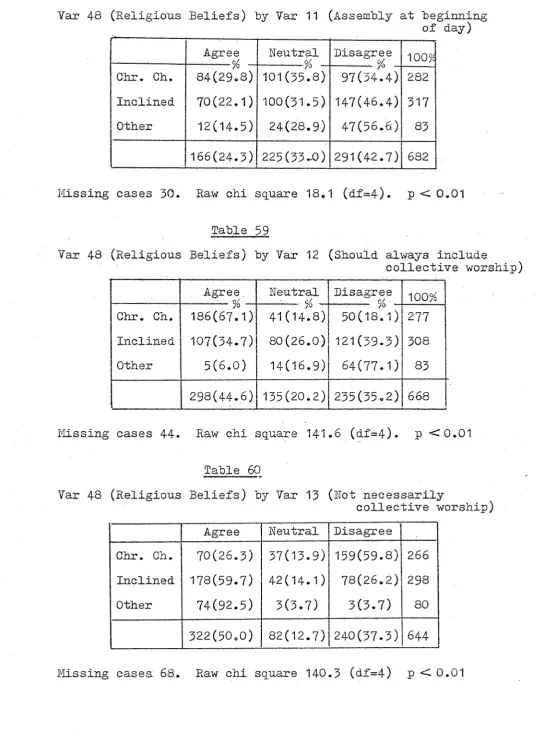
·162(24 .. 0) 675Var 1 (Year of Birth) by Var 11 (Assembly at beginning of day)
I
Year of
Agree
Neutral Disagree
I
Birth
aOO%
I
%
%
%
1912-20
22(39.3) 12(21.4) 22(39.3) 56
1921-25
27(35.5)1 30(39.5) 19(25.0) 76
1926-30
22(26.2)
30(35.7) 32(38.1) 84
1931-35
20(21.5) 28(30.1)
45 (48.4)
I
93
1936-40
18(19.4)1 29(31.2). 46(49.5) 93
I
1941-45
I
15(18.8)1 30(37.5) 35(43.8) 80
18(20.9)1
1946-50
l22(25.6)
46(53.5)1 86
I
1951-56
25(22.5)1 38(34.2)1 48(43.2) 111
167(24.6),219(32o3) 293(43.2) 679
J
.
-. ·----" 'Nissing cases 33. Raw chi square 27.7 (df=14).
p<0.05
Table 17
Var 1 (Year of Birth) by Var 12 (Bhould always include
collective worship)
·.
I
Year of
I
I IBirth
Agree
Neutral Disagree
!
39(70.9)
6(10.9) 10(18. 2)
r : 2 - 2 0I
55
I.921-25
48(66.7) 15(20.8)
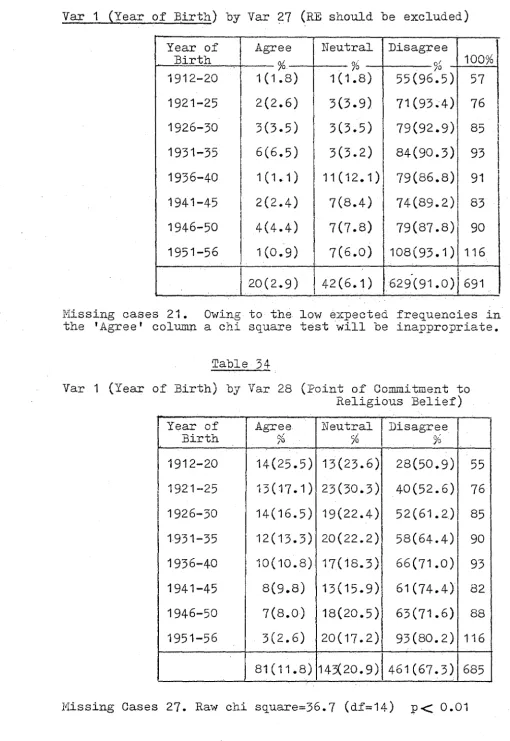
9(12.5)1 72
I
1926-30
!