Published online February 13,2015 (http://www.sciencepublishinggroup.com/j/ajim) doi: 10.11648/j.ajim.20150301.14
ISSN: 2330-4316 (Print); ISSN: 2330-4324 (Online)
Laboratory Evaluation of the Validity of the Current HIV
Testing Algorithm in Kenya
James Kimotho
1, *, Zipporah Ng’ang’a
2, Edna Nyairo
1, Missiani Ochwoto
1, Nicholas Nzioka
1,
Francis Ogolla
1, Michael Kiptoo
11
Kenya Medical Research Institute, Nairobi, Kenya
2
Jomo Kenyatta University of Agriculture and Technology, Institute of Tropical Medicine, Thika, Kenya
Email address:
[email protected] (J. Kimotho)
To cite this article:
James Kimotho, Zipporah Ng’ang’a, Edna Nyairo, Missiani Ochwoto, Nicholas Nzioka, Francis Ogolla, Michael Kiptoo. Laboratory Evaluation of the Validity of the Current HIV Testing Algorithm in Kenya. American Journal of Internal Medicine.
Vol. 3, No. 1, 2015, pp. 23-27. doi: 10.11648/j.ajim.20150301.14
Abstract:
Background: The HIV Lateral Flow Tests (LFTs) provide a good compromise between accuracy, cost, speed and overall effectiveness. Objective: This study assessed the laboratory performance of the LFTs in the current National HIV Testing Algorithm in Kenya. Methods: Four hundred blood samples, 145 HIV positives and 255 HIV negatives, were collected from the Regional Blood Transfusion Centers in Kenya. They were analyzed using five LFTs, three of which were in the HIV Testing Algorithm in Kenya. Samples were also tested using Vironostika™ Uni-Form II Ag/Ab ELISA as a Gold Standard. The decision on the HIV status of the samples was determined by consensus status of the five LFTs. Diagnostic sensitivity (D-SN), specificity (D-SP), Positive Predictive Value (PPV) and Negative Predictive Value (NPV) were then computed together with relative Analytical sensitivity each LFT. Results: The three LFTs in the HIV Testing Algorithm in Kenya (KHB Colloidal Gold, First Response™ 1-2.0 and Uni-Gold™ HIV test) showed a D-SN of 100% (95% CI: 97.4-100.0), 96.4% (95% CI: 91.8 - 98.8) and 100% (95% CI: 97.4-100.0) respectively in relation to the Consensus status with LFTs. However, Determine™ HIV-1/2 showed the highest Analytical sensitivity when compared with two other kits in HIV Testing Algorithm in Kenya and Aware™ HIV-1/2 BSP kit. Conclusion: Though the LFTs in the current HIV Testing Algorithm in Kenya show high performance profiles, Determine™ HIV-1/2 showed higher Analytical sensitivity profile than the two HIV Screening and confirmation test kits. There is a need of reconsidering the financial savings (of 10-16%) vis-ȃ-vis the possibilities of missing HIV positive cases in the current HIV Testing Algorithm in Kenya.Keywords:
Lateral Flow Tests, HIV, Testing Algorithm in Kenya, Sensitivity, Predictive Value, Specificity1. Introduction
The LFTs for Human Immunodeficiency Virus (HIV) provide a good compromise between accuracy, cost, speed and overall effectiveness for Point-of-Care (PoC) use in Resource-Limited Settings (RLS) [1-3]. Currently the World Health Organization (WHO) advises WHO Member States on the laboratory diagnosis of HIV including providing objective assessments of commercially available assays for detecting antibodies to HIV-1 and HIV-2 through the WHO Prequalification of Diagnostics programme. This programme provides robust assessment based on regulatory principles that consider the performance, quality and safety of the assays[4]. In Kenya, the WHO Prequalified HIV test kits are evaluated by the National HIV Reference Laboratory (NHRL)
standard kit itself where wrong inference is likely to be made[7]. In February 2013, Kenya changed its National HIV Testing Algorithm into Serial Testing Algorithm (Table 1)where the HIV (1 + 2) Antibody (KHB Colloidal Gold) (KHB Shanghai Kehua Bio-engineering Co,Shanghai, China) was adopted as a Screening Test; First Response™ 1-2.0
(PMC Medical Pty. Ltd, Daman, India) was adopted as a Confirmatory Test while Uni-Gold™ HIV test (Trinity Biotech, Oregon, USA) was adopted as a “Tie Breaker”[8]. This study was designed to further assess the validity of this Algorithm in a laboratory set-up.
Table 1. The current HIV Testing Algorithmin Kenya
KHB Colloidal Gold First Response™ 1-2.0 Uni-Gold™ HIV Test HIV Status
None Reactive - - Negative
Reactive Reactive - Positive
Reactive None Reactive Reactive Positive
Reaction None Reactive None Reactive Negative
(MoPHs Circular No. MPHS/ADM/1/12)
2. Materials and Methods
Four hundred blood samples, 145 HIV positives and 255 HIV negatives, were collected from the Regional Blood Transfusion Centers (RBTCs) in Kenya (Nairobi, Nakuru, Kisumu, Embu and Mombasa) over a period of three months (May to July 2011) after removing donors' identifiers. The samples were centrifuged to produce plasma and stored at -20°C until use. The samples were used for development of an ELISA and a LFT for HIV guided by the prevailing consensus sequence of HIV env gene in Kenya. One of the key steps of this process was to characterize panels from the collected blood for use in the evaluation of the developed HIV kits. This was done by using six HIV antibody tests: KHB Colloidal Gold (KHB Shanghai Keshaun Bio-engineering Co, Shanghai, China), First Response™ 1-2.0 (PMC Medical Pty. Ltd, Daman, India), Uni-Gold™ HIV test (Trinity Biotech, USA); Determine™ HIV-1/2 (Abbott Diagnostic Division,Hoofddorp,The Netherlands),Aware™ HIV-1/2 BSP (Calypte Biomedical Corporation, Oregon, USA) and Vironostika™ Uni-Form II Ag/Ab ELISA (bioMérieux, Marcy-l'Etoile, France). The first three kits were in the National HIV Testing Algorithm in Kenya while the fourth kit was in the immediate past National HIV Testing Algorithm in Kenya as a Screening Test. The HIV status of the samples was determined by consensus of the five LFTs and Vironostika™ Uni-Form II Ag/Ab ELISA was used as a “Gold Standard”[4].Thirty (30) HIV positive samples were pooled into three equal pools which were later double serial diluted to the 16th dilution using pooled HIV negative samples from 10 donors. Each dilution of HIV positive pool was tested using the randomly picked test strips from the five LFTs mentioned previously in this study and the detection
limits for each pool were determined for each LFT. In another experiment 250HIV negative samples by antibody tests were pooled into 10 equal pools after which HIV viral RNA was extracted from each pool using the QIAamp viral RNA kit (Qiagen, Valencia, Calif.) according to the manufacturer’s protocol. For each LFT the following parameters were calculated and compared: Diagnostic Sensitivity (D-SN), Specificity (D-SP), Positive Predictive Value (PPV), Negative Predictive Value (NPV) and Analytical Sensitivity.
3. Results
3.1. D-SN, D-SP, PPV and NPV Using Consensus Testing from LFTs
As shown on Table 2 and Figure 1 the three(3) LFTs in the current HIV Testing Algorithm in Kenya (KHB Colloidal Gold, First Response™ 1-2.0 and Uni-Gold™ HIV) test showed a D-SN of 100% (95% CI: 97.4-100.0), 96.4% (95% CI: 91.8 - 98.8) and 100% (95% CI: 97.4-100.0) respectively in relation to the Consensus status with LFTs. The other two kits that were also in use in Kenya, Determine™ HIV-1/2and Aware™ HIV-1/2 BSP, had a D-SN of 100% (95%CI: 97.4-100.0%) and 99.3% (95% CI:96.0 to 99.9%)respectively. The KHB Colloidal Gold scored 100% (95% CI: 97.4-100.0) in D-SN, D-SP, PPV and NPV tests. Uni-Gold™ HIV test had the lowest D-SN but it scored 100% (95% CI: 97.4-100.0) in D-SP and PPV tests. The performance of the First Response™ 1-2.0 was the same as that of Determine™ HIV-1/2: D-SN of 100% (95% CI: 97.4-100.0) and PPV of 96.8% (95% CI: 83.2 - 99.5).
Table 2. Performance of various Rapid test kits in respect to Consensus status with LFTs.
HIV Rapid Test Kit D-SN(95% CI) D-SP(95% CI) PPV(95% CI) NPV(95% CI)
Determine™ HIV-1/2 100 (97.4-100.0) 96.8(83.2 - 99.5) 99.3(96.1 - 99.9) 100(88.3-100.0)
KHB Colloidal Gold 100(97.4-100.0) 100(88.7 - 100.0) 100(97.4-100.0) 100(88.7 - 100.0)
Uni-Gold™ HIV test 96.4(91.8 - 98.8) 100.0(88.7 -100.0) 100.0(97.3-100.0) 86.1(70.5-95.3)
First Response™ 100(97.4-100.0) 96.8(83.2 - 99.5) 99.3(96.1- 99.9) 100(88.3 - 100.0)
Figure 1
.
D-SN, D-SP, PPV and NPV in respect to Consensus status with LFTs3.2. D-SN, D-SP, PPV and NPV Using Consensus Testing from LFTs Using ELISA Kit
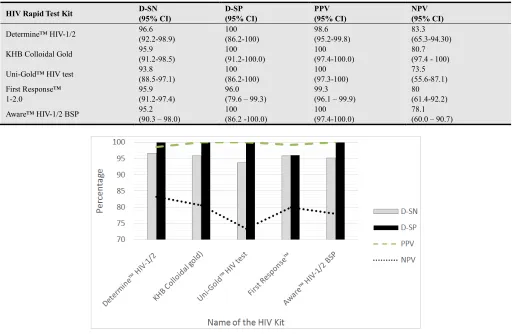
When compared with Vironostika™ Uni-Form II Ag/Ab ELISA (Table 3 and Figure 2) as the Gold Standard the performance characteristics (D-SN, D-SP, PPV and NPV) of the LFTs were apparently reduced due higher Analytical Sensitivity of the ELISA kit. The three(3) LFTs in the current HIV Testing Algorithm in Kenya, KHB Colloidal Gold, First Response™ 1-2.0 and Uni-Gold™ HIV test, showed a D-SN of 95.9% ( 95% CI: 91.2-98.5%), 95.9% (95% CI: 91.2-97.4) and 93.8% (95% CI: 88.5-97.1) respectively. The D-SN of Determine™ HIV-1/2 that was the Screening kit in the
immediate past HIV Testing Algorithm in Kenya HIV was 96.6% (95% CI: 92.2-98.9%) which was the highest among the tested LFTs. The Aware™ HIV-1/2 BSP had a D-SN of 95.2% (95% CI: 90.3 - 98.0). All the LFTs tested in this study showed a D-SP of above 96.0% (95% CI: (79.6 – 99.3) in respect to Vironostika™ Uni-Form II Ag/Ab ELISA. All the LFTs tested displayed high PPV (above 98.6% (95% CI: 95.2-99.8) but low NPV, up to 73.5% (95% CI: 55.6-87.1) as shown by Uni-Gold™ HIV test. This implies that these LFTs had high probability of testing positive when the actual status of samples were positive but low probability of testing negative when the actual status of samples were negative.
Table 3. Performance of various Rapid test kits in respect to Vironostika™ Uni-Form II Ag/Ab ELISA.
HIV Rapid Test Kit D-SN (95% CI)
D-SP (95% CI)
PPV (95% CI)
NPV (95% CI)
Determine™ HIV-1/2 96.6
(92.2-98.9)
100 (86.2-100)
98.6 (95.2-99.8)
83.3 (65.3-94.30)
KHB Colloidal Gold 95.9
(91.2-98.5)
100 (91.2-100.0)
100 (97.4-100.0)
80.7 (97.4 - 100)
Uni-Gold™ HIV test 93.8
(88.5-97.1)
100 (86.2-100)
100 (97.3-100)
73.5 (55.6-87.1) First Response™
1-2.0
95.9 (91.2-97.4)
96.0 (79.6 – 99.3)
99.3 (96.1 – 99.9)
80 (61.4-92.2)
Aware™ HIV-1/2 BSP 95.2
(90.3 – 98.0)
100 (86.2 -100.0)
100 (97.4-100.0)
78.1 (60.0 – 90.7)
3.3. Analytical Sensitivity of the LF Ts
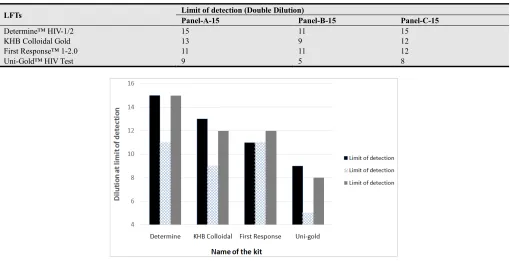
In regards to testing of Analytical Sensitivity of the HIV LFTs, Determine™ HIV-1/2 showed a far much higher sensitivity in comparison with other HIV LFTs from the
results of the three panels. The performance of KHB Colloidal Gold and First Response™ 1-2.0 were comparable. Uni-Gold™ HIV showed the lowest Analytical Sensitivity.
Table 4. The relative Analytical Sensitivity of HIV LFTs in Kenya using panels prepared in-house.
LFTs Limit of detection (Double Dilution)
Panel-A-15 Panel-B-15 Panel-C-15
Determine™ HIV-1/2 15 11 15
KHB Colloidal Gold 13 9 12
First Response™ 1-2.0 11 11 12
Uni-Gold™ HIV Test 9 5 8
Figure 3. The relative Analytical Sensitivity of HIV LFTs in Kenya using panels prepared in-house.
3.4. RNA Extraction from HIV Negative Samples with Antibody Tests
Out of 10 equal pools of the 250 HIV negative samples by immunological-based kits none yielded any HIV viral RNA after extraction.
3.5. Other Observations
With the testing of 400 samples in this study all the HIV positive samples with KHB Colloidal Goldwere also positive with the First Response™ 1-2.0 and hence there would have
been no need of re-testing with Uni-Gold™ HIV test if the test were carried out using the current HIV Testing Algorithm in Kenya.
As illustrated in Table 5 the number of observed agreements between the evaluation of the LFTs by use of Consensus test from five LFTs and Vironostika™ Uni-Form II Ag/Ab ELISA was 394 (98.50% of the observations) with Kappa= 0.967 (95% CI: 0.941-0.993) and P value of less than 0.0001 implying that the strength of agreement was 'very good.
Table 5. Performance of LFTs in comparison with Vironostika™ Uni-Form II Ag/Ab ELISA.
Status as determined by Vironostika™ Uni-Form II Ag/Ab ELISA
Positive Negative
Status as determined by Consensus Status of 6 LFTs
Positive 139 0 139
Negative 6 255 261
145 255
4. Discussions
The study observed an agreement of 98.50% (Kappa = 0.967 (95% CI: 0.941-0.993) and P value of less than 0.0001 between the evaluation of the LFTs by use of Consensus test from five LFTs and Vironostika™ Uni-Form II Ag/Ab ELISA implying that the strength of agreement was 'very good’. These results correlate well with a number of studies
that had established high sensitivity of LFTs when HIV ELISA kits were used as Gold Standard. Madisa et al.
system.
This study did not find any sample that could require the use of a “Tie breaker’ in discordant results with KHB Colloidal Gold and First Response™ 1-2.0 as prescribed in the Kenya HIV Testing Algorithm. According to the findings of the study the Uni-Gold™ HIV test had the lowest Diagnostic and Analytical sensitivities and its specificity profile was not outstanding in comparison with other LFTs. Its preference as a “tie breaker” in the Kenyan HIV Testing Algorithm is debatable given that other HIV Testing Algorithms suggest the use of “tie breaker” testing kits that are more sensitive and specific than kits that are used for either Screening or Confirmation, such as nucleic acid amplification tests (NAATs) or ELISA though the high costs of these tests tend to limit their use especially in developing countries[11].
Determine™ HIV-1/2 showed the highest values of Analytical Sensitivity and D-SN with ELISA as Gold Standard implying that the current National HIV Testing Algorithm in Kenya could benefit more by using this kit as a Screening Test. The results could point out the fact that the change of National HIV Testing Algorithm to slightly less sensitive kits could give an inaccurate HIV prevalence in Kenya in the long run. Possibly, the only reason why Determine™ HIV-1/2 was not included in the current National HIV Testing Algorithm in Kenya was that it was slightly more expensive than other kits that were tested, costing USD 0.87 per test (in 2013) as compared to USD 0.77 for First Response™ 1-2.0 and USD 0.79 for KHB Colloidal Gold over the same period[12]. However, the cost of the missing some HIV positive cases should not be forgotten when such a decision is to be made.
Efforts to extract HIV viral RNA from the 255 HIV negative samples by antibody tests did not yield any RNA positive sample. This could have been due to the fact that either none of these samples were from a subject with acute HIV infection that had been found in some studies to be less than 1%[13] or the sample size in this study was too small to detect any acute infection among the HIV negative samples.
The main limitations of this study include the use of plasma in testing for HIV rather than whole blood. However, previous studies have shown very close correlation between the results found with plasma and those found with whole blood[7].
In conclusion this study has established that the performance of the LFTs in the current HIV Testing Algorithm is Kenya is generally high. The study, however, recommends the review of the Algorithm to have Determine™ HIV-1/2 as the Screening Test as it is the most sensitive LFT in the Kenyan market today.
Acknowledgements
We are grateful to KEMRI-CDC for facilitating
procurement of the HIV diagnostic kits which have been used in this study, Director Kenya National Blood Transfusion Services for allowing us to use rejected donors’ blood for the study and staff, KEMRI Production Department for their moral support of this study and Director KEMRI for permission to publish the findings.
References
[1] WHO-EMRO, Rapid HIV Tests: Guidelines for use in HIV testing and counseling services in resource-constrained setting. 2004.
[2] Van Binsbergen, J.d.R., D.; Peels, H.; Dries, C.; Scherders, J.; Koolen, M. Zekeng, L. and Gürtler, L.G., Evaluation of a new third generation anti-HIV-1/anti-HIV-2 assay with increased sensitivity for HIV-1 group O. Journal of Virological Methods, 1996. 60(2): p. 131-7.
[3] Wong, E., Y.; Indira, K. and Hewlett, 1, HIV Diagnostics: Challenges and Opportunities: Rapid & PoC Testing in RLS. HIV Therapy, 2010. 4(4): p. 399-412.
[4] WHO, HIV assays operational characteristics: HIV rapid diagnostic tests (detection of HIV-1/2 antibodies). report 2013. 17.
[5] National AIDS and STI Control Programme, M.o.P.H.a.S., Kenya, Guidelines for HIV Testing and Counselling in Kenya. NASCOP, 2008.
[6] Plate, D.K., Evaluation and implementation of rapid HIV tests:the experience in 11 African countries. AIDS Res Hum Retroviruses, 2007. 23: p. 1491–1498.
[7] TDR, Evaluation of diagnostic tests for infectious diseases: general principles. 2010.
[8] Ministry of Public Health and Sanitation, K., Circular No. MPHS/ADM/1/12 dated 6th February 2013
[9] Madisa, M.C., S; Kgomotso, S.; Taurayi, T, Performance of Rapid HIV Testing by Lay Counsellors in the Field during the Behavioural and Biological Surveillance Survey among Female Sex Workers and Men who have Sex with Men in Botswana. Journal of acquired Immune Deficiency Syndromes
[10] Fabiani, M.N., B.; Biryahwaho, B.; Ouma, J.; Ninci, A.; Declich, S., Evaluating HIV testing algorithms for research, diagnosis and surveillance. health policy and development, 2005. 3(1).
[11] Slev, P., The changing landscape of HIV diagnostics. Medical Laboratory Observer: Cover Story, 2012.
[12] Lyer, P., Mwai, D., Ng'ang'a, A., Costing Kenya’s current and proposed HIV testing and Counseling Algorithms. Health Policy Project 2013.