Utilization of Industrial Waste in Construction
Material by Partial Replacement of Fine
Aggregate with Crumb Rubber-Experimental
Study
M.Yuvasree Devi#1, N.Shanmuganathan*2,
#1
b.E (Final Year) &Civil Engineering & S.K.P Institute Of Technology
*2
Assistant Professor&Civil Engineering & S.K.P Institute Of Technology Tiruvannamali, Tamil Nadu, India.
Abstract —The crumb rubber is the waste rubber tire which is made in the form of fine aggregates. The disposal of crumb rubber is quiet difficult as it is non-biodegradable, hence the partial replacement of crumb rubber will be an effective way for the disposal in an useful way. This paper describes the experimental study on concrete by partial replacement of fine aggregate with crumb rubber at various percentages(7%,11%,14%).The mix proportion is followed as per IS10262-2009 the M25 grade concrete is used. The result of this paper
gives the values of compressive strength, flexural strength and split tensile strength of the partially replaced concrete by crumb rubber.
Keywords — Crumb rubber, compressive
strength, splitting tensile strength, fine aggregate.
I. INTRODUCTION
Every year, at an average of about 11,000,000 new vehicles are added to the Indian road and also 30,000,000 discarded tyres produces the potential threat to the environment [1]. Management of waste tyre rubbers is challenging to municipalities and burning or biodegradation of waste tyre rubber is harmful to the environment [4]. Due to the high growth of construction in the past years, the conception of products for concrete is also increasing. Even though the concrete based on portland cement is one of the most extraordinary and versatile elements in construction, there is a need for modifying its properties, such as tensile, hardness, ductility and recycling rubber simultaneously is to combine both materials [6]. The possibility of making concrete tough has been made by addition of rubber materials among the traditional components viz., cement, water and aggregates for this purpose recycled grinded tyre rubber is used. The crumb rubber is obtained by cryogenic process [2],[3].in this milled tyre rubbers treaded with sodium hydroxide solution to achieve a patter adhesion with the cement paste[3].Tire derived fuel (TDF), refers to tires as a supplemental energy resource. Cement kilns
combust whole tiers as an alternative to save fossil fuels such as coal, oil or natural gas [7]. Unfortunately much attention is not provided to use the waste tire particles in portland cement mixtures. Limited work was done by researchers to investigate the potential use of waste rubber tires in the ordinary concrete. The literature about the use of tire rubber particles in concrete generally replaces these materials as aggregates [1]. Most of the research shown the use of coarse rubber particles affects the particles more negatively than the finer one, hence the utilization of finer rubber is most suitable and effective than coarser rubber. The use of scrap tyre rubber in normal strength concrete is a new dimension in concrete mix design and if applied on a large scale would revolutionize the construction industry, by economizing the construction cost and increasing the worn out tire disposal. Success in this regard will contribute to the reduction of waste materials dumping problem by utilizing the waste materials as the raw materials in the construction materials [8].
II. MATERIALS USED 2.1. Cement
Cement is used as the binding material in concrete for all the building materials. Portland Pozzolana cement (PPC) of 53 grade is used throughout the project. The specific gravity of cement is 3.148. Initial setting time is 35 minutes.
2.2. Fine Aggregate
The river sand is used as fine aggregates which is a locally available material and conformed to IS: 383-1970(Indian Standard Specifications). The sand is having the specific gravity of 2.6 in Zone П. The water absorption of fine aggregate is 1%.
2.3. Coarse aggregate
20mm crushed angular coarse aggregates are used having the specific gravity of 2.67. Its water absorption is 0.5%.
2.4. Crumb rubber
Chennai (Red hills). In this study machine grinding is used to obtain uniformly grinded crumb rubber. The maximum size of the rubber aggregate was 30 mesh (0.9mm). Specific gravity is 1.07. Water absorption of crumb rubber is 0% the density of crumb rubber is less than the water and it doesn’t comes in contact with the water.
Fig 1: crumb rubber
Table I-Physical properties of materials
Materials used
Specific gravity
Fineness modulus
Water absorption
Cement OPC 53 grade
3.148 1.5% -
Fine
aggregate-river sand
2.6 2.36% 1%
Coarse aggregate
2.67 6.75% 0.5%
Crumb rubber
1.07 4.48% 0%
III. EXPERIMENTALPROCEDURE
This experimental study was conducted to investigate the basic engineering properties of the rubberized concrete mixtures which are made by partial replacement of fine aggregate with crumb rubber at 7%, 11% and 14% respectively and a control mixture (without crumb rubber) is also prepared and the results are compared with the partially replaced concrete.
3.1. Mix proportions
The mix proportions of different types are made with the partially replaced concrete of M25 grade at
the mix ratio of 1:1.35:2.96. Mix design procedure
3.2. Casting of specimens
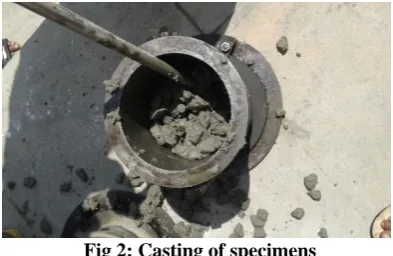
The specimens are casted by using the moulds in the shapes of cubes, cylinder and beam. The crumb rubber is first mixed with the cement and then with the aggregates as the crumb rubber floats when the water is added due its low density.
Fig 2: Casting of specimens
3.3 Test on Fresh Concrete
A. workability test
The slump cone test is used to find the workability of the concrete. The workability is the measure of horizontal free flow or ease of the concrete to work and it is also used to find the correct consistency and water content of the concrete. The test is conducted as per IS 1199-1959. The water cement ratio of 0.40 is preferred as all the rubber replaced with fine aggregate having low value compared to the conventional concrete.
3.4 Test on Hardened Concrete
A. Compressive strength test
This test is used to determine the crushing strength of the hardened concrete. This is
a type of
destructive testing which is carried out on hardened concrete. The
casting is
carried out in the cube of size 150mm×150mm
×150mm is
used. The test is done at 7, 14
concrete. The compression testing machine of 3000 KN capacity is used to carry out the test.
The formula for calculation of compressive strength is
Compressive strength = 𝐹𝑎𝑖𝑙𝑢𝑟𝑒 𝑙𝑜𝑎𝑑 𝐶𝑟𝑜𝑠𝑠 𝑠𝑒𝑐𝑡𝑖𝑜𝑛𝑎𝑙 𝑎𝑟𝑒𝑎
Table III - Results of compressive strength
Fig 4: Graph for compressive strength
B. Split tensile strength
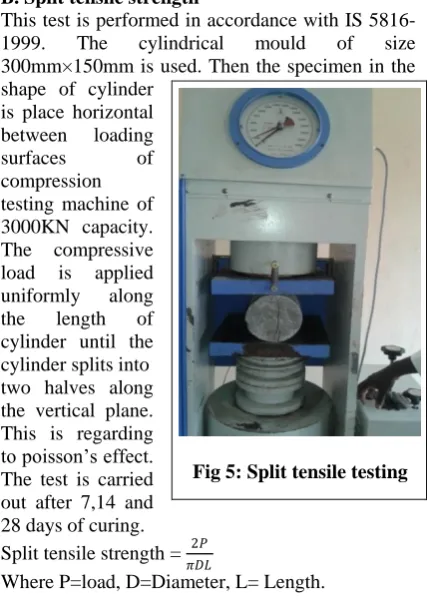
This test is performed in accordance with IS 5816-1999. The cylindrical mould of size 300mm×150mm is used. Then the specimen in the shape of cylinder
is place horizontal between loading
surfaces of
compression testing machine of 3000KN capacity. The compressive load is applied uniformly along the length of cylinder until the cylinder splits into two halves along the vertical plane. This is regarding to poisson’s effect. The test is carried out after 7,14 and 28 days of curing. Split tensile strength = 𝜋𝐷𝐿2𝑃
Where P=load, D=Diameter, L= Length.
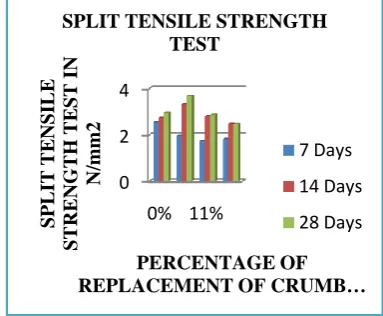
Table IV - Results of split tensile strength
Mix Crumb
rubber
Average strength after 7 days of curing
Average strength after 14 days of curing
Average strength after 28 days of curing
% N/mm2 N/mm2 N/mm2
1 0% 2.54 2.73 2.95
2 7% 1.95 3.32 3.68
3 11% 1.74 2.81 2.86
4 14% 1.82 2.48 2.47
0 20 40 60
0% 7% 11% 14%
COM
PRESSIVE
STRENGTH
IN
N/mm2 PERCENTAGE OF REPLACEMENT OF CRUMB
RUBBER
COMPRESSIVE STRENGTH TEST
7 Days
14 Days
28 Days
Mix Crumb
rubber
Average strength after 7 days of curing
Average strength after 14 days of curing
Average strength after 28 days of curing
% N/mm2 N/mm2 N/mm2
1 0% 16.00 21.00 37.00
2 7% 15.23 22.01 41.36
3 11% 16.71 20.45 39.24
4 14% 14.66 18.98 36.19
Fig 6: Graph for split tensile strength
C. Flexural strength test
This test is performed regarding to IS:516-1959. The mould in
the shape of beam of size 100mm100mm 500mm is used to carry out the test. The specimen is place in flexure testing machine
of 100KN
capacity. The load is applied at the centre of the beam at two points
and after the failure the results is noted. The flexural
strength can be calculated by Flexural strength = 𝑃𝑙
𝑏𝑑2
P=failure load, l=length of specimen, b=breath of specimen, d=depth of specimen.
Table V - Results of flexural strength test
Fig 8: Graph for flexural strength test
RESULTS AND DISCUSSION
1. The results of the compressive strength test, splitting tensile strength test and flexural strength test for replaced concrete of 7% shows increase in strength compared to the conventional concrete and the target strength of 25Mpa is achieved.
2. The strength of the partially replaced concrete of 11% and 14% decreases in strength compared to the conventional concrete.
3. The strength of the concrete decreases with increase in replacement of the
2.The workability of the concrete decreases with the increase of crumb rubber due to demand of water.
3. The crack patterns produced during the test on rubberized concrete does not exhibit the well defined failure, whereas the conventional concrete shows a clean split of sample into two halves. This may be an indication of more ductility in rubberized concrete than the normal concrete 4. Due to increase in ductility, the use of confined crumb rubber concrete in structures subjected to seismic loads will be very effective, where ductility demands are more critical than strength, looks promising.
REFERENCES
[1]Mohammed Islamuddin Faraz, Utkarsh Jain, Shailendra Singh, “Effect of crumb rubber material on concrete mix”
SSRG International Journal of Civil engineering (SSRG-IJCE).
[2] N. N. Eldin, A. B. Senouci, “Rubber tire particles as concrete aggregate” , J. Mater, civil engineering 5(4), page (9478-496), 1993.
[3] N. Segre, I. Joekes, “Use of tire rubber particles as addition to cement paste”, cem.cnocr.Res.30(9), page(1421-1425),2000.
[4] Sunil N. Shah, Pradip D. Jadhao, S. M. Dumne, “Effect of
chipped rubber aggregates on
0 2 4
0% 11%
SPLIT
TE
NS
ILE
STRENGTH
TE
ST IN
N/mm2
PERCENTAGE OF REPLACEMENT OF CRUMB … SPLIT TENSILE STRENGTH
TEST
7 Days
14 Days
28 Days
0 10
0% 11%
FL
EX
URAL
ST
RE
NGTH
IN
N/mm
2
PERCENTAGE OF REPLACEMENT OF CRUMB RUBBER
FLEXURAL
STRENGTH TEST
7 Days
28 Days
Fig 7: Flexural testing
Mix Crumb
rubber
Average strength after 7 days
of curing
Average strength after 28 days of curing
% N/mm2 N/mm2
1 0% 3.46 5.86
performance of concrete” American Journal of Engineering
Reasearch , Vol-3,page(93-101).
[5] Ameer abdul rahman Hilal, effect of crumb tyre rubber on some properties of foamed concrete” Anbar Journal of engineering sciences (AJES-2011), Vol.4,No.2.
[6] Panda KC, Parthi PS and Jena .T (2012), “Scrap-tyre-rubber Replacement for aggregate in cement concrete: Experimental study” International Journal of earth and science Engineering ISSN 0974-5904,Vol-5,No.06.
[7] C. Hammer, T. A. Gray, “Designing building products made with recycled tires”, California Integrated waste Management Board, Jun,2004.
[8] Er. Yogender Antil, “An Experimental Study on Rubberized Concrete” International Journal of Emerging Technology and Advanced Engineering (ISSN 2250-2459), Volume 4, page 309-316.
[9] A. Mansoor Ali, A. Saravanan “Experimental study on partial replacement of fine aggregate with crumb rubber”
International conference on Engineering Trends and Science & Humanities (ICETSH-2015). [10] M. S. Shetty “concrete technology”, S. Chand and